1. Introduction
With the ever-increasing complexity of the navigation application environment, the higher demand on accuracy and reliability of navigation systems has been put forward. In current applications, the system of choice is mainly the integration of the inertial navigation system (INS) and global navigation satellite system (GNSS). The advantages of INS and GNSS are complementary; namely, GNSS prevents the INS solution drifting, while INS smooths the discrete GNSS solution. An integrated INS/GNSS gives a continuous, high-bandwidth, complete navigation solution with high long- and short-term accuracy (Groves, Reference Groves2013; Ye et al., Reference Ye, Li, Fang and Yuan2018a, Reference Ye, Liu, Li and Fang2018b). However, GNSS works with good performance and reliability under the environment of a direct line of sight to four or more satellites. When driving through highway tunnels or operating in harsh electromagnetic interference environments, GNSS may suffer from temporary or prolonged outages due to obstructions and satellite signal interference gradually drifts during outages; thus the solution of an integrated INS/GNSS is a pure inertial navigation solution.
To decrease the impact of GNSS outages, many efforts have been made to mitigate the INS solution drifting. In the past years, several studies focused on constraining observations by using an INS/GNSS filter (Yang and Xu, Reference Yang and Xu2003; Godha and Cannon, Reference Godha and Cannon2007; Einicke et al., Reference Einicke, Falco and Malos2013; Ren et al., Reference Ren, Wang, Xue and Gu2013). The constraints-derived virtual observations are utilised to keep the INS position and velocity errors bounded. However, there were some limitations, as most of these studies focus on evaluating the performance of a land vehicle navigation system (LVNS). The constrained observations of an LVNS are derived assuming that the land vehicle travels in a constant direction without any sideslip and stays on the ground without lifting off. Based on the both assumptions for land vehicles, the velocity solution in the direction perpendicular to the movement of the vehicle must be zero, and the height solution should not changes greatly within a small margin (Godha and Cannon., Reference Godha and Cannon2007). During GNSS outages, the INS solutions are combined with velocity and height constraint observations to keep the INS velocity, position and height errors bounded. However, these assumptions in aircraft navigation system are untenable, because aircraft sideslip typically occurs during flight and the height solution varies by more than a few tens of meters. Another approach for compensating INS errors during GNSS outages is the use of a backward smoothing technique (Godha and Cannon, Reference Godha and Cannon2007; Chiang et al., Reference Chiang, Huang, Li and Chang2011; Shi et al., Reference Shi, Lu and Chen2012). Smoothing takes advantage of the forward observations to estimate the current INS errors, which backward propagates the saved statistics of the forward standard Kalman filter to generate the smoothed estimates. Clearly, smoothing is a post-processing method and is typically not suitable for use in real-time environments.
To further prevent the INS errors from growing during GNSS outages, researchers have focused on artificial intelligence (AI) predicting methods to compensate for the lack of GNSS observations. Sharaf et al. (Reference Sharaf, Noureldin, Osman and El-Sheimy2005), Sharaf and Noureldin (Reference Sharaf and Noureldin2007), Semeniuk and Noureldin (Reference Semeniuk and Noureldin2006) and Shen et al. (Reference Shen, Zhang, Tang, Cao and Liu2019) utilised the radial basis function (RBF) neural network to construct a multi-sensor system integration approach for fusing data from INS and GNSS. The INS position and the instantaneous time were regarded as the input to the RBF network, while the corresponding INS position error was provided at the output. When the GNSS signal was available, the RBF network was trained by the difference between the GNSS position and the INS position, which was the desired signal used as the target network output. During GNSS outages, the RBF network predicted the INS position error, which was then corrected from the corresponding INS position. Chen et al. (Reference Chen, Shen, Zhang, Tomizuka, Xu and Chiu2013) proposed a prediction model combined with a strong tracking Kalman filter and wavelet neural network algorithms for INS errors compensation during GNSS outages. However, the structure of neural network is often designed by artificial experience or the cut & try method, and the neural network suffers from too many training samples, local minimums and over-fitting problems. Noureldin et al. (Reference Noureldin, Karamat, Eberts and El-Shafie2009) and Hasan et al. (Reference Hasan, Samsudin, Ramli and Azmir2011a, Reference Hasan, Samsudin and Ramli2011b) employed the adaptive neuro-fuzzy inference system (ANFIS) to predict INS position and velocity errors which were used to compensate navigation errors during GNSS outages. Although the ANFIS has advantages of fewer training samples and simple model establishment compared to the neural network, one major limitation of ANFIS is the weak processing ability to the nonlinear information which is not suited to process the random and fluctuating data. In addition, the long prediction results of the ANFIS technique are unsatisfactory. Bhatt et al. (Reference Bhatt, Aggarwal, Devabhaktuni and Bhattacharya2014), Tan et al. (Reference Tan, Wang, Jin and Meng2015), Yao and Xu (Reference Yao and Xu2017), Belhajem et al. (Reference Belhajem, Maissa and Tamtaoui2018) and Li et al. (Reference Li, Chen, Chan, Li and Song2019) utilised the support vector machine (SVM) to model the INS error when the GNSS signal was available. The SVM-aided INS/GNSS integrated system was proposed to overcome the shortcomings of the RBF network and ANFIS previously discussed, which could limit the generalisation ability and distort the prediction accuracy during GNSS outages. It can effectively process the highly nonlinear data relationship and avoid local minimums. Nonetheless, SVM is of higher complexity arithmetic, and its kernel function selection and parameter adjustment has great influence on the prediction accuracy. Atia et al. (Reference Atia, Noureldin and Korenberg2011), Chen et al. (Reference Chen, Cheng, Wang and Han2014) and Ye et al. (Reference Ye, Li, Fang and Yuan2018a, Reference Ye, Liu, Li and Fang2018b, Reference Ye, Wang, Liu, Gu and Chen2020) suggested applying the Gaussian process regression (GPR) technique to cope with observation outages and restrain the INS error accumulation during GNSS signal failures. GPR has good applicability with strong generalisation capacity to resolve the high dimension, small sample size and nonlinear characteristic problems. In comparison with neural network and SVM, GPR has the advantages of easy implementation and self-adaptive hyperparameter identification. But for the predicted data series with both linearity and nonlinearity, the single GPR nonlinear prediction model could not comprehensively represent the complex data features.
The methods described were all based on a single prediction model with different application limitations, which would more or less affect the prediction accuracy. Since a combination of predictions from more than one model could bring an improvement of predicting performance (Areekul et al., Reference Areekul, Senjyu, Toyama and Yona2010; Ding et al., Reference Ding, Duan, Zhang, Wu and Yu2018), the hybrid model has been recently used in practice for performance improvement of INS/GNSS integrated system (Chen and Fang, Reference Chen and Fang2014; Adusumilli et al., Reference Adusumilli, Bhatt, Wang, Devabhaktuni and Bhattacharya2015; Xu et al., Reference Xu, Li and Chan2018). Both theoretical analysis and empirical experiment demonstrate that combining different prediction methods could be an effective and efficient way to enhance the estimation capabilities of INS errors in GNSS-denied environments.
This paper introduces a hybrid observation prediction methodology known as PLSR/GPR, with the aim of enhancing navigation accuracy to bridge the period of GNSS outages, which could handle both linear components and nonlinear components in INS/GNSS observation data. Positively because of this, a hybrid strategy of different techniques in the prediction framework and especially its application for the observation prediction enabling Kalman filter to estimate INS errors can be considered as the contribution of this paper. The remainder of this paper is organised as follows. Section 2 provides an overview of the proposed prediction methodology. Section 3 presents the detailed implementation of the hybrid PLSR/GPR predictor. Section 4 shows the results of flight experimental validation, followed by our conclusions in Section 5.
2. Overview of proposed methodology
In this research, we chose a loosely coupled INS/GNSS integration strategy which takes INS position and velocity deviations from GNSS as observations. To improve the accuracy of INS/GNSS during satellite signals outages, we proposed a hybrid prediction methodology to predict INS deviations enabling Kalman filter observation update to estimate INS errors. Because the observation predicting is a complicated time series problem with uncertain, nonstationary both linear and nonlinear characteristics, it is difficult to achieve a satisfying prediction effect by traditional methods. Therefore, the proposed prediction architecture is designed to consist of two different predictors, working in parallel. Since the accumulation of INS deviations within a short time (less than 100 s) follows certain regularity, the first predictor employs PLSR to predict the linear component of observations. PLSR is a multiple linear regression and can readily be applied to situations with small sample sizes and multiple parameters (Song et al., Reference Song, Li, Li and Tedesco2014), so it is a suitable choice for linear trend predictive modelling. The second predictor is built on GPR, which is used to predict the nonlinear component of observations. GPR is a non-parametric regression method with a data-driven model structure (Zihajehzadeh and Park, Reference Zihajehzadeh and Park2017) which adopts a probabilistic approach with the ability to model the prediction uncertainty. Thus, we chose the GPR based on its superior performance in nonlinear fluctuation predicting.
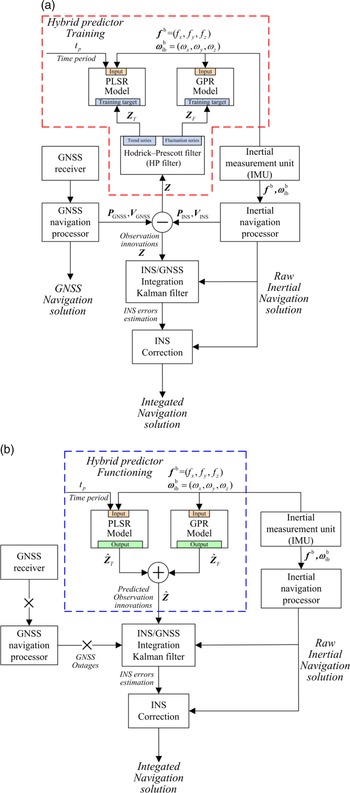
The proposed hybrid prediction architecture operates in two separate modes: training mode and predicting mode. During GNSS availability, the prediction system works in training mode whereby the available observations (INS position and velocity deviations from GNSS) are regarded as the training data. Then we utilise a Hodrick–Prescott (HP) filter approach to decompose the training data into the trend and fluctuation series, which are intended for the training PLSR model and GPR model separately, illustrated in Figure 1(a). For the implementation of the proposed PLSR/GPR prediction method in real-time INS/GNSS integration, a sliding sample window with size n is considered. As the current observation is more relevant with the recent historical observations, the window slides over the training data so that the oldest samples are discarded and the newest ones are added to the window in every observation time. When the GNSS signal is invalid, the prediction system switches to predicting mode, and the previously established PLSR and GPR models are respectively applied to function the linearity predictor and the nonlinearity predictor. Thus, the final prediction output of observations is the combination of linear component predicted by PLSR and nonlinear component predicted by GPR, which would be fed to the Kalman filter as virtual updates to estimate INS errors and correct INS output, illustrated in Figure 1(b).
Diagram of the proposed hybrid prediction methodology. (a) Training mode, (b) Predicting mode

3. Proposed hybrid PLSR/GPR predictor for observation
The inertial navigation equations integrate the gyro drifts, accelerometer biases and initialisation errors to produce the INS solution errors that grow with time. In addition, random gyro and accelerometer noise have an error cumulative effect on the INS solution. As the observations of INS/GNSS integrated system, the INS deviations from GNSS have shown continuous growth trends and short-term fluctuations. Thus, using a single linear or nonlinear model could not completely express the characteristic of the observations. To solve this dilemma, a hybrid predictor is elaborately designed with a linear prediction model and a nonlinear one. The HP filter (Maravall and Rio, Reference Maravall and Rio2001) is adopted to decompose the observations series into trend component and fluctuation component for the purpose of training the two prediction models separately. This section provides more detail on the process of prediction modelling and flow design.
3.1 Decomposing observation series by HP filter
Assume that INS/GNSS observation series is Z = {Z1, Z2, …, Zn}, trend series is ZT = {ZT1, ZT2, …, ZTn}, fluctuation series is ZF = {ZF1, ZF2, …, ZFn} and n is the sample window size. Let Z be the combination of trend component ZT and fluctuation component ZF:

The HP filter algorithm decomposes the smooth trend ZT from the original Z by minimising the following loss function:

The first term in braces of Equation (2) reflects the volatility of fluctuation component, and the second term measures the smoothness of trend component. Here, $\lambda$ denotes the smoothing parameter, which adjusts the proportion relationship between the two parts; $\lambda$
 is given as the ratio of two variances:

where $\sigma _{{\boldsymbol{Z}_{\boldsymbol{T}}}}^2$ and $\sigma _{{\boldsymbol{Z}_{\boldsymbol{F}}}}^2$
 are the standard deviations of trend series ZT and fluctuation series ZF, respectively.
We take the partial derivatives of Equation (2) with respect to ZT1, ZT2, …, ZTn and let the derivatives being zero, which results in:

These equations can be expressed in matrix form:

where ZT = (ZT1, ZT2, …, ZTn)T, ZF = (ZF1, ZF2, …, ZFn)T, P ∈ Ρn × n is the coefficient matrix.
By placing Equation (5) into Equation (1), we find:

where Z = (Z 1, Z 2, …, Zn)T, I ∈ Ρn ×n is the identity matrix.
The trend component ZT and the fluctuation component ZF can be decomposed from the INS/GNSS observation series Z by using Equations (5) and (6).
3.2 Linear component prediction modelling by PLSR
The goal of PLSR is to map the response matrix ZT from a predictor matrix XT and to describe their model structure. PLSR is based on the following latent component decomposition:

where S give the latent components (known as the score matrix), A and B provide the coefficients (known as the coefficient matrix), and ΔXT and ΔZT are the error matrices.
In the process of PLSR training, XT is an input data matrix of size n × m (here, m = 7 represents the number of input variables including time period tp, three specific force information sensed by accelerometers fx, fy, fz and three angular velocity information sensed by gyroscope ωx, ωy, ωz), and ZT is a n × g response matrix (g = 6 represents the number of INS/GNSS observation variables including three position deviation trend components and three velocity deviation trend components). The PLSR training steps are performed as follows:
Step 1. Standardise XT = (x1, x2, …, xm) = (xij)n × m, ZT = (z1, z2, …, zg) = (zij)n × g, and obtain E0 = (eij)n ×m, F0 = (fij)n × g:

where ${\bar{x}_j}$ and ${\bar{z}_j}$
 denote the average value of column j in matrix XT and ZT; sxj and szj denote the standard deviation of column j in matrix XT and ZT.
Step 2. Calculate the eigenvector Vr corresponding to the maximum eigenvalue of matrix $\boldsymbol{E}_{r - 1}^T{\boldsymbol{F}_0}\boldsymbol{F}_0^T{\boldsymbol{E}_{r - }}_1$ , and obtain the latent score vector sr and the residual Er ($r=1,\,2,\,\ldots\,$
 ):


where the extraction number r of latent score vectors in PLSR is determined by cross validation (Gan et al., Reference Gan, Tan, Mo, Li and Huang2020), and αr is calculated by:

Then, obtain the regression equation of E0 to s1, s2, …sr:

where S = (s1, s2, …sr), A = (α1, α2, …αr) and ΔE denotes the residual matrix.
Step 3. Establish the least squares regression of F0 to s1, s2, …sr, and determine the coefficient matrix B = (β1, β2, …βr):

where ΔF denotes the residual matrix.
Since columns of S are mutually orthonormal, the following relation can be derived using Equations (12) and (13):

Step 4. Substitute Equation (9) into Equation (13), and establish the regression from E0 to F0:

Convert Equation (15) back to the regression equation with the original variables:

where cik denotes the corresponding element of coefficient matrix ${C_{m \times g}} = \sum\nolimits_{j = 1}^r {\boldsymbol{V}_j^\ast \boldsymbol{\beta }_j^T}$ .
Step 5. Standardise new training data set {XT_new, ZT_new} and obtain {E0_new, F0_new}. It can be seen from Equation (14) that A AT and A BT may reflect the varying information of $\boldsymbol{E}_0^T{\boldsymbol{E}_0}$ and $\boldsymbol{E}_0^T{\boldsymbol{F}_0}$
 . So, the old data information E0 and F0 can be replaced with AT and BT in the new PLSR computation. The augmented data matrices are:

Step 6. Return to Step 2, and replace E0 and F0 by E0_aug and F0_aug. Steps 2–6 will be repeated until the training data comes to an end. The regression equation of ZT to XT will be established by Equation (16) in the end.
3.3 Nonlinear component prediction modelling by GPR
In this work, we aim to generate a nonlinear regression model that makes ZF prediction for possible inputs XF based on training data set D ={XF, ZF}, where XF = (XF1, XF2, …XFn) is an input data matrix of size d × n (here, d = 6 represents the number of input variables including fx, fy, fz and ωx, ωy, ωz); and ZF = (ZF1, ZF2, …, ZFn) is a g×n output data matrix (g = 6 represents the number of INS/GNSS observation variables including three position deviation fluctuation components and three velocity deviation fluctuation components).
The objective of GPR is to model the dependency:

for the unknown underlying function f(XFi), and ε is Gaussian process noise term drawn from N(0, $\sigma _n^2$ ). Since ZFi is the fluctuation component of INS/GNSS observation, f(XFi) can be considered to obey Gauss distribution with zero mean:

where k(XFi, XFj) is the covariance function.
Based on Equations (18) and (19), the distribution over the noisy outputs ZF is a function of the inputs XF, which is a zero-mean multivariate Gaussian with the form:

where K(XF,XF) is the kernel matrix with elements Kij = k(XFi, XFj), and I is the identity matrix of size n × n.
Conditioning on the training data set {XF, ZF} and unseen input XFi *, a joint Gaussian predictive distribution over the predicted output ZFi * is:

with mean:

and variance:

Here, the mean μ(ZFi *) is then used as the predicted output ZFi *, and the variance Cov(ZFi *) represents the prediction uncertainty which depends on both the process noise ε and the correlation between the unseen input XFi * and the training data set D = {XF, ZF}. Thus, the GPR training steps are performed as follows:
Step 1. Determine the types of the covariance function k(XFi, XFj), and the typical choice is a parameterised squared exponential covariance function:

where $\sigma _f^2$ is the signal variance and Λ = diag(l 1, …, ld) is diagonal matrix of the length-scale parameters.
Step 2. Calculate the GPR hyperparameters θ=[σn, σf, Λ], describing in the process noise [Equation (18)] and the covariance function [Equation (24)]. The hyperparameters θ can be learned by maximising the log likelihood of the training outputs ZF given the inputs XF,

where

Then, we seek the partial derivative of Equation (26) with respect to θ, and use conjugate gradient optimisation:

where $\boldsymbol{\eta } = {({\boldsymbol{K}({{\boldsymbol{X}_F},{\boldsymbol{X}_F}} )+ \sigma_n^2\boldsymbol{I}} )^{ - 1}}{\boldsymbol{Z}_{\boldsymbol{F}}}$ .
Step 3. Calculate the predicted output ZFi * for unseen input vector XFi * and the prediction variance Cov(ZFi *) using Equations (22) and (23).
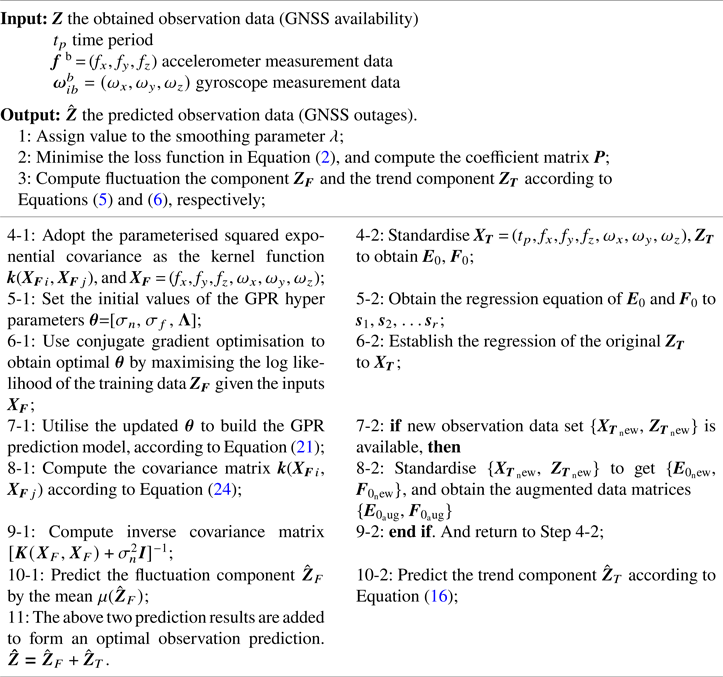
Finally, the accurate predicted INS/GNSS observation can be achieved by combining the predictions of the PLSR model and the GPR model. Algorithm 1 presents the pseudo-code for INS/GNSS observation prediction by PLSR/GPR.
INS/GNSS observation prediction by PLSR/GPR

4. Experimental test and comparative analysis
To evaluate the proposed prediction methodology effectiveness during GNSS outages, a flight experiment was conducted on an airplane platform equipped with INS/GNSS system. The flight data was collected by Beihang University, Beijing, China.
4.1 Experimental equipment configuration
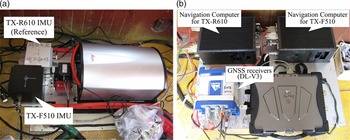
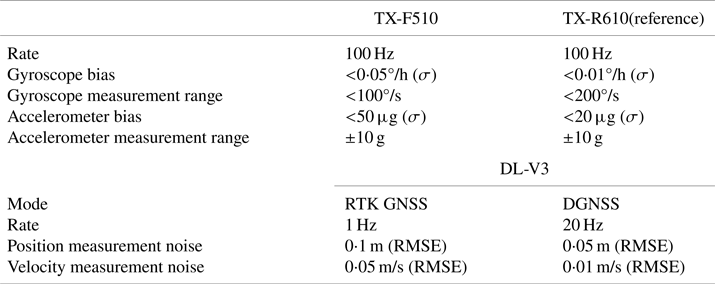
The flight data was acquired using different INS/GNSS integrated systems consisting of two high-grade IMUs, fibre-optic IMU (TX-F510), laser IMU (TX-R610), and two NovATel GNSS receivers (DL-V3). The two IMUs (TX-R610 and TX-F510) were fixed on the same mounting plate shown in Figure 2, and the important device parameters are shown in Table 1. The INS/GNSS integrated system with TX-R610 was used as the reference system, and meanwhile the navigation solutions provided by the INS/GNSS integrated system with TX-F510 were used to verify the performance of the proposed hybrid prediction methodology in bridging the GNSS outages.
Installation of experimental equipment. (a) IMUs, (b) GNSS receivers and navigation computers

Specifications of TX-R610 and DL-V3

4.2 Experimental scheme arrangement
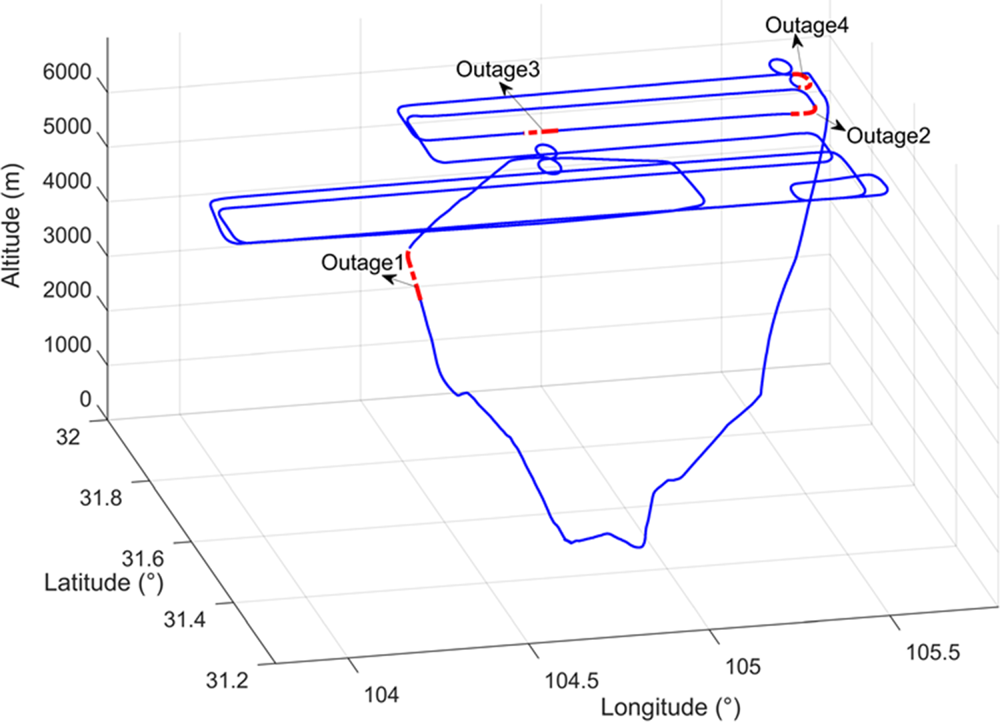
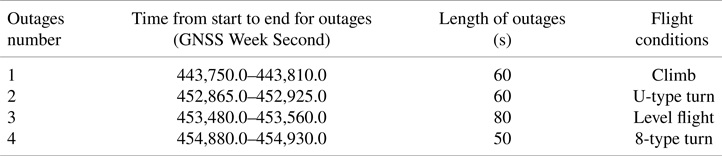
The experiment was conducted in in Mianyang, Sichuan Province, China, which lasted for about 15,487 s with an update rate of 100 Hz. Figure 3 shows the flight trajectory within the reference coordinates, where GNSS outages were intentionally introduced in the trajectory of the INS/GNSS integrated system with TX-F510 by artificially removing the GNSS observations. The four simulated GNSS outages, marked by red dashed lines in Figure 3, were considered under diverse conditions such as climb, level flight and turn manoeuvre. Table 2 provides the start and stop times for these GNSS outages.
Trajectory of flight experiment

Locations of artificial GNSS outages

4.3 Experiment data processing and results analysis
The DGNSS measurements were post-processed using GrafNav™ 8⋅30 software (NovAtel Inc.) in carrier phase difference mode with 0⋅05 m level position accuracy and 0⋅01 m/s level velocity accuracy. The reference trajectories were generated by the TX-R610/DGNSS integrated system using InertialExplorer™ 8⋅30 post-processing software (NovAtel Inc.) with 0⋅005°/0⋅0025° level heading/attitude accuracy. The RTK GNSS measurements were output directly by DL-V3 receiver with 0⋅1 m level position accuracy and 0⋅05 m/s level velocity accuracy. The TX-F510 and RTK GNSS data were integrated and processed by POSProcess™ 2⋅0 (POS Research Group, Beihang University) with 0⋅02°/0⋅008° level heading/attitude accuracy.
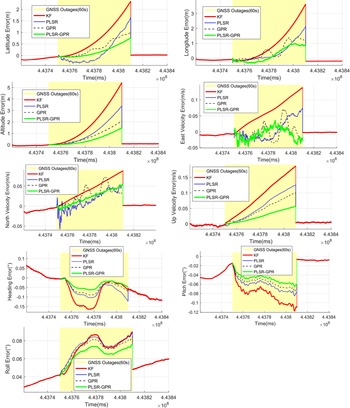
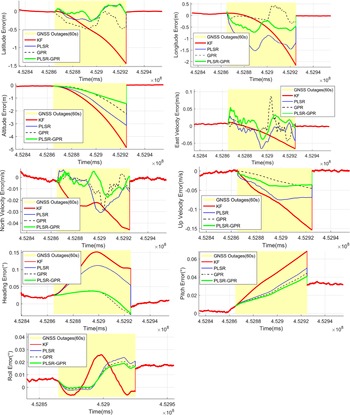
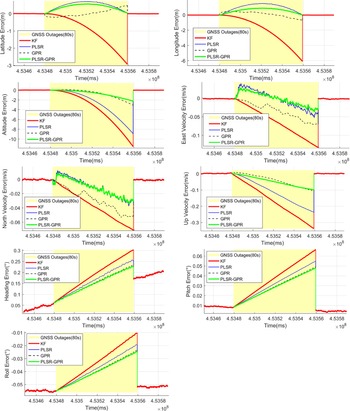
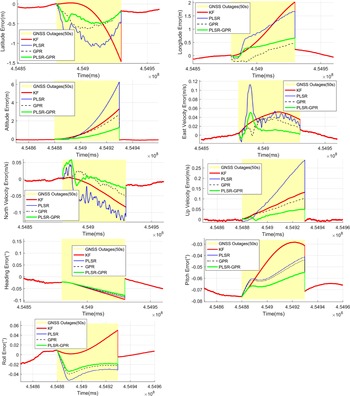
In the cases of GNSS outages with diverse conditions (Climb 60 s, U-type turn manoeuvre 60 s, Level flight 80 s and 8-type turn manoeuvre 50 s), we processed the TX-F510/GNSS integration by four different solutions which were: (1) the KF solution (no observation and pure INS outputs), (2) the KF + PLSR solution (linear prediction modelling for observations), (3) the KF + GPR solution (nonlinear prediction modelling for observations) and (4) the proposed KF + PLSR/GPR solution (hybrid prediction modelling for observations). The results of the solutions were compared for the same trajectory and identical GNSS outages, shown in Figures 4–7. It can be clearly seen that the navigation errors of the KF solution greatly increase during GNSS outages, and the other three solutions with observation prediction almost make better performance of restraining error accumulation than does the KF solution (in red). In the experiments, we quantify the prediction performance by root mean square error (RMSE), which is given as:

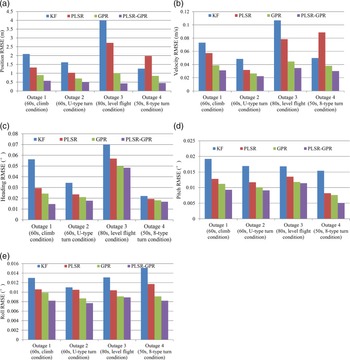
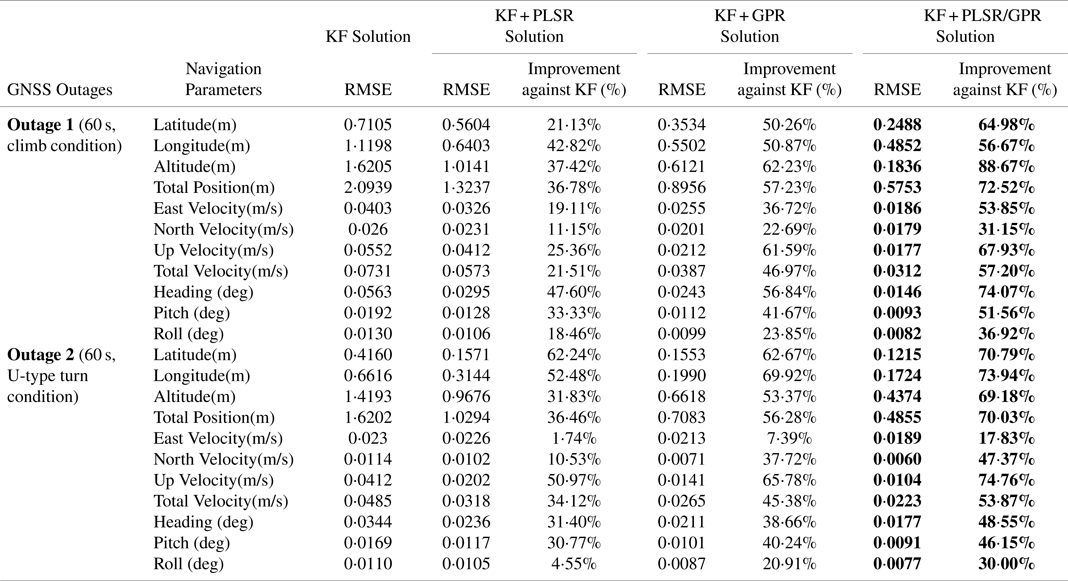
where Op denotes the navigation solution with observation prediction, and O denotes the reference solution. N is the GNSS outage duration. The quantitative prediction performance was evaluated by comparing the position, velocity and attitude components of the four different solutions with the reference solution, shown in Tables 3–5. Furthermore, in order to demonstrate the navigation errors trends intuitively during various GNSS outages with diverse conditions, the histograms of RMSE are shown in Figure 8.
Navigation errors during GNSS outage 1 (climb condition)

Navigation errors during GNSS outage 2 (U-type turn condition)

Navigation errors during GNSS outage 3 (Level flight condition)

Navigation errors during GNSS outage 4 (8-type turn condition)

The histograms of navigation RMSE during GNSS outages. (a) Position, (b) Velocity, (c) Heading, (d) Pitch, (e) Roll

The RMSE of position, velocity and attitude during GNSS outage 1 and 2

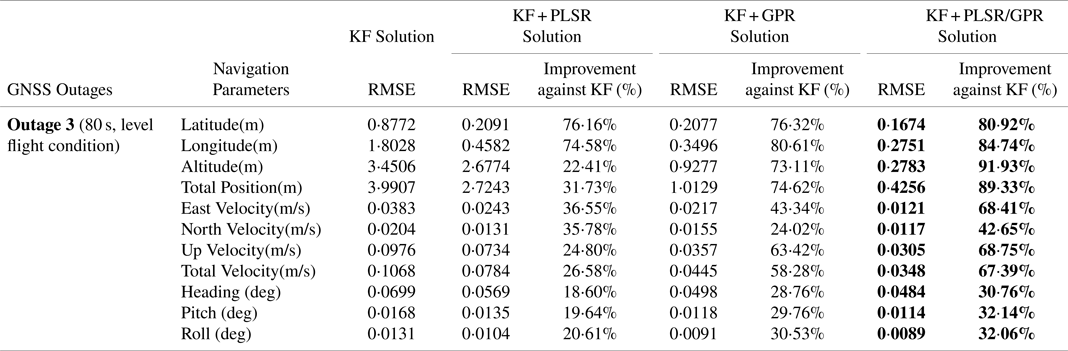
The RMSE of position, velocity and attitude during GNSS outage 3

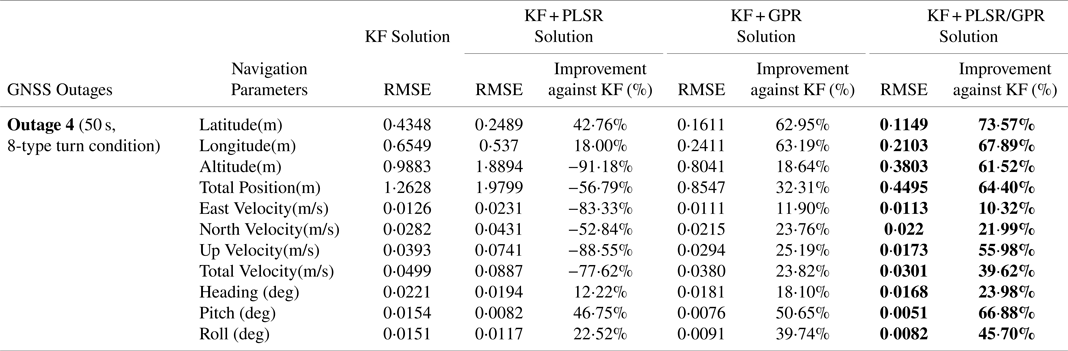
The RMSE of position, velocity and attitude during GNSS outage 4

Figures 4 and 5 depict the navigation error curves of various solutions during the 1st and 2nd GNSS outages, both of 60 s duration, while the flying platform was in climb condition and U-type turn condition. The GPR solution (in black) possesses smaller drift in comparison to PLSR (in blue). This is because that the nonlinear errors caused by climb and U-type turn manoeuvres, which have some influence on predicting the accuracy of the PLSR linear prediction model. But, as a nonlinear prediction model, GPR could properly deal with the above nonlinear errors. For the 60 s GNSS outages in climb condition and U-type turn condition, respectively, it can be seen in Table 3 and Figure 8 that the proposed hybrid PLSR/GPR solution produces the RMS position errors of 0⋅5753 m and 0⋅4855 m, the RMS velocity errors of 0⋅0312 m/s and 0⋅0223 m/s, the RMS heading errors of 0⋅0146° and 0⋅0177°, the RMS pitch errors of 0⋅0093° and 0⋅0091°, and the RMS roll errors of 0⋅0082° and 0⋅0077°. Comparing with the other solutions, PLSR/GPR solution shows the outstanding performance during GNSS outages, and the percentage improvement in position, velocity, heading, pitch and roll accuracy was found to improve by more than 70⋅03%, 53⋅87%, 48⋅55%, 46⋅15% and 30⋅00% against KF, respectively, which is remarkably superior to PLSR and GPR.
The 3rd GNSS outage is taken along a straight line for duration of 80 s. Compared with the climb and U-type turn conditions, PLSR solution has better performance in the level flight condition, and the north velocity error component of PLSR is even superior to GPR solution as shown in Figure 6 and Table 4. This improvement is mainly attributed to the less nonlinear errors actuated under the weak manoeuvring state, and then PLSR solution could effectively build a prediction model for the INS/GNSS observations. Figure 6 also illustrates that the proposed hybrid PLSR/GPR solution has the obvious advantages of reduction in navigation errors in the level flight condition. The RMS position, velocity, heading, pitch and roll errors of the PLSR/GPR solution are obtained to be 0⋅4256 m, 0⋅0348 m/s, 0⋅0484°, 0⋅0114° and 0⋅0089°, respectively, as shown in Table 4 and Figure 8. And PLSR/GPR effectively reduces the drift in position, velocity, heading, pitch and roll errors with 89⋅33%, 67⋅39%, 30⋅76%, 32⋅14% and 32⋅06% improvement against KF, respectively, which similarly outperforms PLSR and GPR solutions.
The 4th GNSS outage corresponds to the portion of the trajectory for the flying platform motion along an 8-type turn, which lasts for 50 s. Since the complex manoeuvre of an 8-type turn may bring about large nonlinear errors, the performance of PLSR solution is badly degraded, or even worse than the KF solution in the altitude error component and velocity error components, as shown in Figure 7. Conversely, the GPR and hybrid PLSR/GPR solutions perform much better than the PLSR in all the navigation parameters resolution accuracy. For the proposed hybrid PLSR/GPR solution over 50 s outages, Table 5 and Figure 8 show the RMS position, velocity, heading, pitch and roll errors are, respectively, 0⋅4495 m, 0⋅0301 m/s, 0⋅0168°, 0⋅0051° and 0⋅0082°, thereby resulting in 64⋅40%, 39⋅62%, 23⋅98%, 66⋅88% and 45⋅70%, respectively, improvement against the KF solution, most of which are superior to the GPR solution.
For all the four GNSS outages considered in our study, the proposed hybrid PLSR/GPR solution is significantly able to restrain the time-growing INS error accumulation. And comparing with the other solutions, PLSR/GPR shows the outstanding performance that can be largely attributed to two aspects: (1) the decomposed observation series by HP filter enable to optimally train the PLSR model and GPR model; (2) the hybrid prediction model of PLSR and GPR can effectively handle both linear and nonlinear data.
5. Conclusion
A hybrid PLSR/GPR prediction model for bridging the GNSS outages has been proposed with the aim of improving the INS/GNSS integrated system accuracy. During the GNSS signal availability, the available observations are decomposed into trend and fluctuation series by HP filter, which are separately used for training a PLSR linear prediction model and GPR nonlinear prediction model. When GNSS outages occur, the combination of PLSR and GPR prediction outputs are fed to a Kalman filter as observation updates and compensate the INS errors thereby obtaining an accurate and reliable navigation solution. The proposed hybrid PLSR/GPR solution aggregates the advantages of both linear regression and nonlinear regression prediction, which has been verified by flight experiment over four GNSS outages under diverse conditions. The PLSR/GPR solution has shown 64⋅40–89⋅33% improvement in the RMS position error in comparison to the KF solution corresponding to different GNSS outages, which is obviously superior to other solutions; meanwhile the RMS velocity error and attitude error also have similar situations. Therefore, it is indicated that the proposed hybrid PLSR/GPR solution can effectively bridge GNSS outages and provide reliable and good performance for INS/GNSS.
Acknowledgements
This work was supported in part by the National Natural Science Foundation of China under Grant 61,763,005 and 61,703,021, Guizhou Provincial Science and Technology Foundation under Grant [2017]1069, the Creative Research Groups Program of Guizhou Educational Commission under Grant [2018]026, the Engineering Research Centres of Guizhou Ordinary Institution of Higher Education under Grant [2018]007, Research Foundation for Talented Scholars of Guizhou Institute of Technology under Grant XJGC20190610.
The authors would like thank Dr. Li and Dr. Gong at the Science and Technology on Inertial Laboratory in Beihang University for preparing the experiment data. The authors also would like to thank Dr. Lei for the valuable comments and polishing the English.