Introduction
Long-chain polyunsaturated omega 6 (n-6) fatty acids (FAs) are obtained from our diet through vegetable oils (such as corn and soybean), chicken, eggs and processed foods. Studies reveal relative over-consumption of n-6 compared to omega-3 (n-3) FAs in Western diets, at a ratio ranging from ~10:1 to 25:1.Reference Simopoulos1 Linoleic acid (LA) is the major n-6 in our diet, and its primary role is incorporation into cell membranes to maintain normal membrane fluidity, structure and function.Reference Naughton, Mathai, Hryciw and McAinch2 Elevated concentrations of LA are also known to be pro-inflammatory and pro-oxidative.Reference Naughton, Mathai, Hryciw and McAinch2 In Australia, LA consumption has increased to three times the recommended daily intake between 1991 and 2009.Reference Shrestha, Cuffe and Holland3 This increase mirrors other Western societies, with LA availability in the USA diet increasing by ~160% over the same period.Reference Shrestha, Cuffe and Holland3 Women of childbearing age are also consuming increasing levels of LA before and during pregnancy. While LA is vital for foetal and postnatal development,Reference Naughton, Mathai, Hryciw and McAinch2 we have demonstrated that elevated LA decreases placental cell viability,Reference Shrestha, Cuffe, Holland, Perkins, McAinch and Hryciw4 suggesting that in addition to LA’s role in maintaining normal cellular function, elevated concentrations may be detrimental.
LA is transported by syncytiotrophoblast brush-border membranes of the placenta from mother to the foetus.Reference Lafond, Simoneau, Savard and Gagnon5 Disruption in normal cellular function in the placenta is associated with pregnancy complication and affects foetal development.Reference Woods, Perez-Garcia and Hemberger6 Research suggests that an optimal ratio of n-6 to n-3 of 1:1 or 2:1 is required for human health.Reference Simopoulos7 In humans, plasma concentrations of LA vary and estimated to be 280–5000 µM in one Western population.Reference Abdelmagid, Clarke and Nielsen8 Maternal plasma LA concentrations of ∼600–1200 µMReference Courville, Keplinger, Judge and Lammi-Keefe9 ,Reference Vidakovic, Jaddoe, Voortman, Demmelmair, Koletzko and Gaillard10 have been identified during pregnancy. The concentration of n-6 in pregnancy is critical, as imbalance between n-6 and n-3 FA in maternal diet impairs neocortical development in offspring.Reference Sakayori, Kikkawa and Tokuda11
Among potential mechanisms, LA modulates the endocannabinoid system (ECS), which modifies physiological functions and processes during early foetal development.Reference Fride, Gobshtis, Dahan, Weller, Giuffrida and Ben-Shabat12 The ECS comprises the endogenous ligands 2-arachidonyl glycerol (2-AG) and anandamide (AEA), which can be generated via LA metabolism and act predominantly via the cannabinoid receptor 1 (CB1) and cannabinoid receptor 2 (CB2).Reference Pertwee13 The ligands 2-AG and AEA are modified by synthesising and degradation enzymes.Reference Naughton, Mathai, Hryciw and McAinch2 ECS signalling controls a variety of physiological processes, and abnormal ECS function has been identified in a variety of diseases.Reference Jenkin, Verty, McAinch and Hryciw14 , Reference O’Sullivan, Kendall and Kendall15 Emerging research also suggests an important role for CB2 in protecting cardiomyocytes during disease; knockout of CB2 exaggerates cardiac apoptosis, inflammation and dysfunction during ischemia–reperfusion.Reference Duerr, Heinemann and Suchan16
Emerging research suggests a role for ECS in development.Reference Bukiya17 The ECS may control development via CB1 and CB2, although our recent study in vivo suggests that elevated maternal LA may also control growth and development via leptin.Reference Shrestha, Cuffe and Holland3 In our rodent model of elevated maternal LA, circulating leptin concentrations in pregnancy are reduced, potentially via downregulation of mRNA expression in adipose tissue.Reference Shrestha, Cuffe and Holland3 As leptin is important for organ development,Reference Briffa, McAinch, Romano, Wlodek and Hryciw18 elevated maternal LA may have developmental consequences when LA and its metabolites are in excess. Further, we have previously demonstrated that elevated LA reduces placental cell viability,Reference Shrestha, Cuffe, Holland, Perkins, McAinch and Hryciw4 suggesting that LA may control cell organ development through the reduction in cell number, and thereby affecting growth.
Currently, we have a limited understanding of the developmental mechanisms modulated by ECS overactivity and the downstream targets involved.Reference Fride, Gobshtis, Dahan, Weller, Giuffrida and Ben-Shabat12 Compounding this, there are little data concerning the effects of prenatal exposure to elevated concentrations of the endogenous ECS ligands. We have identified in rodents that maternal consumption of elevated LA prior to and during pregnancy significantly elevates foetal plasma arachidonic acid (AA).Reference Shrestha, Cuffe and Holland3 LA is metabolised into AA, which is processed by enzymes including N-acyl phosphatidylethanolamine-specific phospholipase D (NAPE-PLD) into the ECS ligand AEA.Reference Naughton, Mathai, Hryciw and McAinch2 Conversely, AA is processed by diacylglycerol lipase (DAGL) to produce 2-AG. AEA and 2-AG modulate a number of targets including the CB1, CB2, GPR55 and GPR18 cannabinoid receptors.Reference Ramirez-Orozco, Garcia-Ruiz, Morales, Villalon, Villafan-Bernal and Marichal-Cancino19 The termination of AEA and 2-AG’s signalling capacity is mediated by fatty acid amide hydrolase (FAAH) activity.Reference Dainese, De Fabritiis and Sabatucci20 Cannabinoid receptors interact with additional targets that may either inhibit inflammation (including leptinReference Pacher and Steffens21) or promote inflammation (including tumour necrosis factor alpha (TNFα).Reference Nagarkatti, Pandey, Rieder, Hegde and Nagarkatti22
Although the ECS influences development and plays a role in regulating cardiovascular function,Reference Shrestha, Cuffe and Hutchinson23 there is a paucity of data concerning the effects of high LA exposure on cardiomyocyte viability and development. Based on prior studies, we therefore predict that 1) exposure to elevated LA will alter cardiomyocyte viability and 2) consumption of elevated concentrations of LA upregulates LA metabolic by-products,Reference Shrestha, Cuffe and Holland3 which leads to altered expression of LA metabolic enzymes and increased downstream pro-inflammatory mediators.
Methods
In vitro study
Rat H9c2 cardiomyoblasts were cultured in Dulbecco's Modified Eagle Medium (DMEM) supplemented with 10% fetel bovine serum (FBS) and 1% penicillin and streptomycin and maintained in a humidified incubator at 37 °C with 5% CO2. LA and bovine serum albumin (BSA) complex was prepared in a 5:1 ratio. BSA is required to allow the cells to effectively take up LA. Cells were seeded at an initial density of 10,000 cells/well in 96-well plates. After reaching 80% confluence, cells were incubated in serum-free media for 2 h before treatment with various concentrations of LA-BSA complex (12.5, 25, 100, 200, 300, 400, 500 and 1000 μM) for 24 h. Cell viability was measured using a 3-(4, 5-dimethylthiazol-2-yl)-2,5-diphenyltetrazolium bromide (MTT) assay (Sigma Aldrich, St. Louis, MO, USA) similar to our previous study.Reference Shrestha, Cuffe, Holland, Perkins, McAinch and Hryciw4 A positive control (15% DMSO) was used as an indicator of induced cell death.
In vivo study
Wistar Kyoto rats (8 weeks of age) were purchased from the Australian Resource Centre (ARC, WA, Australia) and acclimatised in accordance with the Australian Code of Practice for Care and Use of Animals for Scientific Purpose after ethical approval was granted by the Griffith University Animal Ethics Committee (NSC/01/17/AEC). After 1 week of acclimatisation, rats were divided into low linoleic acid (LLA; n = 8) and high LA (HLA; n = 10) dietary groups, as previously described.Reference Shrestha, Cuffe and Holland3 Briefly, female rats were exposed to either LLA or HLA diet for 10 weeks before mating. The LLA diet contains ∼1.44% LA of energy, and the HLA diet contains ∼6.21% LA of energy (which is the average daily LA consumption in Australia, representative of Western society).Reference Shrestha, Cuffe and Holland3 The LLA (SF17-109) and HLA (SF17-110) diets were custom prepared by Specialty Feeds (WA, Australia) based on the AIN-93G diet. The major source of LA in HLA was safflower oil. Respective diets were provided throughout during pregnancy. The gestation period for a rat is 22 days. Pregnant rats were sacrificed at day 20 (E20) as previously described.Reference Shrestha, Cuffe and Holland3 Left ventricular myocardium from maternal hearts and whole foetal hearts were harvested, immediately snap-frozen in liquid nitrogen and stored at −80 °c for RNA extraction. For the analysis, one foetal heart from each sex was used per litter.
Sex determination of foetus
DNA was extracted from the tail of each foetus. Sex determination was undertaken as described previouslyReference Shrestha, Cuffe and Holland3 using q polymerase chain reaction (PCR) amplification of the SRY (sex-determining region Y) gene using a commercially available hydrolysis probe (Rn04224592_ul; NM_012772.1; Applied Biosystems).
Quantitative polymerase chain reaction
Total RNA was extracted from E20 maternal and foetal heart tissues, as described previously with minor modifications.Reference Shrestha, Cuffe and Holland3 Briefly, maternal cardiac tissue was homogenised in lysis buffer supplemented with proteinase K and incubated at 57 °C for 10 min prior to the extraction of the RNA. The RNA was extracted using RNeasy mini kit (Qiagen) following manufacturer’s guidelines. Then, the RNA was synthesised to complementary DNA using an iScript gDNA clear cDNA synthesis kit (Bio-rad) according to manufacturer’s guidelines. Real-time quantitative polymerase chain reaction (qPCR) was performed using QuantiNova SYBR® green master mix (Qiagen) following manufacturer’s guidelines, in line with Minimum Information for Publication of Quantitative Real-Time PCR Experiments (MIQE) guidelines.Reference Bustin, Benes and Garson24 Initial holding stage was set at 95 °C for 10 min to fully denature the DNA. qPCR reactions were set for 40 cycles. The denature stage was set for 15 seconds at 95 °C, and extension set at 60 °C for 1 min using StepOne™ real-time PCR systems (Applied Biosystems). The 2-ΔΔCq method was used to quantify gene expression, which was normalised to the geometric mean of β-actin and β-2 microglobulin as reference genes, as previously prescribed.Reference Shrestha, Cuffe and Holland3 KiCqStart™ pre-designed primers from Sigma Aldrich were used for qPCR: Leptin (Lep; NM_013076), Leptin receptor (Lepr; NM_012596), β-actin (Actb; NM_031144), β-2 microglobulin (B2m; NM_012512), GPR18 (Gpr18; NM_001079710), GPR55 (Gpr55; XM_001063474), FAAH (Faah; NM_024132), IL-6 (IL6; NM_012589), DAGL-α (Dagla; NM_001005886), DAGL-β (Daglb; NM_001107120), CB1(Cnr1; NM_012784), CB2 (Cnr2; NM_020543), TNF-α (Tnfaip8; NM_001107387) and NAPE-PLD (Napepld; NM_199381). PCR products were validated by sequencing using the Applied Biosystems 3130×1 Genetic Analyzer, following clean-up using ExoSAP-IT, performed at the Griffith University DNA sequencing facility.
Statistical analysis
Data are expressed as the mean ± standard error of the mean (SEM). A p value less than 0.05 was considered indicative of statistical significance. Multiple comparisons among groups were performed using one- and two-way ANOVA (maternal diet and sex as 2 factors) or Mann-Whitney U test followed by Dunnett post hoc test using GraphPad Prism 7.
Results
LA decreases viability of H9c2 cells
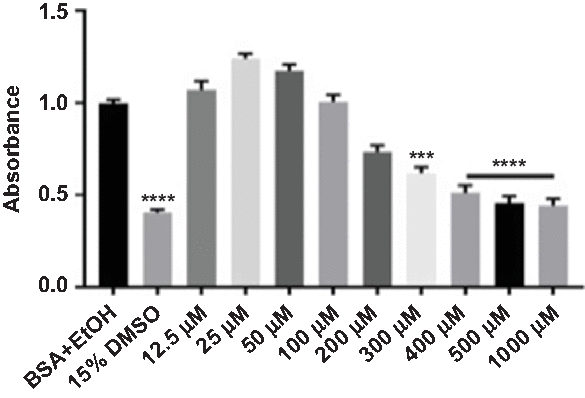
Exposure of H9c2 cells with LA (between 300 μM and 1000 μM) significantly decreased their viability compared to cells exposed to vehicle control alone (Fig. 1).
LA decreases cardiomyocyte viability. Cardiomyocyte metabolic activity after 24 hr experimental treatments assessed via MTT assay in cells seeded at 80% confluence. Data presented as means ± SEM, n = 6 for all treatment conditions. ***p < 0.001, ****p < 0.0001 compared to vehicle control (BSA + EtOH).

Effect of high maternal LA on mRNA expression of genes in foetal heart
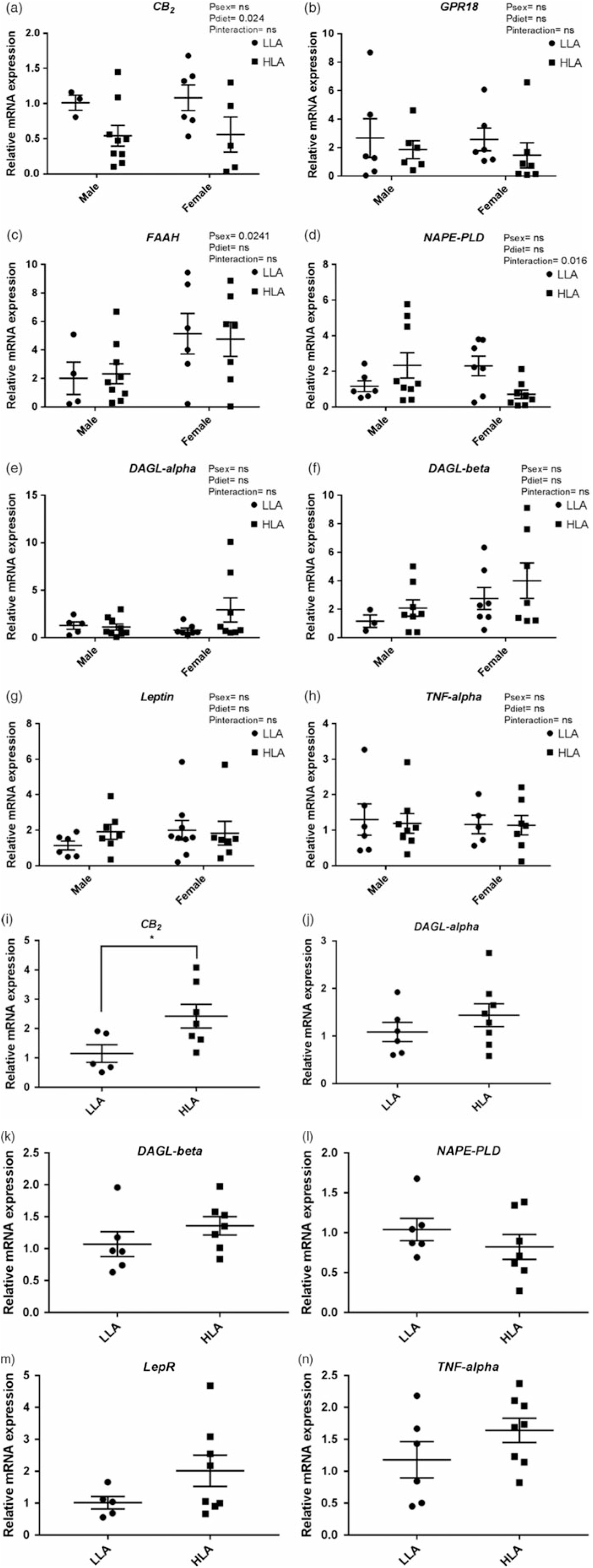
As described previously, there was no change in the body or heart weight in E20 foetuses from mothers consuming a high LA diet.Reference Shrestha, Cuffe and Holland3 However, mRNA expression of CB 2 was significantly decreased in both male and female foetuses of HLA mothers (p < 0.05, Fig. 2a). There was no change in mRNA expression of GPR18 in foetal cardiac tissue (Fig. 2b), while mRNA for FAAH was significantly decreased in hearts of male compared with female foetuses (p < 0.05, Fig. 2c). Cardiac NAPE-PLD mRNA showed an interaction between diet and sex (interaction p < 0.05, Fig. 2d). There were no significant changes in mRNAs for DAGL-α, DAGL-β, leptin and TNF-α (Fig. 2e–2h) in foetal hearts. The mRNA expressions of IL-6, CB 1 , GPR55 and LepR were below the levels of detection in foetal heart (data not shown).
Elevated maternal LA consumption alters endocannabinoid signalling in maternal and offspring hearts. Foetal mRNA expression (a to h) and maternal mRNA expression (i to n) of endocannabinoid targets are altered in response to elevated maternal LA. For offspring hearts, n = 3–6 (LLA) and n = 6–8 (HLA). In maternal hearts, n = 5–6 (LLA) and n = 7–8 (HLA). Data are presented as means ± SEM, *p < 0.05.

Effect of high LA on mRNA expression of genes in maternal heart
There was a significant increase in maternal CB 2 mRNA expression in the hearts of rats fed the HLA vs. LLA diet (p < 0.05, Fig. 2i). There was no difference in maternal mRNA expression for GPR18, DAGL-α and DAGL-β, NAPE-PLD, LEPR or TNF-α (Fig. 2j–2n). The mRNA expressions of IL-6, CB1, leptin, GPR55, GPR18 and FAAH were below the level of detection in maternal heart (no data shown).
Discussion
LA is a precursor for AA and the ECS ligands and may be deleterious to growth and development. This is the first study to investigate the effects of LA on cardiomyocyte viability, revealing a significant reduction in H9c2 cell viability when exposed to ≥300 µM LA. Previous studies demonstrate that H9c2 cells exhibit hypertrophic responses, similar to primary cardiomyocytes, rendering them suitable for in vitro analysis of cardiomyocyte function.Reference Watkins, Borthwick and Arthur25 We have previously demonstrated that elevated LA reduces viability of trophoblast cells,Reference Shrestha, Cuffe, Holland, Perkins, McAinch and Hryciw4 suggesting the LA modulates molecular pathways that are important in different cell types. There is prior evidence of FA modulation of cell survival, for example, 50–500 µM palmitate reduces cell viability, an effect countered by n-3 polyunsaturated fatty acid.Reference Cetrullo, Tantini and Flamigni26 However, our earlier observation that elevated maternal LA does not alter heart weightReference Shrestha, Cuffe and Holland3 suggests that in vivo effects of LA on the heart may be independent of cell viability. Future research should investigate if apoptosis of the heart tissue occurs in response to elevated LA.
This study identified altered ECS gene expression in cardiac tissue of mothers and offspring with maternal consumption of elevated concentrations of LA. The mRNA expression of FAAH was increased in female foetal heart irrespective of diet. As FAAH terminates AEA and 2-AG’s signalling capacity,Reference Dainese, De Fabritiis and Sabatucci20 this suggests potentially augmented ECS activity in male but not female hearts. Downregulation of FAAH promotes reactive oxygen species generation in the liver tissue,Reference Siegmund, Seki, Osawa, Uchinami, Cravatt and Schwabe27 which could additionally affect the development and function in the male offspring. NAPE-PLD mRNA exhibited a sex dependence, with a decrease in females compared with an increase in males in HLA group. This suggests potentially augmented AEA generation in male but not the female foetuses. A key outcome from this study is evidence that sex-specific differences in the programming effects of LAReference Shrestha, Cuffe and Holland3 may reflect in part sex-specific differences in the ECS, with a bias towards augmented AEA generation and AEA/2-AG signalling in male vs. female offspring, although cardioprotective CB2 was significantly decreased by maternal LA in both sexes. Mechanistically, this sexual dimorphism may be influenced by hormones, as CB2 activity in females has been demonstrated to involve estrogen, which also protects against inflammation.Reference Maia, Almada and Silva28
Of particular interest is a significant change in CB2 expression in maternal rats fed a high LA diet during pregnancy. CB2 receptor expression in non-pregnant females has been demonstrated to be cardioprotective, with up-regulation decreasing risk of cardiovascular diseases.Reference Sun, Lu and Wang29 In further support of a beneficial role for CB2, the activation of the receptor increases the production of anti-inflammatory proteins.Reference Defer, Wan and Souktani30 Although we have not investigated cardiovascular function in mothers consuming elevated LA diets and circulating concentrations of pro-inflammatory cytokines appear unaltered,Reference Shrestha, Cuffe and Holland3 the current data suggest that elevated LA during pregnancy may modify maternal cardiovascular function.
This study provides further insight into the importance of LA during pregnancy in modulating key signalling pathways that influence cell viability and cardiovascular function. Our highly novel data show a potential mechanistic pathway that links maternal diet in pregnancy and developmental consequences in her offspring. Importantly, altered ECS gene expression suggests LA consumption may modify foetal heart development, potentially leading to detrimental effect on cardiac function in later life. This preliminary evidence that elevated maternal LA consumption may be deleterious for a developing baby’s cardiovascular health highlights the importance of intake levels prior to and during pregnancy.
Financial support
This work was supported by the Allen Foundation (D.H.H., A.J.M.), and through the Australian Government’s Collaborative Research Networks (CRN) program (A.J.M.). Scholarship funding is provided by Griffith University International Postgraduate Research Scholarship (GUIPRS-N.S.), Griffith University Postgraduate Research Scholarship (GUPRS-N.S.) and Griffith Health Top Up Scholarship (N.S.).
Conflicts of Interest
The authors declare that there is no conflict of interests regarding publication of this article.
Ethical Standards
Ethical approval was obtained from the Griffith University Animal Ethics Committee (NSC/01/17/AEC).