Introduction
Paramphistomosis is a disease of economic importance caused by paramphistomes, the effect of which is still underestimated, especially in Africa (Phiri et al., Reference Phiri, Chota and Phiri2007). The increased occurrence of paramphistomes in some parts of the world (Sanabria et al., Reference Sanabria, Moré and Romero2011) makes it necessary to study their genetic diversity. Accurate morphological identification of paramphistomes is relatively difficult as it requires median sagittal sectioning through thick, robust bodies in order to visualize the internal organs (Lotfy et al., Reference Lotfy, Brant, Ashmawy, Devkota, Mkoji and Loker2010). To overcome this, various molecular tools are being coupled with traditional diagnostic techniques in addressing the challenges associated with describing new species or strains on the basis of phenotypic characteristics (Rinaldi et al., Reference Rinaldi, Perugini, Capuano, Fenizia, Musella, Veneziano and Cringoli2005). Despite its challenges, morphological characterization of paramphistomes remains pivotal in taxonomic studies. Morphological methods can be coupled with molecular techniques, such as amplified ribosomal DNA restriction analysis (ARDRA), to facilitate efficient identification of paramphistomes. Some studies have focused on histology, flattening and electron microscopy (Panyarachun et al., Reference Panyarachun, Ngamniyom, Sobhon and Anuracpreeda2013; Radwan et al., Reference Radwan, Khalil, Shafeey and Wahdan2014) and yet others used histological and molecular characterization (Ichikawa et al., Reference Ichikawa, Kondoh, Bawn, Maw, Htun, Thein, Gyi, Sunn, Katakura and Itagaki2013). Molecular characterization of paramphistomes requires that a careful histological study be done to identify the paramphistome under study to species level.
The application of molecular techniques in paramphistome identification is becoming popular in the developed world but is still limited in Africa. To date, Lotfy et al. (Reference Lotfy, Brant, Ashmawy, Devkota, Mkoji and Loker2010) have used internal transcribed spacer 2 (ITS2) sequences for characterization of paramphistomes from some African and Asian countries. A number of paramphistome species have been recorded across Africa, including southern Africa (Nasmark, Reference Nasmark1937; Dinnik & Dinnik, Reference Dinnik and Dinnik1954; Round, Reference Round1968; Eduardo, Reference Eduardo1982, Reference Eduardo1983; Dube et al., Reference Dube, Siwela, Dube and Masanganise2002; Pfukenyi et al., Reference Pfukenyi, Monrad and Mukaratirwa2005). Calicophoron microbothrium appears to be the most prevalent African species capable of causing paramphistomosis (Phiri et al., Reference Phiri, Chota and Phiri2007; Dube & Tizauone, Reference Dube and Tizauone2014). In southern Africa national borders limit, or completely reduce, movement of cattle between neighbouring countries. This limited movement may result in isolated paramphistome populations with different genetic structures. Morphological structures may not reveal the existing genetic diversity within and among these populations. The aim of this study was to use histological median sectioning for identification of some paramphistomes, and ITS2 sequence data in order to ascertain whether paramphistomes from the different localities are genotypically diverse.
Materials and methods
Collection and examination of isolates
Paramphistomes were collected from the rumen of cattle slaughtered at various locations, namely Livingstone (Zambia), Musina and Johannesburg (South Africa). The cattle slaughtered in Bulawayo were from both Botswana and Zimbabwe. These isolates were washed in normal saline and preserved in 70% ethanol for morphological sectioning and DNA isolation. The preserved specimens for sectioning had a small section from the side cut in such a way as not to distort the internal organs in each individual isolate, and these sections were used for genomic DNA extraction. The rest of the worm was sectioned in the median sagittal plane. Only nine representative samples were selected for detailed characterization.
For morphological studies, preserved specimens were dehydrated in alcohol series, embedded in wax and sectioned in the median area into 7-μm-thick sections, using a microtome. The specimens were stained with haematoxylin and counterstained with eosin and viewed under the microscope. The usual taxonomic structures of paramphistomes, such as genital atrium, testes, acetabulum and pharynx, were observed and noted according to the keys of Nasmark (Reference Nasmark1937), Gretillat (Reference Gretillat1964), Eduardo (Reference Eduardo1982) and Jones (Reference Jones, Jones, Bray and Gibson2005). The dimensions of these features were measured with a calibrated graticule eyepiece and recorded to enable accurate identification.
Molecular analysis
For genomic DNA extraction, sections of paramphistomes were homogenized in 200 μl of sterile lysis buffer (2 mm EDTA pH 8, 10 mm Tris–HCl and 0.4 m NaCl) for 10–15 s. Then 40 μl of 20% sodium dodecyl sulphate (SDS) and 8 μl of 20 mg/ml proteinase K were added and mixed well. The samples were incubated at 55–65°C for at least 1 h after which one-tenth of the sample volume of 5 m NaCl was added to each sample. This was incubated for 1 h on ice, after which it was centrifuged at 12,000 g for 10 min. The supernatant was transferred to fresh tubes and spun down again at 12,000 g for 5 min. The supernatant was again transferred to fresh tubes and 2.5 times the sample volume of 95% ethanol was added. Samples were then incubated at − 20°C overnight to precipitate DNA. Thereafter, the samples were centrifuged for 10 min at 12,000 g to pellet the DNA. The pellet was washed twice with 70% ethanol, dried and finally dissolved in 50 μl of nuclease-free water.
The ITS2 rDNA region plus part of the flanking 5.8S and 28S sequences (ITS2+) were amplified by polymerase chain reaction (PCR) using the primers ITS-2 F (5′-TGTGTCGATGAAGAGCGCAG-3′) and ITS-2 R (5′-TGGTTAGTTTCTTTTCCTCCGC-3′). PCR was performed in a total reaction volume of 50 μl containing DreamTaq PCR Buffer (Thermo Scientific, West Palm Beach, Florida, USA),10 ng of DNA template, and a PCR reagent mixture composed of 0.25 mm of each deoxynucleoside triphosphate (dNTP) (Thermo Scientific), 25 pmol of each primer (Inqaba Biotec, Pretoria, South Africa), 2 mm of MgCl2 and 5 U of DreamTaq DNA Polymerase used with DreamTaq PCR Buffer (Thermo Scientific). The PCR was performed in a GeneAmp 9700 PCR System (Applied Biosystems, Singapore) with the following conditions: 95°C for 3 min; 35 cycles at 95°C for 1 min, 55°C for 30 s and 72°C for 1 min; and a final extension at 72°C for 10 min. The products were resolved by electrophoresis in a 1% agarose gel that was stained with 10 μl ethidium bromide.
ITS2 rDNA PCR products were purified using Zymo Research DNA clean and concentrator kit (Epigenetics Zymo Research, Irvine, California, USA). The purified PCR products were then sent to Inqaba Biotec for sequencing. The sequences generated were analysed on BlastN and then submitted to GenBank. Sequence alignment was done using Clustal W (Thompson et al., Reference Thompson, Higgins and Gibson1994) and the evolutionary distances were computed using the maximum composite likelihood method (Tamura et al., Reference Tamura, Nei and Kumar2004). Phylogenetic analyses were conducted in MEGA 6 (Tamura et al., Reference Tamura, Stecher, Peterson, Filipsi and Kumar2013) and a consensus unweighted pair group method with arithmetic mean (UPGMA) tree was obtained after bootstrap analysis with 1000 replications.
Results and discussion
Morphological studies of paramphistomes revealed that seven of the nine isolates were C. microbothrium according to the keys of Nasmark (Reference Nasmark1937) and Eduardo (Reference Eduardo1983). Three isolates from South Africa and two from Zimbabwe were confirmed to be C. microbothrium. Of the two isolates from Zambia, one was confirmed to be C. microbothrium and the other was Stephanopharynx compactus, as described by Nasmark (Reference Nasmark1937) and Eduardo (Reference Eduardo1986). The pharyngeal pouch and the genital atrium were as described, hence the species was identified as S. compactus. One isolate from Botswana was also revealed to be C. microbothrium, and the other was Carmyerius dollfusi as described by Gretillat (Reference Gretillat1964). Carmyerius sp. was differentiated from the other species, using the genital pore, according to the keys provided by Gretillat (Reference Gretillat1964).
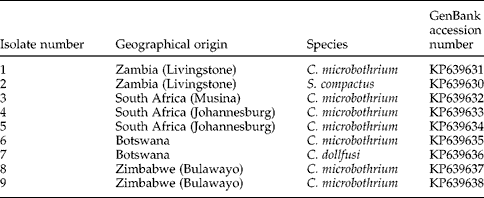
The ITS2 sequences for all isolates were successfully amplified and the sequences generated were submitted to GenBank. The accession numbers acquired are shown in table 1.
The geographical origin and GenBank accession numbers of the ITS2 rDNA sequences of isolates of Calicophoron microbothrium, Stephanopharynx compactus and Carmyerius dollfusi from cattle in southern Africa.

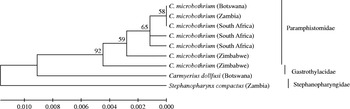
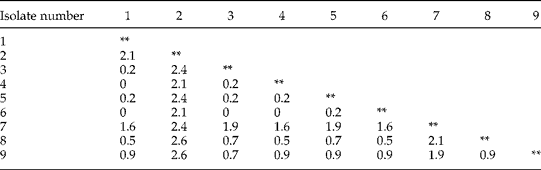
Phylogenetic reconstruction with the sequences generated a UPGMA dendrogram using MEGA 6 as shown in fig. 1. The tree had three clades, with one major clade containing all the C. microbothrium isolates, being supported by a higher bootstrap value of 92%. Two other clades, each with one isolate of S. compactus and C. dollfusi, are also shown. Estimates of evolutionary divergence between sequences, using the maximum composite likelihood model, were generated (table 2). The sequence divergence values, presented as a percentage of the distance estimation in table 2, ranged between 0 and 2.6%. Four isolates were C. microbothrium, found in all countries in the study, with divergence values ranging from 0 to 0.2%. The divergence values within the C. microbothrium isolates was less than 1%, being higher between Zimbabwean isolates and those of other countries (0.9%). Higher divergence values were observed between species, ranging from 1.6 to 2.6%.
Analysis of ITS2 rDNA sequences of paramphistomes using the maximum likelihood composite method, supporting bootstrap values from 1000 replicates.

Pairwise estimates of distances, expressed as percentage evolutionary divergence values, between ITS2 sequences of paramphistome isolates (see table 1 for details of isolate numbers).

Accurate molecular characterization of paramphistomes requires careful morphological identification to species level. This may prove difficult as it often entails histological sectioning and careful use of the given keys for identification (Lotfy et al., Reference Lotfy, Brant, Ashmawy, Devkota, Mkoji and Loker2010). In our study, this was done on individual isolates obtained from four different countries within the southern African region. Histological sectioning and use of keys by previous authors were used to identify the species. Similarly, Ichikawa et al. (Reference Ichikawa, Kondoh, Bawn, Maw, Htun, Thein, Gyi, Sunn, Katakura and Itagaki2013) used median sections as well as morphometric data for identification of some isolates for which they obtained detailed results. Identification is very important if the data obtained are to be used for epidemiological studies and development of tools for detection of paramphistomes that cause disease.
Nine isolates were characterized in this study: seven were identified by morphological analysis as C. microbothrium. This paramphistome occurs in all the four countries and has been implicated in a number of paramphistomosis outbreaks in Africa and worldwide (Phiri et al., Reference Phiri, Chota and Phiri2007). Although C. microbothrium has been recorded across Africa, few studies have been done on its diversity and infection patterns using molecular techniques. Stephanopharynx compactus was identified in cattle from Zambia. According to Eduardo (Reference Eduardo1986), this species was recovered from a number of hosts and locations in Africa, including Zambia. However, limited studies have been done on this particular paramphistome in Africa. This paramphistome, which belongs to the sub-family Stephanopharyngidae Stiles and Goldberger, 1910, was identified by a pharyngeal pouch, which is peculiar to it. Its description had all the features documented by Nasmark (Reference Nasmark1937) and Jones (Reference Jones, Jones, Bray and Gibson2005). Carmyerius dollfusi was isolated from cattle in Botswana. This paramphistome was identified using keys from Gretillat (Reference Gretillat1964). However, the taxonomic sub-family Gastrothylacidae is large, being composed of four genera. Amongst these is the genus Carmyerius with 16 species (Gretillat, Reference Gretillat1964). This presents a challenge, as identifying to species level is rather difficult. The main features that were used for identifying to species level were the genital atrium and ventral pouch, based on the keys from Gretillat (Reference Gretillat1964). The genital atrium fitted the description of the dollfusi type, hence the isolate was assigned to C. dollfusi.
ITS2 rDNA sequences revealed that S. compactus had a larger average evolutionary divergence value (2.34%) than the other paramphistomes (table 2). The ITS2 rDNA sequence for S. compactus reported in this study did not match that of any published paramphistome species; it is thus being published for the first time. Phylogenetic reconstruction using the ITS2 rDNA sequences, grouped the isolates according to their respective species, supporting our morphological identifications. Results from other authors indicated similar trends (Lotfy et al., Reference Lotfy, Brant, Ashmawy, Devkota, Mkoji and Loker2010; Ghatani et al., 2012). Our results correspond to the taxonomic grouping by Jones (2005), which show that S. compactus belongs to a sub-family of its own. A further study on S. compactus should be done in order to help resolve taxonomic ambiguities associated with this paramphistome. On the ITS2 phylogenetic tree, the larger clade with all the C. microbothrium isolates did not show trends according to geographical origins. The results indicate that ITS2 is a reliable marker to study phylogenetic relationships between species, sub-families and genera, but not a good marker to infer phylogenetic relationships within species as in the case of C. microbothrium. This supports similar observations by Bian et al. (Reference Bian, Zhao, Jia, Fang, Cheng, Du, Ma and Lin2013).
In conclusion, sequences of S. compactus and C. dollfusi were characterized and the genetic variability of some paramphistome sub-families determined. Both the histological sectioning technique and ITS2 rDNA sequencing proved to be useful tools for determining phylogenetic relationships. The ITS2 rDNA technique would be very useful for resolving taxonomic ambiguities.
Financial support
Project support was provided by the Research Board at the National University of Science and Technology (grant no. RB/63/13).
Conflict of interest
None.