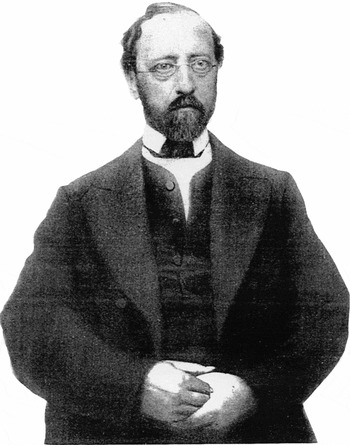
The subject of this essay is the life and work of a Parisian nobody. It concerns in particular the eyes of that Parisian nobody: what they saw and what we can know of what they saw. The nobody in question is Théodore Vacquer, a man whose whole life was lived under the star of anonymity, isolation and non-achievement. He was a failed engineer and a failed architect. A highly ambitious author who wrote copiously behind closed doors, he published next to nothing. ‘Reticent to the point of secrecy’ was the judgement of one acquaintance (an admirer, moreover); he was also ‘whimsical to the point of peculiarity’. His quirkily rebarbative character was such that even his friends referred to him as ‘a wild boar’ and ‘a permanently rolled-up hedgehog’. His desperately unglamorous portrait (Figure 1) reveals an awkward posture, the rough, embarrassed hands of a workman rather than an intellectual and, half hidden from view by his spectacles, a veiled, oblique, reticent gaze.Footnote 1
Théodore Vacquer. From M. Vasseur-Depoux, Catalogue des manuscrits des bibliothèques publiques de France. T. LIX. Bibliothèque historique de la ville de Paris (Paris, 1975).

Théodore Vacquer was a Parisian archaeologist who spent all his life in the city excavating, viewing and reflecting upon its past. And his career covered the period in which Paris was refashioned under the inspiration of Baron Haussmann, Emperor Napoleon III's prefect of the Seine from 1853 through to 1870. Paris rebuilt, boulevardised and mythologised became over that period the archetypal city of modernity, visually celebrated as such in the canvasses of Impressionist and Post-Impressionist painters.Footnote 2 Vacquer's life also coincided, we might note, with the period in which archaeology was emerging as a professional discipline, and in which protection of heritage (patrimoine) was becoming the object of governmental priority.Footnote 3 The thrust of this essay will be to argue that the life of this forgotten and neglected figure allows us – paradoxically, most often by dint of his failures rather than his successes – to explore intersections between archaeology and modernity, history and myth, past and future, record and imagination, and memory and amnesia in the history of nineteenth-century Paris, crucible of urban modernity. Ultimately – a century after his virtually unremarked death – this Parisian ‘nobody’ is a somebody whose life and writings have much to teach us.
Théodore Vacquer was born in Paris in 1824, in the Sorbonne neighbourhood at the heart of the present-day Fifth Arrondissement. The latter encompasses within its limits most of Roman Paris, or Lutetia, which would prove to be his lifelong obsession. He was a true titi parisien – his family was city-bred, and he was educated in the city. He failed the entrance examination for the Ecole Polytechnique up on the Montagne Sainte-Geneviève in the late 1830s, and thereupon renounced plans to become an engineer, so as to train as an architect. It was on a building site in 1841 that he witnessed the discovery of stone sarcophagi from the Merovingian period – a moment which he described in terms of an epiphany. ‘One day, I noticed on a building site that the earth that the workers were bringing up to the surface contained debris from the Roman period. Several days afterwards, there appeared admirable Roman substructures, whose form and state of conservation were excellent.’Footnote 4 But Vacquer did not stop there. He returned home and compared these findings with the record of the city's past as it was recounted in current historical work on the early history of Paris. The most up-to-date scholarship – Dulaure's Histoire de Paris, for exampleFootnote 5 – at once revealed itself to Vacquer as ‘both incomplete and erroneous’. Vacquer left his armchair and went out hunting for other vestiges of a misrecorded Parisian past. ‘Up to now’, he later noted, ‘the history of Paris had been written by the fireside.’ But things looked different, Vacquer was excited to learn, in the field. ‘I saw that every day and in all neighbourhoods the navvy's spade was laying bare and destroying ancient sites.’ His vocation as an architect was abandoned. He now vowed to follow all building work as best he could, with the aim of recording findings and where possible rescuing relics. He soon discovered, moreover, that he was falling into the habit of directing his attention by preference ‘on Roman-occupied areas’, ‘often to the detriment of areas built on in the Middle Ages’. This would be, he projected, ‘his life's work’.Footnote 6
This was a good time to be evolving into the proto-archaeologist of Roman Paris. For at this time, thanks mainly (though not entirely) to Prefect Haussmann, more of the central parts of Paris were being dug up than had ever been dug up before. Emperor Augustus had famously re-made Rome in the image of a great empire, and Haussmann's master, Napoleon III, charged him with the same task for his own imperial capital. It is probably true that historians have tended to follow Haussmann's own lead and make him (with Napoleon III) almost entirely responsible for this transformation. As Nicholas Papayannis has recently pointed out, the idea of rational urban planning on which the Haussmannian project was based dated back to the Enlightenment (and in some respects even earlier).Footnote 7 Haussmann's predecessor as Prefect of the Seine from 1833 to 1848, Count Rambuteau, trialled many of the processes which Haussmann was to employ. And ‘Haussmannisation’ continued unabashed well into the Third Republic down to the outbreak of the First World War.
Yet Haussmann did most to fuse together the range of ideas and practices into an irresistable force for root-and-branch urban transformation. It was, moreover, mainly his diggers that changed the medieval heart of Paris, which had always been a fundamental part of the age-old image of the city. Since the time of Philip Augustus in the thirteenth century, Paris had grown outwards, creating concentric circles around a central, irreducible, historic core. The latter remained relatively unaffected even as the city's fringe went through multiple evolutions, new building and wide streets rarely penetrating the invisible carapace which seemed to protect that inner heart. The Île de la Cité, for example, where Julius Caesar had located the city of the Parisii whom he had defeated in the Gallic Wars, was in Vacquer's youth one of the filthiest, most overcrowded and generally disgusting parts of old Paris.Footnote 8 From around mid-century, however, it was transformed by techniques which were extended throughout these central zones of the city and which tore up the old surface. It was not only the case that Haussmannian techniques metamorphosed old Paris, with its winding, narrow and clogged up streets, its insanitary miasmatic atmosphere, its all-too-contagious political radicalism and turned it into the ordered city of open spaces, flowing boulevards and rationalised infrastructure. They also thereby revealed an ancient substratum. On the latter, Vacquer set to work: all ‘demolition of foundations, [and the building of] channels for sewers, water mains and gas pipes’ were grist to the Vacquerian mill. ‘The earth is a book’, he noted confidently, ‘for he who can read it.’Footnote 9
In 1866, after nearly two decades of ceaseless excavation, Vacquer's semi-official activities were recognised by his appointment as inspector of the Service historique de la ville de Paris. It was probably around this time that he determined to write up his copious findings as a prized work of scholarship, his life's work, as he told himself. He could by now draw on an unruly mountain of documentation. Throughout his career, Vacquer took notes and made sketches on site. These were often on scraps of paper and (literally) the backs of envelopes and restaurant menus, and they utilised his own shorthand conventions. He could feel proud that in the years during which Baron Haussmann had refashioned Paris as a new city, the prized city of modernity, he himself had located a lost one, namely, Lutetia. The Roman baths had long been known – though they had often been mistaken in fact for the palace of the fourth-century ad Roman Emperor, Julian the Apostate. But, as Vacquer's worknotes attest, through extensive observation and excavation he also identified for the first time the late Antique rampart on the Île de la Cité, the Roman streetplan, a theatre on the Rue Racine, a forum and associated buildings on the Rue Soufflot, cemeteries out beyond the Luxembourg gardens and in the south-east of the city close to the Gobelins, and an amphitheatre by the Rue Monge. Virtually all of this was literally terra incognita for a millennium-worth of Parisians.Footnote 10 The scale and significance of Vacquer's findings on the Roman city simply cannot be underestimated.
Vacquer was, however, never to complete the manuscript in which he planned to do justice to all he had found. From 1872 his studies were linked in with work for the Museum of the City (now better known as the Musée Carnavalet) where he was appointed associate curator (sous-conservateur). His growing role in conservation and museum work, particularly in cataloguing the Carnavalet's Gallo-Roman collections, squeezed out time he could devote to writing up his voluminous findings. His only publications amounted to brief worknotes on different archaeological sites, which were mainly published in little-read local history journals.Footnote 11 His evenings and weekends were spent poring over his manuscripts, scribbling amendments and addenda, amassing further materials, classifying and reclassifying his discoveries. The never-ending scale of his task, as new finds continued to be made (the digging of the Paris Metro was just under way in his final years), discouraged him too: ‘by its very nature’, he noted, his cherished volume ‘can in some ways never be complete’.Footnote 12 Personal demons seemed to be haunting him, and he agonised ceaselessly over the act of writing. He never in fact got beyond the preface to his planned opus magnum, and endlessly revisited it, tinkering and retouching his text rather than embarking on the book's substantive contents. The death of his wife in 1898, and administrative reorganisation at the Carnavalet which forced him into retirement, seemed to demoralise him. He now passed his days reading listlessly in public libraries. The perpetually rolled-up hedgehog would die in 1899, his work unfinished and his name so little known that hardly an obituarist could be found to record the passing of the ‘mysterious’ Vacquer,Footnote 13 let alone evaluate his importance. The nearest his work got to having immediate posthumous influence was when his friend and collaborator Pachtère used his work-notes to compose a map of Lutetia – a subject to which I will return at the end of this article.Footnote 14
On his death, Vacquer's papers passed into the possession of the historical services of the city (and his colleagues and acquaintances there were little short of stupefied at what his papers revealed of the extent of Vacquer's secretive discoveries).Footnote 15 The Vacquer archive came to be housed in the Bibliothèque historique de la ville de Paris, on the Rue Pavée in the Marais. There we can still consult them. There are nearly a hundred boxes in all, containing about 10,000 pieces. There is no Ariadne's thread, nor even an Umberto Eco nor a Julian Barnes, to serve as guide to a labyrinthine corpus which increasingly strikes the hapless researcher as the disordered, capillary byway of a somewhat deranged mind. This delphic archive has acquired the appearances of a palimpsest, a crazy quilt of pencilled jottings, quilled scribblings, newspaper snippets, picture postcards, water-coloured topographies and indeterminate sketchings. Indeed the Fonds Vacquer has achieved the form of an archaeological site itself, and its different parts can only be accessed through, and only take their meaning from, a process of historical sedimentation.
Today, archaeologists of Roman and Merovingian Paris are the most assiduous frequenters of the Vacquer archive, scholars puzzling away at even a single one of the hundred boxes so as to get some fleeting glimpse of how Roman Lutetia might have revealed itself to the eyes of Théodore Vacquer.Footnote 16 If they take the trouble to consult the oracle, it is because they realise that those eyes were not simply the first to view most of the vestiges of Roman Lutetia. Vacquer was also the only scholar to have seen many of these things with the eyes of erudition. He was, as he modestly avowed to himself, ‘merely the editor of what existed and what I have seen’.Footnote 17 Wretchedly, this was an ‘editor’ who never published.
Since his death, Théodore Vacquer has thus become a sphinx, an eyeless riddle. Archaeology's inbuilt penchant for destroying evidence as it proceeds must take part of the blame here: we can consult the manuscript sources of Vacquer's historian contemporaries, but not the material remains over which he pored. In addition, Haussmannisation itself contributed to our present ignorance: for, as we shall see, little of what Vacquer found was accounted sufficiently monumental by city authorities or by the French state to be accredited as worthy of preservation and memorialisation. Vacquer received little or nothing in terms of public appreciation for his efforts, which only encouraged this constitutionally uncommunicative and maddeningly reticent man to turn in further on himself. As a result he took most of his unrivalled knowledge of Lutetia to his grave with him and never put into words what his eyes had seen.
While archaeologists obsess over Vacquer, historians ignore him altogether. What, simply, has never been done is to place this extraordinary figure and his life work into the history of the nineteenth century, rather than of Antiquity. Rather than seeing the Vacquer archive as an eye-glass on to ancient Lutetia, the remainder of this article will approach Vacquer's archaeological endeavours as a means of exploring the history and the myths of the city of modernity that nineteenth-century Paris prided itself on being – the city, that is, where Théodore Vacquer lived, prospered, saw – and failed in all he attempted.
It is important to register from the outset the place of myth in this story of proclaimed modernity. In his book, Paris, City of Modernity (2000), Patrice Higonnet analysed a whole miscellany of Paris's self-mythologisations – Paris as revolution, fashion, pleasure and so on – and how these play into an over-riding myth of Paris as the quintessential site of modernity.Footnote 18 This rich study has no space, however, for consideration of how Paris might have mythologised its own history – a startling omission, in fact, not least in that Paris has had a mythic history almost as long as it has had a past. Indeed, its history is inseparable from its self-mythologisations.
The grounds on which Paris's mythologisation was longest based was genealogical, or, rather, faux-genealogical.Footnote 19 From the seventh century onwards, a myth of origins had accorded the Franks a Trojan ancestry, and from the ninth century Paris was fittingly Trojanised. One early standard version of the myth saw a certain Francion fleeing a blazing Troy and settling in Sycambria before moving to the Rhine frontier whence he and his followers invaded Roman Gaul in the fourth century ad. Another variant argued that the origins of the Roman name of Paris – Lutetia – were derived from Leucothea, a marine goddess cited in Homer. Another claimed that the city was ‘like’ (par) the city of Issius (Isius) – and indeed something of a cult around the alleged Greek goddess Issius was still evident at the abbey-church of Saint-Germain-des-Prés which retained until the sixteenth century what was alleged to be her wizened effigy.Footnote 20 Despite the increasingly recondite absurdity of its variants across the Middle Ages and Renaissance, the Trojan myth served clear dynastic purposes: by deriving from Troy, which was thought to have been founded half a millennium before Rome, the Capetian kings of Trojan Paris could claim genealogical and hence ideological precedence over both Roman popes and Holy Roman Emperors. There was something faintly comic about such hubristic pretension: for Lutetia had been little more than a small, provincial Roman city, which even within Gaul had been overshadowed by Lyon, Nîmes, Arles and many others.
This kind of genealogical reading of Paris's mythic past became even less convincing in the seventeenth and eighteenth centuries under the pressure of shifts in modes of historical analysis, but some of its variants continued to find favour. The story that Paris pre-dated the arrival of Julius Caesar in the Gallic Wars provided comfort for the notion of Gaulish origins. But it was above all the emergence in the nineteenth century of the notion of Paris as the mythic city of the future rather than the past which put paid to such approaches. The quiet demise of genealogical accounts of the city's long-standing mythic past was a relatively unnoticed casualty of the establishment of the notion of Paris as city of modernity. The myth now looked forward rather than back. It was still of course a myth.
The process of mythopoeia by which Paris and modernity were fused together had, as its visionary seers, the poet Charles Baudelaire, the ‘painters of modern life’ (Manet, Monet, Renoir, Pissarro, etc.), and belatedly the philosopher, Walter Benjamin. Its principal technician, as we have suggested, was Baron Georges Haussmann.Footnote 21 Baudelaire and his explicator, Benjamin, subscribed to Haussmann's vision of the modern city as a vortex where bodies and commodities ceaselessly circulate in a dazzlingly atemporal whirl of mobility, novelty and exchange. Whether travelling in one of the new omnibus services or else merely strolling in the Haussmannian city, the unrestrained, percipient rambler – the flâneur in fact – would find his steps and eyeline directed by the new streets and boulevards on the public monuments now showcased in isolated splendour.Footnote 22 Some of these monuments dated from the nineteenth century – the Arc de Triomphe, the obelisk Gares du Nord et de l'Est and so on. But others were ancient monuments which were placed in a new context. These tended only to survive if they could be remoulded so as to play a part in the Haussmannian cityscape, their historic aspect largely subsumed under the functionalist, a-historic trappings of the city of modernity. Monuments, first, were cut free from their surrounding medieval or post-medieval overbuilding, according to rules of dégagement formulated by proponents of urban renewal in the Enlightenment.Footnote 23 Second, many monuments were updated and modernised. And third, their elevation was sometimes altered in the interests of the overall planning demands of the modern city.
We see these three processes at work in the case of Notre Dame cathedral on the Île de la Cité, where Vacquer cut his teeth as an archaeologist in the 1850s. Closely crabbed and confined by a jumble of largely undistinguished housing and the crumbling remains of former church buildings, the cathedral was progressively cut free from its surrounding pulp so that it could stand in splendid isolation. Under the scrupulous eye of arch-conservationist and architect, Emmanuel Viollet-le-Duc, incrustations from the sixteenth and seventeenth centuries were ruthlessly excised, to allow the gothic idiom to dominate; the adjacent Hôtel-Dieu demolished outright to improve the monument's all-round visibility; and new statues and gargoyles commissioned in the approved gothic manner. Important here too was the six-fold increase in the size of the square in front of the cathedral, the ancient Parvis de Notre-Dame. This was now generously opened out, completely altering the experience of viewing the site, and bringing it into line with modernist Haussmannian creations. In addition, considerable work was undertaken to level the soil around the square. If one today descends the steps leading to the archaeological crypt on the Place du Parvis-Notre-Dame, one encounters some six metres lower than the existing street level, the medieval street leading along to what were steps up to the cathedral's west front. Much of the Île de la Cité in fact was packed with soil under Haussmann so as to be a metre or more higher than the ancient terrain.
The fate of the Parvis de Notre-Dame is a reminder that the work of Haussmannisation involved the levelling of the historic terrain on which the city had been built. Historians have often stressed how Haussmannisation entailed the building of a massive sewer system and the development of catacombs for the relocated cemeteries of the central zones of the city. Yet these subterranean constructions did not have such a profound effect on the visible historic tissue of the city as the more subtle kind of levelling evident in the Île de la Cité – a process to which the Vacquer archive bears ample witness. Haussmannisation involved not simply the excavation and remodelling of Parisian land-surface, and the replacement of crooked roadways by rectilinear boulevards. Haussmannian vistas worked best across levelled, flattened space. And the legibility of Paris as the city of modernity entailed a profound remodelling of the city's depths and heights, and the consequent erasure of much of its historic density by a process of systematic elevation and depression of topological features which had hitherto played significant parts in the city's history.
The city had originally been located on a marshy bog in a meander of the river Seine – the name Lutetia probably derived from lutum, Latin for mud or muck. That muck now had to be drained, certainly, but it could also be relocated altogether. Merovingian settlement on the Right Bank had clustered around small hillocks – or monceaux – which were now brought down in size, leaving only the vaguest of traces of a millennium's worth of history. Today one may cast one's eye at the steps leading up to the churches of Saint-Gervais in the Marais and of the nearby Saint-Jacques-de-la-Boucherie, little suspecting that those steps are the last remaining vestiges of two such monceaux, erased from the landscape by Haussmann's bulldozers.Footnote 24 Then, again, when one looks up the Avenue de l'Opéra towards the Opéra-Garnier, it takes imagination to visualise the fortified ramparts, the towering midden-heaps and two ramshackle windmills which had to be removed so as to give the enduring modernist impression of monuments viewed across a wide horizontal expanse. In the case of the Opéra, one can do more than visualise in fact, for there are photographic records of the process of change. Haussmann rather championed the new medium of photography as a means of indicating the extent of his achievement and used it to highlight a ‘before and after’ approach to the city. The notion of le Vieux Paris only made sense as a product of the city's modernisation. The function of the city's history was to glorify the present and the future, and to act as a memento of a past that had been mercifully discarded.
The boulevardisation and modernisation associated with the creation of the new city, involving the sweeping away of medieval and post-medieval debris and the flattening of the terrain, uncovered what lay below the surface. Not least, it lay bare the material remains of a civilisation scarcely known hitherto – save through the scanty documentary record – namely, Roman Paris, Lutetia, the focus of Théodore Vacquer's life and energies. In a very real sense, then, we can understand Vacquer as Haussmann's doppelganger. He was literally the archaeologist of Haussmannian modernity. Haussmann operated through erasure of topological features and the material culture and vestigial traces of a discardable past: Vacquer made of those very processes of destruction and reconstruction the substance of his life and work. He, he alone, saw those things happen, he and he alone could piece the jigsaw together.
In order to assess Théodore Vacquer's role in these processes of modernisation, it is helpful to understand something of Parisian historiography in the nineteenth century – and in particular the emergent notion of heritage, or patrimoine.Footnote 25 The foundation of the Ecole des Chartes in 1821 had helped to stimulate the documentarist, Rankean study of national history. In addition, the emphasis of early nineteenth-century liberal historians on the role of the communes within that national past inevitably focused much attention on the history of the nation's capital city. In 1830, Guizot established the French Commission on Historical Monuments, which reconnected with work of inventorisation and classification of urban monuments that had started in the 1790s but fallen into decay.Footnote 26 From 1833, the Commission had its own inspectorate and a skeletal bureaucracy. It proceeded by listing monuments of historic or aesthetic significance, and, where necessary, supplied guidelines on their restoration.
By the 1830s, there were signs of a growing wish to explore the history of the city not only through the archival record but also through analysis of the existing built environment. There was even a sense in which this might be even more instructive than archival research. Particularly outspoken in this respect was the great novelist and poet, Victor Hugo, a fierce opponent of excessive clearance. His paean to the Middle Ages, the novel Notre-Dame de Paris (1829) had already launched a ‘war on demolition’, which he would doggedly pursue for the next half century and more, in a veritable conservationist campaign in journalistic, public and occasional writings, spiced with occasional bursts of bombastic humour. Though he was still in a minority as regards the need for conservation, he shared with his opponents the view that what counted most were public monuments of high aesthetic or historical significance. He and his conservationist allies, like the Commission for Historic Monuments, all prized highest medieval building, and in particular the gothic style. The Commission in particular had a pecking order which valorised politically and artistically significant buildings prior to the Renaissance. This meant that the architecture of the sixteenth, seventeenth and eighteenth centuries was often ruthlessly sacrificed and virtually never defended. At the other end, Vacquer's traces of the pre-gothic also tended to lose out.Footnote 27 The often sparse and invariably unmonumental low-grade public ruins and domestic buildings for the most part, drawn from what was a third-rate Roman conurbation, which were his stock in trade, lay well outside the conservationist purview.
Théodore Vacquer saw his role as informing the public and the state about the Gallo-Roman and early medieval period which was overshadowed so extensively by the high Middle Ages. From the 1840s, Adolphe Berty was collecting data on medieval and Renaissance buildings in work which would produce multi-volumed publication after 1866 as the Topographie historique du Vieux Paris.Footnote 28 Vacquer set about bridging the gap between Berty and his associates on one hand, and on the other the emergent scholarship on the prehistoric period, which was the focus of Eugène Belgrand (the paleolithic scholar was also Haussmann's lieutenant, and was largely responsible for the engineering achievement behind the creation of the Paris sewer system).Footnote 29 Vacquer sought to fill the gap between the Middle Ages and the prehistoric era. He eschewed the prehistoric era, but ran out of interest in Paris after the year 1000. This made him unusual – a characteristic trait – since this was when most other scholars began.
A further influence on Vacquer was the life and work of Viollet-le-Duc, mentioned above. Viollet-le-Duc was the ardent champion of the gothic, and the principal theorist of historical restoration in nineteenth-century France. His views exuded an aggressive historicism which girded the notion of restoration with the mystique of artistic creation. ‘To restore an edifice’, he famously argued, ‘is not to maintain it, repair it or refashion it; it is to reestablish it in its complete state which may never have occurred at any given moment.’Footnote 30 The restorer should be able to work from the functionality of parts to capture the idea of the whole. It is Viollet-le-Duc who was responsible for the restoration of the medieval city of Carcassonne and the chateau of Pierrefonds, producing buildings which seem more to prefigure Walt Disney than literally to depict what these sites ever looked like at any moment in the Middle Ages. Viollet-le-Duc also restored the basilica of kings out at Saint-Denis and was responsible for the restoration of the Sainte-Chapelle on the Île de la Cité – work which came in places dangerously close to medievalist pastiche. His reconstruction of Notre-Dame was also notorious in this respect. His plans included his serious proposal to erect a spire on each of the cathedral's two towers, on the ground that the building's architects had originally planned this eventuality – it was in due time decided that the towers could not bear the weight.Footnote 31 Over in England, John Ruskin was developing a very different version of what could and should be involved in the restoration of historic monuments.Footnote 32 Ruskin had some followers in France – but not many. The ideas of Viollet-le-Duc enjoyed a hegemony in the French world of restoration right down to the end of the nineteenth century, thus ensuring that ideas of historical restoration merged somewhat confusedly with imaginative and artistic creativity. As we shall see, this approach influenced Vacquer.
Many of these strands came together over an archaeological dispute in Paris in the 1870s and early 1880s, which constituted a defining moment in Vacquer's odyssey and a signal marker in the history of Parisian conservation, and in some senses in the history of Parisian memory too. It is an episode which we might call the the ‘Battle of the Arènes’ (‘Battle of the Arena’). The dispute focused on the Roman amphitheatre – the Arènes de Lutèce, as it came to be called – built in the second century ad over towards what is nowadays the Jardin des Plantes in the Fifth Arrondissement.Footnote 33 The Arènes were probably only operational for a century or more, before growing insecurity within the Roman Empire led to their falling into disuse. Although the English student Alexander Neckham recorded the continued existence of the monument in the twelfth century, shortly afterwards much of the masonry was probably carted off to provide substance for the city wall of Philip Augustus, constructed between 1190 and 1215. So remote was memory of Lutetia by this time, so askew any sense of the Parisian past, moreover, that chroniclers recorded that Parisians were using stone from walls which had been constructed to defend the city against invasion by Saracens. After this, the Arènes remained as a place-name, but no visible sign of the former monument was evident. It was buried under one of those hillocks, those monceaux, which, as I have suggested, were so anathematic to Haussmannian horizonality.
It was in the 1860s, during the building of the Rue Monge, one of the outer network of boulevard-like streets which Haussmann had started to establish on the Left Bank, that the relics of the Roman arena were suddenly uncovered. The levelling of a monceau on which had stood the convent of the Augustines of Notre-Dame, sequestered by the state in 1860, revealed substantial Roman remains. Vacquer was soon on hand to confirm that what was now visible were the remains of the northern half of a very substantial arena, and he went on to manage this early phase of excavation. The Arènes accorded far more closely with the notion of the monumental than anything Vacquer had discovered so far. It was a find that was too significant to be merely covered over by the trappings of Haussmann's modernity or dismissed as insufficiently monumental. He also must have been encouraged that public interest was growing too, stimulated by new discoveries (skeletons, medallions, jewellery, stone carvings, etc.) widely reported in the press.
Yet Vacquer had an opponent far more in tune with the Haussmannian Zeitgeist than the prickly antiquarian – namely, an omnibus company. It had been the latter which, on digging down nearly twenty metres, had discovered the Roman remains. The company managers were not interested in conservation: they wanted the old convent site to be converted into an omnibus depot. Napoleon III visited the site in person in 1870, but deferred a decision on it, not least because of the likely high cost of full restoration. Baron Haussmann was by then, moreover, politically on the run, hounded by press and political opponents over alleged financial malversations. It must have been one of the last decisions he made, prior to his dismissal, to refuse permission to restore and conserve. Citing the avis défavorable accorded the site by the Commission of Historical Monuments, Haussmann gave the green light to the omnibus company.
Thus far, the story seems to constitute a nice modernist parable, then – and a cautionary tale for conservationists. The latter had proved to be disastrously divided, and had not put up a sufficiently powerful public case for the preservation of the most monumental pre-medieval remains ever to be uncovered in the city. If Vacquer was disappointed, to some extent he had himself to blame: he was said to have been irritatingly quarrelsome with fellow-conservationists. In any case, the opening of the Franco-Prussian War and the ensuing sieges of Paris hardly provided an encouraging context for public campaigning. The overthrow of the Second Empire was hardly the most propitious moment for attracting support for imperial remains. The conservationists could only take some small pleasure from the fact that German bombs lobbed into the city during the Prussian siege destroyed a number of huts belonging to the omnibus company.
New roadworks and street clearance continued in the vicinity of the bus depot in following years. A decision in the early 1880s to open a side street off the Rue Monge led to the demolition of another convent in the area. Digging down, the builders found what was evidently the other part of the arena. A public campaign was started almost at once, and worked with newfound energy.Footnote 34 This time there was no omnibus company in play, and no Haussmann to say no. The struggle was tough. But a turning point was reached in July 1883, when the now venerable Victor Hugo wheeled magnificently into action, issuing a public letter to the city council in support of conservation:
It is not possible that Paris, the city of the future, should renounce the living proof that it was a city of the past. The arena is an ancient mark of a great city. It is a unique monument. The municipal council which destroys it would in some manner destroy itself. Conserve it at any price.Footnote 35
Three days later, the city council purchased the land containing the remnants of the arena. It was rescued from housing development, and plans for its full display were only inhibited by the need to lay bare the full extent of this ‘ancient mark of a great city’, as Victor Hugo had put it.
The Haussmannian parable of 1870 had thus received a conservationist riposte. The year 1883 was a cautionary tale not for conservationists but for modernisers. The incident seems to have been a pivotal part of a set of developments relating to conservation which were unfolding at an accelerating tempo.Footnote 36 The city authorities began to adopt a more sensitive and responsive attitude towards its own heritage – an approach which was helped by a kind of anti-Haussmannian backlash in planning circles during the Fin de Siècle. The straight line of the boulevard which had been the avatar of Haussmannian modernity was increasingly qualified by a taste for the curvilinear, the neo-rococo, the picturesque and the more organic morphology of art nouveau. This measured (if never complete) shift away from High Haussmannism was popular too. The campaigners who in 1883 had laboured hard to get the media and the public on their side were now actually pushing against an open door. A number of lobbies emerged as effective fighters for the conservationist cause, and highlighted appeals to public support.
The emergence of effective public lobbies would be crowned by the establishment in 1898 of the Commission du Vieux Paris – a semi-official body which is still in existence and which has proved a doughty fighter for a more historic awareness of the city's built environment. The Commission du Vieux Paris played a key role, for example, in changing the protocols of the Commission of Historic Monuments in a way which highlighted the desirability of conserving buildings surrounding a major monument – rather than just cutting it free from its aesthetically ‘inferior’ context. Although France was painfully slow to adopt the kind of rescue archaeology which became the norm in England and many other European countries over the middle decades of the twentieth century, it is probably true to say that no notable destruction of ancient historic sites on the scale and significance of the Arènes farrago has occurred since then.Footnote 37 Generally speaking, from the 1880s, the Haussmannian reflex in Paris has had to find ways of accommodating discourses of heritage and historicity.
There was, however, to be a further twist in the tale of the Arènes. With excavations now steaming ahead, and with public opinion primed to expect great things, it became apparent that there was very little of value actually located at the site. The scale of the arena pit – around a hundred metres in diameter, making it the second largest in the whole of Roman Gaul – had excited wild hopes. In fact, it soon became blindingly obvious to the archaeologists involved that nothing on the scale of the magnificent amphitheatres of Arles and Nîmes was going to emerge. Partly this was because the most impressive part of the monument lay under (and had been destroyed under) the famous 1870 bus depot. The original builders of the amphitheatre had deployed the topography of the site to advantage, using what had been an upward slope on the Rue Monge to erect some thirty rows of seats facing west. These had all gone. Worse, it was now discovered that on the eastern side there was no banked seating at all: on that side was located a stage for theatrical performances – making the Arènes a mixed theatre-arena of a kind found elsewhere in Roman Gaul. What with the Haussmannian destruction of the 1870s, the removal of stone in the thirteenth century to build the Philip Augustus wall, plus age-old attrition on the site, there was extremely little about which to get excited. ‘In order to preserve the arena’, noted one somewhat alarmed official, ‘it would first be necessary to show that the arena exists; experience seems to me to demonstrate the opposite.’ ‘As a monument’, he concluded, ‘there is nothing there any more.’Footnote 38
The city official in question was aware of the eager anticipation of the general public, and feared that the destruction of what little remained would trigger accusations of vandalism which the municipal authorities wished to avoid. In the event, the affair was quietly laid to rest with no public fanfare, as excavations continued at a snail's pace. The existence of a circular wall two metres high encircling the arena pit was identified, excavated – and then to all intents and purposes constructed. Ten rows of seats were also put in place on the southern edge of the site. This was far less than the thirty rows which archaeologists had identified as once being here – but whose reconstruction would have required the demolition of a sizeable chunk of the Rue Monge. Much of the work of (re)construction was only completed in 1915–16, in the midst of a war when issues other than patrimoine were on the minds of government and people alike and when memory of the old Battle of the Arènes was fading into insignificance.
In this remarkable record of archaeological fiasco, one would expect to find our friend Théodore Vacquer. In fact, he was notable mainly by his absence. His bad behaviour towards visitors to the site of the Arènes in 1870, whom he was said to have terrorised with the unbridled rage of a wild boar, was such that he was henceforth banned from most excavations. The man who had indeed discovered the site in 1869–70 was only on the sidelines in the 1880s. In the last years of his life, the grumpy antiquarian refused even to mention the name of the Arènes, and became angry and dismissive if anyone brought it up in his presence – to the extent that a fellow curator at the Carnavalet warned him not to give the impression that he was siding with the enemies of conservation.Footnote 39 Just as the monument itself was being recovered for Parisian memory, he preferred to forget the whole thing. His embittered, unmanageable character meant that he was increasingly excluded from significant excavations in Paris. He preferred to sulk in his tent – and to do (or, in the case of his magnum opus, not to do) other things.
In his unpublished manuscripts, Vacquer himself gave a revealing explanation for his silence over the Arènes, and his growing disenchantment with the discipline of archaeology to which he had devoted his life.
Virtually all the relics and monuments that I have made known would have been destroyed and forever unknown without me. I have acquired the fullest certainty in that no other archeologist except I has ever turned up a excavations and worked them. It was only the Arènes [he added resentfully] which attracted attention and which the curious and the world of savants were interested in.Footnote 40
The hidden archaeologist of Haussmannian modernity, the ‘editor’, as he called himself,Footnote 41 of Paris's pre-medieval past, thus chose to remain hidden, preferring private satisfaction to public éclat. In lines which reveal something of his mental turmoil, he struggled to justify his position of principled invisibility, of keeping effectively to himself all that his eyes had seen.
If I have [crossed out: always] avoided publicising my discoveries as I went along, this was so as to avoid [crossed out: my attracting] generally despoliatory rivalries, and so as not to attract the curious onto sites where I was kindly tolerated [later addition: and where I kept myself more or less invisible]. Had other people, lacking in experience and showing indiscreet and embarrassing zeal, come there as a result of my presence, they would have caused me to be thrown out alongside them by architects and building contractors who have no time for archaeology.Footnote 42
‘Archaeologists show us’ – and this is now another archaeologist speaking, in this case the great archaeologist of Parisian memory – ‘that nothing is forgotten, nothing is destroyed and that the meanest circumstance of life, as far from us as can be imagined, has marked its furrow in the immense catacombs of the past in which humanity recounts its life.’Footnote 43 This quotation from Proust is an interesting one in which to insert the anti-hero of this essay. The curious Battle of the Arènes may well have been, as I have argued, a turning point in terms of public appreciation of heritage. But it was a turning point around which our shy hedgehog stubbornly refused to turn. He felt out of place in the modern world of public heritage campaigning, or incorporative sociétés savantes, and of writerly rivalries. Much about Vacquer's commitment to archaeology in his youth had marked him out as a pioneer. But by the 1890s the rest of the world was catching him up – even regarding him as a remnant as archaic as his subject-matter. When in 1841 he had had his Merovingian epiphany, archaeology was simply not taught in any major establishment of higher education or learning. Now the discipline had already established itself in the Ecole des Chartes, the Louvre, the Collège de France, the Ecole Pratique des Hautes Etudes and the Sorbonne, and was professionalising, fast.Footnote 44
In any case, it must have become increasingly evident to this constitutional loner that the postponement of writing his great work on Gallo-Roman Lutetia – a subject for which no one either then nor since has been more fitted – was a postponement sine die. He had always struggled to write: he preferred a trowel to a pen in the hand. Latterly, his workload at the Carnavalet was a convenient pretext for hiding something akin to writer's block. He published nothing, he stated, ‘so as not to deflower anything’.Footnote 45 He preferred to keep his powder dry and his scholarly virginity intact in his study, where he spent his time simply going over his notes, adding further layers of meaning and punctilious corrections to their already palimpsestic indecipherability.
Vacquer's life thus shows us how wrong Proust really was: in archaeology, much can be forgotten and much can be destroyed, and in order to be a mediator of memory an archaeologist needs to leave traces of his activity which are intelligible to those who follow. If not, then the eyes of the archaeologist – the eyes of Théodore Vacquer in fact – will remain forever those of a sphinx.
Yet despite their ungiving, quizzical nature, the eyes of Théodore Vacquer can help us, I believe, to explore the links between remembering and forgetting, between memory and amnesia, between myth and modernity, which lie at the heart of this article. When we visit or revisit the Arènes de Lutèce – as I fear, as a result of this chapter, we really must – it might also help us to reflect on what is a ‘site of memory’. The idea of ‘sites of memory’ has had tremendous vogue in recent years, grounded in the multi-volumed, multi-authored work edited by Pierre Nora, Les lieux de mémoire.Footnote 46 When one reads Nora and his team one is struck not only by how many such sites were in fact monuments based in Paris – and which largely conform to a Haussmannian aesthetic: made (or, as in the case of Notre-Dame cathedral, as we have suggested, re-made) in the course of the long nineteenth century; best seen at a distance, from the optic of the straight line and across horizontally ordered (and, as I have suggested, horizontalised) space.Footnote 47 The Arènes de Lutèce simply do not conform to this pattern at all. Perhaps this is why Nora and his crew ignore it. The Arènes constitute a very unusual Parisian – and ergo very un-Haussmannian and un-modernist – monument. It is complicatedly encrusted within a tangle of side-streets and a small public park. There are no modernist, Haussmannian framings. The site is dominated visually by the backs of the houses facing on to the Rue Monge; and dominated aurally by the excited yelling of children in the nearby Ecole Maternelle. The place has become in essence a playground. The passing tourist may hear the occasional concert here, but one is far more likely to come across local children playing a scratch game of soccer, lobbing boules or engaging in hide-and-seek. The failure of the Arènes as a monument of modernity and as a site of memory has released it so it could become a locus of neighbourhood sociability – infantile, juvenile, parental, romantic. The tourists may in consequence stay away – but tant pis (or even tant mieux). This is after all a site of memory which Parisians have managed to forget, not once but twice in their history. It is a site of memory which is barely a site at all in the Haussmannian sense, and in which memory jostles along quite comfortably with amnesia. In sum the Arènes de Lutèce suggest that there are more ways of parsing the term lieu de mémoire than are imaginable in the world of Pierre Nora and his eruditely Cartesian confrères.Footnote 48
The failure of the Arènes to be incorporated into Paris's mythologising myths about itself over the nineteenth and twentieth centuries seems also to be linked to more fundamental issues about the Parisian, and indeed the French, past. The national trauma which the Franco-Prussian War of 1870 had inflicted had damaging effects on the fundamental conceptualisation of Vacquer's life-time project. His wish to write on Paris's pre-medieval past – Gaulish, Gallo-Roman, Merovingian, Carolingian – was now out of tune with the times. The post-1871 historical establishment rekindled Germanophobia in polemics which replayed some of the older Enlightenment debate over ‘Germanist’ and ‘Romanist’ readings of the past. The tendency now was to valorise the contribution of the Gauls or the Gallo-Romans to French history, and to downgrade estimation of Germanic influences, Frankish, Merovingian or Carolingian.Footnote 49 This was true of the great national histories of Lavisse, Fustel de Coulanges and Camille Jullian and others just as it was of much of the conservation lobby (including Viollet-le-Duc in fact). It is difficult not to imagine the depth of Vacquer's disillusionment as he read such men who erected this caesura over the French past in a way which made his projected volume on Paris anachronistic – all the more in that such men consistently fetishised historical documents while underrating or even ignoring outright archaeological findings. At his death archaeology was becoming the Cinderella discipline among the ‘ancillary sciences’ of a highly ‘textualist’ tradition of history-writing.Footnote 50
Vacquer's discomfiture linked too to broader issues regarding Parisians’ view of the Roman phase of their own history. It may seem perverse to suggest that Paris has any problem with Romanitas generally. The downgrading of Germanic influence on the French past after 1871 was accompanied by benign readings of Roman influence. Furthermore, from the Renaissance onwards, Roman antiquity has provided many of the building models, the monumental templates and the urban grids which have made Paris what it is. Unsurprisingly too, over the course of the centuries poets and writers are far more likely to compare Paris with Rome than with any city. This was certainly the case in the nineteenth century, according to Pierre Citron's wonderfully (if quaintly) encyclopaedic computations: in his list of literary citations where Parisian comparisons are made, Rome stands way out in front, ahead of Athens and Jerusalem – with Babylon and Sodom and Gomorrah staunchly bringing up the rear (so to speak).Footnote 51
What is less clear – and therefore all the more striking – is the extent to which Paris's debt to Romanitas seems to have excluded positive valuation of the city's own ancient history within the wider community. Napoleons I and III showed far more interest in ancient Rome than ancient Lutetia.Footnote 52 Napoleon III was even an ardent enthusiast for archaeology: he engaged in enthusiastic quest to locate the site of the battle of Alesia in which Julius Caesar had defeated the Gauls under Vercingetorix, and inaugurated the Musée des Antiquités Nationales at Saint-Germain-en-Laye in 1867. Yet ultimately he preferred an omnibus depot to a Roman ruin at the heart of his capital city.Footnote 53 Ancient Lutetia weighed exceeding light in the imperial scales: after all, Lutetia had been a provincial small town, with a small-town history, no major monuments worth exploiting and a Trojan foundation myth far too wacky to be recycled. It was as though some Freudian family romance was in play, in which every Parisian (except of course poor Théodore Vacquer) was ashamed of the ignoble status of Lutetian genealogy and sought out a myth of substitution which would equip the modern city with an altogether nobler – if totally imagined – parentage. Paris was really the child of Rome, not of Lutetia.
Even had Théodore Vacquer managed to bring his magnum opus successfully to fruition, one has leave to doubt whether it would have made much difference. Given the reluctance of his peers to accept a Lutetian heritage, it seems very unlikely. As we have suggested, the nationalist ideology which gripped post 1870 history-writing looked askance at archaeological findings unconducive to Gallophilic national myth. The same was true in addition of the myth of the transhistorical modernity of the city of Paris which developed over the nineteenth century alongside a notion of le Vieux Paris. Neither had time nor much respect for Lutetia. Despite Victor Hugo's support for the Arènes in 1883, his life-time achievement was rather to foster a view of ancient Paris as grounded in the gothic – a mood which the photographers of Parisian modernity like Marville and Nadar inscribed into Parisian memory in their representation of tangled medieval streets and gothic shadings.Footnote 54 In twentieth-century Rome, in contrast, archaeologists would cut through medieval debris like butter through a knife so as to reach the imperial substratum: for Rome's idea of itself was not grounded in the Middle Ages but in Antiquity.Footnote 55 The situation as regards Paris was very different. In order to see the most impressive Roman monument in Paris – the Roman baths – one has actually to enter the Museum of the Middle Ages!Footnote 56 Once Parisian archaeologists had reached the Roman substratum in the nineteenth century they found it difficult – such was the prioritisation of the medieval and the monumental – to get the authorities to conserve them. Furthermore, Vacquer represented the age of amateur archaeologising, which lacked bolstering from professional organisations and publicity campaigns. Only from 1883 was there much of a will to conserve anything Lutetian. By then it was too late – most of the Roman city which the eyes of Théodore Vacquer had seen lay under the remodelled environment of the city of modernity. There were some memories – in this case, Vacquer's memories – which Parisians seemingly did not care to have.
The modernising myth of nineteenth-century Paris was a juggernaut which crushed beneath it the frail and vestigial findings of Théodore Vacquer. It had no time for what the eyes of our failed archaeologist had seen. Furthermore there is evidence that even Vacquer himself fell under the Haussmannian myth which his whole life had seemed to resist.
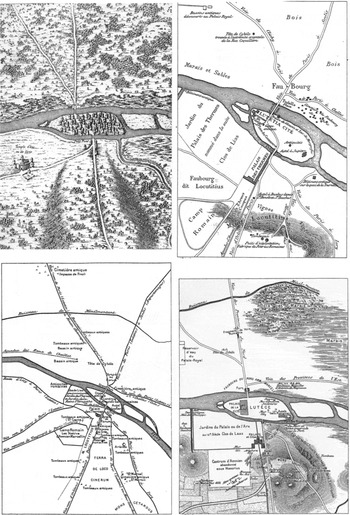
Vacquer spent the last decades of his life preparing a map of Roman Lutetia, based on archaeological findings across the centuries, and especially those which he had seen with his own eyes. The map was – characteristically – unfinished when he died. But his friend Pachtère subsequently published a map of early Paris based on Vacquer's sketches and drawings.Footnote 57 He highlighted all that Vacquer had achieved in revolutionising historical knowledge of the city by also supplying a series of maps based on what earlier savants had imagined the early city to be like (Figure 2). In the Middle Ages and for much of the early modern period, reconstruction had been based on Julius Caesar's account of the Gallic Wars plus some mythological imaginings. The nineteenth century had seen more systematic archival research, plus adventitious archaeological finds, which had gradually reshaped contemporaries’ sense of the ancient physiognomy of Lutetia. Dulaure – the standard source when Vacquer was a boy – showed a Left-Bank city emerging, with traces of Right-Bank occupation too. Dulaure – as Lenoir, in a later depiction – stressed the natural features: the physical relief, the marches, the fields, the vines, the waterways. But Vacquer's map of Lutetia – presented with no natural land features, only contour lines – showed a remarkable transformation.
Historical maps of Paris. Top left: according to De La Mare, eighteenth century. Top right: according to Dulaure, early nineteenth century. Bottom left: according to Jollois, mid-nineteenth century. Bottom right: according to Lenoir, second half of nineteenth century. From ‘Préface’, F. G. de Pachtère, Paris à l'époque gallo-romaine (Etude faite avec l'aide des papiers et des plans de Th. Vacquer) (Paris, 1912).

To a considerable extent, this map is a latter-day triumph for Vacquer's art and science. It presents Lutetia according to the gridiron pattern which late nineteenth-century archaeologists were finding throughout Europe – and in North Africa, in fact, where French colonial archaeologists were revealing geometrically conceived Roman cities which contrasted forcefully with the souk-like intricacy and muddle of the Arabic habitations overlaying them.Footnote 58
Yet this record of all that Théodore Vacquer's eyes had seen was also a record of how much his mind had imagined.
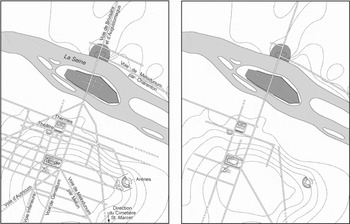
In order to get some purchase on the extent of Vacquer's discoveries, I have taken a highly positivistic step. I have mapped on to Vacquer's gridiron designs the sections of the streetplan which up-to-date archaeological authority shows that we have hard archaeological evidence about (Figure 3, right).Footnote 59 This process allows the wheat of proven material existence to be separated out from the chaff of Vacquerian imaginings. What is as plain as a pikestaff when we compare the maps is that there exists no hard evidence whatever for the majority of streetplan shown on Vacquer's map. They are streets of his imagining. It is a map of his invention.
Left: Ancient Paris, according to Vacquer. From F. G. de Pachtère, Paris à l'époque gallo-romaine (Etude faite avec l'aide des papiers et des plans de Th. Vacquer) (Paris, 1912), xxv. Right: Vacquer's map, adjusted to take account of archaeological finds.

What is also strikingly apparent from Vacquer's map – especially when set against the agreed archaeological record – is that unwittingly (we may profoundly assume) Vacquer had made Roman Lutetia into a Haussmannian city. Unconsciously, Vacquer had swallowed Haussmannian notions of Paris, hook, line and sinker. This Don Quixote of Roman Lutetia, who had spent so much time in his life tilting at the windmills of Parisian modernity, was seemingly a Haussmannian through and through, even if it was sans le savoir. We may indeed, with a few changes of wording, put into Vacquer's mouth the quotation I cited above of the great architectural restorer, Viollet-le-Duc. ‘To excavate an edifice’ (Viollet-le-Duc had said ‘to restore’) ‘is not to maintain it, repair it or refashion it; it is to reestablish it in its complete state which may never have occurred at any given moment.’ Footnote 60 What Viollet-le-Duc had been to the monumental record of the Middle Ages, Vacquer had unconsciously reproduced as regards his highly creative, even fantastical imagining of Lutetia. The archaeologist was thus far more than the servile recorder of the minutiae of the past; he was also the inventor, the mythologiser of history and the servant of a Haussmannian myth he spent much of his life resisting.
It is tempting to dismiss Vacquer the archaeologist as a man who failed in all that he attempted on which he set a price. Intriguingly, that judgement – which may well have been his own – is less widely held in our own day. In the last decades of the century which has elapsed since his death in 1898, Vacquer's scholarly reputation has soared. His findings now structure the historical as well as the archaeological record of Parisian Antiquity. Although his techniques were beginning to look archaic by the time of his death, his concern with minute observation, his eye for depiction, his dating through stratigraphy, his sense of the importance of the environment and his marked preference for fieldwork over fireside archaeology are now hailed as having been well ahead of his time. The revival of urban archaeology in the post-Second World War era has led scholars increasingly to highlight his work. In 1998, in his authoritative study of Lutetia, Didier Busson saluted Vacquer as ‘the first modern archaeologist of Paris and one of the precursors of urban archaeology’.Footnote 61 By then Vacquer's former employer, the Musée Carnavalet, had also finally changed its tune: after bringing out of the warehouses where they had lain, away from public gaze since the First World War, the Gallo-Roman findings which Vacquer had catalogued (and indeed in a great many cases, actually found), they opened up, in 1991, a new room within their premises for them. They called it the Salle Vacquer – in honour of a Parisian nobody who really was a somebody.
In retrospect it is possible to conclude that, in some senses, the time had not been right for Théodore Vacquer's findings to be incorporated unproblematically into the myths which Parisians and French men and women cultivated about their pasts in the late nineteenth century. They nurtured the idea of le Vieux Paris as an undifferentiated but also largely medievo-gothic entity, recalcitrant to Gallo-Roman or Germanic influence. And – especially after the national humiliation of 1870–1 – they established a historiographical caesura in French history with the advent of the Franks, thereby exploding Vacquer's cherished periodisation. If even at the turn of the twenty-first century, moreover, we still, as Bruno Latour has said, ‘inhabit the materialised dreams of Haussmann’,Footnote 62 how much more must this have been the case for someone who had such close personal knowledge of the pre-Haussmannian city – and who had seen the myth of urban modernity growing up round him.
Nonetheless, tracing with care the lineaments of that personal failure, and focusing on the sphynx-like eyes of archaeologist Théodore Vacquer, we can come to grasp and to weigh the force of the ambient myths which structured the reception of his research. Through the eyes and the imagination of the ‘permanently rolled-up hedgehog’ that was Théodore Vacquer, we can can glimpse, as through a glass darkly, not only the shape and texture of Roman Lutetia but also significant domains of the history of nineteenth-century Paris – its archaeology, its built environment, its developing sense of patrimoine and the awesome ideological power of its self-mythologisation, caught midway between past and future, record and imagination, memory and amnesia.