

It is a well-established observation that second language (L2) learners frequently err when using grammatical morphemes (Bailey, Madden, & Krashen, 1973; Dulay & Burt, Reference Dulay and Burt1973, Reference Dulay and Burt1974; Goldschneider & DeKeyser, Reference Goldschneider and DeKeyser2001; Larsen-Freeman, Reference Larsen-Freeman1975, Reference Larsen-Freeman1976). Various recent studies have highlighted problems with tense and agreement morphemes in child L2 development (Haznedar, Reference Haznedar2001; Haznedar & Schwartz, Reference Haznedar, Schwartz, Hughes, Hughes and Greenhill1997; Herschensohn, Stevenson, & Waltmunson, Reference Herschensohn, Stevenson and Waltmunson2005; Ionin & Wexler, Reference Ionin and Wexler2002; Prévost, Reference Prévost2003; Paradis, Rice, Crago, & Marquis, Reference Paradis, Rice, Crago and Marquis2008). The conclusion drawn in these studies is that L2 children know the morphological and syntactic properties of these morphemes, but nevertheless fail to use them in production.
Little is known about the factors that cause L2 children's errors with verb inflection in speech production. Therefore, in this study, we examined the contribution of multiple factors on L2 Dutch children's production of agreement inflection. The use of elicitation techniques allowed the collection of information across a range of syntactic contexts that varied in person, number, and word order. The children in this study were between ages 4 and 9, and had either a richly inflecting or an isolating home language. The outcomes of this study indicate that verb form, sentence position, home language, and L2 proficiency impact on L2 children's accuracy with subject–verb agreement in speech production.
VERB FORM
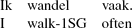
The sentences in (1) and (2) illustrate examples from a Turkish first language (L1) child learning L2 English and an English L1 child learning L2 German, who both fail to express the relation between subject and verb. In (1), the child has omitted the English third person singular (3SG) suffix -s. In (2), the German 3SG suffix -t is left unexpressed.
(1)

(2)


In order to explain omission errors such as in (1) and (2), researchers have proposed the missing surface inflection hypothesis (MSIH; Haznedar, Reference Haznedar2001; Haznedar & Schwartz, Reference Haznedar, Schwartz, Hughes, Hughes and Greenhill1997; Ionin & Wexler, Reference Ionin and Wexler2002; Prévost, Reference Prévost2003; Paradis et al., Reference Paradis, Rice, Crago and Marquis2008). This hypothesis holds that omission of inflection in child L2 English and German results from L2 children's reliance on a morphological default form, a zero morpheme, which is less specified than other forms in the paradigm, and is inserted if lexical access to more specific verb forms is hindered or delayed.
On the MSIH, grammatical morphemes are mapped to functional features that are derived from a universal set of features (Lardiere, Reference Lardiere2009). For instance, the inflectional morphemes -s (in English) and -t (in German) are associated with finiteness, person (3), and number (SG). Discussing English, Ionin and Wexler (Reference Ionin and Wexler2002, p. 118) state that uninflected bare verb forms “are finite forms that have simply not received morphological agreement marking and that can be used across all tense/agreement contexts.”Footnote 1 With respect to German, Prévost (Reference Prévost2003, p. 88) assumes that bare forms “are unspecified for person features but specified as [+finite].” According to the theoretical framework assumed in the aforementioned studies underspecified forms are default forms.Footnote 2 Access to this default is in normal conditions blocked by inflected forms that are associated with person and number features. If for some reason retrieval of the correct inflected form fails, the default rule applies, resulting in incorrect bare verbs as in (1) and (2).
The MSIH predicts that L2 English and L2 German children omit inflection and do not substitute inflected verb forms. A predominance of omission errors has been reported for child L2 English (Ionin & Wexler, Reference Ionin and Wexler2002). English has a very poor inflectional paradigm with many contexts where the bare verb form is grammatical. Hence, L2 English children's overuse of this form may, to a certain extent, be expected. Chilla (Reference Chilla2008) describes the development of subject–verb agreement in four typically developing L2 German children with L1 Turkish. German has a richer agreement paradigm than English with four different verb forms in the present tense indicative paradigm, and German therefore provides more possibilities for substitutions. Two of the L2 German children in Chilla's study showed the omission profile. These children started to acquire German around the age of 3. Two other children, who had an age of onset around age 6, also substituted inflected forms, for example, second person singular (2SG) -st in 3SG contexts or 3SG -t in plural contexts. The differences between children may suggest that a later starting age contributes to the variability in errors with subject–verb agreement (see also Meisel, Reference Meisel2009).
Herschensohn et al. (Reference Herschensohn, Stevenson and Waltmunson2005) investigated errors with subject–verb agreement in the data of L2 Spanish in 6- and 7-year-old Anglophone children. Spanish is a pro-drop language that marks both person and number through inflection on the verb. The present tense indicative paradigm consists of six different froms; there are three verb classes. In this study, the children's age of onset of exposure to Spanish was 5. The children participated in a picture description task that elicited lexical verbs in 3SG and third person plural (3PL) contexts. The results of Herschensohn et al.'s study are interesting for two reasons. First, in this study, the largest percentage of errors (87%) involved substitution of inflection rather than missing inflection. Second, the most frequent error was singular/plural reversal: 3SG forms in 3PL contexts and 3PL forms in 3SG contexts. Both errors occurred approximately equally often.
The different studies indicate that the MSIH may not be equally relevant across languages. Therefore, in this study we investigated another target language: Dutch. Like English, Dutch has grammatical and ungrammatical contexts for the bare verb, but agreement marking in Dutch is more complex than agreement in English.
SENTENCE POSITION
According to the MSIH, inflection drop occurs as the effect of failure to block the default rule. It has been suggested that “retrieval and communication pressures may cause learners to sometimes leave out inflectional morphemes in production” (Ionin & Wexler, Reference Ionin and Wexler2002, p. 128). In other words, because more specific verb forms cannot be retrieved on time, bare verbs are used. Studies that looked more closely at the role of production consistently report that L2 children who make errors with tense and agreement inflection in production are able to comprehend these morphemes (Herschensohn et al., Reference Herschensohn, Stevenson and Waltmunson2005) or judge whether omission of these morphemes is grammatical or not (Ionin & Wexler, Reference Ionin and Wexler2002; Paradis et al., Reference Paradis, Rice, Crago and Marquis2008). Such asymmetries may indeed point to performance factors related to speech production. However, strikingly little is known about which performance factors impact L2 children's omissions of inflection in production.
Given the findings in a recent study on L1 English development by Song, Sundara, and Demuth (Reference Song, Sundara and Demuth2009), a verb's position in the sentence could be one relevant factor. According to Song et al. (Reference Song, Sundara and Demuth2009), children drop 3SG -s inflection more frequently in medial position than in sentence-final position because children may have more time to produce coda consonants and morphemes phrase-finally, compared to phrase-medially. In addition, producing 3SG -s in final position may be less challenging from the perspective of articulation and planning than producing this morpheme in medial position, because no word is following 3SG -s in this position. In medial position, the immediate occurrence of another word may necessitate additional articulatory gestures. Song et al. (Reference Song, Sundara and Demuth2009) report naturalistic and experimental data from children between ages 1 year, 3 months (1;3) and 3;6 showing that 3SG -s is more often omitted in medial position than in sentence-final position. This effect was amplified with increasing sentence length. A similar effect of sentence position was found in Dalal and Loeb's (Reference Dalal and Loeb2005) study on L1 English children diagnosed with specific language impairment (SLI): 5-year-olds with SLI were more likely to produce past tense -ed in final position than in the middle of a sentence.
Both factors mentioned by Song et al. (Reference Song, Sundara and Demuth2009; time and articulation/planning) are performance factors that may impact speech production. These factors can apply to language users irrespective of age and type of acquisition and hence might also explain why L2 children sometimes drop agreement inflection in production. Therefore, the second goal of our study is to explore the effect of sentence position on L2 Dutch children's ability to produce agreement inflection in obligatory contexts.
TRANSFER
Unlike monolingual children, L2 children have prior knowledge of another language, which can shape their performance with inflection in the target language. The question whether L2 children transfer L1 properties in the domain of inflection is of theoretical interest because different hypotheses have been proposed that do not make the same predictions. A study of child L2 acquisition can enhance our insight into effects of transfer because theories of transfer are generally developed for adult L2 acquisition and may not necessarily apply to L2 children (Unsworth & Blom, Reference Unsworth, Blom, Blom and Unsworth2010). Below we expand on these issues.
According to the full access full transfer hypothesis, (adult) L2 learners transfer all morphosyntactic information from their L1 to their L2 (Schwartz & Sprouse, Reference Schwartz and Sprouse1996; White, Reference White2003).Footnote 3 If this hypothesis would apply to child L2 acquisition, we expect that children with richly inflecting L1s are in general more accurate with L2 inflection than children with isolating L1s. However, it has been suggested that L2 children's development in the domain of inflection may be more similar to the development of L1 children than to the development of L2 adults (Schwartz, Reference Schwartz, van Kampen and Baauw2004). In addition, researchers have proposed that L2 learners, irrespective of age of onset, may transfer word order properties from their L1 but will not transfer inflectional properties (Vainikka & Young-Scholten, Reference Vainikka and Young-Scholten2010). Such hypotheses would predict that the child L2 acquisition of inflection is not impacted by inflectional properties of the L1.
Analyses of longitudinal naturalistic data indicate that L2 English children whose L1 has rich agreement reach 90% correct use of 3SG -s in obligatory contexts after fewer months of exposure than L2 English children with isolating L1s; this observation suggests that L2 children transfer L1 properties in the domain of inflection (Blom, Paradis, & Sorenson-Duncan, in press). L2 English children with inflecting L1s also perform better than children with isolating L1s with respect to (a composite score of) 3SG -s and past tense -ed in elicited production experiments (Paradis, Reference Paradis2011). After a long period of exposure child L2 learners of English with an inflecting L1 (Spanish) are as accurate as native speakers with respect to judging sentences that involve errors with English inflectional morphology, whereas child L2 learners of English with an isolating L1 are less accurate (McDonald, Reference McDonald2000). However, Paradis (Reference Paradis2005) and Paradis et al. (Reference Paradis, Rice, Crago and Marquis2008) found little evidence for effects of L2 English children's L1 on 3SG -s and past tense -ed.
The contrasting conclusions of these studies underscore the importance of more research in this area. Therefore, in this study, L2 children have been assigned to two L1 groups based on inflectional properties of their home language.
AGE AND L2 PROFICIENCY
Previous studies have indicated that older L2 children perform better because of more L2 experience (Gathercole, Reference Gathercole, Oller and Eilers2002a, Reference Gathercole, Oller and Eilers2002b, Reference Gathercole, Oller and Eilers2002c) and/or greater cognitive maturity (Gathercole, Reference Gathercole2007; Golberg, Paradis, & Crago, Reference Golberg, Paradis and Crago2008; Paradis, in press). In the present study, both chronological age and L2 proficiency were included. The L2 proficiency measure in our study may index language aptitude, which is the prediction of how well, relative to other individuals, an individual can learn a foreign language in a given amount of time and under given conditions (Carroll & Sapon, Reference Carroll and Sapon2002). Language aptitude is a consistent predictor of success in adult L2 acquisition (Dörnyei & Skehan, Reference Dörnyei, Skehan, Doughty and Long2003), and it may be expected to have a similar role in child L2 acquisition. L2 proficiency may also be relevant in relation to effects of transfer, because effects of transfer are not expected to influence L2 children's development throughout. This is confirmed by a recent study of article acquisition in child L2 English (Zdorenko & Paradis, Reference Zdorenko and Paradis2008). Zdorenko and Paradis compared L2 English children with [+article] and [−article] L1s. Children in the latter group dropped articles more often than children in the former group, but this difference only emerged in the first round of data collection; hence, in a very early developmental stage when the children had lower L2 proficiency.
AIMS OF THE STUDY
The aim of the study is to investigate factors that determine L2 children's accuracy with subject–verb agreement in speech production. In order to evaluate hypotheses concerning the role of verb form, sentence position, home language, age, and L2 proficiency on L2 children's production of subject–verb agreement, the following four research questions were formulated:
1. To what extent does verb form (bare or inflected) impact L2 children's accuracy with subject–verb agreement?
2. Does sentence position (medial vs. final) influence L2 children's accuracy with subject–verb agreement?
3. Is the development of subject–verb agreement determined by inflectional properties of L2 children's home language?
4. To what extent is the development of subject–verb agreement influenced by L2 children's age and their proficiency in the L2?
Questions 1–4 will be addressed through analyses of data obtained in two elicitation tasks. Below we explain the relevant properties of Dutch and design of the study in relation to Questions 1–4.
Dutch is a subject–object–verb (SOV) language. In main clauses, the finite verb (which expresses tense and agreement) follows the first constituent because of a verb second rule; this results in SVO orders. In 1SG contexts, the bare verb stem is used, in 2SG and 3SG contexts, stem+t appears and in plural contexts, stem+en is the required verb form. Examples are given in (3)–(5):
(3)
(4)
(5)


For purposes of emphasis, a constituent can be fronted. In this case, subject and finite verb shift places so that verb second is maintained (inversion; e.g., OVS in case an object is fronted, adverb–verb–subject [AdvVS] in case an adverb is in first position). In such clauses, 2SG subjects are preceded by the bare verb, as illustrated in (6).
(6)

Bare verbs are grammatical in 1SG contexts, irrespective of word order. However, the use of bare verbs in 2SG contexts is marked. Therefore, 2SG sentences with subject–verb inversion would typically be a context where substitution errors occur. Other inflected forms in inversion sentences are identical to those of subject–verb agreement in SVO sentences. In verb-final structures (SOV), such as subordinate clauses, subject–verb agreement is similar to SVO sentences. The comparison between SVO and SOV orders is relevant for assessing the impact of medial versus final sentence position.
Using the experimental method of elicitation, we systematically collected information on L2 children's performance across syntactic contexts and word orders. An experimental procedure was chosen because in naturalistic data the chances of obtaining data from a group of children that are comparable (e.g., use of inflection with the same verbs, contexts, and word orders) would be very low (Eisenbeiss, Reference Eisenbeiss, Blom and Unsworth2010).
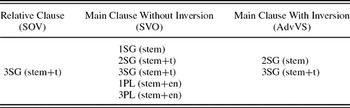
The outcomes of the experiment were organized in three separate data sets; this organization allowed addressing the first two research questions through appropriate statistical analyses. Table 1 gives an overview of the first data set, with the target forms between brackets. Data set 1 contained data on 1SG, 2SG, 3SG, 1PL, and 3PL contexts in sentences with the unmarked SVO order (see Table 1). The second data set comprised data on 2SG and 3SG contexts in SVO sentences and main clauses with subject–verb inversion and an adverb in first position (AdvVS; Table 1). The third set of data included 3SG contexts in SVO and SOV sentences (see Table 1).
Data sets

Note: SOV, subject–object–verb; SVO, subject–verb–object; AdvVS, adverb–verb–subject; 1SG, 2SG, 3SG, first, second, and third person singular; 1PL, 3PL, first and third person plural.
Data sets 1 and 2 are relevant for the first research question. To what extent does verb form (bare or inflected) impact L2 children's accuracy with subject–verb agreement? Given the MSIH, we expect higher accuracies in contexts that target bare verbs than with contexts targeting inflected verbs. Errors with inflected verbs are expected to be errors of omission. The third data set is relevant for the second research question. Does sentence position (medial vs. final) influence L2 children's accuracy with subject–verb agreement? It is expected that more errors are made in SVO than in SOV sentences. In particular, do we expect more drop of 3SG -t in SVO sentences than in SOV sentences?
Is the development of subject–verb agreement determined by inflectional properties of L2 children's home language? For investigating this third research question, we assigned the L2 children to two L1 groups based on inflectional properties of the children's home languages (which was also their L1). Children in one group had a richly inflecting L1 with both person and number agreement, whereas children in the other group had an isolating L1. If transfer impacts L2 children's development of verb inflection, as predicted by the full access full transfer hypothesis, we expect to find differences between these groups in how accurate they are with L2 subject–verb agreement.
To what extent is the development of subject–verb agreement influenced by L2 children's age and their proficiency in the L2? With respect to the fourth research question, we expect older L2 children to perform better than younger children and that more proficient L2 children make fewer errors with subject–verb agreement than less proficient L2 children. Finally, it is expected that differences between L1 groups are more prominent in lower proficiency L2 children than in higher proficiency L2 children.
METHOD
Participants
Sixty-four children were tested. Two children were excluded post hoc because of their low number of analyzable responses. The children came from families that immigrated from China, Morocco, and Turkey and now lived in three major cities in the western part of The Netherlands (Amsterdam, Rotterdam, Utrecht). Children with apparent language or speaking disorders, or who were enrolled in speech therapy were excluded from the study.
Selected children communicated with their caregivers in Mandarin, Cantonese, Moroccan-Arabic (sometimes in combination with Tarifit, a Berber language) or Turkish. Mandarin and Cantonese are tonal languages that do not inflect for person, number, or gender. Another property of both Mandarin and Cantonese that may be relevant with respect to suffixation processes is that these languages do not allow consonant clusters in word-final position. Mandarin is more restricting than Cantonese and allows only the consonants [n] and [ŋ] in the coda; [r] can be attached as a suffix. Cantonese also allows the stops [p], [t], and [k] in word-final position (Lin, Reference Lin2001; Matthews & Yip, Reference Matthews and Yip1991). Participants in a second group spoke Moroccan-Arabic (sometimes in combination with the Berber language Tarifit) or Turkish at home. Moroccan-Arabic and Tarifit differ in lexicon and morphophonology, but are rather similar with respect to subject–verb agreement. Both languages have rich agreement paradigms consisting of seven or eight different forms with distinctions between person (1, 2, 3), number (SG, PL), and between feminine and masculine in 3SG (perfective) or 2/3SG (imperfective). In both languages, word-final consonants and consonant clusters are allowed (Hoogland, Reference Hoogland1996). Turkish is an agglutinative, richly inflecting language. The Turkish present tense indicative paradigm has six different forms that distinguish between person (1, 2, 3) and number (SG, PL). Turkish also allows consonants in word-final position as well as consonant clusters (Lewis, Reference Lewis1967).
The home language was the L1 of the children, who had limited active and passive knowledge of Dutch when they began attending school at age 4. At the age of 4, the children were either unbalanced bilinguals with Dutch as their (much) weaker language or sequential bilingual children, even though nearly all children were born in The Netherlands. Information about a child's level of Dutch when (s)he started attending school was gathered during an interview with the teacher using an adapted version of the Anamnese Meertaligheid (Questionnaire on the Child's Multilingual Situation; Blumenthal & Julien, Reference Blumenthal and Julien2000). In schools, Dutch was the official language; hence, going to school led to a significant change in the children's exposure to Dutch.
L2 proficiency was based on children's performance on the sentence repetition task of the Taaltoets Alle Kinderen (Verhoeven & Vermeer, Reference Verhoeven and Vermeer2002). The Taaltoets Alle Kinderen is a standardized test procedure to assess oral proficiency in Dutch native and nonnative children. The sentence repetition test consisted of 20 sentences, each of which was scored with respect to the child's realization of one specific word order property and a function word. The targeted properties did not include subject–verb agreement. Two points were assigned if both the specific word order and the function word were repeated correctly. If only one of the two was correctly repeated, 1 point was assigned, and if neither was correctly repeated, 0 points were assigned.
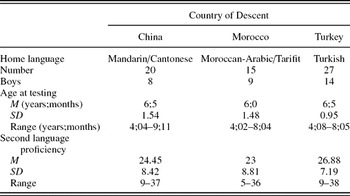
Table 2 gives an overview of properties of the participants, distinguished by their country of descent.
Participant information

Materials
Both tasks targeted the same three verbs (drinking, cleaning, drawing), which were imageable and transitive. The relevant activities were represented by high-quality full-color photos. The photos showed no distracting visual information and focused on the activity (see Appendix A for examples of items used in both the picture description and in the situation description task). All items were presented in a pseudorandomized order in order to prevent immediate occurrence of the same verb after each other. For each task, experimental items were preceded by practice items introducing each experimental condition: five items for the picture description task and three items for the situation description task. For practicing, images were used that depicted the actions of reading and cutting.
The experimental items in the picture description task were presented in a booklet mixed with items testing choice of definite determiners and use of prenominal adjectives (Blom, Polišenská, & Weerman, Reference Blom, Polišenská and Weerman2008). In the 2SG and 3SG AdvVS condition, two pictures depicting the same activity but that differed in actor were placed next to each other. In the 3SG and 3PL SVO condition and the 3SG SOV condition, the two adjacent pictures did not differ in person/number of the actor but the actor(s) manipulated a different object. The number of experimental items was 24. In the situation description task cards were used that depicted actions that were then acted out by both the participant and the experimenter. The number of experimental items was 9.Footnote 4
Procedure
In the picture description task the participant was instructed to describe a difference between two adjacent pictures by completing a sentence initiated by the experimenter. In this context Dutch uses present tense indicative forms. In the main clause conditions, the experimenter elicited a response by pronouncing the subject (referring to the actor[s] on the pictures). In the picture description task, the SVO condition had two subconditions: 3SG (De man [drinkt koffie] “The man is drinking coffee”; the target response is between square brackets) and 3PL (De meisjes [drinken sap] “The girls are drinking juice”). The SOV condition had no subconditions; the experimenter's lead-in required a relative clause with a 3SG verb as response (Dit is de man die [koffie drinkt] “This is the man who is drinking coffee”). Both in the SVO and SOV conditions the two adjacent pictures did not differ in person/number properties of the actor, but the crucial difference was between the object manipulated in the two pictures. This method forced the participants to use a direct object, which was needed to determine whether the correct word order was used, which in turn, was relevant for assessing the impact of sentence position. AdvVS conditions had two subconditions: 3SG (Daar [drinkt hij/de man] “There he/the man is drinking”) and 2SG (Hier [drink jij] “Here you are drinking”). In these conditions, the experimenter pronounced a sentence-initial adverb. Adjacent pictures differed in person/number properties associated with the actor, namely, 2SG versus 3SG. Items testing 2SG agreement depicted the experimenter.
1SG, 2SG, and 1PL contexts were tested with a situation description task, which had the form of a game. This different task was chosen to create a natural context for subject–verb agreement with discourse-related pronouns. The experimenter as well as the participant simultaneously picked up a card from two strictly ordered piles and turned it around. Each card showed an image of an ongoing action. After seeing the image, experimenter and participant performed the action with the help of attributes (e.g., a brush, a glass, a book) that lay before them on the table. The participant's task was to describe the ongoing situation. There were two situations possible, depending on whether experimenter and participant picked up similar or different cards: experimenter and participant either performed the same action or they performed different actions. In the first situation the target response contained a verb in 1PL form (We drinken koffie “We are drinking coffee”). In the second situation the target response contained a verb in 1SG (Ik drink koffie “I am drinking coffee”) and 2SG form (Jij tekent een boom “You are drawing a tree”).
Test sessions took place at the children's schools in a separate room. Each participant was tested individually. The test sessions were recorded on a minidisc, and transcribed afterward and coded for the categories described in the next section.
Coding and analyses
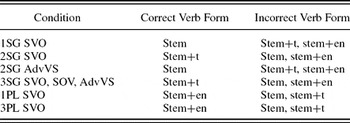
All verbs that appropriately described the pictures were accepted as scoreable responses. Responses with auxiliary verbs were excluded from the analyses because Dutch auxiliaries have irregular agreement paradigms; 14% of the responses were excluded for this reason (see, for more information on the use of auxiliary verbs in L2 Dutch children in a similar task, Blom & De Korte, Reference Blom and De Korte2011). Other excluded responses comprised unintelligible responses, responses in which the participant used a verb that did not pertain to the activity depicted by the picture, responses with incorrect word order, and responses that did not contain sufficient information on the verb's position (18%). As explained above, in the SVO and SOV conditions responses had to contain an object in order to determine a verb's position in the sentence (i.e., medial or final); therefore, in these conditions SV responses were excluded. In the AdvVS condition, responses had to contain a subject in order to determine whether the response was actually a sentence with inversion. However, as the task aimed at contrasts between objects/subjects there were few of such responses. Included responses were scored as correct or incorrect. Table 3 summarizes the coding scheme.
Coding of correct and incorrect responses

Note: 1SG, 2SG, 3SG, first, second, and third person singular; SVO, subject–verb–object; AdvVS, adverb–verb–subject; SOV, subject–object–verb; 1PL, 3PL, first and third person plural.
We analyzed the three subset files with complementary statistical procedures. All data were analyzed using a generalized linear mixed model with a logistic link function and binomial variance (Baayen, Reference Baayen2008; Jaeger, Reference Jaeger2008). Logistic regression is a modification of the linear model using the log odds ratio as dependent variable, instead of proportions. Regression on proportions has various mathematical drawbacks, which is why older textbooks recommend an arcsine transformation (see, e.g., Ferguson & Takane, Reference Ferguson and Takane1989). For a proportion equal to 0.5, the log odds is zero. Proportions greater than 0.5 correspond to positive log odd ratios, and proportions smaller than 0.5 to negative log odds. The transformation from log odds to proportions is nonlinear: a log odds of 0 corresponds to 0.50, a log odds of 2 to 0.88, and a log odds of 4 to 0.98.
Generalized linear mixed models provide a robust statistical method for analyzing experimental data with unequal numbers of observations. Robustness of the method is relevant as the data sets included a relatively large number of missing responses because of exclusion of responses. Participant was modeled as a random-effect factor (Child), and verb form (VerbForm), home language (HomeLanguage), age at testing (Age), L2 proficiency (L2Proficiency), and clause type (ClauseType) were modeled as fixed-effect factors. It is essential to model Child as a random-effect factor, as this guarantees that the model fitted to the present sample of children generalizes to the population of children from which the sample was drawn. We were unable to include item as a random-effect factor, because item-specific information was not available for all participants.
Fixed-effect factors were modeled by means of contrast between levels, where each level of a factor is contrasted to a specified reference level (treatment-coding). The levels of VerbForm (the reference level shown in bold) were stem, stem+t, stem+en. The levels of HomeLanguage were inflecting, isolating. In the first subset of data we analyzed, ClauseType was constant (main clauses without inversion). Therefore, in analyses pertaining to this subset, “ClauseType” was not included as a fixed-effect factor. The second subset included two clause types: main clauses with and without inversion. In this analysis ClauseType had the following two levels: inversion, no-inversion. In the third subset main clauses without inversion and relative clauses were contrasted. In analyses pertaining to this subset, the levels of ClauseType were: main, relative.
Age and L2 proficiency were highly correlated (r = .70). In order to decorrelate the two predictors, we predicted age by L2 proficiency, and created a new predictor (AgeResid), using the residuals of this model. This enabled us to determine whether any variation was explained by age that was not explained by L2 proficiency. The correlation between age and the decorrelated age predictor was large (r = .72), indicating that the decorrelated age predictor still reflects age, albeit age to the extent that it cannot be predicted from proficiency.
We made use of a backward elimination procedure in which predictors that did not reach significance were removed. In order to compare models, likelihood ratio tests were performed that compared the goodness of fit, while taking the costs of extra parameters into account. In this way, models were obtained that were both as simple as possible and as precise as possible.
In order to further explore the data, we applied binary recursive partitioning, buiding single classification trees and and forests (sets) of classification trees for the three data sets. Binary recursive partitioning is a nonparametric nonlinear procedure that splits the data into subsets on the basis of available predictors (Hothorn, Hornik, & Zeileis, Reference Hothorn, Hornik and Zeileis2006). The algorithm begins with the root node, which represents the full data set. At each node, it inspects the data for the most useful predictor, that is, the predictor that is best able to classify most observations in the subset, and splits accordingly.
One of the main differences between classification trees and linear regression models is that the former provide more flexibility for modeling interactions (Strobl, Malley, & Tutz, Reference Strobl, Mallay and Tutz2009). Binary recursive partitioning creates one single optimized tree; such a single tree has the advantage that it provides straightforward insight into how predictors work together to explain the dependent variable. However, trees are optimized locally. Consequently, they may miss the importance of other predictors, and hence yield suboptimal predictions. Therefore, ensembles of trees are grown for random subsets of data and random subsets of predictors (Strobl, Boulesteix, Kneib, Augustin, & Zeileis, Reference Strobl, Boulesteix, Kneib, Augustin and Zeileis2008). An ensemble of trees produces more reliable estimates of the importance of the different predictors in a given data set. Therefore, we created single trees to explore the main trends and an ensemble of trees, a random forest, was used to evaluate the importance of the different predictors in a given data set. A comprehensive overview of classification procedures can be found in Strobl et al. (Reference Strobl, Mallay and Tutz2009). For an application of random forests to sociolinguistic data, the reader is referred to Tagliamonte and Baayen (Reference Tagliamonte and Baayen2010).
Finally, in order to evaluate the goodness of fit of the mixed linear regression models, single classification trees, and ensembles of trees, we compared the predicted observations given a model/tree/ensemble of trees to the actual observations, using the index of concordance C (Chatterjee & Hadi, Reference Chatterjee and Hadi2006). As a rule of thumb: a C value above 0.80 indicates good classification performance.Footnote 5
RESULTS
The impact of verb form, home language, and L2 proficiency
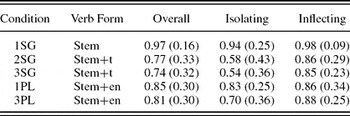
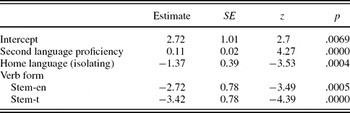
We started with analyzing the first data set. This data set included all verb forms in the Dutch agreement paradigm and did not vary in word order; all responses were SVO. Results from participants for whom no L2 proficiency score was available and who gave responses that did not fall in the categories correct or incorrect were eliminated (N = 4). The total number of remaining participants was 58. The number of observations comprised 685 correct responses and 158 incorrect responses. The proportions of correct responses across different conditions are in Table 4. Of the incorrect responses in 2SG, 3SG, 1PL, and 3PL contexts, the proportion of omission errors was 0.9; the proportions of stem+t and stem+en substitutions were 0.08 and 0.02, respectively. The initial, full model included verb form, L2 proficiency, home language, and age as predictors. Table 5 lists the estimated coefficients, their standard errors, Z values and associated p values for the predictors that emerged as significant in the final model.
Mean (SD) proportions correct in first data set

Note: 1SG, 2SG, 3SG, first, second, and third person singular; 1PL, 3PL, first and third person plural.
Model 1 estimates, standard errors, z values, and associated p values

Note: The values reflect the accuracy of subject–verb agreement in first, second, and third person singular and first and third person plural contexts in main clauses without inversion (subject–verb–object).
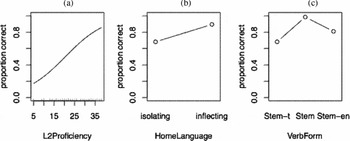
Figure 1a–c visualize the partial effects of these predictors, backtransformed from the logits to proportions. A partial effect is the effect of a factor while all other factors are calibrated for the reference level and covariates for the median. For L2 proficiency the median was 25. In order to illustrate the effects in an optimal manner, the reference level for verb form was set to “stem-t” and for home language to “isolating” in Figure 1a–c.
Partial effects Model 1 (mixed logistic regression) for the (a) second language (L2) proficiency, (b) home language, and (c) verb form; accuracy of subject–verb agreement in first, second, and third person singular and first and third plural contexts in main clauses without inversion (subject–verb–object).

Figure 1a illustrates that greater proficiency offered a substantial increase in accuracy. Figure 1b shows that children with an isolating home language were less accurate than children with an inflecting home language. Figure 1c illustrates that performance with stem+t was least accurate and that performance with the bare stem was most accurate. The estimates in Table 5 and in Figure 1c suggest a difference between stem+en and stem+t. In order to determine whether or not this difference was significant, the reference level of the predictor VerbForm was set to “stem-t” instead of “stem”; this revealed indeed a significant difference (p = .0014). Both contrasts survive a Bonferroni correction for multiple comparisons.
Recall that the children's proficiency highly correlated with the children's ages. As expected, running Model 1 with age as a predictor (instead of L2 proficiency), we found that a higher age predicted more correct responses (p < .0001). However, entering the decorrelated age predictor in Model 1 revealed no significant effect for age (p = .1405), whereas the beneficial effect of L2 proficiency remained unaltered (p < .0001); this indicates that age did not explain variation that remained unexplained by L2 proficiency.
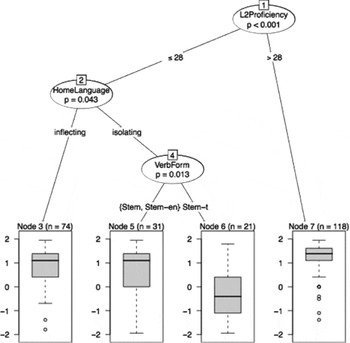
We explored potential interactions with the help of binary recursive partitioning, predicting the empirical log odds ratios based on correct and incorrect responses. The results are illustrated in Figure 2, which is based on one single conditional inference tree. The boxplots indicate the distributions of the log odds; the bottom and the top of the box are the lower and upper quartiles, and the middle of the box is the median. The ends of the whiskers represent the lowest datum within the 1.5 interquartile range of the lower quartile, and the highest datum within the 1.5 interquartile range of the upper quartile. Any data not included are outliers, and plotted as dots.
The conditional inference tree, predicting the empirical log-odds ratios; accuracy of subject–verb agreement in first, second, and third person singular and first and third person plural contexts in main clauses without inversion (subject–verb–object). L2, second language.

Figure 2 reveals interactions between L2 proficiency, home language, and verb form. Starting at the top of the tree, which represents all data in the first subset, we see that a first split was made based on L2 proficiency: children with a proficiency score of 28 or lower performed less accurately than children with a score above 28. The lower L2 proficiency data allowed for a second split indicating that children from isolating languages performed worse than children from richly inflecting languages. Within the data of the children with an isolating home language, a third split was made: children with an isolating home language performed worse with stem+t than with the bare stem or stem+en. If L2 proficiency was above 28, home language and verb form were not significant factors, which was probably because of performance being at ceiling. The boxplots at the bottom of the tree represent the resulting distributions of the log odds.
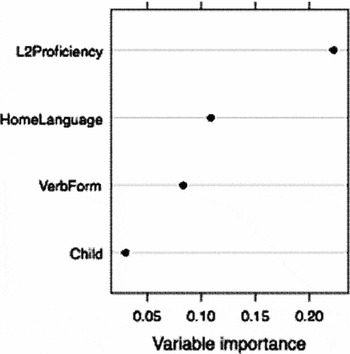
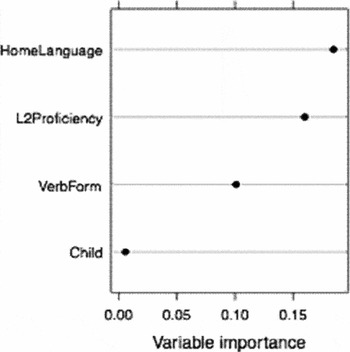
Figure 3, based on a random forest analysis, provided further information on the importance of the different factors. Importance is evaluated by comparing classification accuracy for models with and without a given predictor. The greater the drop in accuracy when a predictor is not made available to the model, the more important that predictor is. The factors, or variables, are sorted: the higher its value on the x axis, the more important a factor was in explaining variation in this data set. L2 proficiency was the most important factor, followed by home language and verb form. Child was the least important predictor variable.
The variable importance plot of predictors (random forest); accuracy of subject–verb agreement in first, second, and third person singular and first and third person plural contexts in main clauses without inversion (subject–verb–object). L2, second language.

Both the parametric logistic regression analysis and the nonparametric random forest procedure accurately predicted the observed values with C scores above 0.80 (in both cases C = 0.90). Binary recursive partitioning was less accurate (C = 0.78) than the random forest procedure; this is to be expected because classification in the former case was based on only one tree, whereas in the latter case many trees were grown and a voting scheme was used.
All analyses revealed that a greater L2 proficiency increased the children's accuracy with subject–verb agreement in 1SG, 2SG, 3SG, 1PL, and 3PL contexts in SVO sentences. Children with an inflecting home language outperformed children with isolating home languages. The effect of home language was restricted to lower L2 proficiency children. The children performed most accurately with the bare verb stem in 1SG contexts and least accurately with stem+t in 2SG and 3SG contexts. Errors were nearly all errors of omission; very few substitution errors were made. The low accuracy with stem+t was because of the lower L2 proficiency children with isolating home languages.
The role of subject–verb inversion
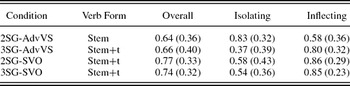
The second data set included subject–verb agreement in 2SG and 3SG contexts in main clauses with (AdvVS) and without inversion (SVO). In 2SG contexts in AdvVS sentences the target form is the bare verb stem; 2SG contexts in SVO sentences target stem+t. After eliminating all datapoints for participants without correct or incorrect responses and/or proficiency scores, data of 57 participants were analyzed, comprising 413 correct responses and 161 incorrect responses. The results of the analyses of SVO sentences revealed that the children made hardly any errors with bare verbs stems in 1SG contexts. The results in Table 6 indicate that the children performed less accurately with bare stems in 2SG contexts in AdvVS sentences:
Mean (SD) proportion correct in second data set

Note: 2SG, 3SG, second and third person singular; AdvVS, adverb–verb–subject; SVO, subject–verb–object.
The data in Table 6 suggest a difference between SVO and AdvVS sentences. In addition, the children with an isolating home language had lower accuracies than children with inflecting home languages, except for the condition in which the bare verb stem is correct, that is, 2SG contexts in AdvVS sentences. In these sentences, the two groups had an opposite profile: whereas the children with an isolating home language performed relatively accurately in 2SG contexts and clearly worse in 3SG contexts, the children with a richly inflecting home language performed more accurately in 3SG contexts than in 2SG contexts. In the 2SG AdvVS condition, the proportion of stem+t was 0.33 (SD = 0.35): nearly all errors in this condition were thus substitutions. In the 3SG AdvVS condition, the proportion of bare verbs was 0.31 (SD = 0.40); here almost all errors were omissions of inflection.
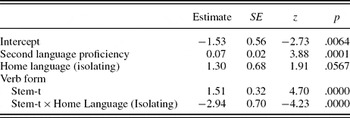
Table 7 summarizes the logistic regression model fitted to the data (Model 1). The initial model contained the predictors clause type, verb form, L2 proficiency, home language, and age with home language and verb form entering into a significant interaction.Footnote 6
Model 1 estimates, standard errors, z values, and associated p values

Note: The values reflect the accuracy with subject–verb agreement in second and third person singular contexts in main clauses with inversion (adverb–verb–subject) and without inversion (subject–verb–object).
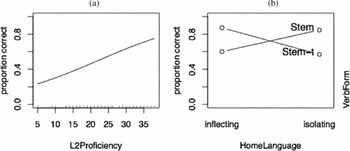
Table 7 reveals that children with higher proficiencies performed more accurately; this is visualized in Figure 4a. Figure 4b sheds light on the interaction effect in Table 7: stem+t elicited more correct responses than the bare stem for children with inflecting home languages, whereas the reverse held for children with an isolating home language.
Partial effects Model 1 (mixed logistic regression) for the (a) second language (L2) proficiency and (b) the interaction between home language and verb form; accuracy with subject–verb agreement in second and third person singular contexts in main clauses with inversion (adverb–verb–subject) and without inversion (subject–verb–object).

We also considered a model that included clause type as a predictor, but this model (Model 2) did not provide a better fit for the data than Model 1: χ2 (1) = 2.6591, p = .1030 (likelihood ratio tests comparing models fitted using maximum likelihood estimation). We were unable to probe for an interaction of clause type and verb form because of empty cells. A model that included age instead of L2 proficiency indicated that a higher age predicted more correct responses (p = .0107), but Model 3, which included age as a decorrelated predictor (p = .9469) as well as L2 proficiency (p = .0001), revealed that chronological age did not explain any variation that was left unexplained by L2 proficiency.
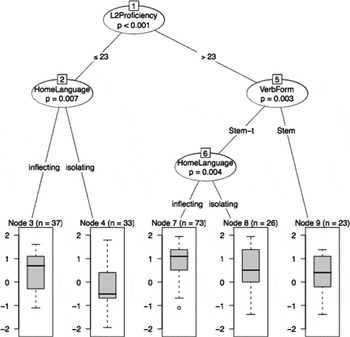
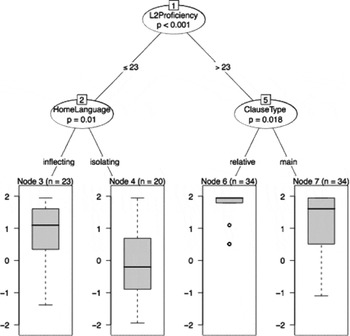
Binary recursive partitioning (Figure 5) indicates that home language was the primary predictor for children with an L2 proficiency score equal to or lower than 23. In this lower L2 proficiency group, children with an isolating home language performed worse than children with an inflecting home language. For children with higher L2 proficiencies (above 23) verb form was the primary predictor: performance was better with stem+t than with the bare stem form. Performance with stem+t led to another split based on home language. Children with a higher L2 proficiency who spoke an isolating home language performed worse with stem+t than children in the same L2 proficiency group who spoke an inflecting language at home. The boxplots at the bottom illustrate the distribution of the log odds.
The conditional inference tree, predicting the empirical log-odds ratios; accuracy with subject–verb agreement in second and third person singular contexts in main clauses with inversion (adverb–verb–subject) and without inversion (subject–verb–object). L2, second language.

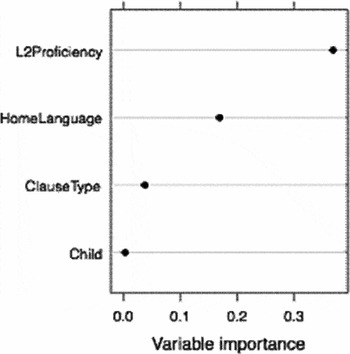
Figure 6 illustrates the importance of the factors according to a random forest analysis. Home language emerged as the most important predictor followed by L2 proficiency, verb form, and, at a distance, the effect of individual children. These results are in line with the logistic regression model. Logistic regression (C = 0.86) and random forest classification (C = 0.85) predicted the observed values accurately; the best single binary recursive partitioning tree was less accurate (C = 0.76), as expected.
The variable importance plot of predictors (random forest); accuracy with subject–verb agreement in second and third person singular contexts in main clauses with inversion (adverb–verb–subject) and without inversion (subject–verb–object). L2, second language.

Analyses of performance with subject–verb agreement in 2SG and 3SG contexts in SVO and AdvVS sentences indicated that children with higher L2 proficiency made fewer errors than lower L2 proficiency children. Children with isolating home languages had lower accuracies than children with inflecting home languages, in particular, in lower L2 proficiency groups. Effects of verb form were clearer in higher L2 proficiency children. Children with inflecting home languages used stem+t forms instead of the bare verb stem in 2SG contexts. Children with isolating home languages tended to drop the suffix -t in obligatory contexts.
Sentence position
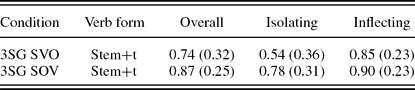
The last data set comprised data on children's accuracy with 3SG contexts in SVO and SOV sentences. In this data set, there were 448 correct responses and 106 incorrect responses (N participants = 57). Of the incorrect responses, the proportions of omissions and substitutions were 0.94 and 0.06, respectively. In both word order conditions, the same verb form was targeted (stem+t), and the only difference was clause type, which involved differences in the position of the verb in the sentence (final vs. medial position). Table 8 lists the accuracies across conditions.
Mean (SD) proportion correct in third data set
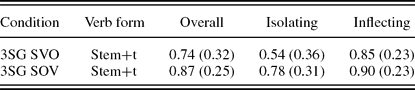
Note: 3SG, third person singular; SVO, subject–verb–object; SOV, subject–object–verb.
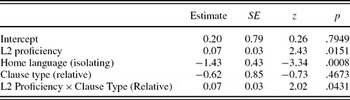
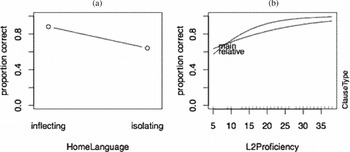
As before, we started with the full model that included, apart from clause type, L2 proficiency, home language, and age as predictors. Table 9 presents the coefficients of the best fitting logistic model, regressing the correctness of 3SG. The model estimates in Table 9 indicate that children with an inflecting home language performed better than children with an isolating home language. Children with higher L2 proficiencies performed better with subject–verb agreement in relative clauses than in main clauses, whereas the reverse held for lower proficiency children (p = .0431). Figure 7a–b visualize the partial effects of the model. The model with age instead of L2 proficiency did not reveal a significant main effect for age (p = .0536) or an interaction between age and clause type (p = .0921).
Model 1 estimates, standard errors, z values, and associated p values

Note: The values reflect the accuracy with subject–verb agreement in third person singular contexts in main clauses without inversion (subject–verb–object) and relative clauses (subject–object–verb). L2, second language.
Partial effects Model 1 (mixed logistic regression) for (a) home language and (b) the second language (L2) proficiency and clause type; the accuracy with subject–verb agreement in third person singular contexts in main clauses without inversion (subject–verb–object) and relative clauses (subject–object–verb).

Figure 8 shows the outcome of the binary recursive partitioning procedure by indicating the distribution of the log odds. This method confirms that more proficient children performed significantly better with 3SG agreement in SOV than in SVO sentences. An interaction of L2 proficiency and home language emerged as well: for those participants with L2 proficiency scores of 23 or below, participants who speak an inflecting home language outperformed participants with an isolating home language.
The conditional inference tree, predicting the empirical log-odds ratios; accuracy with subject–verb agreement in third person singular contexts in main clauses without inversion (subject–verb–object) and relative clauses (subject–object–verb). L2, second language.

Figure 9 illustrates the relative importance of the variables. L2 proficiency emerged as the most important predictor, followed by home language, clause type, and the effect of individual children. All three procedures predicted the observed values accurately: for logistic regression a C of 0.96 was obtained, whereas for binary recursive partitioning C = 0.84 and for random forest C = 0.90.
The variable importance plot of predictors (random forest); accuracy with subject–verb agreement in third person singular contexts in main clauses without inversion (subject–verb–object) and relative clauses (subject–object–verb). L2, second language.

More proficient children made fewer errors with stem+t in 3SG contexts than less proficient children. Children with isolating home languages performed worse than children with inflecting home languages, especially if they had lower L2 proficiency. Higher L2 proficiency children more often omitted inflection in SVO sentences than in SOV sentences.
DISCUSSION
We presented the results of a study in which we tested L2 Dutch children's accuracy with subject–verb agreement. Participants were assigned to two groups: one with children who spoke at home an isolating language (Mandarin, Cantonese), the other with children whose home language had rich inflection (Moroccan-Arabic/Tarifit, Turkish). The first data set included all three verb forms of the Dutch present tense paradigm (stem, stem+t, stem+en) and was restricted to main clauses without inversion (SVO). Accuracy with subject–verb agreement in 1SG, 2SG, 3SG, 1PL, and 3PL contexts was tested. The second data set compared 2SG and 3SG contexts across main clauses without inversion (SVO) and main clauses with inversion (AdvVS). The third data set dealt with 3SG subject–verb agreement in main clauses without inversion (SVO) and relative clauses (SOV). All analyses consistently showed that children who were more proficient in the L2 performed better with subject–verb agreement than less proficient children. It was not surprising that the L2 proficiency scores were highly correlated with the children's ages at time of testing, but in this data set L2 proficiency was the more important predictor. We also observed that home language, verb form, and sentence position impacted the children's performance.
Verb form
Our first research question was: to what extent does verb form (bare or inflected) impact L2 children's accuracy with subject–verb agreement? The effects of verb form are relevant for assessing the MISH. According to this hypothesis, the errors with subject–verb agreement made by L2 children reflect application of a default rule, which results in the incorrect use of bare verbs (Haznedar, Reference Haznedar2001; Haznedar & Schwartz, Reference Haznedar, Schwartz, Hughes, Hughes and Greenhill1997; Ionin & Wexler, Reference Ionin and Wexler2002; Prévost, Reference Prévost2003). The MSIH thus predicts that children learning L2 Dutch will make errors in conditions that target stem+t or stem+en, but not in the conditions that target bare verbs, and that these errors comprise omissions of inflection.
This prediction is largely confirmed by the analyses of the first data set. Analyses of data set 1 indicated that children in both L1 groups made hardly any errors in 1SG contexts, where the bare verb is correct. Significantly more errors were made in those contexts that involved inflected verb forms. In these contexts (2SG, 3SG, 1PL, 3PL) omission errors predominated, and very few substitution errors occurred. The outcomes of the second data set indicate that in more exceptional contexts where the bare verb is grammatical, such as 2SG contexts in sentences with inversion, performance with the bare stem was relatively poor, and substitutions were frequent. This observation seems more difficult to reconcile with the MSIH.
At this point, some more background information on Dutch morphology becomes relevant. Given the premises of the MSIH, the following question arises: why is the bare stem allowed, even obligatory, in 2SG contexts in Dutch sentences with inversion? The MSIH adopts the premises of Distributed Morphology, a morphological theory in which obedience to a blocking principle leads to use of the most specific paradigmatic form given contextual restrictions (in this case, restricting properties of the subject). Thus, in 2SG contexts, a morphological form associated with 2SG features is used (stem+t). According to distributed morphology, the unexpected, but systematic, occurrence of the default form can happen because of language-specific, context-sensitive rules that “impoverish” contextual information (Bonet, Reference Bonet1991; Halle, Reference Halle1997). Without going into any detail, such a rule removes one feature in the presence of another, creating a licit context for the default rule. In order to account for bare stem forms in 2SG inversion contexts, it has been argued that Dutch has an impoverishment rule that removes person features in 2SG contexts if verb and 2SG subject are in the same prosodic phrase, which happens in inversion sentences (Ackema & Neeleman, Reference Ackema and Neeleman2004). If this rule applies, the stem+t form is too specific and for that reason ruled out.
The substitution errors in 2SG contexts could be made by L2 children who did not know the impoverishment rule, and as a result, used the specific form (stem+t) instead of the default form (stem). Three participants consistently produced incorrect stem+t in 2SG inversion contexts; these children may have been unaware of the impoverishment rule. Seventeen participants showed variable behavior in 2SG contexts in sentences with inversion, sometimes using the bare stem and on other occassions using stem+t. It is possible that these children did not know the impoverishment rule but dropped inflection because of performance factors, similar to 2SG contexts in main clauses without inversion. However, within the subset of 17 participants with variable behavior (correct) bare verbs in 2SG sentences with inversion (50%) were more frequent than (incorrect) bare verbs in 2SG sentences without inversion (20%). This difference suggests that variability in 2SG inversion sentences is caused by different factors than variability in 2SG sentences without inversion. Thus, also at closer inspection, it is not immediately clear how the error pattern in 2SG contexts in sentences with inversion could be explained under the MSIH.
One observation that may provide more insight into the children's error patterns is that L1 isolating children tend to drop inflection more frequently in 3SG contexts in sentences with inversion than in 3SG contexts in sentences without inversion (Table 6). This suggests that being exposed to bare verbs in both 1SG and 2SG contexts in inversion sentences in the input spreads to 3SG contexts in the speech of L1 isolating children. This effect is reminiscent of L2 English children with isolating L1s who drop 3SG -s more frequently with verbs that appear often in bare form in the input (Blom et al., in press).
The more general observation underlying both observations would be that L1 isolating children are more sensitive to bare verb forms in the input than L1 inflecting children, suggesting the emergence of a learning bias from prior learning (Ellis, Reference Ellis2006). Prior to learning the L2, children with an isolating L1 have learned a language with only bare verbs. The resulting attention to bare verbs in the L2 may explain two patterns in the data. First, for L1 isolating children hearing the bare verb form in certain contexts (e.g., 1SG and 2SG inversion) may result in overuse of the bare verb in overlapping contexts (e.g., 3SG inversion). Second, it could lead to a relatively strong association between 2SG subjects and the bare verb in inversion contexts for this group of children, and hence, to relatively high accuracies in this rather exceptional context.
Following up on this intuition, we briefly explore the hypothesis that substitution errors in 2SG inversion sentences are influenced by the frequency of co-occurrence of subject form and verb form. Evidence for such input effects has been reported for subject–verb agreement in L1 English children (Joseph, Serratrice, & Conti-Ramsden, Reference Joseph, Serratrice and Conti-Ramsden2002; Wilson, Reference Wilson2003). Suppose that L2 children, like L1 children, are sensitive to the overlap between different structures in the input (Tomasello, Reference Tomasello2003), and that L2 children make use of distributional contingencies—the likelihood of x given y—in the input, similar to what has been proposed for the L1 acquisition of grammatical dependencies between words (Newport & Aslin, Reference Newport and Aslin2004; Santelmann & Jusczyk, Reference Santelmann and Jusczyk1998).
The expectation would be that in the Dutch input the contingency between stem+t and 2SG subjects will be stronger than the contingency between bare verbs and 2SG subjects, because in spoken Dutch, main clauses without inversion outnumber main clauses with inversion at a ratio of 2.3:1 (based on analyses performed on the Corpus Spoken Dutch reported in Van der Wouden, Schuurman, Schouppe, & Hoekstra, Reference Van der Wouden, Schuurman, Schouppe, Hoekstra and Gaustad2003). In addition, the association between 1SG subjects and bare verbs will be stronger than the association between 2SG subjects and bare verbs, because 1SG subjects always appear with bare verbs, whereas 2SG subjects will also often co-occur with stem+t forms in overlapping constructions (e.g., with the same verb).
At first sight, this hypothesis makes the correct predictions that more errors occur in 2SG contexts in inversion sentences than in 2SG contexts in sentences without inversion and that L2 children perform better with bare verbs in 1SG contexts than in 2SG contexts in inversion sentences. However, more research is needed to evaluate the role of frequency distributions and its interplay with L1 properties. Such a study should be based on frequency counts of the different verb forms across contexts in a corpus that is representative of the children's input.
Sentence position
The role of sentence position pertains to our second research question. Does sentence position (medial vs. final) influence L2 children's accuracy with subject–verb agreement? We found support for an effect of sentence position: omission rates of 3SG -t were higher in medial position (SVO) than in sentence final position (SOV) for children with greater L2 proficiency. Song et al. (Reference Song, Sundara and Demuth2009) found similar effects of position for 3SG -s in L1 English. They suggested that medial position created fewer opportunities to produce the agreement morpheme and posed articulatory challenges for the child. They also argued that lengthening of 3SG -s in final position increased input salience of this suffix.
In our study, lengthening did not play a role because the target form ended with a stop. However, differences in time to (prepare to) produce [t] in medial and in final position could have led to relatively more drop in medial position. This effect may have become more pronounced through phonological complexity and articulatory challenges that resulted from -t suffixation. None of the verbs in our study ended on a vowel, reflecting the general avoidance in Dutch of vowel-final verbs (Trommelen, Reference Trommelen1989). Therefore, suffixation of -t created complex coda clusters. Such clusters are more prone to drop than singleton codas, particularly under time restrictions (Song et al., Reference Song, Sundara and Demuth2009). In addition to coda complexity, difficulties with articulatory planning may have contributed to drop of -t when words followed the verb, as was the case with verbs in medial position.
Properties of relative clauses other than word order may have had some influence as well. In the SOV condition, the children's task was to complete a sentence that started with, for instance, Dit is de man die . . . (“This is the man who . . .”). Such a structure, in which the relative clause narrows down the possible interpretations of the sentence subject, is typically used with third person subjects. Relative clauses may thus create a facilitating context for third person verb forms. Moreover, there may have been a phonological effect: the final [t] in the demonstrative subjects dit and dat could have triggered use of stem+t. Evidence for such phonological priming effects has been reported for English irregular past tense (Stemberger, Reference Stemberger2004).
Home language, L2 proficiency, and age
The last two research questions of our study address individual differences. Is the development of subject–verb agreement determined by inflectional properties of L2 children's home language? To what extent is the development of subject–verb agreement influenced by L2 children's age and their proficiency in the L2? A clear effect of L2 children's home language was found, as well as an interaction of home language and L2 proficiency. Children with a richly inflecting home language (Moroccan-Arabic/Tarifit or Turkish) consistently outperformed children with an isolating home language (Cantonese or Mandarin). Binary recursive partitioning revealed that home language impacted children with lower L2 proficiency. This outcome is straightforward: the more advanced the children are in the L2, the less influence their home language will have.
The impact of home language in our study is in line with recent studies on the acquisition of verb inflection in child L2 English (Blom et al., in press; Paradis, Reference Paradis2011). These effects suggest that L2 children transfer properties related to inflection from their L1 to their L2, in line with the full access full transfer hypothesis proposed for L2 adults (Schwartz & Sprouse, Reference Schwartz and Sprouse1996; White, Reference White2003). The full access full transfer hypothesis is phrased in structural terms (e.g., parameter settings), but the effect of home language may also be related to perception or attention. For instance, children who are familiar with a pro-drop language in which verbal inflection provides cues for identifying the sentence subject (such as Turkish, Moroccan-Arabic/Tarifit but not Mandarin and Cantonese) will be attentive to verbal inflection in the L1 and they may transfer this habit to their L2. Or, as pointed out above, L2 children may be more sensitive to the distribution of a particular form, dependent on inflectional properties of the L1.
L2 Dutch children with isolating languages experienced particular difficulties with stem+t. As explained earlier, suffixation of -t resulted in complex coda clusters. Given that both Cantonese and Mandarin do not allow word-final consonant clusters—Mandarin does not even permit word-final [t]—the children's difficulties with stem+t could reflect effects of transfer of L1 phonotactic restrictions in the earlier stages of development. In this respect, it is relevant to note that children with an isolating home language performed worse with stem+t than with stem+en, which is a syllabic morpheme. Unlike suffixation of -t, suffixation of -en will not result in a word-final consonant cluster. Support for this analysis comes from studies that report effects of phonological transfer in bilingual children (Flege, Munro, & MacKay, Reference Flege, Munro and MacKay1995; Fabiano-Smith & Barlow, Reference Fabiano-Smith and Barlow2010; Fabiano-Smith & Goldstein, Reference Fabiano-Smith and Goldstein2005), and in particular, from studies that show that bilingual children's production of consonant clusters in onset position is affected by transfer (Yavaş & Barlow, Reference Yavaş and Barlow2006).Footnote 7
Two previous studies that addressed effects of transfer on subject–verb agreement in child L2 production investigated the production of -s and -ed in child L2 English, but did not find any L1 differences (Paradis, Reference Paradis2005; Paradis et al., Reference Paradis, Rice, Crago and Marquis2008). Possibly, effects of transfer are highest at an intermediate stage of proficiency, when the developmental readiness for transfer is present, but the learners are not so proficient yet that their performance would be at ceiling and not reveal any influence of the L1 anymore (Wode, Reference Wode and Wode1983; Zobl, Reference Zobl1980). The lower proficiency L2 Dutch children in our study may have been in this stage, in contrast to the L2 English children in Paradis’ study. In the latter study the children's length of exposure to the L2 was relatively short (mean exposure = 9.5 months, range of exposure = 2–18 months), which may support this idea. In addition, collapsing -s and -ed may have decreased the impact of L1. Children who have an isolating L1 might be more aware of past tense marking than of 3SG -s in English, given that past tense conveys semantic information whereas 3SG -s in English is an agreement marker.
L2 proficiency was a more important factor than age, and age did not explain variation that was unexplained by L2 proficiency. The older children attended school longer than younger children. Hence, they were not only cognitively more mature than younger children, but they were also more experienced users of the L2. L2 proficiency may index both L2 experience and cognitive maturity, but the greater importance of L2 proficiency (in comparison to age) points to other factors as well. Most likely, L2 proficiency also contains information about language aptitude. Language aptitude is a reliable predictor of success in adult L2 development (Dörnyei & Skehan, Reference Dörnyei, Skehan, Doughty and Long2003), and the same may hold for child L2 development. Language aptitute will influence both the children's L1 and L2 development, and hence, it would be expected that L1 proficiency predicts L2 proficiency (Castilla, Restrepo, & Perez-Leroux, Reference Castilla, Restrepo and Perez-Leroux2009). In the present study, no information about L2 children's L1 skills was collected. It could be insightful, however, to relate effects of transfer not only to measures of L2 development (e.g., length of exposure to the L2, L2 proficiency), but also to L1 development and language dominance profiles. Such a method could shed further light on the different factors that condition effects of transfer in child L2 acquisition.
Applied issues
The omission of 3SG -s is a prototypical error made by English-learning children with a specific language impairment (SLI; cf. Bedore & Leonard, Reference Bedore and Leonard1998; Rice & Wexler, Reference Rice and Wexler1996). Dutch children with SLI who have the same age as the children in our study overuse bare verbs stems as well, and continue doing so at later ages (De Jong, Reference De Jong1999; Steenge, Reference Steenge2006; Verhoeven, Steenge, & Van Balkom, Reference Verhoeven, Steenge and Van Balkom2011). Steenge (Reference Steenge2006, p. 54) even claims that incorrect bare verbs are a clinical marker for SLI in Dutch, regardless of whether Dutch is a child's L1 or L2. However, the data presented here show that nonimpaired Dutch L2 children make errors in contexts that require overt inflection, in particular, if their L1 is isolating. This was particularly clear in 2SG and 3SG contexts in main clauses without inversion, and in 3SG contexts in sentences with inversion. Therefore, if agreement errors are used as a clinical marker, L1 background is a factor that definitely should be taken into account. In this respect, we echo the conclusion of Jia and Fuse (Reference Jia and Fuse2007, p. 1297): the results call for caution when interpreting and using morphological errors as indications of speech, language, or learning disorders in the immigrant children population merely on the basis of similarities between the error profiles of nonimpaired L2 children and children diagnosed with SLI.
CONCLUSION
The aim of this study was to investigate factors modulating Dutch L2 children's use of subject–verb agreement. Analyses of results of controlled elicitation experiments revealed effects of verb form, sentence position, home language, and L2 proficiency. Most errors were omissions of agreement inflection, in line with the MSIH. However, in more exceptional contexts, substitution errors were made as well, which was more difficult to reconcile with this hypothesis. Inflection drop was more frequent in medial than in final sentence position, which was interpreted as evidence for the impact of time restrictions in combination with phonological complexity and articulatory planning on L2 children's expression of subject–verb agreement. Effects of transfer emerged in children with lower L2 proficiency: children with richly inflecting home languages were more accurate than children with isolating home languages. Transfer of phonotactic constraints on coda complexity could explain specific between-group differences. Finally, L2 proficiency was highly correlated with age, but age did not predict variation that was unexplained by L2 proficiency.
APPENDIX A
Examples of picture description task and activity description task


ACKNOWLEDGMENTS
This research was supported by a Marie Curie International Fellowship within the 7th European Community Framework Programme (IOF-219276 to E.B.) and by the Dutch Netherlands Organisation for Scientific Research (NWO 360-70-110 to Hans Bennis and Fred Weerman). We are grateful to Leonie IJzereef and Jitka Horáková for collecting data, transcribing, and coding. Antje Orgassa and Daniela Polišenská helped design the experiment and develop the materials.