Entrepreneurs in the Middle Ages invested the profits of commerce in infrastructure, health care, and education for the wider community. Such support boosted economic performance by strengthening the knowledge economy, improving access to markets, and aiding worker productivity. The philanthropy of entrepreneurs complemented the activities of religious institutions and subscription guilds, which have been the focus of much existing research. Entrepreneurs, the evidence shows, engaged in philanthropy to a greater extent than other professions and exhibited distinctive patterns of giving.
England in the Middle Ages experienced a commercial revolution often seen as a precursor to the Industrial Revolution. Urbanization intensified through an expansion in the number of towns and in the size of existing towns; new urban institutions emerged to regulate trade while the quantity and quality of manufactured products increased. A service sector of scribal and legal services supported merchants in their interactions with one another and with local and central government, and also provided careers for lawyers and administrators. In the countryside, landlords experimented with new cultivation techniques, exploited the natural mineral resources of their landed estates, and grazed sheep for the wool trade. England's wool production and strong currency, together with long-distance distribution networks, encouraged overseas trade with the Continent.
Entrepreneurial individuals seized the business opportunities that resulted from commercialization. Opportunities were particularly prevalent in towns, where settlement was encouraged through the provision of infrastructure, institutions, and markets, and the ability to buy and sell property. Urban merchants operated owner-managed businesses or partnerships with family, friends, and trusted business contacts. In rural areas property ownership was concentrated on a knightly class of rural manorial lords, controlling local peasants who possessed varying degrees of autonomy.
While entrepreneurs are increasingly recognized as important participants in the medieval economy, their philanthropic activities in the Middle Ages have received little attention compared with those of the gentry and nobility.Footnote 1 Business history scholarship on philanthropy, meanwhile, has focused on the nineteenth and twentieth centuries rather than the medieval period. This article redresses these imbalances. For the purposes of this article the term “entrepreneur” is defined as an individual whose main source of income is profit and who has demonstrated initiative and good judgment in business dealings. The analysis focuses on successful entrepreneurs who became wealthy through their own initiative or by building on the achievements of others. It includes both the founders of firms and second-generation entrepreneurs who grew existing businesses by taking advantage of opportunities they discovered for themselves. The analysis therefore allows for the fact that some of the entrepreneurs’ wealth may have been inherited rather than earned. We focus on entrepreneurs who died between 1300 and 1500.Footnote 2
The article examines philanthropy effected through the foundation, endowment, or support of charitable institutions that benefited the public as a whole rather than just family and friends. Gifts could be in money or in kind, or a mixture of the two (for example, a building together with a financial endowment to support its running expenses). The focus is on the causes supported by philanthropists.Footnote 3
Philanthropy by entrepreneurs has been considered from a range of disciplinary perspectives and across a number of chronological periods. There are many approaches to philanthropy, including organizational ones, but given the limited development of business organizations in the Middle Ages, an individual approach is used in this study.Footnote 4
History scholarship debates whether attitudes to philanthropy were altered by the English Reformation (ca. 1530–1547). W. K. Jordan, using evidence from English wills of 1480 through 1660, suggested that the Reformation transformed the social attitudes of philanthropists from spiritual (support for religion) to secular (support for the poor).Footnote 5 Clive Burgess, drawing on wills from fifteenth-century Bristol, suggested that the Reformation's removal of “belief in and provision for” purgatory reduced the level of philanthropic support by members of the laity for their local parish.Footnote 6 The connection between philanthropy and religion was undoubtedly a close one during the Middle Ages. Joel Rosenthal concludes from wills and alienations in mortmain that in the fourteenth and fifteenth centuries, English nobles were motivated primarily by the desire to obtain prayers from recipients of gifts.Footnote 7 Jordan sought to nuance the concept of philanthropic motivation by creating categories of “poor relief, social rehabilitation, municipal betterments, education, and religion.”Footnote 8
Social scientists and business historians have also formulated research questions relating to motivation, drawing primarily on evidence from the nineteenth and twentieth centuries.Footnote 9 There are indications that entrepreneurs exhibit distinctive patterns of philanthropy because they identify opportunities for giving during their careers and apply skills developed in business to philanthropic activities.Footnote 10 It has been suggested that entrepreneurs have displayed a particular interest in supporting “disadvantaged” groups, their employees, and members of their community of origin, and, more generally, promoting enterprise development and education. Mechanisms that encourage philanthropy have been examined.Footnote 11 Evidence suggests that philanthropic entrepreneurs value both the benefits conferred on the recipients and the enhanced status accorded to the donor.Footnote 12
This article first examines the types of philanthropy in which entrepreneurs engaged in the Middle Ages. It then considers whether entrepreneurs supported different types of philanthropy than did members of other occupations. Finally, the article compares philanthropy with alternative uses of personal wealth.
Methodology
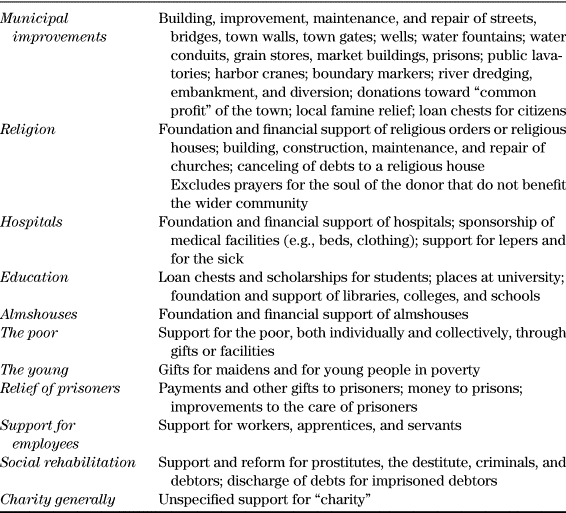
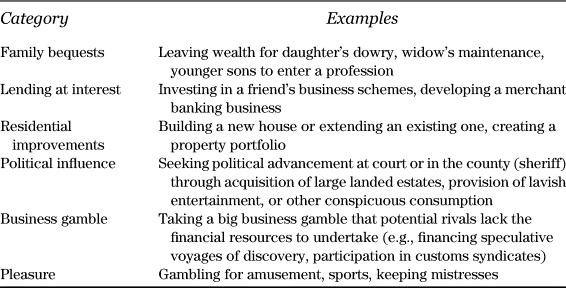
Inspired by David Jeremy's study of business leaders and the church in twentieth-century Britain, we followed a multistage process.Footnote 13 The first step was to create a typology of philanthropy suitable for the medieval period. This step does two things: it distinguishes the different uses of philanthropic resources, and it separates philanthropic uses from nonphilanthropic uses. The objects of philanthropy are classified as the poor, the young, relief of prisoners, support for employees, social rehabilitation, almshouses, other personal charity, municipal improvements, education, and religion (Table 1). Nonphilanthropic uses of resources are categorized in Table 2.
Categories of Giving

Source: Table by authors.
Alternative Uses of Funds

Source: Table by authors.
The second step was to identify key sources from which a sample of medieval entrepreneurs could be compiled. Few business archives from the Middle Ages have survived, but the activities of entrepreneurs can be traced from other sources. These include the Oxford Dictionary of National Biography (ODNB), The History of Parliament (several entrepreneurs were MPs), biographies of famous figures such as Richard Whittington, and histories of medieval towns. This methodology enabled us to identify entrepreneurs without restricting the sample to civic office holders, guild members, or men.
Beginning with the ODNB, a keyword search was conducted for “entrepreneur,” “merchant,” and “trader” in the full-text field of the online edition. Anyone who operated wholly outside of England, died outside of our chronological period, or did not meet our definition of an entrepreneur was excluded. A pool of seventy-one entrepreneurs was generated. Forty-three were then excluded as their activities did not meet our definition of philanthropy, leaving a pool of twenty-eight.Footnote 14 The problem of bias in sample selection is always present when dealing with medieval England and care must be taken drawing inferences on the basis of relatively small observed differences.
The use of the ODNB may introduce a bias in favor of philanthropy if individuals are included as a result of their fame from philanthropy rather than because of their business activities. The second stage of our methodology was to use additional sources to eliminate source bias and increase our range of observations.Footnote 15 This produced a further sixteen people and significantly enhanced the geographical scope of the study.
The third step involved a validation process in which additional information on each of the forty-four entrepreneurs was collected from primary sources such as wills, licenses to alienate lands, guild records, civic records, and the records of charities. For each individual, data was collected on dates of birth and death, residence (birthplace and subsequent residence, if provided), gender, occupation, position as civic office holder (mayor, sheriff, alderman, recorder, or bailiff), other family members, philanthropic activities, and alternative uses of wealth. Material culture and literary sources provided insights into the commemoration of philanthropy by subsequent generations.
A distinction was made between bequests during the philanthropist's lifetime and those made after their death. The former involved greater self-sacrifice on the part of the philanthropist, while the latter impacted surviving relatives to a greater extent. We recorded instances where the philanthropist was childless or had heirs whom they appear to have disinherited.
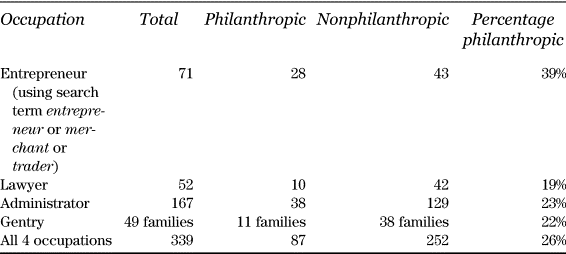
Finally, two dimensions of comparison were introduced: between philanthropists and nonphilanthropists, and between philanthropy undertaken by different occupational groups. A comprehensive comparative study involving all recorded nonphilanthropic medieval entrepreneurs is beyond the scope of this paper, but a more limited study can be carried out based on the ODNB alone. For this purpose we identified all medieval lawyers, administrators, and gentry listed in the ODNB, classified them as philanthropic or nonphilanthropic, and recorded the causes supported by the philanthropists. The results are summarized in Table 3.
Comparison by Occupation in the Oxford Dictionary of National Biography

Source: Oxford Dictionary of National Biography (hereafter ODNB), accessed 23 June 2017, https://www.oxforddnb.com/.
Context to Philanthropy in Medieval England
Philanthropy by entrepreneurs existed alongside, and often in cooperation with, other forms of welfare provision. Religious institutions funded their activities through donations—including gifts of land, moveable property, and cash—and were important providers of health care and education.Footnote 16 Guilds operated on a subscription model, with membership fees funding funeral services and welfare support for sick members and the families of deceased members.Footnote 17 Occasionally guilds also supported infrastructure and education projects that benefited the wider community. Local government used tolls, rents, and other sources of income to fund communal infrastructure (including marketplaces, roads, bridges, and walls), maintain law and order, and support vulnerable groups such as orphans. Although royalty were important patrons of abbeys and the church, the royal exchequer (that is, central government) rarely provided welfare support during this period, partly because there was not yet a system of regular taxation in place to fund it.
Religious teachings and the responsibilities of citizenship provided interconnected spiritual and secular incentives for philanthropy.Footnote 18 A place in heaven could be obtained with greater ease and speed by engaging in the seven Corporal Acts of Mercy: feeding the hungry, giving drink to the thirsty, visiting the sick, visiting prisoners, clothing the naked, sheltering the homeless (also sometimes known as receiving the stranger), and burying the dead.Footnote 19 Recipients could show their gratitude by praying for the soul of the donor, thus reducing the donor's time in purgatory. Reputable merchants also supported their civic communities by trading honestly (for example, by using fair weights and measures), maintaining reasonable prices (not seeking to profit from forestalling, regretting, or other forms of monopoly or speculation), and respecting the assays of bread and ale.Footnote 20 Reputation gained in this way could be reinforced through acts of civic philanthropy.Footnote 21
Characteristics of Philanthropic Entrepreneurs
The entrepreneurs in our sample pursued varied careers; some were mobile, seeking fame and fortune in big cities, and others chose to remain in their birthplace. Ten of the forty-four entrepreneurs originated in London, and all remained there (see Table 4). Thirty-one entrepreneurs originated in English provincial towns, of whom fifteen moved to London and sixteen remained in the provinces, with twelve staying in the town where they were born (Table 4). The four who moved all made a short journey from their place of birth to the nearest major port. Three entrepreneurs migrated from overseas—two from Italy and one from northwest Germany. Thus, while almost half the provincial-born entrepreneurs moved to London, none of the London entrepreneurs moved to the provinces. Altogether, twenty-two entrepreneurs moved and twenty-two stayed.
Locations of Entrepreneurial Activity

Sources: History of Parliament (hereafter HoP), accessed 23 June 2017, https://www.historyofparliamentonline.org/; Oxford Dictionary of National Biography (hereafter ODNB), accessed 23 June 2017, https://www.oxforddnb.com/; “Pious and Charitable Bequests” (1435), Florilegium Urbanum, Medieval English Towns website (hereafter FLU), last updated 20 Mar. 2004, http://users.trytel.com/tristan/towns/florilegium/lifecycle/lcdth19.html; “Wills of Two Southampton Mayors” (late 15th century), FLU, last updated 6 Jan. 2019, http://users.trytel.com/tristan/towns/florilegium/lifecycle/lcdth15.html; “Testaments of a Devout Husband and Wife” (1430s), FLU, last updated 16 Dec. 2010, http://users.trytel.com/tristan/towns/florilegium/lifecycle/lcdth16.html; “Whittington's Charity” (1420s), FLU, last updated 2 Nov. 2014, http://users.trytel.com/tristan/towns/florilegium/community/cmreli17.html; “The Wills and Testaments of Three London Grocers” (15th century), FLU, last updated 8 Jan. 2019, http://users.trytel.com/tristan/towns/florilegium/lifecycle/lcdth12.html; Charles Henry Cooper, Annals of Cambridge, vol. 1 (Cambridge, U.K., 1842); Elizabeth Crittall, ed., A History of the County of Wiltshire, vol. 6 (London, 1962); Frederick J. Furnivall, ed., The Fifty Earliest English Wills in the Court of Probate, London (London, 1882); John Benjamin Heath, Some Account of the Worshipful Company of Grocers of the City of London (London, 1854); N. M. Herbert, ed., A History of the County of Gloucester, vol. 7 (Oxford, 1981); J. C. Hodgson, “The ‘Domus Dei’ of Newcastle, otherwise St Katherine's Hospital on the Sandhill,” Archaeologia Aeliana, 3rd ser., 14 (1917): 191–220; C. L. Kingsford, ed., John Stow A Survey of London: Reprinted from the Text of 1603 (Oxford, 1908); E. MacKenzie, A Descriptive and Illustrative Account of the Town and County of Newcastle including the Vicinity of Gateshead, vol. 1 (Newcastle, 1827); H. C. Maxwell Lyte, Calendar of Patent Rolls Preserved in the Public Record Office: Henry VI, vol. 3, 1436–41 (London, 1907); Kenneth E. Munn, Hidden Portraits of Henry VII's Family and Court Depicted in the Stained Glass at St Mary's Church Fairford (n.p., 2016); Stephen O'Connor, ed., A Calendar of the Cartularies of John Pyel and Adam Fraunceys (London, 1993); Stephen O'Connor, “Finance, Diplomacy and Politics: Royal Service by Two London Merchants in the Reign of Edward III,” Historical Research 67, no. 162 (1994): 18–39; Stephen O'Connor, “Adam Fraunceys and John Pyel: Perceptions of Status among Merchants in Fourteenth-Century London,” in Trade, Devotion and Governance: Papers in Later Medieval History, ed. Dorothy J. Clayton, Richard G. Davies, and Peter McNiven (Stroud, 1994), 17–35; Stephen O'Connor, “Joan Pyel,” in Medieval London Widows, 1300–1500, ed. C. M. Barron and A. F. Sutton (London: 1994), 71–76; W. M. Palmer, ed., Cambridge Borough Documents (Cambridge, U.K., 1931); T. F. Reddaway and Lorna Walker, The Early History of the Goldsmiths Company (London, 1975); J. P. C. Roach, ed., A History of the County of Cambridge and the Isle of Ely, vol. 3 (London, 1959); Miri Rubin, Charity and Community in Medieval Cambridge (Cambridge, U.K., 1987); R. R. Sharpe, ed., Calendar of Wills Proved and Enrolled in the Court of Husting, London, part 1, 1258–1358 (London, 1889); R. R. Sharpe, ed., Calendar of Wills Proved and Enrolled in the Court of Husting, London, part 2, 1358–1688 (London, 1890); E. Veale, “Mathilda Penne, skinner (d. 1392–3),” Medieval London Widows, 1300–1500, ed. C. M. Barron and A. F. Sutton (London, 1994), 47–54.
Entrepreneurs supported causes connected to communities in which they lived and worked. Support for their birthplace was common. Of those who relocated, twelve supported their career-base destination, but three supported only their birthplace, and seven supported both. Hugh Clopton, for example, supported his birthplace of Stratford-upon-Avon, despite moving to London, by funding dowries for two hundred poor local maidens, constructing a stone bridge, and repairing bridges and roads within a ten-mile radius.Footnote 22 Richard Russell of York made a bequest “to repay” Durham Priory “fully for the board and lodging I had there in my youth.”Footnote 23 John Welles III, who moved to London, left one hundred shillings for the upkeep of St. George Muspole's church in Norwich, “in whose holy font I was baptised,” as well as bequests to London causes.Footnote 24 Three entrepreneurs favored their birthplace entirely over their destination, as exemplified by Tidemann Lemberg, who migrated to London from northwest Germany and bequeathed money to religious foundations in Cologne, where he lived from 1352 until 1359 and again from 1363 until his death.Footnote 25
Medieval entrepreneurs used social networks to both accumulate and dispose of their wealth. Nine percent of philanthropic entrepreneurs are reported as having acquired capital from their wives. Drew Barantyn's first marriage, to the widow of Sir Nicholas Twyford, undoubtedly aided him in accumulating a fortune that was by 1412 worth more than that of Whittington and the Goldsmith's company, of which he was a member.Footnote 26 He invested in an attractive property in London and properties in Oxfordshire, Cambridgeshire, Suffolk, and Buckinghamshire and, at his death, left money for the poor of the parish of St. John Zachery along with substantial bequests to his guild and to family members.
There are indications of the cross-fertilization of practices among members of the same social and trading networks. In London, Robert Chichele, Thomas Knolles, Richard Whittington, and William Sevenoak networked together, while Knolles was executor for John Welles III. York's Richard Russell was executor of Nicholas Blackburn's will while Agnes Forster's husband had connections with Bristol's Canynges family via the shipping trade.Footnote 27
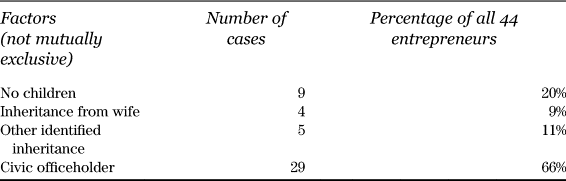
There is some evidence that the absence of descendants or suitable heirs motivated philanthropy. Twenty percent of entrepreneurs had no children, including Whittington and William Canynges (Table 5).Footnote 28 Others had children but chose to disinherit them. Russell's daughter married well and so did not need to be provided for in his will.Footnote 29 Welles had no biological children and disliked his stepson William Osbarn, specifying that any legacies to William should be made “null and void” if he harassed, defrauded, or tricked the executors in any way.Footnote 30 Simon Eyre had a troublesome son who was often imprisoned for debt.Footnote 31
Factors in Philanthropy

Sources: History of Parliament (hereafter HoP), accessed 23 June 2017, https://www.historyofparliamentonline.org/; Oxford Dictionary of National Biography (hereafter ODNB), accessed 23 June 2017, https://www.oxforddnb.com/; “Pious and Charitable Bequests” (1435), Florilegium Urbanum, Medieval English Towns website (hereafter FLU), last updated 20 Mar. 2004, http://users.trytel.com/tristan/towns/florilegium/lifecycle/lcdth19.html; “Wills of Two Southampton Mayors” (late 15th century), FLU, last updated 6 Jan. 2019, http://users.trytel.com/tristan/towns/florilegium/lifecycle/lcdth15.html; “Testaments of a Devout Husband and Wife” (1430s), FLU, last updated 16 Dec. 2010, http://users.trytel.com/tristan/towns/florilegium/lifecycle/lcdth16.html; “Whittington's Charity” (1420s), FLU, last updated 2 Nov. 2014, http://users.trytel.com/tristan/towns/florilegium/community/cmreli17.html; “The Wills and Testaments of Three London Grocers” (15th century), FLU, last updated 8 Jan. 2019, http://users.trytel.com/tristan/towns/florilegium/lifecycle/lcdth12.html; Charles Henry Cooper, Annals of Cambridge, vol. 1 (Cambridge, U.K., 1842); Elizabeth Crittall, ed., A History of the County of Wiltshire, vol. 6 (London, 1962); Frederick J. Furnivall, ed., The Fifty Earliest English Wills in the Court of Probate, London (London, 1882); John Benjamin Heath, Some Account of the Worshipful Company of Grocers of the City of London (London, 1854); N. M. Herbert, ed., A History of the County of Gloucester, vol. 7 (Oxford, 1981); J. C. Hodgson, “The ‘Domus Dei’ of Newcastle, otherwise St Katherine's Hospital on the Sandhill,” Archaeologia Aeliana, 3rd ser., 14 (1917): 191–220; C. L. Kingsford, ed., John Stow A Survey of London: Reprinted from the Text of 1603 (Oxford, 1908); E. MacKenzie, A Descriptive and Illustrative Account of the Town and County of Newcastle including the Vicinity of Gateshead, vol. 1 (Newcastle, 1827); H. C. Maxwell Lyte, Calendar of Patent Rolls Preserved in the Public Record Office: Henry VI, vol. 3, 1436–41 (London, 1907); Kenneth E. Munn, Hidden Portraits of Henry VII's Family and Court Depicted in the Stained Glass at St Mary's Church Fairford (n.p., 2016); Stephen O'Connor, ed., A Calendar of the Cartularies of John Pyel and Adam Fraunceys (London, 1993); Stephen O'Connor, “Finance, Diplomacy and Politics: Royal Service by Two London Merchants in the Reign of Edward III,” Historical Research 67, no. 162 (1994): 18–39; Stephen O'Connor, “Adam Fraunceys and John Pyel: Perceptions of Status among Merchants in Fourteenth-Century London,” in Trade, Devotion and Governance: Papers in Later Medieval History, ed. Dorothy J. Clayton, Richard G. Davies, and Peter McNiven (Stroud, 1994), 17–35; Stephen O'Connor, “Joan Pyel,” in Medieval London Widows, 1300–1500, ed. C. M. Barron and A. F. Sutton (London: 1994), 71–76; W. M. Palmer, ed., Cambridge Borough Documents (Cambridge, U.K., 1931); T. F. Reddaway and Lorna Walker, The Early History of the Goldsmiths Company (London, 1975); J. P. C. Roach, ed., A History of the County of Cambridge and the Isle of Ely, vol. 3 (London, 1959); Miri Rubin, Charity and Community in Medieval Cambridge (Cambridge, U.K., 1987); R. R. Sharpe, ed., Calendar of Wills Proved and Enrolled in the Court of Husting, London, part 1, 1258–1358 (London, 1889); R. R. Sharpe, ed., Calendar of Wills Proved and Enrolled in the Court of Husting, London, part 2, 1358–1688 (London, 1890); E. Veale, “Mathilda Penne, skinner (d. 1392–3),” Medieval London Widows, 1300–1500, ed. C. M. Barron and A. F. Sutton (London, 1994), 47–54.
Civic officeholding connected an entrepreneur's personal and professional lives and was a characteristic of 66 percent of our sample. Civic officeholders were more inclined to support the young, social rehabilitation, almshouses, municipal improvements, and education, while support for the poor, for prisoners, and for hospitals and health care was slightly more common among noncivic officeholders. Welles and Stephen Brown exemplify civic officeholders who funded projects to fill gaps in local services. Welles left legacies to a range of causes, including improvements to a water conduit and “a new boundary marker for my ward of West Cheap.”Footnote 32 Brown, meanwhile, imported grain during his mayoralty to alleviate the famine of 1438 and 1439 in London.Footnote 33 Personal projects from a term of office could be completed by philanthropy. Forster finished her husband's initiative to rebuild and reform Newgate prison, which had burnt down during his mayoralty.Footnote 34 Eyre contributed to the redevelopment of the Leadenhall market during his mayoralty, funding some of its construction directly and bequeathing money to complete his plans.Footnote 35
Types of Philanthropy
We next examine the causes supported by the entrepreneurs.
Municipal infrastructure
Bequests to road and bridge repairs reflected the importance of internal trading connections.Footnote 36 William Eastfield's use of inland trade routes may explain his decision to bequeath money for repairs to Wallingford bridge at his death in ca. 1446.Footnote 37 The timing of the bequest corresponds with a period of decline in Wallingford, attributed to the construction of a bridge at Abingdon by local philanthropic entrepreneurs in 1415 and 1416.Footnote 38 Other entrepreneurs supported infrastructure that encouraged merchants to visit their hometown and helped their colleagues connect with the wider world. Blackburn left bequests for repairs to four York bridges while Alice Chestre, who ran a Bristol export business, funded the construction of a new crane for both local and foreign merchants, the tolls from which went to support the town's finances.Footnote 39
Water was used for industrial and domestic purposes, and businesses were often accused of polluting and excessively using supplies during their production processes.Footnote 40 Monastic houses sometimes allowed civic authorities to utilize conduits they had constructed, but entrepreneurial initiative also helped mitigate problems. Four entrepreneurs—Whittington, Eastfield, and Welles in London, and William Wilford in Exeter—funded fountains and conduits.Footnote 41 Town walls, which were defensive barriers and toll-collection points, were supported by John Crosbie (London) and Willam Soper (Southampton).Footnote 42 Southampton's local government was so grateful for Soper's repairs to Watergate, which led from the quay to the town center, that in 1433 they gave him a hundred-year lease on its towers at a token rent and permission to construct a shop nearby.Footnote 43
Religion
Entrepreneurs came into contact with monasteries through their business dealings and land transactions. William Walworth, an important wool trader with family links in Durham, remitted in his will a debt of one hundred marks (sixty-seven pounds) owed to him by Durham Priory, while John Crosby made a bequest to St. Helen's Priory, which owned the land in Bishopgate Street on which he had built an impressive house.Footnote 44 Smaller bequests were more usual, such as that of London pepperer William de Thorneye to the abbot of Thorney (possibly his birthplace) and to the poor living in the abbey and on the surrounding dairy farms.Footnote 45 Roger Thornton of Newcastle supported St. Michael's Priory—near his house and recently founded by another citizen—and houses across northeast England, including Durham Minster, whose lead mines he rented.Footnote 46
Support for parish churches reflected the ties between philanthropic entrepreneurs and their local community. Four members of our sample—Roesia Burford, Robert Chichele, John Hawley, and John Pulteney—founded churches. Chichele donated land in 1428 to the parish of St. Stephen Walbrok for the construction of a church and churchyard and in 1429 contributed an additional one hundred pounds toward its construction.Footnote 47 Chichele lived in the parish when he arrived in London and his brother Henry (archbishop of Canterbury and founder of All Souls College Oxford) had been rector there. John Pyel, a London wool and grain merchant and financier, established in his will a college for secular canons in the church of St. Peter at his birthplace of Irthlingborough, Northamptonshire.Footnote 48 Existing churches were also expanded and decorated. John Tame used his profits from the wool trade to rebuild St. Mary's Church in Fairford in the fashionable Perpendicular style, from the 1490s onward, while John Lovekyn funded the rebuilding of St. Michael, Crooked Lane, London.Footnote 49
Almshouses and hospitals
Almshouse foundation was more popular than religious house foundation and undertaken by four entrepreneurs. Donors benefited from recipients performing elements of the Corporal Acts and by receiving prayers for their soul, while vulnerable members of the population received accommodation. Surviving rules drawn up in 1424 by Whittington's executors for his foundation, for example, specified that residents should pray when rising and retiring, in church services, and in any spare moments for the souls of Whittington and his wife, their parents, and deceased and living members of the royal family.Footnote 50
Hospitals were founded by Henry Tangmere in Cambridge and by Thornton in Newcastle.Footnote 51 Thornton's foundation of St. Katherine's was founded during the period 1402 to 1412 and continued to be supported and integrated into communal life by his descendants. In 1456, Roger Thornton II permitted the local authorities to make the hospital's hall and kitchen available to newlyweds for their wedding meal, and from 1480 the facilities were used by the merchant adventurers for their court.Footnote 52 Existing hospitals were supported by Richard Buckland, Matilda Penne, and Thomas Knolles, with Knolles bequeathing a shop near to existing property owned by the hospital of St. Antholin.Footnote 53
Education
Education became increasingly important for a career in business as the Middle Ages progressed and a written culture replaced an oral one. School foundation was successfully undertaken by Sevenoak and less successfully by the executors of Eyre.Footnote 54 During his mayoralty, Eyre had added a school and chapel to the new granary under construction at Leadenhall and appointed teachers of “Latin grammar, writing, and song.”Footnote 55 The intention was probably to create an equivalent to the royal foundation at Eton, but resistance or lack of funds meant that the endeavor was halted and replaced with a chantry chapel. Tangmere donated houses and land to Corpus Christi College, founded by the town's guild.Footnote 56 In return, Tangmere expected the college to educate his son and arrange daily prayers for his soul and those of his family. Richard Andrew, also of Cambridge, made substantial cash bequests to Queen's College in return for prayers for his soul.Footnote 57 Donations to the London Guildhall and Cambridge University library were made by John Herrys and Whittington.Footnote 58
The poor, the young, and prisoners
Philanthropists also showed concern for vulnerable members of society by supporting the poor, the young, and prisoners. Knolles, for example, left money to the poor of his parish and his guild as well as “4d to each person incarcerated in the prisons of Newgate, Ludgate, Fleet, Marshalsea, and King's Bench, to pray for my soul” and provided some social rehabilitation for imprisoned debtors by discharging their debts.Footnote 59 Whether such bequests provided short-term or long-term alleviation is difficult to judge. Herrys bequeathed money for Irish cloth to be made into garments for the poor at his funeral, which they were allowed to keep. Dowries provided to “poor maidens,” also funded by entrepreneurs, provided financial security and may have been intended to encourage marriage and prevent prostitution.
Employees
Support for employees focused on the provision of cash. Vintner and wool trader Richard Russell, for example, left thirty pounds to be distributed among the sheep farmers of the Yorkshire Wolds and Lindsey in Lincolnshire from whom he had purchased wool.Footnote 60 The Suffolk clothier Thomas Spring II, meanwhile, bequeathed one hundred marks (sixty-seven pounds) to be distributed to his “spinners, weavers, and fullers.”Footnote 61 Businesses were smaller in the Middle Ages, and apprentices resided with their masters; there was probably little demand for the housing and recreational facilities of the kind that industrialist philanthropists later provided for their employees.
Comparison with Other Occupations
Comparison with members of other occupations can inform as to the extent to which the features noted above are specific to entrepreneurs. Lawyers, gentry, and administrators were chosen as comparisons, as described above (see Table 3).Footnote 62 The comparison reveals that entrepreneurs had a greater tendency toward philanthropy than did those in the other occupations. Thirty-nine percent of entrepreneurs were philanthropic, compared with 23 percent of administrators, 22 percent of gentry, and 19 percent of lawyers.
Differences existed between the causes supported by entrepreneurs and those supported by other professions. Entrepreneurs supported a wider range of causes and showed particularly strong support for municipal improvements, which formed 22 percent of their total recorded donations and only 2 percent of donations by administrators and none of those by lawyers and the gentry. John Cobham is a rare example of an administrator who supervised and funded municipal improvements in and around his home county of Kent, including the reconstruction of Rochester Bridge in 1383 and the restoration of Canterbury's walls in 1385.Footnote 63
Education was supported to a greater extent by administrators than by entrepreneurs; it also received some support from the gentry. Three administrators—Adam Brome, Hervey Stanton, and Robert Wodelarke—founded the university colleges of Oriel, Oxford; Michaelhouse, Cambridge (which was later absorbed into Trinity); and St. Catharine's, Cambridge, respectively, while William Windsor gave a substantial endowment to New College, Oxford.Footnote 64 Joan Greyndour used wealth inherited from her parents and her first husband, an administrator, to establish a grammar school in his memory in the Forest of Dean in 1445 and 1446.Footnote 65 The commemorative aspect was reflected in the provision of a chantry on the site. Administrator Thomas Kent and the gentry Cobham family, meanwhile, donated books to Oxford University.Footnote 66
Religion received the highest proportion of donations from lawyers, gentry, and administrators. House and church foundation was more pronounced among those groups than among entrepreneurs, with three philanthropic administrators and three philanthropic gentry families undertaking such projects. Administrator Nicholas Cantilupe, having disinherited his son and heir, founded two religious institutions during his lifetime, Beauvale Priory near Nottingham and Cantilupe College in Lincoln Cathedral Close.Footnote 67 The use of religious patronage to enhance political and social authority has been noted by historians as a feature of these social groups, and this may be reflected in our findings.Footnote 68 Donations by Somerset administrator Walter Hungerford, for example, corresponded closely with Henry V's support for the Carthusians and Dominicans.Footnote 69 Michael de la Pole, son of the famous entrepreneur William de la Pole, sought a career in administration rather than trade but acted in accordance with his father's wishes to establish a religious house in Hull to commemorate the family.Footnote 70
Comparison of philanthropy before and after death also reveals differences between the groups. Administrators and gentry families made a greater volume of bequests during their life (54 percent and 71 percent, respectively) compared with entrepreneurs (28 percent) and lawyers (43 percent). This difference may have existed because entrepreneurs retained capital during their life to reinvest in their business, a characteristic noted of Whittington.
Comparison between Philanthropy and Alternative Sources of Wealth
Entrepreneurs had a range of options available to them to dispose of their wealth, of which philanthropy was only one (Table 2). Sixty-one percent of entrepreneurs recorded in the ODNB were not philanthropic, by either choice or necessity. Great Yarmouth merchant John Perbroun, for example, had all his capital invested in his business and paid large amounts of tax.Footnote 71
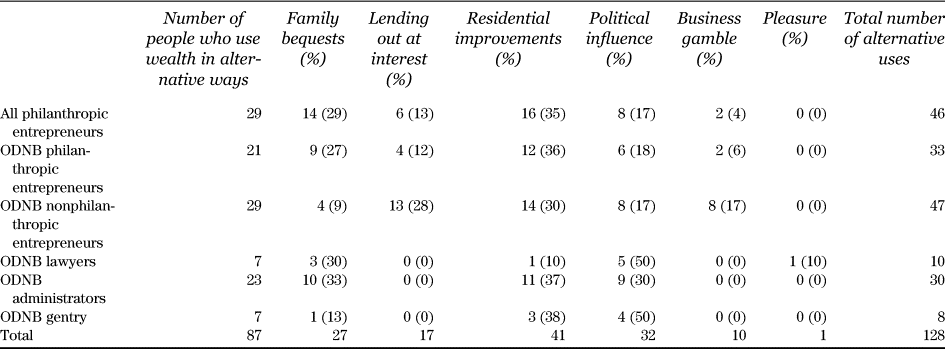
Table 6 shows that residential improvements and lending at interest were popular alternative uses of wealth for nonphilanthropic entrepreneurs. Business gambles were also popular, and biographies reveal that several entrepreneurs participated in the failed customs schemes organized to finance the Hundred Years’ War, which may have left little money for philanthropy.Footnote 72 Family bequests were relatively unpopular and use of wealth for pleasure appears to have been nonexistent. Indications are that nonphilanthropic entrepreneurs preferred to spend their money in ways that resulted in additional profit (such as interest payments, rental income, and trading privileges). They thus displayed qualities of acquisitiveness later imputed to early modern entrepreneurs.Footnote 73
Alternative Uses of Wealth by Philanthropic Individuals or Families

Sources: History of Parliament (hereafter HoP, accessed 23 June 2017, https://www.historyofparliamentonline.org/; Oxford Dictionary of National Biography (hereafter ODNB), accessed 23 June 2017, https://www.oxforddnb.com/; “Pious and Charitable Bequests” (1435), Florilegium Urbanum, Medieval English Towns website (hereafter FLU), last updated 20 Mar. 2004, http://users.trytel.com/tristan/towns/florilegium/lifecycle/lcdth19.html; “Wills of Two Southampton Mayors” (late 15th century), FLU, last updated 6 Jan. 2019, http://users.trytel.com/tristan/towns/florilegium/lifecycle/lcdth15.html; “Testaments of a Devout Husband and Wife” (1430s), FLU, last updated 16 Dec. 2010, http://users.trytel.com/tristan/towns/florilegium/lifecycle/lcdth16.html; “Whittington's Charity” (1420s), FLU, last updated 2 Nov. 2014, http://users.trytel.com/tristan/towns/florilegium/community/cmreli17.html; “The Wills and Testaments of Three London Grocers” (15th century), FLU, last updated 8 Jan. 2019, http://users.trytel.com/tristan/towns/florilegium/lifecycle/lcdth12.html; Charles Henry Cooper, Annals of Cambridge, vol. 1 (Cambridge, U.K., 1842); Elizabeth Crittall, ed., A History of the County of Wiltshire, vol. 6 (London, 1962); Frederick J. Furnivall, ed., The Fifty Earliest English Wills in the Court of Probate, London (London, 1882); John Benjamin Heath, Some Account of the Worshipful Company of Grocers of the City of London (London, 1854); N. M. Herbert, ed., A History of the County of Gloucester, vol. 7 (Oxford, 1981); J. C. Hodgson, “The ‘Domus Dei’ of Newcastle, otherwise St Katherine's Hospital on the Sandhill,” Archaeologia Aeliana, 3rd ser., 14 (1917): 191–220; C. L. Kingsford, ed., John Stow A Survey of London: Reprinted from the Text of 1603 (Oxford, 1908); E. MacKenzie, A Descriptive and Illustrative Account of the Town and County of Newcastle including the Vicinity of Gateshead, vol. 1 (Newcastle, 1827); H. C. Maxwell Lyte, Calendar of Patent Rolls Preserved in the Public Record Office: Henry VI, vol. 3, 1436–41 (London, 1907); Kenneth E. Munn, Hidden Portraits of Henry VII's Family and Court Depicted in the Stained Glass at St Mary's Church Fairford (n.p., 2016); Stephen O'Connor, ed., A Calendar of the Cartularies of John Pyel and Adam Fraunceys (London, 1993); Stephen O'Connor, “Finance, Diplomacy and Politics: Royal Service by Two London Merchants in the Reign of Edward III,” Historical Research 67, no. 162 (1994): 18–39; Stephen O'Connor, “Adam Fraunceys and John Pyel: Perceptions of Status among Merchants in Fourteenth-Century London,” in Trade, Devotion and Governance: Papers in Later Medieval History, ed. Dorothy J. Clayton, Richard G. Davies, and Peter McNiven (Stroud, 1994), 17–35; Stephen O'Connor, “Joan Pyel,” in Medieval London Widows, 1300–1500, ed. C. M. Barron and A. F. Sutton (London: 1994), 71–76; W. M. Palmer, ed., Cambridge Borough Documents (Cambridge, U.K., 1931); T. F. Reddaway and Lorna Walker, The Early History of the Goldsmiths Company (London, 1975); J. P. C. Roach, ed., A History of the County of Cambridge and the Isle of Ely, vol. 3 (London, 1959); Miri Rubin, Charity and Community in Medieval Cambridge (Cambridge, U.K., 1987); R. R. Sharpe, ed., Calendar of Wills Proved and Enrolled in the Court of Husting, London, part 1, 1258–1358 (London, 1889); R. R. Sharpe, ed., Calendar of Wills Proved and Enrolled in the Court of Husting, London, part 2, 1358–1688 (London, 1890); E. Veale, “Mathilda Penne, skinner (d. 1392–3),” Medieval London Widows, 1300–1500, ed. C. M. Barron and A. F. Sutton (London, 1994), 47–54.
Philanthropists also put their wealth to additional uses. Residential improvements were the most popular alternative option for philanthropic entrepreneurs. Thornton, for example, invested his money from the wool, cloth, and lead trades in at least six properties in London, one of which doubled as a business base in the city, while Chestre built a house on Bristol's High Street in 1472.Footnote 74 Philanthropic entrepreneurs were more generous in their support of family members and took fewer business gambles, with the exception of Pyel's involvement in a customs syndicate and Canynges's financing of the unsuccessful 1457 Aegean Sea expedition.Footnote 75
Philanthropic lawyers, administrators, and gentry favored bequests to family, residential improvements and acquisition of political influence. Pleasure was not off the agenda for those groups, however. Philanthropic lawyer John Heydon invested in residential improvements, supported his family, and sought political influence but also reportedly kept a mistress.Footnote 76
Reputation and Legacy
Philanthropy provided benefits for donors as well as recipients. Many were commemorated publicly, although whether this was their intention from the outset is unclear. Blackburn and Thornton symbolically linked their philanthropy to the Corporal Acts of Mercy and are commemorated in stained glass windows at All Saints Church, York (surviving) and in All Saints Church, Newcastle (lost).Footnote 77 Others became role models for subsequent generations. Whittington's legend began soon after his death; in the 1436 poem The Libel of English Policy, he was described as “having worthiness that pen and paper may not … describe,” and he was the subject of a widely disseminated play of 1605.Footnote 78 The legacy of Canynges's philanthropy continued into the nineteenth century and beyond when he was promoted as an ecclesiastical patron by the parishioners of St. Mary Redcliffe church, Bristol, during their restoration appeal from 1842 to 1872 and in subsequent appeals from 1927 to the present.Footnote 79
Later commentators sometimes magnified philanthropic gestures by emphasizing, in the absence of detailed evidence, the humble origins of the donors. Sevenoak featured in the poem The Nine Worthies of London (1584), which described his achievements after a humble birth like “a weed, that grew full low.”Footnote 80 Depicted as a peddler in the play The Love Sick King (1655), Thornton's character states that if he makes a fortune he will “comfort the poor, and perhaps build churches.”Footnote 81 There are hints from commemoration that personal experience of hardship influenced the reinvestment of the rewards of success in philanthropic endeavors.
Conclusion
Medieval entrepreneurs perceived a harmony between self-interest and social interest, our study suggests. They supported not only causes directly connected with religion but also others, such as municipal infrastructure and education, that enhanced entrepreneurial opportunities more generally. There are indications that philanthropic entrepreneurs identified causes through a combination of experience accumulated during their career, knowledge derived from religious teachings that emphasized support for the vulnerable, and periods in civic office, which highlighted gaps in government provision.Footnote 82
Entrepreneurs exhibited distinctive patterns of philanthropy compared with other groups. They were more likely than lawyers, administrators, and gentry families to engage in philanthropy, and they supported a wider range of causes. There are indications that they applied their business skills to identify and fill gaps in existing provision rather than operating solely through the existing framework of religious institutions and guilds.Footnote 83 Support for municipal infrastructure emerges as a distinctive feature of entrepreneurial philanthropy, reflecting their belief in the importance of trade networks and civic reputation. Reinvestment of wealth by entrepreneurs supplemented the resources of local government and almost certainly improved the overall competitive performance of the recipient town.
Personal and family circumstances influenced philanthropy. Support from a wealthy wife was valuable. Unsuitable heirs or an absence of descendants encouraged investment in the wider community. Relocation from a provincial birthplace in search of better opportunities was fairly common, but many successful “movers” continued to support their birthplace.
Entrepreneurs had other opportunities to dispose of their wealth, including through residential improvements, business gambles, and family bequests. Despite that, many chose to use the profits of trade to support both current residents and future generations of their wider community. Entrepreneurs made significant philanthropic contributions to the provision of infrastructure, health care, and education. Future research would benefit from supplementing the qualitative analysis with quantitative analysis, particularly by engaging with the unresolved debates surrounding Jordan's calculations of monetary values of donations.Footnote 84
Appendix Sample of 44 Entrepreneurs