Cardiac arrhythmias affect millions of people worldwide. Dysfunction of cardiac electrical conduction underlies all types of arrhythmia.Reference Kwon and Kim 1 The SCN5A gene encodes the α-subunit of the cardiac sodium-channel Nav1.5, which mediates the fast influx of Na+ (INa) across the cell membrane in the depolarisation phase of the cardiac action potential.Reference Veerman, Wilde and Lodder 2 Mutations in SCN5A can disturb depolarisation and cause cardiac arrhythmia, including long-QT syndrome type 3, Brugada syndrome, progressive cardiac conduction disease, sick sinus syndrome, atrial fibrillation, atrial flutter, dilated cardiomyopathy, and more complex overlapping syndromes.Reference Vohra 3 – Reference Neu, Eiselt and Paul 8
In this study, we performed whole-exome sequencing and identified a novel missense mutation of C335R in SCN5A in a proband with palpitations and atrial flutter. Our study confirms the clinical diagnosis in this case and expands the spectrum of SCN5A mutations.
Methods
This study protocol was approved by the Review Board of the Second Xiangya Hospital of Central South University. All related subjects consented to this study.
Patients and subjects
A family from Central-South China (Hunan Province) with five members across three generations participated in the present research. The proband was a 23-year-old woman suffering from palpitations for 2 years, and she was diagnosed with atrial flutter. Other affected family members were also suffering from cardiac arrhythmias. No other malformation was observed in the proband and other affected members.
DNA extraction
Genomic DNA was extracted from peripheral blood lymphocytes of the patient and all other participants with DNeasy Blood & Tissue Kit (Qiagen, Valencia, California, United States of America).
Whole-exome sequencing
Whole-exome sequencing service was provided by the Novogene Bioinformatics Institute (Beijing, China). The exomes were captured by Agilent SureSelect Human All Exon V6 kits (Agilent Technologies, Inc., Santa Clara, California, USA) and the high-throughput sequencing was performed in Illumina HiSeq X-10 system (Illumina Inc., San Diego, California, USA). The strategies of data filtering are as follows: variants in the 1000 Genomes project (1000 G, www.1000genomes.org) with minor allele frequency>0.01 were excluded; variants in the dbSNP132 (http://www.ncbi.nlm.nih.gov/projects/SNP/) with minor allele frequency>0.01 were also excluded; the remaining data were filtered by cardiomyopathy-related genes; and co-segregation analysis combined with bioinformatics analysis was used to validate the damage-causing variants. The gene list is provided in Supplementary Table S1.
Sanger sequencing
Sanger sequencing was performed to confirm the potential causative mutation in this family. Primer sequences for the pathogenic variant in the SCN5A gene (NM_001099404) will be provided upon request. Sequences of the polymerase chain reaction products were determined using the ABI 3100 Genetic Analyzer (ABI, Foster City, California, United States of America) as previously described.Reference Xiang, Fan and Huang 9
Results
Clinical features
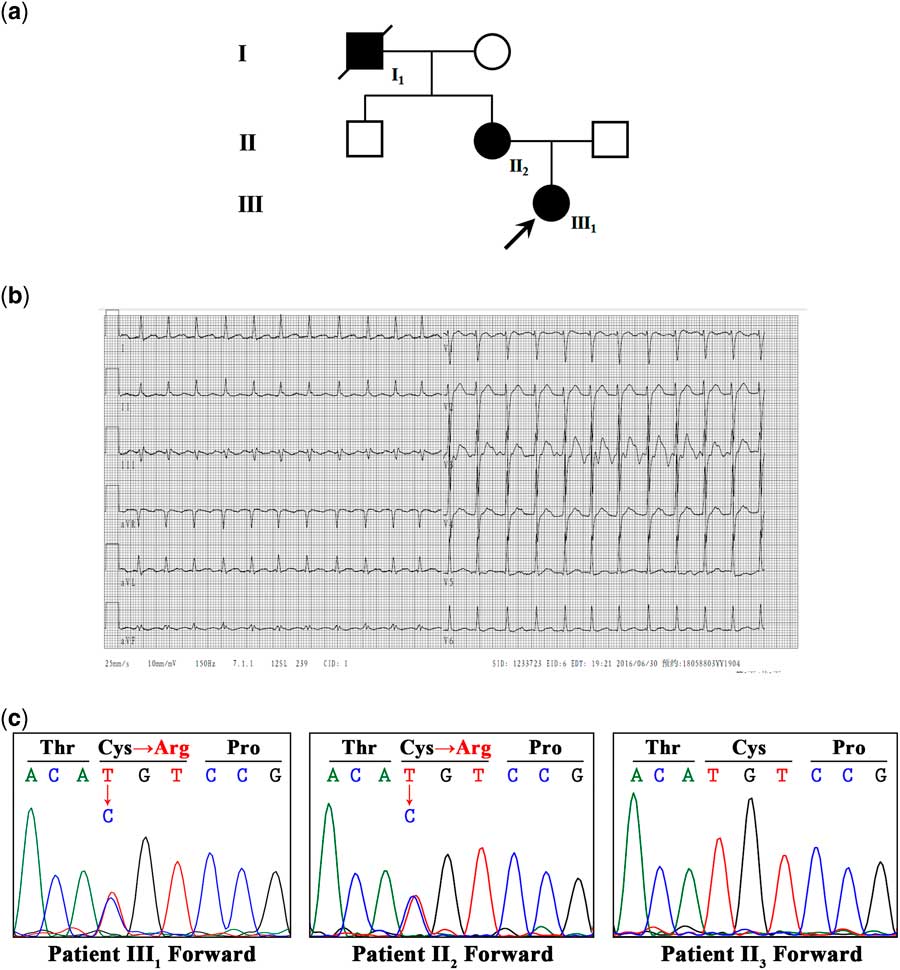
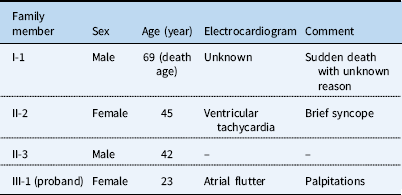
A Chinese family with arrhythmia (Fig 1) was admitted in our hospital. The proband (III-1), a 23-year-old woman from Hunan Province in Central-South China, suffered palpitations for 2 years and was eventually diagnosed with atrial flutter (Fig 1; Table 1). Her mother (II-2) was diagnosed with Brugada syndrome 2 years ago. Her grandfather also suffered from arrhythmia and died at the age of 69 years. No other malformations were observed in the affected members in this family.
Clinical features of the patient with arrhythmia for atrial flutter. (a) Pedigree of the family affected with arrhythmia. Symbols for affected individuals are colored in. The proband (III1) was suffered from atrial flutter. Her mother (II2) was diagnosed with Brugada syndrome two years ago. Her grandfather (I1) was diagnosed with arrhythmia and died in the age of 69. (b) Electrocardiograms (ECGs) of the proband (III1). (c) Sanger DNA sequencing chromatogram demonstrates the heterozygosity for a SCN5A mutation (c.T1003C/p.C335R).

Summary of a family with arrhythmia.

Genetic analysis
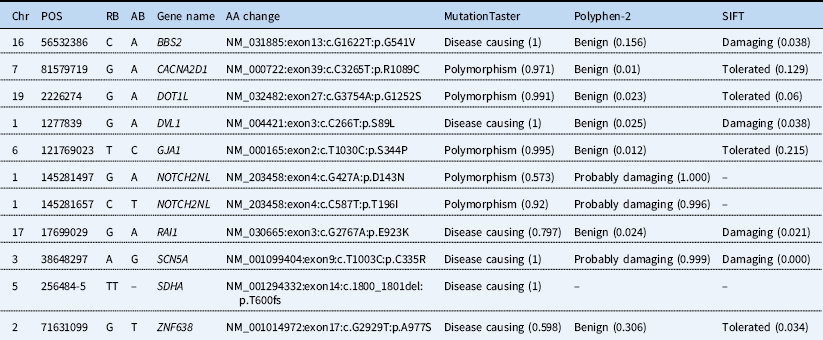
Whole-exome sequencing yielded a mean of 10 Gb data with more than 99% coverage of the target region. After data filtering and excluding shared common variants, 1356 unique single-nucleotide polymorphisms were detected. Variants were filtered by arrhythmia-related genes (Supplementary Table S1). A set of 11 variants in 10 genes in this family were identified (Table 2). All these variants were then predicted by MutationTaster (www.mutationtaster.org), Polyphen 2 (http://genetics.bwh.harvard.edu/pph2/), and SIFT (http://sift.bii.astar.edu.sg/), respectively. Considering the bioinformatics analysis results and known genotype–phenotype correlation, we chose SCN5A as the potential pathogenic gene.
Variants identified by whole-exome sequencing in combination with cardiomyopathy-related gene-filtering in this family.

AA=amino acid; AB=alternative base identified; CHR=chromosome; POS=position; RB=reference sequence base
Sanger sequencing revealed that a novel missense mutation of c.T1003C/p.C335R in the SCN5A gene co-segregated with the affected family members (Fig 1). In addition, this novel mutation of c.T1003C SCN5A was not found in our 200 local control cohorts.
Discussion
In this research, we used whole-exome sequencing to identify a novel C335R mutation in the exon 9 of SCN5A in a woman with atrial flutter. The proband had no other arrhythmia-related gene mutations that had been previously reported. This mutation locates at the pore-lining segment of the first channel domain. Previous function study has demonstrated that mutations in this domain lead to an amplitude reduction in peak Na+ current,Reference Cordeiro, Barajas-Martinez and Hong 10 , Reference Remme, Wilde and Bezzina 11 which were predicted to result in a dysfunctional protein that is closely associated with channelopathies.
Currently, the diagnosis and typing of arrhythmia mostly rely on traditional detection methods, such as electrocardiogram, echocardiography, and histopathological examination et al.Reference Gourraud, Barc, Thollet, Le Marec and Probst 12 However, on the basis of the genetic heterogeneity of arrhythmia, a specific phenotype may be caused by different pathogenic genes, which makes it difficult to determine the real pathogenic genetic factors in those cases. Whole-exome sequencing is becoming an emerging diagnostic approach for cardiac conduction disease, and is also a powerful and cost-effective method to confirm the pathogenic genes in cardiac arrhythmia.Reference Churko, Mantalas, Snyder and Wu 13 , Reference Mizusawa 14 In this case, the proband only manifested atrial flutter without any significant phenotypes and was diagnosed with Brugada syndrome, long-QT syndrome, or other cardiac conduction diseases. After whole-exome sequencing was used, we found a novel deleterious missense mutation of c.T1003C/p.C335R in the SCN5A gene. It confirmed a genetic diagnosis in this family.
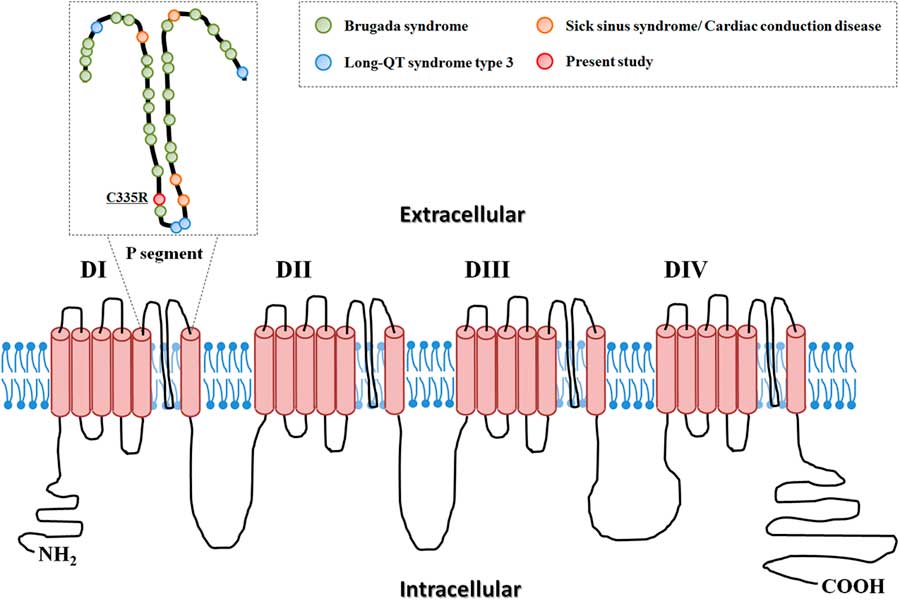
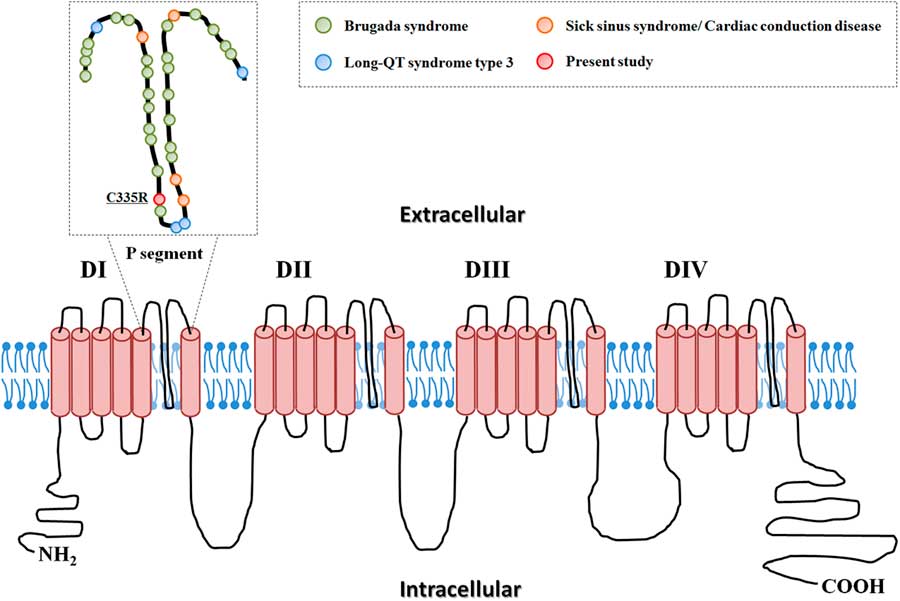
The SCN5A consists of four homologous transmembrane domains named DI-DIV, and each domain is composed of six transmembrane segments. Between each segment 5 and segment 6 (S5–S6) are the extracellular linker regions that together make up the channel pore referred to as “P loop”.Reference Song and Shou 15 Previous studies have revealed that most of the mutation variants in this pore-lining segment of the first DI domain are associated with Brugada syndrome. Only a few cases are linked to sick sinus syndrome and long-QT syndrome (Fig 2). It has been suggested that the linker region between S5 and S6 in DI is pathogenic in Brugada syndrome. However, in our case, the proband’s only arrhythmia was atrial flutter, although her mother was diagnosed with Brugada syndrome and her grandfather suffered from arrhythmia and died in his 60s. On the basis of the current diagnosis, this mutation in the proband was not associated with Brugada syndrome yet. However, Brugada syndrome on average does not manifest until the forties.Reference Cordeiro, Barajas-Martinez and Hong 10 The proband in this case is still young for the manifestation of Brugada syndrome and may manifest Brugada syndrome in the future.
Overview of all known SCN5A mutations in DI S5-S6 linker region. Brugada syndrome are indicated by green circles, long-QT syndrome type 3 are shown as blue circles, sick sinus syndrome /cardiac conduction disease are shown as orange circles, and red circles symbolize the mutation identified in this study.
In conclusion, we have found a novel missense mutation (c.T1003C/p.C335R) in SCN5A in a proband diagnosed with atrial flutter and a family history of Brugada syndrome. Our study expands the spectrum of SCN5A mutations and contributes to genetic counselling of families with arrhythmia.
Acknowledgements
The authors thank all subjects for participating in this study.
Conflicts of Interest
None.
Ethical Standards
The authors assert that all procedures contributing to this work comply with the ethical standards of the relevant national guidelines of China on human experimentation and with the Helsinki Declaration of 1975, as revised in 2008, and has been approved by the Review Board of the Second Xiangya Hospital of Central South University.
Financial Support
This study was supported by the National Natural Science Foundation of China (81370394 to Rong Xiang) and the Fundamental Research Funds for the Central Universities of Central South University (2017zzts074 to Hao Huang).
Supplementary material
To view supplementary material for this article, please visit https://doi.org/10.1017/S1047951117002980