Guatemala may be a small country, but it looms large as a bridge state for the regional drug trade (Bunck and Fowler Reference Bunck and Fowler2012). An estimated 80 percent of cocaine arriving in the United States in recent years first passed through its borders (U.S. State Department 2014). The consequences for Guatemala have been substantial and pernicious. As the drug trade expanded, the amount of territory dominated by drug-trafficking organizations (DTOs) grew, the number of corrupted public officials multiplied, and brutal violence spread. Indeed, until recently, Guatemala was widely portrayed as being on the verge of becoming a failed state under the onslaught of drug trafficking, gangs, and corrupt public officials (Brands Reference Brands2011; Farah Reference Farah2013; Gavigan Reference Gavigan2009; ICG 2010; Torres-Rivas Reference Torres-Rivas2010–11).
Certainly, substantial challenges remain to be accomplished in each of these areas, but the failed-state alarm of the recent past has diminished. Much credit is due to courageous Guatemalan public servants, along with the critical supportive work of the International Commission Against Impunity in Guatemala (Comisión Internacional Contra la Impunidad en Guatemala, CICIG). Credit also is due to the Guatemalan people themselves and their demand for transparency and honesty in government, notably in the 2015 mass movement leading to the resignation of President Otto Pérez Molina and Vice President Roxana Baldetti and their detention, along with numerous other officials from their administration.
As a result of such efforts, numerous top drug traffickers have been brought to justice, often through extradition to the United States and then conviction and imprisonment for long terms. Success in decapitating DTOs, however, does not necessarily secure more fundamental policy goals, as the experience of countries such as Mexico and Colombia shows. The fundamental question for this study is the extent to which significant success in removing DTO kingpins has advanced the more fundamental goals of reducing drug trafficking through Guatemala, as well as its related violence.
This study is divided into four sections. The first reviews and contributes to the relevant literature, especially that related to the decapitation strategy. The middle two sections are descriptive, first characterizing the broader context in which Guatemalan DTOs have operated and then providing brief studies of two of the leading organizations targeted by the strategy. One of the few efforts to evaluate the application of the decapitation strategy to DTO bosses outside of Colombia and Mexico, the final section analyzes the best relevant evidence on Guatemala’s performance. Despite substantial success in bringing major DTO leaders to justice, the overall flow of cocaine through the country has actually increased. Significantly, however, the violence associated with its trafficking appears to have diminished in Guatemala. This important finding runs counter to theorizing based largely on the Mexican experience with the decapitation strategy, as well as Colombia’s first decade or so of its war on drugs, up to 1992.
Failing States and Decapitated Kingpins
Criminal organizations do not generally seek to capture the state, but instead focus on those political vulnerabilities that best advance their criminal enterprises (Dziedzic Reference Dziedzic2016). Ad hoc networks connecting criminal and political actors can be initiated from either side, with power and influence flowing in either direction (Bailey and Godson Reference Bailey and Godson2000). Crucial for transnational drug trafficking are these political-criminal alliances in areas where central state control has traditionally been weak. This has often been along borders with a long history of contraband commerce or in mountainous hinterlands.
As their activities expand, some traffickers move beyond obtaining acquiescence (if not support) for their activities from the area’s few public officials to controlling the territory itself. Rosen and Zepeda (Reference Rosen and Zepeda2016) point out, for example, that even though Mexico is not a failing nation-state, there are failed states within the country, as well as failed zones within other states, where DTO domination allows the leaders impunity for their operations.
As crime, corruption, and violence increase, a “security trap” develops (Bailey Reference Bailey, Bergman and Whitehead2009). Civil society becomes apathetic, cynical, and opportunistic. Declining legitimacy undermines support for law enforcement and compliance. Consequently, public safety diminishes further.
Eventually the state must fight back, as it has in the crucial examples of Colombia and Mexico. Strategies have been multifaceted, but at their heart has been the elimination of DTO leaders (“kingpins”) through the decapitation strategy as a means to weaken or destroy the organizations. The literature on decapitation is broader than that on DTOs, as the strategy also applies to insurgent and terrorist organizations. Scholarly assessments of decapitation effectiveness with the latter groups are mixed (e.g., Abrahms and Mierau Reference Abrahms and Mierau2017; Jordan Reference Jordan2014; Morehouse Reference Morehouse2014; Price Reference Price2012). Furthermore, these mixed findings do not necessarily extend to DTOs, for at least three reasons.
First, the state and any international allies enjoy greater latitude in war against insurgents and terrorists, such as decapitating through targeted killing, than they do in fighting criminal organizations. Successful DTO decapitation as a long-term strategy requires wide-ranging institutional and policy changes to strengthen the rule of law and needs to be pursued accordingly. Strengthening the rule of law constrains state behavior. Second, DTOs are profit-driven, but terrorist and insurgent groups are usually value-based, a characteristic highlighted in studies explaining decapitation success against them (e.g., Price Reference Price2012).
Third, the fundamental objective of DTO decapitation for the United States has been to reduce the flow of drugs trafficked (U.S. DEA n.d.; U.S. Justice Department 2018). There is no corollary objective with insurgent and terrorist groups. Criteria for decapitation success for these latter groups instead have generally been organization termination or reduced violent behavior. As the evidence below indicates, DTO termination does not link with reduced overall drug flows.
Of course, reducing drug flows is often more of an instrumental objective for drug-producing and bridge states toward more important domestic goals of reducing the DTO threat to state control of territory and the corruption and violence associated with the drug trade. Each of these will be considered here systematically, with reduced violence as a DTO decapitation goal. There are nonetheless ample examples of DTOs trafficking high levels of drugs with relatively low levels of violence—when the state leaves them alone.
The findings of this study, then, are restricted to decapitation as applied specifically to DTOs, utilizing “kingpin strategy” as its shorthand reference. The origin of the kingpin strategy is commonly traced back to the 1982 formation of the comprehensive and multijurisdictional Organized Crime Drug Enforcement Task Forces (OCDETF) Program by the U.S. Justice Department (2018). Although the named strategy itself was not launched against DTOs in its more focused, better-coordinated form until 1992, certainly some kingpins were already government targets (U.S. DEA n.d.).
The strategy was first applied in Colombia, where the well-known cartels were indeed broken up, eliminating, along with the leaders, their threat to national security (Bonner Reference Bonner2010). Otherwise, though, Colombian results have been mixed at best. Homicide rates exploded from the late 1970s to the early 1990s as intermittent crackdowns failed to curtail DTO expansion and the cartels themselves struck back at the state, especially to undermine extradition as a policy (UNODC 2014, 36; Bagley Reference Bagley1988; Crandall Reference Crandall2002; Isacson Reference Isacson, Bagley, Rosen and Kassab2015; Kenney Reference Kenney2003; Thoumi Reference Thoumi and Wilson2009). Colombian homicide rates then reversed, roughly coinciding with the explicit 1992 initiation of the kingpin strategy, and have continued to fall, although taking more than three decades to return to their 1980 level and remaining among the highest in the world. For a period, coca cultivation and cocaine production also were reduced. In recent years, however, Colombian coca cultivation has been booming: the two most recent annual estimates (2016, 2017) each have reached the highest levels ever recorded (McDermott Reference McDermott2017; UNODC 2018).
The kingpin strategy has fared even worse in Mexico, where it was initiated in earnest under Felipe Calderón as he assumed the presidency at the end of 2006. Mexico succeeded at removing kingpins, taking out two-thirds of the targeted DTO leaders within the next seven-and-a-half years (Garzón Reference Vergara, Carlos, Bagley, Rosen and Kassab2015). However, homicide rates skyrocketed during Calderón’s six-year term, certainly due to fighting between the government and the cartels but primarily between DTOs competing for territorial dominance. Calderón’s successor, Enrique Peña Nieto, publicly backed away from the kingpin strategy, and for a while, homicide rates did fall (Rosen and Zepeda Reference Rosen and Zepeda2016). Nevertheless, in the end, Peña Nieto’s approach was marked more by continuity: in the next four-and-a-half years, 107 of the 122 kingpins identified as priority targets for this period were captured (El Universal 2015).
Despite this success, the overall homicide rate resumed climbing, and in 2017 topped the previous recorded annual high set under Calderón in 2011 (25.2 vs. 23.8 per 100,000 inhabitants) (INEGI 2018). Estimates of homicides linked specifically to criminal organizations show the same trends (Guerrero Reference Guerrero2018). Concurrently, DTO killing techniques grew more gruesome (Atuesta Reference Atuesta2017), somewhat paralleling the impact of targeted killing on militant groups (Abrahms and Mierau Reference Abrahms and Mierau2017; Morehouse Reference Morehouse2014). Meanwhile, the quantity of cocaine smuggled on to the United States did not diminish (Wainwright Reference Wainwright2016).
Certainly the kingpin strategy was not solely responsible for the explosion of violence surrounding the drug war in Mexico. As Trejo and Ley (Reference Trejo and Ley2018) have established, intercartel violence escalated before the Calderón presidency. They and others demonstrate that the roots of contemporary drug violence have also grown from the demise of Mexico’s one-party system and the resulting changes in federal, state, and local relationships that disrupted previously stable government-DTO networks (Durán-Martínez Reference Durán-Martínez2015; Rios Reference Rios2015; Snyder and Durán-Martínez Reference Snyder and Durán-Martínez2009). Still, recent quantitative analyses document the robust relationship between implementation of the kingpin strategy and increasing homicide rates (Calderón et al. Reference Calderón, Robles, Díaz-Cayeros and Magaloni2015; Osorio Reference Osorio2015; B. Phillips Reference Phillips2015).
The connection should be no surprise, as these studies explain (also see Chindea Reference Chindea2014; Guerrero Reference Guerrero2013). DTOs are profit-driven. Kingpin decapitation does nothing to address market demand and the immense profitmaking possibilities it perpetuates. However, decapitation does hold out increased material gain for ambitious remaining members eager to fill leadership vacancies and willing to fight with rivals if necessary to do so. Decapitation also creates opportunities for other DTOs that believe they could take advantage of a now-weakened rival and move into its territory. The king-pin strategy, then, provokes violence by exacerbating both intercartel and intracartel rivalries. Furthermore, state attacks on DTO leaders reduce whatever inhibitions they might have had about employing violence themselves against state actors.
In summary, Garzón (Reference Vergara, Carlos, Bagley, Rosen and Kassab2015) portrays the resulting situation well. The successes of the kingpin decapitation strategy in countries such as Colombia and Mexico have enhanced national security by reducing DTO capacity to directly challenge state authority. Nonetheless, the resulting fragmentation and localization leave public safety precarious, as the more numerous but smaller cartelitos retain the capacity to dominate areas with weak state control. Indeed, local publics can be even more vulnerable as violence increases when rival smaller organizations compete to dominate places once under the secure control of a larger DTO. Overall, homicide rates are at their peak in Mexico after a little over a decade of vigorously pursuing DTO leaders. Homicide rates did fall in Colombia coinciding with application of the kingpin strategy, but this followed more than a decade of intermittent war on the cartels (and a serious insurgency) that had escalated those rates to possibly the highest in the world. Moreover, cocaine flows have varied over time but currently are at record levels.
To turn now to Guatemala, the assessment of its application of the kingpin strategy will be restricted to cocaine trafficking to keep the scope manageable, even though, at times, the country has been important for poppy cultivation for heroin and the transport of methamphetamine precursor chemicals. Any data related to either the drug trade or homicides are notoriously imprecise (Andreas and Greenhill Reference Andreas and Greenhill2010). For this study’s quantitative analyses, care has been taken to use the best available sources while staying attentive to their limitations. The descriptive sections are based on a near-exhaustive reading across the relevant scholarly literature and NGO and government reports and documents. Among the most important sources has been the Guatemalan press, which has been read closely on this subject for close to a decade.
The Broader Guatemalan Context
There were ample reasons for concern that Guatemala might become a failed narcostate. In 2009 a U.S. embassy officer reported that “control of entire swaths of the country” had been lost to narcotrafficking gangs, while noting that the New York City street value of the cocaine transiting Guatemala exceeded the country’s entire annual national budget (U.S. EmGuat 2009b). The U.S. State Department’s annual report on international narcotics control portrayed Guatemala in 2010 as “the epicenter of the drug threat” in Central America, while the 2012 report found the security situation continuing to deteriorate (U.S. State Department 2010, 2012). Across the years, the reports consistently highlighted corruption as “pervasive,” “widespread,” and “endemic” (U.S. State Department, multiple years). Indeed, even the director of the national police force was dismissed from his position in 2009 and then convicted for cocaine theft (ICG 2010).
The United Nations–established CICIG began its operations in late 2007. Its first commissioner, Carlos Castresana, told U.S. officials that “criminal penetration of the Guatemalan state was substantially worse than he had anticipated,” so CICIG was “in a sense doing an autopsy of collapsed institutions” (U.S. EmGuat 2008b, c).
He estimated that Mexican DTOs controlled 60 percent of Guatemalan territory at the end of 2009 (U.S. EmGuat 2009c). Writing several years later, after the end of his service in 2010, Castresana explained that he and his team carried out their work “absent the ability and willingness of the bulk of the Guatemalan system of law enforcement and justice to cooperate in confronting” the country’s criminalized power structures (2016, 62).
Drivers of Guatemalan Drug Trafficking
The fundamental drivers of Guatemala’s drug-trafficking problem were initiated in two different periods. The first came in the 1980s, when U.S. pressure in Florida succeeded in raising the costs of more direct access across the Caribbean, so Colombian DTOs sought routes through Mexico but also Central America. A top DEA official aptly identified Guatemala’s attraction in his 2002 congressional testimony as “location, porous borders, sparsely populated coastlines, highway infrastructure and ongoing corruption problems” (U.S. House of Representatives 2002, 61). By the early 1990s, from 15 to 25 percent of the Colombian cocaine reaching the United States first passed through Guatemala; by the end of the decade it had reached almost half (Washington Post 1993; Smyth Reference Smyth1999).
Initially, Guatemalans acted primarily as a transportation link between Colombian suppliers and their Mexican connections. As they grew in size and ambition, some of the Guatemalan gangs also purchased cocaine themselves from the Colombians, which they would then sell to their Mexican contacts. Furthermore, some Guatemalans were partially paid in cocaine—estimates ranging from 10 to 30 percent of the value—which they could then sell either domestically, to Mexicans, or in the United States (Grayson Reference Grayson2010, Reference Grayson2014; López Reference López, Arnson and Olson2011b; Espach et al. Reference Espach, Haering, Quiñonez and Girón2016; U.S. State Department 1996, 2002, 2003).
The second period began in the mid-2000s. As a result of the crackdown on Mexican DTOs, large shipments from Colombia directly to Mexico dropped. Instead, it was more secure to transport first into Guatemala shipments to be broken into smaller quantities and then moved into Mexico for transport up to the United States (U.S. EmGuat 2007; UNODC 2012). And then, as the importance of the Guatemalan connection grew, one of the Mexican DTOs, the Zetas, decided to exercise their own direct control over major Guatemalan supply routes—with tragic consequences for the country.
The Zetas began as the violent enforcers for the Mexican Gulf cartel. By early 2007 they were acting with increasing autonomy, breaking completely with the Gulf Cartel by 2010 (Grayson and Logan Reference Grayson and Logan2012). Authorities estimated between three hundred and five hundred Zetas in Guatemala by 2009 and up to eight hundred the following year, two-thirds of them Guatemalan recruits (López Reference López, Arnson and Olson2011b, 193). The situation deteriorated so badly in Alta Verapaz, the department the Zetas had made the center of their Guatemalan operations, that in December 2010 President Álvaro Colom placed it under a state of siege for two successive months.
The Tide Turns: Attacking Kingpins in Earnest
In retrospect, it appears that the turning point was the May 2011 massacre and decapitation of 27 peasants in northern Petén. That, along with several other brutal Zeta killings around the same time, was said to have “shaken the foundations” of the country (Dudley Reference Dudley2011, 1). The Guatemalan government responded, working along with the U.S. DEA, with “an unprecedented effort” against the Zetas and their local allies (López Reference López, Arnson and Olson2011b, 142). Within the year, the government had arrested the head of the leading Guatemalan DTO allied with the Zetas, Horst Walther Overdick Mejía, and almost all of his top lieutenants. Extradition to the United States followed relatively quickly, certainly when compared to prior efforts (La Hora 2012).
Enabling Guatemala’s campaign against the Zetas were the parallel efforts in Mexico waged by both authorities and rival cartels that took down one leader after another, including Miguel Treviño Morales, who had commanded the Zeta sweep into Guatemala. By late 2012, Guatemalan authorities characterized the Zetas as “disorganized and leaderless.” In early 2014 the foreign minister proclaimed (with some overstatement), “The Zetas are not based in Guatemala. We caught them, and we threw them out” (ICG 2014, 10–11).
Strengthening the Criminal Justice System
Concurrently, major changes were being made to strengthen the capacity of the Guatemalan criminal justice system, important in itself but also crucial for the apprehension, conviction, and imprisonment of kingpins. Domestic and international support has been sufficient for dedicated, courageous, and honest people to rise to and stay in key positions of authority. Crucial examples are the past two attorneys general, Claudia Paz y Paz (2010–14) and Thelma Aldana (2014–18). The same support also led to the creation of CICIG and its renewal in 2009, 2011, and 2015. CICIG works closely with domestic prosecutors, not only to help carry out their investigations but also to enhance their capacity (Castresana Reference Castresana2016; Gavigan Reference Gavigan2016; ICG 2016; WOLA 2015).
Crucially, CICIG also provides critical political support and cover for Guatemalan prosecutors and courts. As Guatemalan public confidence has grown in CICIG, so too has its confidence in the domestic criminal justice system. From 2012 to 2017, the percentage of the public expressing some degree of trust in CICIG increased from 37 to 71 percent, while trust in the Constitutional Court grew over the same period from 33 to 43 percent and for the Public Ministry from 33 to 54 percent (Zechmeister and Azpuru Reference Zechmeister and Azpuru2017, 4).
The same reform coalition also successfully lobbied the Guatemalan Congress to pass necessary capacity-enhancing legislation. Examples include the authorization in 2008–9 of wiretapping, undercover operations, plea bargaining, and expedited extradition procedures and an assets seizure law in 2010 (ICG 2014; López Reference López, Arnson and Olson2011b). Other important innovations have included 24-hour arraignment courts, which have brought dismissals of cases for lack of merit down from 75 percent to below 15 percent, and a special High Impact Crime Court with nationwide jurisdiction, whose judges are provided with extra security, as well as scrutiny. In addition, law enforcement’s forensic evidence collection competence has been enhanced.
Each of these innovations has been backed by substantial U.S. support, including financially through USAID (Dininio Reference Dininio2015). Significantly, U.S. personnel work only with vetted police officers and prosecutors (polygraphed, drug-tested, and background-checked) (U.S. State Department 2010, 2011). The national police homicide investigations unit has been professionalized, leading to a more effective working relationship with prosecutors, facilitating many of the successful arrests identified in this study (ICG 2012).
Crucial to the whole effort has been the extradition of major drug bosses to the United States for trial and imprisonment following conviction. After the extradition of the then-dominant figure Arnoldo Vargas in 1992, no narcotraffickers were extradited from Guatemala until 2007, and those in that year were not major players (the few Guatemalan kingpins extradited in between were all captured outside the country). Lack of will was much of the problem. Guatemalan law was the other part. U.S. officials purportedly threatened to cut off antidrug financial support in early 2007 if procedures were not expedited (Prensa Libre 2007).
The United States worked hard to get the law replaced, including providing technical assistance to the drafting process. Under the new law of 2008, all U.S. requests are consolidated and handled by specialized courts (U.S. State Department 2009, 2014). Other features of Guatemalan law still make possible numerous and lengthy delays in the process (as seen in some cases discussed here). Yet the pace of extraditions definitely increased in 2013 and 2014 and has since continued (Dudley Reference Dudley2012a; Human Rights Watch 2017; U.S. State Department 2014, 2015).
Major Guatemalan Drug-Trafficking Organizations
Many different kingpins have dominated the various trafficking routes throughout Guatemala. Dominance was short-lived for many, brought to an end either by death from rivals or arrest by authorities. Two of the most successful of the Guatemalan DTOs—the Lorenzanas and the Sarceño-Ortiz group—are described here to exemplify the general points made by this study, particularly the factors that led to the growth of their organizations as well as to their subsequent decapitation. When a U.S. embassy cable in 2005 identified the five largest DTOs in the country, four were family-based gangs operating in the east, including the Lorenzanas. The fifth was the Sarceño cartel on the Pacific coast, which was later taken over by Juan Ortiz López (U.S. EmGuat 2005). Both remained among the four most important domestic DTOs identified by Guatemalan and United Nations authorities in 2011– 12 (Prensa Libre 2011a; UNODC 2012).Footnote 1
Lorenzana DTO
From minor steps into the drug trade working with Arnoldo Vargas before 1988, the Lorenzana operation grew into one of the two longest-lasting major DTOs in Guatemala. From its core in Zacapa, it became a dominant drug trafficker throughout the east and down to the southern Pacific coast. Its influence also extended into remote parts of the Petén in the far north, where authorities believed that it illegally commandeered farms to use as surreptitious landing strips. In addition, it operated many above-board enterprises, such as cultivating melons, limes, tobacco, and hardwoods; raising cattle; and operating export packing houses, partly to provide a legitimate face and to launder its narcoprofits (López Reference López, Arnson and Olson2011b; Prensa Libre 2010).
In April 2010. the U.S. government declared the head of the Lorenzana DTO, Waldemar Lorenzana Lima, and three of his sons, Haroldo, Waldemar, and Eliú, to be Specially Designated Narcotics Traffickers (SDNTs) pursuant to the Foreign Narcotics Kingpin Designation Act, with rewards totaling one million dollars for information leading to their arrest (U.S. Treasury 2010). A fourth son, Ovaldino, was not indicted at that time and periodically appeared in public to deny all charges against the family, maintaining that they were just legitimate businessmen. His time came a year and a half later, when both he and his sister Marta Julia were added to the list (Prensa Libre 2012).
Arrest of any of the family had long been problematic, however, in no small measure because they so thoroughly controlled their home region. For example, 100 Guatemalan police and military, with 7 U.S.-supplied helicopters, in July 2009 raided the family compound in the small Zacapa town of La Reforma, along with some 60 U.S. DEA personnel. But their targets had already fled. It was the fourth failed effort at their arrest that year. Another four followed in the next (Prensa Libre 2009b; El Periódico 2011b). Senior Guatemalan officials distanced themselves from the failure, claiming “no knowledge [of] the Lorenzana family’s [drug] issues” (U.S. EmGuat 2009a). Upset, the U.S. embassy told the press that there had been a leak to the drug traffickers.
The Lorenzanas dominated their home area in Zacapa through beneficence as well as force. Up to 80 percent of the local population worked in the family’s above-ground enterprises, and many benefited from free services they provided, such as health clinics. Consequently, when law enforcement personnel ventured into the area, they invariably met resistance from residents, such as barricades of burning tires manned by supporters carrying machetes and clubs. Family members easily escaped, having received advance warning from informants along law enforcement’s route (Prensa Libre 2009a, c).
Their security also came through intimidation of the local police. With only 40 police in 2008 to cover the entire department, the U.S. embassy granted that “the rule of law is tenuous at best.” Zacapa’s police were so understaffed, corrupt, and ineffective that the governor told the embassy he did not trust them to provide his own security (U.S. EmGuat 2008d). Acknowledging the heavy drug trafficking in the area, one police official admitted “we get worried” during operations against the drug lords “because los señores get angry and then take it out on us” (Espach et al. Reference Espach, Haering, Quiñonez and Girón2016, 52). At the patriarch’s 2015 sentencing hearing, a key witness claimed that the Lorenzanas used local law enforcement officials to protect their drugs from being stolen or seized and even, on occasion, to help with cocaine transport (U.S. District Court 2015, 10, 16).
The Lorenzanas also had more powerful friends, including high military officials and members of the executive and legislative branches (Prensa Libre 2002; U.S. EmGuat 2009a). A 2003 raid uncovered accounting books detailing the family’s drug transactions. Yet the head of the counternarcotics prosecution office for the ten years through April 2010 claimed, “there is no evidence against the big fish because they never get their hands dirty” (López Reference López2011a, 11). During the Colom administration (2008–12), the Lorenzanas paid Gloria Torres, the sister of First Lady Sandra Torres, “to alert them to security force operations,” according to a high-level source (Dudley Reference Dudley2012b). Not surprisingly, the Lorenzanas were long regarded as untouchable.
Therefore, the April 2011 arrest of the Lorenzana patriarch was a milestone in the U.S.-Guatemalan war on drug lords (Prensa Libre 2011b). Sons Eliú and Waldemar were arrested in November 2011 and September 2013 (Parkinson Reference Parkinson2013). Given their political connections, it was uncertain whether the United States would succeed in gaining their extradition. Indeed, the judicial process for the patriarch took two-and-a-half years to conclude, with his extradition following in March 2014 (Prensa Libre 2014a). The process for son Eliú took even longer (U.S. Justice Department 2015). In contrast, after son Waldemar stopped resisting extradition a year after his arrest, his process moved quickly (Prensa Libre 2014b).
The evidence against the Lorenzanas was overwhelming, as the prosecution presented to the court some sixty thousand documents and ninety thousand transcripts of intercepted telephone conversations (El Periódico 2015b). In November 2014 the elder Lorenzana gave up, entering a guilty plea. The two brothers were tried together on the same set of charges brought against their father and were convicted in March 2016 (U.S. Justice Department 2016).Footnote 2
The decimation of the Lorenzana leadership opened opportunities for others, most notably Jairo Estuardo Orellana Morales, the partner of Marta Julia Lorenzana. Beginning as a gunman, he rose quickly in the organization. Following the arrests of his bosses, he forged an alliance with the Zetas, becoming their major representative in Zacapa after the 2011 arrest of Overdick. Known for his violence, Orellana was implicated in a number of the most notorious of the Zeta murders as the group expanded its presence in the country. Arrested in a shootout in May 2014, he was extradited to the United States in July 2015 (El Periódico 2014a, 2016a). Yet despite these successes, Zacapa continues as a major trafficking zone, as indicated by current news reports.
Sarceño-Ortiz DTO?
Kingpin Allende del Mar Sarceño Castillo was arrested in 2007. He was succeeded by Juan “Chamalé” Ortiz López, whom the U.S. DEA later labeled as the country’s highest-ranking drug trafficker before his own 2011 arrest (U.S. Justice Department 2014). Both came from humble backgrounds—fisherman and farmworker, respectively—and worked their way up through the ranks of the earlier Luciano cartel, at the time the dominant DTO on Guatemala’s Pacific coast.
Sarceño became the Luciano cartel boss in early 2001, following the assassination of its previous leader, and operated mainly in Santa Rosa and Escuintla. At his peak, Sarceño had some one hundred boats at his service, used either to offload cocaine shipments at sea from larger boats or to fish bundles out of the ocean after airdrops. Authorities received a lucky break in early 2007. Unaware that a warrant was out on him, Sarceño was arrested while vacationing in the United States (Plaza Pública 2011).Footnote 3
Ortiz’s operation was headquartered in San Marcos, along the Mexican border. With Sarceño’s arrest, Ortiz absorbed the former’s organization into his own. He also owned numerous other enterprises, such as cable companies, cattle ranches, and African palm plantations. As did many drug lords, he built loyalty among the local population not only by offering employment but also through large donations to support public goods, such as schools. Uniquely, he was also a church builder, as well as a pastor at his own church, for which some knew him as “Hermano Juan.” On his criminal side, prosecutors claimed that he bought the cooperation and silence of local officials, reinforced sometimes by the threat of death. He was charged with the transportation of more than 40 tons of cocaine between 1998 and 2010 (Espach et al. Reference Espach, Haering, Quiñonez and Girón2016; El Periódico 2015a).
Ortiz was captured in March 2011 in an effort assisted by the U.S. DEA. He was able to delay his extradition to the United States until May 2014, perhaps partly through his close relationship with the sister-in-law of former president Colom (El Periódico 2011a; Siglo21 2014). Apparently, Gloria Torres would receive kickbacks from Ortiz’s companies for public works contracts she would help him obtain, as well as conspiring with him to determine local political candidates (Dudley Reference Dudley2014, 3). Ortiz was convicted in July 2015 and sentenced to almost 26 years in prison (El Periódico 2015a).
In the years following Ortiz’s arrest, at least four individuals were identified as the new leader of his DTO. More accurately, the enterprise fragmented, with different parts under the command of individuals who had been working in those regions and roles. Each of those four was also arrested, as was another key associate of Ortiz, who might have been the one to succeed him had he not been arrested five months before Ortiz.
Félix Antonio Pimentel López took over large parts of the Ortiz DTO until he was captured in December 2013 (El Periódico 2014b). His organization was eventually absorbed by one of his associates from the Ortiz days, Manfredo Cordón, who, in turn, was arrested in June 2015 (Diario de Centro América 2015). Sebastiana Hortencia Cottón Vásquez played a central coordinating role for the Ortiz DTO with Mexico’s Sinaloa cartel. Indeed, her October 2014 capture occurred in the Sinaloan capital of Culiacán, from where she was promptly extradited to the United States (Prensa Libre 2014c). Nery Manfredo Natareno Chacón worked for many years for Ortiz, becoming a major trafficker himself following the latter’s arrest. Following his own arrest in July 2015, he was soon extradited to the United States, where he entered a guilty plea and then went to prison (El Periódico 2016b). Ortiz’s brother Rony Alexander was also identified as the leader of the DTO when he was arrested on murder charges in August 2015 (Siglo21 2015).
Actually, the person who had been best positioned to succeed Juan Ortiz was his close associate Mauro Solomón Ramírez Barrios. However, Ramírez had been arrested in October 2010 following a well-publicized confrontation the month before that had left three dead and him on the run. He was able to delay his extradition for five years. Entering a guilty plea in June 2016, he was sentenced the following January (El Periódico 2017a).
The most important conclusions that can be drawn from this brief survey of the Sarceño-Ortiz and Lorenzana DTOs are the following. First, corruption has played a major role in facilitating their operations, from the local to the national levels, and then in slowing down the extradition process. Second, in recent years, authorities have had great success in arresting DTO leaders and eventually getting them to the United States for conviction and imprisonment. When new leaders arise, they, too, have faced the same fate. Third and perhaps most significant, there has been no shortage of ambitious new leaders to take the place of those who have been removed.
Assessing the Results of the Guatemalan Kingpin Strategy
The kingpin strategy, then, has had substantial success in Guatemala in its immediate objective of decapitating leading DTOs. The important question, though, is how much this success has reduced both the flow of cocaine through the country and the widespread violence often associated with drug trafficking.
The Flow of Cocaine
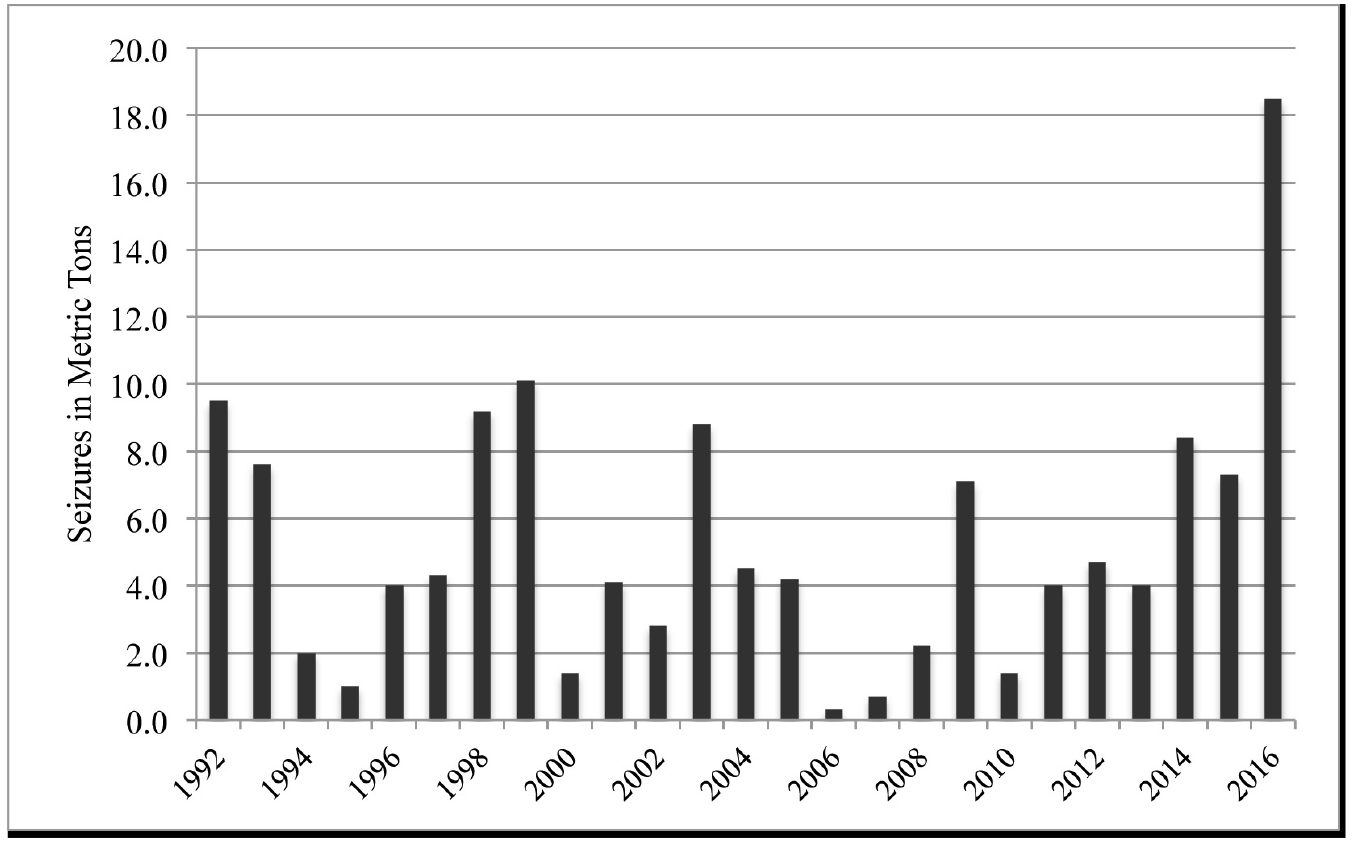
The most frequent indicator authorities use to measure efforts against cocaine trafficking is the very indirect one of annual data on seizures. Figure 1 shows the results across the most recent 25 years, using data supplied by the U.S. State Department in its annual International Narcotics Control Strategy Report (INCSR).Footnote 4 Four points stand out. First, seizures in 2016 were not only the highest on record but almost double the previous bests; preliminary data indicate that 2017 seizures could be as high (U.S. State Department 2018, 171). Second, otherwise, recent years do not emerge as successes: the previous top four years for drug seizures occurred more than a decade—even two decades—earlier. Third, trends in annual cocaine seizures, then, seem unrelated to kingpin decapitation. Indeed, authorities credited the record seizures of 2016 not to law enforcement advances but to increased South American drug production and trafficking (U.S. State Department 2017, 167).
Annual Cocaine Seizures, Guatemala, 1992–2016

The final point comes from comparing President Alfonso Portillo (2000–2004) with his two successors. Seizures were very low during Portillo’s first three years, especially when compared to the prior term of Álvaro Arzú (1996–2000). Portillo was such a disappointment that in January 2003 the United States decertified Guatemala’s antidrug efforts because, as an embassy cable stated, there had been “steadily declining cooperation … in large part due to pervasive corruption” (U.S. EmGuat 2003).Footnote 5 The Portillo administration got the message, and seizures went up substantially for his final full year in office (2003), reaching one of the highest scores across the period. Still, as unreliable as Portillo was as a partner, the annual average for even his disappointing first three years was still better than the comparable scores for the administrations that followed of Óscar Berger (2004–8) and Álvaro Colom (2008–12).
However, whether these seizures have any meaningful relationship to overall amounts being trafficked through the country is an open question. Since what we are trying to measure is an illicit commodity, it is improbable that we could have anything close to reliable estimates of annual ebbs and flows. And even if we did, are variations related more to the sincerity of domestic antidrug efforts or could they instead be more about variations in Colombian supply or Mexican DTO demand— or even traffickers’ strategies?
The best we have are U.S. government estimates, including those occasionally reported in the INCSR. As a baseline, U.S. officials in 1991 estimated 300 to 450 metric tons of cocaine passing through Central America (Christian Science Monitor 1991). The first INCSR estimate that I find for Guatemala itself is from 1999, giving a range of 200 to 300 metric tons of cocaine. For the next year, the range increased to 300 to 400 metric tons. Two years later, the estimate was 300 metric tons; in 2003, it was 200. The next estimate was not until 2010, which estimated 250 metric tons but did not include cocaine arriving from Honduras.6 The report’s estimate for 2015 was 400 metric tons of cocaine. However, the estimate skyrocketed to 1,000 metric tons for 2016 and even further for 2017 to 1,400 metric tons (U.S. State Department 2018, 170). That is, the current level of estimated cocaine trafficked through Guatemala is now more than triple the estimates for previous years—even after a half decade of creating an impressive record of crippling the best-known domestic DTOs.
Drug-related Violence
As an authoritative 2012 UN report on transnational organized crime pointed out, “There is no easy association between the amount of drug trafficking and the amount of violence experienced” (UNODC 2012, 65). Furthermore, homicide rates have multiple additional causes, from family conflict to gang violence. President Colom estimated in 2009 that 41 percent of Guatemala’s homicides were related to the drug trade (El Periódico 2009). That estimate has remained standard, still appearing, for example, in the INCSR for both 2015 and 2016. It is a very rough estimate, though, and problems with the source data have been identified (Dudley Reference Dudley2016; N. Phillips Reference Phillips2015).
Granted the difficulty of establishing causality, the key analytic question is whether DTO decapitation success in Guatemala has coincided with escalating homicide rates, such as occurred in Mexico. We can examine this relationship at the national, departmental, and municipal levels. It should be kept in mind that although the first significant kingpin arrests occurred in Spring 2011 (when both Juan Ortiz and Waldemar Lorenzana were arrested and the government escalated its response to the Zetas), the broader institutional changes that made decapitation possible were put into effect earlier and undoubtedly already were having their own direct impact. These include the initiation of CICIG’s work in 2007 and the many legislative changes of 2008–10.
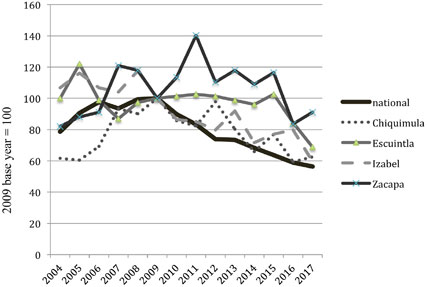
The national trend is broadly consistent with positive results from the Guatemalan antidrug effort, unlike the comparable decades in Mexico and Colombia (see figure 2). Homicide rates leveled at around 45 per 100,000 during 2006–9 after having risen sharply in the prior half decade, but notably have since steadily declined. A significant accomplishment, this contrasts with a comparative study finding the average rate increasing in nine neighboring countries up to 2014 (ICG 2018). However, the association between the Guatemalan decline and the crack-down on leading drug traffickers is loose. Monthly data indicate that the national decline began at the end of 2009 (Mendoza Reference Mendoza2016).
Standardized Homicide Rates in Highest Departments, 2004–2017

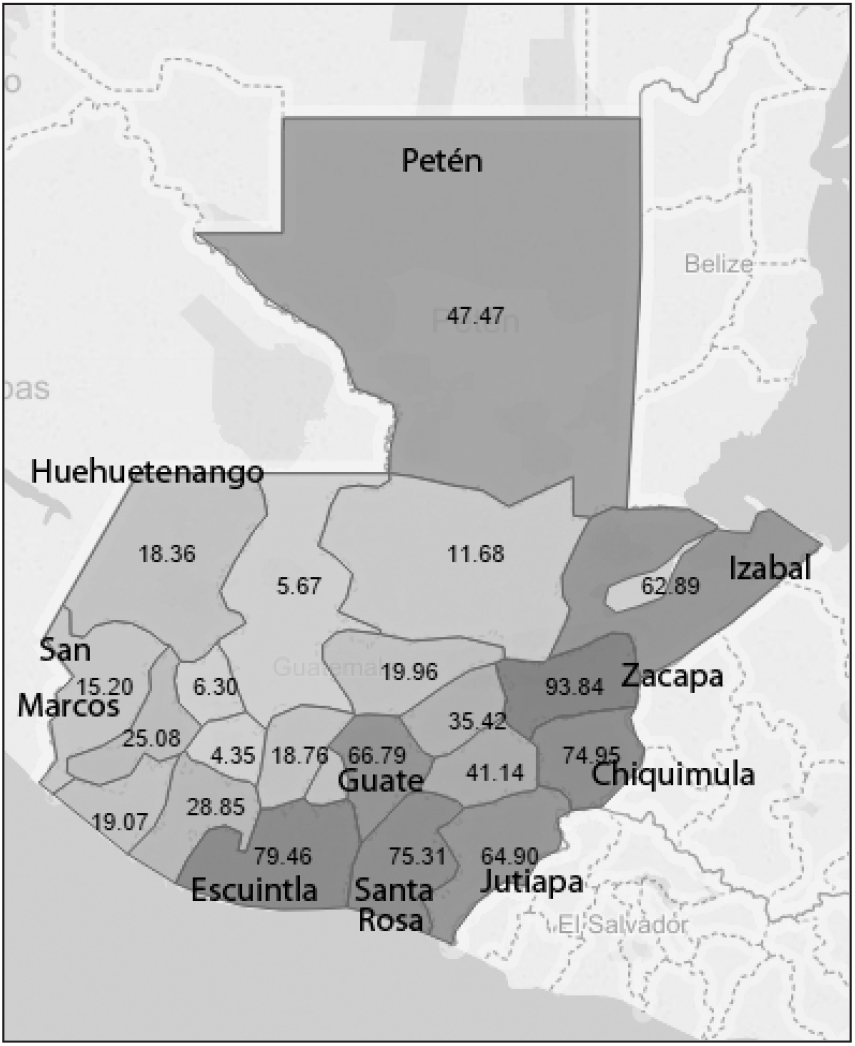
Dropping down to the department level, the trends are again, on the whole, positive. Map 1 portrays homicide rates for Guatemala’s 22 departments in the crucial transition year of 2011. There is a clear regional differentiation, with the higher rates (darker on the map) extending along the eastern third of the country and up to the far north. Computing the annual average rates for 2001–17 finds the highest level of homicides to be in Escuintla (average of 73 per 100,000), which links the capital area and the country’s primary Pacific ports and is crossed by the major coastal highway to Mexico.Footnote 7 The next three are the eastern departments along the Honduran border, from north to south: Izabal (67), Zacapa (66), and Chiquimula (68), each of which had the highest departmental annual homicide rate at least three times over this period.
All these departments are in major drug-trafficking corridors. The relationship to violence is a conditioned one, however, because the three departments on the western side of the country also contain important drug-trafficking routes, but with much less violence (ICG 2014; N. Phillips Reference Phillips and Olson2015). In 2011, homicide rates in San Marcos, Huehuetenango, and Quiché ranged from 6 to 18, compared to Zacapa’s high for that year, 94; the annual rates for 2016–17 for the three western departments ranged from 3 to 10 while Zacapa’s was 59 (highest in the country, along with Escuintla). A primary explanation for the higher homicide rates in the east is that it has been a region of territorially based DTOs with contested control. In this interpretation, it is contested trafficking rather than drug trafficking itself that links with higher homicide rates (UNODC 2012, 66–67; ICG 2014, 4).Footnote 8
Map 1. Homicide Rates by Department, 2011

Figure 2 contrasts the trends for the four departments with the highest homicide rates, along with the nation as a whole (the darker, thicker line). As can be seen, rates have fallen in recent years in each department. However, the relevant issue for evaluating the kingpin strategy is how these departmental decreases compare to the national trend. While not conclusive, departmental declines greater than the national trend would be evidence for success (and declines less than the national, less success). To allow this comparison, figure 2 standardizes the data for the four departments and the country as a whole using 2009, the year when the national homicide rate peaked, as its base.
From the base year of 2009, homicide rates sharply fell in three of the four departments, although none with the magnitude of the national decline. When change is measured from 2011, only Chiquimula decreased less than the national decline. Zacapa far exceeds the national (49 to 27 points), providing the strongest evidence for a hypothesis that the kingpin strategy has reduced violence. When change is instead tracked from the year a department’s homicide rate peaked, all departments except Chiquimula outperformed the country as a whole. However, this decline in homicide rates actually began some years before decapitation policy initiation in both Escuintla (2005) and Izabal (2008). Clearly, then, a closer examination is needed.
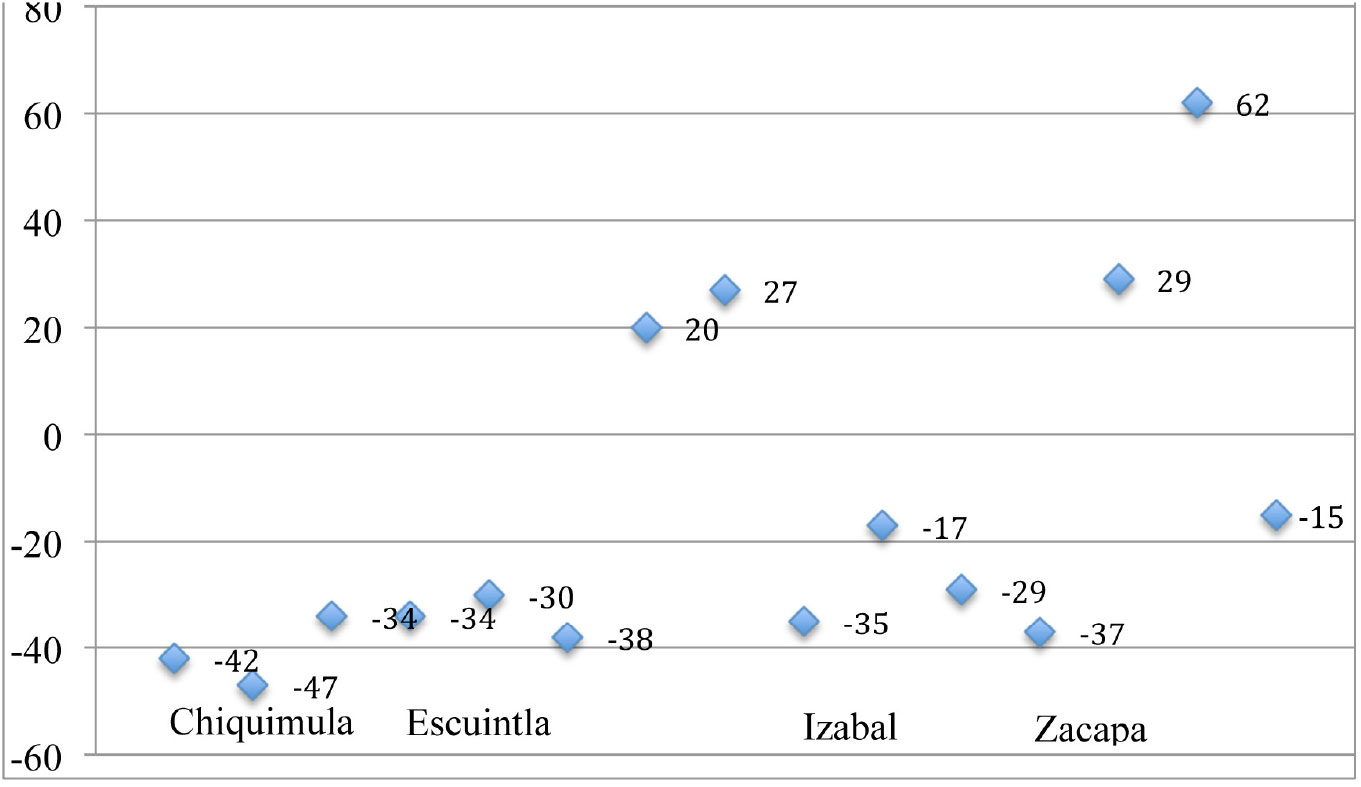
Municipal Homicide Rates: Change from 2009–10 to 2016–17 (%)

Guatemala is divided into 340 municipalities, and their homicide rates vary substantially, in a manner appearing highly consistent with a strong relationship between murder and the drug trade. Of the 10 municipalities with the highest homicide rates for the 2004–13 period, half were in the 3 departments along the Honduran border and the other half were split between the departments of Guatemala and Escuintla.Footnote 9 When the next 10 municipalities are added, the results are much the same: 2 in the east, 5 in Guatemala, 1 in Escuintla, and the remaining 2 along the Pacific highway leading toward Mexico. In 2015, just these 20 municipalities (5.9 percent of the total) accounted for half of all the country’s homicides (Soy502 2016).
Figure 3 focuses on just the municipalities with the highest homicide rates in the same four departments having the highest homicide rates. There are three municipalities in Chiquimula (Chiquimula, Esquipulas, and Ipala), five in Escuintla (Escuintla, Masagua, Nueva Concepción, San José, and Tiquisate), three in Izabal (Los Amates, Morales, and Puerto Barrios), and four in Zacapa (Estanzuela, Rio Hondo, Teculután, and Zacapa). Once again, homicide rates are standardized: this time the baseline is the average for 2009–10, which is just before the initiation of the kingpin strategy. The endpoint averages 2016–17. The data points in figure 3 are each of the municipalities’ change across this period. The 15 municipalities are arrayed alphabetically from left to right, separated by department.
This evidence shows that success can be found at the municipal level as well. The national homicide rate declined 39 percent over this period. This decrease was exceeded by 2 of the 3 Chiquimula municipalities (the first two scores from the left, –42 and –47). Another 5 municipalities fall within 5 points of the national decline, and a total of 9 of the 15 within 10 points. If the analysis were just for Chiquimula and Izabal’s municipalities, the results would be impressive. On the other hand, 2 municipalities in both Escuintla (20, 27) and Zacapa (29, 62) registered increases across this period (as seen in the top half of the figure). As a result, the average for the 15 municipalities was a decrease of only 15 percent, substantially short of the national decline.
In summary, it bears repeating that the relationships among factors that drive homicide rates are complex and clearly vary between regions and years. For longitudinal data, variations in starting and endpoints clearly alter results. Nonetheless, there is sufficient evidence from the previous analysis to conclude that the kingpin strategy in Guatemala did not unleash a wave of violence like the one that has engulfed neighboring Mexico, as well as Colombia for a decade, and that would have been predicted from the decapitation literature based on those cases. Instead, Guatemalan homicide rates have declined in recent years at each level—national, departmental, and municipal.
Accounting for these country differences is complicated, given the multiplicity of variables, including a lengthy civil war in Colombia intermingled with its war on drugs, and Mexico’s long border with the United States. My best explanation is size and permeability. As dominant in their home areas as the largest Guatemalan DTOs once were, they were dwarfed in resource-generating capacity and size by their Colombian and Mexican counterparts. Substantial investments from the international community (notably CICIG and the United States but others, too) greatly strengthened the capacity of the Guatemalan criminal justice system to deal not only with these DTOs but also other sources of violence, such as gangs and delinquents (Dininio Reference Dininio2015).Footnote 10 Furthermore, international actors have been able to push this agenda, even in the face of resistance from the last two Guatemalan presidents and other powerful actors, to an extent that would be highly improbable in Colombia and Mexico. In addition, the most violent criminal force in Guatemala was another international actor, the Zetas. Their eventual eclipse in Guatemala was at least as much a consequence of their crippling in Mexico as of actions in Guatemala.
Still, the record of the Guatemalan departments and municipalities with the highest levels of drug-related violence has been mixed. On the whole, their homicide rates have fallen less than those of the nation itself. However, this average masks a superior performance in some and a dismal record in others, where rates have actually increased. These findings reiterate the lack of any necessary correspondence between the kingpin strategy, drug trafficking, and violence. Indeed, the department with the best record here in reducing homicide rates at the municipal level, Chiquimula, remains the country’s most important entry point for cocaine (López Reference López2017).
Conclusions
In October 2008, Guatemalan president Álvaro Colom and U.S. Ambassador Stephen G. McFarland jointly journeyed to Izabal for a special security cabinet meeting with local participants. They were told by the director of military intelligence, according to the U.S. embassy report, that “narcotraffickers have outclassed state security forces in nearly every way” in the region. An officer complained, “everyone knows what’s going on, and everyone shuts up.” That included even President Colom, who observed that in Izabal “there are last names we cannot say, and places we cannot go.” The confidential U.S. embassy cable did say them: the “Lorenzana and Mendoza narcofamilies” (U.S. EmGuat 2008a).
Soon thereafter, Guatemala made great strides back from the brink of becoming a failed narcostate by strengthening the capacities of its criminal justice system and bringing numerous leading narcotraffickers to justice. Notably, this has included the Lorenzana and Mendoza families, operators of the country’s longest-lasting major domestic drug DTOs, along with Juan Ortiz López, usually described at the time of his arrest as the country’s most important drug lord. Significantly, implementation of the kingpin strategy in Guatemala has not triggered escalating violence like that experienced in Mexico and predicted by the related literature. Instead, the homicide rate has dropped in the departments that have chronically suffered from the highest levels of drug-related violence, as well as in a large majority of their most violent municipalities.
Unfortunately, though, these decapitation successes have not reduced the level of cocaine trafficking itself. Indeed, the increase has been dramatic in the most recent years, despite impressive concurrent gains in drug seizures. Accordingly, the Guatemalan experience is more like that of Colombia, where homicide rates eventually began falling yet cocaine production and exports are currently at record levels (Tokatlian Reference Tokatlian, Bagley and Rosen2015). Furthermore, it must be acknowledged that Guatemalan successes have most probably been at the expense of expanded trafficking in Honduras (Fonseca and Pestana Reference Fonseca, Pestana, Zepeda and Rosen2015).
Corruption remains rampant in Guatemala, including at the highest levels of government, despite all the impressive improvements in the criminal justice system that have been described here. Former president Otto Pérez Molina and a number of other top officials from his 2012–15 administration are in jail, facing charges from massive corruption schemes, including receiving money from drug cartels, such as the Zetas (El Periódico 2017b; 2018). CICIG was crucial in bringing these charges, yet at the time of this writing, it was locked in a perhaps mortal showdown with the current president, Jimmy Morales (2016–). Facing corruption charges against family members, his party, and potentially himself, in 2017 Morales barred CICIG’s director from the country and stripped top investigators of their visas (ICG 2018). The future of Guatemala’s criminal justice efforts, then, is uncertain. The successes of any strategy, of course, are constrained by the integrity of those who are in charge.