Throughout the nineteenth century, opera served as a central element of a broadly based popular culture in the Americas. While a few cities had regular opera seasons, in most, the works of Rossini, Donizetti and other favourites were heard in a myriad of arrangements, transcriptions and fantasies, performed by brass bands, piano teachers and amateur vocalists. From the 1840s, both North and South Americans increasingly enjoyed this music in performances by touring professionals. With a repertoire drawing heavily on opera, soloists such as Jenny Lind, Henri Vieuxtemps and Sigismond Thalberg earned large sums from their travels, while itinerant troupes brought opera – most often in the form of excerpts with little staging – to towns and cities across the continent, on a circuit that carried them through Canada.Footnote 1
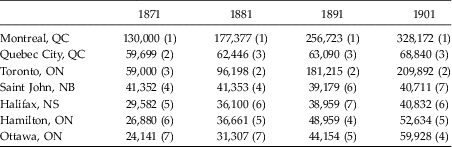
In Canada, however, the popularity of operatic music did not easily translate into local opera productions. From the final years of the eighteenth century to the 1870s, there were only a few attempts to produce opera.Footnote 2 At a time when patronage was rare and government subventions non-existent, opera was a form of commercial music like any other. Not only were there financial obstacles to producing it, but the country had no music schools to train the singers and instrumentalists it required.Footnote 3 Canada's first famous musician, Emma Albani (née Lajeunesse), received her early training in a convent school and then completed her studies in Europe. Few young musicians were able to fund overseas studies, however, and without music schools few cities had enough well-trained singers and instrumentalists. In the 1870s, even Montreal, the country's metropolis with a population of over 160,000, relied on touring companies (see Table 1).Footnote 4
The largest urban centres in Canada, 1871–1901: population (ranking)

Source: Population, 1871–1931 (Ottawa: J.O. Patenaude, 1934): 8–9.
This article examines in detail one effort to change that situation: the productions of the short-lived Société Canadienne d'Opérette et d'Opéra de Montréal. It explores the social and cultural milieu at the time the company came into existence and the reception of its productions. It also considers the goals of the company's creators, Calixa Lavallée and Frantz Jehin Prume, which many have begun as simply presenting a stage work to a local audience, but which soon expanded to include establishing a provincial conservatory. The project, although ultimately unsuccessful, was likened by its supporters to an act of patriotism, and serves as an example of the challenges facing pragmatic and determined musicians seeking to develop civic musical institutions.
§
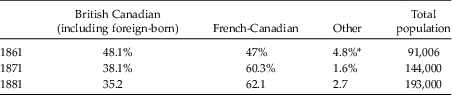
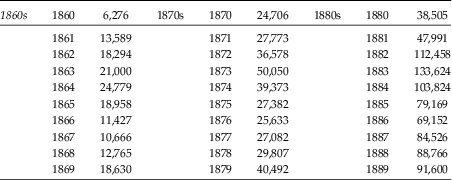
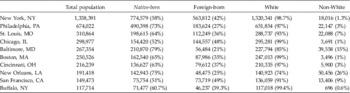
Montreal in the 1870s was a city in transition. Since the early 1860s it had changed demographically in a number of ways. In 1861, 29 per cent of the city's population of 91,006 was foreign born, while linguistically the population was nearly equally divided between English- and French-speaking inhabitants (Table 2). Through the 1860s, the Francophone proportion of the population rose, as French Canadians from surrounding areas migrated to the city. Although we have no statistics on the number of foreign-born residents after 1861, the number undoubtedly declined as a proportion of the overall population, despite the continued immigration (Table 3). In the wider context of North America, Montreal's diversity was unique in character but significantly lower in proportion than in many US cities (see Table 4).Footnote 5
Montreal population by origin

Sources: For 1861 (population of the City of Montreal, only), Census of 1861 published in MacKay's Montreal Directory for 1863–64 (Lovell, 1863: 368). For 1871–1901 (figures for the Island of Montreal), Norbert Lacoste, Les Caractéristiques sociales de la population du grand Montréal (Montreal: Les Presses de l'Université de Montréal, 1958): 77; Cited in Andrew Sancton, Governing the Island of Montreal: Language Differences and Metropolitan Politics (Berkeley and Los Angeles: University of California Press, 1985): 15.
*The ‘other’ in 1861 were born in Lower Canada, 121; Upper Canada, 1,208; France, 184; Germany, 363; US, 1,706; other countries, 793.
Immigrant arrivals in Canada, 1860–1889

Source: Statistics Canada. Table 075-0001 – Historical statistics, estimated population and immigrant arrivals, annual (persons), CANSIM (database), Using E-STAT (distributor). http://estat.statcan.gc.ca/cgi-win/cnsmcgi.exe?Lang=E&EST-Fi=EStat/English/CII_1-eng.htm (accessed 14 May 2013).
The ten largest US cities in 1870

Source: Ninth Census, Volume I. The Statistics of the Population of the United States, Embracing The Tables of Race, Nationality, Sex, Selected Ages, and Occupations (Washington, D.C.: Government Printing Office, 1872). http://www.census.gov/prod/www/decennial.html
Like many of the major cities of the US, this diverse population gave rise to numerous divisions, but unlike those cities, Montreal retained a fundamental sociocultural division, whose origins dated back to the British conquest of New France. While the city's coat of arms, designed in 1833, identified the dominant groups—with a fleur-de-lys, rose, thistle and shamrock, representing the French, English, Scottish and Irish, respectively – its motto, ‘Concordia Salus’ (‘salvation through harmony’), spoke more of a goal than a reality, as conflicts over politics and religion were part of daily life.Footnote 6 By 1877, a decade after Confederation had brought together several of Britain's North American colonies as a new country, the various components of Montreal society were still far from united.Footnote 7 Even beyond the basic French–English distinction, those of British ancestry and new immigrants from the British Isles retained their respective identities in part through membership in churches and national societies. Newspapers gave voice to these differences: several of the city's English-language dailies were decidedly pro-Protestant, among them the Witness and the Herald, while the Post catered primarily to an Irish Catholic readership. The Gazette, fervently Tory in earlier years, was now relatively moderate, as was the more recent addition, the Evening Star. The French-language dailies had clear alliances: La Minerve to the Conservatives, Le National and La Patrie to the Liberals, Le Nouveau monde to the Catholic Church.Footnote 8
The same newspapers serve now as the primary source of information on cultural life in the city. To some extent, the linguistic or ethnic makeup of audiences at professional concerts in Montreal can be inferred through what was advertised and discussed in the newspapers (as I discuss below). Music reinforced differences, as could be heard in the marching bands on St Patrick's Day and on the Orangemen's commemoration of the Battle of the Boyne, in the annual French-Canadian Fête Nationale concert, as well as in the dance bands that performed in hotel ballrooms on St George's Day and St Andrew's Day. Each of these events was given prominence in the newspapers that catered to the community most concerned, as were, for example, the charity concerts held throughout the year. These events were aimed at audiences from those communities and usually involved participants from within the same communities. Among both amateur and semi-professional musicians, it was rare for members of the city's different linguistic groups perform within the same ensemble or attract audiences from beyond their linguistic community.Footnote 9 To create broadly civic arts institutions promoters would have to earn support across the political, religious and national lines.
In this context, creating broad-based arts institutions was challenging but not impossible. In larger North American cities, diversity did not prevent the establishment of civic arts institutions. In New Orleans, the large French population cultivated opera from the beginning of the nineteenth century. Predominantly English Boston opted for oratorio. New York, with its large German population and its sheer scale, usually had competing opera companies and in 1842 established the New York Philharmonic. In Montreal, however, amateur ensembles rarely developed the audiences needed to sustain them. In the late 1870s, there were German and English choral societies, an amateur orchestra and the professional Band de la Cité. For their entertainment, however, citizens still relied mostly on visiting artists based most often in New York.
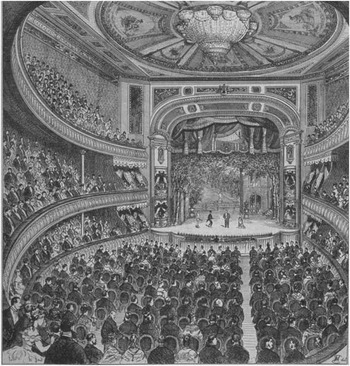
Performance venues for these artists and for local performers were plentiful, but increasingly they reflected Montreal's widening linguistic and economic divisions.Footnote 10 The Theatre Royal had been the city's main theatre since opening in 1852. Its location, on Côté Street in what is now Chinatown, was considered central when it opened, and it served both the English- and French-speaking citizens. After a quarter of century, it was conveniently located to central neighbourhoods and the predominantly Francophone east end. The more affluent elements of the Anglophone population, however, had migrated northward from the old city, building grand homes in what was becoming known as the ‘Square Mile’. Sainte-Catherine Street West was the community's fashionable new commercial street. Since 1860, it had been home to the Crystal Palace, which had been built for that year's Industrial Exposition and the visit of the Prince of Wales (later King Edward VII).Footnote 11 By the early 1870s, it was joined by the 1,100-seat Queen's Hall, which had opened in time to host Anton Rubinstein during his 1872–73 concert tour, and, in 1875, by the city's grandest theatre: the 2,100-seat Academy of Music. Commissioned by a consortium led by shipping magnate Sir Hugh Allan, the Academy was designed by architect Andrew B. Taft and constructed of brick with a stone façade. Inside, it offered four orchestra sections, four boxes, and two balconies, and a stage that was slightly larger than that of the Theatre Royal (see Fig. 1).
The Academy of Music, Victoria Street, Montreal, at the time of its opening. Canadian Illustrated News 4 December 1875.

The city's growing wealth helped it to attract musicians from abroad, many of whom were drawn to opportunities within the Anglophone community. The organist Charles F. Davies arrived in about 1870, after holding positions in and around London, and established himself as a teacher and church musician. The Scottish musician Peter Maclagan arrived in about 1873 to assume the post of organist at Christ Church Cathedral. He soon took up other activities, establishing the Beethoven Quartet Club and serving as conductor of the Philharmonic Society. When he left his post at the cathedral, it was filled by the English organist Frederick Lucy-Barnes, who arrived in 1878 with his wife, the soprano Lenora Braham. Both Barnes and Braham had been connected with the German Reeds theatre in London, and they pursued their careers in both Montreal and New York.
While these Anglophone musicians cultivated ties primarily in their own linguistic community, in the summer of 1875 four Francophone artists arrived in the city and set about establishing themselves within both communities. Calixa Lavallée and Guillaume Couture had returned from Paris, where they had been studying. Both were already experienced musicians. The 26-year-old Couture had worked as a church musician, teacher and critic, activities to which he quickly returned. Lavallée, then 33, had spent most of his professional life in the United States travelling as a musical director of a minstrel troupe. This was an unconventional background for an opera director, but minstrel performances usually began with opera overtures, concluded with a parody based on a popular opera, and included a variety of other vocal and instrumental numbers. Lavallée had also briefly led a ‘parlour opera’ troupe and in 1870, while working in New York, he had composed an operetta (which had not yet been performed). Also returning late that summer was the Belgian violinist Frantz Jehin Prume and his Montreal-born wife, Rosita del Vecchio, after a two-year stay in Europe.Footnote 12 Jehin Prume was the nephew of the famous violinist and composer François Prume. During his first visit to Montreal in 1865 he met the amateur vocalist Rosita del Vecchio, whom he married in 1866. After this, they resided part of the time in Montreal, while he continued to tour in both North America and Europe. Del Vecchio had made her professional debut in November 1868 and continued to study while in Europe; she expanded her repertoire to include such demanding arias as that of the Queen of Night, from Mozart's The Magic Flute. In November 1875 the critic Joseph Marmette hailed her Quebec City debut as a triumph, writing that her voice ‘captivates, moves and ravishes by the extreme charm of her diction and phrasing’.Footnote 13 She had garnered similar praise in Montreal. Prume and Lavallée had performed together in 1865 and on several occasions since then. From the fall of 1875, Lavallée, Jehin Prume and del Vecchio established a teaching studio in an upscale Anglophone neighbourhood, and began presenting concerts of chamber music and operatic works in both Montreal and Quebec City.
It was through a series of seemingly disconnected events that this group of musicians became opera producers. In the summer of 1876 Couture decided to give up his position as music director at Saint-Jacques Church and return to Paris. Lavallée then accepted Couture's post, considered one of the most important in the city. Saint-Jacques had been a cathedral before being destroyed by fire in 1852. It was rebuilt as a parish church but remained geographically at the heart of Francophone Montreal; its spire, newly completed in 1876, soared 85 metres above Saint-Denis Street. Serving as its music director was a demanding job that was made more difficult by the Church's conservative hierarchy, led until 1876 by Bishop Ignace Bourget and then by his protégée Édouard-Charles Fabre. In 1878, Bishop Fabre passed a decree forbidding the use of mixed choruses in diocesan churches, but the idea was already being discussed at the time Lavallée took up the job, and in the spring of 1877 he resigned from his post.Footnote 14 But rather than simply dissolving the choir, he decided to make it the basis of a theatrical production, and the starting point for the Société Canadienne d'Opérette et d'Opéra de Montréal. The unwieldy title, abbreviated here as the Société, stamped the company as French-Canadian and its repertoire as potentially wide-ranging.
§
Charles Gounod and Jules Barbier's lyric drama Jeanne d'Arc was to be the first work produced by the Société. Barbier had provided a cantata text on the Joan of Arc story for Gustave Serpette's winning entry in the Conservatoire's 1871 Prix de Rome. The subject had served well in the immediate aftermath of France's humiliating defeat in the Franco-Prussian War. The expanded text used in Gounod and Barbier's adaptation had been conceived and assembled to replicate Serpette's success on a larger scale. The work's creators had reason to expect Parisians would embrace Jeanne d'Arc for its patriotic values, but audiences and critics alike received it coolly when it was first produced at the Théâtre de la Gaîté in 1873.Footnote 15
The details of how Lavallée and Jehin Prume came to choose Jeanne d'Arc remain uncertain.Footnote 16 Both had been in Europe at the time it was first performed: in the months before the premiere, Jehin Prume and del Vecchio had been in Spa, Belgium, when Charles Gounod visited there in 1873. Lavallée was in Paris at the time of Jeanne d'Arc's premiere. He, Jehin Prume and del Vecchio would all have been well acquainted with the demands of the work. For the Société, it was a somewhat unusual choice, as, strictly speaking, it was not an opera but a stage play, and the company's performers were singers with no stage experience. On the other hand, French Canadians were familiar with Gounod's music, even if only from excerpts heard in concert, and readers of l'Opinion publique had learned of Jeanne d'Arc in 1873.Footnote 17 More importantly, the subject would appeal to Francophone nationalists while containing little that might offend the sensibilities of the Catholic Church. Gounod's music was composed mostly for chorus rather than for soloists, making it possible to rely on Lavallée's singers. The work was obviously also seen as a vehicle for the 30-year-old Rosita del Vecchio who had not yet made her stage debut.
Although little is also known about how the production was funded, it is clear that costs were substantial and that they concerned the producers. In early April, the Canadian Illustrated News reported that ‘the outlay for costumes, scenery, and other accessories [amounted] to more than $2,000’.Footnote 18 Lavallée and the Prumes held a concert at the Mechanics’ Hall on 2 March 1877 to raise money for this project.Footnote 19 The concert, however, may not have raised a large amount; a review published the next day in Le Nouveau monde called the event a ‘brilliant success’’ but also mentioned it had been performed for the community's ‘elite’, and noted the ‘unfavourable weather’; both comments suggesting a light turnout.Footnote 20 It is not known where Lavallée and Prume raised whatever additional funds they required; if the project had financial backers, they seem to have remained anonymous.
Lavallée and Prume may have been relying on ticket sales to cover expenses. If so, then to succeed financially, Jeanne d'Arc would need to attract an audience from both of Montreal's linguistic communities. Given their reputation and the subject of the work being performed, Lavallée and Prume could expect the support of the French-speaking population. Anglophones were more unpredictable, and perhaps partly for this reason they opted to stage the work at the Academy of Music. The interest of the Canadian Illustrated News would have been a promising sign of Anglophone interest. In its 7 April article, it provided its readers with a number of facts about the company, reporting that 239 persons where involved in the production in some way, with a cast comprising ‘34 active parts, 10 silent parts and 40 figurants.’Footnote 21
Advertisements for the show listed a chorus of 80 singers and an orchestra of 50 musicians. Assembling an orchestra of this size would have been a formidable task, as competent string players were in short supply. Aside from del Vecchio in the lead role, choir members filled the rest of the cast, many of them closely connected in some way. The role of King Charles VII was played by Charles Labelle, a 27-year-old lawyer.Footnote 22 Paul Dumas, editor of the Revue Canadienne, played Jacques, Joan of Arc's father. Among the female cast members were Octavie Desmarais (as Saint Marguerite), Clorinde Gauthier (as Saint Catherine), and three of Lavallée's younger sisters, Cordélia, Catherine and Ida, in minor roles. As none of these performers was a professional, Lavallée and Prume brought in the stage manager Achille Génot to prepare them.
After three months of preparation, Jeanne d'Arc opened on Monday 14 May for a six-night run. Evidence suggests that the audiences were both large and receptive. Critics wrote favourably about all aspects of the production. Le National took the lead in promoting the production, running not only their own previews and reviews but also reprints of what the other newspapers were reporting. On Wednesday they opened their review: ‘The production of “Joan of Arc” at the Academy of Music is an event whose scope can escape no one. This artistic display marks the beginning of a new era for us, and the organizers who produced the work, the artists who contributed to it and the public who encouraged it must also be proud as we in the great success they have achieved.’Footnote 23 Coverage of the performances in the English-language press indicates that the production indeed drew an audience from both linguistic communities.Footnote 24 The Canadian Illustrated News published some of the more judicious observations, concluding that the production was ‘a brilliant artistic as well as financial success’, and congratulating ‘the enterprising managers, Messrs. Prume and Lavallée’, advising that, with Génot, they ‘should form a regular company, … [as] the soprano is toute trouvé in Madame Prume’.Footnote 25 The comment may indicate that Lavallée and Prume had not yet considered the future. Three days earlier, they had issued a lengthy note of thanks to the organizing committee, the participants, the public and the press, but in it said nothing specific about their plans.Footnote 26
A little over a week after Jeanne d'Arc closed, Montreal's English-speaking community had a comparably grand event of its own: a three-day music festival modelled on the triennial festivals in Boston and Cincinnati. The festival was organized by Peter Maclagan, who staged it in the Victoria Rink, just a few blocks from the Academy. Maclagan had a pipe organ erected in the arena, assembled a chorus of about 140 singers, brought in soloists from Boston, and expanded the ranks of the Philharmonic Society with musicians from the United States. Both Lavallée and Jehin Prume joined in, playing in the orchestra. By a remarkable stroke of poor luck, the festival coincided exactly with a three-day engagement of P.T. Barnum's circus, which had set up its big top at the Montreal Lacrosse Club grounds.Footnote 27 With big advertisements and daily parades of his menagerie, Barnum provided formidable competition for the music festival. The Daily Witness, which had been taciturn on Jeanne d'Arc, came to Maclagan's defence, providing a detailed account of the opening night's performance of Handel's Messiah, reporting the audience to have been the largest ‘ever gathered in Montreal to listen to an entertainment purely musical’, and describing the event itself as the ‘greatest undertaking of its kind ever attempted in the city’.Footnote 28 But despite this claim, the festival does not seem to have crossed Montreal's linguistic divide as the Société's production had: Le National was silent on the event, despite the participation of Lavallée, Prume and a number of other French-Canadian performers.
In June, Lavallée and Prume returned to Victoria Rink to host the Fête Nationale concert. As usual on that occasion, the concert attracted Mayor Jean-Louis Beaudry and numerous provincial politicians.Footnote 29 In addition to selected instrumental works, the concert featured music from Jeanne d'Arc, with Lavallée's chorus and soloists Rosita del Vecchio, Cécile Hone, Clorinde Gauthier and Charles Labelle. But this was not the last the public would hear of Jeanne d'Arc. In November, despite the absence of Prume and del Vecchio, who had returned to Belgium on family business, Lavallée restaged it.Footnote 30 Taking del Vecchio's place was Theresa Newcomb, then a member of the stock company at the Academy of Music, and on 19 November the production once again opened for a six-night run, this time at the Theatre Royal. Critics received Newcomb warmly. After the opening night La Minerve concluded that, while Newcomb could not make one forget Madame Prume entirely, she ‘filled one with admiration’: ‘Her diction is perfect, her intonation rich and varied, her poise and taste artistic; she is, in a word, an enchanting actress.’Footnote 31 Le National called the first performance an artistic and popular success, and predicted Newcomb would become a star of the French-language stage.Footnote 32 The Star noted simply that ‘too much praise cannot be given her’.Footnote 33 The public appears to have agreed, as Lavallée added six nights, with benefit performances for the cast and crew during the week, and a fund-raiser for the poor on closing night, 1 December.Footnote 34
§
With no sign of Prume and del Vecchio returning from Europe, 1878 found Lavallée forced to decide his own way forward. His goals had evolved by this time into something much more than simply keeping a choir alive. Through performance, the company was to help build the case for a provincially funded music school. It could also develop audiences for opera (and especially for French-language opera), and grow into an enduring civic institution and a point of pride for the community. To achieve all of these goals, he had to bring the provincial government on side. The economic environment already made this a challenge, and a political scandal that became known as the ‘Letellier Affair’ would complicate things further.Footnote 35 If that was not enough, Lavallée also had to avoid a confrontation with the Church, so repertoire had to be selected carefully.
By the beginning of March, plans were well underway for a new stage production. Some of the choices were not difficult to make. Of the three basic categories of French musical theatre, grand opera was too costly to produce and required a whole cast of professionally trained singers. Opéra bouffe was manageable on a budget, feasible in its vocal demands, and popular with audiences, but did not project the dignified image expected of a national opera, especially under the glare of bishops Fabre and Bourget. So it really had to be opéra comique: serious but not too serious, with a mix of music and spoken text, it could be produced without elaborate staging or foreign singers. The genre was known mostly through performances by visiting troupes and innumerable concert performances of selections and overtures. From this repertoire Lavallée made an obvious choice for the fledgling opera company: François Adrien Boieldieu's La Dame blanche.Footnote 36
As part of a larger scheme of winning support for a conservatory, La Dame blanche was an opera with something for everyone. Although, like most of the popular opéra comiques of the Romantic era, it dropped out of the standard repertoire in the early years of the twentieth century, in 1879 it was still much admired and often performed. It had been performed more than 1,000 times at the Opéra Comique in Paris. It had been seen in London, New York and New Orleans, and throughout continental Europe. It was especially popular in Germany, where it was usually sung in German. Boieldieu's score spawned numerous instrumental fantasies and even some satires. Nor was it unknown in French Canada. The first act had been staged in Quebec City in the 1850s by the French immigrant Antoine Dessane.Footnote 37 In his 1871 memoire, Adolphe Adam, a student of Boieldieu's, devoted a chapter to La Dame blanche and his own role in its creation, and this had been reprinted by the Canada musical in 1875.Footnote 38
The opera is one of many based on the stories of Sir Walter Scott.Footnote 39 Here, librettist Eugène Scribe adapted elements from two of Scott's novels, Guy Mannering (1815), which tells the story of Harry Bertram, the son of the Laird of Ellangowan, who, having been kidnapped as a child, makes his way home to Scotland and fights to reclaim his inheritance, and The Monastery (1820), which is set in southeast Scotland in about 1550, and tells of the fate of the Avenel family and the threat to Kennaquhair monastery. Scribe retained the eighteenth-century setting of Guy Mannering, aspects of its general conflict, and some of its main characters. From The Monastery he took the mysterious White Lady, the protector of the Avenel family. He omitted from the libretto the more serious elements of Scott's novels, such as the depictions of criminality in the eighteenth century and the more violent aspects of the Scottish Reformation. The main roles are George Brown (tenor), a young officer in the English army who, unknown even to himself, is Julian Avenel; Anna (soprano), a young woman who as an orphan was raised by the now-deceased Count and Countess of Avenel; Dickson (tenor) and Jenny (soprano), tenant farmers on the Avenel estate; Marguerite (contralto), the Avenels's elderly servant; Gaveston (bass), the scheming former steward of the Avenels's estate; and MacIrton (bass), a justice of the peace. The libretto is a model of opéra comique aesthetics: dramatic and entertaining, with much mistaken identity, and a clear sense of good and evil.
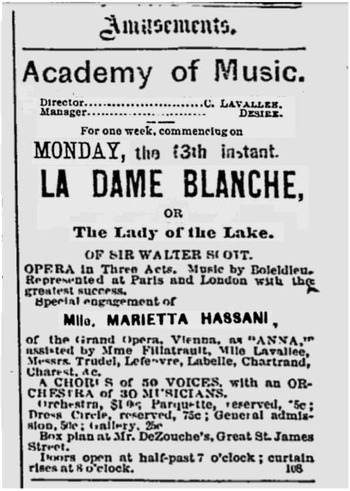
In Montreal of the 1870s, La Dame blanche was a story that worked on a number of levels. Perhaps foremost, there was nothing in the story to which the Catholic Church could easily object. With its rustic setting and focus on life around the Avenel estate, it recalled the quasi-feudal society of New France and the only recently abolished seigneuries. For some, George Brown likely brought to mind the returning émigré – one not unlike Lavallée himself (as he had spent year in the Union Army during the US Civil War). But Montreal Anglophones, too, had much to admire in La Dame blanche. In a country dominated by Scottish industrialists and politicians, producing an opera based on Walter Scott's novels was an inspired choice, and Lavallée marketed accordingly.Footnote 40 Whereas the advertisements in the French-language press emphasized Boieldieu's name, those in English drew attention not only to Scott but also to his most widely read work of the time The Lady of the Lake (see Fig. 2). On 17 April, The Gazette published an article about the forthcoming production, discussing the origins of the libretto and providing a good synopsis of the plot, emphasizing the popularity of The Lady of the Lake, while noting ‘necessarily a flavoring of the “Guy Mannering” stamp.’Footnote 41 The writer describes the music as being ‘suitable to the words and scene’, mentions the costumes (‘the garb of old Scotland’) and the ‘irresistible charm of the legend’, all likely leading to a successful production.Footnote 42
Advertisements for La Dame blanche in the English-language press in Montreal in 1878, emphasizing Sir Walter Scott and his best known work at the time, The Lady of the Lake, even though it was based on different works by the Scottish writer. The Gazette, 13 May 1878.

Although it went unmentioned in the lead up to the opening, Boieldieu's score also contained a number of references to Scotland. The first comes just 12 bars into the overture in the form of a quotation from the tune ‘The Bush Aboon Traquair’, a melody that does not appear later in the opera.Footnote 43 A second appears at the Allegro, in the form of a march tune.Footnote 44 The composer makes only sparing use of the ‘scotch snap’, but it appears most notably in the final section of ‘Chantez, joyeux ménestrel’, sung by George and the chorus near the end of Act III.Footnote 45 Among the more popular numbers in the opera is Jenny's ballad of the white lady (‘Prenez garde’), from Act I, George's ‘Quelle plaisir d’être soldat’, and George and Anna's duet ‘Ce domaine.’Footnote 46
Once again, Lavallée cast members of his choir in most of the main roles. George Brown was played by Tancrède Trudel, a 30-year-old physician. Charles Labelle took on the role of Dickson. The remaining male leads, Gaveston, MacIrton and Gabriel, were played by three relatively inexperienced members of Lavallée's choir, Frédéric Lefebvre, Félix Chartrand and Auguste Charest. Lavallée's sister, Cordélia, played the part of Marguerite. Octavie Desmarais (now married and known as Octavie Filiatreault) played Jenny. There is no surviving membership list of the 50-voice chorus, which Lavallée dubbed the ‘Montagnards Ecossais’ (Scottish Highlanders).
In the absence of Rosita del Vecchio, Lavallée chose to have a professional singer fill the demanding role of Anna. The decision could have been justified on musical grounds alone, but it also acknowledged the need to have an international performer in the cast. He kept the identity of the star attraction a secret until March, when he announced that he had signed Marietta Hassani. Local newspapers reported Hassani to be a regular member of the Vienna Grand Opera – presumably the Vienna Court Opera (Wiener Hofoper) – but published no biography to support the claim, no doubt because Lavallée chose not to provide one. She had in fact arrived in Montreal by way of South America, having been with a French company in Brazil in 1876 and 1877, performing at Rio de Janeiro's Alcazar Lyrique. Her roles there were more eclectic than Lavallée might have wanted the public to know. They included Leonora in Verdi's Il Trovatore, Euridice in Offenbach's Orphée aux Enfers, and Jeanne in Paul Lecombe's new opéra comique, Jeanne, Jeannette, et Jeanneton.Footnote 47 The reasons for promoting Hassani in Montreal as Lavallée did are obvious: while she may have been adept at serious roles, she had been appearing mostly in opera bouffe, a form of theatre to which the Catholic Church most strongly objected.
Nevertheless, as an opener, Lavallée added to the programme Octave Feuillet's one-act domestic comedy from 1860, Le Cheveu blanc! (The White Hair!). It was a clever thematic tie-in with La Dame blanche, but must have made for a long evening. For this piece, he hired Anna Granger Dow, a French-trained actress and soprano who had taken part in Maclagan's festival in 1877, and whose company had since that time played an engagement at the Academy of Music.Footnote 48 In Le Cheveu blanc! she starred alongside actor and stage manager Monsieur Désiré.
A bilingual libretto of La Dame blanche that Lavallée had produced for sale at performances provides many of the surviving details about the 1878 production.Footnote 49 To design and build the sets, he hired the painter R.J. Garand, who had worked on the Jeanne d'Arc production. The costumes were designed by tailor Joseph Chrétien and made by the Saint Lawrence Street tailor shop of Boisseau & Frère. Some of these costs were covered through advertisements placed in the libretto. The libretto was itself an important factor for attracting an Anglophone audience, as it provided a rhyming English-language translation (uncredited). It faithfully followed the original text, which was itself unaltered, with just one judicious exception: it omitted to note that the story was set in Scotland in 1759, the year of the Conquest of New France – a coincidence to which Lavallée would not have wanted to draw attention.
Full rehearsals began in early April. By this time Lavallée had assembled a 30-piece orchestra, whose members included his father and his brother Charles. On 10 April, Marietta Hassani arrived in Montreal.Footnote 50 This left only a little over a week to complete preparations. Since Sunday 21 April was Easter, the final full rehearsal was held on Saturday. On Friday, The Gazette announced that the rehearsal would be open to the public, and the following Monday noted that it had been well attended. The same Monday notice reminded its English-speaking readers that as an opéra comique, La Dame blanche was ‘the antipodes of opera bouffe.’Footnote 51
The production then opened on Monday 22 April, for a six-night run. On 24 April, Le National published a full review, drawing attention to most of the leading performers and placing some emphasis on the significance of the production:
So we finally have the right to say that we can appreciate the art of music in Canada, whereas until very recently so many people did not. But it was enough last night to see the large audience enthusiastically applauding our artists to convince us that French-Canadians love music. If one had not been able to prove this fact before now it has been due to a lack of opportunity. In the future, our ability to distinguish between entertainers and real musicians will be the proof of our good taste and progress in the arts.Footnote 52
Le National followed up each day with updates from the previous night and reminders to the public to show their support for the company. The Gazette's review was unsigned but evidently written by a singer, given its focus on technical aspects of singing – and its even-handedness lends it much credibility as an objective assessment of the performance. The writer begins with some harsh comments on the ensembles, referring to ‘the want of finish in some of the duetts [sic] and arranged parts for three or more voices’, and giving the example of the auction scene (which, to be fair, would be quite a challenge to bring off well). Hassani was said to have ‘a voice of great power’ but sometimes exhibited ‘a lack of warmth’. The writer continued, ‘she acts fairly, dresses admirably and is pleasing in form and feature’. The love duet between Anna and George Brown (‘Ce domain’) was described as ‘decidedly well rendered, except that M. Trudel's bad habit of singing falsetto marred the effect’. The writer offered several more observations on Trudel's vocal production, and concluded by describing his acting as ‘capital throughout’. Among the other local performers, Lefebvre was said to have ‘sung his parts admirably’, but was limited as an actor, Filiatreault ‘made good use of a very sweet and well-trained voice, while her acting was natural and easy’. The chorus was described as being ‘very well together, and in much better form than the orchestra, which was very often harsh with the soloists. To look back at the whole performance, it must be said that to have produced such an effect from among our amateurs with the aid of one professional prima donna is creditable to all concerned, and we trust that the efforts of Mr. Lavallée will be encouraged’. The writer concluded by reminding readers of the Scottish setting and noting that the production would be ‘very interesting to many who have read Sir Walter Scott's manner of dealing with the legend of the white lady of Avenel’.Footnote 53
In La Minerve, Guillaume Couture, who had returned in December, published a review that focused on Hassani. He described her performance as ‘very intelligent and very competent’, but added that ‘her movements and gestures are too solemn for opéra-comique’. He attributed these ‘shortcomings’ to what he believed to be her previously singing ‘nothing but grand opera’, which suggests that Lavallée may not have let even Couture in on Hassani's previous experience – or that Couture was willing to support his colleague's prudent reticence about it.Footnote 54 Couture also discussed the other performers. Without mentioning him by name, he dismissed Trudel's contribution as Georges Brown: ‘What is missing in the performance that would make La Dame Blanche really good? A first class tenor. A rare bird; not always found even on first-rate stages.’Footnote 55 More generally, Couture was pleased by the progress made during his absence. He praised the quality of Lavallée's chorus and orchestra, referring to him as ‘a genuine conductor. The first we have possessed.’Footnote 56 Coming from Couture, this was high praise and acknowledgement that Lavallée had improved upon his own work with the choir.
Following a short break, on 7 May the cast travelled by steamer to Quebec City for three performances at the Music Hall. The day before their arrival, The Daily Telegraph published a column about the production, emphasizing that this was to be a performance of the full opera and not the excerpts that the public had come to expect from travelling troupes. It was also said to be a ‘chaste and delicate entertainment’, unlike the still-popular minstrel shows.Footnote 57 Reviews over the following days were enthusiastic and attributed much of the success of the performances to Hassani's singing and to Lavallée's direction.Footnote 58 L’Événement described the orchestra's performance as ‘a bit too loud sometimes’, but reported that ‘a foreigner, attending yesterday's performance would never have believed that the orchestra comprised mostly amateurs’.Footnote 59 Returning to Montreal, the opera re-opened for a week at the Academy of Music. Again it attracted regular and generally positive reviews throughout this second run. On the eve of the opening, The Gazette again noted La Dame blanche's Scottish connections, referring to the opera as ‘one of the best of Sir Walter Scott's creations’, and saying nothing about the composer of the music.Footnote 60
In all, La Dame blanche was performed 16 times. Given the scale of the production, it is again difficult to determine how Lavallée funded it. The local singers and the chorus might have sung for free, but Hassani's salary and those of the orchestral musicians would have to be paid.Footnote 61 Lavallée supplemented Hassani's pay by making the final Friday performance a benefit for her. The next day the company gave both a matinee and an evening performance, with the final one being a benefit for Octavie Filiatreault, who had become a local favourite. No financial record of these benefits or of any of the other performances seems to have been published. For the final two performances of the opening run, Lavallée reduced ticket prices for the parterre seats from 50 to 25 cents. Newspapers were typically inconsistent on reporting how full the halls were. In Quebec City, newspapers reported large audiences each evening, but it is less clear how well attended the Montreal performances were. The day after the production reopened in Montreal, The Gazette noted that ‘the theatre was not as well filled last night as the quality of the piece merited.’Footnote 62 For many members of the public, opera might have seemed a luxury during the economic difficulties that had begun five years earlier. In a summary of the events of 1878 published in the Revue de Montréal, Couture described the public as ‘recalcitrant’, either due to apathy or to the state of the economy, and noted that it was difficult to draw an audience to the concert hall, even for a ‘patriotic enterprise such as the performances of La Dame blanche.’Footnote 63
§
The staging of La Dame blanche in 1878 had been part of Lavallée's plan to win the provincial government's support for the project of a state-supported conservatory. A number of journalists were already sympathetic to the idea before the opera opened. In an article discussing the roles that local singers would play, an unnamed writer at La Minerve reported, ‘we have the talent that requires only a school’.Footnote 64 Following the opera's performance in Quebec City, the critic Joseph Marmette wrote a review of the opera that amounted to an open letter to the Government:
If the material needs of the people are the first concerns that governments must consider, the State must not neglect to see to the intellectual and moral progress of its subjects as well. In contributing seriously to the cultivating of musical art in a country as gifted as ours, however, not only do we create new opportunities for our virtuosos, but also steer the population away from the degrading shows offered too often by the American minstrels.Footnote 65
Marmette's comments clearly articulated Lavallée's musical goals and, by presenting the project as morally elevating, anticipated possible objections of the Church. Neither this point nor the performance itself, however, seems to have reached the politicians Marmette was addressing. The political elite seems to have been entirely absent from all the performances. Newspapers usually noted the appearance of officials at public events, but a close perusal of the reporting of these events revealed no politicians at performances in either Montreal or Quebec City. If this is true, the reasons may not have been a lack of interest, but rather that they were preoccupied with the election campaign that was underway in the lead up to the production. Even the 1 May vote itself did not end the distraction, as the outcome was inconclusive and resulted in further manoeuvring.
L’Événement reported that Lavallée planned to follow La Dame blanche with a production of Fra Diavolo in Montreal, and there was talk also of Gounod's Philémon et Baucis, but neither of these became a reality.Footnote 66 The project's larger goal, however, remained, and on 15 June Lavallée submitted a letter to the Legislative Assembly petitioning the government to fund a conservatory of music and dramatic arts. It advised the government to provide a suitable site, hire a director and instructors and provide free tuition to 10 students each year, with others required to pay annual fees of $40.Footnote 67 The three other signatories of the letter were writers: Faucher de Saint-Maurice, Octave Chavigny de la Chevrotière and Napoleon Legendre. The petition, however, was rejected on procedural grounds later that summer.Footnote 68 Seemingly undeterred, Lavallée relocated to Quebec City, where he would have more opportunities for direct contact with provincial politicians and bureaucrats. Leaving behind his work with the Société Canadienne d'Opérette et d'Opéra de Montréal, he would spend the next two years attempting to establish an educational institution that would secure a future for opera and classical music in Quebec.
While the Société produced only two works, through it Lavallée illustrated that it was possible for a local opera company to succeed in Canada. The public's established love for opera was a necessary precondition of the company's successes, but Lavallée's abilities and determination were crucial to realizing this new level of production. In a city divided by language and religion, he was nonetheless able to enlist broad community support. That support came in part because nearly all of the members of this project were Canadian, and their success became a source of pride for French Canadians in particular – while still managing, through deft repertoire choices and publicity strategies, to appeal to Anglophones. Under more favourable economic and political conditions Lavallée might have realized much more, but as it was, even his remarkable efforts had reached the limits of their impact: not until the twentieth century would enduring musical institutions with state support become a part of Quebec's musical life.Footnote 69