Introduction
Pesticides are chemical or biological agents used to protect crops and other plants from insects, weeds, and infections. Pesticides are commonly grouped based on their functional class related to the organisms that they are designed to control (e.g., insecticides, herbicides, fumigants, or fungicides), or according to their chemical class (e.g., organophosphate insecticides, triazine herbicides). They are widely used worldwide in agricultural settings, commerce, and individual households, resulting in increased productivity but also in continued human exposure. Footnote 1 People are exposed to these chemicals from a variety of sources, with various exposure levels. Direct, generally high exposure occurs in occupational, agricultural, or residential settings when pesticides are applied, mixed by hand, loaded from one place to another, when seeds with pesticides are handled, and when pesticide containers are cleaned. Indirect, generally chronic low-level exposure occurs through residues in food, drinking water, air, and soil. In contrast to these occupational exposures, nonoccupational exposure to pesticides occurs primarily via diet. Footnote 2
Pesticide exposure has profound effects on human health, including increase risk of cancer, diabetes, genetic disorders, and neurotoxicity. Footnote 3,Footnote 4,Footnote 5 Although it is established that neurotoxicity can result from high-level exposure to most types of pesticides, the neurotoxic effects of chronic exposure to moderate levels has been a matter of controversy. Footnote 6 Robust animal data and large prospective epidemiological studies provide evidence for the neurotoxic properties of pesticides such as organophosphate (OP) and organochlorine pesticides, both through interfering with the functioning of the brain and damaging the developing brain. Footnote 7,Footnote 8,Footnote 9,Footnote 10 However, for many other types of pesticides, including fungicides, fumigants, and carbamate insecticides, the quality and quantity of evidence regarding neurotoxic effects in humans so far is comparably weak to that from animal studies. In addition, most of the available studies come from direct exposures in the occupational setting, and many rely on self-reported measures. Nonetheless, the accumulating evidence for the effect pesticides have on the central nervous system (CNS) constitutes an area of rising importance.
A Matter for Neuroethics
Although neuroethics issues are similar to those previously addressed in bioethics, such as safety of new treatment methods, neuroethical issues require special consideration because the affected organ is the human brain. Likewise, although prior scholarship has discussed ethical and social concerns for modern food production systems Footnote 11 and the ethical implications of environmental exposures for overall health, Footnote 12,Footnote 13,Footnote 14 an environmental neuroethics approach Footnote 15,Footnote 16 offers an interdisciplinary and pragmatic perspective focused on the particular ethical and societal implications for brain and mental health. There are several ethical and societal issues at the intersection of pesticides and brain health. These include conflicts among fundamental values such as productivity and human well-being; conflicts between commercial interests and human rights; social, environmental and intergenerational justice concerns; and issues related to regulation of neurotoxic substances. This article advances three major themes followed by a five-tier framework Footnote 17 for exploring the issues at hand.
Themes
Developing and Aging Brains
The brain is uniquely sensitive; however, there are two key windows of time when the brain is particularly vulnerable to environmental exposures: early in life when the brain is still developing and, later in life when the compensatory mechanisms of the body lose strength.
Pesticides constitute one of three major contaminants known to harm the structure and functioning of the developing brain and nervous system. Footnote 18,Footnote 19,Footnote 20,Footnote 21,Footnote 22 Some pesticides readily cross the placenta and bioconcentrate in breast milk, resulting in early-life exposure during critical prenatal neurodevelopment. Footnote 23 Prenatally, the fetus is vulnerable, as it is not well protected against toxic substances that pass through the placenta. Research indicates that children born to mothers exposed to pesticides during pregnancy via maternal occupational exposure lag an average of 2 years behind in motor and spatial development when compared with children of mothers without exposure. Footnote 24,Footnote 25 Other studies have found an association between residential proximity to agricultural fields where exposure to pesticides during pregnancy was correlated with autism spectrum disorder. Footnote 26,Footnote 27,Footnote 28 The evidence from prenatal exposures suggests that the spread of environmental contaminants, such as pesticides, not only affects those individuals directly exposed, but also increases adverse brain and mental health effects for future generations.
Postnatally, children are particularly susceptible because they absorb proportionally greater amounts of many substances, and take in more food, air, and water per kilo than adults. Children also do not have fully developed immune and nervous systems or detoxifying mechanisms, leaving them less capable than adults of fighting the introduction of toxic pesticides into their systems. The impact of dietary prenatal pesticide exposure is associated with poorer intellectual development, including working memory deficits and IQ reduction, Footnote 29,Footnote 30,Footnote 31,Footnote 32 abnormalities in neonatal behavior and primitive reflexes, Footnote 33 and decreases in behavioral competence in preschool children. Footnote 34 Although there have been several studies linking childhood pesticide exposure and autism spectrum disorder, the evidence is not as strong as that for prenatal exposures. Footnote 35
Pesticide risks in childhood are compounded when children play in treated grass or on treated carpets. This combination of increased exposure to pesticides and insufficient bodily development to combat the neurotoxic effects of pesticides leads children to suffer disproportionately from their impacts. As Philippe Grandjean and Philip J. Landrigan wrote, “children worldwide are being exposed to unrecognized toxic chemicals that are silently eroding intelligence, disrupting behaviors, truncating future achievements and damaging societies.” Footnote 36
Considering the evidence from prenatal and childhood pesticide exposure, it is possible that pesticides might be implicated in the disturbing rise in children’s neurodevelopmental disorders. In the United States, the Centers for Disease Control and Prevention estimates that the prevalence of autism and developmental disabilities climbed nearly 123% during 2002–2010. Attention-deficit/hyperactivity disorder (ADHD) diagnosis, for example, increased an average of approximately 5% per year from 2003 to 2011. Moreover, there are many more cases that do not rise to the level of clinical diagnosis.
In Europe, a panel of experts on neurodevelopmental disorders estimated with a strong probability that each year 13,000,000 IQ points are lost as a result of prenatal organophosphate exposure, and that there are 59,300 additional cases of intellectual disability. Footnote 37 Those statistics suggest that more children will require special education programs, which can have a substantial economic impact. For example, the same European study found that neurological effects from prenatal organophosphate exposure in particular represent the most substantial costs, totaling at least €146 billion per year. Footnote 38 In addition to economic impacts, adverse effects on cognition directly and negatively affect the ability of these future generations to navigate an increasingly complex society. Footnote 39
In the case of the aging brain, the magnified vulnerability to environmental exposures arises from declining body defense mechanisms combined with accumulated exposures over a lifetime. The outer layers of the skin, for example, become thinner with age, making the absorption of pesticides quicker through the skin of older adults than through that of young adults. Footnote 40 As individuals age, changes in their response times might make it difficult to determine when they are being exposed to a pesticide. For older adults, reduced blood flow and decreases in liver and kidney size can slow the breakdown and removal of pesticides from their bodies. Footnote 41 Aging also affects how the body stores pesticides. Pesticides are stored in fat, and as people age they tend to lose lean muscle and gain body fat. The amount of pesticide that can build up in the bodies of older adults therefore increases. Footnote 42 In addition, prescription drugs can react with pesticides. These chemical reactions are more worrisome in older populations because older adults are increasingly likely to take prescription drugs. In addition, because chemicals stay longer in older bodies, there is an increased probability of a reaction. Footnote 43
Effects from chronic pesticide exposure may not become apparent until later in life, and, therefore, their effects might be confused with or compounded by age-related changes and diseases of old age. Footnote 44,Footnote 45 Studies support an association between increased risk of sporadic Parkinson’s disease and occupational pesticide exposure, with stronger evidence in the case of organochlorine insecticides; other studies have also looked at insecticides, fungicides, and herbicides. Footnote 46,Footnote 47,Footnote 48,Footnote 49,Footnote 50 A recent meta-analysis suggested a positive association between pesticide exposure and Alzheimer’s disease. Footnote 51 Pesticides are also associated with cognitive impairment, pseudodementia, and neuropathy when present in elder populations. Footnote 52,Footnote 53 There is evidence, for example, that elders with high serum concentrations of organochlorine pesticides are at risk of greater cognitive decline. Footnote 54 The elderly population is growing in size, and that proportional demographic shift magnifies concerns over the effects that pesticides have in the aging brain. Footnote 55
Brain Health and Well-Being Across the Adult Lifespan
Brain health and mental well-being enable people to achieve their life goals, promote equality of opportunity, Footnote 56 and prevent disease-related suffering and disability. There is growing evidence implicating pesticides in various neurological and psychiatric disorders, and symptoms can manifest over a lifetime. Thus pesticide exposure can prevent people from reaching their full potential.
The degree of a pesticide’s neurotoxicity depends both on the type of exposure and individual vulnerabilities. Pesticide poisoning, which is the most severe type of exposure, can have long-term sequelae. In the case of organophosphates, for example, in which individuals might develop organophosphate-induced delayed polyneuropathy 2–5 weeks after exposure, Footnote 57 long-term sequelae include deficits in cognitive and psychomotor function, and impaired nerve conduction. There is evidence that past pesticide poisoning doubles the likelihood for depression. Footnote 58 In some cases, effects were observed 10 or more years after poisoning, suggesting that the residual damage is permanent. Footnote 59
Chronic levels of exposure also have significant impacts for brain and mental health. Chronic low-level exposure is associated with nonspecific symptoms including dizziness, fatigue, headaches, insomnia, and difficulty concentrating. Health effects may occur years after a minimal exposure to pesticides in the environment, or result from the pesticide residues, ingested through food and water.
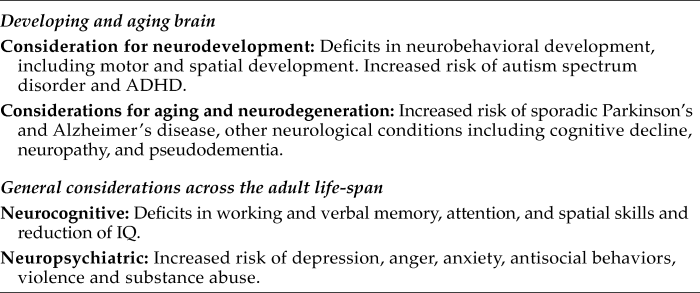
Workers exposed to specific pesticide exposures, including OPs, fumigants, and organochlorine insecticides, have reported higher levels of tension, anger, and depression. Footnote 60,Footnote 61 as well as higher risk of suicide. Footnote 62 Even spouses of workers who use pesticide have an increased risk of depression. Footnote 63 Chronic exposure to neurotoxic substances is associated with antisocial behaviors, violence, and substance abuse, burdening both the individual and society (Table 1).
Effects of Pesticides in Humans

ADHD, attention-deficit/hyperactivity disorder.
Brain Health, Environmental Justice, and Human Rights.
The widespread use of pesticides in modern societies, and the consequential increased human exposure, represents an important challenge to environmental justice and human rights. There are related gross inequities between resource-poor and industrialized countries as well as within different socioeconomic groups within countries. Pesticide exposures can magnify inequalities with short- and long-term consequences for quality of life, and hamper educational and economic productivity. Moreover, patterns of exposure to pesticides may be defined by environmental injustices. Those with lower socioeconomic status are more likely to have occupations that involve direct pesticide contact. They are more likely to live near fields where pesticides are being deployed on a greater scale and less likely to take adequate precautions to protect against pesticide hazards. They may be unaware of the potential risks involved with direct and indirect pesticide exposure. Footnote 64
In resource-poor countries with rudimentary pesticide registration processes, there is high pesticide overload per capita, including products that are banned or severely restricted elsewhere, such as paraquat, mancozeb, and chlorpyrifos. In those countries, pesticide labels often are not listed in the local language nor are they intelligible to those who lack sufficient literacy. Pesticide adulteration is not uncommon. In such conditions, there is minimal if any training in hazard awareness and application procedures. Storage is commonly inadequate and resources are insufficient to implement and enforce existing national and international recommendations regarding use and disposal. Footnote 65 Problematically, international recommendations do not always consider particular use conditions of those countries. For example, climatic conditions might make it impractical to wear the suggested protective clothing. All of these considerations cumulatively contribute to further disparities in pesticide burden. Footnote 66,Footnote 67
In countries were the current level of occupational protection may be adequate to avoid pesticide toxicity in the workers themselves, the protections still might be insufficient to prevent lasting adverse effects in offspring caused by prenatal exposures. Footnote 68 As mentioned, prenatal exposures are particularly worrisome because of their association with neurodevelopmental disorders and cognitive impairment risks. Considering the extraordinarily disproportionate risks that future generations might well bear as a result of prenatal pesticide exposures, this current state of affairs can be considered a matter of intergenerational justice. What matters in the ethical assessment of acts that will impact future generations is that they will suffer the consequences of our actions. Furthermore, future generations are, in principle, unlikely to consent to environmental exposures that might pose a risk to their brain and mental health. National and international documents, such as the Stockholm Declaration on the Human Environment, recognize this moral duty affirming that humans have “a solemn responsibility to protect and improve the environment for present and future generations.” Footnote 69
Pesticides’ impact on brain and mental health also matter from a human rights perspective; in particular, their neurotoxic effects bring challenges to key human rights, such as the right to life, health, food, and information. To date, scholarly attention at the intersection of human rights and the environment has been directed at the question of the coherence of environmental human rights; Footnote 70 the environmental rights of future generations, Footnote 71 and, more recently, the human rights implications of climate change. Footnote 72 In the case of pesticides, existing measures have not been enough to reduce levels of toxic exposure. That fact, in combination with the difficulties of vulnerable populations to initiate action (e.g., for children) or to take essential or even adequate precautions to protect against pesticide hazards (e.g., for poor and disadvantaged communities), points to the importance of guidance from human rights instruments Footnote 73 in pesticide regulation and assessments.
Various national and international documents make important contributions to the consideration of rights to a healthy environment, including one free of neurotoxic pesticides. The Stockholm Declaration, Footnote 74 for example, recognizes the relationship among environmental protection, human rights, and economic development. The Ksentini report Footnote 75 highlights how a right to a healthy environment would add value to human rights. Legally binding international instruments, such as the Aarhus Convention, recognizes that “every person has the right to live in an environment adequate to his or her health and well-being.” Footnote 76 The Aarhus Convention also promotes the right to a healthy environment through public participation in decision making, the promotion of access to information, and access to justice in environmental matters.
The substantive component of the right to a healthy environment, therefore, is informed by existing human rights charters—the right to be free from pollution and environmental degradation, and the right to protection, inter alia, of air, water, soil, biological diversity, and ecosystems—whereas the procedural component is constituted by access rights and public participation. Among the challenges to the right to a healthy environment are issues of definition, scope, and enforceability within the current human rights discourse and practice. Footnote 77 A complementary avenue for research is to be found in the study of vulnerability as a theoretical lens, which has been used in feminist human rights theory, to bridge issues on environmental risk exposures and resilience. The interdisciplinarity of human rights scholarship Footnote 78 opens new venues for an environmental neuroethics perspective on human rights, including rights related to health and a healthy environment, implementation, advancement, and effective policymaking.
Policy Implications
Hundreds of pesticides are used worldwide, despite their long history of use and regulation controversies. Pesticides are commonly regarded as desirable based on the assumption of pest reduction and improved yield. However, those economic and productivity values confront face-on both well-known and potential adverse health effects. Although it may well be that societal gain in terms of cheaper food is possibly greater than the monetized health cost of pesticides, the question is whether that is also the case with respect to brain and mental health. Consideration of pesticide implications for the developing and aging brain, human well-being across the adult life-span, intergenerational justice, and human rights should lead to evidence-based policy and measurable outcomes.
Rachel Carson’s publication Silent Spring in 1962 popularly highlighted the risks associated with dichlorodiphenyltrichloroethane (DDT), Footnote 79 subsequently resulting in its ban. Other high-risk-profile pesticides have since been banned globally, but many remain in use, and their legacy remains in the environment. For, example, atrazine has been banned since 2004 in the European Union because of its toxicity, but is still a mainstay pesticide used in United States corn production. Footnote 80
Regulatory agencies may determine that a given chemical may be used despite its public health hazard if the economic, social, or environmental benefits are deemed greater than its risk. Here, industry and commercial interests have an important role in shaping which pesticides are used. Pesticide companies manifest double standards when those products banned in the country in which they are made are then shipped to other countries where they are legal, as is the case in some resource-poor countries. It is more likely that poor farmers purchase the cheapest pesticides available in the market, which translates into use of older or adulterated chemicals, which may be more hazardous and less effective. Footnote 81 Proprietary interests add a layer of complexity when companies refrain from making publicly available the full list of ingredients used in pesticide products available on the market.
Equally, there are the livelihood interests of communities who depend on food production. In this regard, strong opposition from farmers to policies targeted at reducing pesticide use makes those policies difficult to implement in practice. It is important to recognize that from a monetary perspective the use of fewer pesticides can mean lost crop yields. Industry groups argue that stringent pesticide regulation could inflate product costs, making it more difficult for farmers to sell their products. Considerations such as these illustrate the economic challenges of pesticide regulation and the potential consequences of continuing neurotoxic pesticide use.
Risk assessment practices and risk perceptions also play a role in pesticide regulation. As part of risk assessment practices, the United States Environmental Protection Agency (EPA) and other regulatory bodies require premarket toxicology testing in laboratory animals to prevent pesticide exposure harms. However, because toxicological testing does not account for the complex mixture of compounds over a lifetime and human susceptibility variations, the adequacy of this approach has been called into question. Footnote 82
The “de minimis risk” approach, in which policymakers are instructed by their authorities to ensure that the probability of a negative outcome is below a low probability threshold, has been the predominant approach influencing pesticide regulation. Footnote 83 For example, in the United States, the EPA is responsible for pesticide regulation under the Federal Insecticide, Fungicide, and Rodenticide Act (FIFRA) and the Food Quality Protection Act (FQPA). Through the FQPA, the EPA admits tolerances for carcinogenic pesticide residues in food such that there is a “reasonable certainty that no harm will result from aggregate exposure to the pesticide.” Likewise, in the case of the FIFRA, the EPA essentially seeks to reduce exposures to carcinogenic pesticides below an individual risk level of 1 in 1,000,000, with some tolerance for higher levels. A similar approach is adopted in Europe, where pesticide residues on crops are monitored through a maximum residue level. Footnote 84 Such “de minimis risk” approaches are seen as simple, fair, and easily translated into law. They are also judged to be politically convenient, as they are oriented to ensure safety below the critical threshold. In practice, however, there are several concerns raised by these approaches.
First, the threshold might be excessively ambitious and impossible to reach, making it less likely to be honored in practice. There is also evidence that a significant percentage of food samples exceed the maximum residue limits set by regulators both in the United States and in Europe. Footnote 85 There are additional issues related to differential variations in population vulnerability. Therefore, targeting a uniform pesticide and population risk exposure probability threshold seems particularly inefficient. In trying to address some of these issues, the EPA has added for youth specifically “an additional safety factor to account for developmental risks and incomplete data when considering a pesticide’s effect on infants and children, and any special sensitivity and exposure to pesticide chemicals that infants and children may have.” Footnote 86
Recent risk assessment strategies have built-in uncertainty factors to account for different effects from person to person; Footnote 87 however, application of these factors has been uneven. Footnote 88 Likewise, for certain chemicals, there simply is no established safe threshold. Footnote 89 Therefore, because many pollutants do not have thresholds below which they have no effects, the current pesticide regulatory approach gives only the illusion of safety.
Finally, risk perceptions may influence pesticide regulation. Perceived risks are not always attuned to the actual risks. The way different people perceive, estimate, and handle risks is based on their different worldviews and values. Footnote 90 There is evidence, for example, that people overestimate the risks from carcinogenic pesticides while underestimating the risks from natural carcinogens. Footnote 91 When risks are made salient and popular, people are more likely to overestimate small risks. However, is the effect the same when certain risks are not addressed, addressed poorly, or only addressed in certain settings?
Although the industry tests for a wide range of environmental and health impacts, the majority of pesticides currently on the market have not been fully tested. Footnote 92 Considering the many chemicals, including new ones to which people are exposed, there needs to be better and faster methods to determine which chemicals have neurodevelopmental and neurotoxic effects. In this regard there are already programs such as the Toxicology in the 21st Century program (Tox21), a federal collaboration among the EPA, the National Institutes of Health, and the Food and Drug Administration, which are laying groundwork for a new kind of accelerated, large-scale testing that is helping researchers prioritize chemical for further in-depth investigation. Footnote 93
In spite of such efforts, the individual and societal costs of waiting for the development of improved test mechanisms can no longer be ignored. In some countries, particularly in the European Union, this recognition has fostered the use of precautionary approaches in which early indication of a potential for neurotoxicity is translated into strict regulation, which later then can be relaxed if subsequent testing shows less harm than initially anticipated. A related concern is that many regulations are biased toward direct exposures, such as those found in occupational settings. This then begs the question about the regulation of pesticides aimed at more broadly protecting the health of citizens. More studies are needed looking at these less direct but chronic exposures to which we are all exposed.
One method for limiting pesticide exposures is through personal choice, such as is the case in opting to buy bottled water and organic fresh products, which are less likely to contain pesticide residues, Footnote 94 or opting to live far from fields sprayed with pesticides. For some scholars, this suggests that there is no strong argument for public intervention: it would prevent freedom of choice and the diversity of consumer taste and risk preferences from being expressed in the market. Footnote 95 In an ideal world, that position might have merit; however, there is evidence that such choices are neither feasible nor informed homogeneously across populations. The higher price of organic products might put them out of reach; on average such products can cost more than 49% more than standard produce. Footnote 96 Policies, therefore, should take into account the cumulative effects of chronic exposures to neurotoxic chemical in food products, and the fact that many of these chemicals used in food production have no established safe cutoff for exposure. To be fair and just, policies should also balance the risk of contaminants with nutritional benefits, and account for accessibility of certain products to those who are economically marginalized. Quality resources and products should not be available only to historically privileged sectors of the population. Policies are needed to ensure the full range of transparent, unbiased dissemination of information about food options and nervous system effects, such as understandable neurotoxic risk profiles from substances involved in food production. This could be accomplished in a fashion similar to calorie counts but with a layout similar to drug risk labeling. As it stands the United States Food and Drug Administration (FDA) already requires labeling when there is ‘‘a substantial difference in the nutritional or safety characteristics’’ of a particular food. This then would respect consumer autonomy, and related decisions could be transparent and implemented democratically. Footnote 97 Finally, given children’s particular vulnerability to pesticides, the use of pesticides should be limited, if not prohibited, in places where children live and play, including parks, schools, and playgrounds.
Framework Environmental Neuroethics
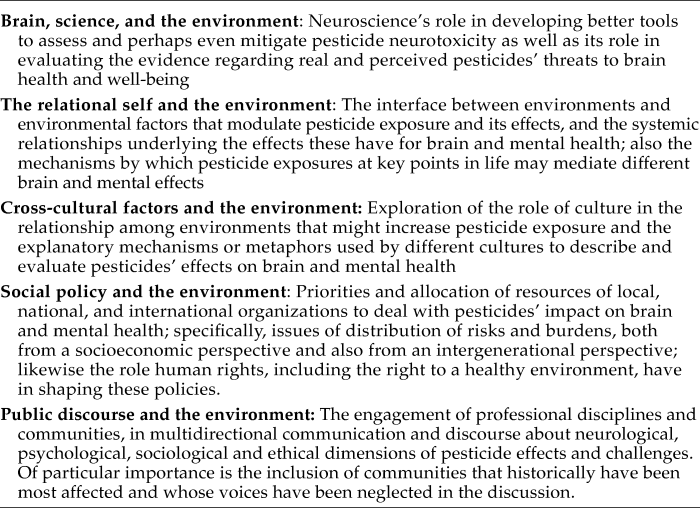
Based on the compelling evidence and neuroethical considerations of anthropogenic environmental change, I and my colleagues introduced a five-tier framework for comprehensive and critical investigations of the ethical and social implications brought by these environmental changes, to brain health across the lifespan and across cultures (see Table 2).
Environmental Neuroethics Framework: The Case of Pesticides *

* Adapted from Cabrera and colleagues15
The five-tier framework can be used to address a variety of human-initiated environmental changes such as air pollution, mining waste, nuclear facilities, ocean degradation, and habitat destruction. Here, the framework is adapted to consider the ethical and social implications brought forward by ubiquitous pesticide use.
Challenges Ahead
Although there is substantial evidence for the impact of certain pesticides on brain and mental health, for a majority of pesticides, the synergistic and cumulative effects can neither be measured nor assessed. To date, few laboratory studies have addressed issues of concurrent exposure to multiple pesticides over a lifetime. Such longitudinal studies are needed in order to better understand the impact of complex synergistic or cumulative effects. Footnote 98 Those effects can be considered an invisible threat, a “silent pandemic” of subclinical neurotoxicity. Footnote 99 Unlike obesity, the effects on brain and mental health of chronic low doses of pesticide might take years before they can be detected. Variations in sociodemographic features of pesticide-exposed study populations may confound or modify effects, as might genetic variation influences on human susceptibilities. Footnote 100 Therefore, major unresolved issues demanding our attention include the relative importance of acute and chronic exposure, the relationship of pesticide-related neurotoxicity to neurodegenerative disease, the effect of moderate exposure in the absence of poisoning, and the role of sociodemographic features in terms of vulnerability, resilience, and susceptibility. Footnote 101
Pesticide regulation is a high-stake, politically sensitive issue, where the values of productivity and efficiency (i.e., use of pesticides to support large-scale production of cheap food) will continue to conflict with values of preventing harm, and of safety related to brain and mental health (i.e., individuals being harmed by the consumption of food products sprayed with pesticides). The debates surrounding scientific evidence and ethical issues are exacerbated not only by uncertainty regarding risk and potential consequences, but also by powerful vested interests including profits from industry and organized interest group efforts to strategically design studies so as to spread confusing and misleading information that might support their preferred positions. Footnote 102 The issue of trust in experts and public authorities that arises makes it especially challenging to effectively inform and engage citizens.
Considering the aforementioned observations, one can see the challenges ahead in terms of informing consumers and workers in an unbiased and transparent way about pesticide exposure and brain and mental health effects. It is not only the case that certain populations might be uninformed about such pesticide risks, but also that they simply might not have sufficient resources to avoid exposure. Even if they were to be informed of pesticide risks, there are complexities such as the way in which small risks tend to be overestimated, as well as issues connected to the loss of public confidence about what is really at stake when people are exposed to mixed messages.
In spite of these challenges, the conversation opens the door for discussion regarding the ethical and social consequences for brain and mental health related to direct and indirect exposures to pesticides. Of particular importance is the discussion of environmental and intergenerational justice issues that may exacerbate disadvantages related to exposure, the human rights at stake in terms of protections from harms associated with the use and exposure to pesticides, and the availability of and access to food, air, and water environments, free of neurotoxic pesticides.
Conclusions
The ethical and societal implications of pesticide exposure for the CNS are largely lacking from current discourse. When mentioned, they are rarely critically assessed. To promote this endeavor, we presented three main themes for exploration—brains matter, human well-being, and social justice (including human rights)—as well as a framework with which to guide it. Neuroethicists, those interdisciplinary scholars committed to and engaged with the ethical, social, and legal implications of advances in neuroscience and neurotechnologies, have a social responsibility: a duty to care and to warn and to robustly contribute to the discussion. Investigational methods of neuroethics, such as evidence-based normative analysis; qualitative, quantitative and experimental research methodologies; community-based participatory research; and risk analysis, provide solution-oriented and pragmatic tools to achieve this goal. Neuroethicists can help to discover and address problems of the translation of epidemiological findings into prevention strategies and public health campaigns. They can play a key role in communicating and creating awareness between clinicians and the wider public regarding the ethical and societal implications of the effects of pesticides on brain and mental health. Neuroethicists should be at the frontline of policy development that aims to reduce the burden of brain and mental disorders attributable to direct and indirect pesticide exposure, to address environmental injustices that might exacerbate adverse effects from pesticides, and to foster environments that support brain and mental health.