I. INTRODUCTION
Recently metal matrix composites (MMCs) are under serious consideration to replace conventional materials for a large number of structural applications such as aeronautical/aerospace, transportation, defense, and sports industries. Reference Vijaya Ramnath, Elanchezhian, Jaivignesh, Rajesh, Parswajinan and Siddique Ahmed Ghias1 Aluminum matrix composites (AMCs) reinforced with particles and whiskers are extensively used for lofty concert applications such as in automotive, military, aerospace, and electricity industries because of their improved physical and mechanical properties. Reference Sajjadi, Ezatpour and Torabi Parizi2 The properties of composites are desired by the size, shape, and volume fraction of the reinforcement, matrix material and reaction at the interface. Reference Gowri Shankar, Jayashree, Shetty, Kini and Sharma3 The interface between the reinforcement and matrix plays a vital role in determining the properties of AMCs. AMCs can be reinforced with alumina (Al2O3), Reference Saravanakumar, Sasikumar and Sivasankaran4 aluminum nitride (AlN), Reference Clyne and Withers5 boron nitride (BN), boron carbide (B4C), Reference Kerti and Toptan6 magnesium oxide (MgO), Reference Samal, Paanigrahi and Sarangi7 silicon carbide (SiC), Reference Kalkanli and Yılmaz8 silicon nitride (Si3N4), Reference BakiKaramıs and Halıcı9 titanium boride (TiB2), Reference Kennedy, Karantzalis and Wyatt10 titanium carbide (TiC), Reference Kerti11 and titanium dioxide (TiO2). Reference Ravichandran, Naveen Sait and Anandakrishnan12,Reference Ravichandran, Naveen Sait and Anandakrishnan13 While SiC and Al2O3 are common reinforcing materials in AMCs, the limited research has been conducted on TiC reinforced AMCs due to the higher cost of TiC powders. Reference Kumar, Mahapatra and Jha14 TiC was used as reinforcement to prepare AMCs because of its high hardness and elastic modulus, low density, good wettability with molten aluminum and its low chemical reactivity and higher hardness (32 GPa). Reference Gopalakrishnan and Murugan15 The stir casting process has some important advantages: the wide selection of materials, better matrix particle bonding, simple, and low cost processing, flexibility, and applicability to huge quantity production and outstanding productivity for complex shaped components. Reference Sajjadi, Ezatpour and Beygi16 Aghajanian et al. proposed the Al2O3 particle reinforced AMMCs, with varying particulate volume percentages and improvement in mechanical properties with an increase in percentage of reinforcements. Reference Aghajanian, Langensiepen, Rocazella, Leighton and Andersson17 Abdulwahab Reference Abdulwahab18 found that addition of Mn to the Al–Si–Fe–Mn alloy increased the tensile strength to 0.4% for both the as-cast and age hardened conditions. The formation of a fine dispersion of (Mn, Fe) and α (Al–Si–Fe–Mn) constituent in aluminum with the Mn-rich precipitate, created a dislocations movement, thus increases the strength of the alloys. Wang et al. reported the impact behavior of Al–7Si–0.35Mg–12.5TiB2 in situ composite at various temperatures and found that, the increase in TiB2 content decreases the impact toughness of the composite and reported two failure mechanisms of the in situ Al–TiB2 composite: the eutectic silicon cracking and the pullout of the TiB2 reinforcement. Reference Wang, Ma, Li, Li and Wang19 Jebeen Moses et al. analyzed the influence of process parameters on tensile strength of AA6061/TiC AMCs produced via stir casting method. Reference Jebeen Moses, Dinaharan and Joseph Sekhar20 Lekatou et al. synthesized aluminum reinforced WC and TiC nanoparticles and aluminide particles composites and reported the microstructure, wear, and corrosion behavior of the composites. Reference Lekatou, Karantzalis, Evangelou, Gousia, Kaptay, Gácsi, Baumli and Simon21
In the present study, stir casting process was used to fabricate AA6063 alloy composite reinforced with different weight percentages of TiC. The characterization study was conducted by scanning electron microscopy (SEM) and energy dispersive X-ray spectroscopy (EDS) analysis. The mechanical behavior of TiC reinforced AA6063 alloy composites were investigated by tensile test, Vickers hardness test, Charpy test, and flexural test at ambient temperature. Further corrosion behavior of the composites is also reported.
II. EXPERIMENTAL DETAILS
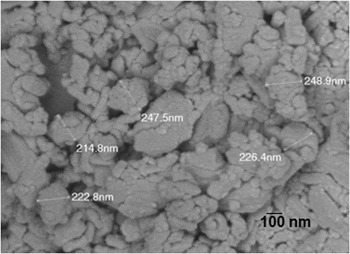
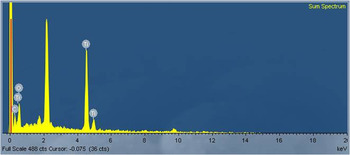
The chemical composition of AA6063 is given Table I. The SEM image of TiC powder is shown in Fig. 1 and the size of the particles is marked. Figure 2 shows the energy dispersive analysis of TiC powder. Stir casting route was used to fabricate the composites. The required quantity of AA6063 and TiC particles were measured accurately to add 0, 3, 6, 9, and 12 wt% of TiC. Initially AA6063 matrix was melted in a crucible at 750 °C and the preheated (1000 °C) TiC particles were introduced in to the melt. The temperature was first raised above the liquidus temperature of aluminum near about 750 °C to melt the AA6063 completely and was then cooled down just below the liquidus to keep the slurry in semisolid state. Reference Kaviya, Saravanan, Ravichandran and Senthilkumar22 The stirring of the slurry was performed for 3–5 min with a motor controlled stirrer. The composite slurry was then heated to 720 °C and a second stirring by a mechanical stirrer to improve the distribution of the TiC particles in the molten of AA6063. The molten composite was then cast into prepared cast iron molds.
Chemical composition of the AA6063.

SEM image of TiC powder.

EDS Analysis of TiC powder.

The microstructure of specimens was observed by using a SEM attached with energy dispersive spectroscope (JSM-6390, JEOL Ltd., Peabody, Massachusetts). The measurement of density was carried out to determine the percentage of porosity of the AA6063-TiC composite samples. Percentage of porosity was achieved by comparing the experimental and theoretical densities of each weight percent (0, 3, 6, 9, and 12) of TiC particles reinforced to AA6063. The theoretical density was evaluated by using the rule of mixtures, Reference Alaneme23 and the experimental density was determined by the Archimedes method. According to ASTM E8M standard, the tensile tests were conducted on round specimens (12.5 mm diameter and 62.5 mm gauge length) on a fully automated servo-hydraulic mechanical testing machine (Model: MTS/C64.106, INNOVATEST, Maastricht, The Netherlands). Hardness measurements were performed using a Vickers indenter under a test load of 0.5 kg and a dwell time of the 30 s on a polished as-casted materials using an automatic digital micro hardness tester [Model: Innovatest/4303]. The test was conducted at a room temperature and measurements of hardness were taken at five different places on each AA6063/TiC composite samples to obtain an average value of hardness. According to ASTM E23, the toughness of the AA6063/TiC composite was evaluated by Charpy V-notch test. The size of specimens was 10 × 10 × 55 mm with single V notch 2 mm deep 45° with a root radius of 0.1 mm. The flexural test was performed, and flexural strength values are calculated according to ASTM International Standard C1161. The three-point bend test was conducted with a constant displacement rate of 0.5 mm/min in computer-controlled WDW-300J (Jinan Fine Testing Instrument Co. Ltd., Jinan, China) instrument. The three-point bending test was conducted on all the composite samples according to the ASTM C1161 standard. The flexural strength of the composite was determined using the following equation:
 $${\rm{Flexural\ strength}} = {{3Pl} \mathord{\left/ {\vphantom {{3Pl} {2b{t^2}}}} \right. \kern-\nulldelimiterspace} {2b{t^2}}}\quad ,$$
where l is the span length of the sample −140 mm, P is maximum load (N), b is the width of specimen −20 mm, t is the thickness of specimen −11 mm.
Electrochemical measurements were carried out by using Versa STAT MC (Potentiostat/Galvanostat with versa studio electrochemistry software package, Princeton Applied Research, Princeton, New Jersey). During the test, electrochemical cell consists of three electrodes: (i) AA6063/TiC composite as working electrode, (ii) platinum as counter electrode, and (iii) saturated calomel as reference electrode. The potential values are measured by concerning the saturated calomel electrode. After polarization studies, the same electrode was used for the electrochemical impedance spectroscopy (EIS) studies without any surface treatment. The polished AA6063 alloy specimens with 1.0 cm2 surface area are exposed to corrosion medium of 3.5 NaCl solutions at room temperature. The potentio dynamic current–potential curves were recorded by polarizing the specimen to −1 mV to +1 mV on open circuit potential (OCP) at a scan rate of 0.1 mV/s. EIS measurements was carried out using a small amplitude AC signal of 10 mV over a frequency range of 100 kHz–0.01 Hz. The above all techniques are repeated at least three times and the average values are reported.
III. RESULTS AND DISCUSSION
A. Density and porosity
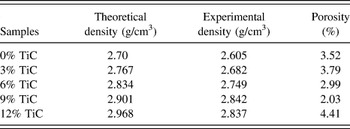
Table II shows the porosity of various AA6063–TiC composites in percentage. The porosity and its size in cast MMCs have more impact on mechanical properties. Reference Kok24 In this work, the porosity for all the composites were obtained was less than 4% except composite contains 12% of TiC particles. These results agreed with previous reports of cast composites. Reference Prabu, Karanamoorty, Kathiresan and Mohan25 From Table II, it is observed that, the experimental density is less than the theoretical density and it indicates that the better bonding between the AA6063 matrix and TiC reinforcements. Reference Rao, Rao and Bhargava26 The experimental density is found to be increased with increase in amount of reinforcement in the composite materials is due to the addition of hard TiC reinforcements in to the AA6063 matrix alloy.
Comparison of porosity percentage for AA6063–TiC composites.

B. SEM and EDS analysis
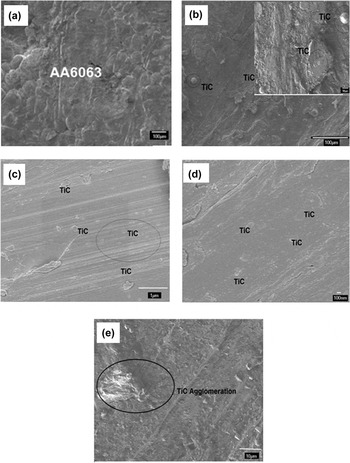
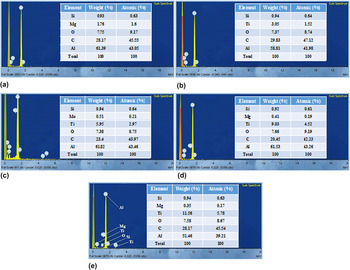
Figures 3(a)–3(e) illustrates the SEM image of unreinforced AA6063, AA6063–3 wt% TiC, AA6063–6 wt% TiC, AA6063–9 wt% TiC, and AA6063–12 wt% TiC composites. Figure 3(a) shows the SEM image of unreinforced AA6063 and it ensures the absence of TiC particles in the matrix. From Figs. 3(b)–3(d), it is observed that, fine TiC particles are distributed in aluminum matrix. It is evident by the intensity of corresponding peaks in their respective EDS analysis shown in Figs. 4(b)–4(d). The uniform distribution of TiC particles is observed for the AA6063–9% TiC composites it is attributed because of proper stirring during casting process. From Fig. 3(e) corresponding to AA6063–12 wt% TiC composite, TiC particle agglomeration and lot of Al3Ti intermetallics are observed. The reason for this is due to the isothermal heat reaction between AA6063 and TiC particles. Reference Tjong and Ma27 EDS revealed, as expected, the light phase to be Al3Ti and the dark phase to be Al4C3 is identified. The results of EDS analysis of unreinforced AA6063, AA6063–3 wt% TiC, AA6063–6 wt% TiC AA6063–9 wt% TiC and AA6063–12 wt% TiC composites is provided in Fig. 4, and it evident the appearance of peaks corresponding to the presence of Al, TiC, and other minor elements. A large number of peaks with the highest intensity of aluminum confirm the presence of large amount of aluminum in the composite. The observed weight percentage of TiC reveals that it is well incorporated into the AA6063 matrix. From the Figs. 4(c) and 4(d), a more number of Ti peaks are observed and it clearly shows the presence of increased weight percentages of TiC particles in the composites.
SEM image of (a) AA6063–0 wt% TiC, (b) AA6063–3 wt% TiC, (c) AA6063–6 wt% TiC, (d) AA6063–9 wt% TiC, and (e) AA6063–12 wt% TiC composites.

EDX Analysis of (a) AA6063–0 wt% TiC, (b) AA6063–3 wt% TiC, (c) AA6063–6 wt% TiC, (d) AA6063–9 wt% TiC, and (e) AA6063–12 wt% TiC composites.

C. Evaluation of mechanical properties
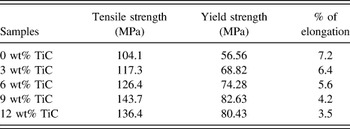
Table III shows that the effect of the weight percentage of TiC on the yield and ultimate strength of AA6063–TiC composites. It has been observed that the ultimate and yield strength are initially increased up to 9 wt% of TiC then decreased for the 12 wt% of TiC particles. The morphology, uniform distribution, and interface bonding between reinforcement and matrix plays a vital role in the enhancement of tensile strength in composites. Reference Swamy, Ramesha, Veeresh Kumar and Prakash28 The highest tensile strength (143.7 MPa) is observed for AA6063–9 wt% TiC composite. The high tensile strength for the AA6063–9 wt% TiC composite was obtained is due to the presence of hard nature of TiC particles. The TiC phase in the AA6063 composites bears a significant fraction of stress, as it is much stiffer than the AA6063. Microplasticity in composites that takes place at fairly low stress has been attributed to stress concentrations in the AA6063 at the poles of the reinforcement sharp corners of the TiC particles. Also the improvement in strength of AA6063–9 wt% TiC composite is resulting from the uniform dispersion of TiC particles to the matrix through by stir casting process as seen in SEM analysis [Fig. 3(d)]. The elongation marginally decreases [Table III] with increasing TiC reinforcement because of the presence of hard reinforcement in the soft ductile matrix which reduces the ductility of composites.
Tensile properties for AA6063–TiC composites.

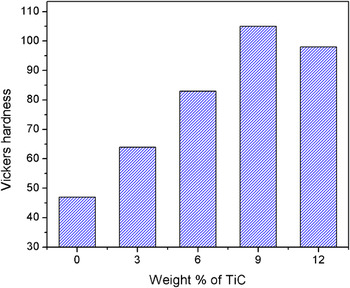
Figure 5 shows the effect of the weight percentage of TiC on the hardness of the AA6063–TiC composite. From the graph, the hardness was increased for the addition of weight percentage of TiC particles in the AA6063 matrix. Ramesh et al. Reference Ramesh, Keshavamurthy, Channabasappa and Ahmed29 have experimentally proved that the incorporation of hard reinforcement into a soft, ductile matrix enhances the hardness of the matrix material. In the present study, the presence of hard TiC particles in the AA6063 matrix improves the hardness. TiC particles act as a barrier and restrict to local plastic deformation, so it can easily resist or withstand the applied load of 0.5 kg. But in the case of AA6063–12wt% TiC composite, the hardness is marginally reduced compared to AA6063–9wt% TiC composite because of uneven distribution of TiC reinforcements (agglomeration). The reason for the agglomeration is due to the presence of more weight percentage of high-density TiC particles are grouped in the molten aluminum. It is observed that the resistance to localized plastic deformation is enhanced only up to the addition of 9 wt% of TiC in AA6063 matrix.
Vickers micro hardness versus weight percentage of TiC.

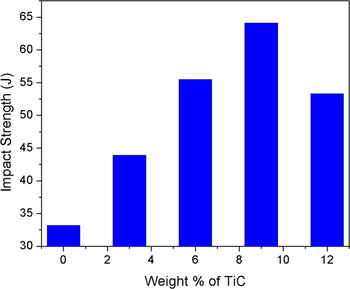
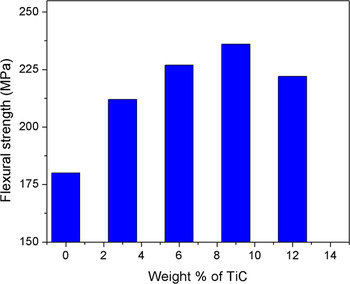
Figure 6 shows the effect of the weight percentage of TiC on the impact strength of the AA6063–TiC composite. The increase in impact strength was observed for the increase in weight percentage of TiC up to 9 wt%. The reason for the increase in impact strength could be the proper interfacial bonding between AA6063 matrix and TiC particles in the composites. Addition of more than 9 wt% of TiC decreases the impact strength since the more addition of TiC particles in the soft matrix materials make particle agglomeration and it destroys the strength of the composites. Figure 7 shows the flexural strength of the AA6063–TiC composites and it was observed 236 MPa for AA6063–9 wt% TiC which is higher than that of composites contains 12 wt% TiC. The reason for the decrease in flexural strength is due to the agglomeration of TiC particles in AA6063–12 wt% TiC composite as evident in SEM analysis [Fig. 3(e)].
Impact strength versus weight percentage of TiC.

Flexural strength versus weight percentage of TiC.

D. Evaluation of electrical properties
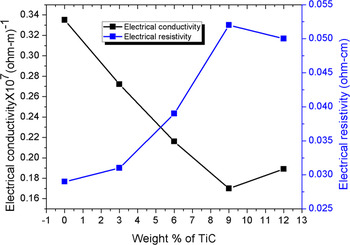
The results of electrical resistivity (ρ) and electrical conductivity (σ) of AA6063–TiC composites are shown in Fig. 8. From that result it is understood that the electrical resistivity increases with increase in wt% of TiC particles. The reason for this could be the decrease in grain size and introduction of low conductive nature of reinforcements. The change in electrical conductivity of the composites is shown in Fig. 8. Addition of TiC particles decreases the electrical conductivities of AA6063–TiC composites. The reason for this could be the porosity of the AA6063–TiC composites dramatically increases, especially at higher TiC volume contents, which is detrimental to electrical conductivity. Also another reason is the electrical conductivity of TiC is lower than that of Ti3Al and presence of more Al solutes in Cu, g, Si decreases the electrical conductivity of the AA6063 matrix.
Electrical resistivity and electrical conductivity versus weight percentage of TiC.

E. Evaluation of corrosion behavior
The corrosion behavior of unreinforced AA6063, AA6063–3 wt% TiC, AA6063–6 wt% TiC and AA6063–9 wt% TiC composites are discussed in this section. The corrosion studies for AA6063–12 wt% TiC composites not attempted since the mechanical behavior of 12% TiC composite was very poor as reported in previous sections.
1. Polarization studies
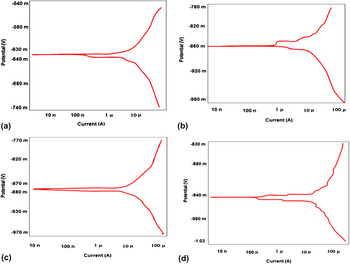
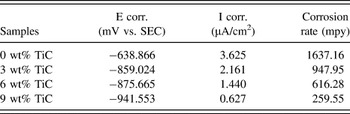
The polarization curves of AA6063 and 3, 6, and 9 wt% of TiC reinforced composites are shown in Figs. 9(a)–9(d). From that Tafel plots, it is observed that the increase in TiC particles in the composites decreases the corrosion rates. Table IV shows the corrosion parameters, corrosion current density, and corrosion rate obtained from the Tafel polarization measurements. The corrosion current values and the corrosion rate were decreased for the increases in wt% of TiC are shown in Table IV. The presence of intermetallics that act as cathodic on metal matrix has been the reason to enhance the pitting corrosion.
(a–d) Polarization curves for AA6063/TiC composites in 3.5 NaCl solutions.

Electrochemical corrosion and polarization results of AA6063–TiC composites.

2. EIS studies
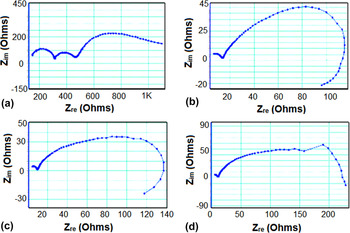
Nyquist plots of the AA6063 and 3, 6, and 9 wt% of TiC reinforced composites in 3.5 NaCl solution are given in Fig. 10(a)–10(d). The EIS of the matrix alloy and its composites is measured after OCP recording for 60 min to speculate the contribution of an oxide film on AA6063 to the corrosion resistance of the composites. The high frequency capacitive loop is attributed to the presence of a protective oxide film on the surfaces of composites. The samples are conquered by the capacitance of the oxide film, but the diameters of the capacitance arcs increase with an increase in TiC content, which means that the resistance of the surface oxide film on the composites increases with increase in TiC reinforcement. It can be professed as because the hydroxide formed by the oxides of Si, Mg, and Al play an inhibitive role around the conducting TiC and intermetallic phases. The corrosion resistance increases with increase in the wt% of TiC reinforcement.
(a–d) Nyquist plots of the AA6063/TiC composites in 3.5 NaCl solutions.

IV. CONCLUSIONS
In the present work, AA6063/TiC composite was successfully fabricated by stir casting method. The following conclusions are drawn:
-
(1) The scanning electron micrographs revealed the uniform distribution of TiC in AA6063 matrix and agglomeration of TiC particles was observed for composites contains 12 wt% of TiC.
-
(2) EDS analysis ensured the presence of TiC in AA6063 matrix.
-
(3) The hardness, tensile strength, impact strength, flexural strength, and electrical resistivity of composite increases with increase in weight percentage of reinforcement up to 9% TiC.
-
(4) The AA6063 and AA6063–TiC composites samples have similar anodic polarization curves and show passivation potentials, but the base alloy exhibits less susceptibility to pitting corrosion in 3.5% NaCl solution.
-
(5) Increasing the weight percentage of the TiC particulates increased the corrosion resistance of the AA6063/TiC composites.
ACKNOWLEDGMENTS
The authors would like to thank the Mr. S. Ramesh, Department of Mechanical Engineering, K.S.R College of Engineering, Tiruchengode, India for providing necessary support in conducting the experiments; and also Mr. Vincent, ACIC Lab, St. Joseph’s College, Trichy, India for his support in SEM-EDX and corrosion studies.