1. Introduction
Functional morphology presents considerable difficulty to second language speakers (L2ers) who started acquiring the L2 after childhood. Their production often shows a degree of variability, irrespective of the overall levels of proficiency and fluency they have attained. What causes such variability is still undecided and has been a recurrent topic in research on bilingual language acquisition in adults. A question that has received considerable attention is whether or not some form of grammatical (representational) deficit is involved.
An aspect of nominal morphology that has often been discussed in this respect are English articles (cf. Kuribara, Reference Kuribara and Robinson1999; Robertson, Reference Robertson2000; Trenkic, Reference Trenkic2000; Kowaluk, Reference Kowaluk2001; Leung, Reference Leung, Bonch-Bruevich, Crawford, Hellerman, Higgins and Nguyen2001; Ionin, Reference Ionin, Beachley, Brown and Conlin2003; White, Reference White2003; Goad and White, Reference Goad, White, Foster-Cohen, Ota, Smith and Sorace2004; Snape, Leung and Ting, Reference Snape, Leung, Ting, O'Brien, Shea and Archibald2006; for earlier studies on L2 articles see Huebner, Reference Huebner1983; Tarone, Reference Tarone1985; Parrish, Reference Parrish1987; Thomas, Reference Thomas1989; Master, Reference Master1990). All these studies established that English articles pose a particular problem to L2ers from article-less L1 backgrounds.
This paper focuses primarily on substitution errors (i.e. where the is supplied in indefinite and a in definite contexts). Such errors are suggestive of how L2ers understand what articles signal, and what representations are assigned to them in interlanguage grammars. Two recent proposals are compared, one supporting and the other rejecting the idea of grammatical deficit. The account of Ionin, Ko and Wexler (Reference Ionin, Ko and Wexler2004) argues that L2ers have full access to UG, including the parameter settings of the postulated semantic parameter which regulates article choice. Substitution errors are viewed as the result of learners temporarily fluctuating between the available parameter settings, before sufficient input is received to set the parameter to its appropriate value for the given language. Trenkic (Reference Trenkic2007), on the other hand, assumes a grammatical deficit, suggesting that L2ers from article-less L1 backgrounds persist in misanalysing English articles as adjectives. Article forms produced as adjectives would not only show a clearly defined pattern of omissions (as discussed in Trenkic, Reference Trenkic2007), but would also exhibit principled substitution errors, reflecting the meanings that learners have attributed to them. The two accounts are evaluated by testing their respective predictions regarding L2 article choices, in a study with a group of L1 Mandarin/L2 English speakers.
The discussion is organised as follows. Section 2 introduces the concepts of specificity and definiteness. Section 3 focuses on the theoretical basis for Ionin et al.'s (Reference Ionin, Ko and Wexler2004) proposal, and spells out its predictions regarding L2 article choices. Section 4 highlights some problems in the design of Ionin et al.'s (Reference Ionin, Ko and Wexler2004) study, and proposes a way to overcome them in a new study. Section 5 introduces an alternative account, based on Trenkic (Reference Trenkic2007), detailing its implications for L2 article choices. In section 6 the present study is described. The implications of the results are discussed in section 7.
2. Defining the terms
Talking about the systems of articles involves, by definition, talking about the concepts of definiteness and specificity. I shall argue in the paper that these concepts are sometimes inappropriately operationalised in L2 studies, leading to unwarranted claims about the nature of second language learning. To understand the nature of the problem in the L2 article studies, it seems essential to spell out what definiteness and specificity are, and perhaps more crucially, what they are not.
2.1 Specificity
In their pre-theoretical sense, the terms specific and specificity seem intuitively clear. Yet, in theoretical discussions of language meaning and communication, these terms have been used to label different, if sometimes overlapping, phenomena. The interest of this paper is primarily in specificity as signalled by article systems of world languages. As specificity is normally discussed in relation to indefinite noun phrases, and there is some controversy in the literature whether the distinction should apply to definite noun phrases as well, I restrict my initial discussion to indefinites, but return to the question of definites in the end.
Specificity as “narrow scope” (non-specific) vs. “wide scope” (specific) readings
It has been long noted that English indefinite nominal phrases can receive two different readings in the so-called “opaque contexts”. Opaque contexts are created by logical operators – for example, a BELIEF operator present in verbs of propositional attitude such as intend in (1) (taken from Lyons, Reference Lyons1999). If the operator is within the scope of the indefinite noun phrase, the noun phrase is said to have a wide scope over it, resulting in a specific, or de re, reading. Reference is to a specific referent which exists in the world,Footnote 1 as in (1a). If the noun phrase is within the scope of the operator, then it has a narrow scope, and a non-specific, de dicto reading. Reference is to whatever satisfies the description, i.e. no specific referent exists, as in (1b).
- (1)
a. Peter intends to marry a merchant banker – even though he doesn't get on at all with her.
b. Peter intends to marry a merchant banker – though he hasn't met one yet.
This distinction relating to scope, while conceptually available, is not morphologically marked in English. But in some other languages it is. For example Lakhota, Jacaltec (see Lyons, Reference Lyons1999), and St'at'imcets (see Schaeffer and Matthewson, Reference Schaeffer and Matthewson2005) all appear to have two indefinite articles, one used for wide scope and the other for narrow scope contexts.
Specificity as referential (specific) vs. quantificational (non-specific) readings
Specificity is sometimes also defined in relation to referential vs. quantificational (non-referential) readings of indefinite nominal phrases (Fodor and Sag, Reference Fodor and Sag1982). This classification will be of most relevance in the present paper. In essence, the difference is between whether a speaker has a referent in mind and intends to refer to it, or not (cf. Ionin and Wexler, Reference Ionin, Wexler, Liceras, Zobl and Goodluck2003). In the following example, taken from Fodor and Sag (Reference Fodor and Sag1982), the indefinite nominal phrase a student is ambiguous:
(2) A student in the syntax class cheated on the final exam.
On one interpretation, the speaker knows who the student in question was (referential, specific reading). On the other, the speaker only knows that one of the students cheated but does not know which one (quantificational, non-referential, non-specific reading). While indefinite nominals in English are ambiguous in this way in principle, the context and discourse continuation normally disambiguate between the readings. Thus, as Fodor and Sag (Reference Fodor and Sag1982) observe, the indefinite noun phrase a man is more likely to be understood as referential in (3a) than in (3b):
- (3)
a. A man just proposed to me in the orangery (though I'm much too embarrassed to tell you who it was).
b. A man is in the woman's bathroom (but I haven't dared to go in there to see who it is).
In both (3a) and (3b), however, the reading is de re in the sense that the referent exists (there is a man who proposed to me, just as there is a man who is in the woman's bathroom), and on the previous classification (wide scope vs. narrow scope), both would be specific. Referential readings are always de re, while quantificational readings can either be de re as in (3b) or de dicto as in (1b).Footnote 2
Again, the specificity distinction understood as referential and quantificational readings, while conceptually available, is not formally marked in English, but is in some other languages, such as Samoan (a Polynesian language). Samoan has one article that is used in all referential contexts, and another used in non-referential contexts (details to follow in section 3.1 below).
An important note regarding the referential/non-referential distinction
It would be easy to conclude, if the English examples were to be considered alone, that the difference between referential and non-referential indefinites lies simply in whether the speaker thinks of a particular referent, or of an arbitrary member of a class. The distinction that natural languages actually mark is subtly different (cf. Lyons, Reference Lyons1999, p. 178). Thus, the crucial aspect is not whether the speaker has a particular referent in mind, but whether he intends to refer to it. (Here I presume that an intention to refer presupposes that the speaker has a particular referent in mind, but the opposite does not hold.) Just having a particular referent in mind is not sufficient to classify the context as referential, and to call for a specific article, if a language marks this distinction. This can be seen in the examples from Samoan in (4)–(5). (The critical abbreviations used in glosses are art specific article, art(nsp): non-specific article.)
(4)

“Bring me a coconut!”
(5)
“A lady asked us who our father was.”

In (4), the speaker does not have a particular referent in mind (any coconut would do), and the context is clearly [−specific]. But what is interesting is that the context is also [−specific] in (5), as witnessed by the choice of article (se = non-specific), even though the speaker must have a particular referent in mind. He has obviously had an encounter with the woman in question, and heard her talk. Assuming that it was a face-to-face encounter, he must know a great deal about her: what she looks like, her approximate age, and all the information that one can infer from the way someone speaks (social and regional background, education level, friendliness, etc.). What seems to be at issue, however, is that despite there being a specific referent for the speaker, its particularity was not deemed important for the point being made (the point probably being along the lines: we were asked who our father was). The speaker did not intend to say anything more about the lady, and did not expect the hearer to establish a new discourse referent.Footnote 3
This can be seen as similar to English examples in (6):
- (6)
A: So what did you achieve last year?
B: Quite a lot, actually. I bought a house and gave birth to a baby daughter. How about you?
In one sense of the word specific (on top and above the wide-scope, de re readings, which are not considered here), both a house and a baby daughter are specific: speaker B must know which particular house she bought and which baby daughter she gave birth to. At the same time, however, the particularity of these referents is of no importance for the point being made, the point being the speaker's achievements (i.e. house-buying and childbearing), and in that sense the speaker can be said to have no intention to refer.Footnote 4 In discourse terms, then, these referents are non-specific. For clarity's sake, we could call the first type of specificity “speaker specificity” and the second one “discourse specificity”. The conceptual difference involved in speaker specificity is the one between a particular entity and an arbitrary member of a class, but no language seems to mark this difference lexically or grammatically (Lyons, Reference Lyons1999). In contrast, the difference involving discourse specificity, as defined above, can be marked and signalled in languages like Samoan. In English, it must be pragmatically inferred.
To summarise, specificity is here understood as the speaker's intent to refer. When there is an intent to refer, the context is classified as specific, irrespective of whether the distinction is morphologically marked in the language or not.
One further point to note is that while intention to refer presupposes that the speaker has a particular referent in mind, it does not follow that the speaker has personal acquaintance or is familiar with the identifying attributes (e.g. name or physical appearance) of the entity which corresponds to the referent. We can conceptualise of an individual without knowing their name or being able to identify them on an identity parade; the acquaintance may even be explicitly denied. Still, even with the sketchiest of discourse referents, if there is an intention to refer – and this is the only condition – they will be specific. Given an adequate stylistic context, they may even appear with the “introductory this” which is considered an overt marker of specificity in English (see Prince, Reference Prince and Cole1981):
(7) Office gossip
Gina: . . . and what about the others?
Mary: Well, Dave is single, Paul is happily married, and Peter . . . he is engaged to a/this merchant banker, but none of us knows who she is, or what she's like.
In (7), the speaker most obviously has a referent in mind (“the merchant banker who Peter is engaged to”), but does not know her name, and almost certainly would not be able to pick her out from a crowd. Still, the context is [+specific], as witnessed by the appropriate use of the introductory this. This is because the speaker has an intention to refer, that is to say something about Peter's fiancé (as conceptualised by the speaker), or in relation to her, even if that something is denying acquaintance or familiarity. The hearer, in turn, is expected to create a new discourse referent, add it to her knowledge base, and update the entry as more information accumulates, even if the information is all about the lack of knowledge, or importance, or personal relevance. It is the act of reference that is important, rather than what is predicated about the referent. This issue will become important when we discuss Ionin et al.'s (Reference Ionin, Ko and Wexler2004) study.
Specificity as “noteworthiness”
More recently, specificity as intent to refer has been supplemented by the concept of “noteworthiness”, in a series of publications by Tania Ionin and colleagues. Thus, Ionin et al. (Reference Ionin, Ko and Wexler2004, p. 5) spell out that “[i]f a Determiner Phrase (DP) of the form [D NP] is . . . [+specific], then the speaker intends to refer to a unique individual in the set denoted by the NP and considers this individual to possess some noteworthy property”. Noteworthiness, however, is a vague term, which is difficult to pin down or defend. We have seen in examples (5) and (6) that the speaker may know many noteworthy properties about the individuals or objects concerned, but without an intent to refer the contexts remain non-specific. Similarly, in (7) the speaker denies that she knows any properties, noteworthy or otherwise, about the merchant banker that Peter is engaged to, still the context qualifies as [+specific].
It is possible to redefine noteworthiness, as Ionin (Reference Ionin2006) does, and see it simply as having something worthy to note about the referent in the present context. So in (5) and (6), it can be said that there is nothing worthy of note in the present context about the lady herself, the speaker's house or her child. In contrast, there is something noted (hence worthy of note) about the referent in (7), and it is that Peter's colleagues, including the speaker, do not know who she is. While this seems more acceptable, on this revised reading, “noteworthiness” appears to be nothing more than “an intent to refer”. And while “noteworthiness” may be neither adding nor taking away anything from the original definition of specificity as “intent to refer”, we shall see that this notion is responsible for bringing considerable confusion into the operationalisation of specificity in SLA studies.
Specificity and definite noun phrases
Specificity is normally discussed in relation to indefinite noun phrases. There is less agreement whether the same distinction applies to definites. Lyons (Reference Lyons1999) thus notes that the same conceptual distinction(s) between different readings of indefinite noun phrases can be observed in definite contexts as well. At the same time, he admits that no language seems to mark specificity distinction on definites (irrespective of which version of specificity is considered). While he appears perplexed as to why this should be so, he accepts the importance of empirical evidence and concludes that, despite his intuition to the contrary, specificity may be hyponymous to indefiniteness (Lyons, Reference Lyons1999, p. 178). I return to this question later, as it bears importance for L2 studies as well.
2.2 Definiteness
Definiteness has been discussed extensively in semantic, pragmatic, discourse and syntactic literature, from both formal and functional points of view. I am primarily interested here in definiteness as a universal cognitive concept, which in some languages can be signalled by the use of definite articles. Most of what I have to say is based on work by J. Hawkins (Reference Hawkins1991, Reference Hawkins2004) and Lyons (Reference Lyons1999).
Definiteness is related to the identifiability of referents in discourse. In this paper, I use the terms definite and (uniquely) identifiable interchangeably, to denote the discourse status of a referent, and use the term grammatical markers of definiteness to refer to overt elements, such as definite articles, that signal this status.
Just as specificity, definiteness is also a discourse-related concept. It adds to specificity the dimension of hearer perspective: a discourse referent is definite if the speaker intends to refer to it, and expects the referent to be uniquely identifiable to the hearer, too. Defined as discourse referent identifiability, definiteness is an element of interpretation in all languages: it can be part of lexico-semantic content of some expressions (e.g. demonstratives), or can be inferred through the context of communication. Every nominal context can be classified as definite and non-definite, irrespective of whether it is formally marked in a language as such.
While the majority of world languages infer the definiteness status of referents pragmatically, some languages grammaticalise this concept and have overt grammatical markers of definiteness. Typically, these markers are definite articles (see Lyons, Reference Lyons1999, for a cross-linguistic overview). While definite articles will prototypically signal definiteness (the concept they grammaticalise), not all definite contexts will be marked by an article (if at all). Thus in English, plural and mass generics, which can be construed as pragmatically definite (in the sense of class-identifiable referents), are grammatically non-definite:
(8) I like cheese.
French, on the other hand, covers this area of identifiability grammatically:
(9) J'aime le fromage.
I like the cheese
Similarly, proper names – while pragmatically definite – are grammatically non-definite in English:
(10) Marina was looking for you.
In Greek, in contrast, this area of semantic definiteness is grammatically covered:
(11)
The reason for this cross-linguistic variation is the fact that the grammaticalisation process (during which the definite article typically develops from a demonstrative, cf. Greenberg, Reference Greenberg, Greenberg, Ferguson and Moravcsik1978) is slow and gradual (cf. Epstein, Reference Epstein and Andersen1993). When a language acquires a definite article, it is at first restricted to some areas of identifiability (e.g. overlap with demonstratives in anaphoric and immediate situation uses), and only gradually expands from there (e.g. to associative and broader situation uses, and to generics and proper names). Due to language-specific grammaticalisation histories, languages that do grammaticalise definiteness may cover different areas of identifiability grammatically. This absence of one-to-one correspondence between definite contexts and overt definiteness marking may present a particular difficulty in second language learning.
I have so far talked about discourse referents being uniquely identifiable, but not how this identifiability is to be determined. Discourse identifiability may be best described using the features of existence and uniqueness, proposed as far back as Russell (Reference Russell1905), but more recently advocated by J. Hawkins (Reference Hawkins1991): a discourse referent is definite/uniquely identifiable when the speaker intends to refer to it, and conceptualises that it exists and is unique in one of the pragmatically delimited domains mutually manifest to him and his interlocutor on-line. Definiteness as discourse-related identifiability is thus reduced to the referent's conceptualised existence and uniqueness (within a domain) – it is not related to the referent's other attributes, and it depends on neither the speaker's nor the hearer's ability to determine the “real world identity” of discourse referents, as illustrated in (12):
(12) We are looking for the vandals who broke into the office last night.
While the identity of the perpetrators of the crime in question is not likely to be known to either the speaker or the hearer, as referents, the vandals are uniquely identifiable. They are uniquely identifiable in the sense that their existence and uniqueness (in the maximal set sense) hold relative to the discourse-defined domain, mutually manifest to speaker and hearer on-line, of vandals who broke into the office last night.
English has another overt article, a(n), which is normally labelled indefinite article. While the two articles can be described as a system in the present day English, most writers on the issue are aware that (i) their sources are different (the derives from a demonstrative, and a from the numeral for “one”), (ii) they did not develop in parallel (cf. Heine, Reference Heine1997), and (iii) they do not signal diametrically opposite concepts (cf. Chesterman, Reference Chesterman1991). In fact, number (or cardinality) signalled by the indefinite article is not even incompatible with definiteness.Footnote 5 The indefinite article is believed to signal indefiniteness only indirectly, by the fact that the definite article (as a stronger member of the pair) did not occur (cf. J. Hawkins, Reference Hawkins1991; Lyons, Reference Lyons1999).
This leads me to the final point on which my view of definiteness differs from the majority of writers on this topic. Article systems are usually believed to have developed, and that their primary function is, to signal (in)definiteness. I, however, side with Hawkins, who argues that “[t]here is no compelling semantic/pragmatic reason why the definite article should emerge out of a demonstrative to express meanings that are perfectly expressible in languages without articles” (J. Hawkins, Reference Hawkins2004, p. 84). The same, I assume, hold for the indefinite article. Rather, articles emerge for processing and structural reasons (in essence, to make the processing of nominal arguments more efficient, when some structural changes affect a language – see J. Hawkins, Reference Hawkins2004, chapter 4 for details). This means that articles' reson d'etre is structural, and their signalling of (in)definiteness only peripheral and accidental (a consequence of their source). This, I shall argue later, is an additional – and possibly the principal – reason why second language acquisition of articles is difficult.
3. Ionin, Ko and Wexler's (Reference Ionin, Ko and Wexler2004) account of L2 article choices
Ionin et al. (Reference Ionin, Ko and Wexler2004) is a recent but influential account of how L2ers understand English articles and why they produce substitution errors. Its two central ideas are the Article Choice Parameter and the Fluctuation Hypothesis.
3.1 The Article Choice Parameter
Article systems most often signal definiteness, as in the case of English. However, it is also well documented that the definite article may spread into specific indefinite contexts, at which point it ceases to be a marker of definiteness and becomes a marker of specificityFootnote 6 (cf. Lyons, Reference Lyons1999; J. Hawkins, Reference Hawkins2004). This is the case with a number of Polynesian languages.
Ionin et al. (Reference Ionin, Ko and Wexler2004) start from this observation to propose the Article Choice Parameter (ACP), a semantic parameter that governs article choices cross-linguistically. This parameter is assumed to have two settings (Ionin et al., Reference Ionin, Ko and Wexler2004, p. 12):
(13) The Article Choice Parameter (for two-article languages)Footnote 7
A language that has two articles distinguishes them as follows:
The Definiteness Setting: Articles are distinguished on the basis of definiteness.
The Specificity Setting: Articles are distinguished on the basis of specificity.Footnote 8
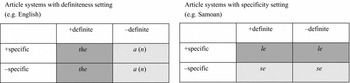
Definiteness and specificity are viewed here not simply as universal cognitive concepts (as I have done above), but as discourse-related semantic features that are part of UG inventory. Crucially, on this account, article systems that encode [±definiteness] are viewed as cutting across the conceptual distinction of [±specificity]: both articles can receive either +specific or − specific interpretations, while not being morphologically marked for it. The opposite is true for article systems that encode [±specificity]. This division is represented in Figure 1.
Article systems cross-linguistically.

Contexts corresponding to the four combinations of definiteness and specificity, and their associated markers, are illustrated by examples from English (the definiteness setting) and Samoan (the specificity setting). The English examples, in (14)–(17), come from Lyons (Reference Lyons1999) and the Samoan examples, in (18)–(21), from Mosel and Hovdhaugen (Reference Mosel and Hovdhaugen1992). Examples introduced in previous sections are repeated here to provide a systematic overview.
(14) [−definite; +specific] context, marked as indefinite in English, by a(n)
Peter intends to marry a merchant banker – even though he doesn't get on at all with her.
(15) [−definite; −specific] contexts, marked as indefinite in English, by a(n)
Peter intends to marry a merchant banker – though he hasn't met one yet.Footnote 9
(16) [+definite; +specific] context, marked as definite in English, by the
We can't start the seminar because the student who's giving the presentation is absent – typical of Bill, he's so unreliable.
(17) [+definite; −specific] contexts, marked as definite in English, by the
We can't start the seminar because the student who's giving the presentation is absent – I'd go and find whoever it is, but no-one can remember, and half the class is absent.
(18) [−definite; +specific] context, marked as specific in Samoan, by le
“There was a couple who had a child, a girl called Sina.”
(19) [+definite; +specific] context, marked as specific in Samoan, by le
“It was the man's practice to get up early and . . . while the woman stayed at home with her child.”
(20) [−definite; −specific] context, marked as nonspecific in Samoan, by se.
(a)
“Bring me a coconut!”
(b)
“A lady asked us who our father was.”
(21) [+definite; –specific] context, marked as non-specific in Samoan, by se.
“Oh you filthy little bastard, you pig, whoever is your father.”
This proposal, in which definiteness and specificity are fully crossed, runs into its first difficulty when [+definite; −specific] contexts are considered more closely. While indefinite environments take well the subdivision into specific and non-specific, both conceptually (cf. (14) and (15)) and linguistically (cf. (18) and (20)), this is less clearly the case for definite contexts (see Lyons, Reference Lyons1999, pp. 170–178 for a discussion). Ionin et al.'s decision to classify the complex noun phrase translated as “whoever is your father” in example (21) as [+definite; −specific] appears particularly contentious, as no previous account of Samoan classifies this example as definite. Mosel and Hovdhaugen (Reference Mosel and Hovdhaugen1992, pp. 259–264) say that Samoan specific article may be used with both definite and indefinite referents, but the same claim is not made about the non-specific articles. Lyons, after an extensive review of world languages (including Samoan), concludes that all the languages that mark specificity do so only for indefinites, and no language marks specificity for definites (Lyons, Reference Lyons1999, p. 177). Ionin et al.'s argument that the phrase in question is [+definite; −specific] seems to be based on a weak premise that possessive nominal phrases are always grammatically definite inEnglish. This overlooks a number of issues, including the fact that possessives are not semantically incompatible with indefinites (and in many languages combine with indefinite articles), and more crucially, that the given phrase was not even headed by a possessive but by an indefinite pronoun (i.e. whoever in the English translation).
The possibility that no language, including Samoan, marks the specificity distinction formally on definites makes the construct of the Article Choice Parameter problematic in principle. For the time being, however, I accept the division introduced by Ionin et al. (Reference Ionin, Ko and Wexler2004) as it serves as the basis for a hypothesis on how article systems are acquired and used by second language speakers.
3.2 The Fluctuation Hypothesis
Moving to the area of second language research, Ioninet al. (Reference Ionin, Ko and Wexler2004) combine the assumption that L2ers have full access to UG with the theoretical construct of the ACP to formulate the Fluctuation Hypothesis for L2 acquisition, along the following lines:
(22) The Fluctuation Hypothesis (FH)
a. L2ers have full access to UG principles and parameter-settings (→ they have full access to the two settings of the ACP);
b. L2ers fluctuate between different parameter-settings until the input leads them to set the parameter to the appropriate value (→ L2ers fluctuate between the two settings of the ACP).
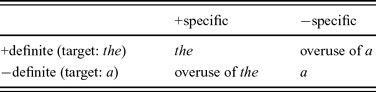
The chief prediction for L2 learners of English (if they come from article-less L1 backgrounds) is that they will fluctuate between associating articles with definiteness and with specificity, and that this should result in a clear pattern of substitution errors. In contexts where the values of definiteness and specificity clash (one is positive and the other one is negative), article substitution errors are expected. Thus, if the specificity setting is accessed, the may appear in [−definite; +specific] contexts, and a(n) in [+definite; −specific] ones. In contexts where both features have the same value, no substitution errors are predicted: [+definite; +specific] should always trigger the in production, and [−definite; −specific] should trigger a(n). Table 1 summarises the prediction.
Predicted article choices in L2 English (Fluctuation Hypothesis).
Ionin and colleagues tested this prediction with speakers of L2 English whose L1s were Russian and Korean. These L1s were chosen on the grounds that they do not have articles, and so their speakers would not have had the Article Choice Parameter set to either definiteness or specificity. Results seem to be broadly in line with the above prediction (Ionin and Wexler, Reference Ionin, Wexler, Liceras, Zobl and Goodluck2003; Ionin, Reference Ionin, Beachley, Brown and Conlin2003; Ionin et al., Reference Ionin, Ko and Wexler2004; though see some reservations in Hawkins et al., 2006). This is taken as evidence for (i) full UG access in second language acquisition (L2A; the ability to acquire new parameter values); (ii) the Fluctuation Hypothesis in L2A; and (iii) the validity of the theoretical construct of the ACP.
However, I want to suggest that the results were seriously affected and the conclusions compromised by the way the notion of specificity was operationalised in the study. The next section highlights the problem, and suggests how it could be addressed.
4. Problem in Ionin et al.'s study: The operationalisation of specificity
It was noted in section 2.1 above that specificity, understood as “having a referent in mind and intending to refer to it”, must be distinguished from being familiar with identifying attributes of the entity in question. It was also suggested that the idea of “noteworthiness” may inadvertently lead to the blurring of this distinction (while technically neither adding to nor taking anything away from the original definition). This is, I suggest, what happened in Ionin et al.'s study.
In the L2 test materials aimed at testing the Fluctuation Hypothesis and the availability of the Article Choice Parameter in L2A, specificity was routinely operationalised, via the notion of noteworthiness, through the speaker explicitly predicating personal acquaintance with the individual/object being talked about, stating knowledge of their name or some other insider information; the lack of specificity (and noteworthiness) was operationalised as denying such knowledge.Footnote 10 The following examples from Ionin et al.'s forced-choice elicitation task,Footnote 11 one classified as creating a [−definite; +specific] context, and the other a [−definite; −specific] context, illustrate this (the target form is underlined):
(23) [−definite; +specific]
Gary: I heard that you just started college. How do you like it?
Melissa: It's great! My classes are very interesting.
Gary: That's wonderful. And do you have fun outside of class?
Melissa: Yes. In fact, today I'm having dinner with a girl from my class – her name is Angela, and she is really nice!
(24) [−definite; −specific]
At a university
Professor Clark: I'm looking for Professor Anne Peterson.
Secretary: I'm afraid she is busy. She has office hours right now.
Professor Clark: What is she doing?
Secretary: She is meeting with a student, but I don't know who it is.
In short, the speaker in (23) explicitly states that she is aware of the “real-world identity” of the referent and her “noteworthy” properties (e.g. name: Angela; character: nice), which is therefore classified as [+specific]; the speaker in (24), on the other hand, states that she is not aware of the “real-world identity” of the referent, which is consequently classified as not having properties worthy of note, and hence [−specific]. Assuming for the moment that the classification of the above contexts as [+specific] and [−specific] was correct (and I shall call the latter into question in the discussion), these examples still conflate two unrelated factors: the speaker's explicit statement of her familiarity with the person/object being talked about (I shall call this “explicitly stated knowledge” (ESK)), and her intention to refer (specificity).Footnote 12
What this effectively means is that Ionin et al.'s (Reference Ionin, Ko and Wexler2004) results do not provide unequivocal evidence that specificity plays a role in L2 article choices (and so that it is a setting of a parameter that learners can access). Because specificity and ESK were conflated, the results are equally compatible with the explanation that L2ers were influenced in their choices by whether familiarity with the person being talked about was claimed or denied. It is, then, on examples such as (7), repeated here as (25), that the Fluctuation Hypothesis needs to be tested.
(25) Office gossip
Gina: . . . and what about the others?
Mary: Well, Dave is single, Paul is happily married, and Peter . . . he is engaged to a/this merchant banker, but none of us knows who she is, or what she's like.
If learners indeed associate article use with specificity, we should expect to see a higher overuse of the in [+specific] contexts, irrespective of whether the knowledge of the individual being talked about is claimed in the dialogue (as in (23)) or denied (as in (25)). However, if learners overuse the only in [+specific] contexts where knowledge is asserted, but not in [+specific] contexts where knowledge is denied, then the FH must be rejected. The result would suggest that learners' article choices are influenced by extra-linguistic considerations and strategies. This latter outcome would support an alternative account, described in the following section.
5. An alternative model: L2 English articles misanalysed as nominal modifiers
In languages without articles, demonstratives and other elements of the semantic class determiner are argued to behave syntactically as adjectives, and that they should be categorically treated as such (Lyons, Reference Lyons1999; for further evidence on the adjectival status of determiner-like elements in languages without articles see Corver, Reference Corver and Broderick1992; Zlatić, Reference Zlatić1997; Trenkic, Reference Trenkic2004; Bošković, Reference Bošković2005). This means that speakers of article-less languages approach L2A without a category determiner in their repertoire. Whether new syntactic categories and features could be acquired in L2A is a subject of intense debate in the literature (Clahsen, Reference Clahsen, Flynn and O'Neil1988; Tsimpli and Roussou, Reference Tsimpli and Roussou1991; Smith and Tsimpli, Reference Smith and Tsimpli1995; Hawkins and Chan, Reference Hawkins and Chan1997; Lardiere, Reference Lardiere and Archibald2000; Prévost and White, Reference Prévost and White2000; inter alia). Two recent studies on the acquisition of L2 English by L1 Japanese (Kuribara, Reference Kuribara and Robinson1999) and L1 Serbian speakers (Trenkic, Reference Trenkic2007) suggest that, as far as the category determiner is concerned, this may not be the case. Both authors argue that L2ers from article-less languages misanalyse English determiners, including articles, as adjectives.Footnote 13
5.1 Articles as adjectives: Implications for article production
If L2 articles are analysed as adjectives, several consequences arise for article form production: their suppliance, omission and substitution.
Suppliance and omissions
As outlined in section 2.2, I assume, in line with J. Hawkins (Reference Hawkins2004), that the primary function of articles is not to mark (in)definiteness, but to structurally signal in certain contexts, in the absence of other categories, that a nominal phrase is being projected. The need for article suppliance is determined syntactically (structurally), with pragmatic considerations coming in later to determine which article is compatible with the context.
If, however, article forms are misanalysed as adjectives, their production will obey different rules. Lexical elements' communicative function is to express referential meanings. And with referential meanings, it is the pragmatics of rational communication that determines whether the meaning should be expressed in the context at all, with syntax consequently offering alternatives of how it could be expressed.Footnote 14
Let us consider this first with an example of real adjectives. For example, in the situation where the speaker and the hearer can see a single blue mug on a table, both, unless colour-blind, are expected to perceive its blueness. However, it would be unlikely (and, in fact, unjustified) for the speaker to mention the colour in the context, and say Pass me the blue mug, as the information about this attribute would be pragmatically redundant for the hearer (it costs effort to process, while nothing extra is gained through it). In fact, Pass me the blue mug would wrongly suggest to the hearer that there was a choice, e.g. that there was a mug of a different colour there as well. Speakers of English are highly sensitive to such pragmatic constraints in real-time processing (see e.g. Hanna, Tanenhaus and Trueswell, Reference Hanna, Tanenhaus and Trueswell2003).
Now, let us consider this with an example of L2 articles-misanalysed-as-adjectives. In the same context as above (a single blue mug on the table which the speaker wishes passed to him), the speaker and the hearer are also likely to perceive the mug's existence (it is there) and its uniqueness (it is the only one). In this context the lexico-semantic information signalled by the definite article (i.e. existence and uniqueness) is as pragmatically redundant as the information about the colour is. If article forms are produced as adjectives (i.e. with the principal reason of signalling the meaning that the learner attributes to them), and the learner has not developed a grammar where articles are required for structural reasons, he would have no reason to supply an article in this context. In fact, there will rarely be a genuine communicative need to express definiteness, as the identifiability status of referents is easily inferable from the context (this is, after all, why the majority of the world's languages can do without a dedicated form for expressing this concept). For L2 production of articles-misanalysed-as-adjectives, this spells out many omissions, as indeed attested in the literature.
Learners, however, may develop strategies for articles-as-adjectives production. The sheer frequency of articles in the input may lead a learner to conclude that expressing this meaning, however redundant it may appear, is nevertheless important in the L2 (in the way that saying thank you appears to be more widespread in English than in some other languages). He may thus decide to monitor the context and express the meaning whenever the minimal conditions are met. But such strategic production would be dependent on the available cognitive resources (i.e. attention), leading to a range of consequences. While, as a rule of thumb, more cognitive resources would become available as function of proficiency, and so more articles would be supplied overall, there will always be contexts that are more resource-demanding than others. This should lead to predictable patterns of omissions at all levels, with fewer articles omitted in less demanding, and more articles omitted in more demanding contexts (all other things being equal).Footnote 15
Article choices and substitution errors
Most importantly for the present discussion, the model which assumes that L2 articles are analysed as adjectives also makes interesting predictions regarding learners' article choices. Trenkic (Reference Trenkicin press) reasons that even though lexically based article production will be by necessity non-categorical and variable, when articles are supplied, there is no reason to expect substitution errors if learners have linked article forms to the discourse identifiability of referents. A failure to do so, however, should result in principled substitution errors, reflecting whatever other form-meaning connections the learner has established. These meanings need not be UG-constrained, but it is not speculated precisely what they might be.
The question then is, if the meanings L2ers link to article forms are not UG-constrained, what meanings could these be, where could they develop from, and why may learners from diverse educational and cultural backgrounds converge on similar ones? As Ionin et al. (Reference Ionin, Ko and Wexler2004) rightly note, textbooks differ widely in how they treat articles, if at all. There will also be personal differences in how much attention students pay to the instruction, how much time they spend studying the “rules”, or just how much or which ones they can remember. So why should we expect to find similarities across learners and learner populations?
What may be misleading in the above reasoning is an underlying expectation that, unless UG is available, it will be pedagogical materials and classroom instruction that will be the most powerful factors in shaping learners' understanding of what articles mean and how they are used. While their role should not be neglected, I suggest that it may only be secondary to the power that the labels that we give to article forms – definite and indefinite (and/or any L1 equivalents) – may exert.Footnote 16 I propose that “definite” and “indefinite” are, in fact, bona fide lexical meanings that L2ers who analyse articles as adjectives attribute to article forms:
(26) the: adj, definite (that can be identified)
a: adj, indefinite (that cannot be identified)
But if learners understand the as meaning “definite” and a as meaning “indefinite”, one may rightly ask: what is the problem then? The problem is that articles are here misanalysed as adjectives, and hence “definite” and “indefinite” as adjectival, referential meanings.
Articles proper signal procedural meanings. They signal identifiability understood in a very precise and narrow way: as a transient status attributed to the referent within the bounds of on-going discourse, based on the speaker's assessment of its existence and uniqueness within the mutually manifest cognitive environment. In short, articles signal how discourse is to be structured. Adjectives, on the other hand, carry lexical, or referential, meanings: they tell us something about entities being talked about and their properties.
If L2 articles are analysed as adjectives, then their attributed meanings “definite” and “indefinite” would be seen not as a property of discourse, but as a property related to some factual information on the basis of which the entity being talked about can be identified:
(27) the cat = definite cat (= “a cat that can be identified”)
a cat = indefinite cat (= “a cat that cannot be identified”)
The point is that objective identifiability is a much broader concept than discourse identifiability (see discussion in 2.2), and can be determined against a broader range of criteria. Thus something may be perceived as (objectively) identifiable because it is physically present or has been previously introduced; but it may also be on the grounds that the language users are familiar with its name or some other “identifying attributes”. When the latter criterion is applied, the learner may inappropriately supply a definite article in an indefinite context, as the example (28) of a Japanese learner from Butler (Reference Butler2002) illustrates. In this example, (a) shows the learner's article choice on a cloze test, and (b) his metalinguistic reflection on the choice.
(28)
a. …For example, the world's first novel, called TheTale of Genji was written almost 1000 years ago by the Japanese noblewoman…
b. “This was written by Shikibu Murasaki. Because this woman is specific, it should be the.”
(Reference ButlerButler, 2002, p. 459)
The learner's comment reveals that he does not see definiteness in terms of the referent's existence and uniqueness relative to mutually manifest cognitive environment. His intuition tells him that the referent is definiteFootnote 17 because it can be linked to some factual information (its name), by virtue of which it becomes “identifiable” on the common-sense understanding of this word.Footnote 18
Names are not the only attribute that could be viewed by learners as contributing to objective identifiability. For example, imaginable entities (e.g. letter =  ) may be perceived as more identifiable than non-imaginable ones (e.g. disaster). On that count, noun phrases denoting imaginable objects may be more prone to incorrectly receiving the definite article in indefinite contexts. Such a pattern is reported in Trenkic (Reference Trenkic, Foster-Cohen, Ruthenberg and Poschen2002) for the behaviour of L1 Serbian/L2 English learners on a short-story translation task.
I presume that all the different criteria for identifiability are largely intuitive, and processed in parallel by the learner. In many cases, the criteria would converge on the same outcome, and one article or the other would be chosen consistently. But in cases where there is a conflict between the criteria, fluctuation in article choice is expected. This is exactly what seems to be going on in Ionin et al.'s forced choice elicitation task, and how their results could be interpreted.
Thus in example (23) above, the referent of girl from my class is not physically present, has not been previously introduced, and on those criteria it is unidentifiable for the hearer (unidentifiable → a). However, the speaker provides explicit identifying attributes to the hearer: her name is Angela, and she is really nice. This comes as a conflicting cue for the learner, as on these grounds, the referent become identifiable (identifiable → the, for the learner). Notice also that in this task the learner makes the choice not just based on the previous discourse (i.e. the part of the dialogue preceding the nominal phrase), but on the dialogue as a whole, including the information about the referent's identifying attributes. This means that at the point at which the learner needs to decide, the referent's identity has become common knowledge between the speaker and the hearer (and the learner himself, as the “overhearer”).
In contrast, in example (24), where the secretary denies knowledge of the identity of the student whom Professor Peterson is meeting, the student is not present in the physical environment, it has not been previously mentioned, and no identifying attributes are provided. All the available criteria suggest that the referent is unidentifiable to the hearer (→ a), and therefore no fluctuation is expected.
Thus contrary to Ionin et al., learners' errors may be said to be traceable to “non-UG-based strategies” and not to “UG access or miss-set parameters” (Ionin et al., Reference Ionin, Ko and Wexler2004, p. 52).
6. The study
To investigate whether in the forced choice elicitation task of Ionin et al. the learners fluctuate in article choices because of the access to the two settings of the Article Choice Parameter, or because of what is explicitly stated about the entity being talked about, a partial replication of Ionin et al.'s (Reference Ionin, Ko and Wexler2004) study was conducted.
6.1 Method
Participants
The participants in this study were 43 L1 Mandarin/L2 English speakers. All were postgraduate students at the University of York, aged between 22 to 32 years (mean age 24.1). They were recruited through the Language Teaching Centre, and offered a small confectionary present for their participation. At the time of the testing all participants had studied English for at least seven years, and had achieved a score of 6.5 or 7 on the IELTS test.Footnote 19 None had lived in an English speaking country for more than three months.
The reason for choosing this population was that they were L1 speakers of a language without articles.Footnote 20 In that way, they were directly comparable to the participants in Ionin et al.'s study, who were L1 speakers of Russian and Korean. It goes without saying that Mandarin, Russian and Korean would all have ways of signalling the identifiability of referents in discourse (all languages do), and that they would differ in how they achieve this. But all that matters for the present discussion is that none of them has articles. For Ionin et al.'s account, it means that the Article Choice Parameter could not have been set. For our own proposal, it means that they all are assumed not to have the syntactic category determiner in their L1. For details of how the identifiability of referents is signalled or inferred in Chinese, the interested reader is referred to Cheng and Sybesma (Reference Cheng and Sybesma1999), and Chen (Reference Chen2004).
Materials
The materials consisted of 24 short dialogues, based on items from the forced-choice elicitation task in Ionin et al. (Reference Ionin, Ko and Wexler2004). In each dialogue, there was a gap in front of the target nominal phrase, which participants were instructed to fill, choosing between the, a and no article (—)Footnote 21 All of the targets were singular, and the number of definite and indefinite contexts was equal (12 each). The materials were tested on five native speakers of British English who performed as expected, supplying target articles in all contexts.
To test the predictions that specificity (i.e. speaker intent to refer) plays a role in L2 learners' article choices on this task, vs. that the choice is influenced by the stated/denied familiarity with “identifying attributes” of the person being talked about, definiteness was crossed with three combinations of specificity and explicitly stated knowledge (ESK) values, yielding six contexts, as follows:Footnote 22
(29) [−definite], [+specific; +ESK]
[−definite], [−specific; −ESK]
[−definite], [+specific; −ESK]
[+definite], [+specific; +ESK]
[+definite], [−specific; −ESK]
[+definite], [+specific; −ESK]
Each context type was represented by four items on the test. An example of each context type is given below:Footnote 23
(30) [−definite], [+specific; +ESK]: The speaker has a specific referent in mind, and she explicitly states that she knows the identity of the person being talked about.
Gary: I heard that you just started college. How do you like it?
Melissa: It's great! My classes are very interesting.
Gary: That's wonderful. And do you have fun outside of class?
Melissa: Yes. In fact, today I'm having dinner with (a, the, —) girl from my class – her name is Angela, and she is really nice!
(31) [−definite], [−specific; −ESK]: The speaker does not have a specific referent in mind, and she explicitly denies that she knows the identity of the person being talked about.Footnote 24
At a university
Professor Clark: I'm looking for Professor Anne Peterson.
Secretary: I'm afraid she is busy. She has office hours right now.
Professor Clark: What is she doing?
Secretary: She is meeting with (a, the, —) student, but I don't know who it is.
(32) [−definite], [+specific; −ESK]: The speaker has a specific referent in mind, but she explicitly denies that she knows the identity of the person being talked about.
Office gossip
Gina: . . .and what about the others?
Mary: Well, Dave is single, Paul is happily married, and Peter . . . he is engaged to (a, the, —) merchant banker, but none of us knows who she is, or what she's like.
(33) [+definite], [+specific; +ESK]: The speaker has a specific referent in mind, and she explicitly states that she knows the identity of the person being talked about.
Paul: Do you have time for lunch?
Sheila: No, I'm very busy. I am meeting with (a, the, —) president of our university, Dr. McKinely; it's an important meeting.
(34) [+definite], [−specific; −ESK]: The speaker does not have a specific referent in mind24, and she explicitly denies that she knows the identity of the person being talked about.
Bill: I'm looking for Erik. Is he home?
Rick: Yes, but he's on the phone. It's an important business matter. He's talking to (a, the, —) owner of his company. I don't know who that person is – but I know that this conversation is important to Erik.
(35) [+definite], [+specific; −ESK]: The speaker has a specific referent in mind, but she explicitly denies that she knows the identity of the person being talked about.
Paul: Will Bob join us for lunch?
Sheila: No, he's very busy. He is meeting with (a, the, —) director of his company. I don't know who that person is, but he will decide whether Bob gets his promotion or not.
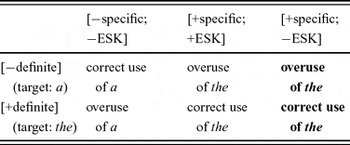
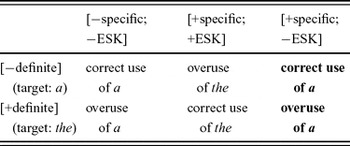
These six contexts allowed us to test the prediction of Ionin et al.'s (Reference Ionin, Ko and Wexler2004) Fluctuation Hypothesis vs. the predictions of our alternative hypothesis. Tables 2 and 3 summarise the contrasting predictions.
Predicted article choices in L2 English, if the choice is influenced by accessing the specificity setting of the ACP (Fluctuation Hypothesis).

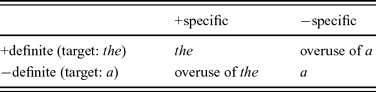
Predicted article choices in L2 English, if the choice is influenced by the stated/denied familiarity with “identifying attributes” of the person being talked about.

If specificity plays a role in L2 article choices, we expect to see a similar pattern of results in [+specific; +ESK] and [+specific; −ESK] contexts. If, however, learners are influenced by explicitly stated vs. explicitly denied extra-linguistic knowledge, we expect to see a similar pattern in [−specific; −ESK] and [+specific; −ESK] contexts.
Procedure
The test was administered in a classroom environment. Participants were tested in small groups (10, 13 and 20). The investigator explained that they would read 24 short dialogues, in each of which they would find an empty slot. They were asked to decide whether the, a or no article should be used. An illustrative example was provided on the cover page of the test, and participants were asked to confirm that they understood the nature of the task. At the end of the test, there was a short questionnaire collecting background information such as age and length of exposure to English. Participants were assured that any information provided would be treated as confidential and would only be used for research purposes. The participants were given 25 minutes to complete the test, but the majority finished in 15 minutes or less.
6.2 Results
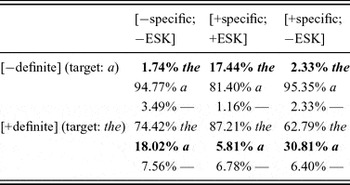
Table 4 summarises L1 Mandarin/L2 English speakers' results, detailing the percentages of the, a and no article in each context. The overuses of the in indefinite contexts and of a in definite contexts are marked in bold. The total number of items in each category was four per participant.
L2 results (N = 43).

As can be seen from the table, L1 Mandarin speakers overused the more in [+specific; +ESK] indefinite contexts, than in either [−specific; −ESK] or, crucially, [+specific; −ESK] indefinite environments. They overused a more in both [−specific; −ESK] and [+specific; −ESK] definite contexts, than in [+specific; +ESK] ones.
To determine the significance of the contribution of the combination of specificity and ESK values to the use of the vs. a, a repeated measure analysis of variance (ANOVA) was performed on the overuse of the in indefinite environments, and the overuse of a in definite environments by context type. The combination of specificity and ESK values had a highly significant effect on article (over)use, whether (over)use of the or a was measured. Mauchly's test indicated that the assumption of sphericity was violated in indefinite contexts (χ2 (2) = 46.08, p < .05); therefore degrees of freedom were corrected using Greenhouse-Geisser estimate of sphericity (ε = .60). Sphericity was not violated in definite contexts.
The results show that the overuse of the in indefinite contexts was significantly affected by the combination of specificity and ESK values, F(1.19, 50.15) = 16.486, p < .001. Contrasts revealed that overuse of the in [+specific; +ESK] indefinite contexts was significantly higher than in [−specific; −ESK] contexts, F(1, 42) = 17.78, p < .001, r = .55 (replicating Ionin et al.'s findings with L1 Korean and Russian speakers), but also significantly higher in [+specific; −ESK] contexts, F(1, 42) = 17.25, p < .001, r = .54, contradicting the claim that the overuse of the is tied to the positive value specificity.
Overuse of a in definite contexts was also significantly affected by the combination of specificity and ESK values, F(2, 84) = 28.38, p < .001. Contrasts show that overuse of a was significantly lower in definite [+specific; +ESK] contexts than in either [−specific; −ESK] contexts, F(1, 42) = 14.01, p = .001, r = .50, and also in [+specific, −ESK] contexts, F(1, 42) = 64.50, p < .001, r = .78. This again contradicts the prediction that the overuse of a(n) will be tied to the negative value of specificity.
Overall, the patterning of results was along the dimension of explicitly stated knowledge, and not along the dimension of specificity. The definite article was overused in [+specific] indefinite contexts, but only when the knowledge of the person/object was explicitly claimed. It was not overused in [+specific] indefinite contexts where such knowledge was denied. Similarly, the indefinite article was overused in definite contexts where the knowledge of the person/object was denied, irrespective of whether the context was classified as [−specific] or [+specific]. The results thus support the hypothesis that in their article choices on this particular test, the learners were influenced by the stated/denied familiarity with “identifying attributes” of individuals being talked about (an extra-linguistic, non-UG-based considerations), and not with the positive or negative value of specificity.
7. Discussion
Contrary to Ionin and colleagues' claim, this study found no evidence that specificity plays a part in L2 article choices. Note, at the same time, that the behaviour of L1 Mandarin speakers in our study did not differ from that reported for the L1 Korean and L1 Russian speakers in Ionin et al. (Reference Ionin, Ko and Wexler2004). In the contexts that were directly borrowed from their study, the results were effectively replicated. The L1 Mandarin speakers, like the L1 Korean and Russian speakers, overused the English definite article in [−definite; +specific] contexts (when the speaker claimed to know the person being talked about), and overused the indefinite article in [+definite; −specific] contexts (when the speaker denied knowing the person being talked about). However, it is through the Chinese learners' behaviour in the new contexts that this study introduced, in which the target referent was specific while at the same time the speaker's personal acquaintance with the referent was denied, that it becomes obvious that what we were previously observing was not an effect of specificity, but of what the speaker was explicitly saying about his familiarity with the person being talked about.
Clearly, what is being said here refers to specificity that could be a setting of the postulated Article Choice Parameter: specificity as marked in languages like Samoan, discourse specificity, specificity as “intent to refer”. Of course, if one chooses to view specificity as “speaker specificity”, i.e. as a difference between whether the speaker thinks of a particular entity (implying familiarity), or of an arbitrary member of a class (implying non-familiarity), then specificity obviously plays a part. The point, however, is that this is not the type of specificity that is postulated to be a setting of the ACP – and this is what is at issue here. The results of the study show that L2ers do not fluctuate between the two settings (definiteness, and specificity as “intent to refer”) of the postulated ACP, as predicted by the Fluctuation Hypothesis, and thus they falsify the prediction of the Fluctuation Hypothesis, and question the validity of the construct of the Article Choice Parameter.
Further, the findings are consistent with the view that articles may be misrepresented as adjectives in L2 grammars, to which learners assign referential meanings of “definite” (= identifiable) and “indefinite” (= non-identifiable). The fact that learners' article choices are influenced by whether familiarity with entities being talked about are explicitly claimed or denied suggests that learners view identifiability as something objective, as something that depends, at least in part, on the language users' ability to determine the “real-world identity” of discourse referents.
The question that remains is whether L2ers from article-less L1 backgrounds could recover from the misanalysis, and start to treat articles as determiners in production (i.e. supply them for principally structural reasons). This study cannot answer the question as it considered learners who could potentially still develop. And even though Trenkic (Reference Trenkic2007) shows that learners across a range of levels, including highly-proficient and end-state speakers of L2 English, show omission patterns consistent with articles-misanalysed-as-adjectives, a possibility remains that some learners may make the shift. This issue remains to be explored further.
Still, one point that this study makes which I hope future research will take note of is that (discourse) specificity must not be conflated with explicitly stated knowledge: it must not be operationalised through stating familiarity with noteworthy/identifying attributes of the person being talked about, nor the lack of specificity as denying such familiarity. If one insists on preserving the idea of noteworthiness, then it must be understood in the sense of merely having something worthy to note about the referent in the present context (cf. Ionin, Reference Ionin2006). Note, however, that on this understanding, most contexts which were originally classified as [−specific], and which were accepted as such in the design of the present study too, would have to be re-classified as [+specific].
When I introduced new contexts as [+specific] (e.g. the office gossip example in (7)), I used a very conservative test: native speakers had to accept an introductory, specificity-marking this as a possible choice. But this test is unidirectional: if a nominal can appear with this, it is a reliable clue that the referent is treated as [+specific]. The opposite, however, is not always true: when the introductory this is infelicitous, it does not have to be the case that the referent is [−specific]. The introductory this is a stylistically limited choice, restricted not only to a small number of genres, but also within the genres, to introducing referents that will receive special discourse prominence, i.e. those that may become topic entities of a fragment of discourse (see Brown and Yule, Reference Brown and Yule1983, p. 134). There is only a limited number of referents that can be main characters/topic entities at any one time, and the number of specific referents is likely to be always greater than the number of main characters in a piece of discourse. In short, specific contexts where this is appropriate are only a small subset of all specific contexts. For this reason one cannot use this test to rule out referents as being [+specific]. If there is an intention to refer – or in terms of noteworthiness: if there is something worthy of note – the referent must be treated as specific. Example (24), repeated here as (36), is a case in point.
(36) [−definite; −specific] (→ [−definite; +specific])
At a university
Professor Clark: I'm looking for Professor Anne Peterson.
Secretary: I'm afraid she is busy. She has office hours right now.
Professor Clark: What is she doing?
Secretary: She is meeting with a student, but I don't know who it is.
In (36), there is something noted, hence worthy of note, about the student: it is that the secretary is not aware of who it is. Note that had the secretary simply stated,
(37) Professor Peterson can't see you now, she is meeting with a student.
there would, indeed, be a strong tendency for the specificity status of a student to be [−specific] in discourse terms. In languages that mark specificity, we would expect a marker of non-specificity; this would be the case even if the secretary knew who the student was (parallel to the Samoan “lady” example in (5)). The crucial aspect is that the particularity of the referent is not relevant to the point being made, the point being: you cannot see Professor Peterson now, she is otherwise engaged.
However, with but I don't know who it is added, the referent becomes [+specific] in discourse terms. The particularity of the referent, and the fact that the secretary is not acquainted with its “identifying attributes”, becomes relevant, in the technical sense of this notion (cf. Sperber and Wilson, Reference Sperber and Wilson1986/1995). Every act of communication carries with it the presumption of its own optimal relevance: the speaker will not put the hearer to a gratuitous processing effort, i.e. effort that does not yield extra cognitive effects. In this case, it means that the extra information that the secretary has provided (but I don't know who it is) must be treated as relevant enough for the hearer to process (and also the most relevant one that the secretary was willing or able to provide). The hearer has no other option but to create a discourse referent (= “the student that Professor Peterson is meeting now”) and update it with what is said about it in discourse (= “the secretary does not know who that person is”). Paradoxically, the act of denying acquaintance (−ESK), being the act of referential communication, makes the referent relevant and specific in discourse terms.Footnote 25
In the case of definites, the need for reclassification seems even more pertinent. Consider example (34), repeated here as (38):
(38) [+definite; −specific] (→ [+definite; +specific])
Bill: I am looking for Erik. Is he home?
Rick: Yes, but he's on the phone. It's an important business matter. He is talking to the owner of his company! I don't know who that person is – but I know that this conversation is important to Erik.
The speaker here not only conceptualises that there is a company that Erik works for, but conceptualises that it must be mutually manifest to him and his interlocutor that within the schema of the company there must also exist a unique person who owns the company.Footnote 26 In other words, the speaker conceptualises (that there is) a mutually manifest referent, to which reference can be, and is being, made. In discourse terms, then, the referent is specific.
In fact, on the definition of specificity as “intent to refer” (but which does not presuppose the speaker's ability to objectively identify the entity being talked about), definite contexts may indeed be universally specific:Footnote 27 the speaker is effectively referring to a discourse referent that he conceptualises as mutually manifest in some way. If so, it should not be surprising that it is only on indefinites that specificity is linguistically marked.
In sum, it appears that all definite contexts, and all indefinite contexts that have an ESK part (i.e. the speaker explicitly comments on his familiarity with the entity being talked about, be it a claim (+ESK), or a denial (−ESK) of knowledge) should be treated as specific. When such a reclassification is carried out, all contexts from Ionin et al. (Reference Ionin, Ko and Wexler2004), and also from this study, should be [+specific], in which case, even Ionin et al.'s (Reference Ionin, Ko and Wexler2004) original data could no longer support the claim that specificity plays a role in L2ers' article choices: there are now [+specific] contexts in which both articles are consistently supplied correctly, others in which the is consistently overused, and others still in which a is overused. The only viable conclusion remains that in this type of task, learners' article use is influenced by the language users' alleged familiarity with entities being talked about. The results from our study, which additionally included contexts satisfying more conservative criteria for specificity, lend further support to this conclusion.