Introduction
There are 16 valid genera in the Terapontidae, a group of fish that inhabit coastal marine, brackish and freshwater systems in the Indo-West Pacific region (Froese & Pauly, Reference Froese and Pauly2013). Four species of terapontids, i.e. Terapon theraps Cuvier, 1829, T. jarbua (Forsskål, 1775), T. puta Cuvier, 1829 and Pelates quadrilineatus (Bloch, 1790), have been reported from the waters off Peninsular Malaysia (Mohsin & Ambak, Reference Mohsin and Ambak1996). Of these, only T. theraps was available for parasitological examination. Two diplectanid monogenean species were obtained from this host caught off Carey Island in the Klang Straits, and off Kuala Selangor, Peninsular Malaysia.
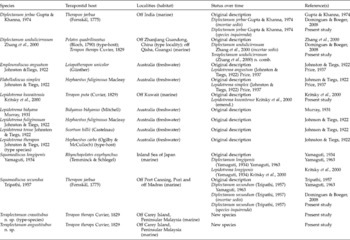
To date 11 species of monogeneans belonging to five genera, Lepidotrema Johnston & Tiegs, Reference Johnston and Tiegs1922, Empleurodiscus Johnston & Tiegs, Reference Johnston and Tiegs1922, Flabellodiscus Johnston & Tiegs, Reference Johnston and Tiegs1922, Squamodiscus Yamaguti, Reference Yamaguti1934 and Diplectanum Diesing, 1858, have been reported from terapontids at different localities and habitats, ranging from freshwater systems of Australia to marine waters off Japan, China, India and Kuwait (table 1). Four of these genera have been synonymized by Price (Reference Price1937) and Kritsky et al. (Reference Kritsky, Jiménez-Ruiz and Sey2000), and those species of Diplectanum recorded from terapontids have recently been considered as incertae sedis by Domingues & Boeger (Reference Domingues and Boeger2008). Price (Reference Price1937) synonymized Empleurodiscus and Flabellodiscus with Lepidotrema, and Squamodiscus, a synonym of Diplectanum according to Yamaguti (Reference Yamaguti1963), was considered to be a junior synonym of Lepidotrema by Krtisky et al. (Reference Kritsky, Jiménez-Ruiz and Sey2000). Consequently, there are now eight species accepted as belonging to Lepidotrema, six from freshwater terapontids in Australia and two from marine terapontids (table 1). The two Lepidotrema species from marine terapontids are L. kuwaitense Kritsky et al., Reference Kritsky, Jiménez-Ruiz and Sey2000 (emend.), from Terapon puta off Kuwait, and L. longipenis (Yamaguti, Reference Yamaguti1934) Kritsky et al., Reference Kritsky, Jiménez-Ruiz and Sey2000 (syns. Diplectanum longipenis (Yamaguti, Reference Yamaguti1934) Yamaguti, Reference Yamaguti1963; Squamodiscus longipenis Yamaguti, Reference Yamaguti1934) from Rhynchopelates oxyrhynchus (Temminck & Schlegel) off Japan. Diplectanum secundum (Tripathi, Reference Tripathi1957) Yamaguti, Reference Yamaguti1963 (syn. S. secundus Tripathi, Reference Tripathi1957) and D. jerbae Gupta & Kanna, Reference Gupta and Khanna1974 from T. jarbua off India (table 1), and D. undulicirrosum Zhang et al., Reference Zhang, Liu, Ding and Chen2000 from Pelates quadrilineatus and T. theraps off Guandong and Guangxi, China (table 1) were considered incertae sedis by Domingues & Boeger (Reference Domingues and Boeger2008) based on their morphological analysis.
Diplectanid monogeneans recorded from terapontid fish worldwide.

The present paper describes two new species of diplectanid from T. theraps which possess a unique male reproductive system not previously reported for any diplectanid, or indeed any monogenean. Based on the presence of this feature, a new genus is proposed to accommodate these two new species.
Materials and methods
Sixteen specimens of the large-scaled terapon T. theraps Cuvier were collected in the coastal waters off Carey Island (2°51′N, 101°22′E) in the Klang Straits and off Kuala Selangor (3°34′N, 101°25′E) on the west coast of Peninsular Malaysia between the years 2010 and 2013. Monogeneans were collected from freshly killed or frozen fish and processed for morphological studies. Briefly, the monogeneans removed from the gills were placed on glass slides with coverslips and gently flattened to properly expose the hard parts and soft anatomical structures. The monogeneans were fixed and cleared in modified ammonium-picrate–glycerine (Lim, Reference Lim1991). Later, after examination, these specimens were washed and dehydrated through a graded ethanol series and mounted in Canada Balsam without staining (Lim, Reference Lim1991). Some specimens were fixed in AFA (acetic acid–formalin–alcohol) on glass slides, stained in Gomori's triple stain and mounted in Canada Balsam after dehydration in a graded ethanol series (Lim, Reference Lim2006; Lim & Gibson, 2010).
The stained and unstained specimens were studied under bright-field and phase-contrast microscopy. Photomicrographs of the hard and soft anatomical structures of the monogeneans were taken using a Leica digital camera, measured using image analysis software (QWin Plus, Hi-Tech Instruments, Selangor, Malaysia) and illustrated using a digitizing tablet (Wacom, Saitama, Japan) and Adobe Illustrator software. Measurements are presented in micrometres; for two-dimensional measurements, length is given before breadth. Type specimens of the two new species were deposited in the Natural History Museum, London (NHMUK) and the Zoological Museum University of Malaya, Kuala Lumpur (MZUM).
Teraplectanum n. g. (Diplectanidae Monticelli, 1903)
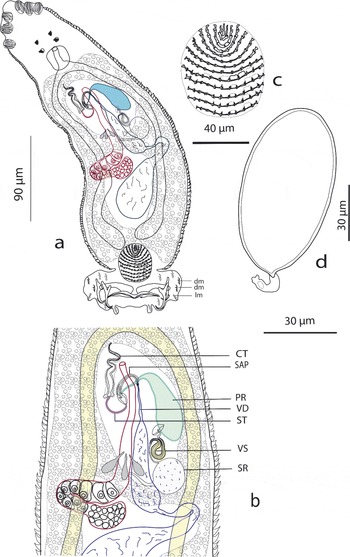
Diagnosis. Diplectanid with four eyespots, three pairs of head organs and anteriorly oriented tegumental scales covering entire body proper from constriction dividing body from haptor to anterior head region about level of head organs (fig. 1a). Peduncle short, usually obscured by constriction demarcating haptor from body proper. Haptor wider than long; two (ventral and dorsal) squamodiscs (fig. 1c) composed of plate-like rodlets linked in open rings; 14 marginal hooks; two haptoral digits with single marginal hook located on each digit; two pairs of anchors; dorsal anchor with developed outer root only; ventral anchors with developed inner and outer roots; paired dorsal bar; single ventral bar. Sclerotized male copulatory organ composed of copulatory tube and sclerotized auxiliary piece (SAP); copulatory tube enclosed in lightly sclerotized external tube; proximal part of copulatory tube straight; distal part undulating, twisted and tapered; SAP with shape of tobacco pipe, comprised of curved, tubular stem and pyriform bowl; SAP stem with single pore at proximal extremity (associated with vas deferens), fuzzy in appearance; SAP bowl with two pores, one close to junction between stem and bowl (associated with prostatic tube) and another at distal end (through which single seminal tube connects with copulatory tube) (fig. 1b); testis post-ovarian; vas deferens loops around left intestinal caecum to ventral side, expands medially to form prominent seminal vesicle, narrows anteriorly, enters SAP stem via proximal pore; prostatic reservoir simple, pyriform; prostatic tube enters pore of SAP bowl; single seminal tube leaves distal pore of SAP bowl to connect with initial part of copulatory tube. Ovary overlaps right intestinal caecum from dorsal to ventral side, continues anteriorly as oviduct, receives ducts from Mehlis' gland, vitelline duct and seminal receptacle, continues as uterus, opens near male pore. Vaginal pore sinistro-median at level of seminal vesicle, muscular; vaginal tube non-sclerotized, but with heavily sclerotized median loop; distal vaginal tube opens into seminal receptacle. Egg oval with short filament (fig. 1d). Gill parasites of marine perciform fish (Terapontidae).
Teraplectanum crassitubus n. sp. (type species): (a) ventral view; (b) male and female reproductive systems; (c) squamodisc; and (d) egg. dm, marginal hook located on dorsal side; lm, marginal hook located laterally; CT, copulatory tube; SAP, sclerotized auxiliary tube; PR, prostatic reservoir; VD, vas deferens; ST, seminal tube; VS, vaginal system; SR, seminal receptacle.

Type species. Teraplectanum crassitubus n. sp.
Other species. Teraplectanum angustitubus n. sp. and T. undulicirrosum (Zhang et al., Reference Zhang, Liu, Ding and Chen2000) n. comb.
Etymology. Teraplectanum is derived from Terapon (the host genus) and Diplectanum, the type genus of the family. It is neuter in gender.
Remarks. Teraplectanum crassitubus n. sp. (figs 1 and 2) and T. angustitubus n. sp. (fig. 3) (see below), collected from T. theraps off Peninsular Malaysia, possess characteristics of the family Diplectanidae, such as an ovary overlapping the right intestinal caecum, two squamodiscs composed of rodlets, 14 marginal hooks, two dorsal anchors with only the outer root developed and two ventral anchors with developed roots, single ventral bar, paired dorsal bars, haptoral digits and tegumental scales.
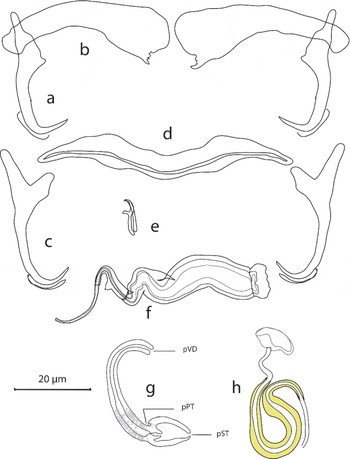
Sclerotized parts of Teraplectanum crassitubus n. sp.: (a) dorsal anchor; (b) paired dorsal bars; (c) ventral anchor; (d) ventral bar; (e) marginal hook; (f) lateral view of copulatory tube; (g) sclerotized auxiliary piece (SAP): pVD, pore for vas deferens; pPT, pore for prostatic tube; pST, pore for seminal tube; and (h) vaginal tube system showing heavily sclerotized vaginal loop.

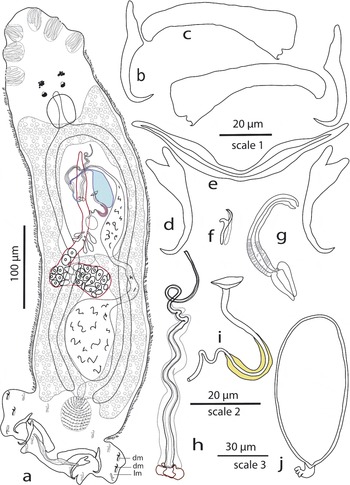
Teraplectanum angustitubus n. sp.: (a) ventral view; (b) dorsal anchor; (c) paired dorsal bars; (d) ventral anchor; (e) ventral bar; (f) marginal hook; (g) sclerotized auxiliary piece (SAP); (h) copulatory tube; (i) vaginal tube system showing heavily sclerotized vaginal loop; (j) egg. dm, marginal hook located on dorsal side; lm, marginal hook located laterally. Scale 1 for b–f; scale 2 for g–i; scale 3 for j.

The two new diplectanid species described below possess a unique arrangement of the male reproductive system which has not been reported previously for diplectanids, or indeed for other monogeneans. The sclerotized male reproductive organ (fig. 1b) includes a copulatory tube and a sclerotized auxiliary piece (SAP), which is shaped like a tobacco pipe and consists of two parts, a curved stem and a pyriform bowl. The curved SAP stem has a pore at its proximal end, while the pyriform SAP bowl has two pores, one pore close to the junction between stem and bowl, and another at its distal end. The SAP is not an accessory piece, although it is closely associated with the male copulatory tube. The function of the accessory piece is mainly to direct and support the male copulatory tube, whereas the SAP enables spermatozoa stored in the seminal vesicle to be mixed with prostatic secretions from the prostatic reservoir, to form semen. This semen is then transferred via a seminal tube into the copulatory tube (fig. 2). Such a structure and process for the mixing of spermatozoa and prostatic secretions to form semen has not been reported previously for monogeneans. In the majority of known monogeneans, the mixing of the sperm and prostatic secretions to form semen occurs within the copulatory tube. In species of this new genus, the mixing of the sperms and prostatic secretions occur within the SAP bowl before being directed by the seminal tube into the copulatory tube.
Another diagnostic feature of this new genus is the sclerotized vaginal loop (fig. 2h and see fig. 3i). The vaginal system consists of a sinistro-median, muscular vaginal pore and a vaginal tube with a heavily sclerotized loop. It is difficult to ascertain whether this loop is part of the wall of the vaginal tube which has become heavily sclerotized, or whether it is an independent sclerotized region through which the vaginal tube passes, since this sclerotized layer tapers at both ends, especially in the direction of the seminal receptacle.
A review of the existing diplectanid genera indicates that none of them can reasonably accommodate the two new species without major changes to their concept. Two species of Lepidotrema, i.e. L. kuwaitense and L. longipenis, have been reported from marine terapontids off Kuwait and Japan, respectively (Kritsky et al., Reference Kritsky, Jiménez-Ruiz and Sey2000; table 1). Species of the new genus resemble these two species in having similar types of haptoral elements in terms of the dorsal and ventral squamodiscs, ventral anchors with developed inner and outer roots, dorsal anchors with only the outer roots well developed, and a single lip-liked ventral bar, which is narrow in its mid-length, and claviform paired dorsal bars (toothed or serrated with a hook on the inner posterior surface) connected by ligaments or muscles. The copulatory tube of the species of the new genus is enclosed within a lightly sclerotized tube, which is similar to the nested copulatory tube described by Kritsky et al. (Reference Kritsky, Jiménez-Ruiz and Sey2000) for L. kuwaitense. However, many of these features are common characteristics of many diplectanid genera and, in particular, members of the subfamily Diplectaninae. For example Paradiplectanum sillagonum (Tripathi, Reference Tripathi1957) Domingues & Boeger, Reference Domingues and Boeger2008, as redescribed by Kritsky et al. (Reference Kritsky, Jiménez-Ruiz and Sey2000), has similar haptoral elements and a male copulatory organ with nested tubes, but lacks an accessory piece (see below). Lepidotrema spp. do not possess the specialized SAP associated with the male reproductive system, nor the sclerotized vaginal loop, and the sinistro-ventral vaginal pore of L. kuwaitense and L. longipenis, with its circular, muscular rim and funnel-shaped vagina, is different from the vaginal system of species of the new genus. Teraplectanum spp. possess a sinistro-ventral muscular vaginal pore and have a vaginal tube which passes through a heavily sclerotized loop. Furthermore, according to Kritsky et al. (Reference Kritsky, Jiménez-Ruiz and Sey2000), the primary distinguishing feature of Lepidotrema spp. is the presence of groups of elongate spinelets forming fan-like structures on the posterior region of the squamodiscs. Such elongate spinelets are not observed in species of the new genus.
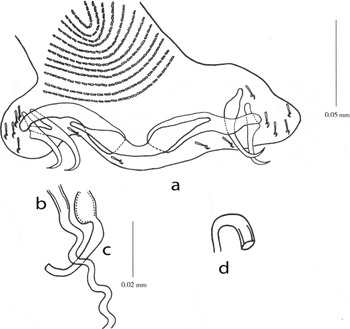
The three species of Diplectanum described from T. theraps, i.e. D. jerbae, D. secundum and D. undulicirrosum (table 1), were considered as incertae sedis by Domingues & Boeger (Reference Domingues and Boeger2008). Judging from their original descriptions, it is not possible to distinguish D. jerbae and D. secundum based on the information available, and these two species are here considered as species inquirendae (table 1).On the other hand, D. undulicirrosum possesses haptoral hard parts, a copulatory tube, an SAP and a sclerotized vaginal loop, which are recognizable and similar to those of the type species of the new genus (see fig. 4). These sclerotized features strongly suggest that D. undulicirrosum likely has the same form of the male reproductive system as described above for species of this new genus. Zhang et al. (Reference Zhang, Liu, Ding and Chen2000) gave no description of the connections between the SAP (which they mistakenly identified as an accessory piece), the vas deferens, the prostatic tube and the copulatory tube, nor did they describe the vaginal system in detail (see fig. 4).
Teraplectanum undulicirrosum (Zhang et al., Reference Zhang, Liu, Ding and Chen2000) n. comb.: (a) haptor and hardparts; (b) copulatory tube; (c) sclerotized auxiliary piece (SAP); (d) vaginal loop.

The new genus, Teraplectanum, is therefore erected to accommodate the two species, T. crassitubus n. sp. and T. angustitubus n. sp., described below, based on: (1) the presence of a distinct, sclerotized auxiliary piece (SAP) associated with the mixing of spermatozoa and prostatic secretions to form semen prior to its extrusion via seminal tube into the copulatory tube for insemination; and (2) the presence of a sclerotized vaginal loop.
Teraplectanum crassitubus n. sp
Type host. Terapon theraps Cuvier, 1829.
Type locality. Malacca Strait off Carey Island (Klang Strait), Selangor, Malaysia; off Kuala Selangor, Selangor, Malaysia.
Site. Gills.
Type specimens. Holotype: NHMUK 2013.11.25.1; three paratypes: NHMUK 2013.11.25.2–4; 39 paratypes: MZUM(P)2013.579(P)–617(P).
Materials studied. Forty-one specimens studied; 19 specimens measured.
Etymology. This species name crassitubus is named with reference to the stout, proximal part of the copulatory tube. ‘Crassus’ (L.), wide; ‘tubus’ (L.), tube. It is treated as a noun.
Description (figs 1 and 2). Body elongate, 572 (423–748) × 149 (108–197), with three pairs of head organs and two pairs of pigmented eyespots, posterior pair larger. Tegumental scales extend from posterior extremity of body proper to level of head organs; scales oriented anteriorly. Mouth subterminal, ventral; pharynx ovoid, 39 (31–45) × 35 (30–46); intestine bifurcates posterior to pharynx; caeca do not re-unite. Peduncle short, usually obscured by constriction between haptor and body proper. Haptor well demarcated by constriction, wider than long, 88 (68–104) × 157 (121–197), with two posteriorly directed haptoral digits. Haptoral armature includes: 14 similar, larval type marginal hooks, 10 (9–11) in length, two pairs located on dorsal side on lateral lobe of haptor, two pairs on ventral side of lateral lobe, one pair on lateral margin of haptoral lobe, one pair on haptoral digit, one pair near ventral anchor; two pairs of anchors; ventral pair of anchors with developed roots, inner length 31 (29–35), outer length 38 (35–39), inner root 11 (8–12), outer root 14 (11–16), point 7 (5–9); dorsal pair of anchors with undeveloped inner root modified for articulation with dorsal bar, inner length 20 (18–21), outer length 34 (32–35), inner root 3 (2–4), outer root 12 (11–14), point 6 (5–9); two connecting bars: broad, lip-shaped ventral bar, 372 (64–84) wide, with narrow median region 6 (5–7), expanding laterally to 9 (7–11) before tapering at both ends; paired dorsal bar, claviform, with hook and serrations on posterior inner surface of broader end, length 49 (44–53), widest width 15 (12–19) narrowing to 6 (5–7), two halves probably connected via muscle or ligaments but not obvious in flattened specimens. Dorsal and ventral squamodiscs consist of 13 (8–16) rows of rodlets with length 50 (41–62), width of 58 (52–70). Sclerotized male organ consists of copulatory tube nested within external, lightly sclerotized tube and sclerotized auxiliary piece (SAP). Copulatory tube with robust proximal part, tapers and twists distally, 91 (86–99) in total length, width of initial part 7 (6–9), greatest width of robust proximal part 9 (7–10), begins to taper at 33 (30–39) from initial part, diameter 4 (4–5) twisting distally to fine point; external tube extends 49 (43–59) from initial part. SAP with shape of tobacco pipe, 46 (43–50) in total length, comprised of curved, tubular stem and pyriform bowl; SAP stem with single pore (pVD) at proximal extremity, length 34 (29–38), width 5 (4–6), fuzzy in appearance close to bowl; SAP bowl 12 (11–13) × 7 (6–9), with two pores, one close to junction between stem and bowl (pPT) and other at distal end (pST) (fig. 2g). Testis single, elongate–ovoid, postero-dorsal to ovary; vas deferens leaves anterior region of testis, loops around left intestinal caecum to ventral side, distends forming large seminal vesicle medially, narrows anteriorly to enter proximal pore of SAP stem (pVD); tube from prominent, elongate, pyriform prostatic reservoir opens into SAP bowl via pore at junction of stem and bowl (pPT); single seminal tube leaves distal end of SAP bowl (pST) to enter initial part of copulatory tube. Ovary elongate, anterior end passes around right intestinal caecum from dorsal to ventral side; narrows anteriorly to form oviduct, which continues anteriorly as ootype surrounded by Mehlis' gland (not obvious in all specimens), receiving ducts from vitellarium and seminal reservoir (see below); female duct continues anteriorly to uterine pore situated close to copulatory tube. Vaginal pore muscular, ventro-dextral, at about mid-body, posterior to copulatory tube; vaginal tube 71 (65–79) in total length, short distance from pore it passes through heavily sclerotized loop 54 (49–62) × 6 (4–7) in length which is tapered at both ends, emerging from loop to open into seminal receptacle; connection between seminal receptacle and ootype obscured in many but visible in some specimens. Vitellarium follicular; lateral fields approximately co-extensive with intestinal caeca, confluent just posterior to intestinal bifurcation, just anterior to ovary and just posterior to testis. Egg oval (N= 2) 87.7 (85.9–89.6) × 45.6 (42.7–48.5), with short filament.
Differential diagnosis. Teraplectanum crassitubus n. sp. is characterized by having a copulatory tube with a robust proximal part which tapers and twists distally. The copulatory tube has a thin, external sclerotized tube covering both the proximal portion and the twisted distal part, but does not extend as far as the distal tip. Associated with the male copulatory tube is the unique sclerotized auxiliary piece (SAP). This species also possesses a heavily sclerotized vaginal loop, which is tapered at both ends, especially at the end leading to the seminal receptacle. This species is similar to D. undulicirrosum in the general morphology of sclerotized vaginal loop and haptoral armament, but differs in its detailed morphology. Diplectanum undulicirrosum possesses an SAP, which Zhang et al. (Reference Zhang, Liu, Ding and Chen2000) considered to be an accessory piece. In T. crassitubus n. sp., the copulatory tube has a robust proximal section and a twisted undulating, tapered distal end, whereas in D. undulicirrosum it is slender with an undulating distal end which is almost equal in diameter (compare figs 2 and 4). The sclerotized vaginal loop of the new species (with tapering terminals) is also different from the U-shaped tube of D. undulicirrosum with non-tapering ends. Furthermore, the curved, tapered, sclerotized, tubular piece associated with its vaginal system is different from the curved tube with a constant diameter described for D. undulicirrosum. The copulatory tube of the new species is enclosed by an external sclerotized tube, which could be similar to that described for L. kuwaitense by Kritsky et al. (Reference Kritsky, Jiménez-Ruiz and Sey2000), except that in the latter species the copulatory tube is a straight, tubular structure rather than being twisted distally. Zhang et al. (Reference Zhang, Liu, Ding and Chen2000) did not mention the presence of a thin external tube around the copulatory tube of D. undulicirrosum, but this feature is readily missed because it is very lightly sclerotized.
The haptoral elements of the new species are similar to those of D. undulicirrosum, P. sillagonum and L. kuwaitense as they include a single ventral bar, paired dorsal bars, ventral anchors with developed inner and outer roots, dorsal anchors with a developed outer root and an inner root area modified to articulate with the dorsal bars, and squamodiscs (Kritsky et al., Reference Kritsky, Jiménez-Ruiz and Sey2000; Domingues & Boeger, Reference Domingues and Boeger2008). In the new species, the inner surface of each of the paired dorsal bars has tooth-like serrations and an obvious hook, a feature also observed in L. kuwaitiense and P. sillagonum but absent in D. undulicirrosum. As already noted, L. kuwaitensis lacks the SAP and sclerotized vaginal loop and possesses a different type of copulatory tube.
Haptoral digits are found in this new species but not in D. undulicirrosum nor in Lepidotrema spp. Tegumental scales are observed for the present new species of Teraplectanum but not on the two Lepidotrema spp. from marine tetapontids according to Kritsky et al. (Reference Kritsky, Jiménez-Ruiz and Sey2000). However, tegumental spines are present on specimens of L. longipenis from Japan collected by Professor Kazuya Nagasawa and Masato Nitta (pers. comm.). Tegumental scales are also not reported for D. undulicirrosum, but these are probably lost during preparation of the specimens.
In view of the differences outlined above, this species is considered to be new to science and is named Teraplectanum crassitubus n. sp. and designated as the type species of Teraplectanum n. g.
Teraplectanum angustitubus n. sp
Type host. Terapon theraps Cuvier, 1829.
Type locality. Malacca Strait off Carey Island (Klang Strait), Selangor, Malaysia; off Kuala Selangor, Selangor, Malaysia.
Site. Gills.
Type specimens. Holotype: NHMUK 2013.11.25.5; four paratypes: NHMUK 2013.11.25.6–9; 31 paratypes: MZUM(P)2013.618(P)–648(P).
Material studied. Thirty-six specimens studied; 15 specimens measured.
Etymology. This species is named angustitubus with reference to the slender proximal part of the copulatory tube. ‘Angustus’ (L.), narrow; ‘tubus’ (L.) for tube.
Description (fig. 3). Body elongate, 536 (448–629) × 127 (95–152), with three pairs of head organs and two pairs of pigmented eyespots. Tegumental scales extend from posterior end to body proper close to peduncle to level of head organ pores. Mouth subterminal, ventral; pharynx ovoid, 31 (24–34) × 31 (24–35); intestine bifurcates just posterior to pharynx; caeca do not re-unite. Peduncle present but usually obscured by constriction of haptor from body proper. Haptor well demarcated, 100 (95–117) × 167 (154–184); two posteriorly directed haptoral digits; 14 larval type marginal hooks, all of similar shape, length 10 (9–11), two pairs located on dorsal side on lateral lobe of haptor, two pairs on ventral side of lateral lobe, one pair lateral margin of haptoral lobe, one pair on haptoral digit, one pair near ventral anchor; two pairs of anchors: ventral pair with developed roots, inner length 35 (32–39), outer length 40 (36–43), inner root 11 (9–14), outer root 13 (11–15), point 8 (6–9); dorsal pair with undeveloped inner root modified for articulation with dorsal bar, inner length 22 (20–27), outer length 37 (35–42), inner root 3 (2–3), outer root 13 (11–17), point 7 (6–8); two connecting bars: ventral bar single, broad, lip-like, 77 (71–84), with narrow median region, 5 (4–5) expanding laterally to 10 (8–12) before tapering at both ends; dorsal bar paired, claviform, serrate, with hook on posterior inner surface of proximal part, each measuring 54 (48–58), widest width 15 (10–19), distal end diameter 6 (5–7), apparently connected by muscle or ligaments. Dorsal and ventral squamodiscs with 12 (9–14) rows of rodlets, length 47 (43–54), width 58 (47–65). Sclerotized male organ consists of copulatory organ and sclerotized auxiliary piece (SAP). Copulatory tube slender, with its proximal part tapered and twisted distally, enclosed in lightly sclerotized external tube; copulatory tube, total length 99 (95–107), width of proximal part 7 (6–9), width of tube 3 (3–5) at mid-length, width of tube 3 (2–4) at point where it starts to narrow and twist at c. 25 (22–29) from initial part; thin external sclerotized tube extends for distance of 53 (51–60). SAP with shape of tobacco pipe, 44 (40–46) total length, comprised of curved, tubular stem and pyriform bowl; SAP stem with single pore at proximal extremity, length 34 (28–37), width 4 (4–5), fuzzy in appearance close to bowl; SAP bowl 10 (9–12) × 6 (5–7), with two pores, one close to junction between stem and bowl and other at distal end. Testis single, elongate–ovoid, postero-dorsal to ovary; vas deferens leaves anterior region of testis on ventro-sinistral side, loops round left intestinal caecum, distends forming seminal vesicle, then narrows to enter SAP via proximal pore of stem; prostatic tube from prominent, elongate, gourd-shaped prostatic reservoir opens into SAP bowl via pore close to junction between stem and bowl; single seminal tube leaves SAP via distal pore of bowl to enter initial of copulatory tube. Ovary elongate, curves around right intestinal caecum; distal end narrows to form oviduct, continues anteriorly as ootype surrounded by Mehlis' gland (not clear in all specimens); female duct continues anteriorly to uterine pore situated close to male pore. Vaginal pore dextro-ventral at level of seminal vesicle, with muscular rim; vaginal tube 53 (49–60) in length, passes through heavily sclerotized loop, measuring 38 (33–40) × 5 (4–5), before opening into seminal receptacle; connection with ootype not readily observed. Vitellarium follicular, in lateral fields approximately co-extensive with intestinal caeca, confluent just posterior to intestinal bifurcation, just anterior to ovary and just posterior to testis. Egg oval (N= 1) 91 × 43, with short filament.
Differential diagnosis. Teraplectanum angustitubus n. sp. differs from T. crassitubus n. sp. in having a slender proximal part of the copulatory tube compared to the thick, robust proximal part in T. crassitubus n. sp. (compare figs 2f and 3h). In both species the distal part of the copulatory tube tapers and twists. The copulatory tube of T. angustitubus n. sp. is similar to that of D. undulicirrosum in being slender and undulating, but differs in that its distal tip tapers until it is a fine tube, whereas in D. undulicirrosum the slender copulatory tube is of almost equal diameter throughout its length (compare figs 3h and 4b). The SAP of T. angustitubus is almost the same size as that of T. crassitubus, i.e. 44 (40–46) versus 46 (43–50), and its sclerotized vaginal loop is also similar to that of T. crassitubus, except that it is shorter and thinner, i.e. 53 (49–60) versus 71 (65–79).
In view of the differences outlined above, this species is considered to be new to science and is named Teraplectanum angustitubus n. sp.
Teraplectanum undulicirrosum (Zhang et al., Reference Zhang, Liu, Ding and Chen2000) n. comb
Syn. Diplectanum undulicirrosum Zhang et al., Reference Zhang, Liu, Ding and Chen2000
Type host. Pelates quadrilineatus (Bloch, 1790).
Other host species. Terapon theraps Cuvier, 1829.
Type locality. Off Zhanjiang, Guandong, China.
Other locality. Off Qisha, Guangxi, China.
Remarks. Attempts to borrow the type-specimens of D. undulicirrosum for re-examination were unsuccessful, hence the comparative analysis relied entirely on the original illustration and description. (The original illustrations are reproduced here with the permission of the authors as fig. 4). As noted above, D. undulicirrosum possesses a similar SAP, paired dorsal bars, single ventral bar, ventral anchors with developed outer and inner roots, and marginal hooks as T. crassitubus n. sp. and T. angustitubus n. sp., although all three species differ in their detailed morphology (compare figs 2, 3 and 4) (see differential diagnoses above for T. crassitubus and T. angustitubus). An external tube was not described for the copulatory tube of this species. In D. undulicirrosum the vaginal tube is only depicted as U-shaped with non-tapering ends, compared to the vaginal tube with sclerotized vaginal loop in T. crassitubus and T. angustitubus (compare figs 2, 4d). Therefore it is necessary to re-examine and re-describe T. undulicirrosum in order to determine the vaginal arrangement and whether the copulatory tube is covered by an external tube. The similarities in the morphology of sclerotized structures, especially the presence of an SAP plus the general organization of the reproductive organs, suggest that the three species, D. undulicirrosum, T. crassitubus and T. angustitubus are congeneric. Hence, it is proposed that D. undulicirrosum be transferred to Teraplectanum as T. undulicirrosum (Zhang et al., Reference Zhang, Liu, Ding and Chen2000) n. comb. In retrospect, Domingues & Boeger (Reference Domingues and Boeger2008) were correct in considering D. undulicirrosum as incertae sedis until more information is available.
Discussion
Teraplectanum n. g. is represented by two new species, T. crassitubus n. sp. and T. angustitubus n. sp., and one reassigned species, T. undulicirrosum (Zhang et al., Reference Zhang, Liu, Ding and Chen2000) n. comb. This new genus has a unique sclerotized auxiliary piece (SAP) which is part of the male reproductive system. The SAP is shaped like a tobacco pipe with a curved stem with a proximal pore (pVD) and a bowl with two pores (pPT and pST) (figs 2g and 3g). The SAP is associated with the seminal vesicle, prostatic reservoir and copulatory tube and it is likely involved in the mixing of spermatozoa and prostatic secretions to form semen (fig. 1b). Briefly, what appears to happen is that spermatozoa from the seminal vesicle are transported through the vas deferens into the SAP via the proximal pore (pVD) at the SAP stem, and the prostatic secretions pass from the prostatic reservoir and are directed into the SAP bowl through the prostatic tube via one of the pores in the bowl (pPT). These two fluids are mixed in the SAP bowl, forming semen, which is channelled by the seminal tube into the copulatory tube. This unique arrangement of the terminal region of the male reproductive system has not been described previously for a diplectanid or, indeed, any other monogenean group. In other monogeneans, the prostatic tube and the vas deferens open directly into the initial part of the male copulatory tube, where the spermatozoa and prostatic fluid are mixed.
The two new species of this genus also have a sclerotized copulatory tube surrounded by an external tube, a feature not described for T. undulicirrosum. A male copulatory tube comprising two nested tubes is common amongst diplectanids and, in particular, among members of the subfamily Diplectaninae, being found, among others, in species of Lepidotrema, Diplectanum and Paradiplectanum (see Domingues & Boeger, Reference Domingues and Boeger2008), whether or not this external tube is an accessory piece is open to question. However, both Kritsky et al. (Reference Kritsky, Jiménez-Ruiz and Sey2000) and Domingues & Boeger (Reference Domingues and Boeger2008), when noting that the accessory piece is lacking in the genera with a nested copulatory tube, did not consider this external tube to be an accessory piece. It is difficult to ascertain a function for this external tube, other than to protect and support the copulatory tube.
Another feature unique to this new genus is the presence of a heavily sclerotized vaginal loop. This loop could be an independent, nested sclerotized tube through which the vaginal tube passes, or a thickening of the tube wall itself. Herein it is considered that the former is more likely, although the function of this sclerotized vaginal loop is not known.
Anteriorly oriented tegumental body scales (‘spines’) are observed in the new species of Teraplectanum, extending from the just before haptor up to about the level of the posterior most lateral pair of head organs (fig. 1). Such scales also occur in other diplectanid species, e.g. those described from Toxotes jaculatrix (see Lim, Reference Lim2006). However, there was no mention of tegumental scales or spines on the two Lepidotrema spp. from marine terapontids (Kritsky et al., Reference Kritsky, Jiménez-Ruiz and Sey2000). However, scales are present on specimens of L. longipenis (Yamaguti, Reference Yamaguti1934) collected recently from off Japan (observed in photomicrographs kindly provided by Professor Kazuya Nagasawa). Although no scales were described for T. undulicirrosum by Zhang et al. (Reference Zhang, Liu, Ding and Chen2000), it is highly probable that they are present.
The anterior rodlets of the squamodiscs of the new species are arranged in an open ring formation; this type of squamodisc is also found in the two Lepidotrema spp. from marine terapontids, Latericaecum cazauxi (Oliver & Paperna, 1984) Domingues & Boeger, Reference Domingues and Boeger2008 and Paraplectanum sillagonum as revised by Kritsky et al. (Reference Kritsky, Jiménez-Ruiz and Sey2000).
Haptoral digits were observed in the two new species and have also been depicted for L. cazauxi by Kritsky et al. (Reference Kritsky, Jiménez-Ruiz and Sey2000). However, these structures may readily be missed or unreported, especially if they are contracted.
All three species attributed to Teraplectanum and the two marine species of Lepidotrema possess two pairs of anchors, with the ventral pair having developed inner and outer roots and the dorsal pair with a developed outer root only, a single lip-like ventral bar and a paired dorsal bar armed with a hook. A serrate (toothed) margin on the inner surface of the dorsal bar occurs in the two new species, but was not described for T. undulicirrosum; however, this may be due the way the specimens were oriented. The two new species of Teraplectanum n. g. were observed to have a muscle bundle between the two parts of the paired dorsal bar.
The closest relatives of the new genus appear to be the species of Lepidotrema from marine terapontids. This observation is based on based on similarities in the structure of the haptoral elements and the external tube of the copulatory tube, features which may also occur in other diplectanids, such as species of Paradiplectanum and Latericaecum Young, 1969. However, species of all of these genera lack an SAP and a sclerotized vaginal loop, which are found in the species belonging to Teraplectanum n. g. The other two diplectanid species from marine terapontids, i.e. D. jerbae and D. secundum, could not be identified based on information (description and illustrations) given in the literature for these two species, and are here considered as species inquirendae.
Teraplectanum is included in the Diplectanidae as its constituent species possess the diagnostic features of this group (see ‘Remarks’ on the new genus, above). Our conceptions of the Diplectanidae and its component groups are still undergoing change, and many of the subfamilies have been considered as sedis mutabilis and many lower taxa, and in particular species of Diplectanum, have been considered incertae sedis (see Domingues & Boeger, Reference Domingues and Boeger2008). More data, both morphological and molecular, are needed to ascertain the relationship between Teraplectanum n. g., Lepidotrema and other diplectanid genera. Therefore, until such data are available, the new genus is attributed to the Diplectanidae but without a subfamilial designation.
Acknowledgements
I would like to thank Dr David Gibson, The Natural History, London, UK, for his very useful comments and discussions during the course of writing this manuscript and also for procurement of literature; Dr Miguel A. Alonso-Zarazaga, Museo Nacional de Ciencias Naturales, Madrid, Spain for discussion on the name of the new genus; Professor Delane Kritsky, Idaho State University, Pocatello, USA, for discussion on Lepidotrema spp. and various features of the species described in this paper; Mr K.S. Liew for collecting, preparing and staining the specimens; and Dr W.B. Tan for help in measuring the specimens. I would like to thank Professor Kazuya Nagasawa and Masato Nitta, University of Hiroshima for collecting Lepidotrema longipenis (Yamaguti, Reference Yamaguti1934) Kristsky et al., Reference Kritsky, Jiménez-Ruiz and Sey2000 from the type host and in the type locality, and Professor Zhang and his co-workers for their permission to reproduce their original illustration of Teraplectanum undulicirrosum (Zhang et al., Reference Zhang, Liu, Ding and Chen2000) n. comb.
Financial support
This project is funded by two UMRG grants (RP004D-13SUS and RP008-2012B) from the University of Malaya, Kuala Lumpur.
Conflict of interest
None.