The history of the thirteenth-century motet is being gradually re-fashioned, not least because of the heterogeneity of the many musical pieces that are collected under this generic label in modern editions. Those things termed ‘motets’ today are to some extent a hybridisation of other genres and their transmission history – being largely collected retrospectively after significant use, adaptation and further hybridisation – makes it difficult, perhaps impossible, to uncover with certainty the pathway by which any given medieval motet was generated. Earlier studies of motets focused on so-called ‘motet books’, which seem to represent a central, Parisian tradition of thirteenth-century liturgical polyphony. These books offer a picture of motets deriving from the trope-like Latin texting of sections of discant (note-against-note counterpoint) within organa (polyphony built on a plainchant tenor). These motet books present motets as a further ornament to specific festive liturgies in the sacred world of the church, with later French contrafact texts viewed as exploring allegorical parallels between sacred and secular spheres.Footnote 1
More recent work has proposed two kinds of extension to this basic history. First, building on sporadic earlier work that had been seen at the time as iconoclastic or even quixotic, Catherine A. Bradley has shown that sometimes, even when a clausula and Latin-texted version exist, the vernacular motet in a given motet network can affect earlier versions retrospectively or may itself represent the original form of the piece.Footnote 2 Second, work by Gaël Saint-Cricq has taken seriously the seemingly anomalous (but actually quite large) presence of motets in trouvère songbooks, emphasising the songlike aspects of certain motets’ construction, including those in the ‘central’ tradition, and proposing a more complicated and diverse story of their origins.Footnote 3
Moreover, the history of the motet is changing incrementally as, despite their anonymity, motets are increasingly treated not en masse, or in large taxonomical blocks, but as individual works, highly fashioned by skilled composers, deeply embedded in complex networks of other voices, musical works, genres and poetry. The present article seeks to further the discussion of the diversity of the motet in the long thirteenth century by considering a specific, rather unusual example of motet-related materials in a songbook. The songbook in question has two notable features: Oxford, Bodleian Library, MS Douce 308 (hereafter D308) is unnotated and organised by genre.Footnote 4 These features mean that the source has been of limited use as a witness to the history of motets; what attention it has been paid has been directed specifically at the seventh of these eight genre sections, which contains an extensive collection of song-like motets (albeit without musical notation), with no indication of tenors, and nearly all in the refrain-bounded motet form known as the motet enté.Footnote 5 The example discussed here, however, is not found in the motet subsection of the songbook, but rather in the subsection that contains pastourelles. Like some of the other motets in D308, its relation to the ‘same’ motet in other sources shows considerable differences, leading to questions about the function of the version in D308 and its chronology relative to the other versions of the work. This article will present these differences and consider their implications.
Pastourelle no. 56 and its motet relations
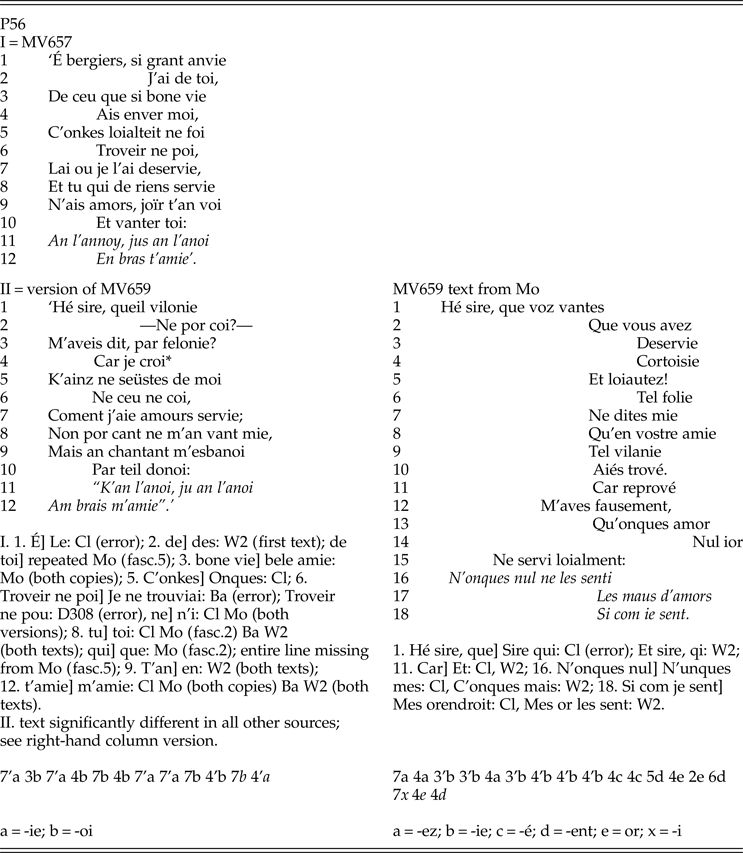
The first stanza of pastourelle no. 56 (hereafter P56) in D308 is identical with the motet voice Hé bergier (MV657; for text and translation, see Ex. 1).Footnote 6 This voice, Hé Bergier, is found as the motetus part of two, three and four-voice motets in several of the main motet sources (for details, see Ex. 2), which will be discussed below.Footnote 7 The ‘je’ of the text is a knight who addresses a shepherd informally (using ‘tu’), saying: ‘Hey shepherd, I am so envious of you, because you have such a good life compared to me.’ The knight claims he has never been able to find loyalty or faith even where he has deserved it, and yet the shepherd, who, the knight alleges, has ‘not served Love in any way’ is seen to be rejoicing in it and is boasting ‘in the alder grove, down in the alder grove, in the arms of your beloved’.Footnote 8 These final lines of the first stanza, in which the knight ventriloquises the boasting song of the shepherd, is classified by modern scholarship as a refrain.Footnote 9 It is one that is found, however, only in this text, albeit in both its motet and pastourelle versions, which makes it a ‘unique refrain’.Footnote 10
Text and translations of P56 and Mo22.

* The apparent hypometric line here is explained by the lack of elision from the preceding line compared to the first stanza; see Example 4 below.
I
Hey shepherd, I am so envious of you, because you have such a good life compared to me, since I can never find loyalty or faith where I have deserved it, and I see you, who have not served Love in any way, rejoicing in it and boasting in the alder grove, down in the alder grove, in the arms of your beloved.
II
Hey sire, what a vile thing – and for what? – have you said to me out of nastiness? Because I know that you don't know such a thing about me – neither this nor that – how I might have served love; nor have I ever boasted at all, but have enjoyed myself in singing by means of this amorous pleasantry: ‘in the alder grove, down in the alder grove, in the arms of my beloved’.
MV659
Hey sire, how you boast that you have deserved courtesy and loyalty! Don't speak such foolish words to me, [as to say] that you have found such baseness in your beloved, because you have falsely reproved me, [saying] I have never served love loyally: no one has ever felt the pains of love as I feel them.
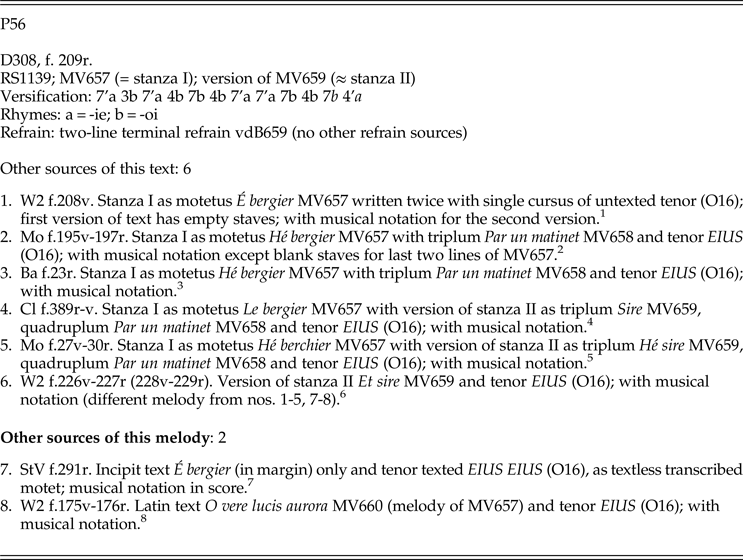
The sources of the motet voices in the P56-related motet complex.

2 https://manuscrits.biu-montpellier.fr/images/196195vZ.jpg; https://manuscrits.biu-montpellier.fr/images/196196rZ.jpg; https://manuscrits.biu-montpellier.fr/images/196196vZ.jpg; https://manuscrits.biu-montpellier.fr/images/196197rZ.jpg. The general site is accessed through https://manuscrits.biu-montpellier.fr/vignettem.php?GENRE%5B%5D=MP&ETG=OR&ETT=OR&ETM=OR&BASE=manuf.
4 https://gallica.bnf.fr/ark:/12148/btv1b530121530 and https://gallica.bnf.fr/ark:/12148/btv1b530121530.
5 https://manuscrits.biu-montpellier.fr/images/196027vZ.jpg; https://manuscrits.biu-montpellier.fr/images/196028rZ.jpg; https://manuscrits.biu-montpellier.fr/images/196028vZ.jpg; https://manuscrits.biu-montpellier.fr/images/196029rZ.jpg; https://manuscrits.biu-montpellier.fr/images/196029vZ.jpg; https://manuscrits.biu-montpellier.fr/images/196030rZ.jpg.
If the P56 version of this text did not survive, the classification of the refrain as a refrain would rely on the fact of it being marked, functionally and generically, by its terminal positioning and repeated verbal phrasing. However, P56 is a two-stanza song with an unchanging refrain (a chanson à refrain), which confirms the status of the refrain as a refrain, albeit a different kind from the refrains ordinarily found in motets, which are typically non-stanzaic. Motet refrains, if intertextual, are quotations found elsewhere or, if (as more often) unique, are quotation-like in function, positioning and verbal content. Nonetheless, this refrain, like all the refrains operating here function as refrains and exhibit typical refrain-like formal and textual markers, whether or not they are unique (as in MV657), intratextual (as in the chanson à refrain of P56), or intertextual.
The second stanza of P56, which is voiced by the shepherd, re-uses the refrain (which is one way to confirm the status of a refrain as such), and in fact explains it as an ‘amorous pleasantry (donoi)’ he was singing to himself for his own amusement. The shepherd accuses the knight of knowing nothing about him, his service to love or his boasting. The knight has based his vile accusation purely on a song that he has wrongly taken as truth when the shepherd was just singing for fun; ironically, the knight has committed base speech (‘vilonie’, ‘felonie’) because he has incorrectly read (in fact, heard) the lower-class character's courtly ‘donoi’ as a true boast. The ‘donoi’ itself is a refrain because it is re-used within a single stanzaic refrain-song (where it is confirmed as a refrain – a short snippet of courtly poetry, sung by courtiers – precisely at the point the shepherd sings it, proving his point).Footnote 11 While it is possible that it was a more widely circulated ‘intertextual refrain’, no evidence survives of such wider use; in any case, it is plausible it was written for this particular text, not least because it seems retrospectively to generate the versification of the rest of the stanza in the parameters of rhyme types and syllable count.
As seen in Example 2, the first stanza of P56 is widely transmitted as the entire text of a motetus voice in a variety of motet contexts (nos.1–5); the melody associated with this stanza in notated sources is in turn found transcribed into textless notation with its French incipit in the margin (no. 7), as well as being copied with an alternative Latin text (no. 8). When transmitted within a three-part motet, Hé bergier (MV657) is combined with Par un matinet (MV658) as the triplum. The first-person singer in Par un matinet is the voice of a different knight who has clearly overhead the same shepherd's song. Like the first knight, he hears it as a factual boast and deems it folly, because such love is base. This second knight then claims that he loves more loyally than anyone, and, ‘because a beautiful lady loves me, I ask for nothing more’. This text is also a refrain, since it is found in two other motet voices, where it has similar text and melody.Footnote 12 The three-part version of the motet is found in Ba, and in the fifth fascicle of Mo (no. 145), where the motetus (but not the triplum) is incompletely copied.Footnote 13
While two-part versions, with only the motetus melody and the EIUS tenor, do exist – two of them – neither transmits the French motetus text. The version in W2 (fol. 175v–176r) has a sacred Latin text, which nonetheless replicates the versification pattern of the French text and seems to belong to a group of pieces in this source that represent later Latin re-textings of French originals.Footnote 14 This text name-checks Samson and Delilah without further elaboration, which provides an implicit moral judgement on the French motetus text, and, indeed, on the several upper-voice texts of the vernacular motet, since Samson's strength was undermined by being in the arms of his beloved, suggesting that the original text still lurks behind its contrafact. The version of the melody in the two-part arrangement in score in StV is labelled in the margin with the incipit of the French text ‘Hé bergier’, but is otherwise textless. This is, as Fred Büttner has shown, a transcription of the motet into modal ligatures facilitated by the removal of its text, here, clearly, the French text that is most commonly found with this melody and seems likely to have been its original text.Footnote 15
A four-part version exists in two sources: Cl and in the second fascicle of Mo. Both these copies apparently view the Par un matinet voice, which had been the triplum of the three-part version, as a quadruplum, placing it first in the sequence of voices presented. In the triplum position of these four-part versions, that is, copied in second position in the sources, is a new text, Hé sire (MV659), which, unlike the other two texts, gives voice to the shepherd (see Ex. 1 for text and translation). This new text has been slotted into the triplum position, seemingly bumping the triplum found in the three-part versions of the motet up into the quadruplum position.Footnote 16 This Hé sire text seems an especially fitting riposte to the motetus: it echoes the opening Hé bergier with Hé sire, thus addressing the knight directly, and then starts with a specific reference to him having boasted that he has ‘deserved courtesy and loyalty’. The shepherd denies the knight's allegation that he has never served love loyally as a false reproach. He has never not served love loyally: ‘no one has ever felt the pains of love as I feel them’. Once more, the closing words of this text is a refrain, this time one that circulated more widely, including outside the motet repertoire in a song with changing refrains (a chanson avec des refrains), as well as a refrain song (a chanson à refrain).Footnote 17 As Example 1 shows, it is this triplum text which bears an interesting relation to the second stanza of the D308 pastourelle: the Hé sire triplum is not the same text as the second stanza of P56, but it apparently voices the same individual and, like the second stanza, this shepherd ‘je’ strongly refutes the motetus knight's accusation. This similarity of content goes beyond what might be expected from the general generic framing of the pastourelle, which actually rarely stages a dialogue between a knight and a shepherd, especially on the rather abstract topic of base versus noble love and without any explicit mention or presence of a shepherdess. While there are virtually no precise verbal echoes between the texts, this can be explained by the necessity of replicating the versification of MV657, which is very different from that of MV659 (incidentally lending additional evidence of the second stanza being created from MV659 rather than vice versa, when versification would have been unconstrained and more verbal echoes might have been expected, even if the poetry were to be re-written for the sake of the new musical setting). In effect, the two-stanza text of P56 presents the two simultaneous texts of motetus and triplum as found in the four-voice motet, with their contrasting refrains, as a sequential dialogue, sharing a single refrain.
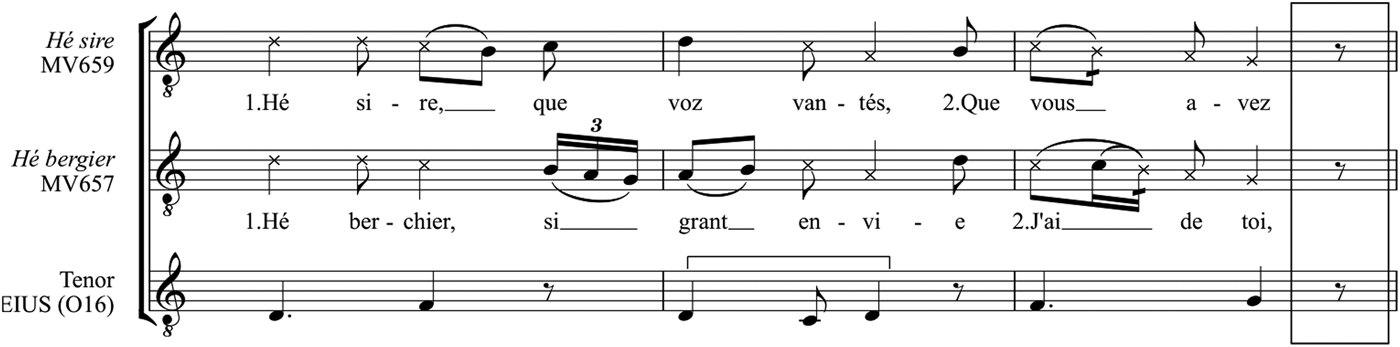
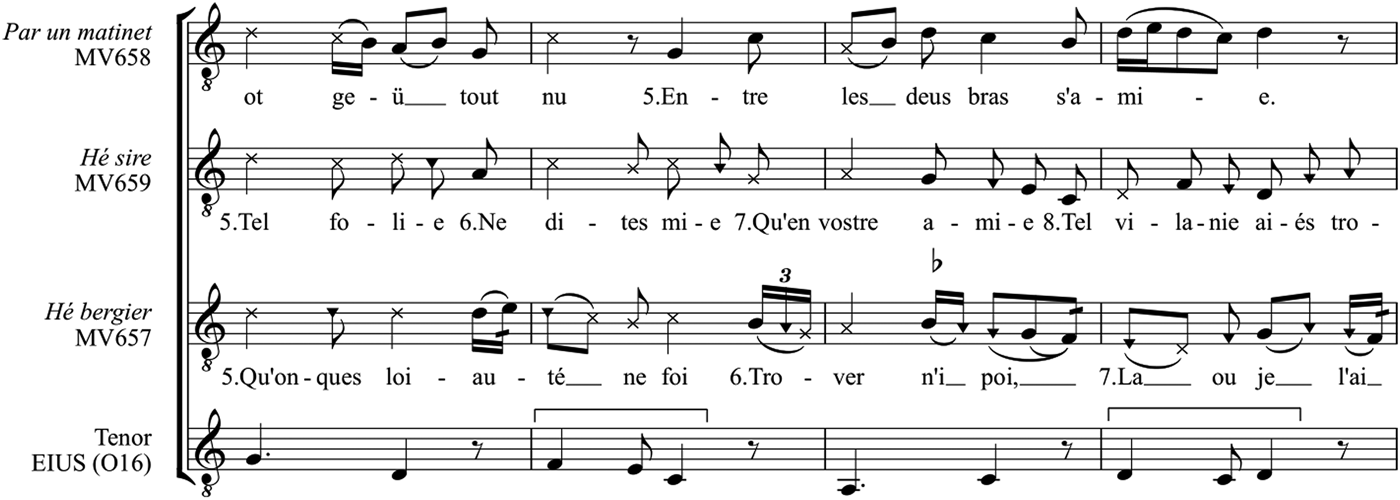
As well as serving as the triplum of the four-part version of the motet found in Mo and Cl, however, the Hé sire text appears in W2 as the motetus of a two-part motet that uses precisely the same tenor in the same rhythmicisation as the motetus Hé bergier. While it could appear that this two-part motet is a curious reduction of the four-part motet to tenor and triplum, it seems more likely that the four-part motet was created by inserting the motetus of another motet, Hé sire / EIUS, which happened to be on precisely the same tenor, into the text of the three-part motet Par un matinet / Hé bergier / EIUS. This is not just because W2 is an earlier source than Mo and Cl, since source chronology is sometimes at odds with musical chronology for motets.Footnote 18 Both the melodies of Hé sire and Hé bergier have a similar contrapuntal profile in terms of overall range and of sonorities at major points of articulation (the beginning of the piece, shown in Ex. 3, the end of the piece, and the start of individual perfection groups); they also share rests. Hé sire frequently duplicates pitches already present in the motetus. The original triplum of the three-part version, Par un matinet, by contrast, is mainly differentiated from the Hé bergier motetus, with pitch duplication between these two parts relatively minimal (see Ex. 4, giving all four parts for the last eight perfections of the first tenor cursus). And these two upper voices in the three-part motet have overlapping phrases except just before the refrain, which further differentiates the two voice parts. I am not the first to suggest that the motetus voice Hé bergier and the apparent triplum that is only found either in the four-part version, or on its own with tenor (Hé sire), were not originally intended to be performed simultaneously. Büttner, whose point of departure is also the D308 text, has proposed that the two motet voices Hé bergier and Hé sire were originally intended to be a pair of separate motets on the same tenor, presenting the knight's speech and the reply of the character he addresses.Footnote 19 This, he explains, is why there are barely acceptable dissonances between Hé sire and the other voices, and why this voice part only appears in the four-voice version, where such dissonances are more acceptable.Footnote 20
The opening six perfections of the tenor, Hé bergier and Hé sire voices (identical pitches shown with crossed noteheads; shared rests boxed).

Section from line 5 in all parts, perfections 11–18 (identical pitches shown with crossed noteheads; triangles note dissonances between Hé bergier and Hé sire).

The only argument against the idea that the motetus voice Hé bergier and the four-part version's triplum Hé sire were originally separate motetus voices in separate motets might be the presence of textual links between what the knight says and what the shepherd replies. Büttner's proposal that they were designed to go together, but in sequential performance of a motet pair on the same tenor, rather than as two parts in the same motet, makes sense of this feature. Collections of motets in songbooks tend to exhibit small runs of motets on the same tenor, hinting that the smaller sources, perhaps bifolios, that served as ephemeral records and possibly exemplars, collected motets in this way.Footnote 21 In Büttner's scenario, the paired motet performances would resemble the performance of P56 in having the two characters perform separately, although they would not, as in the pastourelle, parallel their accusation and answer by singing them to the same tune in the same versification. Instead, the paralleling would be provided more discreetly by their shared length and their shared use of precisely the same double-cursus tenor, patterned rhythmically in the same way.
Questions of chronology, comprehension and performance
It is possible that some of the evidence here is lacking. It seems strange that no two-part version with the Hé bergier text exists, for example, but merely the later contrafact version in W2. Nonetheless, the existence of the version in StV, a textless transcription, but cued by the French incipit, might derive from just such a two-voice version which just, by chance, no longer exists. Might there also have been, at some stage, a three-part version of the motet, which presented the dialogue as a simultaneous version of what is present in the pastourelle in sequential stanzas? That is, a version that had the motetus Hé bergier and the triplum used on the four-part version, Hé sire, but without the former triplum Par un matinet being used as a quadruplum? Büttner rejects this idea, noting Hé sire as ‘hardly serious as a useable triplum for the two-part underpinnings made by the EIUS-tenor and the Hé bergier motetus’.Footnote 22 My comments above about the level of pitch duplication between Hé bergier and Hé sire, while used there to argue that they are in fact two separate motetus parts, would also make these parts unsatisfying in combination without the presence of a fourth voice, singing in a third pitch ambitus, to add fuller harmonic interest. I therefore concur, once more, with Büttner. And although lack of evidence is not conclusive, it may be indicative that no three-part version in this arrangement survives.
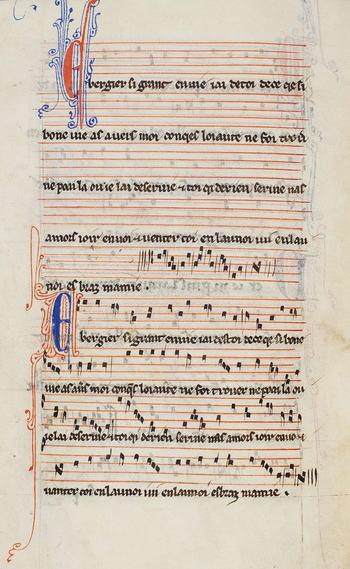
There may, however, be the trace of an attempt to copy this very three-part arrangement in the incomplete copy in W2.Footnote 23 The page on fol. 208v in W2 is set up for a three-part motet (Fig. 1), the staves and text have been entered, including the large initial capitals, but the text scribe has copied the same text twice, the fundamental motetus text MV657, its incipit here spelled both times as ‘E bergier’, with the initial letter illuminated. The second text has been provided with the MV657 melody, but the staves above the first text have been left blank. While one might assume, as Ludwig did, that it should have carried the Par un matinet voice, could it instead have been intended to be E sire?Footnote 24 Suggestively in a manuscript with pervasive use of ordering by initial letter, this copy is surrounded by three-part motets in which the triplum and motetus begin with the same letter: it is preceded by Dex je fui ja pres de joir / Dex je n'i puis la nuit dormer / ET SUPER, and followed by Dame de valor / Dame vostre douz regart / MANERE, so that the opening which contains E bergier / E bergier / [EIUS] is visually striking, with two letter Es on the left and two Ds on the right.Footnote 25 Perhaps the scribe knew of the existence of a motet that had the texts E sire / E bergier / EIUS and intended this to fit the bill here, but was unable to find an exemplar for it. This would support the hypothesis (advanced above on harmonic evidence) that no such three-part version was in circulation.
W2, fol. 208v. © Herzog-August-Bibliothek Wolfenbüttel, Cod. Guelf. 1099 Helmst. http://diglib.hab.de/mss/1099-helmst/start.htm (colour online)

Furthermore, the one cursus that is entered for the tenor has two features unique for this manuscript: it has no textual label, and no space has been left for it in the regular position of last in the copying order, so that after the first five pitches, the rest is copied at the end of the (musically un-notated, incorrectly texted) ‘triplum’, before the start of the (musically notated, correctly texted) motetus. The space after the end of the first voice on this folio might possibly indicate that this is where the tenor was originally positioned in the exemplar, pointing to a scribe working from two independent two-voice motets that shared the same tenor and which the scribe was combining on the fly because the scribe knew that they were also to be found in combination, albeit not in this three-voice (as opposed to the four-voice) combination. Knowing that these two motetus parts on the same tenor were sometimes performed together might have prompted the W2 scribe to include them here among the three-voice motets with upper-voices starting on the same letter.
The questions about the relationship between P56 and the two motet texts that it relates to are thereby complicated further. When it seemed that both voices to which the stanzas of P56 relates were originally part of a single polyphonic piece, the question was whether the song inspired the motet or whether it was distilled from it, perhaps as a way of explaining or introducing the polytextual version. But if the voices were originally two separate motets, as seems likely, the song either inspired the composition of two motets designed to be performed in sequence or one must pre-suppose this mini motet-cycle as being reduced to a single song by composing a second stanza that would fit to the tune of the Hé bergier motetus but express the sentiments of Hé sire. Even if the original situation was that of two separate motets, there is no guarantee that the song was not generated after they had been combined into the four-part version.
The tacit assumption in cases where a monophonic song stanza forms one voice part in a polyphonic motet had been to assume the priority of monophony, presumably in line with the assumed history of the motet itself, starting with a monophonic melody (chant). However, dissertations by Saint-Cricq and Matthew P. Thomson both note the possibility for songs to be extracted from motets, and some motets may anyway have been originally a monophonic upper-voice part (a ‘monophonic motet’) with the tenor retrospectively fitted to it.Footnote 26
It seems unlikely, and has already been rejected by Büttner, that P56 was a pre-existing pastourelle song whose pithy dialogue inspired the creation of two separate motet voices. Such a scenario would involve a composer deriving the motetus Hé bergier directly from the first stanza of the pastourelle, probably (if comparable borrowing can serve as a guide) preserving its melody entirely, and either newly fixing its rhythm, or reflecting its rhythmic monophonic performance (depending on one's views on the fraught issue of trouvère rhythm, which is, thankfully, outside the scope of the present article). This composer, who knows this two-stanza pastourelle in the form of a dialogue between knight and shepherd, would then have had the idea of presenting it in motet form over a Marian tenor. We would have to hypothesise that the composer wanted to preserve the sequential nature of the dialogue and thus chose to write a pair of motets, each using the same tenor. In the process the composer re-writes the poetry of the second stanza and chooses a different terminal refrain.
Such a hypothesis has elements that stretch credulity: why would the composer bother to write a new Hé sire poem with a new, and very irregular verse, form? Even if it is to accommodate the new refrain, this seems a poor decision, since it removes one of the chief poetic complexities of the pastourelle, making the motet version no longer about the truth-value of song, as in the pastourelle. While the composer of Hé sire might simply have been a worse poet (and better composer?) than the original pastourelle trouvère, this supposition is still doubtful. It would have been possible, arguably easier, and a way of preserving the lyric complexity of the pastourelle poem, simply to compose a new melody for the second stanza. And at that point, it would have been an obvious move, in the context of the motet genre, to set the second stanza in another voice part simultaneously, as a triplum.Footnote 27
The alternative – and, to my mind, far preferable – scenario is one in which the pastourelle derives from the motet or motets, that is, the song is some kind of response to the pre-existence of Hé bergier and Hé sire. Again, Büttner has already proposed this chronology, although purely on the grounds of the late date of D308 itself, which is reasoning that can be shown to be problematic in the chronology of motet manuscripts in general, and has been explicitly rejected for D308 in particular.Footnote 28 I therefore reject Büttner's rationale, while feeling inclined towards his conclusion.Footnote 29 The question then becomes whether the composer of the pastourelle version knew the two motetus texts in separate (but connected) motets, or only in the four-part motet version. The latter is not impossible, although the former seems most likely, given that P56 shows no trace of Par un matinet.Footnote 30 If Hé bergier and Hé sire were two separate motets being performed sequentially, a sequence of stanzas replicates that situation most closely, keeping the dialogue aurally graspable. The new ‘Hé sire’ text is now forced to replicate the versification of the motetus poem and, because the refrain is so integrated into the versification of the ‘Hé bergier’ stanza, to share its refrain. In the process the second stanza loses some of its elements of direct reply, but gains a new interpretation of the fixed refrain and the knight's original understanding of it, making for a more complex interaction between the two characters, together with a nuanced poetic reflection of the inter-relations of poetry, song, courtliness, class and truth.
One aspect of the versification in the second stanza suggests that the pastourelle writer not only knew a melody but that it was probably the melody present in the motet. Line 4 is four syllables long in stanza I, but only three in stanza II. This is because the unstressed ‘-e’ of the ‘-ie’ rhyme of line 3 is elided by the opening vowel of line 4 in stanza I, but stanza II's line 4 starts with a vowel (compare the underlay of these two lines in each stanza in Ex. 5). This kind of procedure is found in motet poetry, which is not bound by considerations of syllabic regularity because it is non-stanzaic, but is not typical in stanzaic songs.Footnote 31 The second stanza regularises the versification by preventing the elision of the line 3 rhyme word's unstressed ‘-e’ by starting the following line with a consonant (‘Car’). This necessitates line 4 being a syllable shorter than the corresponding line in the first stanza.Footnote 32
Lines 3–4 in the two stanzas of P56 underlaid to the Hé bergier motetus voice.

Most intriguing here is the plausible suggestion, first voiced by Büttner, that there existed two separate but linked motets providing a dialogic mini-cycle. The resulting imagined sequential performance of two motets on the same double-cursus tenor brings together various genres under the motet umbrella, including the pastourelle, the agonistic dialogue (hinting at the jeu-parti) and, because of the changing terminal refrains, the chanson avec des refrains. This generic heterogeneity in turn proposes social hybridity, with clerical and courtly genres, particularly those associated with the borderlands from Arras to Lorraine. Nonetheless, without the testimony of no. 6 in Example 2, the two-part Hé sire motet in W2, this conclusion would be rather more tentative, being forced to rely on the contrapuntal evidence, when there is still insufficient analytical study of the interaction of thirteenth-century motet counterpoint, voice function and dissonance treatment. Better understanding of these features might make it possible, in cases where no second motetus survives in a two-part version, to ask whether other such performance pairings exist.
The further and fuller investigation of whether the repertoire contains traces of other such motet pairs is beyond the scope of this article but one might legitimately ask whether the attested phenomena of motets copied separately in some sources and together (as if a single piece) in others, and the clustering pieces related by tenor source in close proximity, might be related to the sort of pairing suggested here.Footnote 33 Saint-Cricq has recently suggested that a run of so-called Kurzmotetten copied in two songbooks form a musical and dramatic dialogue in which ‘the cyclic aspect of the set is obvious not only on the basis of similar compositional procedures, but also on the basis of the dramatic potential of their successive presentation, their unity of register, theme and vocabulary, their homogeneous musical sonorities, their ties to literature, and their layout’.Footnote 34
There is already good indication that connections between motets go beyond the way in which they have most often been traced, that is, by comparing different versions (i.e., with contrafact texts or variant number of voice parts) of the ‘same’ motet setting. Wider links have been seen, for example, in different motets that use the same tenor source, which can show shared musical material between the upper voices of different motets.Footnote 35 Saint-Cricq has added formal upper-voice modelling to this list of motet–motet connections in his discussion of two motets whose motetus parts have song-like AAB form, borrowed song materials and shared musical material despite not sharing a tenor source (although their tenors ‘exhibit similar melodic patterns’).Footnote 36
The relationship between Hé sire and Hé bergier advanced above correlates with these being the only two motets on this tenor to share this particular version of the tenor melody, sharing both its length of 30 pitches and this particular tenor rhythm.Footnote 37 A reasonable starting point for further work might thus be other motetus parts with identical tenor melodies (using the same portion of the chant melisma), which are also in the same repeating rhythm, or at least use repeating rhythms that share the same placement of pitches at the start of perfections.Footnote 38 While I have yet to be aware of other chanson texts that combine texts from two different motet voices, an increased awareness that separate motets may potentially be in a similar kind of dialogue with one another – musically and/or textually – generates further layers to the dense intertextual meanings in which motets are already enmeshed.