Electoral systems represent one of the primary levers through which constitutional engineers can shape emergent democratic polities. Yet most of what we know about the effects of electoral rules emerges from the experience of well-established democracies. Should we expect similar outcomes when we place these same rules in contexts that are new to free and fair elections?
Political scientists have long contemplated the consequences of election rules. Going back to the nineteenth century, scholars noted the importance of giving numerical minorities a voice in government, and many advocated for proportional representation (PR), a set of rules in which there is more than one seat per district and seats are allocated to parties in proportion to their share of the vote. In 1861, John Stuart Mill argued that single-member or winner-take-all electoral rules tend to advantage the largest parties.Footnote 6
The modern study of the consequences of election rules dates from Maurice Duverger's Political Parties, Footnote 7 which articulated the “sociological law” that single member district plurality rules tend toward two-party systems and also observed that proportional representation rules promote multiparty systems. Douglas Rae's Political Consequences of Electoral Laws Footnote 8 converted Duverger's observations into quantitative hypotheses and tested them with cross-national data. Over the next thirty years, numerous empirical studies—led by the 1994 work of Arend Lijphart and his colleagues—explored these relationships. By 2005, Matthew Shugart could write of a “mature field” of electoral systems and party systems, with “core concerns” of “macro” (aggregate) outcomes such as the number of parties and proportionality.Footnote 9 Independently, the field also developed insights into the “micro” dimension—the calculations and actions of voters, candidates, party leaders, campaign contributors, and so on—which Gary Cox integrated with past work on macro outcomes.Footnote 10
The field explored a variety of features of electoral systems, but its most widely accepted generalizations distinguished between the effects of single member district (or high threshold, low district magnitude PR) rules and multi-member, low threshold, high district magnitude PR. The former type of electoral system was associated with “two-party” systems, greater disproportionality, and frequent single-party majority governments. The latter type was associated with more parties, less disproportionality, and the absence of single-party governments. These outcomes were in turn associated with secondary outcomes of government stability, effectiveness, accountability, and representation.
Nevertheless, some looked upon the generalizations of the electoral system literature with skepticism, in part because of notable “exceptions.” Much recent research has sought to replace the exceptions with theoretically-founded and systematically-specified explanations of when variation from the generalization should be expected. This new research is significant, since it is critical to constitution makers in the “real” world, and because it often relates to new democracies whose contexts make “exceptions” appear more likely. In many new democracies, there is significant social division, incomplete rule of law, electoral fraud, intimidation of candidates and voters, less educated and informed electorates, shallow media systems, poverty, vote buying, and weakly developed parties and party systems. A growing literature documents how these contextual factors impact the effects of electoral rules.
In this essay, we argue that differences in context are significant—electoral rules will not have the same effects in all cases.Footnote 11 Context shapes the effects of electoral rules in specific and systematic ways. We suggest that the longer the causal chain connecting rules to an outcome, the more context should alter the relationship. Moreover, contextual factors have less impact when the causal linkage between an institution and the outcome is mechanical (involving no human decision-making) versus behavioral (involving human discretion). Constitutional engineers should therefore have the greatest success in influencing outcomes mechanically produced by electoral institutions. Where the intended effect of an institution is mediated by discretionary human action or that effect also requires many intermediate steps, a particular institution may produce outcomes that vary across different contexts. Ultimately, most significant political outcomes that concern institutional engineers do not flow directly from the mechanical effects of electoral rules, thus providing numerous opportunities for context to shape outcomes.
How Does Context Shape the Effects of Electoral Rules?
We define context, broadly and inclusively, as anything external to the institutional rule itself. We expect two features of the causal chain linking electoral institutions to outcomes to shape how contextual factors mediate the effects of electoral rules. First, we expect the length of the causal chain to be significant.Footnote 12 A particular outcome may flow immediately from an electoral rule or it may be distantly related. In the former (proximate) category are outcomes such as disproportionality and malapportionment. In the latter (distal) category are outcomes such as the size of the national party system, the stability of parliamentary governments, the accountability of governments to electorates, and the ideological representation of the electorate in government. Electoral rules do, to some extent, affect distal outcomes, but because there are so many links in the chain, there are more opportunities for context to affect outcomes in these cases.
Second, we expect the type of causal linkages to be important. Following a tradition dating back to Maurice Duverger, we distinguish between “mechanical” and “behavioral” causal linkages.Footnote 13 Mechanical linkages flow directly from rules, independent of human decision-making: given a set of inputs, the rules produce outputs by means of a mathematical algorithm. In contrast, behavioral mechanisms are a function of discretionary human action. People interpret the rule and respond to it, filtering the rule through their perceptions, beliefs, and cost-benefit calculus (including anticipation of mechanical effects). Because people respond in ways shaped by context, we speculate that context will more systematically shape the outcomes of electoral rules when the link between the institution and the outcome involves human discretion.
In sum, the shorter the chain, and the more mechanical the linkages, the less context should matter. The exception is that coercive contextual factors may interfere with both behavioral and mechanical linkages. Coercive contextual factors involve blatant political interference that prevents rules from working as anticipated. Coercive factors shape the extent to which the formal institutions are “the real rules of the game.” Examples include the use of violence and intimidation to subvert outcomes, fraud, and more broadly, items from Andreas Schedler's “Menu of Manipulation.”Footnote 14
We illustrate these general expectations through a discussion of specific outcomes, starting with district-level disproportionality and party systems, and then moving on to more distant outcomes—the number of parties in the national legislature and the extent to which the government represents the views of the public.
Forming the National Legislature
A rich literature discusses how electoral institutions shape party systems.Footnote 15 Because of the significantly greater number of behavioral steps in the chain linking electoral rules to the national party system, contextual factors ought to shape that outcome to a much greater degree than they will the level of disproportionality.
Disproportionality
Disproportionality is the degree to which the share of seats allocated to parties matches the share of votes that they win. In first-past-the-post (FPTP) systems, whenever there is more than one contestant winning a significant number of votes, disproportionality at the district level is high. In contrast, where there are many seats in a district and there is no minimum number of votes needed for a party to gain seats, parties tend to win roughly the same share of votes and seats and disproportionality is low.
Disproportionality is therefore an example of an outcome that is connected to an electoral rule through a short causal chain and largely mechanical linkage. Because the link is mechanical, we expect contextual factors to have a limited mediating impact on how electoral rules shape disproportionality. Put another way, conditional on a particular distribution of votes and barring coercive efforts to manipulate outcomes in a blatant and illegal fashion, electoral rules should have the same effect on disproportionality everywhere.Footnote 16
The Number of Parties in Elections to the National Legislature
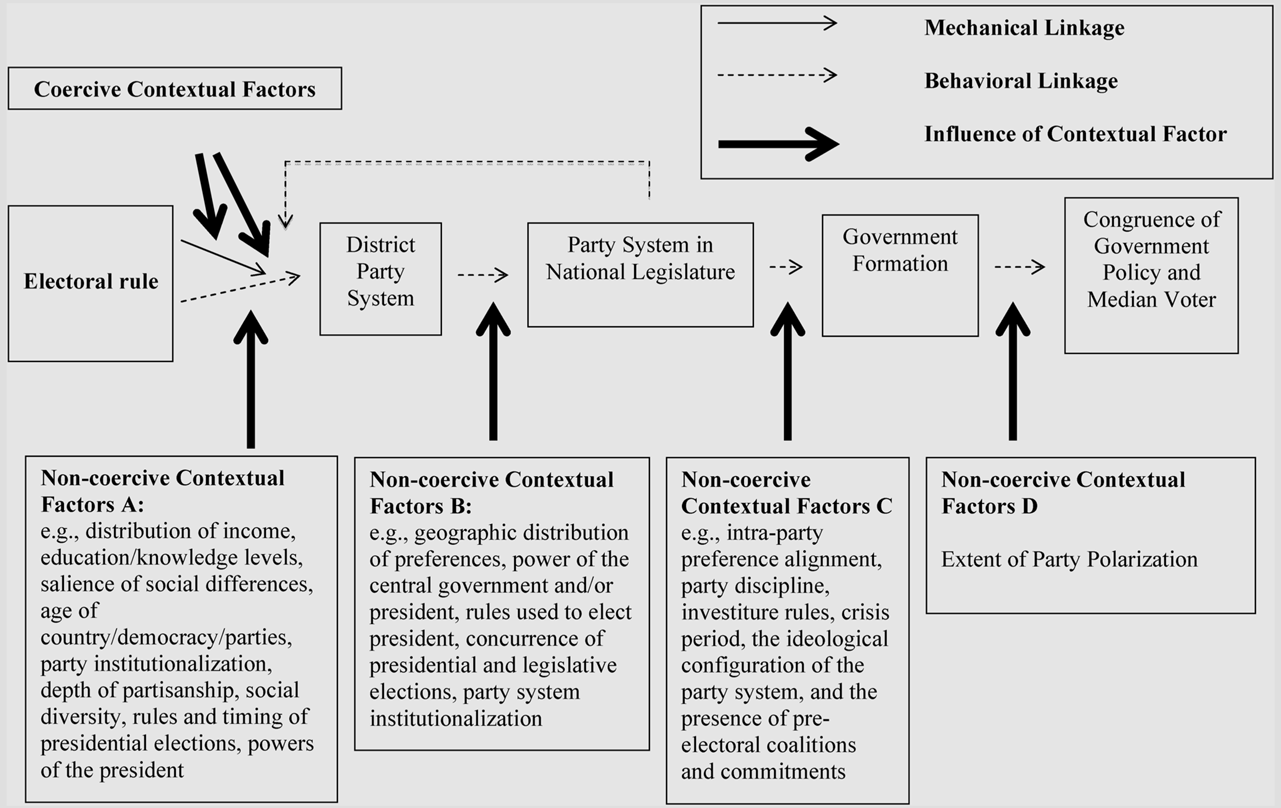
In contrast, contextual factors ought to impinge heavily on how electoral rules shape national party systems. There are two stages in the chain linking electoral rules to national party systems: from the electoral rule to the number of parties competing at the district level, and from the number of parties at the district level to the number of parties competing for seats in the national legislature (refer to Figure 1).Footnote 17
Representation—Ideological Congruence of Voters and the Government

Number of Parties at the District Level
The impact of electoral rules on the number of parties at the district level has been the focus of many waves of research in political science. As originally argued by Duverger,Footnote 18 there are both mechanical and behavioral mechanisms linking electoral rules to the district-level number of parties.
On the mechanical side, “restrictive” rules—most notably, FPTP, which awards a single-member district seat to the top vote-winning candidate in a district—lead to outcomes with high disproportionality, favoring large parties or parties with geographically concentrated support. In contrast, “permissive” rules—especially proportional representation with large numbers of seats per district—allow even small parties to win seats, and thereby minimize disproportionality.
On the behavioral side, anticipation of the mechanical effect shapes the behavior of voters and elites. Restrictive rules induce supporters to strategically concentrate campaign contributions and votes on truly competitive candidates. Candidates anticipate these actions, and often choose not to run if they have no chance of victory. Put together, this behavior reduces the number of candidates or parties winning votes in restrictive systems. In contrast, in permissive electoral systems, even parties that win relatively small numbers of votes can win seats. Supporters in such systems therefore worry less about wasting their support, and can engage in more “sincere” behavior, backing their top choice in the election. The expectation of Duverger's Law is therefore that FPTP rules lead to only two viable candidates per district, whereas systems with permissive electoral rules tend to contain more than two viable parties contesting elections. CoxFootnote 19 synthesizes the logic underpinning these outcomes and identifies the common pattern across them: the M+1 rule, whereby the number of parties or candidates in a district is capped at the district magnitude (M) plus one.
The Effects of Context
Contextual factors can interact with electoral rules to shape the number of parties at the district level in two ways. First, contextual factors can winnow down the number of parties/candidates contesting seats below the M+1 ceiling. The M+1 rule places an upper bound on the number of parties that a system can support, but, for highly permissive systems, this is not particularly informative. For example, South Africa uses a national list proportional representation system, where half of the 400 parliamentary seats are drawn from a single national list and the other half are drawn from nine provincial lists. Voters cast a single national vote, and votes are allocated to seats from a single national district of 400. Applying the M+1 rule to the national district implies that, at most, 401 parties will form. In practice, around seven parties win votes in most South African elections, with one party, the African National Congress (ANC), taking almost two thirds of the vote. To explain these outcomes, we need to look to context: the significance of race in shaping voting behavior after 40 years of apartheid and several centuries of segregation; the success of the ANC in becoming a focal point for anti-apartheid forces; the strategic use of resources by the ANC to prevent its opponents from making inroads into its constituency; and the ANC's success at cauterizing splinters within its coalition.Footnote 20
Second, context may mediate the operation of the mechanical and behavioral mechanisms by interfering with the strategic behavior of voters, candidates, and elites that underlies the M+1 rule, thus producing a larger effective number of viable candidates than predicted by the institutions. As Cox highlights, a number of conditions shape the strategic coordination underlying the M+1 rule.Footnote 21 One such condition involves the nature and strength of voter preferences for parties. Where many voters see little difference between the competitive options, they are less likely strategically to shift their votes away from their uncompetitive first choice party—thus preventing the reduction in the number of parties necessary for the M+1 rule. In fact, a number of contexts may promote this very situation. For example, salient social divisions (racial, ethnic, or religious) may breed intense partisan attachments, particularly if voters see the party as an extension of their group.Footnote 22 Perhaps for this reason, socially diverse countries produce larger party systems, even under FPTP rules.Footnote 23
Widespread strategic behavior consistent with the M+1 rule will also be unlikely where information is lacking about which candidates are in or out of the running. In political systems with limited democratic experience, there may be significant uncertainty about likely political outcomes. In fact, plurality races in new democracies, especially those with poorly-institutionalized party systems, often involve relatively little strategic defection from weak candidates and, in turn, a large numbers of parties.Footnote 24 Expectations of coercion can also inhibit strategic defection. Uganda has FPTP rules, for example, yet the number of parties at the district level frequently exceeds two. Recent Ugandan elections have been dominated by Yoweri Museveni and his party, the National Resistance Movement (NRM). Museveni employs a number of techniques to stay in power including blatant fraud, coercion of candidates, threats of violence, and vote buying. A number of opposition parties challenge Museveni, most notably the Forum for Democratic Change (FDC), headed by Kizza Besigye. However, voters generally believe that these parties have no chance of beating Museveni, even if they form a common front. In this context, it is not surprising that opposition voters see little incentive to defect from their first choice to vote for a party that has a slightly higher probability (but realistically no chance) of defeating the NRM. When a party can create an image of invincibility through ideological positioning, fraud, clientelism, intimidation, or any combination thereof, it may discourage strategic coordination amongst opposition voters and candidates, even under FPTP rules.
Context can also come in the form of other political institutions. Most notably, presidentialism appears to shape the district number of legislative parties. Voters and elites have incentives to behave sincerely under permissive electoral rules, but presidential elections may push such voters and elites to behave strategically, leading to a concentration of support for candidates from parties with front-runners in the presidential race.Footnote 25
Projection to the National Level
The district-level (Duvergerian) behavioral effect is but one step in the chain linking electoral rules to the number of parties at the national level (refer to Figure 1). In an additional step, voters and elites in each district decide—usually through the coordination of a nationally-centralized organization—whether to join with voters and elites in other districts in support of a slate of candidates. When this coordination is successful, the district-level party systems become nationalized and the district-level number of parties becomes “projected” to the national level. The number of parties represented in the national legislature is therefore a result of the extent to which the different district-level parties aggregate across the country. In decentralized federal systems with FPTP, such as Canada and India, there may be roughly two candidates per district, but failure of projection leads to more than two national parties. In recent Canadian elections, for example, the (effective) number of candidates per district has been roughly 2.8, but the nationally-aggregated effective number of parties has been closer to 3.8.
Projection from districts to the nation depends on human discretion—that is, whether political actors in different districts coordinate with one another—thus, adding another point at which any of a number of contextual factors can shape the outcome. Rules that promote coordination across districts by tying presidential and legislative elections together or by increasing the significance of gaining control of either the presidency or the government more generally often lead to greater matching of district-level and national outcomes. In this way, projection tends to be greater in systems in which there is a plurality-elected president, concurrent legislative and presidential election, or governmental power is centralized in the national government.Footnote 26
Representation of Ideological Interests
Political scientists have given particular attention to the effect of rules on the number of parties, but constitutional engineers may be more concerned with other issues, such as how different rules shape representation. A core dimension of representation is the extent to which the ideological position of the median voter is represented in government. The more congruent these positions, the more ideologically representative the system. As Figure 1 makes clear, the relationship between rules and ideological representation is long and involves many behavioral links, thus providing many opportunities for context to shape outcomes.
Continuing along the causal chain in Figure 1, we can see that congruence is shaped by the nature of government formation, which is in turn shaped by the number of parties in the legislature, as well as other factors, including whether the system is presidential or parliamentary, the degree of party discipline among legislators, and the ideological configuration of the party system.Footnote 27 The causal mechanisms linking government formation to representation differ depending on whether two large parties compete for power and a single-party majority government forms or many parties compete for power and a minority or coalition government forms.Footnote 28 When two large parties compete and win most parliamentary seats, the link runs through Downs'Footnote 29 median voter theorem, which predicts that the legislative majority party should be close to the median voter. In contrast, when many parties divide up parliament, the link runs through the inclusion of the median or plurality party in the governing coalition.Footnote 30 Regardless of the causal route, both mechanisms are behavioral. The median voter theorem assumes that parties and voters behave in specific ways. When behavior departs from assumptions, parties' full convergence to the policies of the median voter is not guaranteed. Indeed, substantial research suggests that full convergence often fails, underlining the contingency of the outcome. Moreover, while the median or plurality party is often included in governing coalitions, this inclusion is contingent on the decisions of elites. In principle, elites could opt for coalitions that poorly represent the median voter.
Although the mechanisms are behavioral for both routes to representation, for several decades following World War II in developed democracies, legislatures and governments in PR systems more consistently matched the issue positions of the median voter (i.e., created close ideological congruence) than those in SMD systems,Footnote 31 apparently because of breakdowns in Duverger-Downsian convergence in the SMD systems. However, studies of the more recent time period (roughly 1997–2004) indicate that the greater congruence under PR election rules has disappeared.Footnote 32 A contextual factor—specifically, the changing context of party-system polarization—seems to be responsible for this change.
Higher levels of party-system polarization in the SMD systems, found in the immediate post-World War II decade and again in the 1970s and 1980s, limited Downsian convergence. For example, during the Thatcher years in the UK, both major parties were far apart, especially in the 1983 election. Such polarization under SMD electoral rules virtually guaranteed that majority governments would be far from the median voter. Although polarization also limited the formation of coalitions close to the median voter in the PR systems, the effects were larger and more direct in single-party majority SMD governments.Footnote 33
With declining polarization in the SMD systems during the 1997–2004 period (produced, for example, by the strategic convergence of the New Labour Party in the UK), ideological congruence in SMD and PR systems still followed different causal paths but now produced similar levels of congruence between the policy positions of the median voter and the legislature/government. This shift illustrates our central contention that ideological congruence is connected to the election rules by a number of causal steps and this lack of proximity, as well as the role of multiple behavioral processes, renders it relatively vulnerable to contextual conditions like polarization.
Conclusion
The framework we have laid out in this essay is not specific to the outcomes we have discussed, and ought to apply to numerous other important political outcomes—such as government stability and accountability, descriptive representation, the extent of party cohesion, the nature of the linkage between politicians and citizens, types of policies emphasized by the national government, and the degree to which politicians engage in corrupt practices. Our argument is not simply that context matters and that all analysis must be country-specific. There is no reason to think that every unique feature of a given country will mediate the effects of electoral rules. Specific contextual conditions shape the effects of electoral rules in specific ways. Where rules have mechanical effects, involving no human discretion, contextual factors will have little influence, but that where outcomes are a product of human behavior, contextual factors may be powerful forces.
Armed with this information, constitutional engineers will be better able to design institutions. Understanding the effects of electoral rules and specific contextual factors is important for any country, but especially so for new democracies that are only just beginning to implement new constitutions and electoral systems, and may have markedly different social, economic, and political foundations from established democracies.