A burgeoning literature informing the character and scope of political polarization investigates the phenomenon of affective polarization, or the growing contempt that partisans hold for the opposite party, its adherents and its candidates (Mason, Reference Mason2015; Rogowski and Sutherland, Reference Rogowski and Sutherland2016; Iyengar et al., Reference Iyengar, Lelkes, Levendusky, Malhotra and Westwood2019). In this paper, we explore core value polarization's contribution to individuals’ differential emotional responses to political stimuli. Core political values shape citizens’ ideological and partisan attachments (Jacoby, Reference Jacoby2006; Evans and Neundorf, Reference Evans and Neundorf2018) and are central to attitude formation (e.g., Feldman, Reference Feldman1988; Schwartz, Reference Schwartz and Zanna1992; Goren, Reference Goren2012). Thus, we argue that value extremity should generate affective polarization because an individual whose value orientation is farther from the average orientation of the opposite party—indicating a more starkly different worldview from that held by one's political adversary—should hold more positive views of one's own party and more negative views of the out-party than another citizen whose values are less extreme.
We investigate our hypothesis using CPS American National Election Studies (ANES) data from 1988 to 2016, and we find evidence that value polarization contributes to affective polarization, independent of issue attitude extremity and partisan-ideological sorting. Moreover, the relationship between value extremity and differential emotional reactions to the major parties, ideological groups, and presidential candidates has strengthened in recent years as the elite party coalitions have increasingly diverged ideologically. Lastly, we investigate the direction of the causal relationship between value extremity and affective polarization using ANES panel data from 1992 to 1996. Cross-lagged panel models reveal that past value polarization induces future affective polarization, whereas polarized emotional responses to political stimuli do not engender later value changes. The results suggest that core values underlie an important element of citizens’ evaluation of the polarized American political landscape.
1. Theoretical framework
Although crystallized policy positions and strong liberal-conservative commitments contribute to affective polarization (Rogowski and Sutherland, Reference Rogowski and Sutherland2016; Bougher, Reference Bougher2017; Webster and Abramowitz, Reference Webster and Abramowitz2017; Lelkes, Reference Lelkes2019), evidence shows that individuals’ emotional hostility toward the out-party importantly can and does manifest in the absence of issue extremity or ideological consistency (Iyengar et al., Reference Iyengar, Sood and Lelkes2012; Mason, Reference Mason2015; Lelkes, Reference Lelkes2018). This phenomenon occurs because citizens’ evaluation of, and response to, the political world is rooted more in their attachments to partisan and ideological groups than in their attitudes toward the major issues of the day (Malka and Lelkes, Reference Malka and Lelkes2010; Lupton et al., Reference Lupton, Myers and Thornton2015b). Here, we consider whether the roots of affective polarization are deeper than these social identities (e.g., Iyengar et al., Reference Iyengar, Sood and Lelkes2012; Mason Reference Mason2015, Reference Mason2016), or even ideology (e.g., Rogowski and Sutherland, Reference Rogowski and Sutherland2016; Webster and Abramowitz, Reference Webster and Abramowitz2017; Orr and Huber, Reference Orr and Huber2019). More specifically, we expect that the extremity of one's broad postures toward equality and moral traditionalism—two guiding core values in American politics—are related to differential affective evaluations of political in- and out-groups.
Empirical evidence from the United States and elsewhere demonstrates that citizens maintain ranked, transitive, and durable values preferences (Jacoby, Reference Jacoby2006, Reference Jacoby2014; Ciuk and Jacoby, Reference Ciuk and Jacoby2015; Searing et al., Reference Searing, Jacoby and Tyner2019) that shape subsequent political attitudes and behavior (e.g., Evans and Neundorf, Reference Evans and Neundorf2018; Lupton et al., Reference Lupton, Smallpage and Enders2020), even as they are not immutable (e.g., Lupton et al., Reference Lupton, Singh and Thornton2015a, Reference Lupton, Myers and Thornton2015b; Connors, Reference Connors2019). Which values, though, are salient to American public opinion? A wealth of evidence shows that egalitarianism and moral traditionalism meaningfully influence citizens’ political attitudes and behavior (e.g., Jacoby Reference Jacoby2006).Footnote 1
Given these values’ importance for understanding individuals’ political attachments and attitudes, we argue that they are theoretically relevant for understanding citizens’ reactions toward in- and out-party groups. We therefore hypothesize that fundamental beliefs about what is good and bad in the world—core values—should also relate closely to citizens’ emotional reactions to political stimuli. Moreover, this relationship should have strengthened over time amid an atmosphere of increasing and unabated elite polarization, which has produced higher levels of affective polarization among the electorate (Mason, Reference Mason2015).
Specifically, we argue that extreme preferences for egalitarianism and moral traditionalism will produce more positive evaluations of one's own party, ideological group, and presidential candidates, and more negative evaluations of each of these out-groups. We further hypothesize that the relationship between value polarization and affective polarization has strengthened over the last three decades against the backdrop of elite polarization. Namely, we anticipate that the major parties’ and candidates’ ideological divergence will have led citizens to connect their core principles more strongly to their affective evaluations of politically salient individuals and groups.
2. Data and method
We begin our investigation of the relationship between value extremity and affective polarization using pooled ANES surveys for the years 1988–2016, a span representing every presidential election year in which the egalitarianism and moral traditionalism batteries needed to test our hypotheses have been featured on the ANES. This timeframe is fortuitous because it coincides with a period of heightened elite conflict (e.g., Hare and Poole Reference Hare and Poole2014), allowing us to interrogate our argument that the relationship between value extremity and affective polarization has increased concomitantly with elite polarization. We also employ ANES panel data from 1992 to 1996 in order to examine the nature of the causal relationship between value extremity and affective polarization. These panel data usefully feature measures of key variables identical to those in the aforementioned cross-sectional ANES data, permitting different empirical tests of the same hypothesized relationships.
The key independent variable in this analysis is value polarization, which is measured by first constructing a core value orientations scale for all individuals across time, following recent work by Lupton et al. (Reference Lupton, Smallpage and Enders2020). This value orientations scale is a reliable (α = 0.71) additive index comprised of eight items capturing individuals’ relative preferences for egalitarianism and moral traditionalism. Although many treat egalitarianism and moral traditionalism separately, recent work by Jacoby (Reference Jacoby2014) finds that these values lie at opposite ends of a continuum. Republicans and conservatives cherish moral traditionalism and devalue equality, whereas the opposite is true for Democrats and liberals. Our own item analysis supports our operationalization of value orientations using a unidimensional scale.Footnote 2
After creating the value orientations scale, we construct the value polarization variable by calculating the absolute difference between each respondent's value orientations score and the mean value orientations score for members of the opposite party. In other words, if a respondent identifies as a Democrat, then his or her degree of value polarization will be calculated as the absolute value of his or her value orientations scale score minus the average Republican value orientations scale score. The larger the numerical value of the value polarization variable, the greater the difference between one's own value profile and the average value orientation of out-party members.
Our three dependent variables are standard measures of affective polarization capturing citizens’ reactions to the major parties, ideological groups, and presidential candidates, as measured by 101-point feeling thermometers. Following a wealth of previous scholarship (e.g., Iyengar et al., Reference Iyengar, Sood and Lelkes2012; Mason, Reference Mason2015; Druckman and Levendusky, Reference Druckman and Levendusky2019), we subtract individual thermometer scores for counter-partisan (parties and presidential candidates) and counter-ideological stimuli from each other to obtain an estimate of differential emotional reactions to those groups or individuals.
3. Cross-sectional data evidence
We begin our investigation of the relationship between core value orientations and affective polarization by specifying three ordinary least squares regression models in which we regress each measure of affective polarization on our measure of value polarization, plus measures of issue extremity, partisan sorting, political interest, and a host of demographic control variables.Footnote 3 Issue extremity is a critical variable to incorporate into our models because we argue that core value extremity relates to affective polarization independent of individuals’ policy attitudes.Footnote 4 That is, we anticipate that possessing extreme issue attitudes will relate to disdain for the out-party, but we do not expect that such attitudes are necessary for individuals to connect their core value preferences to their emotional judgements of political stimuli. We construct the issue extremity variable by calculating the average absolute difference between individuals’ issue attitudes and the most moderate possible position across five political issues: defense spending, government spending and services, aid to minorities, health insurance and government-guaranteed jobs, and standard of living.Footnote 5
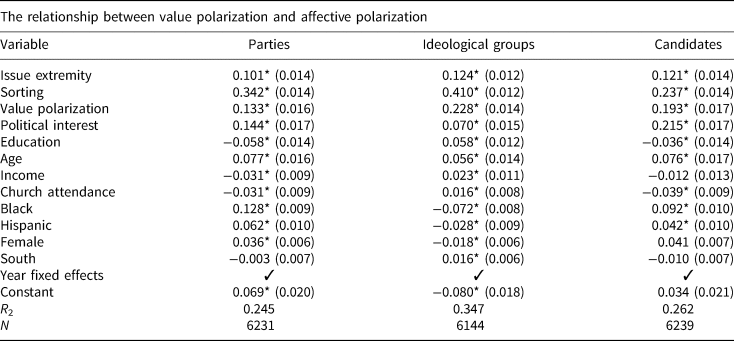
We first observe that, consistent with previous evidence, issue extremity's relationship to all three measures of affective polarization is statistically significant (Webster and Abramowitz, Reference Webster and Abramowitz2017). Additionally, more thoroughly sorted individuals are biased favorably toward their own party, ideological group, and presidential candidates, and biased negatively toward the out-party, as well as associated stimuli (e.g., Mason Reference Mason2015).
Our primary interest involves the relationship between core values extremity and affective polarization. We observe in Table 1 a statistically significant association between core value polarization and polarized emotional responses to the major parties, their affiliated ideological groups, and their presidential candidates, supporting our key hypothesis regarding fundamental principles’ contribution to citizens’ feelings toward prominent political stimuli. Moreover, as all independent variables have been recoded to range from 0 to 1, we can compare the magnitude of the relationship between each covariate and affective polarization measure. As expected, sorting exhibits the strongest connection to each outcome measure, but the link between value polarization outstrips even that of issue extremity across all three models. We argue that these findings testify to the overlooked relevance of core values to Americans’ heightened emotional reactions to parties, ideological groups, and candidates.
Predicting affective polarization, 1988–2016 ANES

Cell entries are unstandardized OLS coefficients (standard errors). *p < 0.05; two-tailed tests.
We can further explore whether the observed relationships strengthen over time against a backdrop of increasing elite polarization. In order to do so, we specify conditional regression models in which we interact our value polarization measure with time, which we operationalize as election year. Since interpreting multiplicative interaction term coefficients is sometimes difficult, we underscore our key independent variable's substantive influence by depicting the interactive relationships visually. Figure 1 below plots the estimated marginal effect of core value polarization on each of our three measures of affective polarization over time, where the dashed lines represent 95 percent confidence intervals. The plots underscore our expectation regarding values’ role in the age of polarization: The relationship between citizens’ core value extremity and biased emotional reactions to the major political parties, ideological groups, and presidential candidates has strengthened dramatically throughout this period.Footnote 6 More specifically, the marginal effect of value extremity more than doubled between 1988 and 2016 for candidate- and ideological group-based operationalizations of affective polarization, and more than quadrupled for the party-based measure.Footnote 7 Finally, we note that the estimated marginal effect of value polarization in 2016 across all operationalizations of affective polarization is at least as large as, and in several instances considerably larger than, that of issue extremity, political interest, and all sociodemographic characteristics.
Marginal effect of value polarization on three affective polarization measures, 1988–2016 ANES.

We conclude that individuals’ orientations toward the fundamental principles of equality and moral traditionalism influence their emotional responses to the major parties, ideological groups, and candidates. Individuals whose value orientations are further from the average value orientation of the opposite party are more likely than others to respond more emotionally in favor of their own parties, ideological groups, and candidates, and to exhibit biased evaluations of the out-group. These relationships have increased over time as elite party conflict has intensified.
4. Panel data evidence
Although the evidence presented in the previous section documents the relationship between individuals’ core value extremity and affective polarization, as well as these variables’ increasingly close connection over time, cross-sectional observational data are incapable of testing the causal relationship between these two phenomena. One could investigate these variables’ causal ordering experimentally, but manipulating core value polarization likely cannot be accomplished straightforwardly. Indeed, if values behave as social scientific theories and empirical evidence suggest—as foundational and stable (Searing et al., Reference Searing, Jacoby and Tyner2019)—then they should not, for example, be easily manipulable via a survey experiment. Instead, we turn to panel data in order to gain some insight into which orientation most likely causes the other. Although panel data frequently suffer from their own limitations (e.g., high attrition rates), they are nonetheless an attractive data analytic option when the variables of interest are less amenable to experimental manipulation.
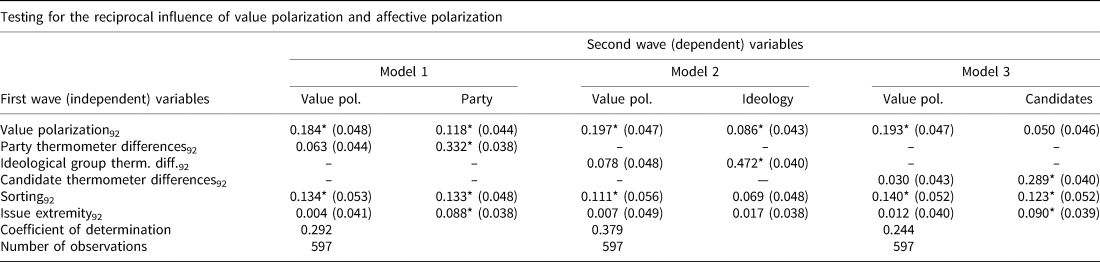
Fortunately, the 1992–1996 ANES panel data contain the relevant variables for constructing measures of both value and affective polarization, and therefore testing causality.Footnote 8 We specify three cross-lagged panel models predicting value polarization and each affective polarization measure using the 1996 data. More specifically, each of three models includes two equations: one in which 1996 value polarization serves as the dependent variable, and one in which one of our three measures of 1996 affective polarization serves as the dependent variable. Both equations are estimated simultaneously, via maximum likelihood with missing values, in each of the three models. Independent variables in each model include value polarization and the associated measure of affective polarization in 1992, along with the 1992 measurements of the controls employed in previous models.
This modeling strategy allows us to examine the causal effects of value polarization and affective polarization on each other, while controlling for previous values of those variables (for recent examples of related work assessing causal relationships using similar modeling strategies, see Evans and Neundorf (Reference Evans and Neundorf2018) and Lelkes (Reference Lelkes2018)). Of course, we expect that 1992 value polarization predicts 1996 value and affective polarization. However, 1992 affective polarization should not predict 1996 value polarization if our theory is supported. These dual findings would be consistent with our theory that value polarization drives affective polarization more so than the reverse.
The empirical results, presented below in Table 2, confirm nearly all of our expectations.Footnote 9 We first observe that 1992 measurements of value and affective polarization predict 1996 measurements of the same variables in all three models. We also observe that in no instance does 1992 affective polarization significantly predict 1996 value polarization. Finally, 1992 value polarization significantly predicts two of three operationalizations of 1996 affective polarization: party and ideological group affect. Value polarization in 1992 does not, however, predict polarized affective reactions to the major party presidential candidates in 1996.
Panel models predicting value polarization and affective polarization, 1992–1996 ANES

Cell entries are unstandardized OLS coefficients (standard errors). *p < 0.05; two-tailed tests.
Although we expected 1992 measurements of value polarization to predict all 1996 value polarization measurements, the candidate thermometers surely provide the hardest test of our theory. Unlike major political parties and “liberal” and “conservative” ideological groups, presidential candidates are not constant. In our view, anticipating that value polarization would be sufficiently domineering to traverse the characteristics of particular candidates and promote strongly polarized emotional reactions to them is unreasonable. That said, both value polarization and affective polarization were lower in the early-mid 1990s than they are today. Perhaps a similar analysis of data from the past two presidential elections would reveal a predictive effect of previous measurements of value polarization on current measurements of candidate-based affective polarization, where the necessary data available for empirical scrutiny. Regardless of any possible explanation (or lack thereof) for this single unrealized expectation, the panel analyses provide support for our theory that value polarization tends to precede affective polarization.
The empirical patterns that these analyses reveal also provide additional clues regarding the precise nature of the two types of polarization. That previous affective polarization does not explain future value polarization challenges recent work showing that those with the strongest and most divergent affective attachments to parties and ideological labels change their values, issue attitudes, and identities (e.g., Lelkes, Reference Lelkes2018; Egan, Reference Egan2019). Moreover, the effect of value polarization on affective polarization suggests a deep-seated base to affective polarization, consistent with scholarship demonstrating the ideological foundations of affective polarization (e.g., Rogowski and Sutherland, Reference Rogowski and Sutherland2016; Webster and Abramowitz, Reference Webster and Abramowitz2017).
5. Conclusion
We endeavored in this paper to understand more fully the underlying source of the observed affective polarization in American politics. Scholars have documented the normatively troubling trend of individuals displaying heightened animosity toward the out-party, a phenomenon that leads to judgmental biases, anger, and even discrimination that has been shown to exceed racial hostility (Iyengar and Westwood, Reference Iyengar and Westwood2015). Previous work locates the source of these emotional responses in social identity theory, specifically the alignment of individuals’ ideological, partisan, and even racial and religious identities (Mason, Reference Mason2015, Reference Mason2016; Davis, Reference Davis2018).
We argued that “there is a there there” to citizens’ emotional responses to politics. As Evans and Neundorf write in theorizing about values’ role in shaping party attachments, “It seems unlikely that people randomly attach themselves to parties” (Evans and Neundorf, Reference Evans and Neundorf2018, 1). We similarly argue that individuals’ antipathy toward the parties, ideological groups and candidates are rooted in worldview differences, or competition over the broad and enduring orientations that citizens bring to bear in their approach to the political world. In other words, we do not reduce out-party enmity entirely to partisan, often derisively called “tribal,” allegiances. Instead, we departed from this tradition to argue and demonstrate that citizens’ deeply help political principles are capable of producing the observed discord: Those “other” folks do not arouse negative emotion merely because they subscribe to a different party label, but also, and perhaps mostly, because they define the good life differently.
Moreover, we demonstrated that as elite polarization has intensified over the past generation, so too has the relationship between value extremity and disdain for the out-party. Our results thus offer at least a partial explanation for why affective polarization has increased in recent years. Core values help individuals connect their partisan and ideological attachments (Lupton et al., Reference Lupton, Smallpage and Enders2020), and they similarly promote positive affection for in-groups and dislike for the out-groups when value preferences are extreme. Our evidence that value differences underlie affective polarization builds upon existing work showing that ideology—closely interwoven with values—is capable of producing emotional biases toward political out-groups (e.g., Rogowski and Sutherland, Reference Rogowski and Sutherland2016; Webster and Abramowitz, Reference Webster and Abramowitz2017). It also builds on recent experimental work showing that a hypothetical candidate's ideological positioning affects citizens’ feeling thermometer ratings of the candidate far more than does the candidate's party label (Lelkes, Reference Lelkes2019). Our results provide further skepticism of claims that sorted social identities alone are the salient source of individuals’ affective responses and judgements. Instead, core values—the “glue” connecting disparate attitudes within relevant policy domains—are capable of producing observed affective evaluations of the major stimuli in the American political system.
We also wish to acknowledge that our argument and analyses do not deny, much less disprove, that social identity sorting is relevant for understanding the strength of citizens’ partisan attachments or emotional responses to political actors and events. Our own panel evidence suggests that sorted partisan and ideological identifications move value orientations, leading us to believe that larger, glacial political, social, and cultural movements likely undergird both the alignment of citizens’ self-understanding and their professed principles that they bring to bear in the realm of politics. Indeed, these findings provide additional caution to claims that values are immutable. Connors (Reference Connors2019), for example, provides extensive observational and experimental evidence that purported core values are at least partially socially constructed: Individuals subscribe to the values that they believe they should hold based upon social group membership. Although we find merit in the vast literature documenting values’ contemporaneous and temporal influence on partisanship, ideology, candidate evaluations, and issue attitudes, we do not consider our findings to be at odds with an account that citizens may have changed their values, or altered the strength of their value commitments, in response to the parties’ shifting platforms and reputations.
The likely next step in this agenda, then, is to unpack more precisely the connection between core values, sorting, and issue extremity. This paper robustly evidences the relationship between value extremity and affective polarization, and subsequent research should investigate directly values’ potential contribution to the sorting of individuals’ social identities. Experiments are a potentially useful option. One possible experimental test would be to connect elite rhetoric and cues to the observed relationships between value extremity and citizens’ emotional reactions to the political world. For example, independent of sorted identities, does particular candidate rhetoric activate citizens to apply their core values to party, group, and candidate assessments? Perhaps scholars might even reveal—despite a mostly polarized landscape—additional communication strategies that appeal to common values and mitigate the concerning levels of out-party antagonism poisoning the contemporary American electorate (e.g., Levendusky, Reference Levendusky2018). This task may be essential to repairing American democracy.
Supplementary material
The supplementary material for this article can be found at https://doi.org/10.1017/psrm.2020.27
Acknowledgments
We thank Michael S. Lewis-Beck for providing helpful discussant comments on a previous version of this paper that was presented on a panel in Chicago at the 2019 conference entitled “Measurement Meets Politics and Policy: Honoring the Scholarship and Mentorship of William G. Jacoby and Saundra K. Schneider.” Additionally, we thank Nathan Kalmoe for valuable suggestions for improving this project that he offered when an inchoate version of this paper was presented on a panel at the 2017 Southern Political Science Association annual meeting in New Orleans. We also thank David Ciuk, Christopher Hare, William G. Jacoby and Paul Sniderman for their valuable insights into the relationships we explored in this paper. Finally, we thank the Editor and three anonymous referees, all of whom helped strengthen this paper throughout the peer-review process.