


Introduction
Recent studies have used qualitative methodologies to investigate psychological change (Carey et al. Reference Carey, Carey, Stalker, Mullan, Murray and Spratt2006; Higginson & Mansell, Reference Higginson and Mansell2008; Carey et al. Reference Carey, Carey, Mullan, Spratt and Spratt2009). These investigations have used Perceptual Control Theory (PCT; Powers et al. Reference Powers, Clark and McFarland1960; Powers, Reference Powers1973, Reference Powers2005), described below, as an explanatory framework, and have focused on what participants have reported about their experience of psychological change, but have not investigated the process of change as it happens. The present study aims to qualitatively investigate control, conflict, and the switching between perceptual levels in a single session of Method of Levels (MOL) psychotherapy.
PCT
PCT is a theory that attempts to explain human functioning and behaviour. It is based on the idea that all living things have a need for control, where the goal is to make what is perceived from the environment match with reference perceptions. According to the theory, in order to achieve control we must act against disturbances that might potentially push perceptions away from their reference values. Powers describes a hierarchical arrangement of control systems, where systems at one level will receive perceptual input from lower levels and the output of these systems become reference perceptions for the lower-level systems.
The closed causal loop, operating according to the principles of negative feedback, is the basic explanatory unit of PCT. In the living control system's closed causal loop, environmental inputs (in the form of sensory perceptions) are compared to a reference value, and where what is actually perceived is found to differ from the reference, actions are produced to act on the environmental influences to make them match with reference perceptions. A simple example of this would be adjusting a tap to get water to the right temperature. A person will have their own reference value for the ‘right’ temperature. When the current temperature of the water is experienced, the difference between this and the reference value is determined, and the output, in the form of a physical action, will be to turn the tap to adjust the temperature of the water until it matches with the person's reference perception.
Within PCT, when two control systems at the same level receive opposing reference signals from a higher level, conflict occurs. It happens when the two systems are attempting to control the same variable in relation to two different reference values. It is a normal occurrence for control systems to conflict and systems usually adapt and reorganize, but unresolved conflict can sometimes occur, resulting in psychological distress (Mansell, Reference Mansell2005; Powers, Reference Powers1973, Reference Powers2005).
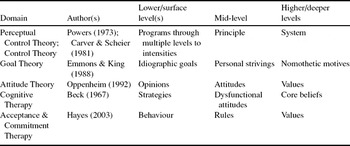
PCT postulates that within humans there are (at least) 11 classes that represent progressively more abstract levels of perception. The levels discussed in this paper relate to the highest levels: System concept, Principle, and Program perceptions. Program-level concepts are if-then contingencies between lower-level perceptions, and describe programs of action, such as ‘brushing my teeth’; principles are general rules that organize lower perceptions; and system concepts are sets of principles exemplified by the states of lower- level perceptions, and relate to more abstract values, such as ‘being normal’. Table 1 illustrates how the levels of control in PCT can be loosely construed in comparison with other psychological frameworks. In particular, we suggest that control hierarchies are somewhat analogous to schemas in cognitive therapy (Beck, Reference Beck1967). Within these hierarchies, principles within PCT may be at a similar level to dysfunctional attitudes in Cognitive Behavioural Therapy (CBT) and system principles may be similar to core beliefs. Importantly, control hierarchies within PCT are schematic in that they parallel the implicational meaning (i.e. automatic; implied meaning) described in recent theories applied to CBT (e.g. Teasdale & Barnard, 1993), rather than propositional information (e.g. consciously accessible overt statements).
Potentially equivalent levels of cognition within commonly cited frameworks in Perceptual Control Theory and within social and clinical psychology

Reorganization
The concept of reorganization is essential to the psychological model offered by PCT. In PCT, reorganization is the process that explains learning. Reorganization occurs through a process of trial-and-error, whereby properties of control systems are changed until error is reduced. Subsequently, this can also lead to actual change of reference values, to the extent that previously impossible outcomes become possible (Runkel, Reference Runkel2003). Reorganization stops when reduction of error (decrease in negative feedback) within the control system is achieved; at which stage the properties of the control system will then remain more constant (Powers, Reference Powers2005).
According to PCT, psychological distress occurs as the result of conflict occurring within a person's control system hierarchy; and reorganization must take place in order for any resolution to occur. The success of any form of psychotherapy, from a PCT perspective, will ultimately require reorganization to occur at the correct level.
Throughout any control system there will be multiple zones of conflict where reorganization could occur. It is thought that the process whereby reorganization occurs within a specific location reflects what people experience as ‘awareness’. Thus, in order to bring about reorganization it is sometimes necessary to maintain awareness on higher perceptual levels ‘in order to relocate the locus of reorganization’ (Carey, Reference Carey2005, p. 248; Reference Carey2006). According to Carey (Reference Carey2006), the common element of effective psychotherapies will be the shifting of awareness into higher levels in the control hierarchies.
MOL
Shifting of awareness to higher levels is the primary goal of MOL: a form of psychotherapy based on the principles of PCT (Powers, Reference Powers1973; Carey, Reference Carey2006). The goal of MOL is to resolve the internal perceptual conflicts that are causing psychological dysfunction. This is made possible by enabling awareness to shift to different levels in the hierarchy.
The ultimate aim is to facilitate the client shifting awareness upwards in the hierarchy in order to access the level of the control hierarchy where the conflict originates. For example, where a client is describing their tendency to criticize themselves for not achieving their own high standards, that client would benefit from becoming aware of why they set these work standards for themselves and why they tend to criticize themselves for lack of achievement –for example they may be striving for acceptance by other people.
It is proposed that this process of going up levels will enable the client to resolve his/her own problem – that is, for reorganization to take place (Carey, Reference Carey2006) – and that shifting awareness to higher perceptual levels where conflicts arise is what all forms of successful psychotherapy have in common – the ‘essential nature of the assistance that psychotherapists provide’ (Carey, Reference Carey2006, p. 9). As stated earlier, this shift of awareness may allow a client to access the implicational meanings (goal hierarchies) that are directing their particular use of language to describe their problem within a propositional code (cf. Teasdale & Barnard, 1993).
The MOL therapist has two goals: to get the client to talk about the difficulty that they want to resolve; and to identify and discuss disruptions that occur in the flow of speech or thought as the person talks about their difficulties. The assumption is that the client has become ‘stuck’ with the conflict because he/she has been approaching it from an unproductive point of view (Goldstein, Reference Goldstein2008).
Disruptions occur during speech, and according to Carey (Reference Carey2006), indicate some sort of evaluation or conclusion about something a person has just said. They take the form of a short pause, smile or other gesture, and often people will go on speaking from where they left off without noticing the disruption. In MOL these disruptions are indicative of the accessing of ‘background thoughts’, while ‘foreground thoughts’ would be the focus of awareness (Carey, Reference Carey2006). When a person is speaking, his/her awareness will not constantly be focused on the same thing, and disruptions indicate moments when awareness has shifted to a background thought, such as a different perspective on the same topic. In MOL background thoughts are believed to typically represent higher perceptual levels. It is, therefore, the role of the MOL therapist to look for disruptions in the client's speech and when they occur, ask about them to help focus the client's awareness on the background thought and to higher perceptual levels. They also elicit these thoughts through reflective questioning (e.g. ‘What is going through your mind as you say this?’; ‘How does that sound to you?’)
Qualitative methodology
According to Smith (Reference Smith2008), there is a current shift in psychological research from an emphasis on quantitative research to a recent increase in interest in qualitative methods. According to Geertz (Reference Geertz1973), qualitative research is able to describe phenomena under investigation, providing analyses rich in descriptive detail. Qualitative methods can therefore provide effective techniques of analysing and making sense of the personal experience of individuals (Smith, Reference Smith2008) in situations where quantitative methods might miss out important nuances (Smith & Osborn, Reference Smith, Osborn and Smith2008; T. Carey et al. unpublished observations).
It has been suggested that when attempting to research psychological change and the mechanisms underlying it, qualitative methods are very useful (Rubin & Rubin, Reference Rubin and Rubin1995; Higginson & Mansell, Reference Higginson and Mansell2008; Smith, Reference Smith2008). One question that has received little attention is that of how change actually occurs (Higginson & Mansell, Reference Higginson and Mansell2008). One study that did look into the ‘how’ of psychological change during psychotherapy was that of Carey et al. (Reference Carey, Carey, Stalker, Mullan, Murray and Spratt2006), who used semi-structured interviews of participants. They approached the analysis of their interview data using PCT as an explanatory framework to give an account of the process of change based on participants’ experiences.
Higginson & Mansell (Reference Higginson and Mansell2008) used qualitative methodologies to attempt to supplement the findings of Carey et al. (Reference Carey, Carey, Stalker, Mullan, Murray and Spratt2006). Their investigation used interpretative phenomenological analysis (IPA; Smith & Osborne, Reference Smith, Osborn and Smith2008) to investigate whether PCT provides a ‘valid theoretical framework to explain the process of psychological change’ (Higginson & Mansell, Reference Higginson and Mansell2008, p. 4). Their results are consistent with PCT as a possible explanation of psychological change. Furthermore, the methodology employed demonstrated that ‘qualitative methodology provides a unique opportunity to investigate how psychological change occurs’ (Higginson & Mansell, Reference Higginson and Mansell2008, p. 18).
Aims of the study
The current study has several aims in relation to a single session of MOL:
(1) to explore adherence to MOL through expert ratings using an adherence scale;
(2) to explore adherence by determining what proportion of therapist utterances were directed at MOL goals;
(3) to code a whole session of MOL using a ‘macroanalysis’ within a PCT framework in order to formulate the levels of control and the zones of conflict within an individual client;
(4) to code a brief excerpt from a MOL session using a ‘microanalysis’ within a PCT framework to demonstrate the process of control and conflict within a therapy session.
Case formulation is recognized as being a useful tool in psychotherapy (Sim et al. Reference Sim, Gwee and Bateman2005). Denman (Reference Denman and London1994) proposed that a good formulation would capture the essence of the case, be sensitive about and specific to the patient, and have a theoretical basis. The macroanalysis undertaken for the current study aims to show that in MOL conflict is the basic formulation, and provides a preliminary attempt to create a conflict diagram which could potentially be later developed into a generic diagram to be applied to specific cases. It is expected that MOL grounding in PCT will enable an evaluation of the technique and illustrate its capacity for formulation. This analysis aims to demonstrate the validity of the approach.
IPA (Smith & Osborn, Reference Smith, Osborn and Smith2008) was chosen as a methodology to guide this analysis. The goal in IPA is for the researcher to investigate an individual's account or perception of a phenomenon as they present themselves in consciousness. It is not an attempt to achieve an objective view of the event, but to gain an understanding of the participant's view of the event (Smith et al. Reference Smith, Flowers, Osborn and Yardley1997). According to Smith (Reference Smith1996), the other facet to IPA is that the researcher will have to use their own conceptions in order to access and make sense of the participant's personal world, through interpretation. IPA is a two-step process (Smith & Osborn, Reference Smith, Osborn and Smith2008). The first stage involves the participant attempting to make sense of their experiences, and the second stage is the researcher interpreting the participant's interpretation of these experiences (Smith & Osborn, Reference Smith, Osborn and Smith2008). In MOL the participant talks about their perceptions and goals as they appear in awareness at that moment. PCT and MOL take a first-person, phenomenological perspective similar to that used in IPA, which is person-centred, focuses on immediate perception, and emphasizes the construction of meaning (Higginson & Mansell, Reference Higginson and Mansell2008). IPA was therefore deemed to be a suitable approach to the analysis planned in this study.
Method
Participant's characteristics
The participant in this study was a white female in her early 20s. She was an undergraduate university student studying biology at the University of Manchester. The participant had been recruited to a larger study evaluating the usefulness of MOL (Carey, Reference Carey2006), and consented to having her anonymized therapy session recorded, analysed and published for training purposes. As part of the screening process she completed a set of measures. She presented with frequent panic attacks in the context of a history of depression and self-harm. This session was chosen for analysis based on its good adherence ratings. The session was also thought by the authors to be a good reflection of the process of MOL.
Materials
Online screening questionnaires were used to recruit for the larger study. In addition to the study measures, people were asked to give a brief description of a long-standing problem they were unable to resolve alone (e.g. a problem concerning their university workload, relationships, etc.) and they were asked to rate how easy they believed it would be to solve. The questionnaires used in the questionnaire pack included:
Depression, Anxiety and Stress Scale – Short Form (DASS-21; Lovibond & Lovibond, Reference Lovibond and Lovibond1995). This scale is made up of 21 items measuring stress, anxiety and depression over the past week on a 4-point severity/frequency scale. The three factors form the three subscales of the measure. It was used as it has good validity and reliability. Scores for the DASS-21 are calculated by summing the scores of the relevant seven items. Internal consistencies of the DASS subscale from a normative sample (Lovibond & Lovibond, Reference Lovibond and Lovibond1993) were: Depression 0.91; Anxiety 0.84; Stress 0.90.
Penn State Worry Questionnaire (PSWQ; Meyer et al. Reference Meyer, Miller, Metzger and Borkovec1990). The PSWQ is a 16-item inventory designed to assess the characteristics of the trait of worry. Internal consistency of the measure has been found to be high, with a normative Cronbach's α value of 0.93. Test–retest reliability was also quite high (r = 0.92).
World Health Organization Quality of Life Assessment (WHOQOL-BREF; Harper et al. 1998). The scale consists of 26 questions covering 25 facets of quality of life that have a high level of international consensus. The scale generates scores in four domains: Physical Health; Psychological; Social Relationships; and Environment. Cronbach's α scores for the four domains ranged from 0.66 to 0.84 for a normative sample, demonstrating good internal consistency. It also shows good test–retest reliability. It was included in the present study to assess how MOL could help improve quality of life.
This study also used a newly developed scale, the MOL Adherence Rating Scale (Mansell, Reference Mansell2008; W. Mansell et al. unpublished observations), which was completed by other therapists after listening to recordings of the MOL sessions. The scale is designed to measure to what extent the therapist focused on the problem at hand, on the client's present perception, noticed disruptions and background (higher level) thoughts, asked about process rather than content, maintained curiosity, and treated the individual with respect as another controlling, living system. The adherence sheet was developed based on the structure of the Cognitive Therapy Scale (CTS; Young & Beck, Reference Young and Beck1980).
Procedure
The participant was recruited through an online screening questionnaire. When completing these measures she provided consent to be contacted again to take part in MOL. Before receiving MOL the participant was provided with an information sheet which gave a description of the therapy and she signed a consent form. She also provided consent for the session to be audio-recorded for analysis and training purposes. The session lasted about 45 minutes and the participant did not request any further sessions. The MOL therapy was delivered by Dr Warren Mansell, under the supervision of Dr Timothy Carey.
Analyses
Two independent raters, who were not authors of this paper, were used to established scores on the MOL adherence scale from an audio recording.
The recording of the MOL session was transcribed verbatim. In order to investigate therapist adherence, therapist utterances were coded according to nine categorizations that were developed after the first author had explored the transcript in detail. These were:
(1) Asking or prompting the client to discuss the problem further.
(2) Queries about what the client wants to talk about.
(3) Asking about disruptions.
(4) Clarifications of meanings of words.
(5) Reflections of statements to confirm meaning or confirm that is what the client is saying.
(6) Queries about the level of importance or pervasiveness of a process.
(7) Asking about higher level judgements of how reference values are determined (e.g. how do you know?).
(8) Brief confirmations that the client is being listened to (mmm, OK, etc.).
(9) Requests to repeat a statement.
Two further independent raters (the second and third authors) coded the utterances and an inter-rater reliability analysis using the kappa statistic was performed to determine consistency among raters.
The macroanalysis in this study was adapted from the IPA methodology for PCT. With IPA, the dataset is studied and themes are extracted and related themes form super-ordinate categories. The analysis in this study represented inferred control hierarchies within the client and their zones of conflict, organized broadly according to the levels set out by Powers (Reference Powers1973). Therefore themes were dropped if they were not reference values for perceptions within a goal-oriented process.
In the first instance, the transcript was read a number of times in order for the researcher to become very familiar with it. During this phase of the analysis any possible indications of disruptions were also noted on the transcript (e.g. laughing by the client; interruptions in speech; or any indication from the therapist that he noticed these types of changes). These were then studied in order to identify possible themes associated with conflict and control. This process generated a sizable list of themes, which, in a second phase of analysis, were grouped in accordance with super-ordinate themes that emerged. Relationships between these super-ordinate themes were then examined in a third phase of analysis, with some categories being further collapsed into single merging themes. The fourth stage of analysis involved examining the remaining clusters and checking these against the transcript to ensure they represented reference values for perceptions within a goal-oriented process. This led to a preliminary mapping of levels of perception for the session. This model was subsequently reviewed and one of the initial system concepts was dropped for a more relevant one.
Each stage of the analyses was reviewed by and discussed with the second author who provided suggestions for possible directions for the subsequent analyses. This process included the reviewing of emerging themes and recommendations were made as to which appeared to be most significant within the analysis. The final model was generated in collaboration with the second researcher and with further supervision to ensure that the final analysis was well-reasoned.
Having a second researcher provide feedback and suggestions allowed some triangulation to the analysis, in keeping with general guidelines for qualitative research (Elliott et al. Reference Elliott, Fischer and Rennie1999).
The microanalysis was conducted in a purely descriptive and inferential manner, based on an awareness of PCT.
Results
The participant's scores on study questionnaires were closer to clinical than non-clinical normative data. She scored 34 on the DASS-21 scale, which lies between normative data for non-clinical and clinical samples [values given are mean (s.d.)] [9.43 (9.66) and 46.52, (30.36), respectively; Antony et al. Reference Antony, Bieling, Cox, Enns and Swinson1998; Henry & Crawford, Reference Henry and Crawford2005]. Her PSWQ score of 73 was high compared with non-clinical normative data [43.14 (12.02); van Rijsoort et al. Reference Van Rijsoort, Emmelkamp and Vervaeke1999], but comparable to the normative mean for a sample of generalized anxiety disorder patients [68.11 (9.59); Brown et al. Reference Brown, Antony and Barlow1992]. She rated her problem as a 9/10 on the distress rating, and 2/10 on the rating of how easily the problem would be resolved. The participant gave her consent for the full transcript to be reproduced, and this is provided in the Appendix (available online).
Findings relating to each of the three aims of the study will be covered separately.
Adherence
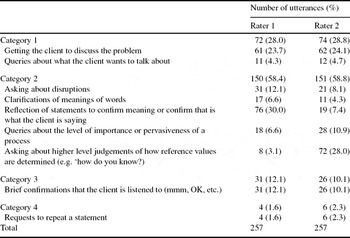
Ratings on the MOL Adherence Scale for this session were good. These are presented in Table 2.
Adherence sheet individual item and total scores for two independent raters

An analysis was carried out on the transcript by two independent raters to determine what proportion of therapist utterances during the session related to the two therapist goals in MOL, and what proportions of utterances were directed at other goals; these are presented in Table 3. The two goals in MOL are to encourage the participant to talk about the problem they want to resolve, and to ask about disruptions and background thoughts. Every statement could be categorized. Two categories involved the first MOL goal – the process of eliciting the participant's description of their problem in some way: asking directly about the problem and asking what the client wants to talk about right now. Five categories involved the second MOL goal of ‘going up levels’: asking about disruptions; asking about the importance or pervasiveness of a process; reflecting statements back to the client; asking about the meaning of significant words used; and a judgement of how reference values (goals) are determined. The inter-rater reliability for this analysis was found to be kappa = 0.43 (p < 0.001, 95% CI 0.361–0.495), indicating a moderate level of agreement (Landis & Koch, Reference Landis and Koch1977). Inspection of the utterance codings indicated that many of the categories used may have related to the MOL goals. Certain categories were therefore combined; yielding four new categories (see Table 3). A reliability analysis was carried out using these four categories, and was found to be kappa = 0.61 (p < 0.001, 95% CI 0.515–0.699), indicating substantial agreement (Landis & Koch, Reference Landis and Koch1977).
Proportion of therapist utterances for the initial categories used for coding therapist utterances, ordered according to their four categories they were subsequently put into

Macroanalysis
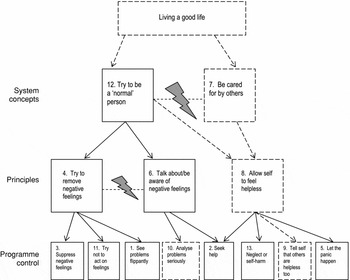
The macroanalysis was designed to develop a formulation of control hierarchies and their zones of conflict for this individual. Two super-ordinate higher-level themes emerged: ‘trying to be normal’ and another which was not explicitly stated but was inferred, ‘being cared for by others’. Both of these super-ordinate themes were considered to represent system-level control within PCT. They were related to many subthemes that emerged during the analysis that appeared to occupy the program level of control which will be described in turn. It was unclear from the analysis as to the nature of the highest system that regulated the two system-level perceptions; this was tentatively labelled as ‘living a good life’. Figure 1 represents the hierarchy of control systems that the analysis produced.
A representation of the control systems at different levels revealed by interpretative phenomenological analysis for this MOL session. Conflict is implicit between lower level goals of the two conflicting system concepts as conflict between systems at higher levels ‘trumps’ the conflict between lower-level subgoals of these systems; numbers in the boxes represent the order in which the themes occur in the session; lightning bolts represent conflict between goals. Dashed boxes represent inferred goals, and solid boxes represent explicitly stated goals. Dashed arrows represent inferred relationships between goals and solid arrows represent explicitly stated relationships.

System level: ‘trying to be normal’
This theme seemed to be the most important reference perception during the session. The idea of ‘normalcy’ is brought up during the session when the participant describes her experience of having ‘good and bad days’ in relation to her panic and worrying, and acknowledges that she does not consider herself normal. This is apparent in the following passage:
I mean I also realize that most people don't have some of the issues that I do or at least not to the same extent, and so when I look at my emotions I try to look at them from an outside perspective.
With this passage she effectively communicated not only her belief that she is not normal, but also her attempts to fix her problems in order to achieve this goal of ‘normalcy’. The analysis indicated that attempts to try to be normal specified two kinds of principles at a lower level that conflicted with one another: ‘Trying to remove all negative feelings’ and ‘Being aware of and discussing negative feelings’. Both of these goals in turn appeared to specify several program-level goals which were discussed during therapy. These are described below.
Program level: ‘seeing problems flippantly’
This subtheme emerged early in the session and was related to the participant's attempts to be ‘normal’. At the start of the session when describing the frequency with which she has panic attacks the participant smiled and was asked about the smile:
T: What'd you just smile about or just laughed about it then.
P: You gotta laugh right? I mean . . . either laugh or you cry.
T: Is that what you sometimes kind of think, gotta laugh or cry?
P: Umm . . . I don't take myself very seriously . . . I don't take anyone very seriously, I believe in laughing at things so . . . [. . .]
P: If you find humour in things it helps.
When she was asked later on about what she made of being flippant, she replied: ‘it's a lot easier than worrying about it’. Being flippant and laughing at things rather than taking them seriously was seen as a way for her of trying to stop her panic attacks and negative feelings by avoiding them. She explained that she does this to get ‘out of the habit [of worrying]’. This theme was noticeable throughout the session as she frequently laughed at times when feelings of frustration, helplessness or negative emotions were addressed. Her laughter during the session was seen as a possible way for her to ‘become flippant’ about a specific conflict as it arises in the session. Throughout the session the participant laughed when discussing issues involving negative emotions or frustration, for example when she said that helplessness is ‘just life’, she laughed. This also happened earlier on when talking about her GP thwarting her attempts at seeking help:
Just kind of a bitter spot right now [laughs]
Here again she was talking about a negative feeling and laughed. Examples of this can be found throughout the transcript. When asked to describe what it is like to talk about her panic, she responded:
Kind of raises my blood pressure a little bit [laughs]
Here she was discussing something which she tends to try to avoid thinking about for fear that it will trigger the panic, and she laughed.
Program level: ‘seeking help’ and ‘analysing problems seriously’
The participant's tendency to deal with her problems by laughing at them and not taking them seriously is a potential source of conflict. Two other program-level references emerged during analysis which could both conflict with being flippant. The first of these was labelled: ‘seeking help’.
As seen earlier, the participant discussed her experience of going to a GP in the UK to try to seek help for her problems, and being thwarted. The following passage gives the impression that this was not the first time she had sought help for her problems:
Well just [American] doctors that I have experienced as opposed to coming here and having a woman tell you that you're depressed when you've told her you're not, that you don't need a counsellor and you don't need medication and she wants to take you off everything without knowing anything about your history.
She expressed quite clear expectations of how a doctor should respond to her problems. We are also told that she has been on medication for her problem, and that she had possibly been in counselling. Therefore she had not always been completely flippant, as the act of seeking help is presumably an admission of the seriousness of the problems.
Seeking help was also related to another program-level perception; that of ‘analysing problems seriously’. Attending counselling sessions would mean talking through her problems and taking them seriously, which would come into conflict with her attempts to be flippant about them. This particular MOL session in itself can be seen as falling into the category of ‘analysing problems seriously’, as this is what occurs. The following passage demonstrates that she does believe that analysing her problems can be helpful:
T: So doing what we were . . . where you're at then, and you're getting interested and amused by where you're at, that's philosophical and it's a waste of time.
P: No, see, I think that has a point. I think when you're sitting there trying to maybe figure out the cause of issues and the outlook of like and how it, you know, is reflecting on a person's actions and, you know, that has some basis, but you know.
T: and what makes you know it has a basis or a point?
P: Because it's helpful in some way to someone.
We were later given an idea of why she might have favoured being flippant over thinking about and analysing her problems. She stated that ‘being philosophical’ and analysing her thoughts led her to ‘over-thinking’, which she saw as a problem:
If I allow myself, I'll completely get wrapped up in my own thoughts and never do anything.
Program-level: ‘self-harm’ vs. ‘trying not to act on feelings’
Allowing herself to get ‘wrapped up’ in her thoughts appears to be something which the participant tried to avoid. In the following passage she described how she does like to address her negative emotions:
It's just sort of knowing yourself, I know that there are times that I get really down and think really upsetting thoughts and were I allowed to act on them would probably haul up in my room, you know, or self-harm or stuff like that.
Here she described two possible ways in which she might deal with her ‘upsetting thoughts’. First, she talked about allowing herself to act on her feelings, which the therapist then asked about:
T: Were you to allow – you say allowed to act on them or
P: If I allow myself
T: How do you allow yourself to or not allow yourself to?
P: Well because you feel those things and then you remind yourself that you have a tendency to do that and step away from the emotion and [. . .] go do something and not think about it and then come back to the situation at hand. You know, and it's just sort of a check to keep yourself from overreacting I guess.
She described her tendency to check herself to keep from ‘overreacting’, or ‘making a decision that I regret when I was feeling sad’. This method of dealing with her feelings involves ‘stepping away’ in order to keep her negative feelings in control. Contrasting with this is the suggestion that if she allowed herself to act on negative feelings she would probably self-harm. This could also be regarded as a way for her of attempting to handle her panic and negative feelings, although a very different one. Her tendency to want to self-harm would come into conflict with her goal of not allowing herself to act on her emotions. What is interesting is the way she chose to describe not allowing herself to act on her feelings. Her description is given in terms of lower-level systems (‘step away from the emotion and go do something and not think about it’). She described, a little later, how she used to deal with her feelings:
I used to self-harm a lot, um, tried to kill myself once, um, and even on a more shallow level you know, um, getting depressed and quitting your activities you know.
We know, therefore, that this is something that she does tend towards. Not allowing herself to act on negative thoughts would create conflict with this tendency, while her self-harming itself understandably appears to have caused her distress. This is apparent in the following passage:
I don't like telling people because they immediately look at you like ‘oh my god, you must be crazy’.
Asked what it is like talking about it now, she responded:
I'm wondering if you think I'm crazy.
These two utterances give clues as to how she felt about the self-harming. She expressed in quite definite terms that people would think she was ‘crazy’ if they found out. Furthermore, we see at that moment that she was worrying about whether the therapist was thinking she is ‘crazy’. Thus her tendency towards destructive coping strategies is something which embarrasses her, in itself causing more worry. The self-harming, therefore, was seen by the participant as not being ‘normal’, and is something she tried to stop herself from doing in an attempt to be normal.
From a PCT perspective, these two methods of trying to get rid of her negative feelings – ‘not allowing herself to act on feelings’ and ‘self-harming’ – are likely to be program-level goals. The conflict between these two programs can be traced back to system-level perceptions. The super-ordinate theme currently under discussion, ‘trying to be normal’, is related to two principle-level concepts, ‘trying to remove all negative feelings’ and ‘allowing self to feel helpless’. These two principles would conflict with each other, leading to conflicts between their lower-level systems. The program concept of trying not to act on feelings fits well under the principle of ‘trying to remove negative feelings’, whereas ‘self-harming’ seems to relate more to a principle-level goal of ‘allowing self to feel helpless’ that conflicts with this. However, ‘self-harming’ could also be interpreted as falling under the principle of ‘giving up trying to stop the panic’, as she said that the self-harm happens when she gives in to the panic. The conflict between these goals could be traced to higher-level goals as well; the system concept ‘Trying to be normal’ appears to be in conflict with another system-level goal, which relates to the participant's goal of being cared for by others.
System level 2: ‘being cared for’
This system concept, from a PCT perspective, is particularly relevant. It was seen to specify the principle-level perception of ‘allowing self to feel helpless’, which was discussed during the session. The participant first talked about her feeling of helplessness when describing how a lack of support from her GP had affected her:
It just makes me feel like I'm in even more of a position that I can do nothing about, I feel a bit helpless.
She said she was in ‘even more’ of a position of helplessness, referring to how helpless she already was to stop her panic and negative feelings. She explained that the one person she went to for help actually made it worse:
I think the issue is really that, you know, I have these panic attacks, I have this trouble and this was sort of like I don't usually go to anyone, or at least since I've been here I haven't gone to anyone for help [. . .] I became very frustrated because my panic attacks were getting worse, to the point where it was really starting to become a problem and the one person I go to for help really just sort of thwarted all attempts.
Seeking help seems to be a means of applying the principle of ‘allowing self to feel helpless’ which in turn is selected by the system-level goal of ‘being cared for by others’. Going to seek help could be considered as an admission that she feels helpless and that her other conflicting coping strategies (e.g. ‘try to remove all negative feelings’) are not working. When talking about allowing herself to feel helpless, she generalized the feeling. The therapist asks her what it is like to talk about being helpless, and she responded:
It's just life isn't it? [laughs]
When asked by the therapist whether she could explain why she believes that helplessness is a reality of life, she responded:
Well, in your life there's so many things that you have absolutely no control over. Big things, not just like, you know, random stuff, and I think in the long-term to assume you have control over your life, and I mean you do to a certain extent [. . .] like you got up this morning and you chose what you wore, you know, but your circumstances in life change so much based on things that you have absolutely no control over, that to assume that you are in charge of your life so to speak, is a bit ridiculous.
What may be understood from this statement is that she felt that she has very little control in her life. Her feelings of helplessness and her frustration at being ‘thwarted’ by her GP are indications of this loss of control. For this participant, normalcy seems to represent a dichotomy, where she is either a ‘normal’ person and effectively coping with her own problems, or she is ‘crazy’, which to her means that she is allowing herself to experience her negative feelings and allowing others to help her. Critically therefore, there is no being normal while also receiving help. Telling herself that helplessness is a reality for everybody might, therefore, be an attempt at making herself feel normal.
Overview of macroanalysis
Within PCT, the conflict between goals at the highest level of control ‘trumps’ the sub-goals of each of those systems at lower levels. Therefore the presence of two conflicting system-level references, from a PCT perspective, appears to be what is causing a significant degree of the participant's distress. The analysis revealed a tentative higher-level reference setting which relates to the participant's goal of living a good, healthy life. There are also conflicts within the lower systems; for example between the two principle-level goals ‘try to remove all negative feelings’ and ‘talk about and be aware of feelings’, which are both part of the ‘trying to be a normal person’ system concept. The apparent conflict between the two system concepts ‘trying to be a normal person’ and ‘being cared for by others’ may be quite a common conflict for many people. Seeking help implies that there is something wrong with a person, and for this participant behaviours associated with allowing herself to feel helpless, such as neglecting herself, self-harming and seeking help, represent being abnormal, or ‘crazy’. Our society's views concerning receiving psychological help could serve to bolster this belief that being cared for by others is not ‘normal’.
Microanalysis
To further investigate how the therapist used his questions to address the MOL goals, a microanalysis was performed on a brief interchange during the session. The goal was to investigate what the therapist was attempting to control and what the participant is attempting to control, on a very fine level. We are interested in whether the goals of the interchange match with the aims of MOL. The interchange under analysis is the following:
T: OK. So it's something and you're descri – earlier you described to me some of these internal things that happen when you're panicking. What's it like talking about those things?
P: (.) Kind of raises my blood pressure a little bit [laughs]
The therapist
The MOL therapist has two goals: to get the client to talk about the problem they want to resolve, and to identify and discuss disruptions. The utterance of the therapist in this interchange can be seen to represent the first of these goals. He is asking specifically about things associated with the panic in a possible attempt to keep her awareness on the problem. Furthermore, he is asking about specific perceptual levels of the problem (‘earlier you described to me some of these internal things that happen. . .’), in a possible attempt to focus the participant's awareness on that perceptual level.
The question asked by the therapist, ‘What's it like talking about those things?’ is an attempt to bring the conversation into the present. His phrasing of the question is important. The phrasing of first part of the question this way (‘what's it like’) instead of something more specific leaves room for the participant to interpret the question and respond in her own way. By putting the question this way the therapist might be purposely attempting to allow the participant the opportunity to interpret it and respond however she chooses. He is asking about her current memory of her voice speaking about these things. Using such indirect wording would allow the participant to give a superficial response should she not want to go into further detail.
The therapist asks specifically what it is like talking about her experience. This might be an attempt by the therapist to bring the conversation into the present, instead of her relating her past experiences of panicking; she is being asked what it is like at that moment as she talks about it. He asks specifically about ‘those things’ (internal things associated with panicking). While the first part of the question is allowing her some control over the way in which she responds, the second part, ‘talking about those things’, is quite specific and is allowing the therapist to control for the relevance of her response. He is giving her the opportunity to give a vague response, but ensuring that she remains on the topic.
The participant has been discussing her experience of panicking, but in MOL the goal is to talk about the problem as it is at that moment. In asking this question, the therapist is asking the participant to discuss the problem in the present rather than her previous experience of it.
The participant
The participant's response to the question gives us some clues as to what she might be trying to control for. We know from the IPA analysis of the session that she may not like to allow herself to feel negative feelings. This may help to explain her response to the therapist's question.
When the question is asked, the participant pauses for a few seconds before answering, which might just represent the time it takes her to process the question. However, it could also indicate an attempt by her to think of a response that will allow her to avoid negative feelings. It could also be that being asked what it is like to talk about her panic brings up those feelings and that the pause is related to this. To further suggest that the question makes her feel uncomfortable is how she begins her response. She begins with ‘kind of’ instead of ‘it kind of’. Most of her responses in this session are quite well-worded, and leaving out the ‘it’ from the beginning of the sentence may indicate that she wants to keep the response brief.
She tries to minimize her response, saying ‘Kind of’ and ‘a little bit’. She seems to be trying to suppress the feelings the question brings up, to avoid discussing them and thinking about them. This may also be apparent from her using a lower-level perception to describe what it is like for her (‘raises my blood pressure’). Putting her response in biological terms may allow her to avoid discussing the possible negative emotions that may have arisen because of the question. The therapist's non-specific wording of the question enabled such a response.
The participant's response is followed by laughter. This is in keeping with the earlier observation that during this session she laughed when asked about things which might bring up negative feelings or memories of negative feelings. In this case laughing seemed to be a way of dismissing the feelings and attempting to forget about them. It seems that the system goal associated with this response is that of ‘Trying to be normal’, its principle-level goal ‘Trying to remove all negative feelings’, and the associated program concept of ‘Seeing panic flippantly’. The laughter has been claimed by the participant to represent her flippancy; it is the outwardly observable lower-level manifestation of ‘being flippant’. The concept of flippancy has been found in this analysis to be related to the participant's goal of trying to remove the negative feelings, which represents one of the ways she uses to attempt to be a normal person.
Discussion
The overall aim of the present study was to explore the validity of MOL using four methods: a six-item adherence scale; a categorization of therapist utterances; a macroanalysis of a session based on IPA; and a microanalysis of a brief exchange within a session.
MOL adherence scale
With regard to the first aim, a MOL adherence scale was successfully developed by applying the goals of MOL to the structure of the CTS (Young & Beck, Reference Young and Beck1980). Experts on MOL were able to use the scale to rate adherence. Future studies will be necessary to explore the reliability and validity of this scale, and modify its content and structure appropriately, now that it has been developed and piloted within this case study. A version of the CTS-R (Blackburn et al. Reference Blackburn, James, Milne, Baker, Standart, Garland and Reichelt2001) will also be adapted for MOL.
Categorization of therapist utterances
The second aim of this study was to demonstrate that therapist utterances during MOL could be systematically and reliably coded in terms of their goals. The categorization was found to be moderately reliable using two coders to code therapist utterances into nine categories, including the two MOL goals. Interestingly, seven of the utterance categories fell into recognizable themes that could be considered as consistent with the two goals of MOL: ‘Queries about what the client wants to talk about’ was thought to be linked to the MOL goal of ‘getting the client to discuss the problem’, and these statements were coded within the same category. Similarly, ‘clarifications of meanings of words’, ‘reflections of statements to confirm meaning’, ‘queries about the level of importance of a process’, and ‘asking about higher level judgements of how reference values are determined’ were thought to be referring to similar processes to the MOL goal of asking about disruptions. All of these statements were allocated into the same category. Two further categories were found which did not directly relate to MOL goals: ‘brief confirmations that the client is listened to’ and ‘requests to repeat a statement’. These two latter categories may represent a basic form of engagement, a crucial non-specific component of any therapy. For MOL this occurs at quite a basic level, with simple indications that the therapist is listening and interested. A kappa analysis using these four categories yielded a higher value. Significantly, around 87% of all therapist utterances were consistent with the two proposed goals of MOL. Notably, no utterances were categorized as advice-giving, or as directive attempts to change cognition or behaviour in a direction planned by the therapist.
The inter-rater reliability for coding of therapist utterances was found to be statistically significant. However, while being significant, the value obtained from the initial codings was only marginally convincing. According to Landis & Koch (Reference Landis and Koch1977), kappa values between 0.40 and 0.59 are considered moderate, with values between 0.60 and 0.79 substantial, and those over 0.80 outstanding. When utterance ratings for the two raters were classified into the four subsequent categories, the reliability analysis carried out yielded a kappa of 0.61. Given the provisional nature of the current study, it is hoped that a future coding and training scheme would generate higher levels of agreement.
Taking the recommendations for MOL as a whole (Carey, Reference Carey2006), this session would seem to be an accurate representation of MOL. A further implication of this coding scheme is that future sessions of MOL can be analysed and the balance of these utterances explored. For example, one empirical question is how a therapist decides when to prompt further discussion of a problem vs. accessing a disruption or background thought and whether the balance of these goals is important in outcomes for different clients. It is also notable how many therapist utterances seemed to address the goal of accessing higher level control without explicitly targeting disruptions. There are many examples of these kinds of questions in MOL manuals (Carey, Reference Carey2006, Reference Carey2008) yet at present they are not seen to be systematically distinguished from questions that prompt discussion of the problem.
Macroanalysis
The themes that emerged from the analysis were organized broadly according to levels as set out by PCT (Powers, Reference Powers2005). Only emergent themes representing reference values of perceptions within a goal-oriented process were included in the analysis. Two conflicting higher-level system concepts emerged: ‘Trying to be a “normal” person’; and ‘Being cared for by others’. The analysis of these two themes and their associated lower-level concepts presented in the current study serves to shed some light on how conflicts emerge during a session of MOL; and which mechanisms might work to block reorganization and how.
According to PCT and MOL, shifting awareness to higher perceptual levels is the key to resolving psychological conflict (Powers, Reference Powers2005; Carey, Reference Carey2006). The qualitative analysis of a session of MOL presented in this study sought to understand and explain just how a person's awareness shifts during the course of a session. Previous studies have used qualitative methods to investigate patient improvement (Carey et al. Reference Carey, Carey, Mullan, Spratt and Spratt2009) and to investigate how and why psychological change occurs from a PCT perspective (Higginson & Mansell, Reference Higginson and Mansell2008). The IPA analysis in the present study, in a way, sought to provide an explanation of psychological change but on a more minute level than that of Higginson & Mansell (Reference Higginson and Mansell2008). Here the investigation used a PCT framework in an attempt to provide, for a single session, a description of how the participant's awareness moved between perceptual levels and how the MOL therapist was able to apply the technique and aid in moving awareness upwards and help reorganize conflicted systems. The analysis revealed many conflicting lower-level goals, which formed the bulk of what the participant discussed during the session. A large number of these goals seemed to be program-level concepts, such as ‘trying not to act on feelings’ and ‘seeking help’, which were related to three conflicting principle-level goals. The analysis revealed that the source of the conflicts occurring at these levels was a conflict between two system-level concepts.
Microanalysis
The microanalysis of a single exchange between the therapist and client revealed that it was possible to infer overarching goals, such as avoiding negative emotions that impacted on subtle features of dialogue. This analysis merely represents the demonstration of a method rather than providing any systematic test of the higher-order systems of control that have been inferred. Future research may be able to test the validity of a microanalysis of dialogue more directly, for example though developing a simplified control system model whose functioning can be compared against actual behaviour. At present, there are several provisional attempts to model socially interacting control systems using PCT (McPhail et al. Reference McPhail, Powers and Tucker1992; Moore, Reference Moore2007).
Relating qualitative findings to the literature
The analysis conducted here shows that the views and perspective of the participant in this session matched with some of the themes that Higginson & Mansell (Reference Higginson and Mansell2008) identified as being indicative of mechanisms underlying psychological change. Her descriptions of self-harming and her suicide attempt fit into their ‘Inability to see a future’ category, and her description of being thwarted by her GP when she sought help matches with the ‘Lack of understanding and control by others’ category. These categories form a super-ordinate theme (‘Hopelessness and issues of control’) which the authors suggest relates to the ‘thoughts, feelings, and beliefs of the participants whilst experiencing their problem’ (Higginson & Mansell, Reference Higginson and Mansell2008, p. 8).
Higginson & Mansell's (Reference Higginson and Mansell2008) ‘change process’ category's subtheme ‘avoiding the problem giving way to facing the problem’ provides an insight into the functioning of the participant in the present study. The present analysis has shown that the participant frequently employed strategies to avoid facing her problems, such as being flippant. What has not yet occurred for this participant, however, is the realization described by Higginson & Mansell (Reference Higginson and Mansell2008) which leads to reorganization of the systems maintaining long-term distress. She described realizations she has had in the past, but none of them have led to effective reorganization at higher levels, but rather, in her case, new avoidance strategies employed at lower levels.
These findings provide some support for the mechanisms underlying psychological change proposed by Higginson & Mansell (Reference Higginson and Mansell2008). The session analysed in the present study provided the account of a participant who had not yet managed to solve her problem. In the present study, the participant was found to frequently employ avoidance strategies, which represented a large number of conflicting program-level goals. For MOL to be effective, therefore, it appears that an important stage in Higginson & Mansell's (Reference Higginson and Mansell2008) change process is that in which avoidance gradually turns to facing up to and accepting the problem.
Limitations
The qualitative analyses in this study were conducted on only one participant in a single session of MOL. The analyses provided here do not represent a highly generalizable model of a client's awareness shifts during a MOL session. Moreover, it should be noted that the structured formulations that have been produced are merely hypotheses which would deserve further attention in therapy. Within MOL itself, it is not necessary to produce structured formulations of the zones of goal conflict for the client because the core process of change is seen to occur within the individual as they discuss their problem. Nevertheless, for empirical purposes, we feel that it is fruitful to develop the kinds of analyses used here to attempt to validate MOL as a therapy and PCT as a psychological framework.
The present study is limited by the fact that the participant did not attend any subsequent therapy sessions, so the investigation was limited to a single session with no information about any reorganization resulting from this session. The participant in the study also did not complete the follow-up measures, making it impossible to draw conclusions about any changes in psychopathologies or distress resulting from MOL.
Directions for future research
This study represents a preliminary attempt to explore, from a phenomenological perspective, the control hierarchies within a conflicted system and the zones of conflict. Applying a similar analysis to different MOL sessions delivered by different therapists might enable the validation of the present analysis, and also provide some insight into the process of control for clients in MOL, which could provide a useful frame of reference for MOL therapists. What is still unknown is whether MOL works by helping people go up levels generally in relation to their current perception, or whether it works by reorganizing a specific conflict at the top of the goal hierarchy. Furthermore the architecture for the process of guiding a person to the ‘zone of conflict’ using verbal conversation is not yet spelled out within PCT, but is likely to be a sophisticated control process that involves multiple systems within the client and therapist.
The conflict diagram developed in this study could be further developed by applying it to different MOL sessions and possibly made into a generic diagram that could be applied to specific cases. The diagram illustrates that for MOL, conflict is the basic formulation. Because MOL is based firmly on PCT, the conflict formulation has the advantage of providing a transdiagnostic approach to formulation which is a model of both function and dysfunction.
Acknowledgements
Thanks are due to Tim A. Carey, Richard Mullan, Chris Spratt and David Goldstein for their help with this project. This research was supported by the ESRC Programme Grant: Emotion Regulation in Others and the Self: A Collaborative Network.
Declaration of Interest
None.
Note
Supplementary material accompanies this paper on the Journal's website (http://journals.cambridge.org/cbt).
Learning objectives
(1) To learn about the style and content of a Method of Levels session through reading a full transcript of a session.
(2) To become acquainted with four provisional methods of validating a Method of Levels session.
(3) To become familiar with how Perceptual Control Theory (PCT) informs a psychological formulation.
(4) To critique the validity of Method of Levels and consider how to extend its testing and validation.





Comments
No Comments have been published for this article.