Introduction
At least 100,000 new cases of cancer were diagnosed annually in Nigeria before 2007. It is projected that nearly 17 million Nigerian would be affected by cancer in 2020, with incidence of 90.7/100,000 and 100.9/100,000 and the death rate of 72.7/100,000 and 76.0/100,000 in men and women, respectively (WHO, 2008). Adejoh and Olorunlana (Reference Adejoh and Olorunlana2016) noted that managing breast cancer in Nigeria has been problematic, but little is known about patients’ experiences of family members’ reactions to diagnosis of breast cancer and the role of family support in the management of breast cancer. Studies have documented the experiences of partners of women diagnosed with breast cancer. For example, Segrin and Badger (Reference Segrin and Badger2013) demonstrated how spousal support has been beneficial for psychological well-being of Latinos diagnosed with cancer. Another study shows that many partners report significant psychological distress (Snyder and Pearse, Reference Snyder and Pearse2010). Some other studies specifically highlighted hypochondria, moodiness, low energy, sleep disturbances, sexual dysfunction, eating disorders, and difficulty focusing on occupational responsibilities as possible distress experienced by partners of breast cancer patients (Sheridan et al., Reference Sheridan, Sherman and Pierce2010; Sherman et al., Reference Sherman, Kasparian and Mireskandari2010; Sprung et al., Reference Sprung, Janotha and Steckel2011).
Other studies identified the consequences of diagnosis of breast cancer in a woman, within the family. These include disruption in the daily family routine and decreased access to the mother, which can lead to increased stress and conflict among family members (Lewis et al., Reference Lewis, Fletcher and Cochrane2008; Forrest et al., Reference Forrest, Plumb and Ziebland2009; Yang and Schuler, Reference Yang and Schuler2009; Sheridan et al., Reference Sheridan, Sherman and Pierce2010; Sherman et al., Reference Sherman, Kasparian and Mireskandari2010; Snyder and Pearse, Reference Snyder and Pearse2010; Tunin et al., Reference Tunin, Uziely and Woloski-Wruble2010; Oktay et al., Reference Oktay, Bellin and Scarvalone2011). Another study identified first-degree relatives to be at risk of difficult adjustment to breast cancer diagnosis because they are the most likely to experience role changes, be called on to provide emotional support to the patient, and be confronted with familial predisposition to the disease if one is found (Tunin et al., Reference Tunin, Uziely and Woloski-Wruble2010).
Similarly, studies have identified risk factors for increased family difficulty with adjustment to maternal breast cancer to include limited social support, a high level of stress unrelated to breast cancer, a lack of optimism or hope of a successful recovery, and ineffective coping strategies (Yang and Schuler, Reference Yang and Schuler2009; Sheridan et al., Reference Sheridan, Sherman and Pierce2010). Positive family functioning and patient's increased ability to cope with stress are strong predictors of easier family adjustment during treatment and recovery (Mokuau et al., Reference Mokuau, Braun and Daniggelis2012). Family support for breast cancer patient (Benson et al., Reference Benson, Gobbold and Boamah2020; Kusi et al., Reference Kusi, Boamah Mensah and Boamah Mensah2020), but adequate attentions have not been given to the experience of the patient on family support, our study makes a unique value-added contribution by filling this gap in the literature. Therefore, the goals of this study were to describe patients’ experiences of family members’ reactions to diagnosis of breast cancer and the role of family support in the management of breast cancer. This is important, as it will enable us to identify problems and the kind of support those living with breast cancer may need within the family context.
Methods
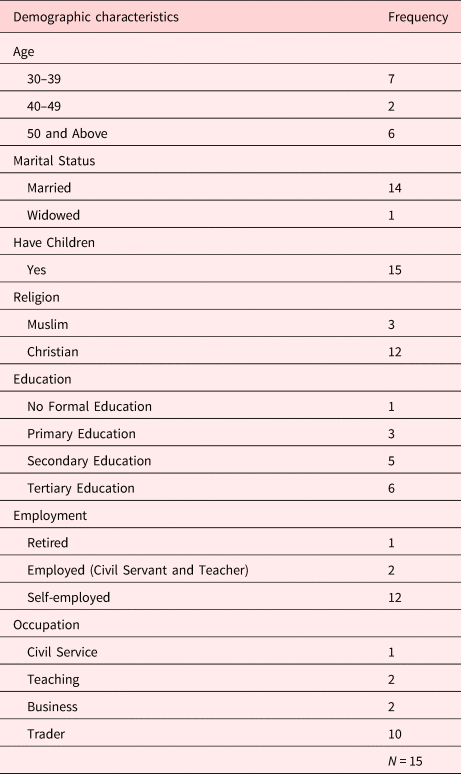
The study used a qualitative research design. According to Olorunlana et al. (Reference Olorunlana, Igharo, Mark, Nwaodu, Ijeoma, Nzewi and Wande2018), qualitative research is a means for exploring and understanding the meaning of what individuals or groups ascribe to a social or human problem. This method is appropriate to breast cancer patient because, according to, Aguinis and Solarino (Reference Aguinis and Solarino2019), in qualitative research, the study takes place in a particular research setting, researchers make choices about sampling procedures, they have a specific position along the insider–outsider continuum and make decisions about the saturation point as well as data coding and analysis. Phenomenological approach was employed for the analysis, as it examines the uniqueness of individual's lived experience (see Table 1).

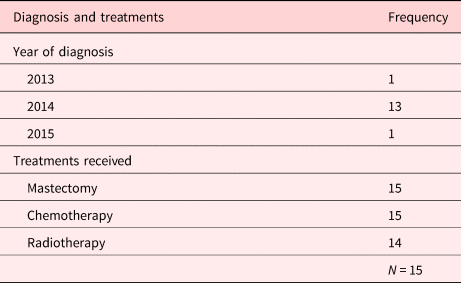
The population of this study were married women diagnosed with breast cancer and were receiving treatment at a private hospital in Lagos as at the time of the study (see Table 2). The criteria for the selection of participants in the study were the participants should be diagnosed with breast cancer, currently receiving or had recently received treatment for the disease; should be living with family members; and should voluntarily give consent to participate in the study. The set criteria for participation were complemented with convenience and criterion sampling techniques (Polit and Beck, Reference Polit and Beck2017). The participants were recruited during clinic visits by one of the authors with the assistance of the nurses at the hospital. Participation was voluntary and with informed consent was obtained from the participants. Participant who agreed to participate was interviewed on the day of her routine clinic appointment. One of the authors explained the study's objective and obtained verbal consent before each interview. Participants were not under any compulsion to answer all the questions. Prior to data collection, the protocol for the study was approved for use with patients receiving treatment at an outpatient cancer clinic in the hospital by the hospital management board and the ethical board. The interviews took place in a room provided by the hospital, where only the participant and the interviewer were present (Table 3).
Profile of participants (female breast cancer patients)

Diagnosis and treatment history of participants

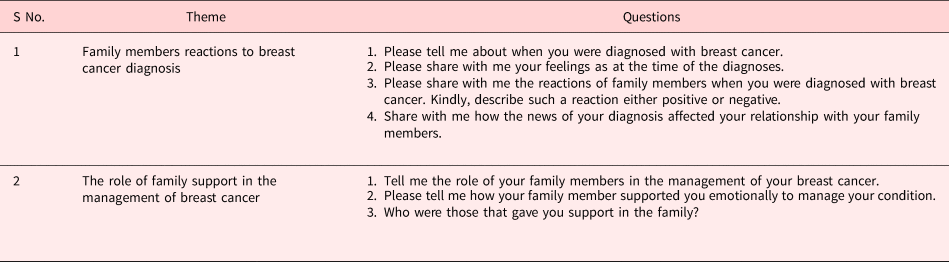
Fifteen women with breast cancer were interviewed. Four women declined to be interviewed, as they were not interested in sharing their experiences with an outsider. The authors utilized a semi-structured interview guide for the study. The questions aimed at exploring the participants’ experience of family members’ reaction to breast cancer diagnosis and the support received from family members because of their cancer condition. Some of the questions asked (see Table 4) included “Please tell me about when you were diagnosed with breast cancer”; “Please share with me the reactions of family members when you were diagnosed with breast cancer”; and “Tell me the role of your family members in the management of your breast cancer.”
Interview guide for breast cancer patient

Each interview took an average of 20–30 min, and the study lasted for 2 months. Interviews were conducted in three languages: Yoruba, Pidgin, and English. Audiotape-recorded interviews were transcribed verbatim, except where translations were needed for three participants who spoke Yoruba and “Pidgin.” Two experts in the languages did the translation from Yoruba and “Pidgin” to English. Two of the authors who are versed in the three languages carefully read the transcriptions and double-checked for accuracy. The conventional approach to content analysis, where codes were derived from data during data analysis was used. Themes were identified from the data. Thereafter, codes were developed as well as the coding scheme before the coding of all the transcripts (Hsieh and Shannon, Reference Hsieh and Shannon2005; Elo and Kyngas, Reference Elo and Kyngas2008; Elo et al., Reference Elo, Kaariainen and Kanste2014). Two of the authors started the coding by immersing themselves in the data to have a deeper understanding of the data by reading and rereading all the transcripts. They then open coded by taking notes, while reading the transcripts and created themes. Five themes were identified initially but with further analysis, three recurring themes were finally identified and analyzed: participants’ experiences on reactions of family members, role performance, and family support. However, this paper reports on participants’ experiences on reactions of family members and family support.
Among the fifteen participants interviewed, fourteen were married, and one was a widow. The majority of them were Christians. All the participants have children and had occupations prior to their illness. At the time of the interview, out of the 15 participants, two worked full-time in the public sector but have been on extended leave. One was retired; 10 identified themselves as traders, two were into other businesses. However, the ones into business and trading were unable to attend to their businesses because of the symptoms and side effects of cancer treatment.
Theoretical framework: Family system theory
The study is anchored on family system theory. The theory argues that contextualizing individual's experiences allows us to better comprehend their reactions to a critical event (White and Klein, Reference White and Klein2008). In this context, a woman diagnose with breast cancer should get the support of other family members in the management of her cancer condition. Understanding the reactions of other family members to her being diagnosed with breast cancer will offer a useful holistic perspective (White and Klein, Reference White and Klein2008). This may help in understanding the constraints that might affect effective breast cancer management and provide the necessary support for effective management. Social support could be one critical ingredient in the management of cancer and helps in navigating this critical period of illness. When the patients are supported, it enabled them to cope with the sick role behavior as prescribed by the health professionals. In line with this argument, Jim and Anderson (Reference Jim and Andersen2007) argued that patients with fewer social resources are more distressed, which shows that family and social relationships provide meaning to life, life satisfaction, and purpose.
Findings
Two major themes were identified: reactions of family members to breast cancer diagnosis and family support received.
Reactions of family members to breast cancer diagnosis
Participants experienced a different kind of reactions from in-laws, extended family members and husbands, which could act as constraints to breast cancer management. One participant said that her in-laws and family members did not treat her fairly:
Even though I may not call these challenges, the people around me (neighbours) weren't mocking me, but my husband's people (in-laws), even my own family members. Sometimes when they see me, they will be pissed and make certain comment “what type of sickness is this”, but it has not been easy. (Female; 30 years old; diagnosed in 2014, was receiving radiotherapy)
A participant stated her experience with her in-laws, reporting that the husband gave her the needed support.
My husband's family are terrible; they have been my greatest trouble since I have this condition, and irrespective of their attitude, my husband has been there for me. (Female; 60 years old; diagnosed in 2014, receiving radiotherapy)
A participant, whose husband had been supportive, shared a similar experience. She lamented that her extended family has been antagonistic:
I have really been affected, since I no longer do a lot of things that I used to do in the house again. My husband's people have been pestering him to possibly get me divorced or marry another wife, but I so much thank God for the husband He gave to me; he has been there for me. (Female; 38 years old; diagnosed in 2014, receiving radiotherapy)
A participant explained the attitude of her in-laws during her surgery. They pronounced her dead and tried to prevent her husband from paying her hospital bills:
You know how our people behave here. Before my husband began to spend money to take care of me, they were acting apprehensively towards me. They were already looking at me like a ghost. Some even said it to my hearing, that, there was no need for him to spend his money on me. But I have been crying to God, and He helped me. (Female; 45 years old; diagnosed in 2014, was receiving radiotherapy)
Similarly, some family members’ reactions to breast cancer diagnosis were as if they have been sentenced to death. One participant noted, “at first, my family members treated me like someone that was about to die.” She stated further that sometimes it is good to hide the health condition to avoid further embarrassment from family members: “My family members are aware that I am sick, but I don't disclose to them that it is breast cancer. I don't want to expose myself to families” (Female; 36 years old; diagnosed in 2014, receiving radiotherapy).
Negative reactions from some family members heightened the tension of having breast cancer for the participants. Although they experience these negative reactions, their spouses stood by them to give them the necessary support, especially financial support. The participants had strong faith in God to see them through their illness; this was a major coping mechanism for the participants.
Family support
Despite the challenges faced by some of the participants, the data show that family support still exists in some families. One participant explained how much support she got from family members:
My immediate family, my brothers and my sisters, and my brothers-in-law, everybody from my husband side knows… Like my in-laws, most of them have been giving me support and my people too, my brothers, all of them contributed. (Female; 56 years old; diagnosed in 2014, receiving radiotherapy)
Some participants explained the degree of support that they received from their children and husbands. A participant particularly averred that “I am no longer affected by my condition, because my husband is providing everything now. Talk of the children school fees, food stuff, and what have you, my husband is providing them” (Female; 44 years old; diagnosed in 2014, receiving radiotherapy).
My kids do everything for themselves now. I have two children; my last-born is in primary 6, and he does everything himself. I don't really look into their homework like before. Now my husband is the sole breadwinner of the family, and I assist to do a little in the house now not like before. (Female; 39 years old; diagnosed in 2014, receiving radiotherapy)
A participant described her experience by referring to herself as the baby of the home in place of her children. In her mind, she looks like the husband; she probably had made fun with her condition referring to her husband as wife at home as demonstrated in her statement:
I was seriously affected; I am now like a baby that all will be taking care of. The role change in the family is that I am now a baby, while my husband is the wife (doing what I am supposed to do). The children are trying; they are really trying for me. They care for me physically and otherwise. (Female; 50 years old; diagnosed in 2013, receiving radiotherapy)
Participants had immediate support from their spouses initially. A participant noted that her condition almost resulted into a “hullabaloo” before her husband came to terms with her. In her words, she noted that:
At first, it was kind of tough, it almost brought problem between me and my husband. But along the line, he just decided to accept it like that. He said, “well it has come, what should we do? We just have to put our heads together and manage ourselves”. I will say now the condition is fair. My husband and the kids have come to realise that mummy is sick, and it is not her fault, I think they are coping. (Female; 37 years old; diagnosed in 2014, receiving radiotherapy)
Discussion
This study provides insights into the individual experiences of women diagnosed with breast cancer. Specifically, the study describes the patient experience on the family members’ reactions to their breast cancer diagnosis, and consequently, the family level of support among 15 breast cancer patients receiving either chemotherapy or radiotherapy in a private hospital in Lagos, Nigeria.
On the reaction of some family members after diagnosis, participants reported the negative reactions of avoidance, mocking, and antagonism toward them. However, husbands were receptive. Some in-laws became hostile because they perceived treatment of breast cancer as waste of money, and such money could be used for a more productive venture rather than spending it on an individual with breast cancer. This finding is in line with Hirscham and Bourjolly (Reference Hirschman and Bourjolly2005) and Brennan (Reference Brennan2004) that when a person has cancer people respond in different ways ranging from supportive and caring; trying to fix the problems, minimizing the seriousness of the situation; silent and withdrawn; and critical and undermining. Previous studies observed that patients and their partners demonstrate a high level of psychological interdependence, with partners often experiencing a level of distress equal to the breast cancer patient, and giving the most important support (Kraemer et al., Reference Kraemer, Stanton and Meyerowitz2011; Gardner and Werner-Lin, Reference Gardner, Werner-Lin, Gehlert and Browne2012; Mokuau et al., Reference Mokuau, Braun and Daniggelis2012). However, in this study, some of the women did not initially receive psychological support from their husbands, and for those who did, their in-laws were against such support. The findings of this study are paradoxical. Some partners gave support to their spouse(s), and few in-laws heightened the level of distress faced by the patient through their lack of support and negative interpersonal relationship, as they encourage the man to marry another wife because of the belief that having breast cancer is equivalent of death sentence. This could act as constraints to the management of the condition, as the woman may face emotional trauma resulting from her inability to get the necessary support.
On family support, some participants affirmed the supportive role played by family members, most especially their partners and children. Some of the participants got the support of their family members either physically or psychologically. This finding is in line with Kimlin et al. (Reference Kimlin, Geraldine and Dianne2006), Shelby et al. (Reference Shelby, Crespin and Gregorio2008), and Segrin and Badger (Reference Segrin and Badger2013). They observed how spousal support has been beneficial for psychological well-being of those diagnosed with cancer; the central role of family and friends in providing emotional and instrumental support; how the family has helped to improve care-seeking and treatment adherence.
Limitations
This study has a limitation in that its submissions are only based on the setting of the study. The number of participants may limit generalization of the study; however, the study is worth a further exploration. We proposed further study to include a larger study for adequate generalization, and areas not covered by this present study.
Implications
The negative reaction from family members could be explained as a result of fear of financial resources that will be needed to treat and care for a woman with breast cancer since breast cancer treatment is mostly paid out of pocket. Also, cancer diagnosis is considered as death sentence. We suggest that the family institution should be strengthened through health education to care and give maximum support to any sick family member. Based on the findings of this study, the health institution may need to do continuous interventions through social workers and bring family members into the management of breast cancer. Also, there is the necessity of addressing the needs of breast cancer patient for a better life living for those that may require palliative care.
Conclusion
Women diagnosed with breast cancer experienced both negative and positive reactions from family members. Through the narrative of the patients, it was found out that family support is one of the most essential needs of women diagnosed with breast cancer because family support played a significant role in the management of breast cancer. However, most women experience neglect from some close family members when they needed both physical and emotional support at the initial stage of diagnosis. The presence of family support, however, is an integral part of human behavior which makes the family an emotional unit. Further, that complex interaction is the core nature of a family which makes its members intensely connected emotionally. Therefore, family members should be made to be part of the management of women diagnosed with breast cancer. This is because the experiences of breast cancer patients on family support help the women to quickly adjust to management recommendations. Hence, to manage breast cancer, family support is key in the successful adjustment to a new order of lifestyle. Further study may explore breast cancer patient emotional support as a correlate to a new way of living.