Recent years have seen an increase in extraterrestrial exploration projects. What was once a series of competing displays of Cold War political and military might between the US and the USSR has now re-emerged with international collaborations and fresh contestants that range from newly developed, government-based Space programmes to a growing list of private and corporate investors and entrepreneurs. The launch of the International Space Station (ISS) in 1998; the deployment of American, Indian and Chinese rovers and satellites on and around the Moon and Mars; the European Space Agency's probe Rosetta; and the rise of Elon Musk's SpaceX and other non-state-based Space agencies are all indicative of this new wave of Space exploration.Footnote 1
Historically, performances and performative actions and utterances have been important instruments for the representation and politicization of Space discovery and exploration. For example, already evident in Neil Armstrong's famous 1969 lunar landing was a performative that coded and defined Space as an extension of human affairs onto the Moon: ‘That's one small step for man, one giant leap for mankind’. This utterance was contextually significant in light of the contrast between the bipolar tensions of the Cold War and the actual advancement of terrestrial science and technology that the Apollo missions encompassed. Something similar had already happened in 1957 with the launch of the Soviet spacecraft Sputnik 2 and its passenger, the stray dog Laika. As Olesya Turkina argues, in spite of dying within hours of the launch, Laika's ‘beatification’ as the first cosmonaut was achieved through the fictional extension of her life in orbit (the official version was that the dog lasted seven days before dying), and her later portrayal in Soviet mass media as the exemplary case of self-sacrifice for the motherland.Footnote 2
An inevitable corollary of these recent developments in Space exploration, is that diverse performances and performatives in and about Space are also flourishing. Their multiplicity reflects the complexity of contemporary geopolitics as well as the forms that these performances may take, including extreme sports, theatre, music videos, social-media interactions and experimental performance. The result is that while the rise of performances and performatives in and about Space offers a variety of opportunities to perceive and interact with the Cosmos, the increase in expressive possibilities calls for a mode of critical attention that addresses them in their scientific, geopolitical and formal particularities.
Already under way in parts of the social sciences and humanities, new scholarship is addressing the societal, political and cultural impacts of the current orientation towards Space, its histories and probable futures. Important examples are the peer-reviewed journal Astropolitics (launched in 2003), and titles such as Societal Impacts of Spaceflight, Securing Outer Space, Space Travel and Culture, Imagining Outer Space: European Astroculture in the Twentieth Century, and the Palgrave Handbook of Society, Culture and Outer Space.Footnote 3 This article contributes to this growing body of scholarship, responding particularly to Stephen Patersen's Space-Age Aesthetics: Lucio Fontana, Yves Klein, and the Postwar European Avant Garde, and Nicola Triscott's ‘Transmissions from the Noosphere: Contemporary Art and Outer Space’.Footnote 4 Although both authors analyse the aesthetic implications of performance art and installations in and about Space, neither addresses the question of performing Space as a way of generating knowledge about it. In contrast, I propose contemporary astroaesthetics as the study of the performative framing of Space observation, discovery and exploration, as well as an enquiry into theatre and performance art in and about Space.
Historically, contemporary astroaesthetics is concerned with the period that starts with the first projects of atmospheric exploration in the early second half of the twentieth century. This period marks the differentiation between earlier, more speculative methods of practising Space research, and the physical exploration of Space, dominated by the assumption that Space exploration means the performance of extraterrestrial human presence. This assumption is currently being challenged by the critical analysis offered in some of the sources listed above. In light of this debate, contemporary astroaesthetics addresses performances and performatives in and about Space on the basis of their geopolitical, astropolitical, epistemological, formal and technological implications and definitions. It integrates multiple approaches that correspond to the diverse ways in which Space can be known, imagined, enacted or brought within our reach through performance.
Defining performance in relation to Space is an important factor in defining how we envision and practise the production of knowledge about the Cosmos. This is because the production of knowledge about Space has performative characteristics. We bridge cosmological immensity and our limited capacities to apprehend it by way of enacting Space at our spatial, temporal and perceptual scales, effectively making it appear as a sensible and knowable entity. The argument in this article therefore suggests three astroaesthetic registers that define performance in and about Space in relation to how it has been practised as a social process since the second half of the twentieth century. These are laid out historically: first in relation to the rise of atmospheric and extraterrestrial exploration at the outset of the Cold War Space race, and then in relation to the current reawakening of Space research in a multipolar geopolitical context. The argument also responds critically to existing categorizations of Space research. A leading reference point here is NASA, which, in its role as the (still) leading Space agency and as the major stakeholder in the ISS, categorizes the experiments carried out in the ISS (including those led by Japanese, Russian, Canadian and European researchers, astronauts and cosmonauts) in six distinct rubrics: biology and biotechnology, Earth and Space science, educational activities, human research, physical sciences, and technology.Footnote 5 In this sense, the argument identifies astroaesthetic registers that define performance in and about Space in relation to specific historic contexts, and that attend critically to the epistemic contours that are already established in Space research and exploration in order to suggest alternative trajectories for the conception and definition of interplanetary culture.
Break the record, break the planet: stratospheric free falling and the human question
16 August 1960: Joseph Kittinger (b. 1928) is sitting on a metal gondola that is being pulled up by a helium balloon to the stratosphere – the top layer of our atmosphere (between eight and fifty kilometres above sea level, depending on the latitude of measurement). Kittinger is a captain with the United States Air Force, and since 1959 he has been assigned to the Aerospace Medical Research Laboratories at Wright-Patterson Air Force Base. Today, he is performing his third stratospheric free fall. In his first attempt he was not able to prevent his body from spinning violently midway through the fall. Kittinger lost consciousness and could not activate his main parachute. On that occasion, his automatic parachute saved his life. Today seems no less of a challenge. His suit is already registering minor failures that are making his right hand swell to double its size; he will only be able to rely on his left hand during the remaining mission. Ninety minutes after lift-off he has reached his destination: thirty-one kilometres above sea level. Kittinger gets ready: he unlocks his safety belts, stands at the edge of the gondola, and falls.Footnote 6
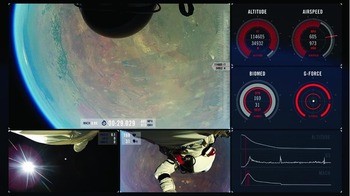
Fifty-two years later: 14 October 2012. Felix Baumgartner (b. 1969) is inside the Red Bull Stratos capsule ascending to the limits of the stratosphere (see Fig. 1). As he ascends, Baumgartner has Kittinger talking to him through an earpiece. Kittinger is now a retired US colonel and today plays a paternalistic role. He motivates and encourages, ensuring that Baumgartner remains in the right mental condition to risk his life. After a little more than three hours, the Stratos capsule reaches its destination – thirty-nine kilometres above sea level, somewhere between the middle and top layers of the stratosphere. There, he breaks his first world record: the highest manned balloon flight, held by Nick Piantanida since 1966. A few minutes later, Baumgartner is ready to go. He opens the capsule, activates the cameras attached to his suit, disconnects the oxygen supply, stands at the edge of Space, and falls. As he descends he breaks two more world records: the highest-altitude free fall, previously held by Kittinger, and the first human body to break the sound barrier without a powered vehicle.
The image above is a split screen that includes images taken with video cameras located on Baumgartner's suit at the time of the jump. It was taken five seconds away from supersonic speed. Photo credit: Red Bull Stratos/Red Bull Content Pool. Image courtesy of Red Bull.

24 October 2014: two years on, Alan Eustace (b. 1957) is attempting to break Baumgartner's record. But things are different. Unlike Baumgartner, Eustace does not have a previous record in extreme sports – he is not a Red Bull star and he does not receive substantial mass-media coverage. This is because Eustace is paying for his own extreme recreation and his free-fall attempt is a rather private event. A senior vice president for knowledge at Google, Eustace was able to put together a team of experts, place his own resources at their disposal and entrust them with the mission of developing the technology to, as he puts it, ‘linger in the stratosphere and be able to explore it’.Footnote 7 Indeed, the technology that he is using today improves on the capsule technology used by Baumgartner in several respects. To begin with, he is not using a capsule at all – the balloon is attached directly to his suit, which is made of a material much more resistant to extreme atmospheric conditions than Baumgartner's. In fact, the company that manufactured all the suits for the Apollo missions, ILC Dover, made this suit especially for Eustace. He is their first civilian customer. After two hours in ascent, Eustace has already broken Baumgartner's record of the highest manned balloon flight. A few minutes later, he reaches his destination at the upper edge of the stratosphere. It is time. He is released from the balloon and is now in free fall. Soon he will also break the sound barrier.
Video documentation and documentaries of these and other stratospheric free falls are publicly available – especially Baumgartner's, which was a major media event. These audiovisual documents insistently present free-falling as a record-breaking activity. In the documentaries about his free falls, Kittinger often narrates how and when he broke a record; in the full-length video of Baumgartner's fall, information banners appear when he reaches a record altitude or when his falling body breaks the speed of sound; lastly, Eustace claimed the record during a TED talk he delivered about his feat (possibly the most comprehensive document publicly available of his private event). This presents an intriguing lineage of sorts because as much as breaking atmospheric records may bind all stratospheric free-fallers together, it also sets them apart.
Kittinger inaugurated ‘the highest step in the world’ – his gondola had those words printed on one side – then Baumgartner took that record one step higher, and finally Eustace changed the paradigm from ‘falling’ to ‘lingering’. With each step, the human body was taken to a higher degree of atmospheric stress, and the technological sophistication necessary to prevent death increased accordingly. Nevertheless, as Craig Ryan argues, in Kittinger's time stratospheric free-falling was the US Space programme.Footnote 8 Extraterrestrial exploration was barely in its first years and experimental free-falling delivered crucial intelligence about safety procedures and body reactions in Space during the development of the first astronaut programmes of the Cold War. During the 1950s and 1960s, there were several stratospheric exploration programmes – Kittinger's stratospheric missions, for example, were part of the Excelsior projects – which were military research programmes focused on testing the limits of the human body in radical atmospheric conditions.Footnote 9 Their task was to master the limits of our planet, and therefore our own physical limits: both those of the committed and trained individual and those of the species as a whole. Nevertheless, while many greeted free-falling actions as the performance of unique exemplars of humankind, at stake were contesting claims on Space by warring terrestrial powers. As pre-astronauts and astronauts became superhumans, the US and the USSR were becoming the first Spacefaring nations. Decades later, when Baumgartner and Eustace jumped, Russia and the US were partners in the ISS, which in turn had already been orbiting for more than a decade; the US had three rovers on Mars and China was deploying one more on the Moon; the spacecraft Rosetta was about to land on a moving comet; and the New Horizons probe was closing on Pluto. Kittinger's free fall was the application of technology for a military research-oriented performance, Baumgartner's a globally broadcast extreme action, Eustace's a personal hobby inspired by curiosity. The ‘lineage’ of stratospheric record-breakers therefore implies a proportional relationship between the records that are broken in terms of the increasingly high placement of the body and the technology that is available to make that action possible. However, this lineage is also shaped by the different meanings that each fall had in relation to a changing geopolitical context.
In 1957, at the same time as stratospheric free-falling was becoming an early display of Cold War physical and military prowess, Hannah Arendt wrote in The Human Condition of her surprise when she learnt about reactions to the Soviet launching of the first man-made object into Space:
This event, second in importance to no other, not even to the splitting of the atom, would have been greeted with unmitigated joy if it had not been for the uncomfortable military and political circumstances attending to it. But, curiously enough, this joy was not triumphal; it was not pride or awe at the tremendousness of human power and mastery which filled the hearts of men, who now, when they looked up from the earth towards the skies, could behold there a thing of their own making. The immediate reaction, expressed on the spur of the moment, was relief about the first ‘step toward escape from men's imprisonment to the earth’. And this strange statement, far from being the accidental slip of some American reporter, unwittingly echoed the extraordinary line which, more than twenty years ago, had been carved on the funeral obelisk for one of Russia's great scientists: ‘mankind will not remain bound to the earth forever’.Footnote 10
Arendt's observation and anxiety about the idea of extraterrestrial exploration as ‘escaping Earth’ are indeed symptomatic of the central assumptions that inform contemporary astroaesthetics in the larger global cultural context and outside the military–industrial–university complex. The transition of atmospheric exploration from an exclusive military activity into a diversified private enterprise frames the enactment of the atmosphere as a limen that must be crossed in the advancement of a dramaturgy of atmospheric liberation. In this Space dramaturgy of planetary confinement, the atmospheric border of our planet becomes a barrier that humankind must break to achieve its dreams of interplanetary mobility. As Kittinger and other pre-astronauts demonstrate, extraterrestrial exploration was in this sense originally framed as the performance of daredevils who committed themselves to the project of breaking free from the constrictions of our planet. Today, that ‘prison break’ has already occurred.
Arendt argued that the planet is ‘the very quintessence of the human condition’ on the grounds that, ‘for all we know, it may be unique in providing human beings with a habitat in which they can move and breathe without effort and without artifice’.Footnote 11 This raises the question of what becomes of the human condition in the context of an interplanetary culture. The transformation of stratospheric free-falling from a military research programme into a sponsored extreme sport and private leisure activity indeed shadows the trajectory of Space exploration very clearly. After Kittinger came the first man in Space, Yuri Gagarin; the Apollo missions and the first man on the Moon; the Soviet Mir and the US Skylab Space stations; and many other ‘scenes’ or ‘acts’ that would eventually lead us to a time in which astronauts might spend a year in Space, as was the case of Russian cosmonaut Mikhail Kornieko and US astronaut Scott Kelly, who remained in orbit inside the ISS from 27 March 2015 to 1 March 2016 as part of the One-Year Mission and the Human Research Program. According to NASA, during their year in Space ‘Kelly and Kornienko participated in dozens of studies to provide new insights into how the human body adjusts to weightlessness, isolation, radiation and the stress of long-duration spaceflight’.Footnote 12
Once humankind succeeds as a whole in the performance that breaks the atmospheric limen, the desire to defeat death slowly becomes the wish to harness life outside Earth. In Space, as gravity fades, the human body undergoes material changes. Bones, for example, lose mass. Human interaction also changes; intimacy and work are redefined in terms of common survival. Experiments like NASA's One-Year Mission and the Human Research Program define an inquiry that addresses the human condition in Space. In that inquiry, a first astroaesthetic register for the appearance of performance in Space is the dynamics between defying death and harnessing life, consequentially opening post-human possibilities that might arise when, after Arendt, the human body is experimented with under extraterrestrial conditions. At the time of writing, the ISS has been uninterruptedly inhabited for almost sixteen years, and counting.
Dramaturgies of expansion: colonial interplanetary performance
12 May 2013: After a little more than five months in orbit, Canadian Chris Hadfield (b. 1959) is stepping down as commander of the ISS. Charismatic, but with a humble demeanour, Hadfield is already a world famous orbital superstar, as throughout his time in orbit he has been constantly active on social media as part of the educational activities offered by NASA and the Canadian Space Agency. He has given public lectures about scientific experiments in Space and has had live interactions with celebrities and politicians. Twitter, YouTube and Facebook have been his terrestrial domains. He bids farewell to the station and, moments before departing, releases a video of himself performing a cover version of David Bowie's ‘Space Oddity’ on YouTube – the first music video to be recorded outside Earth.
The video, as Bowie himself said, is perhaps the most poignant rendition of the song in its history. Watching it is an exciting experience, not least because Hadfield is a good singer and performer – his melancholy for the planet is palpable in his voice and gestures – but also because, as the first music video recorded in Space, it sets the bar for how a music video in Space might look and sound. Hadfield is white and male, and his demeanour is sombre; the ISS is a lonely place and the first song recorded in Space is in English. The images of the ISS orbiting the Earth while the gentle voice of Hadfield calls for ground control become a mellow audiovisual anthem for extraterrestrial exploration: a guitar floating around the station is left behind for the next mission commander to reminisce of a place he calls home.
Significantly, Hadfield's ‘Space Oddity’ drew attention to the copyright questions it posed. Even before the release of the video, copyright scholars had been considering the need for a new legal framework able to deal with the requirements of an eventual interplanetary culture. For example, in the article ‘Space Copyright Law: The New Dimension’, J. A. L. Sterling writes, ‘in due course we may see the presence of thousands of human beings in Space. What copyright law will they take with them, and how will it be exercised and administered?’Footnote 13 His argument goes so far as to employ the Rome Convention for the Protection of Performances and Performers in order to suggest that astronauts are performers in and of themselves: ‘performers are defined in the Rome Convention . . . as, inter alia, persons who “deliver, declaim . . . or otherwise perform” literary works, and it may be argued that the giving of the verbal reports by the astronauts constituted performances in these terms’.Footnote 14 He then suggests several scenarios. For example: ‘an astronaut on the Moon creates a work. Is the work protected by copyright? If so, will the astronaut or the Government entity responsible for the expedition be the copyright owner?’Footnote 15
Space law initially emerged out of post-Second World War international legal frameworks and has so far mostly been treated as analogous to international law. The ISS itself is regulated by an agreement that determines that national legal frameworks prevail in each of the respective modules of the station.Footnote 16 In this sense, to define performance in Space in terms of copyright and intellectual property reveals a project of territorialization that, even when it is not deliberately hostile or invasive, presupposes a geopolitical and an astropolitical gaze that is both inwards- and outwards-looking. In Critical Geopolitics Gerard Ó Tuathail argues that a geopolitical gaze presumes ‘the global scene as inseparable from the desire to use the displayed scene for one's own purposes’.Footnote 17 Drawing from Ó Tuathail's work, the political scientists Jonathan Havercroft and Raymond Duvall identify an ‘astropolitical gaze’ that emphasizes how the conception and representation of extraterrestrial exploration and Space is always already a political gesture.Footnote 18 An astropolitical gaze is determined by the position that the nation(s) behind it has or have within the international nexus of politics, finance, academia and technology. In light of this, we might ask how interplanetary culture and performance are conceived in nations that are not part of the ISS consortium or that have little or nothing by way of a Space programme, and what critical insights can we obtain from these ‘other’ cases.
25 January 2014: a few days after being deployed on the Moon's surface, China's lunar rover, Jade Rabbit, is facing severe technical difficulties. These seem to be fatal and thus Jade Rabbit promptly announces its premature death:
大家早上好!我有一个好消息和一个坏消息。好消息是, 三姐昨天凌晨已经进入梦乡, 成功开始第二次月夜休眠。坏消息是, 我的机构控制出现异常, 有些结构不太听话了。本来应该今早开始睡觉, 但现在. . .. . .师父们都在使劲想办法, 不过, 我还是有可能熬不过这个夜晚了。
Good Morning everyone! I have bad news and I have good news. The good news is Third Sister [Chang'e 3 carrier] entered dreamscape early yesterday, successfully embarking on her second hibernation. The bad news is [that] my system controls are acting strange, some things are no longer reacting. I should have been asleep this morning, but now . . . my masters are trying to fix the problem, but I may not be able to survive this Moon night.Footnote 19
Jade Rabbit quickly became famous around the world due to its Twitter-like Weibo account, which established the robot as a rising star of interplanetary social media. Throughout this sino-lunar online soap opera some notable features in Jade Rabbit's social-media persona and discourse were apparent self-awareness, a passionate nationalistic righteousness and sensitive poetic imagery. ‘It’ also showed a clear sense of sacrifice for the greater good, referring to its Chinese officials and scientists as its masters. Jade Rabbit constantly affirmed that it was one among many explorers who would eventually make a larger lunar or even interplanetary mission possible. Yet the fact that these comments were published on a social-media platform that is predominantly used in China (Twitter is not available in mainland China) reveals an ideological apparatus that contextualizes Jade Rabbit's online performance as one embedded in a larger discourse of geopolitical and astropolitical soft power. In twenty-five years of existence, the Chinese Space programme has managed to catch up with the achievements of the Russian and US Space programmes by clocking manned missions, Space walks and orbiting labs, and achieving the first flawless soft landing on the Moon since 1972. Behind Jade Rabbit's seemingly heroic tone is a strong political agenda that aims to assert China's further extraterrestrial ambitions for an economic and military presence on the Moon, in the face of a somewhat hostile international environment for its ambitions. The US, for instance, has consistently rejected the participation of the Chinese Space programme in the ISS for reasons of national security.Footnote 20 Today, Jade Rabbit continues to ‘perform’ online along with other instruments for remote observation. For example, NASA Mars rover Curiosity also ‘tweets’ in the first person about its activities. These cases reveal an astroaesthetic register in the anthropomorphism and subjectification of remote-observation devices and technologies.
13 February 2010: Mexican theatre-maker Alberto Villareal (b. 1977) is opening his latest work, Desierto Bajo la Escenografía Lunar (Desert Landscape beneath the Lunar Scene) at the University Cultural Centre, south of Mexico City.Footnote 21 The play, an extrapolation of a possible form of US-led Space colonialism, enacts the story of the first girl to be born on the Moon. She is the daughter of professional actors who won a contest to be part of the first extraplanetary human settlement.Footnote 22 They live in the first human condominium on the Moon, built in Californian style, and spend their days reminiscing about their time as second-rate Hollywood stars. In the meantime, their daughter spends her lunar days tracking the Earth's phases and plays cowboys and Indians alone in her room with a Wild West-style revolver, a prop brought by her father from Earth.
By setting the play against a backdrop of Californian styles, characters typical of a Western, and Hollywood memorabilia, Villareal suggests an imaginary in which the success of the US in the Cold War and its Space race has come with colonial benefits on the Moon. In the Mexican context this is particularly potent, as the cultural relationship with the US is heavily charged with both interdependence and conflict, and Hollywood movies like Independence Day (1996, 2016) are greeted with a bittersweet mix of enthusiasm and rejection.Footnote 23 Significantly, the play inaugurated a wave of Mexican plays that explored Space dramaturgies, of which two recent examples are La Velocidad del Zoom del Horizonte (Speed of Horizon's Zoom) by David Gaitan (2014), and Laika by Antonio Zuñiga and Hasam Díaz (2015).
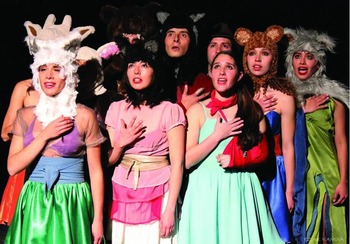
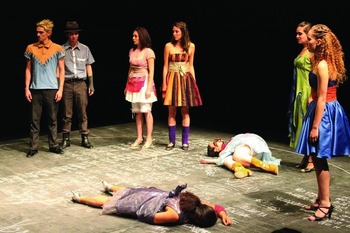
Mexico is not a Spacefaring nation and its Space programme is limited to a few satellites in orbit. Of these, none has a social-media account. In general cultural terms, Space in Mexico remains knowable and representable largely in light of the cultural legacies of the US Space agenda. Cases like Desierto therefore might stand as countergazes to the current explosion of extraterrestrial exploration, and the ways in which the projects of an interplanetary colony are being commonly conceived (see Figs 2 and 3).
The cast in the original production of Desierto Bajo la Escenografía Lunar. In the staging, the actors wore costumes that resembled Western-like attire, and in particular scenes, like the one shown above, would also wear animal-shaped headgear. Photo credit: José Jorge Carreón. Image courtesy of Alberto Villareal.

Villareal decided to use a circular, orbit-like, stage-wide choreography so that the scene would literally be spinning out of control yet only punctuated by moments of stillness whenever a gun shot was fired. In the image, a moment of stillness amid orbital madness. Photo credit: José Jorge Carreón. Image courtesy of Alberto Villareal.

The Outer Space Treaty (signed in 1967) establishes that it is prohibited for a nation to annex territory on the Moon and other celestial bodies.Footnote 24 Yet the legal frameworks for Space that were crafted during the Cold War are already under pressure. Luxembourg, for example, revealed on 3 June 2016 its intentions to craft the necessary legal allowances to become ‘the silicon valley of Space mining’, while US military chiefs have long maintained that, alongside land, air and sea, ‘Space power will also evolve into a separate and equal medium of warfare’.Footnote 25 As long as Space is being projected as a place for economic development or military might, interplanetary colonialism is already a register for our interactions with Space and therefore also a determining factor of how actions are coded as performances in and about Space. Indeed, as Jill Stuart argues, ‘the perception of “collectivity” and “humanity” in the discourse of outer Space politics is in fact that of the dominant, most powerful forces, and [thus] a common category of “humanity” is not possible (or at least not in the present state of affairs)’.Footnote 26
Projects like MarsOne further demonstrate the need for a colonial critique. MarsOne is a corporate interplanetary project that aims to place the first human crew on Mars by 2026. The grounds on which MarsOne has been conceived are remarkably neocolonialist in the sense that it aims to territorialize Mars for the benefit of a terrestrial enterprise. The crew, referred to as the first human colonizers on Mars, are expected to be picked from a global selection that began in 2013 with an online open call and that, at the time of writing, is on its third round, with a hundred finalists.Footnote 27 Once selected, their training, travel and life on Mars will be broadcast as a reality television show on Earth. The project plans for the colonizers to travel to Mars and remain there until their deaths. Furthermore, although it does not represent national aspirations for an interplanetary colony, MarsOne's astropolitical ambitions take a different, and perhaps more powerful, tone as the model that it follows is that of a corporate claim to extraterrestrial soil. The not-for-profit organization behind the mission, the MarsOne Foundation, is in fact associated with the for-profit MarsOne Corporation, which, among other things, aspires to monetize interplanetary broadcasting. In October 2014 two MIT PhD students called the scientific viability of the project comprehensively into question.Footnote 28 Yet, if it manages to stay credible and turns out to be successful, people on Earth will be able to watch the colonizers live and then die on their televisions and mobile devices. They could witness the sacrifices made in the name of the human astropolis and its circus.
Strictly speaking, an interplanetary colony is not yet feasible. However, interplanetary colonialism is already a buzzword among Space powers. NASA, for example, has announced that its project Journey to Mars anticipates processing from an ‘Earth reliant to an Earth independent Mars’, while Elon Musk, CEO of SpaceX, has also announced his plans and ambitions to build a colony on the red planet.Footnote 29 A colonial critique that addresses the ways in which Space is performed and represented in terms of the dominant powers therefore sheds light on the geopolitical, astropolitical and astroaesthetic registers that define a performance in relation to one or more of the rising dramaturgies of interplanetary expansion.
Interplanetary synaesthesia: performance and cosmology
But . . . is it all about escaping, life, death and breaking the barrier of sound while propelling oneself either upwards or inwards through our atmosphere? Can we understand contemporary astroaesthetics in any other way beyond performing the ideologies of planetary expansion? Can technology allow other sorts of cosmic interaction?
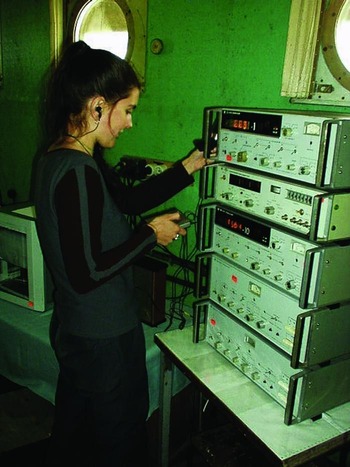
4 August 2001: Honor Harger and Adam Hyde, a duo otherwise known as r a d i o q u a l i a, have arrived in western Latvia and are about to start their participation in the international Acoustic.Space.Lab symposium. This is a symposium organized by RIXC Centre for New Media, and is being held at the Ventspilis International Radio Astronomy Centre (VIRAC), inside the facilities of a radio telescope abandoned by the Soviet Army in 1994 (see Fig. 4). During the next four days Harger and Hyde will join a larger group of international scientists and artists whose visit is focused on reclaiming these facilities for the purposes of artistic research.Footnote 30 Three years later, in 2004, r a d i o q u a l i a will open the immersive installation Radio Astronomy, produced as a result of their research at VIRAC.
Honor Harger listening to the radio telescope at Ventspilis International Radio Astronomy Centre, during the Acoustic.Space.Lab international symposium held in a military facility abandoned by the Soviet Army in 1994. Photo credit and courtesy of r a d i o q u a l i a.

Radio Astronomy had its first iteration at the 2004 International Symposium on Electronic Art in Helsinki, Finland, where it was presented as a site-specific installation at a planetarium observatory. The dome of the planetarium was open, so people were able to see the night sky while listening to Space sounds streamed live from VIRAC. The piece was shown in the same year at the Ars Electronica Festival in Linz, Austria, and its final iteration was in 2008, at the NTT Inter Communications Centre in the Tokyo Opera City Centre. However, unlike the first version of the piece, what was shown in Linz and Tokyo was not site-specific but rather a ‘gallery version’. In this version, the installation was staged as a dark room where visitors could walk around while listening to the live stream of a radio telescope in either Latvia, Spain or the US, depending on time-zone availability, or directly from r a d i o q u a l i a's archives if the time differences did not allow a direct connection.
In its gallery version, the work was a sonic installation designed to give listeners the ‘feeling of being in the midst of interstellar traffic’.Footnote 31 This was achieved by the manipulation of sounds so that they blue-shifted towards the listeners and red-shifted away from them. When an object moves away from us, the light shifts towards the red end of the spectrum, while when that object moves closer, lights tends to shift towards the blue end of the spectrum: these shifts indicate how objects in Space are moving closer to or further from our planet. During an interview, Harger clarified that the references to red shift and blue shift were only used in Radio Astronomy as an inspiration, and not as strict scientific modelling. However, she explained that their decision to eliminate any visual stimuli sought to highlight the fact that what the visitors were listening to was already a ‘translation’ from radio waves into sound. Indeed, sound does not travel in the void of Space and, as Harger explained to me, the sounds that were presented in the installation were a conversion of electromagnetic waves into sonic frequencies.Footnote 32
Another important component of Radio Astronomy was an online radio station that broadcast the signal either from one of the radio telescopes involved in the project or from r a d i o q u a l i a's archive. The first few times I listened to the sounds in that archive I could not really make any sense of them, and that led me to think that perhaps astronomic sound represented the limits of our capacity to know Space. When I shared this observation with Harger, she responded that the more you listen, the more noise begins to make sense. In her words, ‘you learn, you develop an aesthetic sense of how Space sounds’.Footnote 33 r a d i o q u a l i a place their work in relation to a lineage of composers and sound artists who, according to Harger, were making interplanetary performance long before they created Radio Astronomy. For example, Harger, whose doctoral dissertation was on astronomic sound research, identifies the work of Gérard Grisey (1946–98) as a direct antecedent to r a d i o q u a l i a's interplanetary work. In 1990, Grisey composed the piece Le noir de l’étoile (The Black of the Star), which used six drums and the pre-recorded sounds of a dying quasar. However, r a d i o q u a l i a finds a closer connection to musique concrète, and composers like John Cage (1912–92) and his influential piece 4′33″ (1952). In particular they relate Radio Astronomy to Cage's piece, since both challenge the listener to ‘hear their ambient surrounds, taking into account the . . . qualities of the performance location’.Footnote 34 Certainly, in Radio Astronomy the agency of the listener is not as radical as the one required in 4′33″. However, in Radio Astronomy Space is reframed as an aural experience, and in that sense the relation to Cage's work is persuasive.
Here, sitting at my desk at my home in northern Singapore listening to the archives of Radio Astronomy (and radio astronomy), I am able to have an immersive interplanetary experience of Space. This can be challenging. I am barely starting to learn how to listen. The ‘noises’ from different samples are different from each other. This may sound obvious, but Jupiter does not sound like the Sun, and the Sun does not sound like the leftover radiation waves from the Big Bang. Each has a particular pattern. The sound of the Sun is a hiss that is interrupted every so often by ‘marks’ or ‘beats’. The more I listen to it, the more I realize that I am listening to a sonic interpretation of the radio waves emitted by a star that I could never have physical proximity with, nor see directly. Something similar happens with the sound of the Big Bang. Discovered in 1964 by Arno Penzias and Robert W. Wilson and easily found through several online portals, NASA's included, this sound is particularly special. Initially it is nothing more than a constant and intense noise similar to television white noise. Yet when I realize that what I am listening to is really the sound of the first electromagnetic waves to have existed, it immediately registers a different meaning. Listening acquires a more subtle quality because I start to frame my experience as a ‘translation’ or ‘mediation’ with deep time. I am affected by matter (and possibly antimatter) that is far removed from my temporal immediacy. In this sense, when I listen to the tracks of Radio Astronomy I can deduce that in framing these sounds in an interactive installation, r a d i o q u a l i a was indeed, like Grisey, performing with delayed signals of interplanetary Space. This is a way of understanding interplanetary performance differently from actions of risk, death or the might of the species or a nation. Instead, it is an experience of interplanetary synaesthesia and cosmological delay, and radio astronomy might not be the only technology that allows us to engage with the Cosmos in this way.
11 February 2016: the group of scientists at the Laser Interferometer Gravitational-Wave Observatory (LIGO) scientific collaboration are announcing that they have finally been able to observe and register gravitational waves. Gravitational waves are ‘ripples in the fabric of space–time caused by some of the most violent and energetic processes in the Universe’.Footnote 35 These ripples, or waves, travel from their point of origin uninterruptedly throughout the universe, disrupting space–time in their path. Originally predicted by Einstein's 1915 general theory of relativity, the first proofs of their existence came in 1974, and they were finally observed and recorded physically by LIGO on 24 September 2015. These were the consequence of the collision between two minor black holes that allegedly occurred 1.3 billion years ago: before life existed on Earth.
At the centre of the LIGO scientific collaboration are two gravitational telescopes, or interferometers, located in the US at Livingston, Louisiana and Hanford, Washington. Broadly speaking, each of these interferometers has the shape of a very large right angle, with each arm four kilometers long. Inside each of them there is an intricate system of mirrors that reflects a hyper-sensitive laser beam that intially ‘translates’ gravitational waves into light waves.Footnote 36 Curiously enough, when the group of scientists presented their observations, they did so by first showing a computer-generated animation of what the collision between the two black holes would have looked like from above. However, the gravitational waves themselves were only introduced through sound. Participants at that press conference and all the other viewers spread around the planet (myself included) heard a sonic interpretation of the ripples in space–time that were left by an event that occurred outside any intelligible time frame for humankind.
It is too soon for any LIGO-associated artistic practices to emerge and be discussed on their own terms. In the meantime, and while we wait for that to happen, we can now safely say that the possibilities and implications for performance-based practices are significant. The fact that we are able to translate gravitational waves into light and then sound places us in a particular relation to the Cosmos, one in which interplanetary performance allows us to experience something from Space without disavowing our limited capacities – when we listen to gravitational waves, it is hard not to be aware that there is something that escapes us. This suggests an alternative to contemporary astroaesthetics that unsettles the predominant visual archives of Space exploration and its death-defying stunts. It is an important counterweight, reminding us that our atmosphere is not really a prison wall but in fact a membrane that mediates our interactions with the Cosmos at large. It further implies an ethical position that enables alternatives to the assumptions of discovery, mastery, colony and habitation that have largely informed interplanetary culture thus far, as it stresses our constant interactation with phenomena that precede and will supersede our existence.
In line with examples like Radio Astronomy and its conceptual sound-art lineages, and with LIGO and the possibilities it offers, to think of interplanetary performance in terms of synaesthetic perceptions reveals and emphasizes the fundamental problem of human-based cosmological knowledges: the Cosmos greatly exceeds human terrestrial, temporal and perceptual scales. Here, a significant astroaesthetic register is the delay of our audiovisual interactions with Space: the further we explore, see and listen, the further in time we are in relation to the non-human agency or phenomena we perceive. Indeed, in a cosmological framework, co-presence slides through different temporal scales. When we listen to or see distant cosmic phenomena, we are performing an interaction with the past.
Interplanetary culture, now
Debate in contemporary astroaesthetics should attend to the conception of an interplanetary culture: between, on the one hand, what we might call a dramaturgy of interplanetary expansion and colonialism, and, on the other, the potential for other kinds of interplanetary interactivity. However, by suggesting these two possibilities, I am also hinting at the potential diversity for the performative knowing of Space. Both stands are not entirely distinct from each other as both are united by the indelible mark of the technology that makes them possible. This technological nuance should prevent us from falling into easy and unproductive binaries (normative/non-normative, good/bad), and instead direct our attention to the complexities that inform and impact the design, development and application of the technologies with which we reach out and interact with the Cosmos. As Bormann argues, the new technologies that allow us to relate to Space ‘are producing new domains of experience and new modes of representation and perception’, offering the possibility of ‘unbundling’ Space from long-standing assumptions that inform its performances to suggest instead alternative reasons and trajectories.Footnote 37
The interplanetary debate is paramount as it offers the grounds for theatre and performance scholars and makers to generate alternatives for the production of knowledge in and about Space, as well as to converse with disciplinary formations in the social sciences and humanities that are already dealing with similar astral issues and debates. Indeed, related subfields are already being institutionalized to different extents. Astropolitics has a peer-reviewed journal, astrolaw is an established profession, and astrosociology has an institute that publishes in collaboration with NASA. In this context, theatre and performance scholars have the opportunity to model the critical methods through which we study the development of theatre and performance practice in and about Space, and, by extension, to contribute to the larger debate about the conceptions, perceptions and definitions of our interplanetary condition.