Introduction
Interception by plant canopies can have an effect on diaspore dispersal and on the distribution of species (Bullock et al., Reference Bullock and Moy2004; Nathan et al., Reference Nathan, Katul, Bohrer, Kuparinen, Soons, Thompson and Horn2011; Stone et al., Reference Stone, Malloy and Murray2017). Diaspore appendages such as wings and pappus (Pounden et al., Reference Pounden, Greene, Quesada and Contreras2008) and vegetation structure and density can increase the possibility of diaspore interception by plant canopies (Liang et al., Reference Liang, Liu, Liu, Qin, Xin and Lv2019; Lipoma et al., Reference Lipoma, Cuchietti and Gorné2019). Interception could increase diaspore deposition in local areas and prevent them from reaching some areas, thus modifying spatial patterning of vegetation (Brooker et al., Reference Brooker, Maestre, Callaway, Lortie, Cavieres, Kunstler, Liancourt, Tielb, Travis, Anthelme, Armas, Coll, Corcket, Delzon, Forey, Kikvidze, Olofsson, Pugnaire, Quiroz, Saccone, Schiffers, Seifan, Touzard and Michalet2008).
Wind dispersal is an important mechanism of diaspore dispersal, especially in open habitats (Willson et al., Reference Willson, Rice and Westoby1990; van Rheede et al., Reference van Rheede, Oudtshoorn and van Rooyen1999). Although wind conditions may play a decisive role in dispersal (Maler et al., Reference Maler, Emig and Leins1999; Tackenberg et al., Reference Tackenberg, Poschlod and Bonn2003a; Baker and Beck, Reference Baker and Beck2008; Pinceel et al., Reference Pinceel, Brendonck and Vanschoenwinkel2016), it is difficult to conduct controlled experiments in nature (Maler et al., Reference Maler, Emig and Leins1999). Thus, wind tunnels are important for conducting controlled experiments on diaspore dispersal by wind (Maler et al., Reference Maler, Emig and Leins1999; Baker and Beck, Reference Baker and Beck2008; Pinceel et al., Reference Pinceel, Brendonck and Vanschoenwinkel2016; Liang et al., Reference Liang, Liu, Liu, Qin, Xin and Lv2019).
Previous studies have reported that diaspores can collide with the plant canopy in forests (Pounden et al., Reference Pounden, Greene, Quesada and Contreras2008) and that plant shape and the number and arrangement of branches and leaves can determine dispersal distance and pattern of ballistically dispersed diaspores (Thiede and Augspurger, Reference Thiede and Augspurger1996; Wender et al., Reference Wender, Polisetti and Donohue2005; Thomson et al., Reference Thomson, Moles, Auld and Kingsford2011). However, the effect of canopy interception of diaspores has not been explicitly studied for diaspores dispersed by wind (Nathan et al., Reference Nathan, Katul, Bohrer, Kuparinen, Soons, Thompson and Horn2011). Since shrubs are common in arid and desert areas (Mcglynn and Okin, Reference McGlynn and Okin2006; Chandregowda et al., Reference Chandregowda, Murthy and Bagchi2018), it is important to understand how shrub canopy interception of diaspores is linked to plant population structure.
Diaspore attributes, such as appendages, mass, wing loading, terminal velocity and shape, can have different effects on wind dispersal (Augspurger and Franson, Reference Augspurger and Franson1987; Jongejans and Telenius, Reference Jongejans and Telenius2001; Tackenberg et al., Reference Tackenberg, Poschlod and Kahmen2003b; Nathan et al., Reference Nathan, Katul, Bohrer, Kuparinen, Soons, Thompson and Horn2011). Diaspores can be spores, seeds, fruits, fruits plus appendages such as perianth or bracts, parts of plants or whole plants (i.e. tumbleweeds) (Mark and Ersen, Reference Mark and Ersen1993; van Rheede et al., Reference van Rheede, Oudtshoorn and van Rooyen1999; Jongejans and Telenius, Reference Jongejans and Telenius2001). Previous studies usually have focused on a single family with several species or on only a few appendage types or diaspore characteristics (Pounden et al., Reference Pounden, Greene, Quesada and Contreras2008; Zhu et al., Reference Zhu, Liu, Xin, Zhao and Liu2015). There are only a few studies on how the morphological characteristics of diaspores could affect canopy interception of diaspores. The use of diaspores with various types of appendages and other attributes will give us a better understanding of how plant canopies affect the dispersal potential of diaspores.
Although it is known that multiple factors can interact to influence diaspore dispersal (Thompson, Reference Thompson1987; Horn et al., Reference Horn, Nathan and Kaplan2001; Pounden et al., Reference Pounden, Greene, Quesada and Contreras2008; Thomson et al., Reference Thomson, Moles, Auld and Kingsford2011; Poschlod et al., Reference Poschlod, Abedi, Bartelheimer, Drobnik, Rosbakh and Saatkamp2013), research on how multiple factors interact to influence canopy interception of diaspores is rare. It seems reasonable that wind conditions, plant architecture and diaspore attributes affect canopy interception of diaspores dispersed by wind (Pounden et al., Reference Pounden, Greene, Quesada and Contreras2008; Thomson et al., Reference Thomson, Moles, Auld and Kingsford2011; Liang et al., Reference Liang, Liu, Liu, Qin, Xin and Lv2019). Further, exploring the impact of these three major factors on canopy interception of diaspores will increase our understanding of wind dispersal of diaspores and help predict the future distribution patterns of species and thus aid in developing species conservation strategies.
In this study, we aimed to answer the question: what role do diaspore morphological attributes, canopy types and wind speeds play in plant canopy interception of diaspores during dispersal by wind? Controlled experiments on the effects of wind speed, diaspore attributes and canopy type on canopy interception of diaspores during wind dispersal were conducted in a wind tunnel.
Materials and methods
Wind speed control
Wind speed was controlled in a wind tunnel that was 2 m × 2 m × 20 m (height × width × length). Speed of wind coming out of the tunnel was monitored with a Magnesense II Differential Pressure Transmitter (MS2-W102-LCD, Dwyer Instruments Inc, Indiana, USA), and wind speed in the tunnel was measured with a Pitot tube (160-96, Dwyer Instruments Inc, Indiana, USA) (Liang et al., Reference Liang, Liu, Liu, Qin, Xin and Lv2019). In this study, the six wind speeds (at 1 m above the ground) were 2, 4, 6, 8, 10 and 12 m s−1, and they approximate levels 2–7 of meteorological wind measurements, which is the common range of wind speeds in nature (Mather, Reference Mather and Oliver1987).
Canopy selection
We used the strong sprout-branching cultivar Zhonghua Jinye of Ulmus pumila L. because it possesses dense branches and a full canopy. Young trees with mature leaves and a uniform plant canopy (plant height about 100 cm and canopy size about 125 cm × 125 cm) were selected as the plant model. Branch level was measured by centrifugal ordering systems (Borchert and Slade, Reference Borchert and Slade1981). Branch length was measured with a tape measure, branch diameter with a Vernier caliper and branch angle with a protractor (Table 1). The plant was transplanted to the front end of the wind tunnel test section (8 m away from the power section and in the middle of the two walls of the wind tunnel). For all canopy types, plant height was 1 m (Fig. 1). To study the interception effect of different shrub canopy types on diaspores, shrub canopy with or without leaves, different canopy sizes and branch densities were obtained by trimming the tree to represent different canopy types:
• Leafy and large canopy with high branch density (LBH). All leaves were present, size of canopy was 120 × 120 cm (length × width) and branches included 1–3 levels (Fig. 2).
• Leafless and large canopy with high branch density (NBH). All leaves were removed, size of canopy was 120 × 120 cm (length × width) and branches included 1–3 levels (Fig. 2).
• Leafless and medium canopy with high branch density (NMH). All leaves were removed, size of canopy was 100 × 100 cm (length × width) and branches included 1–3 levels (Fig. 2).
• Leafless and small canopy with high branch density (NSH). All leaves were removed, size of canopy was 80 × 80 cm (length × width) and branches included 1–3 levels (Fig. 2).
• Leafless and medium canopy with medium branch density (NMM). All leaves were removed, size of canopy was 100 × 100 cm (length × width) and branches included 1–2 levels (Fig. 2).
• Leafless and medium canopy with low branch density (NML). All leaves were removed, size of canopy size was 100 × 100 cm (length × width) and branches included 1 level (Fig. 2).
A sketch of the wind tunnel used in the experiment. The wind tunnel was 2 m in height, 2 m in width and 20 m in length. 1, pitot tube; 2, differential pressure transmitter; 3, diaspore release device; 4, target plant; 5, V 1 speed of wind before passing through the canopy (1 m above the ground and 10 cm in front of the canopy); 6, V 2 speed of wind after passing through the canopy (1 m above the ground and 10 cm behind canopy).

Types of canopies used in study. LBH, leafy and large canopy with high branch density; NBH, leafless and large canopy with high branch density; NSH, leafless and small canopy with high branch density; NMH leafless and medium canopy with high branch density; NMM, leafless and medium canopy with medium branch density; NML, leafless and medium canopy with low branch density.

Characteristics of the six types of canopies used in the study (mean ± SE)

LBH, leafy and large canopy with high branch density; NBH, leafless and large canopy with high branch density; NSH, leafless and small canopy with high branch density; NMH, leafless and medium canopy with high branch density; NMM, leafless and medium canopy with medium branch density; NML, leafless and medium canopy with low branch density.
Diaspore release device
A stainless steel tube 4 cm in diameter was inserted into the plant canopy from the top of the wind tunnel. Diaspores were released from the upper part of the steel tube, which was controlled by a bottom flap to ensure that initial release rate was zero. The diaspore release point was in the middle of the canopy 10 cm below the top of the canopy (Fig. 1).
Wind permeability coefficient measurement
Wind speed on the front side of the plant (V 1 = speed of wind before passing through the canopy) was measured by a Magnesense II Differential Pressure Transmitter and a Pitot tube 1 m above the ground surface and 10 cm in front of the plant. Wind speed on the back side of the plant (V 2 = speed of wind after passing through the canopy) was measured 1 m above the ground surface and 10 cm behind the plant. Wind permeability coefficient α = V 1/V 2 (Fig. 1).
Diaspore selection and trait measurements
Twenty-nine angiosperm species with different kinds of diaspores were used in the study. They differed according to appendage type (spherical-winged, flat-winged, thorn, hair, pappus, plumed and balloon) and quality or absence of appendages. Spherical-winged diaspores were called samara diaspores, and flat-winged diaspores were called wing diaspores. Twenty intact diaspores of each species were selected for attribute measurements. Length, width and thickness of each diaspore were measured with Vernier caliper (0.01 mm accuracy). The diaspore shape index was calculated as follows (Thompson et al., Reference Thompson, Band and Hodgson1993):
 $$Shape\,index = variance\left({\displaystyle{{{\rm Length}} \over {{\rm Length\;}}}\comma \;{\rm \;}\displaystyle{{{\rm Width}} \over {{\rm Length}}}\comma \;{\rm \;}\displaystyle{{{\rm Heigth}} \over {{\rm Length}}}} \right)$$
The projected area of each diaspore was scanned with image analysis software (Motic Image Plus 2.0, Motic China Group Co., Ltd, USA). Diaspore mass was determined with an electronic balance (0.1 mg accuracy). Wing loading is diaspore mass divided by projected area (Greene and Johnson, Reference Greene and Johnson1997). The terminal velocity was measured with an apparatus (a black lightproof box provides a calm space for the determination of the falling velocity) described by Zotz et al. (Reference Zotz, Weichgrebe, Happatz and Einzmann2016). The constant falling velocity of a diaspore in still air was recorded by a camera (Zhou et al., Reference Zhou, Liu, Xin, Daryanto, Wang, Li, Wang, Liang, Qin, Zhao, Li, Cui and Liu2020).
The ranges of diaspores properties were: mass, 1.12–316 mg; shape index, 0.002–0.2; projected area, 5–604 mm2; wing loading, 0.04–2.1 mg mm−2 and terminal velocity, 0.7–40 m s−1 (Table 2).
Diaspore attributes of the 29 study species (mean ± SE)

Controlled experiment on plant canopy interception of diaspores
Diaspores were placed into the release device, and when wind speed reached the target speed (2, 4, 6, 8, 10 or 12 m s−1), they were released. The wind was allowed to flow for 2 s after diaspores were released and then stopped. The number of diaspores intercepted by the canopy was counted.
Each of the 29 species was used to conduct experiments with the six kinds of canopies at six wind speeds. Twenty diaspores of each species were employed for each experiment, and five replicates were used for each treatment. In total, there were 104,400 diaspores (29 species × 6 canopy types × 6 wind speeds × 20 diaspores × 5 replicates).
Data analysis
Interception percentage for diaspores of each species exposed to the different canopy types at each wind speed was analysed. Contributions of diaspore properties to canopy interception at different wind speeds and canopy types were analysed comparatively; the plots were drawn using Origin Pro 8.5 (OriginLab Corporation 1991-2010, USA). Ordination analysis was conducted to assess variation in diaspore interception by canopy in relation to diaspore shape index, mass, projected area, wing loading and terminal velocity; canopy type; and wind speed. Canonical correspondence analyses (CCAs) based on correlation matrixes of canopy interception probability of diaspores and explanatory factors were conducted using Canoco 5.0 (version 5.0, Microcomputer Power, Ithaca, NY) (Tackenberg, Reference Tackenberg2003). The contribution of each explanatory variable to variation in diaspore interception percentage was tested following standardized interactive-forward-selection procedures.
Results
Interception percentages of different canopy types
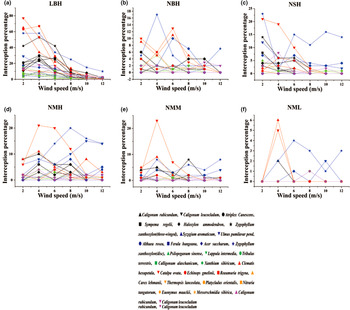
Plant canopy had no effect on interception of diaspores without appendages. Diaspores with hairs and wings were intercepted more frequently than those with other kinds of appendages. Maximum interception (77%) was for diaspores with hairs (Clematis hexapetala) at low wind speed in the LBH type of canopy. Interception percentages of diaspores with the same kind of appendage did not change significantly with an increase in mass. The interception percentage by the plant-leaf type of canopy (LBH) was higher than that of the leafless type canopies (NBH, NSH, NMH, NMM and NML), and the difference decreased with increased wind speed. Interception percentages increased with branch density of the plant canopy, and the middle size type of canopy had the highest interception percentage among the three sizes of canopy. More types of diaspores were intercepted, and interception percentage of each diaspore was higher in a low air permeability coefficient canopy than in a high air permeability coefficient canopy (Fig. 3).
Changes in diaspore interception percentages by different types of canopies at different wind speeds (a–f). The black line is diaspore with spherical-winged, ‘▴▾●■◆★’ indicates percentage (from high to low) of diaspores with spherical-winged, blue line diaspore with flat-winged, ‘ ’ indicates percentage (from high to low) of diaspores with flat-winged, blue line diaspore with flat-winged, green line diaspore with thorn, ‘
 ’ indicates percentage (from high to low) of diaspores with thorn, red line diaspore with hair, puppus and plumed, violet line diaspore with balloon, ‘
 ’ indicates percentage (from high to low) of diaspores with balloon, and orange line diaspore without an appendage, ‘
 ’ indicates percentage (from high to low) of diaspores without an appendage. Diaspores with an interception percentage of 0 are not shown on the graphs. In all graphs, LBH means the canopy type of leafy and large canopy with high branch density, NBH canopy type of leafless and large canopy with high branch density, NSH canopy type of leafless and small canopy with high branch density, NMH canopy type of leafless and medium canopy with high branch density, NMM canopy type of leafless and medium canopy with medium branch density and NML canopy type of leafless and medium canopy with low branch density.

Explanation of wind speed, diaspore attributes and canopy type on interception
All factors combined explained 60.9% of the total variation in the probability of interception. The contribution of wind speed, diaspore trait and canopy type to the variation in interception was 9.2, 53.5 and 37.3%, respectively. Wind permeability coefficient, which was negatively related to interception, was an important factor affecting canopy interception of diaspores and explained 22.7% of the variation. Diaspore attributes explained 32.6% of the variation in canopy interception, and projected area and wing loading were the most important attributes. However, wind speed explained only 9.2% of the variation (P < 0.01; Table 3).
Explanations and contributions of various parameters to the total variation in diaspore interception by canopy

* 0.01 < P < 0.05, **P < 0.01.
Contribution of diaspore attributes to canopy interception at different wind speeds
The contribution of diaspore attributes to interception increased with the increment of wind speed. Contribution of projected area of diaspores to interception increased with wind speed, whereas contribution of wing loading of diaspores decreased with wind speed. At wind speeds of ≤ 6 m s−1, wing loading of diaspores was the most important factor for interception, but at wind speeds of > 6 m s−1, projected area of diaspores was the most important. The effect of shape index on interception percentage increased with the increment of wind speed. At wind speeds of < 12 m s−1, wing loading and terminal velocity of diaspores had a significant effect (P < 0.05) on interception, whereas shape index of diaspores did not have a significant effect (P < 0.05) until wind speed was 12 m s−1 (Table 4).
Contribution of diaspore attributes to canopy interception at different wind speeds

E, Percentage explained by diaspore trait; F, diaspore attributes; TE, total percentage explained by diaspore attributes; PA, projected area (mm2); WL, wing loading (mg mm−2); TV, terminal velocity (m s−1); SI, shape index; MS, diaspore mass (mg).
* 0.01 < P < 0.05, **P < 0.01.
Contribution of diaspore attributes to interception by different canopy types
The contribution of diaspore attributes to interception decreased when wind permeability coefficient of the plant canopy increased. With an increase in canopy width and branch density, the contribution of diaspore attributes to interception increased. Wing loading and projected area of diaspores were the most important diaspores attributes for interception in all canopy types. Wing loading of diaspores contributed the most to interception percentages in the leafy type of canopy, while diaspore projected area contributed the most to interception in other canopy types. Shape index of diaspores had the lowest contribution percentage to the leafy canopy type, but its contribution to interception percentages in the leafless plant canopies was greater than that of mass and terminal velocity of diaspores (Table 5).
Contribution of diaspore attributes to interception by different types of canopy

E, percentage explained by diaspore trait; F, diaspore attributes; TE, total percentage explained by diaspore attributes; PA, projected area (mm2); WL, wing loading (mg mm−2); TV, terminal velocity (m s−1); SI, shape index; MS, diaspore mass (mg); NSH, leafless and small canopy with high branch density; NMH, leafless and medium canopy with high branch density; NMM, leafless and medium canopy with medium branch density; NML, leafless and medium canopy with low branch density; NBH, leafless and large canopy with high branch density; LBH, leafy and large canopy with high branch density.
* 0.01 < P < 0.05, **P < 0.01.
Discussion
Diaspore dispersal is affected by the interaction of many factors (Augspurger and Franson, Reference Augspurger and Franson1987; Baker and Beck, Reference Baker and Beck2008; Helge et al., Reference Helge, Jürgen, Oliver, Jonathan, Borja, Stephan, Zoltán, Milan, Richard, Florian, Jens and Valério2018). Our study showed that diaspore traits, canopy type and wind speed could interact to influence canopy interception of diaspores dispersed by wind. Further, diaspore attributes had the greatest influence on canopy interception and wind speed the least. Diaspores with appendages were more likely to be intercepted by the canopy than those without appendages. At low wind speed, diaspore wing loading had a large influence on canopy interception, but at high wind speed, diaspore projection area had a large influence. The chance of canopy interception at a given wind speed was affected by the type of canopy. Information on the effect of canopy interception of diaspores dispersed by wind increases our knowledge of the dispersal process, corrects previous understanding of diaspore dispersal potential, and it improves the theoretical basis for predicting spatial patterns and dynamics of plant populations.
Relative contributions of wind speed, diaspore attributes and canopy type to interception
Canopy interception of diaspores can affect the final destination of diaspores dispersed by wind (Pounden et al., Reference Pounden, Greene, Quesada and Contreras2008; Thomson et al., Reference Thomson, Moles, Auld and Kingsford2011). Based on the results of our controlled experiments, wind speed, canopy type and diaspore attributes have different effects on canopy interception, and diaspore attributes contributed the most and wind speed the least to canopy interception of diaspores. Wind speed has a high impact on diaspore dispersal through the air and after they are on the ground and subject to secondary dispersal by the wind (Liang et al., Reference Liang, Liu, Liu, Qin, Xin and Lv2019). However, wind speed may have different effects on air and ground dispersal. High wind speeds can decrease interception percentage by the plant canopy and increase soil-surface interception of diaspores (Liang et al., Reference Liang, Liu, Liu, Qin, Xin and Lv2019).
Plant canopy interception changes with wind speed
The amount of canopy interception of diaspores was affected by leaves, branch structure and canopy size (Fig. 3), and the more wind impermeable the canopy was the more diaspores are likely to be intercepted (Liang et al., Reference Liang, Liu, Liu, Qin, Xin and Lv2019; Lipoma et al., Reference Lipoma, Cuchietti and Gorné2019). This means that diaspore dispersal can be affected by vegetation type and plant growing season (Abedi et al., Reference Abedi, Dechmann, Wikelski, Scharf and Fahr2016). However, the effect of the canopy on diaspore interception may be affected by the turbulence generated by wind blowing through the plant (Greene and Johnson, Reference Greene and Johnson1997; Nathan et al., Reference Nathan, Katul, Horn, Thomas, Oren, Avissar, Pacala and Levin2002; Nathan and Katul, Reference Nathan and Katul2005; Bohrer et al., Reference Bohrer, Katul, Nathan, Walko and Avissar2008). We used the wind permeability coefficient to evaluate differences in plant canopies and found that most diaspores were intercepted by a canopy with a low wind permeability coefficient under a low wind speed. A canopy with a low wind permeability coefficient slow the wind speed more than a canopy with a high wind permeability coefficient (Skarpaas et al., Reference Skarpaas, Auh and Shea2006; Bohrer et al., Reference Bohrer, Katul, Nathan, Walko and Avissar2008; Greene and Quesada, Reference Greene and Quesada2011), which would result in increased diaspore interception. Although plant canopies with high branch density may experience increased turbulence and hence easily release diaspores (Raupach and Thom, Reference Raupach and Thom1981; Poggi et al., Reference Poggi, Porporato, Ridolfi, Albertson and Katul2004; Kelly et al., Reference Kelly, Cousens, Taghizadeh, Hanan, Mouillot and Santamaria2013), they can also intercept more diaspores and reduce initial dispersal ability.
Contribution of diaspore attributes to interception at different wind speeds
Diaspore attributes, such as mass, wing loading and body shape, can have different effects on wind dispersal (Augspurger and Franson, Reference Augspurger and Franson1987; Jongejans and Telenius, Reference Jongejans and Telenius2001; Nathan et al., Reference Nathan, Katul, Bohrer, Kuparinen, Soons, Thompson and Horn2011), and many morphological attributes facilitate diaspore dispersal by wind (Hintze et al., Reference Hintze, Heydel, Hoppe, Cunze, König and Tackenberg2013). Our results showed that diaspores with appendages were more likely to be intercepted by branch and twig tips than those without appendages (Fig. 3). Also, diaspores with a large projected area were more easily caught than those with a small area (Table 3). Terminal velocity of diaspores is important in predicting primary wind dispersal capacity (Greene, Reference Greene1980; Nathan et al., Reference Nathan, Katul, Bohrer, Kuparinen, Soons, Thompson and Horn2011; Zhu et al., Reference Zhu, Liu, Xin, Zhao and Liu2015; Zhu et al., Reference Zhu, Liu, Xin, Liu and Schurr2019), but the probability of diaspore interception by a plant canopy is associated more with projected area than with terminal velocity.
Shape index of diaspores has been reported to be a factor affecting wind dispersal ability (Casseau et al., Reference Casseau, DeCroon, Izzo and Pandolfi2015; Planchuelo et al., Reference Planchuelo, Catalán and Delgado2016). Our results showed that the shape index had a significant effect at high wind speed and that the effect of the shape index on the interception percentage increased with wind speed (Table 5). Thus, shape index of diaspores should be considered as an important factor when determining interception effects and predicting species distribution in high wind speed conditions.
Diaspore dispersal is affected by many factors, and previous studies suggest that plant height is more strongly correlated to diaspore dispersal than diaspore mass (Tackenberg et al., Reference Tackenberg, Poschlod and Bonn2003a; Thomson et al., Reference Thomson, Moles, Auld and Kingsford2011). That is, plant height determines the time that diaspores remain air-borne, thereby affecting dispersal potential by the wind (Jongejans and Telenius, Reference Jongejans and Telenius2001). However, previous studies on diaspore dispersal have ignored the interception of plant canopy. Our study found that canopy interception was more strongly correlated with diaspore attributes than with plant canopy size, branch density or presence of leaves. Thus, the effects of diaspore attributes and plant characteristics on wind dispersal of diaspores are complex.
Acknowledgements
We thank Liang Tian, Zhigang Lei and Ruibing Duan for their assistance in diaspore collection and field experiment. We also thank all the staff of the Experimental Center of Desert Forestry for their cooperation. This study was financially supported by the National Natural Science Foundation of China (41571270).