I. INTRODUCTION
The application of antenna array processing has been suggested in recent years for mobile communication systems to cope with the problem of limited channel bandwidth to satisfy an ever growing demand that a large number of mobiles put on the channel. The application of the array processing requires either the knowledge of a reference signal or the direction of the desired signal source to achieve its desired objectives. There exists a range of schemes to estimate the direction of arrival (DOA) with conflicting demands of accuracy and processing power. The DOA estimation techniques with antenna arrays are applied in wide areas of research fields and have received considerable attention in the literature [Reference Godara1, Reference Liao and Chan2]. These algorithms are also known as spectral estimation, angle of arrival (AOA) estimation, or bearing estimation. Some of the earliest references refer to spectral estimation as the ability to select various frequency components out of a collection of signals. This concept was expanded to include frequency-wave number problems and subsequently AOA estimation. Much of the state of the-art in AOA estimation has its roots in time-series analysis, spectrum analysis, periodograms, eigenstructure methods, parametric methods, linear prediction methods, beamforming, array processing, and adaptive array methods. These estimation algorithms, which are available in the literature, have different capabilities and limitations [Reference Abdallah, Chahine, Rammel, Neveux, Vaudon and Campovecchio3, Reference Arja, Huyart and Begaud4]. The techniques for estimating DOA of signals using an antenna array have been booming in recent years. Many methods exist and are classified according to the technique used, the information they require (external or not) and finally the criterion used (conventional methods, projection on the noise or source subspace, maximum likelihood method, etc. [Reference Liberti and Rappaport5]). These methods have been widely studied in the literature and can be grouped into two categories. In the first category, the so-called global or classical methods provide a representation of the source field (power and angular positions of the sources) by projecting the model vector (steering vector) on the space of observations without beforehand considering the determination of the number of sources. However, these conventional methods do not have a good resolution. The second category concerns methods known as “parametric” or high-resolution methods, which require prior knowledge of the number of uncorrelated sources before estimating their characteristics (angular position, power, etc ). The estimation problem is first solved by estimation methods of the number of sources [Reference Wu, Yang and Chen6–Reference Wong, Zhang and Reilly8]. Then a high-resolution method is applied to estimate the angular position of these sources. These high-resolution methods are known to be more robust than conventional techniques. In this work, we only consider the case of uncorrelated radio frequency (RF) signals and do not take into account the presence of mutual coupling between antennas. It is true that this aspect is not always addressed in the literature; however, some researchers have analyzed this constraint and demonstrated that the consideration of the mutual coupling requires to make an analysis based on an electromagnetic concept in order to calculate an approximation of the impedance matrices that define the mutual coupling matrix which is highly dependent on the antenna array geometries [Reference Akkar, Harabi and Gharsallah9, Reference Hoi-Shun, Hon Tat and Mook Seng10].
The rest of the article is organized as follows: in Section II, we present the methods applied for estimating angular positions of RF sources. In Section III, the principle for estimating the covariance matrix is presented and multiple signal classification (MUSIC), Root-MUSIC, and estimation of signal parameters via rotational invariance technique (ESPRIT) algorithms are developed. Section IV is devoted to the validation of the DOA detection system using Advanced Device System (ADS) software and Matlab. Concluding remarks of this research work are given in Section V.
In this paper, the superscripts (.)T, (.)H, and (.)−1 are the matrix transpose, Hermitian, and inverse operators, respectively.
II. HIGH-RESOLUTION METHODS USING THE SUBSPACE CONCEPT
The origin of high-resolution methods goes back to the work of Prony published in 1795. This approach has been deepened by Pisarenko to estimate the sinusoids [Reference Pisarenko11]. Both methods are based on linear prediction techniques (on the linear recurrence equations), which characterize the signal model. The modern high-resolution methods based on the concept of subspace, such as MUSIC developed by Schmidt [Reference Schmidt12], Root-MUSIC [Reference Xiong and Zi Cheng13], and ESPRIT [Reference Roy, Paulraj and Kailath14], are among the most efficient for estimating the DOA of signals using antenna arrays. These three methods have greater resolution and accuracy than others like Bartlett [Reference Trees15] or Capon [Reference Capon16], which are quadratic-type algorithms, and hence they are investigated much in detail. As mentioned above, these methods are based on the specific properties of the covariance matrix of the signal. The principle is based on the decomposition of the observation space into two subspaces: signal subspace and noise subspace. These methods have a high-resolving power when sources are uncorrelated or weakly correlated. Their advantage is that subspaces only depend on the geometry of the network and the position of sources. However, they must comply with certain standard assumptions, namely:
a. the noise is white Gaussian and uncorrelated with the signal;
b. the wave fronts incident on the network are plans;
c. the number of sources is known and is less than the number of sensors;
d. the sources are uncorrelated and spatially coherent;
e. the sensors are equally spaced, identical, and independent;
f. the system is stationary (that is to say that moving sources are negligible over the entire sampling window);
g. the treatment should be done in real time.
For real-time applications, these assumptions are particularly restrictive. Indeed, assumptions “b” and “e” are not always verified and their invalidity leads to a significant degradation of the performance of angles estimation methods. In a real system as in the case of multipath propagation where signals can be fully correlated, the assumption “d” is not generally true. In this case, high-resolution methods based on the concept of subspace are no longer valid or at least are not directly applicable. In fact, the covariance matrix is not singular and desired steering vectors are not theoretically located in the signal subspace. One solution to this problem consists of a pre-processing of samples or the covariance matrix [Reference Evans, Johnson and Sun17]. An improvement of this technique was then proposed in the case of highly correlated sources in the presence of an important noise [Reference Hoctor and Kassam18, Reference Manikas, Ratnarajah and Jinsock19]. To apply these methods for estimating angular positions of RF sources, we need to know the number of these sources. This will not be discussed in this study because we assume that this number has been previously determined by one of the existing methods. In the following sections, we will develop one by one the main methods mentioned at the beginning of this section and we will present in detail the specific particularities of each method.
III. DOA ESTIMATION PROCEDURE
Methods using the concept of subspace are based on the particular structure of the covariance matrix of the signal, which contains information on the model of signal propagation. The principle is to decompose the data space into two subspaces: signal subspace and noise subspace. So the first step in the implementation of these high-resolution methods based on decomposition into orthogonal subspaces consists of the proper analysis of the covariance matrix of observation vectors. As it is not generally known, it must be estimated.
A) Principle for estimating the covariance matrix
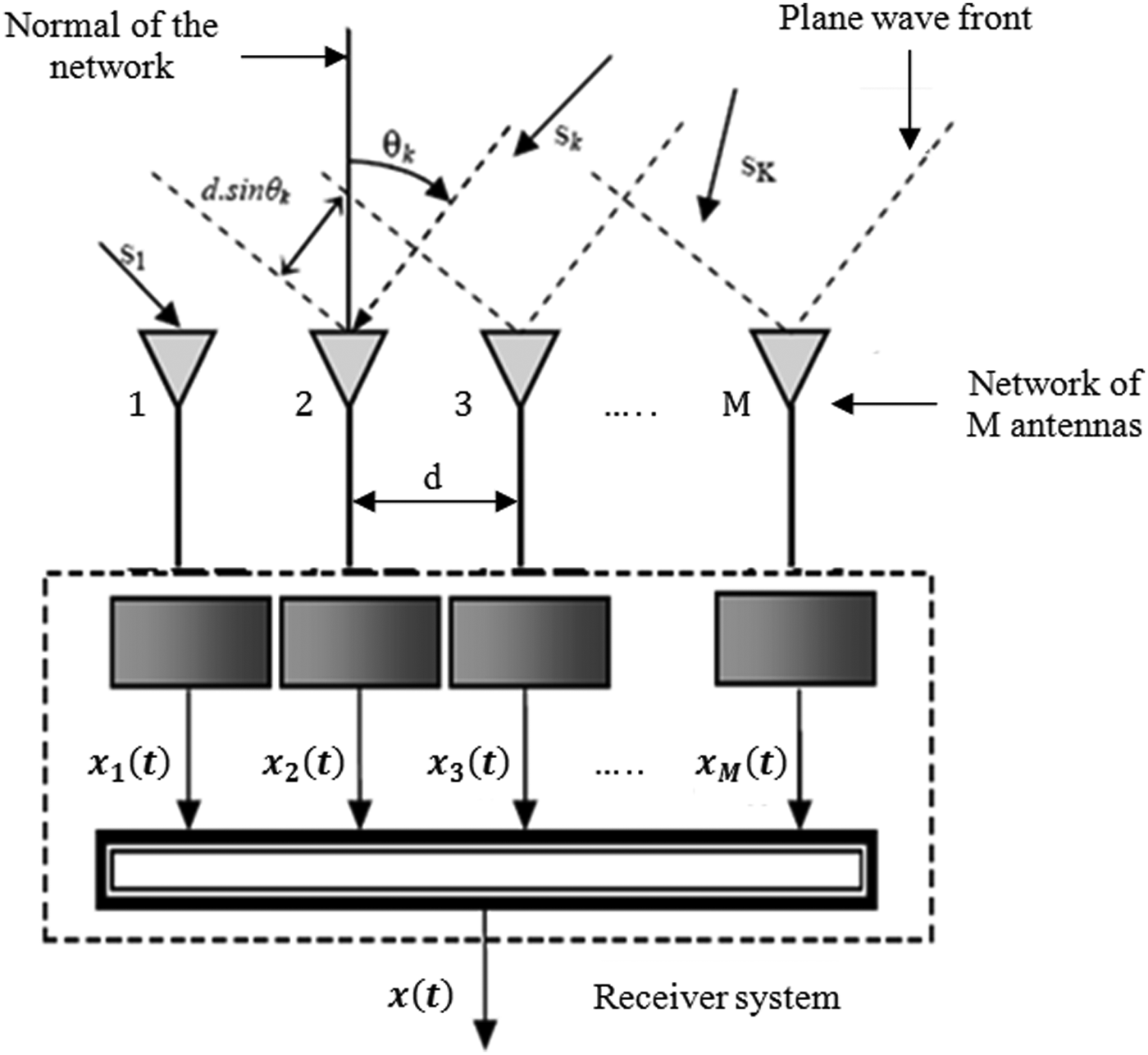
Consider K narrow-band plane wave signals from directions θ1,θ2, …, θk,…, θK centered at frequency f 0 and received by a linear array composed of M identical elements (M > K) spaced by a distance d as shown in Fig. 1. It is supposed that the signals and noises are stationary and uncorrelated, and the reference element is the first one. These signals can be fully correlated as in the case of multiple paths or uncorrelated as in the case of multiple users. Using complex signal representation, the complex envelope representation of the received signals can be expressed as
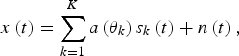 $$x\left(t \right)=\mathop \sum \limits_{k=1}^K a\left({\theta _k } \right)s_k \left(t \right)+n\left(t \right)\comma$$
where  ${a\lpar {\theta _k}\rpar =\big[{1\comma \; e^{ - j{{2\pi d} \over \lambda }{\rm sin}\, \theta _{k\; } }\comma \; \ldots\comma \; e^{ - j{{2\pi d} \over \lambda }\lpar M - 1\rpar {\rm sin}\, \theta _{k\; } } } \big]}$ is the M × 1 steering vector for the kth signal and λ is the wavelength, s k(t) is the kth transmitted signal, and n(t) = [n 1(t), n 2(t), …n m(t), …, n M(t)]T is the M × 1 vector of the noise.
Network of M antennas and the receiver system with K incident signals.

In matrix notation, (1) becomes
 $$x\lpar t\rpar =A\lpar \theta \rpar s\lpar t\rpar +n\lpar t\rpar \comma$$
where x(t) = [x 1(t), x 2(t), … x m(t), …, x M(t)]T is the envelope representation of the K received signals of the array, A(θ) = [a(θ1), a(θ2), …, a(θk), …, a(θK)] is the M × K matrix of the array response vectors and s(t) = [s 1(t),s 2(t), …, s k(t), …, s K(t)]T is the K × 1 signal vector.
The covariance matrix for the data vector x(t) can be written as
 $$R_{xx}=E\left\{{x\left(t \right)x^H \lpar t\rpar } \right\}=AR_{ss} A^H+\sigma ^2 I\comma$$
where R ss is the covariance matrix for the signal vector, σ2 is the noise power, and I is the K × K identity matrix [Reference Swindlehurst20].
In practice, the covariance matrix is estimated by an average over N observations. Assuming that the noise subspace and signal subspace are orthogonal, it will then be possible to compare the performance of high-resolution methods based on the concept of subspace to estimate the DOA of RF signals [Reference Kundu21]. The MUSIC, Root-MUSIC, and ESPRIT algorithms that we are going to develop in the following sections use the search for extrema in a pseudo-spectrum, finding zeros of a polynomial and eigenvalues of a matrix, respectively.
B) MUSIC algorithm
Among high-resolution methods estimating DOA of RF signals [Reference Abdallah, Chahine, Rammel, Neveux, Vaudon and Campovecchio3, Reference Schmidt12], the MUSIC algorithm developed by Schmidt in 1979 [Reference Schmidt22] and Bienvenu [Reference Bienvenu and Kopp23] is the most widespread and the best known. It uses the eigenvector decomposition and eigenvalues of the covariance matrix of the antenna array for estimating DOA of sources based on the properties of the signal and noise subspaces [Reference Bakhar, Vani and Hunagund24]. For this, the initial hypothesis is that the covariance matrix R xx is not singular. This assumption physically means that sources are totally uncorrelated between them [Reference Khan, Kamal, Hamzah, Othman and Khan25]. The MUSIC algorithm assumes that signal and noise subspaces are orthogonal. The signal subspace E s consists of phase shift vectors between antennas depending on the AOA. All orthogonal vectors to E s constitute a subspace E N called noise subspace. The MUSIC algorithm being based on the properties of signal and noise subspaces, vectors derived from E s generate a signal subspace collinear with steering vectors of sources a(θk) and vectors derived from E N generate a noise subspace orthogonal to the steering vectors of these sources. It follows that
 $$E_N^H a\left({\theta _k } \right)=0\quad {\rm for}\; k=1\comma \; 2\comma \; \ldots\comma \; K.$$
For determining various DOA, it is necessary to diagonalize the covariance matrix of the data, identify the signal and the noise space, and project onto the noise space. The principle is to project all possible steering vectors (averaging over several vectors) on the noise subspace and retain only those minimizing this projection, resulting in the following discriminant function:
 $$d^2=a\left(\theta \right)^H E_N E_N^H a\left(\theta \right)=0\quad \left({E_N=\left[{e_1\comma \; e_2\comma \; \ldots\comma \; e_{M - K} } \right]} \right)\comma \;$$
whose zeros are the DOAs.
C = E NE NH is the projection matrix and a(θ)HE NE NHa(θ) is the projection of the vector a(θ) on the noise subspace.
Estimating DOA of signals is equivalent to look for maximum values of the MUSIC pseudo-spectrum P(θ):
 $$P_{MUSIC} \left(\theta \right)=\displaystyle{1 \over {a\left(\theta \right)^H E_N E_N^H a\left(\theta \right)}}.$$
The amplitude of the peaks of the MUSIC pseudo-spectrum is not related quantitatively to that of the corresponding component of the model because resulting peaks only serve to indicate precisely the position of sources. Qualitatively, if the amplitude or the signal-to-noise ratio (SNR) is more important, the pseudo-spectrum will be less disrupted, resulting in a higher peak value. The amplitude or SNR can be obtained without difficulty by an optimization method of least squares. The MUSIC algorithm does not allow obtaining directly the DOA of wave fronts. To know exactly the AOA of the signals, we need to calculate an average over all vectors of an orthonormal basis of the noise space. In other words, we have to calculate the pseudo-spectra on the extent of the parameters space and seek the minima of this function, which limits its performance in terms of speed and computational resources. Several variants of the MUSIC method have been proposed to reduce complexity, increase performance, and resolution power. This is the case for the Root-MUSIC algorithm developed by Barabell [Reference Barabell26] for linear and equidistant networks. Note finally that in our work, we consider only the case of uncorrelated signals. For correlated signals as multipath signals, the MUSIC algorithm is strongly degraded. The correlations between the arrival signals should be suppressed. In order to decorrelate the signals, it is possible to use the spatial smoothing pre-processing (SSP) method as described in [Reference Shan, Wax and Kailath27] before using the MUSIC algorithm, or apply other techniques such as those proposed in [Reference Akkar and Gharsallah28], where authors have proposed three algorithms to estimate the DOA of impinging highly correlated signals.
C) Root-MUSIC algorithm
The advantage of this method lies in the direct calculation of the DOA by the search for zeros of a polynomial [Reference Hwang, Aliyazicioglu, Grice and Yakovlev29, Reference Wang, Zhang, Xiong, Xue and Zhang30], which so replaces the search for maxima, necessary in the case of MUSIC. This method is limited to arrays of linear antennas uniformly spaced out. In addition, it allows a reduction in the computing time and so an increase in the angular resolution by exploiting certain properties of the received signals. For a linear antenna array uniformly spaced out, the projection of the steering vector a(θ) on the noise subspace can be expressed according to (4) by the following relation:
 $$P^{ - 1} _{MUSIC} \left(\theta \right)=a\left(\theta \right)^H E_N E_N^H a\left(\theta \right).$$
Let C = E NE NH, relation (5) becomes
 $$P^{ - 1} _{MUSIC} \left(\theta \right)=a\left(\theta \right)^H Ca\left(\theta \right).$$
Using the analytical representation and the expression of the steering vector 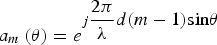 $a_m \left(\theta \right)=e^{j\displaystyle{{2\pi } \over \lambda }d\lpar m - 1\rpar {\rm sin} \theta } $ of the mth element of the linear network (m = 1,2, …, M), we can write
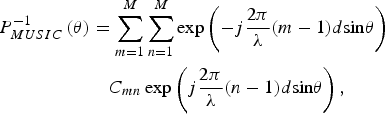 $$\eqalign{P^{ - 1} _{MUSIC} \left(\theta \right)& =\mathop \sum \limits_{m=1}^M \mathop \sum \limits_{n=1}^M \exp \left({ - j\displaystyle{{2\pi } \over \lambda }\lpar m - 1\rpar d {\rm sin} \theta } \right)\cr & \quad C_{mn} \exp \left({j\displaystyle{{2\pi } \over \lambda }\lpar n - 1\rpar d {\rm sin}\theta } \right)\comma \; }$$
where C mn is the element of the mth line and the nth column of C. By combining the two sums in equation (6), we obtain the following expression:
 $$P^{ - 1} _{MUSIC} \left(\theta \right)=\mathop \sum \limits_{l=- M+1}^{M+1} C_l \exp \left({ - j\displaystyle{{2\pi } \over \lambda }ld {\rm sin} \theta } \right)\comma$$
where C l = ∑m−n=lC mn.
Equation (7) can be transformed into Root-MUSIC polynomial which is a function of z defined by:
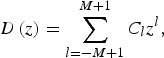 $$D\left(z \right)=\mathop \sum \limits_{l=- M+1}^{M+1} C_l z^l\comma$$
where 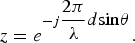 $z=e^{ - j\displaystyle{{2\pi } \over \lambda }d {\rm sin} \theta }.$
DOAs of signals being functions of z, the problem is therefore to calculate the (M − 1) double roots of the polynomial whose useful zeros are thus on the unit circle. The phases of these complex roots correspond to the desired electric phase shifts. The AOA of signals can then be deducted from the following equation:
 $$\theta _{m\; \; }=- {\rm sin}^{ - 1} \left({\displaystyle{\lambda \over {2\pi d}}{\rm arg}\left({z_m } \right)} \right)\comma$$
where z m are the m closest roots to the unit circle.
It has been shown in [Reference Pisarenko11] that the Root-MUSIC algorithm has better resolution than the spectral MUSIC algorithm. In addition to MUSIC and Root-MUSIC, there are other techniques for estimating DOA which are also based on the concept of subspace. One of them is known as ESPRIT that we will develop in the next section.
D) ESPRIT algorithm
ESPRIT was developed by Roy and Kailath in 1989. It is based on the rotational invariance property of the signal space [Reference Roy and Kailath31, Reference Zhou, Huang, Duan and Chen32] to make a direct estimation of the DOA and obtain the AOAs without the calculation of a pseudo-spectrum to the extent of space, nor even the search for roots of a polynomial. This method exploits the property of translational invariance of the antenna array by decomposing the main network into two sub-networks of identical antennas which one can be obtained by a translation of the other as shown in Fig. 2.
Principle of the ESPRIT algorithm.
The main advantage of this method is that it avoids the heavy research of maxima of a pseudo-spectrum or a cost function (therefore a gain calculation) and the simplicity of its implementation. In addition, this technique is less sensitive to noise than MUSIC and Root-MUSIC.
By designating x 1(t) and x 2(t) as observation vectors at the outputs of sub-networks 1 and 2, the received signal vector in the baseband of the complete network can be expressed as
 $$x\left(t \right)=\left[{\matrix{ {x_1 \lpar t\rpar } \cr {x_2 \lpar t\rpar } \cr } } \right]=\left[{\matrix{ A \cr {A{\rm \Phi }} \cr } } \right]S_k \left(t \right)+n\lpar t\rpar \comma$$
with
 $${\rm \Phi }=diag\left[{e^{j\displaystyle{{2\pi } \over \lambda }d {\rm sin} \theta _1 }\comma \; e^{j\displaystyle{{2\pi } \over \lambda }d {\rm sin} \theta _2 }\comma \; \ldots\comma \; e^{j\displaystyle{{2\pi } \over \lambda }d {\rm sin} \theta _k } } \right].$$
This relation will allow estimating the AOA without knowing the expression of the matrix A of the source vectors. It so allows the use of the ESPRIT algorithm to antennas of badly known or unknown geometry. The covariance matrix of the complete network is given by
 $$R_{xx}=\left[{\matrix{ A \cr {A{\rm \Phi }} \cr } } \right]R_{ss} \left[{\matrix{ {A^H } \cr {{\rm \Phi }^H A^H } \cr } } \right]+\sigma ^2 I\comma$$
where A = [a(θ1), a(θ2), …, a(θk)] is a M × K matrix of the source vectors defined at the level of a sub-network and R ss is the spatial matrix of sources. The matrix R xx being Hermitian, its eigenvalues are real: (λ1 ≥ λ2 ≥ …≥ λk ≥ λk+1 = …= σ2). The largest eigenvalues K correspond to the space signal generated by the K sources. The signal subspace E S is an M × K matrix composed of K eigenvectors associated with the signal subspace. The signal subspace E S of the whole network can be decomposed into two subspaces E 1 and E 2 which are the (M − 1) × K matrices, whose columns are composed of K eigenvectors corresponding to eigenvalues of the covariance matrices of the sub-networks 1 and 2. These two matrices E 1 and E 2 are related by the relation of the following invertible linear transformation:
 $$E_s=\left[{\matrix{ {E_1 } \cr {E_2 } \cr } } \right]=\left[{\matrix{ {AT} \cr {A{\rm \Phi }T} \cr } } \right]\comma$$
where T = R 11−1R 21, and R 11 = (1/N)X 1X 1H and R 21 = (1/N)X 2X 1H are the covariance matrices between the two sub-networks of antennas. From equation (13), we can write
 $$E_2=ATT^{ - 1} {\rm \Phi }T=E_1 {\rm \Psi\comma}$$
where Ψ = T −1ΦT is a K × K matrix.
The eigenvalues of Φ and Ψ are common and are expressed by λi = e jkdsinθi for i = 1,2, …, K.
The AOA is given from λi = |λi|e jarg(λi), hence
 $$\theta _i={\rm sin}^{ - 1} \left({\displaystyle{{{\rm arg}\left({\lambda _i } \right)} \over {kd}}} \right)\quad i=1\comma \; 2\comma \; \ldots\comma \; K.$$
In practice, to determine DOA, it is necessary to:
– achieve the decomposition in singular value of the data covariance matrix R xx = (1/N)XX H where N is the number of observations;
– estimate the dimension of the signal subspace;
– separate the eigenvectors corresponding to the signal subspace and form the matrices of sub-networks E 1 and E 2;
– estimate the rotation operator Ψ given by equation (14);
– calculate the eigenvalues λ1, λ2, …, λK of the matrix Ψ;
– finally, calculate the AOA given by equation (15).
It has been shown in [Reference Stoica and Söderström33–Reference AI-Ardi, Shuhair and AI-Mualla35] that MUSIC and ESPRIT algorithms achieve almost identical performance in the case of unmodulated sinusoids, but that ESPRIT is slightly better than MUSIC. The study conducted in [Reference Hua and Sarkar36] in the more general case of exponentially modulated sinusoids goes to the same direction. Ultimately, ESPRIT appears less sensitive to noise than MUSIC.
IV. VALIDATION OF THE DOA DETECTION SYSTEM
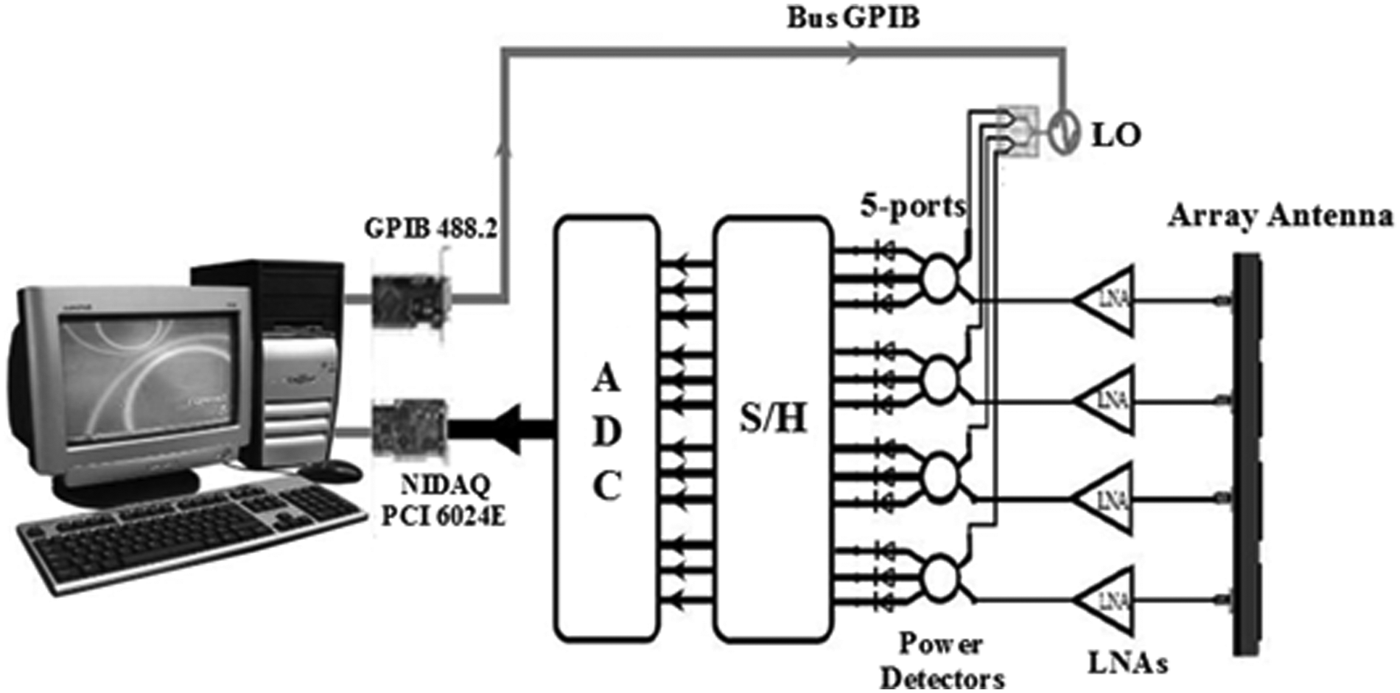
To validate the operating principle of the DOA detection system and compare the performance of the methods presented in this study, we carried out co-simulations using ADS software and Matlab knowing that the analysis of the performance of direction finding schemes has been dealt by many researchers. We are particularly interested in a receiving system composed of a linear array of four omnidirectional antennas spaced by λ/2 and a network of four five-port demodulators achieved in microstrip technology and operating at 2.4 GHz frequency [Reference Sfar, Osman and Gharsallah37]. Each five-port has two inputs excited by RF and local oscillator (LO) signals, respectively and three outputs connected to three diode power detectors. As shown in the measurement system of Fig. 3, each antenna is connected to the RF input of a five-port through a low noise amplifier (LNA). The local oscillator signal is injected to the LO inputs of five-ports via a power splitter 1–4. The outputs of detectors are connected to a sample and hold (S/H) circuit, which is used to freeze the signal at the same time before carrying out the A/D conversion. The system is controlled by a computer equipped with an acquisition board PCI 6024E and a 488.2 GPIB bus controller for controlling its functioning using a program developed in LabView. We note that simultaneous measurements are very important for the phase discrimination of RF signals. The three voltages at each five-port are measured and then the ratio of RF and LO signals for each one is determined as a linear combination of these voltages:
 $$x\left(t \right)=I+jQ=g_3 V_3+g_4 V_4+g_5 V_5.$$
Measurement system.
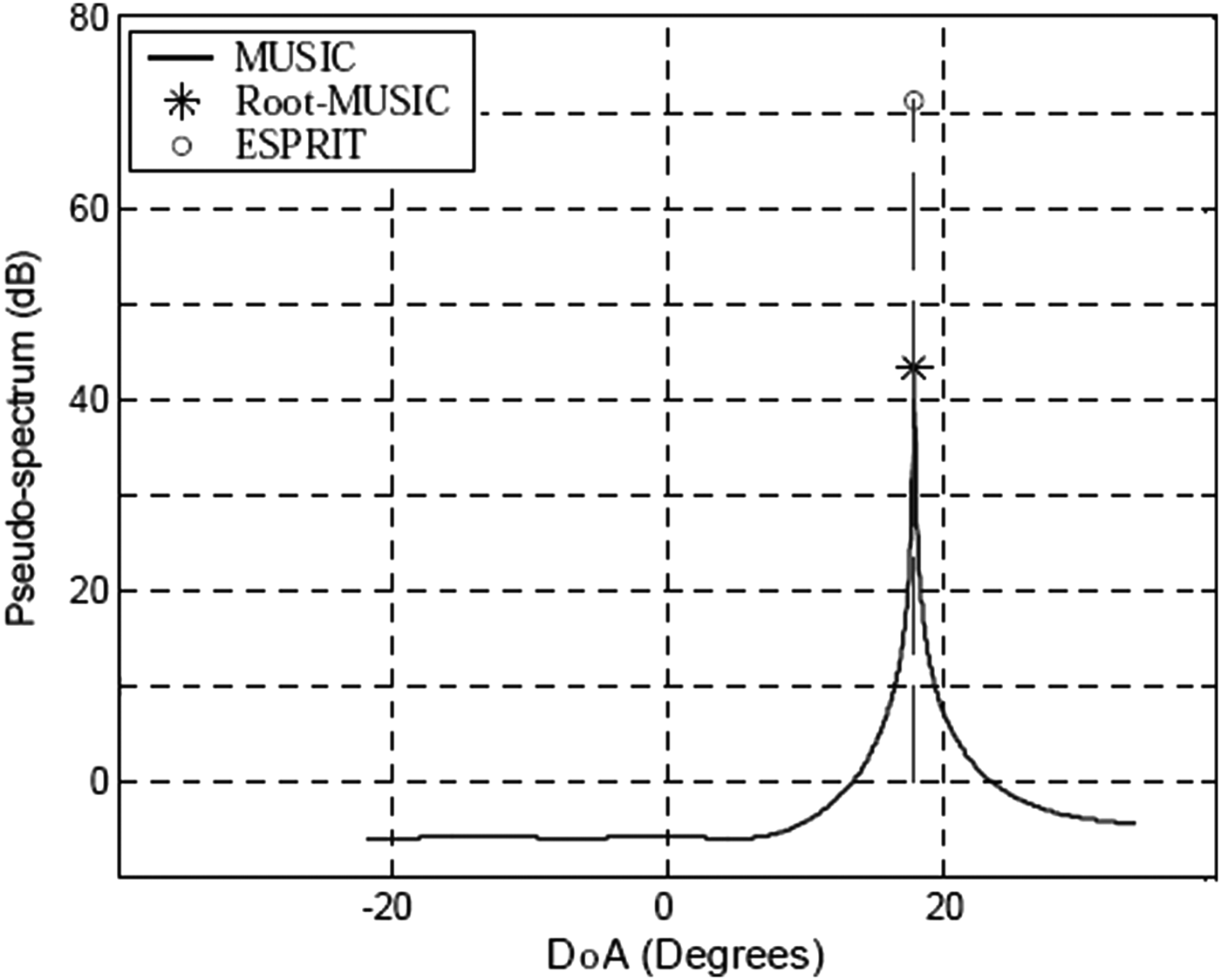
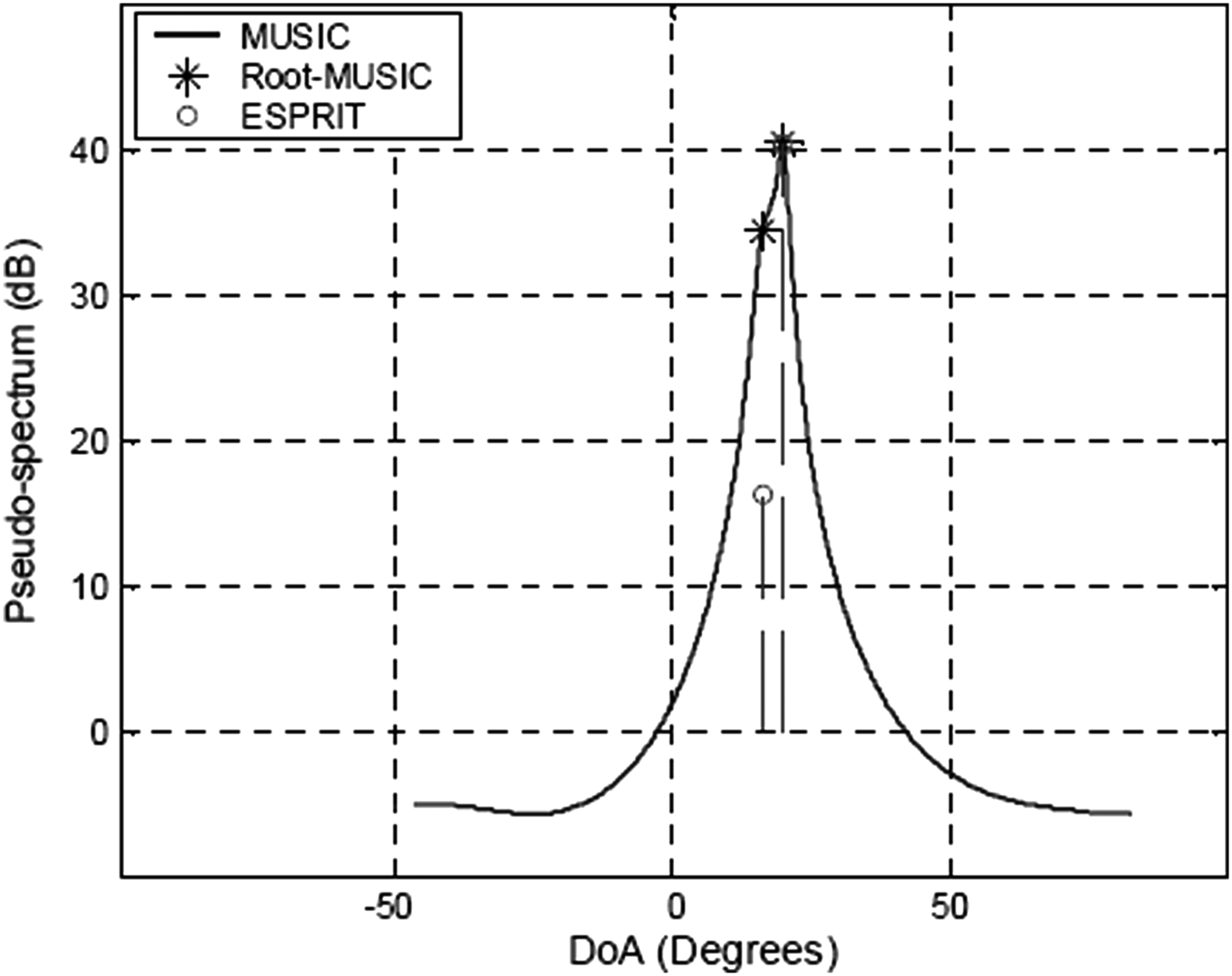
The processor takes care of demodulating the RF signals and calculates the DOA of RF signals. Multiple tests were performed. For a single source from 18° and a power signal of 5 dBm, the DOA estimated by the three algorithms is obtained with an excellent precision as can be seen in Fig. 4.
Comparison of the three algorithms for a single source from 18°.
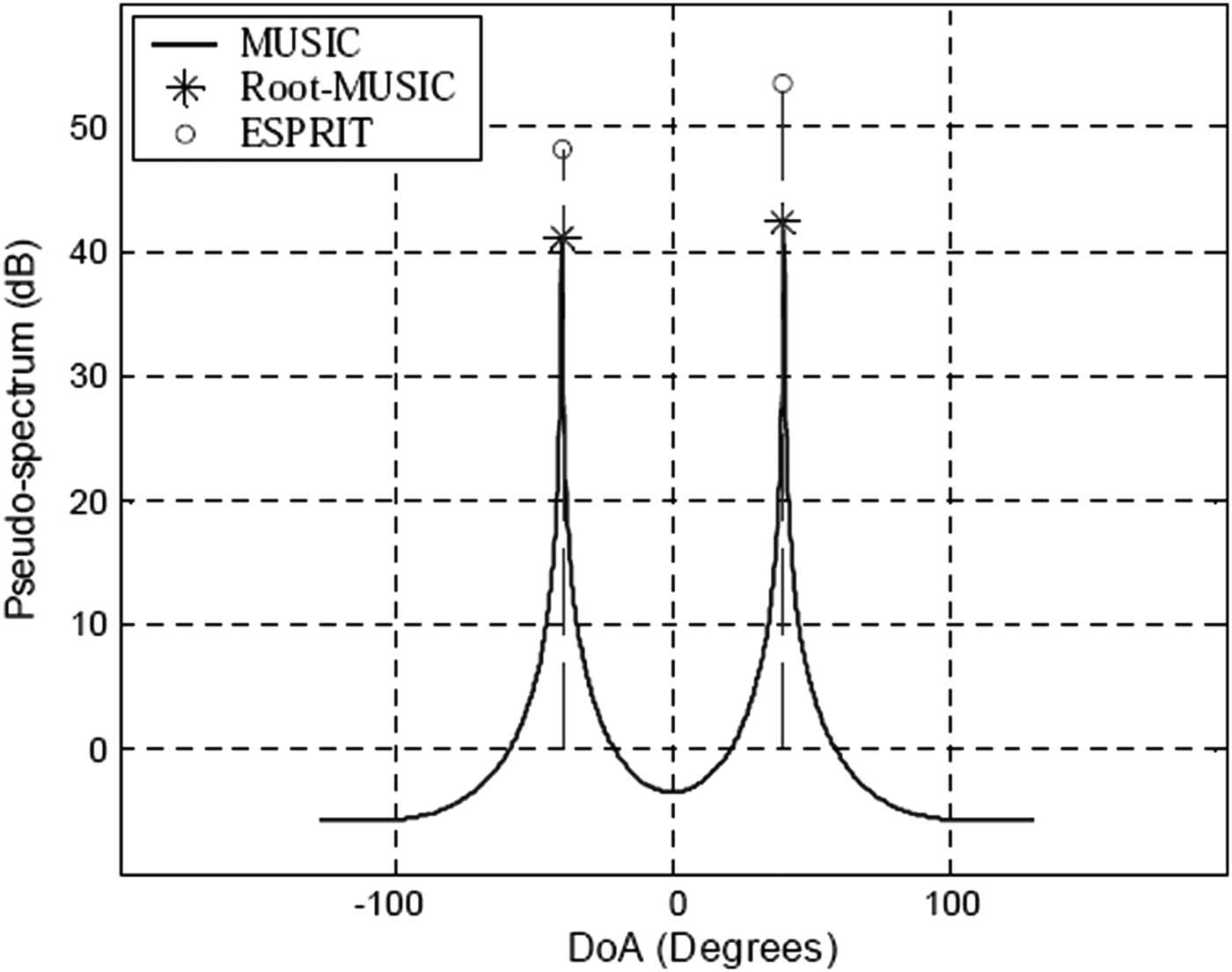
In Fig. 5, two sources from −40° and +40° are estimated. As can be seen, good performance is obtained by the three techniques.
Comparison of the three algorithms for two sources from −40° and +40°.
In Fig. 6, two sources close from 16° and 20° are estimated.
Limitation of the robustness of the MUSIC algorithm.
We notice that the peaks are only obtained with ESPRIT and Root-MUSIC. The MUSIC algorithm becomes unable to distinguish those two sources. A computationally efficient estimation algorithm for closely spaced sources is proposed in [Reference Kim, Park and Kyung Lee38] to resolve this problem through a proper combination of the direction mode vectors.
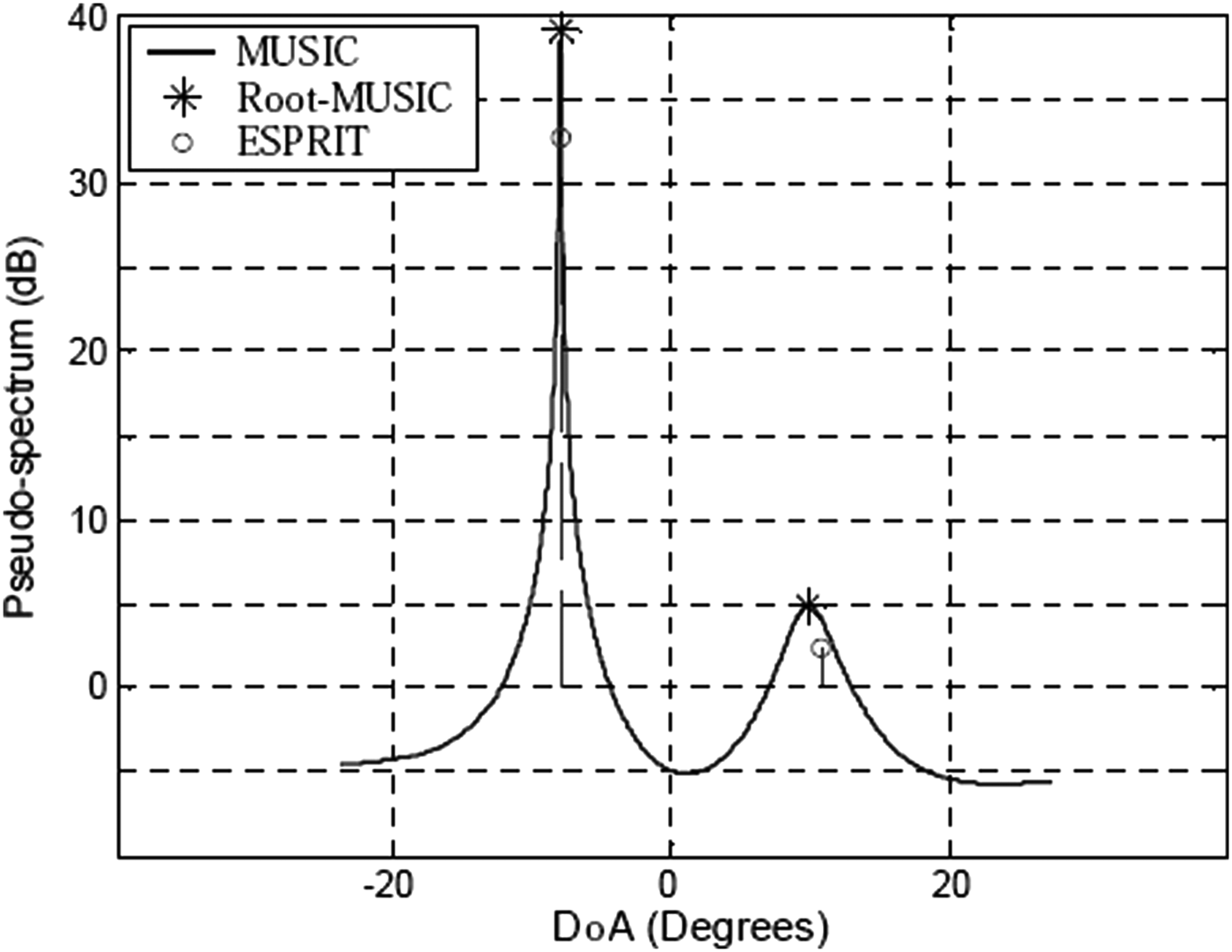
Finally, we have tested the case where a high-power source tends to mask a low-power one. For this, we have considered two sources placed at −8° and 8°, Fig. 7. We obtained an excellent estimated DOA of the high-power source for the three techniques, whereas the estimation of the low-power source was tainted with a certain inaccuracy due to the low value of the SNR ratio.
Case of two sources of very different powers one relative to the other.
V. CONCLUSION
In this paper, we have investigated three high-resolution methods (Music, Root-Music, and ESPRIT) including both their performance and limitations to estimate the DOAs of uncorrelated RF signals impinging onto the linear array antenna. Our contribution lies in the combination five-port/high-resolution algorithm which allowed us to implement a real demonstrator, which is an essential element of a smart antenna system for estimating the DOA. Co-simulations made under ADS software from Agilent Technologies and Matlab validated the operating principle of this demonstrator.
As regards the MUSIC algorithm, it was the most promising and a leading candidate for further study and actual hardware implementation. In its standard form, also known as spectral MUSIC, it estimates the noise subspace from the available samples and can be applicable to arrays with arbitrary geometry. Thereby, it showed a high resolution but along with an increase in the computational complexity and the processing time since it requires a search for the steering vectors that are orthogonal to the noise subspace.
For a uniformly spaced linear array, the search for DOA can be made by finding the roots of a polynomial using another method known as Root-MUSIC. The latter has better performance than spectral MUSIC, where the sources are identified by the localization of spectral peaks. Note that the peaks in the spectrum space correspond to the polynomial lying close to the unit circle.
Finally concerning ESPRIT, this algorithm can be applied to a wide variety of problems including accurate detection and estimation of sinusoids in noise. This technique, when applicable, manifests significant performance and computational advantages. Furthermore, it is also manifestly more robust and then less sensitive with respect to array imperfections than the two previous methods.
Lastly, we note that the performance of MUSIC, Root-MUSIC, and ESPRIT improves with more elements in the array, higher number of snapshots of signals and greater angular separation between the signals. In the case of fully or partially correlated sources situation, which is very common in communication systems, these methods show poor performance and their efficiency degrades severely when the rank of the data covariance matrices is affected.
ACKNOWLEDGEMENTS
The authors would like to express their gratitude to the referees for their time and effort in carefully reviewing the preliminary manuscript. The incorporation of their suggestions and comments significantly improved the quality of the final manuscript.
L. Osman received his master's degree in automatic speciality from Lille 1 University – Science and Technology, France in 1984 and his Ph.D. in automatic and computer engineering in 1987 from the same University. In June 2013, he obtained the habilitation degree in electronics and microelectronics from the National Institute of Applied Sciences and Technology (INSAT) in Tunis, University of Carthage, Tunisia. He is currently assistant professor in the Department of Electronics, Physics and Propagation at the Higher School of Communication of Tunis, Sup'Com. In 2004, he joined the research unit “CSEHF” at the faculty of sciences of Tunis, Tunis El Manar University. His current research interests include antennas and modeling in microwave integrated circuits. He is also involved in experimental characterization and antenna measurement.
I. Sfar was born in Tunis in 1978. She received her Ph.D. in June 2013 from the faculty of sciences of Tunis in electronics speciality. Her current research interests include antennas for wireless communication and analysis of microwave structures.
A. Gharsallah is Professor at the faculty of sciences of Tunis and Head of Research Unit “CSEHF” (code 05/UR/11-10) at the Department of Physics of the faculty of sciences of Tunis – University of Tunis El Manar. He received his engineering degree in radio electrical from the Higher School of Telecommunications of Tunis in 1986 and the Ph.D. degree in 1994 from the National Engineering School of Tunis. Since 1991, he has been with the Department of Physics at the faculty of sciences of Tunis. His current research interests include antennas, multilayered structures, and microwave integrated circuits.