Introduction
Creativity is an essential characteristic of new products and services and a prerequisite for innovation (e.g., Amabile, Reference Amabile1996; Bharadwaj and Menon, Reference Bharadwaj and Menon2000). In today's competitive environment, the pressure to generate creative ideas is greater than ever before. To meet the constant demand of new ideas, numerous idea generation techniques have been proposed to foster their development. Brainstorming (Osborn, Reference Osborn1979), random or remote associations (Mednick, Reference Mednick1962), lateral thinking (de Bono, Reference de Bono1970), and TRIZ (Altshuller, Reference Altshuller1996) are some of these techniques, to name a few. Yet, as Verganti (2016) points out, the availability of techniques is not an issue anymore. The world is full of ideas (Weisberg, Reference Weisberg2006), and there are more people working in the creative industries than ever before (Verganti, 2016), pouring an abundance of creative knowledge onto the market. Indeed, idea contest sites such as Innocentive and Designboom get about 4500 ideas for each challenge they post, illustrating the availability and abundance of ideas (Verganti, 2016). The challenge lies in recognizing and identifying the truly creative solutions from this sea of available ideas (Weisberg, Reference Weisberg1986).
Amabile's work (Reference Amabile1983, Reference Amabile1996, Reference Amabile2001) on creative products is one of the most established approaches for recognizing a creative idea. Her body of work, among others, specifies that ideas should be novel and useful to be considered creative. Novel ideas refer to those considered to be original and unique, never seen before, while useful ideas concern those considered to be appropriate and useful, effectively answering the problem at hand. These two components have been considered equally important in the context of engineering, technology, and design creativity, which is also the background domain of this paper. This definition of creativity stems from Guilford (Reference Guilford1950) and Stein (Reference Stein1953), and has become one of the most accepted definitions of creativity, encompassing thousands of citations and hundreds of articles (e.g., Finke et al., Reference Finke, Ward and Smith1992; Boden, Reference Boden1994; Amabile, Reference Amabile1996; Sternberg and Lubart, Reference Sternberg, Lubart and Sternberg1999; Runco, Reference Runco2007; Bronson and Merryman, Reference Bronson and Merryman2010; Hennessey and Amabile, Reference Hennessey and Amabile2010; Sarkar and Chakrabarti, Reference Sarkar and Chakrabarti2011). Throughout the years, several researchers have tried to expand on this definition. Generally, researchers have attempted to do so by suggesting additional dimensions to novelty and usefulness, as numerous researchers feel that two dimensions are insufficient for capturing all creative ideas and felt the need for additional dimensions or criteria. Examples are numerous, and include surprise (Simonton, Reference Simonton2012), un-obviousness (Lopez-Mesa and Vidal, Reference Lopez-Mesa and Vidal2006; Howard et al., Reference Howard, Culley and Dekoninck2008), unexpectedness (Gero, Reference Gero1996), cohesiveness (Chiu and Shu, Reference Chiu and Shu2012), elegance (Besemer and O'Quin, Reference Besemer and O'Quin1999), affect (Horn and Salvendy, Reference Horn and Salvendy2009), and arousal (Horn and Salvendy, Reference Horn and Salvendy2006), among others.
Yet, the question is if these are truly defining characteristics of creativity. When analyzing creative output, in the field of engineering, technology, and design creativity, one can always find examples of additional dimensions, which become more or less important considering the problem context. Also, it becomes difficult to separate components of a creative solution from its outcomes; emotion theorists, for example, would argue that affect and surprise are outcomes of a creative solution, rather than representing defining characteristics of it (e.g., Smith and Ellsworth, Reference Smith and Ellsworth1985; Roseman et al., Reference Roseman, Spindel and Jose1990; Roseman, Reference Roseman1996; Watson and Spence, Reference Watson and Spence2007; Ellsworth, Reference Ellsworth2013). Perhaps, a more fruitful way of approaching this issue would be to view it from a demand-driven perspective, rather than a supply-driven one. A demand-driven approach involves focusing on what people want and desire, instead of what the market provides (e.g., in terms of available ideas). A demand-based approach is consistent with Amabile's notion that creativity is socially and historically bound; for example, what was considered novel and useful 30 years ago is not novel and useful now (Amabile, Reference Amabile1983, Reference Amabile1996). Yet, from a broader perspective, a demand-based approach also brings into question what is creative. So what is creative now may not only hold implications for the dimensions novelty and usefulness, but may also call for a new dimension that may have been irrelevant at the time when novelty and usefulness were originally defined (in the 1950s, when Guilford put creativity on the agenda as a research-worthy topic, see Guilford, Reference Guilford1950; Sawyer, Reference Sawyer2006). We aim to capture what is creative now by taking a demand-based approach to creativity. Demand-based approaches, which focus on user needs instead of what is available, allows for a broad perspective of creativity and its dimensions in context. Demand-side approaches have successfully been used in technology development (von Hippel, Reference von Hippel1988; Lynn et al., Reference Lynn, Morone and Paulson1996; Adner, Reference Adner2002), business strategy (Day, Reference Day1990; Kim and Mauborgne, Reference Kim and Mauborgne1997), and for examining the evolution of technological trajectories (Abernathy and Clark, Reference Abernathy and Clark1985; Christensen, Reference Christensen1997; Adner and Levinthal, Reference Adner and Levinthal2001), but has not yet been applied in the context of creativity. Given that demand-based views are particularly relevant in a changing marketplace (Adner, Reference Adner2002) such a view would seem ideally suited for examining changes that may have taken place with regards to creativity and its dimensions.
The user needs change over time, but only a few changes are sufficiently fundamental to constitute a shift in needs. We propose that meaning represents such a fundamental shift, and therefore deserves consideration as a third dimension of a creative product. In the context of our paper, as it is demonstrated later in the section “Measuring the meaning dimension”, we define meaning as a creative component, in which ideas are considered meaningful when they are understood (both by creators and evaluators) as personal, similar to them, significant and influential to the user's context. It is important to note that the focus of this paper is on technological and design creativity, and excludes other artistic fields, in which the defining components of creativity may differ. Meaning captures user needs, as it has been widely documented that contemporary users seek and aspire for meaning in their lives (e.g., Sommer and Baumeister, Reference Sommer, Baumeister, Wong and Fry1998; Lyubomirsky and Lepper, Reference Lyubomirsky and Lepper1999; Lyubomirsky et al., Reference Lyubomirsky, King and Diener2005; Baumeister et al., Reference Baumeister, Vohs, Aaker and Garbinsky2013). Meaning is also a shift in user needs which has taken place after the initial creativity dimensions of novelty and usefulness were established (e.g., Guilford, Reference Guilford1950; Amabile, Reference Amabile1982) when users mainly chose a new product based on the technology and the accompanying benefits it provided (Rogers, Reference Rogers2003). Due to its rapid development, technology alone no longer suffices for differentiating between competing products/services. Instead, users seek meaningful interactions with products based on a solution's ability to communicate a personal purpose, their role in society, and support their well-being (Hassenzahl et al., Reference Hassenzahl, Eckoldt, Diefenbach, Laschke, Lenz and Kim2013). Although this shift has not been explicitly noted by creativity researchers, they have implicitly taken note; Kaufman and Gregoire (Reference Kaufman and Gregoire2015, Preface, p. xxx), for example, define creativity as “expressions of originality and meaningfulness in daily life”, and Im et al. (Reference Im, Bhat and Lee2015, p.166) frame it as “a new product is perceived to be uniquely different from competitors” products in a manner that it is meaningful to target customers”. Similarly, Norman and Verganti (Reference Norman and Verganti2014) position new products along axes of “technology change” and “meaning change”, and state that a meaningful innovation “starts from the comprehension of subtle and unspoken dynamics in sociocultural models” by involving “a change in sociocultural regimes” (Norman and Verganti, Reference Norman and Verganti2014, p. 90). Although none of these researchers explicitly define meaning, it seems clear that meaning has started to play a defining role in relation to creative solutions.
The goal of this paper is to position meaning as a defining characteristic of creative solutions. We propose, consistent with Amabile (Reference Amabile1996), that meaning has emerged from the historical and sociocultural context of our times, to become a third component of creativity. We present our viewpoint by (1) examining the historical and social developments that lead to the emergence of meaning (2) exemplifying the role of meaning in creative solutions, (3) proposing a way of measuring meaning in creative solutions, (4) illustrating the complementary and additive effect of meaning in creative solutions with regard to novelty and usefulness, and (5) showcase that despite its complementary effect, meaning is a separate dimension that can be empirically distinguished from novelty and usefulness.
Why is meaning important in design solutions?
Definitions of creativity arise from the historical and social context in which they transpire (Amabile, Reference Amabile1996; Sosa and Gero, Reference Sosa and Gero2005; Puccio et al., Reference Puccio, Cabra, Fox and Cahen2010). So too, is the case of meaning. Technological progress was considered the underpinning of a post-industrialist modern society, and products that contributed to that progress were hailed as groundbreaking and revolutionary (Isaacson, Reference Isaacson2014). For the post-industrial user, creative solutions were mainly distinguished based on technology, as it provided the basis for innovation (Rogers, Reference Rogers2003). At the time, markets were typically limited to a handful of choices in different product categories (Chandler, Reference Chandler2001), where users could relatively easily compare available options, without investing too much time and effort (Rogers, Reference Rogers2003).
Several developments contributed to technology's demise as a differentiating factor for products. First, during World War II, technological development took on a rapid pace (Marvin, Reference Marvin1990; Chandler, Reference Chandler2001; Isaacson, Reference Isaacson2014). Products such as the radio, the TV, and the personal computer rapidly diffused onto the market after their introduction, allowing people to gain access to other people's lives for the first time (Chandler, Reference Chandler2001; Beniger, Reference Beniger1986; Isaacson, Reference Isaacson2014). Technology gave people unprecedented access to information, enabling them to get acquainted with other lifestyles and products of the world. During this time, new product introductions also took on an unprecedented rate. Suddenly, when the consumer had a buying decision to make, there was an array of choices available, which progressively, came to feature the same technology. Technology, as such, no longer separated one product option from another, prompting users to find other ways of differentiating products from one another (Pfeffer, Reference Pfeffer1994; Chandler, Reference Chandler2001; Isaacson, Reference Isaacson2014).
Second, when social progress advances to a stage where most people in industrialized countries have their basic needs met (e.g., food and shelter), they start to focus on self-actualization and fulfillment (Maslow, Reference Maslow1967). The post-war society increasingly evolved to focus on the self as a means of progress and achievement (Sommer and Baumeister, Reference Sommer, Baumeister, Wong and Fry1998). The self-became the center of decision making (Levy, Reference Levy and Newman1966) and products were now considered means for promoting one's wants, desires, prestige, and social status (e.g., Fershtman and Weiss, Reference Fershtman and Weiss1993; Vigneron and Johnson, Reference Vigneron and Johnson1999; Wang and Wallendorf, Reference Wang and Wallendorf2006). This can also be seen in the happiness movement that took place a decade ago, in which users started searching for happiness in their lifestyle (e.g., Easterlin, Reference Easterlin2001; Ryan and Deci, Reference Ryan and Deci2001; Seligman, Reference Seligman2004; Ben-Shahar, Reference Ben-Shahar2007; Hassenzahl et al., Reference Hassenzahl, Eckoldt, Diefenbach, Laschke, Lenz and Kim2013). Having a fixed job, a regular income, a house, and sufficient disposable income to guarantee a comfortable lifestyle was no longer sufficient for making users happy (e.g., Ryan and Deci, Reference Ryan and Deci2001; Diener and Diener McGavran, Reference Diener, Diener McGavran, Eid and Larsen2008; Dunn et al., Reference Dunn, Aknin and Norton2008; Oishi and Kesebir, Reference Oishi and Kesebir2015). This paved way for a quest for meaning, in which users started thinking about how they live their lives, and the role products play in that realm (e.g., Ostrom and Ostrom, Reference Ostrom and Ostrom2004; Rowles, Reference Rowles2008; Beattie, Reference Beattie2009; Morgan and Farsides, Reference Morgan and Farsides2009; Klinger, Reference Klinger, Wong and Fry2012; Wong, Reference Wong, Wong and Fry2013).
The advent of the internet and social media blew new winds in the self-expressive capacities of products, to the point that this capacity is nowadays taken for granted. Users expect an array of products to cater to their every need and to be available for self-expressive functions, including personalization, self-design, and co-production, in addition to the more traditional means of branding, and a product's color, shape, and size. It is at this point in time that we can no longer ignore the rise of meaning, or set aside the importance of meaning in the design and assessment of products and services.
Meaning in products and services
Users desire products and service solutions that communicate something about who they are or would like to be. A meaningful product is defined by Csikszentmihalyi and Rochberg-Halton (Reference Csikszentmihalyi and Rochberg-Halton1981) as “an object that symbolically expresses the integration of the owner with his/her social context” (p. 39). Products (tangible or intangible ones, e.g., services) communicate meaning with their inherent qualities and are dependent upon the investment of meaning both the encoding/creation and decoding/consumption stages for their very existence (Csikszentmihalyi and Rochberg-Halton, Reference Csikszentmihalyi and Rochberg-Halton1981). Meaning is communicated by a producer/designer (the creator, at the encoding/creation stage), and interpreted by the user (the evaluator, at the decoding/consumption stage) (Csikszentmihalyi and Rochberg-Halton, Reference Csikszentmihalyi and Rochberg-Halton1981).
Meaning consists of an individual part, as well as a shared part. Although both creators and evaluators may have personal interpretations, a great deal of meaning is shared. The shared meaning has a mirroring quality, which enables a creator to imbue it in a solution and to be understood by an evaluator. This paper focuses on shared meaning. Personal meaning is idiosyncratic to each individual and rely more on an individual's unique memories and experiences than the product per se; a song can be meaningful to an individual because it was played at his wedding, but this meaning is unlikely to be shared by other users (Solomon, Reference Solomon1983).
Shared meaning, on the other hand, can be used for fostering individual goals, or one's social goals. On the individual side, users apply meaning to communicate their self-identities, while on the social side, users use it to communicate to others how they would like to be perceived. As meaning relies on a shared understanding of the social world (consensus) (Solomon, Reference Solomon1983), people derive different meanings from a luxury watch and a recycled handbag, and of the people who consume such products.
As meaning is conveyed by a creator, solutions that capture symbolic expressions, which in turn capture peoples’ wants and desires, could be considered creative. In this case, the creative solution does not only become novel and useful, it also becomes meaningful to users. Considering creativity as being composed by novelty, usefulness, and meaning provides additional understanding of the value of a solution to the market, which cannot be captured by novelty and usefulness alone.
Why do we need a third component of creativity?
As previously indicated, creativity has been defined as a combination of novelty and usefulness (e.g., Amabile, Reference Amabile1996; Moreau and Dahl, Reference Moreau and Dahl2005; Horn and Salvendy, Reference Horn and Salvendy2006, Sarkar and Chakrabarti, Reference Sarkar and Chakrabarti2011), a description which has been referred as the “standard definition of creativity” (Runco and Jaeger, Reference Runco and Jaeger2012).
Novelty pertains to the originality and uniqueness of a solution (e.g., Guilford, Reference Guilford1967; Moreau and Dahl, Reference Moreau and Dahl2005), which ensures that it stands out from other solutions in the same category. Usefulness pertains to the appropriateness and effectiveness of a solution (e.g., Guilford, Reference Guilford1967; Moreau and Dahl, Reference Moreau and Dahl2005), which relates to its ability to solve a pre-specified problem or address a specific need in the market.
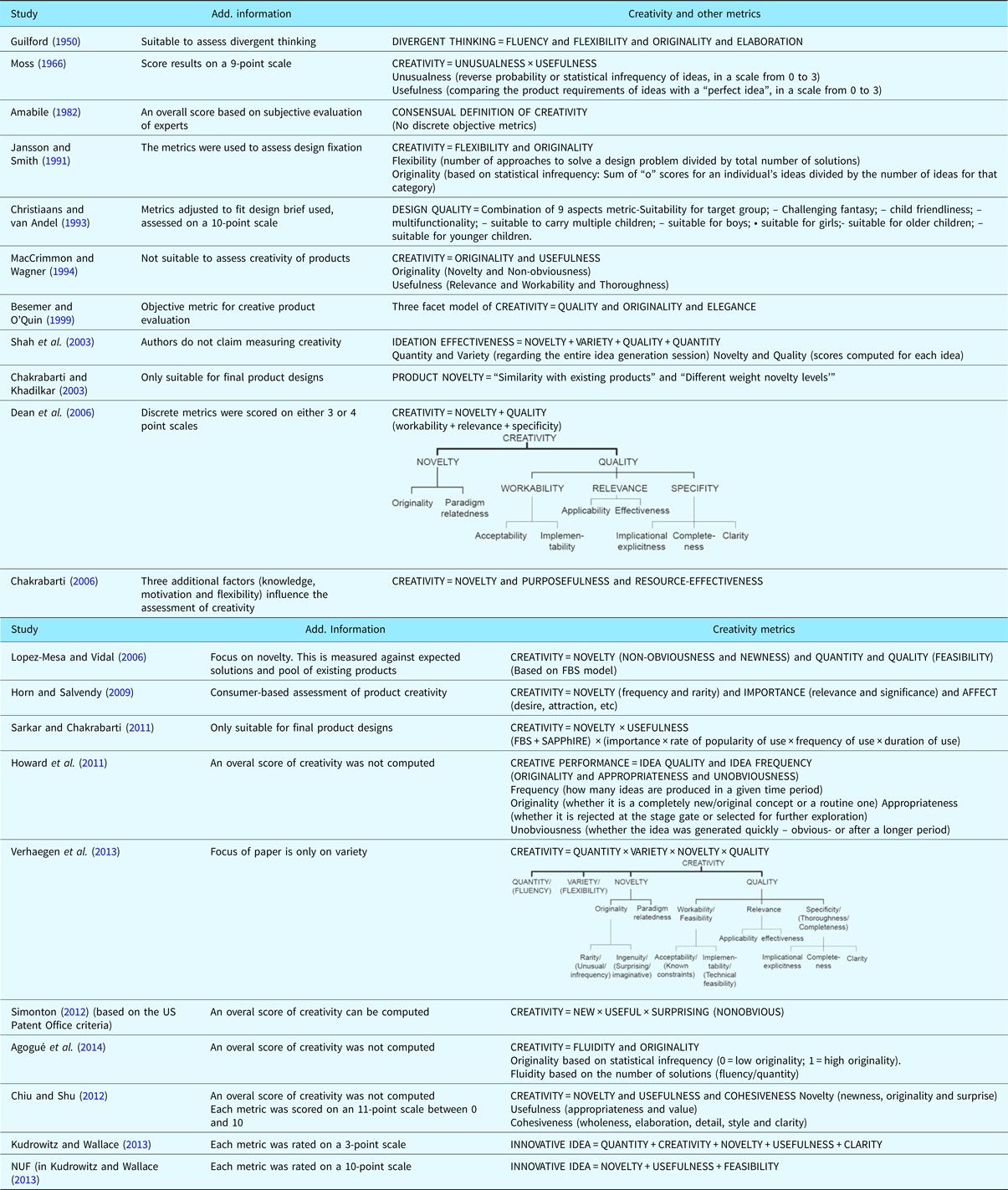
Despite the prevailing presence of these two components in the literature, the measurement of creativity has been considered fragmented (Hennessey and Amabile, Reference Hennessey and Amabile2010; see the many overviews by Shah et al., Reference Shah, Vargas-Hernandez and Smith2003; Dean et al., Reference Dean, Hender, Rodgers and Santanen2006; Sarkar and Chakrabarti, Reference Sarkar and Chakrabarti2011; Kudrowitz and Wallace, Reference Kudrowitz and Wallace2013 and Gonçalves, Reference Gonçalves2016). Many studies have, in fact, proposed additional components, as mentioned in the introduction of this paper, or have decomposed creativity in different sub-criteria (e.g., Christiaans and van Andel, Reference Christiaans and van Andel1993; Dean et al., Reference Dean, Hender, Rodgers and Santanen2006; Verhaegen et al., Reference Verhaegen, Vandevenne, Peeters and Duflou2013). Table 1 presents a review of research studies, in psychology, design engineering, and consumer research, which have evaluated creativity as a combination of different components.
Review of selected studies involving assessment of creativity

As can be seen from the overview presented in Table 1 and as many others have pointed out (e.g., Simonton, Reference Simonton2003; Averill, Reference Averill, Snyder and Lopez2005), novelty and usefulness seem to be insufficient on their own to be able to capture the spectrum of products and services that can be considered creative. For instance, patents are often used as a measure of creative output (cf. Pelz and Andrews, Reference Pelz and Andrews1966; Keller and Holland, Reference Keller and Holland1983), yet few creativity researchers explicitly examine the US Patent Office when defining creativity (Simonton, Reference Simonton2012). The US Patent Office states that any person who “invents or discovers any new and useful process, the machine, manufacture, or composition of matter, or any new and useful improvement thereof, may obtain a patent” (https://www.uspto.gov/patents-getting-started/general-information-concerning-patents#heading-5). Besides being new and useful, they add a third criterion, non-obviousness, by stating that “the subject matter sought to be patented must be sufficiently different from what has been used or described before that it may be said to be non-obvious to a person having ordinary skills in the area of technology related to the invention” (https://www.uspto.gov/patents-getting-started/general-information-concerning-patents#heading-5). As the US Patent office makes discrete patent decisions (either a patent is granted or not granted), these criteria are qualitative in nature and are not meant for ranking purposes (Simonton, Reference Simonton2012). Yet, they are helpful for purposes of content validity, criterion validity, and external validity.
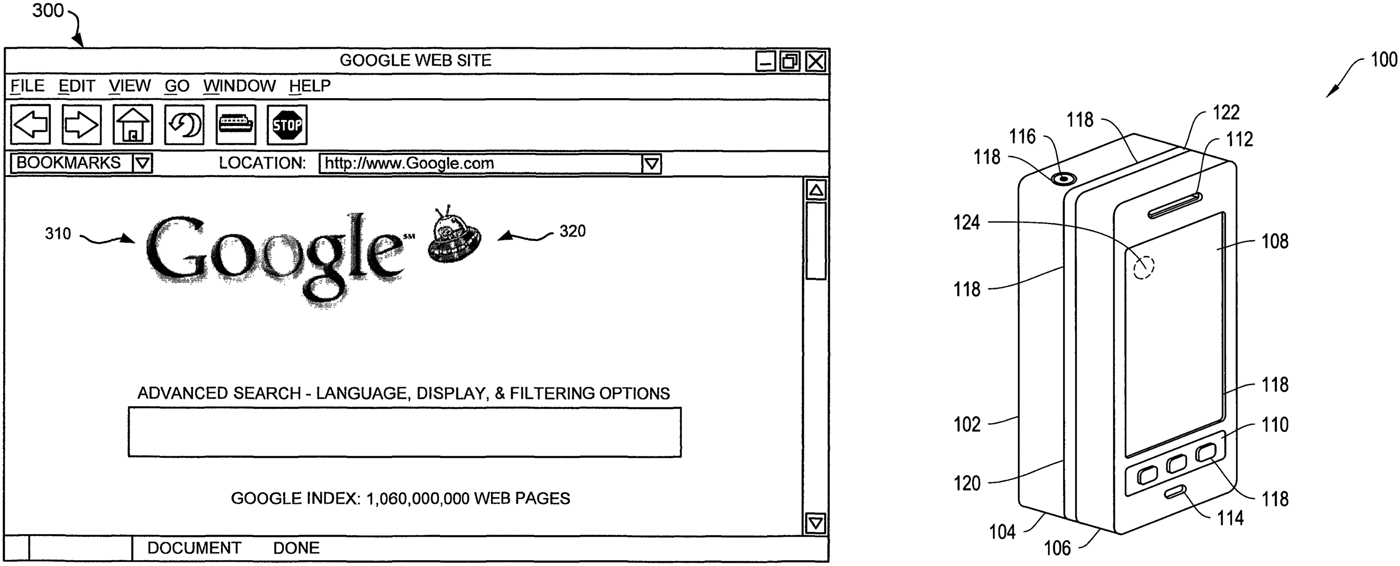
In the same way that the US Patent Office (and many other researchers) uses a three-partite definition of creativity, we position that creativity is indeed composed of three parts. However, instead of non-obviousness (US Patent Office) or surprise (Simonton, Reference Simonton2012), we take a different viewpoint, and point toward meaning as a third component. For illustrative purposes, we examine two prominent patents that may not be considered directly or particularly novel or useful, but could be considered meaningful: Google's Doodles and Apple's “Personal computing device control using face detection and recognition”. Google was granted a patent for its Google Doodles (Patent US 7,912,915, see Fig. 1 Right), that is, its habit of altering its logo for special events or holidays. The invention was described as “periodically changing story line and/or special event company logo to entice users to access a web page” (https://www.uspto.gov/patentsgetting-started/general-information-concerning-patents#heading-5). This invention is not directly unique – retailers have long decorated their logo for seasonal purposes – nor is it directly useful as it does not solve anything or utilize any new technology. Yet, it was granted a patent. Another example is Apple. Apple was given patent protection on a system that unlocks devices via face recognition (Patent US 8,600,120, see Fig. 1 Left). The invention pertains to the detection of the user's face and unlocking the device without actively entering a password or taking any other action. One could argue that this invention is novel when compared with existing ways of controlling electronic devices, such as fingerprint recognition or password input. However, it is not necessarily more useful than current solutions, as the device automatically unlocks when the user is present even in unwanted situations, or does not unlock at all if the user changes his/her physical appearance. Yet, Apple was also granted a patent.
(Left). Google doodles patent figure (Patent US 7,912,915); (Right). Apple's face recognition control system (Patent US 8,600,120)

We are not aware of the actual criteria that the US Patent Office may have used, but both of these inventions would fit the criteria of meaningFootnote a. Google's Doodles help users stay up to date with the times and the society they live in, and teach them about people and events in other parts of the world. Apple's face recognition unlocking system, besides being to some extent, novel and useful, provides users with a sense of belonging to an exclusive group. Apple products can be considered self-expressive symbols that communicate membership to an exclusive club – that is, the Apple user club – as the product helps communicate the self by signaling to the self and others what type of person the individual is or desires to be (“I am an Apple user”). The value of these inventions seems to lie in their ability to capture symbolic expressions that tap into user needs.
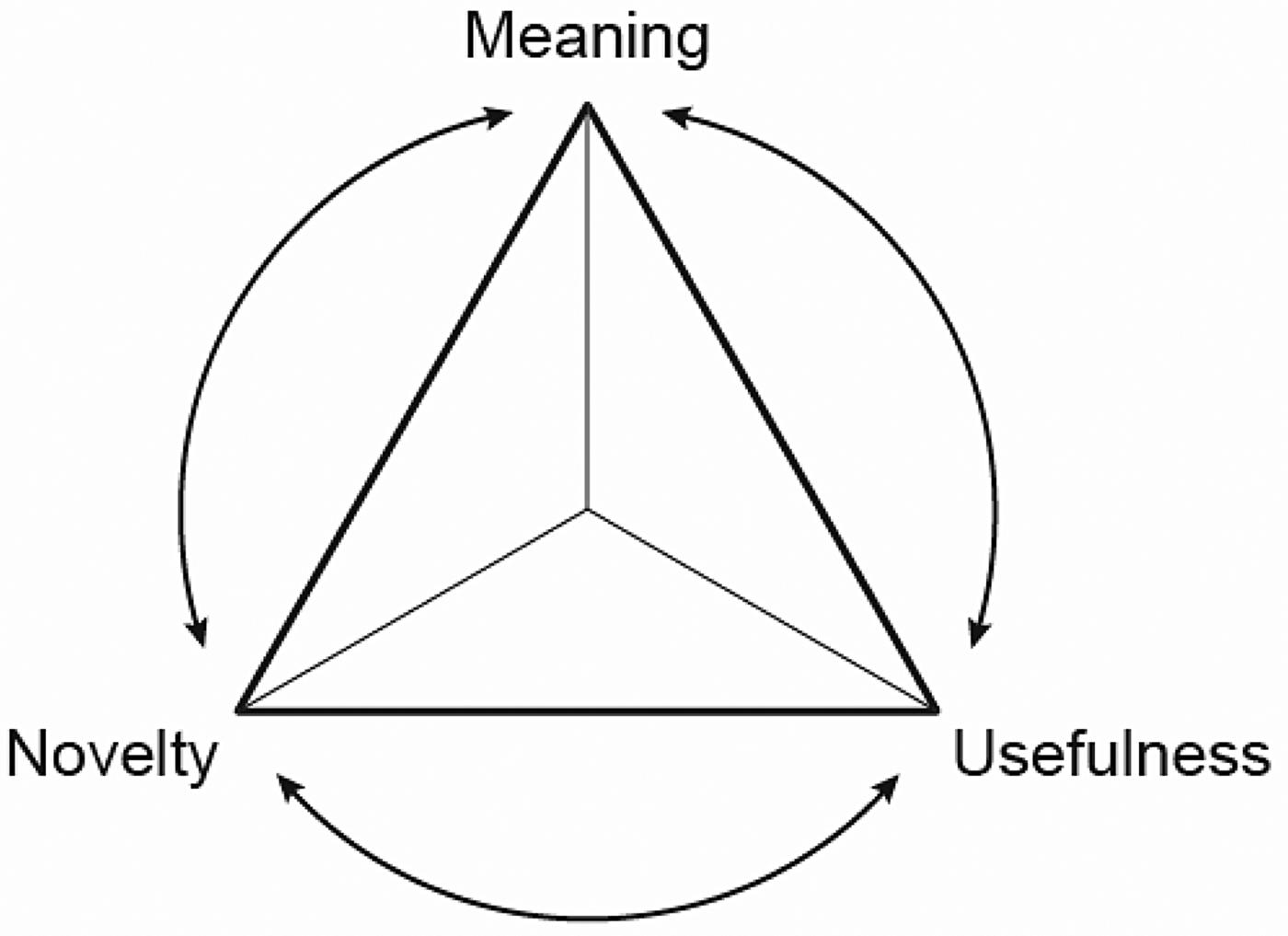
Summarizing, we propose that creativity is composed by three components: novelty, usefulness, and meaning, which are interrelated and contribute to a timely understanding of creative outcomes (Fig. 2). We believe meaning is an important component of creative products, as (1) it is inherent to products and services, (2) it is contextually and historically relevant (3) expresses a need in society that can be met by creative output, and (4) serves to differentiate products and services when novelty and usefulness do not.
Creativity in design as an interrelationship between meaning, novelty, and usefulness

How can meaning be measured?
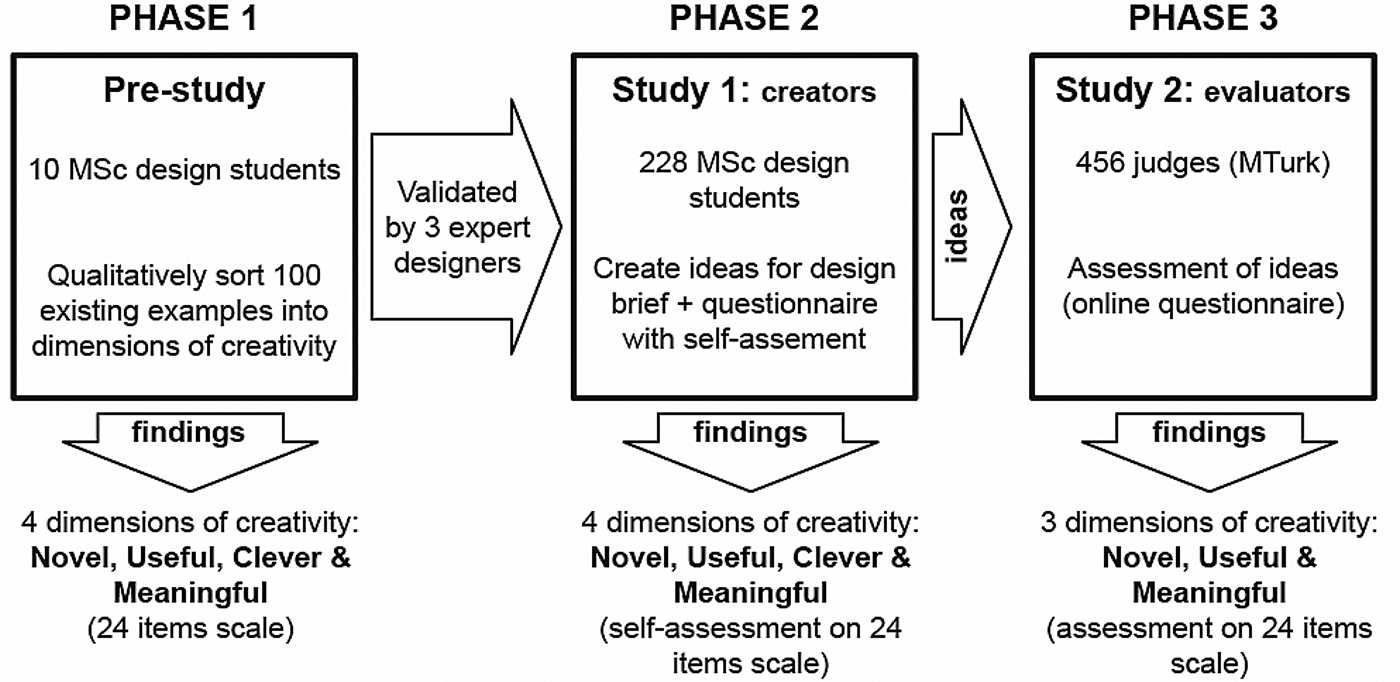
In order to devise a more comprehensive understanding of creativity and its components, we devised a research set-up consisting of several phases. The phases are described in the following sub-sections and are summarized in Figure 3.
Set up of the overall research study

Phase 1 – Pre-study
Meaning is created by a producer/designer (at the encoding/creation stage). To gain an understanding of what meaning could entail to creators, and how they could see it being manifested in solutions, we recruited ten experienced design Master students, from an industrial design engineering faculty, to examine what in their view, constitutes a creative product/service. The students were second-year Master students (50% males, 50% females, age range 22–27), and each of them had working experience as designers in various organizations (2–5 years of experience). Further, all of them had been involved in designing actual products that have been launched onto the market for an audience. Thus, they could be considered potential creators of creative outcomes. To gauge the dimensions of creativity, we asked the students to independently find ten existing products/services they considered creative, from any source they deemed appropriate. They were also asked to bring a picture of each example, along with a short piece of text describing it. Then, they presented each of the ten ideas they had found to each other in a session regulated by the first author and a research assistant, and explained why they deemed the solution to be creative, and what creativity dimensions the solution embodied that made it creative. At this stage, they provided these dimensions themselves and supplied definitions for each of them.
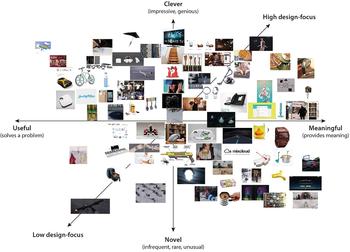
After presenting the ideas to each other, we asked each participant to undertake a qualitative sorting task, in which each one of them individually sorted the 100 solutions (10 × 10) that had just been presented to them into different categories. The sorting was based on the pictures alone, which means that no text or other information was provided. The participants were free to define creativity as they best saw fit on the basis of the presentations. After each participant had individually completed the sorting task, the group got together and compared the categorizations they had reached based on the sorting task. Each participant had sorted the creative products into four of five different types (i.e., dimensions) of creativity. The four dimensions that all participants agreed on were novel, useful, clever, and meaningful; the one dimension in which there was disagreement was the dimension that was defined by the participants as designerly. The group outcome that emerged is shown in Figure 4. As can be seen, participants thought some products purely fit into one dimension, whereas other products were almost in-between dimensions. The vast majority (8 out of 10 participants) did not consider designerly to be a separate dimension of creativity, but something that was embedded in the other creativity dimensions. The group discussed this disagreement, and reached a consensus regarding the four categories: novel, useful, clever, and meaningful.
Outcome of the qualitative sorting task to categorize products into four dimensions of creativity (novel, useful, clever, and meaningful). A larger version of this image is shown in Appendix 2

For purposes of verification, we consulted three expert designers with regard to the pre-test results. All three designers were international professional designers actively engaged in product, service and interaction design, with 9, 8, and 6 years of experience. First, we asked them to provide their own definition of creativity. Then, we showed them Figure 4, and asked them whether they agreed with the dimensions portrayed there (novel, useful, clever, meaningful). Two of the designers readily agreed with the proposed dimensions, and felt that it accurately captured creativity. The third one was more skeptical, because he associated creativity mainly with novelty, and not with other dimensions such as usefulness or meaning. Overall, we may conclude that the pre-test results have sufficient face validity among professional designers, allowing us to proceed with the proposed dimensions.
The measurements for these dimensions were then derived from the literature. For dimensions that had previously been measured (novel and useful), scale items were readily available (e.g., Csikszentmihalyi and Rochberg-Halton, Reference Csikszentmihalyi and Rochberg-Halton1981; Moreau and Dahl, Reference Moreau and Dahl2005; Horn and Salvendy, Reference Horn and Salvendy2006), and we opted for the most commonly used Likert-type adjective scale, in which scale items are listed as adjectives, and rated on a Likert-scale from 1 to 7. For example, for novelty, the items would be infrequent, unusual, rare, and original. In line with the recommendations for scale development (DeVellis, Reference DeVellis2003), for the dimensions that had previously not been measured (clever and meaningful), we created scale items by extracting adjectives from the literature pertaining to these dimensions, considering semantic as well as literal similarity (Csikszentmihalyi and Rochberg-Halton, Reference Csikszentmihalyi and Rochberg-Halton1981; Solomon, Reference Solomon1983; Norman and Verganti, Reference Norman and Verganti2014). We extracted adjectives until we no longer found items that were unique to the dimensions or separated them from others. The resultant scale consisted of 24 items, with 4 items denoted to novelty and 4 to usefulness (as these scale items have been widely tested) and 7 to clever, and 7 to meaning (as these scale items have not been tested before). It is noteworthy to consider that novelty, usefulness, clever, and meaning are all unobservable concepts, and should, therefore, be measured using multiple items (Fox, Reference Fox1983; Edwards and Bagozzi, Reference Edwards and Bagozzi2000; Tabachnick and Fidell, Reference Tabachnick and Fidell2012). We follow this recommendation and measure novelty, usefulness, and meaning using multiple items, as multiple items provide a more accurate estimate of each concept it intends to measure whilst reducing its associated measurement error. The complete scale can be seen in Appendix 1.
Measuring creativity
We measured creativity using the consensual assessment technique (Amabile, Reference Amabile1982, Reference Amabile1983). We conducted two studies to reach this goal. First, we recruited a set of design Master students, who were asked to generate ideas (Phase 2 – Study 1; see the section Creators below). Then, we recruited a set of evaluators for assessing each idea (Phase 3 – Study 2; see the section Evaluators below).
For meaning to be considered a separate dimension, it would need to meet four criteria. First, it would need to load as a distinct component among both creators and evaluators for purposes of convergent validity (Russell, Reference Russell1978; Cunningham et al., Reference Cunningham, Kristopher and Mahzarin2001); second, the items assigned to the component would need to be sufficiently similar across both creators and evaluators (so that items load on the same component in both groups) for purposes of factorial invariance (Drasgow and Kanfer, Reference Drasgow and Kanfer1985; Marsh and Hocevar, Reference Marsh and Hocevar1985); third, it would need to be sufficiently different from novelty and usefulness for purposes of discriminant validity (Fornell and Larcker, Reference Fornell and Larcker1981; Bollen, Reference Bollen1989); and fourth, it would need to add to the variance explained by novelty and usefulness in the judgment of creative ideas by having an Eigenvalue above 1 (Tabachnick and Fidell, Reference Tabachnick and Fidell2012; Field, Reference Field2013).
Phase 2 – creators
In Study 1, 228 design Master students were recruited to individually create ideas in an ideation session, followed by a questionnaire. The participants were randomly allocated to one of two design briefs, which focused either on the creation of a lamp for a museum (design brief 1), or a lawn chair to sit multiple people (design brief 2).
Design Brief 1
Your task is to design a lamp for in a (big) entrance hall of a museum. The lamp should stimulate interaction between museum guests. During the design task, you can draw your ideas on the given scratch papers. Make sure your final design is drawn on the backside of this paper, and handed in. When you are finished, please give the moderator a sign. The study includes an online questionnaire, to be filled in after the design task on one of the laptops in this room. Thank you for your cooperation.
Design Brief 2
Your task is to design a lawn chair for several people. The chair should be able to comfortably seat multiple people at the same time. During the design task, you can draw your ideas on the given scratch papers. Make sure your final design is drawn on the backside of this paper, and handed in. When you are finished, please give the moderator a sign. The study includes an online questionnaire, to be filled in after the design task on one of the laptops in this room. Thank you for your cooperation.
These design briefs can be considered wicked problems (Rittel and Webber, Reference Rittel and Webber1973), for the following reasons: They are open, enabling exploration and definition of the problem space, and do not have one correct solution; they are complex, as they involve more than one stakeholder, whose wishes and needs may be conflicting; and they involve to some extent societal and/or cultural issues, which are interconnected and changeable. Therefore, these briefs were considered adequate for representing design problems designers usually deal with in practice and education.
Each creator was asked to design one idea. In total 124 creators created designs for the lamp, and 104 for the chair. Each participant worked individually, and no time limit was put on the ideation session. After the participants had designed their idea and handed it in, they were asked to fill in a questionnaire. The questionnaire asked the designers to rate their own design in terms of 24 creativity items (shown in Appendix 1), which were defined in the pre-study, phase 1.
Although self-assessing one's own designs can be unreliable, as creators tend to overvalue their own creations (Amabile, Reference Amabile1996), our goal is merely to use the self-assessments for checking the mirroring quality of meaning – that the creator imbues meaning into the idea which is communicated (or not) to the evaluator. As such, the actual rating (i.e., high or low) is of a lesser concern than the dimensions creators embed, which makes self-assessment acceptable in this context. Indeed, Amabile (Reference Amabile1996) recommends checking for self-assessment in cases in which it may be useful. Of the 228 creators, 221 filled in the questionnaire pertaining to their design (101 males, 119 females, mean age 23 years), and are used for examining the (self-assessed) dimensions of creativity. Per the consensual assessment technique (Amabile, Reference Amabile1996), we then asked a separate group of participants to assess the ideas created by the creators, using the same dimensions. These participants are considered evaluators, who have degrees in relevant domains, that is, design, arts, marketing, or industrial engineering. We made this distinction between creators and evaluators as Amabile (Reference Amabile1996) suggest that evaluators should be experts in their domain, that is, people with related and relevant degrees, to be able to evaluate ideas created by students.
Results – creators’ self-assessment
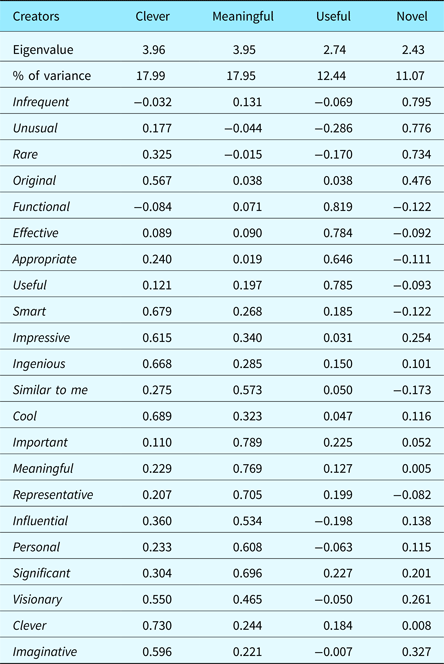
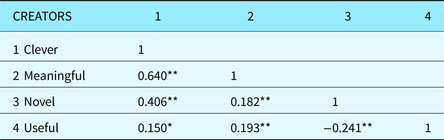
We used exploratory factor analysis with Varimax rotation to extract the components from the data and to assign the different factors to the components. The aim with the factor analysis was to ensure that items belonging to a factor would have a high loading on that factor (>0.60), and not cross-load with other factors (Tabachnick and Fidell, Reference Tabachnick and Fidell2012; Field, Reference Field2013). We did not impose a pre-defined structure on the factor analysis, but let the factor structure emerge from the analysis. The results showed that there were four components that could be extracted, and that there were four items that loaded on novel (original, rare, unusual, infrequent), four items that loaded on useful (functional, effective, appropriate, useful), five items that loaded on meaningful (important, meaningful, representative, personal, significant), and four items that loaded on clever (ingenious, smart, cool, impressive) (see Table 2). Of these components, meaningful accounted for most of the variance in the data (Eigenvalue 4.05, 16.89% of the variance), followed by clever (Eigenvalue 3.84, 16.06% of the variance), then novel (Eigenvalue 2.74, 11.41% of the variance), and finally, useful (Eigenvalue 2.56, 10.65% of the variance). These findings indicate that the four dimensions of meaningful, clever, novel and useful, together account for more than 55% of the variance in the overall concept creativity, with meaning accounting for the most (16.89% of the variance). The correlation matrix for creators is displayed in Table 3, and shows a negative correlation between novel and useful (which is a common trait of the relationship between novelty and usefulness, and has been reported in other studies on creativity assessment, e.g., Sarkar and Chakrabarti, Reference Sarkar and Chakrabarti2011) and positive correlations between all other constructs.
Factor analysis of four creativity components in relation to other sub-components (Creators)

Correlation matrix for Creators

*p < 0.05.
**p < 0.01.
Clever and meaningful are highly correlated, but their inter-correlation is below the cut-off point of 0.70 for considering a construct to be distinct (Tabachnick et al., Reference Tabachnick, Fidell and Osterlind2001). As these correlations show, creativity as an overall construct has common denominators (as captured by the correlations). Yet, as evidenced by the correlations, each dimension also has a variance that is uniquely its own, and may not be captured in the other dimensions. We may thus conclude that the factor structure for creators consists of four factors: novel, useful, clever, and meaningful. Next, we move to the evaluators.
Phase 3 – evaluators
A total of 456 evaluators rated the ideas ideated by the creators, in the form of an online questionnaire. The evaluators were recruited from Amazon Mechanical Turk, and were paid 1.20 USD for their assessments. Amazon Mechanical Turk has proven very reliable for assessing new ideas (Paolacci and Chandler, Reference Paolacci and Chandler2014; Berg, Reference Berg2016) provided that screening criteria that serve the purpose of the consensual assessment technique as used. As earlier mentioned, as per the consensual assessment technique, we recruited Amazon MTurk Workers with degrees in design, arts, marketing, or industrial engineering as evaluators, as all of these disciplines are involved in creative problem-solving. Each idea (generated by the creators in Study 1) had two evaluators assessing it, which resulted in 248 evaluators assessing design brief 1 (the lamp), and 208 design brief 2 (the lawn chair).
The questionnaire for evaluators asked them to judge the design using the same questions that the creators had used for assessing their own designs; we also added some questions that creators, having created the idea, could not really respond to (such as how innovative or how surprising the idea is), but are important for examining creative outcomes. Apart from these additional questions, the questionnaires for creators and evaluators had the same set of questions in them. Per Amabile (Reference Amabile1983) the ratings of the evaluators were averaged to reach consensus.
Results on evaluators’ assessment
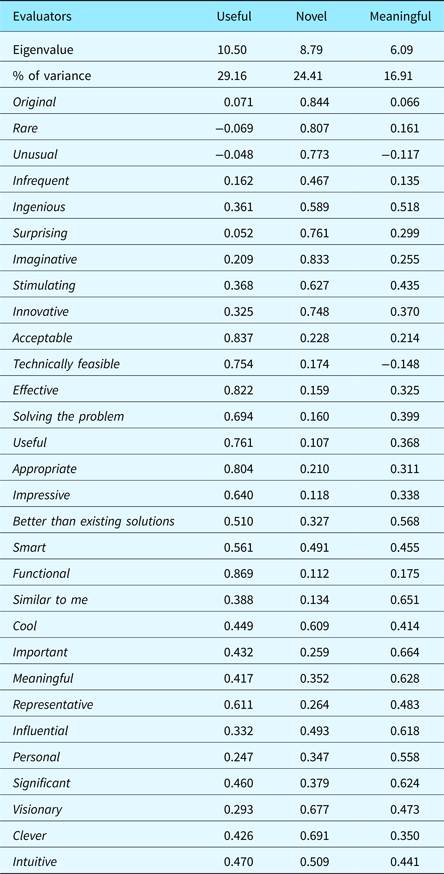
As for the creators, we used factor analysis with Varimax rotation to examine the scale components. This time, three components could be extracted from the data (See Table 4): usefulness (Eigenvalue 10.50, 29.16% of the variance), novelty (Eigenvalue 8.79, 24.41% of the variance), and meaning (Eigenvalue 6.09, 16.91% of the variance). These findings indicate that the three dimensions of usefulness, novelty, and meaning together account for more than 70% of the variance in the overall concept creativity, with usefulness accounting for most of the variance (29.16% of the variance).
Factor analysis of three creativity components in relation to other sub-components (evaluators)

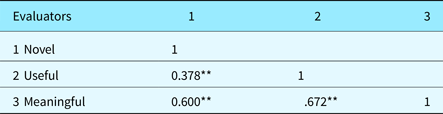
Clever did not emerge as a separate component: all of the items for clever loaded on novelty, with the exception of smart, which loaded on usefulness. This finding illustrates that if something is original and unique it tends to be surprising and imaginative as well. Meaning is the only component that emerges as distinct and separate in addition to novelty and usefulness. Meaning correlates with novelty and usefulness (see correlation matrix in Table 5); although the correlations are high, they are below the cut-off point of 0.70 used for determining if a construct is unique (Tabachnick et al., Reference Tabachnick, Fidell and Osterlind2001). These correlations show that creativity is a construct with three components that are distinct, but related to each other, indicating that creativity as an overall construct has some common denominators that are captured in all three dimensions, but that each dimension also has unique parts that it brings to the overall construct.
Correlation matrix for Evaluators

*p < 0.05.
*p < 0.01.
Recall that for meaning to be considered a separate dimension, it would need meet four criteria: (1) show up as a distinct component among creators as well as evaluators – it did; (2) items assigned to the component would need to be sufficiently similar across both groups – they do; (3) it would need to be sufficiently different from novelty and usefulness to be considered an additional dimension – it is ; although it is highly correlated with both novelty and usefulness, it is a separate dimension as the correlation is below 70; and (4) it would need to add to the variance explained by novelty and usefulness in the judgment of creative ideas – it does. All of these criteria are fulfilled, as in both studies, meaning emerged as a separate component of creativity, which is distinct from novelty and usefulness. It explains a significant portion of the variance in the data that is not captured by novelty or usefulness, and shares sufficient similarities across the items in both groups (i.e., the factor has an Eigenvalue >1 (Tabachnick and Fidell, Reference Tabachnick and Fidell2012; Field, Reference Field2013).
Measuring the meaning dimension
To refine the meaning dimension, we re-ran the initial factor analyses with only the items that loaded consistently across creators and evaluators. A consistent loading reflects that the item loads on the same factor in both samples, and stays true to the mirroring quality of meaning – that is, the notion that the meaning imbued into the creative idea by the creator is interpreted by the evaluator. Six items fulfill the mirroring quality of meaning: influential, personal, significant, important, meaningful, and similar to me. Including only these six items did not significantly change the results, as meaning, as portrayed here, is a reflective scale, for which items (once agreed upon) can be considered to be largely interchangeable (e.g., Jarvis et al., Reference Jarvis, MacKenzie and Podsakoff2003). The items that load on the factor we refer to as meaning for both creators and evaluators capture the consensus regarding meaning across creators and evaluators, as both groups agree that the items belong to that specific dimension. It does not mean that creators and evaluators would necessarily agree on the ratings of the items included in the dimension, but that both creators and evaluators agreethat these six items constitute the dimension we refer to as meaning. These six items can thus be considered the measurement items for the dimension of meaning.
Thus, our definition of meaning, as a component in creativity, refers to the extent that an idea or solution can be understood (by creators and evaluators) as personal, similar to them, and significant and influential to the user's context.
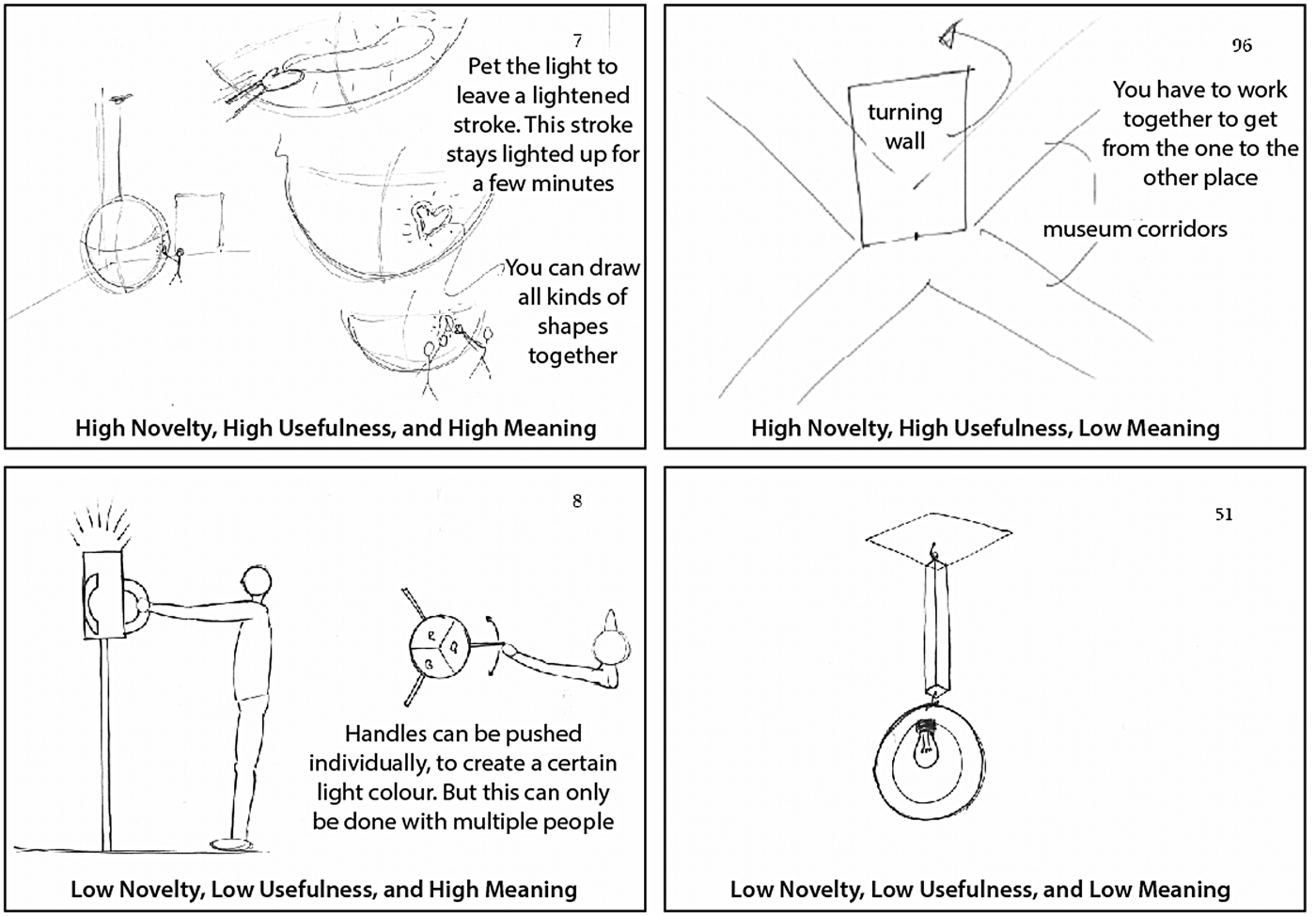
Figure 5 shows four examples of ideas created in Study 1, by the creators, which were subsequently rated by the evaluators. All ideas were created for design brief 1 (lamp in a museum). In these examples, it is possible to observe how the evaluators rated meaning, in relation to novelty and usefulness. Ideas could be considered both novel and useful, without being meaningful (Fig. 5, top right) or, on the contrary, be considered meaningful without being novel or useful (Fig. 5, bottom left), illustrating the distinctiveness of the three components.
Examples of ideas produced by creators for Design Brief 1 and rated by evaluators

Discussion
Generating creative solutions is the best way for organizations to succeed in an increasingly competitive world. Traditionally, creative solutions have been defined as solutions that are novel and useful. This is the most widely accepted definition of creativity to date. Other dimensions of creativity have been suggested (e.g., Besemer and O'Quin, Reference Besemer and O'Quin1999; Horn and Salvendy, Reference Horn and Salvendy2006; Howard et al., Reference Howard, Culley and Dekoninck2008; Simonton, Reference Simonton2012) but none of them have gained mainstream acceptance in the literature on creativity the way that novelty and usefulness have.
Creativity is contextual, and as context, it changes over time. The world that the contemporary user lives in looks widely different from the world as it was more than half a century ago when the creativity dimensions of novelty and usefulness were established. Although most contextual changes are more gradual than fundamental, in this paper, we identify one fundamental change. This change has profoundly affected the way users view their world, impacting their view of products and/or services that they surround themselves with. This social contextual change is what we encapsulate in the dimension we refer to as meaning.
In this paper, we set out to examine the role of meaning in creative solutions. Our aim was to investigate whether creativity could be considered the third dimension of creativity, and whether it could explain something more about creative solutions than novelty and usefulness alone. We conducted a pre-study and two empirical studies to examine if this is indeed the case. The first study was conducted with creators, and centered on how designers assess their own creative solutions. The second study was with evaluators, and centered on how independent judges assess creative outcomes. The first study revealed that creators tend to discern four components in their own designs; novelty, usefulness, cleverness, and meaning. The second study revealed that evaluators agree on three of these components: novelty, usefulness, and meaning. In both studies, the meaning was able to explain some of the variances of creative solutions that novelty and usefulness did not explain. Furthermore, although it was highly correlated with novelty and usefulness, it was still a distinct component, capable of adding value to novelty and usefulness as a separate component. We may thus conclude that, based on the results of our studies, the meaning is a component of creativity together with novelty and usefulness.
The component of meaning can be captured by six measurement items, that both creators and evaluators agree are part of that specific dimension. These agreed-upon items allow us to construct a definition of meaning as a component of creativity, referring to it to the extent that an idea can be understood (by creators and evaluators) as personal, similar to them, and significant and influential to the user's context.
Limitations and future research
When interpreting these findings, it is important to consider the following limitations. We investigated creativity and its components within the field of design, where problems are considered to be “open, complex, dynamic and networked” (Dorst, Reference Dorst2015, p. 1). Possibly, the weight given to each of these components may vary depending on the context of the problem, leaning towards usefulness if, as an example, the problem prompts for more practical requirements. Nevertheless, although the weights may shift, our findings suggest that the components of creative solutions remain the same. Furthermore, as we have pointed out in Table 1, prior measures of creativity were not always suitable for measuring creative solutions at different completeness levels (i.e., early-phase sketches vs. finished products). As our meaning scale was reliable at the early ideation stage, and the same scale was reliable for both creators and evaluators, we do believe that it is possible to assess meaning at the early concept stage. We further propose that meaning becomes crucial for understanding overall composite creativity in relation to design solutions for intended users and consumers, especially during ideation. Conversely, when measuring creativity of purely industrial or technical solutions, meant for organizations rather than for individual users, the meaning is arguably not a critical component of creativity. We thus acknowledge the need to examine meaning in other domains, such as in highly technical areas. Further, we acknowledge the need to examine meaning in the final design stages, with potential consumers, and cross-verifying the results with our findings.
We are now in a better position to understand how creators and evaluators see contemporary creativity, yet there are still many possible avenues to explore. Future research could verify whether meaning, as a creative component, maintains its relevance when evaluating ideas created for different types of design problems or other fields within the design (for instance, service design or engineering). Additionally, considering our take on the demand-based approach, a follow-up study should focus on the relationship between what consumers desire with what the market provides, and how meaning could bridge supply with demand.
Meaning as a component of creativity opens up new possibilities for designers to use their knowledge and imagination to create solutions that are meaningful for users. Positive psychology (e.g., Kahneman, Reference Kahneman, Kahneman, Diener and Schwarz1999; Seligman, Reference Seligman2004) and positive design (e.g., Desmet & Pohlmeyer, Reference Desmet and Pohlmeyer2013; Hassenzahl et al., Reference Hassenzahl, Eckoldt, Diefenbach, Laschke, Lenz and Kim2013) have been attracting attention in the last decade and their growth is representative of users’ search for meaning in today's society. Designers then have the opportunity (and responsibility) to design for meaningful experiences, which can support users’ well-being and happiness. Recognizing meaning as a component of creativity, alongside novelty and usefulness, can trigger designers to explore ideas that are innovative in meaning for users. Meaning also provides a source of differentiation for organizations developing creative solutions, opening up new possibilities for creating competitive advantage. As it embodies knowledge of the social context, meaning creates the type of differentiation that may be difficult for the competition to imitate.
Designers would benefit from social science education alongside education pertaining to the traditional design skills. This issue, already raised by Norman (Reference Norman2013), as well as Beyer and Holtzblatt (Reference Beyer and Holtzblatt1998), becomes even more pertinent in the context of meaning. To design for meaning, designers would need in-depth knowledge of the social context of the world in which we live today, and stay on top of the changes that take place in the social context over the years. We do not foresee that the importance of meaning will change, but as the items for meaning illustrate, there will be differences over time with regards to the type of solutions users will consider to be influential, personal, significant, important, meaningful, and similar to them.
Supplementary material
The supplementary material for this article can be found at https://doi.org/10.1017/S0890060418000112
Acknowledgements
We would like to thank Lisa Schmidt and the students who participated in the SPD Research Project course, of the Industrial Design Engineering Faculty, TU Delft, in the topic Measuring Creativity for their assistance in data collection.
Maria Sääksjärvi is associate professor of Marketing at the Department of Product Innovation Management at Delft University of Technology, The Netherlands. She holds a PhD and an MSc in Marketing from Hanken Business School in Helsinki, Finland. Prior to her academic career, she worked at Accenture as a technology consultant. Her main research interests lie in the areas of creativity and innovation. She has published 30 articles in journals such as the Journal of the Academy of Marketing Science, PloS One, Psychology & Marketing, Journal of Interactive Marketing, and European Journal of Marketing.
Milene Gonçalves is assistant professor of Creativity in Product and Service Design at TU Delft, the Netherlands. She holds a PhD Diploma in Design Creativity from TU Delft, on the inspiration process of designers and its influence on design creativity and innovation. Her research and educational interests include collaborative creativity, co-creation, creativity facilitation, sketching and other design representations and their influence on the development of innovative ideas. She has published in relevant journals, such as Design Studies, International Journal of Design Creativity & Innovation and Design Sciences, and has been an invited lecturer at DTU, Denmark and Aalto University, Finland.