Introduction
Hyperemesis gravidarum (HG) may be defined as persistent, unexplained nausea and vomiting resulting in more than a 5% weight loss, abnormal fluid and nutritional intake, electrolyte imbalance, dehydration and ketonuria.Reference Goodwin 1 Symptoms often extend beyond the first trimester and can last throughout the entire pregnancy in as many as one-third of cases, leading to extreme weight loss and possibly a state of malnutrition and extended dehydration of pregnancy.Reference Fejzo, Poursharif and Korst 2
HG accounts for over 285,000 hospital discharges in the United States annually.Reference Wier, Levit and Stranges 3 Estimates of severe nausea and vomiting of pregnancy vary greatly and range from 0.3% in a Swedish registry to as high as 10.8% in a Chinese registry of pregnant women, with most authors reporting an incidence of ∼0.5%.Reference Verberg, Gillott, Al-Fardan and Grudzinskas 4 – Reference Zhang and Cai 6 HG can be associated with serious maternal and fetal morbidity such as Wernicke's encephalopathy,Reference Chiossi, Neri, Cavazutti, Basso and Fucchinetti 7 fetal growth restriction and even maternal and fetal death.Reference Bailit 8 , Reference Fairweather 9
Many studies on the long-term outcome of dehydration, starvation and/or anxiety in pregnancy in animal models and humans reveal adverse effects on exposed offspring including cardiovascular disease, obesity, diabetes, as well as neurodevelopmental, cognitive, emotional and behavioral disorders.Reference Mulder, Robles de Medina and Huizink 10 – Reference Ross and Desai 14 Given that HG can be a form of prolonged dehydration, starvation and stress in pregnancy, it follows that long-term outcomes could possibly mimic those identified in these studies. Indeed, recently, we showed a 3.6-fold increased risk of emotional/behavioral disorders in adult offspring exposed to HG in utero.Reference Mullin, Bray and Schoenberg-Paik 15 All cases and controls in the previous study had a family history of HG. In the previous study, 38% of adults whose mothers had HG while pregnant with them had an emotional or behavioral disorder compared with 15% of adults whose sister had HG but not their mother. This suggests being exposed in utero to HG is linked to emotional/behavioral disorders in adulthood, but the actual affected rate of 0.38 could be confounded by the possibility that HG and emotional/behavioral disorders may cluster together in families. To determine whether or not this is the case, the background rate of emotional/behavioral disorders in families with no family history of HG is calculated herein using a new control group. This new control group consists of participants with no family history of HG. By comparing the rates of emotional/behavioral disorders in participants with and without a family history of HG, we will determine whether the rates of psychological/behavioral disorders reported in the previous study may be inflated because of confounding familial emotional/behavioral disorders linked to HG.
Method
Sample and settings
This study is part of a larger investigation evaluating the genetics and epidemiology of HG. Eligible patients were primarily recruited through advertising on the Hyperemesis Education and Research Foundation Web site at www.HelpHer.org. Another method of recruitment of affected individuals was a recruitment video on YouTube at http://www.youtube.com/watch?v=92NFOwvAXcI, which provided the rationale for starting this study, information about the study, and contact information. Some participants have also recruited their own affected acquaintances to participate and some participants heard about the study from articles, news stories and pregnancy or parenting websites.
The inclusion criteria for affected individuals were a diagnosis of HG and treatment with intravenous fluids and/or total parenteral nutrition/nasogastric feeding tube. Affected participants were asked to submit their medical records. Minors (under 18 years) were not included in the study because few teens are expected to fit the study criteria of having had two pregnancies and it would be difficult to justify the risks/benefits to minors who never experienced HG. Women over the age of 50 at the time of first contact were not included to limit the possibility of recall bias. Because multiple or chromosomally abnormal gestations may be associated with HG due to unique physiological pathways, women with these types of pregnancies were also excluded.
Each participant was asked to recruit a friend with at least two pregnancies that went beyond 27 weeks to participate as an unaffected participant. Unaffected participants with only one pregnancy were not included to provide more confidence that the unaffected individuals are at the other end of the spectrum from participants with HG in that the unaffected participants did not have any severe nausea, weight loss nor treatment for nausea in a minimum of two pregnancies. Thus, unaffected friends were eligible if they experienced normal (did not interfere with their daily routine) or no nausea/vomiting in their pregnancy, no weight loss due to nausea/vomiting and no medical attention in their pregnancy due to nausea. Biological relatives of participants in the study were not included in the study as the case–control study depends on non-relatedness of individuals in the study.
This study has been approved by Institutional Review Boards, USC IRB no. HS-06-00056 and UCLA IRB no. 09-08-122-01A.
Study procedures
Participants were asked to complete an online survey regarding information on a variety of demographic characteristics and medical conditions in their siblings, including all diagnosed and/or treated emotional/behavioral disorders. The survey instrument can be found at http://www.helpher.org/HER-Research/2007-Genetics/2007rsch-start.php.
A total of 162 participants with HG, confirmed their mother did not have HG while pregnant with their siblings and reported on health complications in 172 siblings that were not exposed to HG in utero. This group of 172 non-exposed siblings of participants who had HG themselves, represents the Cases in this study because they have a family history (sibling with HG, mother not affected).
A total of 95 unaffected friends of participants with HG, confirmed their mother did not have HG while pregnant with their siblings and reported on health complications in 101 siblings that were not exposed to HG in utero. This group of 101 non-exposed siblings of participants who did not have HG themselves, represents the Controls in this study because they have no family history of HG (no affected mother or sister).
For comparison purposes, the original published participantsReference Mullin, Bray and Schoenberg-Paik 15 whose mothers had HG while pregnant with them are also included herein. In summary, this study compares three groups: (1) adult offspring of a pregnancy complicated by HG, (2) adult offspring from a pregnancy NOT complicated by HG but do have a positive family history of HG (sister with HG) and the new group of (3) adult offspring from a pregnancy NOT complicated by HG and do NOT have a family history of HG. This new group is added herein with the purpose of comparing emotional/behavioral disorders in families with a history of HG to families with no family history of HG to determine whether or not there are increased emotional/behavioral disorders in families with HG independent of whether their mother had HG. In other words, the purpose of this study is to identify the background rate (no HG in family) of emotional/behavioral disorders in the study population and compare that to the participants who have a family history of HG but were not exposed in utero (sister had HG but not their mother), as well as to those participants whose mother did have HG while pregnant with them (sister had HG and mother had HG while pregnant with the participant).
Data analysis
The survey participants were compared for a number of variables including number of siblings, age, ethnicity and education. Ethnicity and education were compared using a two-tailed Fisher's exact test, number of siblings and age of siblings were compared using the Wilcoxson rank-sum test (Mann–Whitney U-test or robust t-test) in addition to the conventional t-tests and Kolmogorov–Smirnov tests.
We report on the psychological/behavioral diagnoses and other health complications are not included herein. The frequency of diagnoses was compared among each group using two-sided Fisher's exact test. Some participants had more than one diagnosis in a given group and therefore the overall affected rate is the number of affected siblings out of the total number of siblings rather than the number of diagnoses out of the total number of siblings.
Results
Matched-pairs analysis
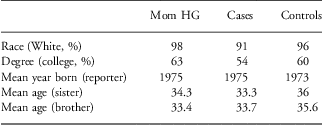
Respondents were primarily white and born in the mid-1970s. On average, over 50% had a college degree. At the time of the survey, female and male siblings were primarily in their mid-30s. Respondents were well matched for all variables tested; no significant differences were found between groups (Table 1).
Participants reporting on cases (cases) and participants reporting on controls (controls) are well matched for all demographic variables tested

HG, hyperemesis gravidarum.
*All comparisons tested yielded P > 0.05.
Psychological/behavioral disorders
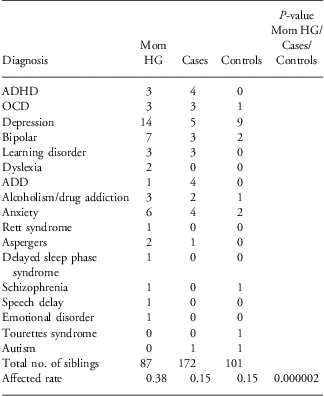
Psychological and behavioral disorders reported by participants on behalf of their siblings are listed in Table 2. Fifteen percent of participants were reportedly diagnosed and treated for an emotional/behavioral disorder regardless of a family history (sister) affected with HG (Table 2).
Psychological/behavioral diagnoses

HG, hyperemesis gravidarum; ADHD, Attention deficit hyperactivity disorder; OCD, Obsessive–compulsive disorder; ADD, attention deficit disorder.
Mom HG – offspring from a pregnancy complicated by HG.
Cases – offspring from a pregnancy Not complicated by HG but do have a positive family history of HG (sister with HG).
Controls – offspring from a pregnancy Not complicated by HG and do Not have a family history of HG.
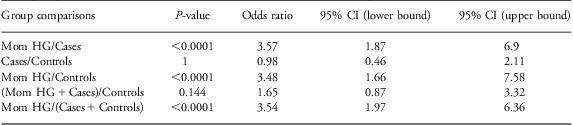
Group comparisons of affected rate

HG, hyperemesis gravidarum.
Mom HG – offspring from a pregnancy complicated by HG.
Cases – offspring from a pregnancy Not complicated by HG but do have a positive family history of HG (sister with HG).
Controls – offspring from a pregnancy Not complicated by HG and do Not have a family history of HG.
Discussion
This is the first study to explore emotional and behavioral issues in families with HG compared with families without HG. Herein adults with a sibling affected with HG were no more likely to have emotional/behavioral disorders including depression, bipolar disorder and anxiety, than adults with no affected sibling. The cause of HG is unknown, but is reported to have a genetic basis,Reference Zhang, Cantor and Mac Gibbon 16 , Reference Vikanes, Skjaerven and Grjibovski 17 most likely of hormonal etiology.Reference Fejzo, Poursharif and Korst 2 Currently, the existence of a psychological component is accepted by the scientific community to be the result of the burden of prolonged physical illness rather than a causal factor.Reference Macle, Varlet and Cathébras 18 – Reference Tan, Vani, Lim and Omar 21 Unfortunately, however, there continues to be skepticism among healthcare providers, causing a lack of timely and appropriate treatment and resulting in more severe symptoms and outcomes.Reference Macle, Varlet and Cathébras 18 – Reference Munch and Schmitz 22
Although in this study 15% of adults with and 15% without a sibling with HG were affected with emotional/behavioral disorders, this is in stark contrast to the 38% reported to have a behavioral or emotional disorder in adults whose mother's had HG while pregnant with them. The cause for this association is unknown, but may be due to common factors relating to HG pregnancies such as prolonged maternal stress, malnutrition and vitamin deficiency, abnormal hormone levels during fetal development and/or maternal–newborn bonding after birth.Reference Mullin, Bray and Schoenberg-Paik 15
Admittedly, there are multiple limitations to this study. For example, the study includes a retrospective component, and self-reporting of maternal HG status and sibling diagnoses, as well as the fact that our well-matched analysis and diagnosis comparison were conducted on two different pairs of groups. Additionally, the college degree prevalence is high, possibly due to internet-based recruiting, which requires internet access and the use of ‘hyperemesis gravidarum’ as a search term. However, the survey respondents appear to have been well matched for all factors studied including education, and reported a similar occurrence of other outcomes not presented herein (i.e. autoimmune disorders and cancer). Therefore, we can think of no reason why one group would be more likely to have a greater reporting or recall bias than another with respect to the diagnoses reported here.
One of the strengths of this study comes from the long-standing collaboration with the Hyperemesis Education and Research Foundation that resulted in a unique opportunity to identify a large group of individuals affected by HG and the ability to collect long-term outcome data. In addition, the study design allowed for a significantly well-matched study population with respect to race, education and age.
In conclusion, our evidence suggests that women with HG do not have an increased familial risk of emotional/behavioral disorders in their siblings, only in their children. The significance of this is two-fold. First, it provides further confirmation that HG leads to a 3.6-fold increased risk of emotional/behavioral disorders in offspring born of pregnancies affected by HG because both women with and without a sibling history of HG reported a 15% disorder rate suggesting this may be the true background rate in this population, and the 38% of affected participants whose mothers had HG while pregnant with them may represent a significant increased risk.
Second, this study provides further evidence in refutation of the spurious claim of a link between pre-existing emotional/behavioral factors and HG. HG is an understudied and undertreated condition of pregnancy that may result in not only short-term maternal physical and mental health problems, but also, potentially life-long consequences to the exposed fetus. Recently, HG was linked to adverse pregnancy outcomes including an increased risk of spontaneous preterm birthReference McCarthy, Khashan and North 23 and a smaller head circumference, and it was concluded that studies designed to assess the long-term consequences of HG should be given high priority.Reference Coetzee, Cormack, Sadler and Bloomfield 24 , Reference Roseboom, Ravelli, van der Post and Painter 25 This study lends further support to a 3.6-fold increased risk of long-term emotional/behavioral disorders in offspring of HG pregnancies and supports current evidence against a psychological etiology. The increased psychological sequelae noted in past studies in women with HG may be the result of an HG pregnancy while their mothers were pregnant with them, or due to persistent physical symptoms from a previous or current HG pregnancy, rather than causes of HG. Understanding the etiology of HG and its associated outcomes will lead to more effective therapies or a cure for this debilitating disease of pregnancy.
Acknowledgments
This research was supported in part by the Intramural Research Program of the National Institute of Child Health and Human Development, National Institute of Health, Department of Health and Human Services.