Introduction
At least 5 per cent of the European population suffers from olfactory dysfunction.Reference Landis, Konnerth and Hummel1, Reference Damm, Temmel, Welge-Lüssen, Eckel, Kreft and Klussmann2 People are often unaware of their smell deficit, and of changes in their sense of smell. This contrasts with other sensory functions, for which people can usually accurately rate their own abilities, and can easily distinguish their performance as being normal or pathological. Environmental feedback is especially important: it is easier to compare visual or auditory abilities with other individuals, or with one's own previous experience, than to make such comparisons for olfactory ability. Continuous stimulation of the visual and auditory senses enables ongoing self-assessment, and if one of these senses is significantly reduced or even lost completely, the affected person usually realises this fact immediately.
The situation is very different for the chemical senses, i.e. the sense of taste and the sense of smell. One difficulty lies in distinguishing between these two senses, as taste perception only covers sweet, bitter, salty, sour and umami tastes, whereas other ‘tasted’ qualities of orally ingested substances are perceived retronasally via the sense of smell.Reference Hummel4 Therefore, an impaired sense of smell always reduces one's taste perception as well. In everyday life, this difference is rarely recognised.
Failure to recognise a malfunctioning sense of smell can lead to dangerous situations in which persons with reduced olfactory abilities cannot rely on this human sense. Examples include possible threats from unrecognised smoke or fire, or from the ingestion of spoiled food. Workers in certain professions, especially fire fighters, chefs and gas workers, can be significantly impaired, endangered or even unable to perform their work due to impaired olfaction.Reference Muttray, Haxel, Mann and Letzel5 Unlike visual and auditory function, it is not common practice to test olfactory function prior to starting a profession which depends upon it, and at regular intervals thereafter. At the most, people are only asked about their subjective assessment of their olfactory ability. However, such self-assessment may be inaccurate.
Reliable, standardised methods for testing the human sense of smell are available. The Sniffin' Sticks system (which tests olfactory threshold, discrimination and identification)Reference Wolfensberger, Schnieper and Welge-Lüssen6 and the 40-item University of Pennsylvania Smell Identification TestReference Doty, Shaman, Kimmelman and Dann7 are the two best known representatives. However, as these tests are time-consuming, costly and not easily available, physicians usually rely on patient self-assessment.
Few studies have investigated the self-assessment of olfaction in patients or healthy controls.
One such study assessed patients presenting to a specialised centre complaining of a smell problem, and found a correlation between their performance in standardised tests and their self-reported olfactory ability.Reference Welge-Luessen, Hummel, Stojan and Wolfensberger8 However, this study made no distinction between different causes of olfactory dysfunction or different age groups.
Another study, of healthy subjects, found no correlation between subjective olfactory ratings (measured on a visual analogue scale) and objective olfactory threshold test results.Reference Philpott, Wolstenholme, Goodenough, Clark and Murty9
Landis et al. Reference Landis, Hummel, Hugentobler, Giger and Lacroix10 found that the correlation between olfactory performance (measured by Sniffin' Sticks) and smell self-assessment was poor if self-assessment was performed prior to objective smell testing.
The aim of the current study was to investigate the accuracy of subjective smell assessment in a larger number of patients with olfactory deficits and healthy controls (compared with previous studies), and also to investigate any differences between these two groups. We compared self-assessment visual analogue scale scores with the results of a standardised testing method (i.e. Sniffin' Sticks, assessing olfaction threshold, discrimination and identification). The influence of subject age and olfactory dysfunction aetiology was also investigated.
Materials and methods
Participants
This was a prospective, controlled study conducted at the otorhinolaryngology and head and neck surgery department of the University Medical Center, Mainz, Germany. Olfaction was investigated in 167 persons. Ninety-six patients presented to the smell clinic with complaints of smell dysfunction; these patients comprised 53 men and 43 women, with an age range of 12 to 81 years and a mean age of 50 years.
The main causes for olfactory dysfunction were chronic rhinosinusitis (n = 18, 19 per cent), previous upper respiratory tract infection (n = 25, 26 per cent), previous head trauma (n = 16, 17 per cent) and idiopathic (n = 30, 31 per cent). Other rare causes were congenital (n = 2), toxic (n = 2) and iatrogenic (i.e. surgery; n = 3).
The control group consisted of 43 men and 28 women, with an age range of 16–76 years and a mean age of 36 years. Individuals were selected from out-patient clinic attendees or departmental in-patients with otolaryngological complaints but reportedly normal olfaction.
Our exclusion criteria were: rhinological symptoms or symptoms of chronic rhinosinusitis in the control group; and neurodegenerative disorders, oncological diagnoses, or medication that may influence the sense of smell or taste, in both groups.
All participants underwent a complete ear, nose and throat examination, including nasal endoscopy.
A demographic questionnaire was completed, and all participants subjectively assessed their smell ability, taste ability and nasal patency.
Additionally, all participants underwent detailed subjective measurement of their olfactory threshold, discrimination and identification abilities, using the Sniffin' Sticks system.
All participants signed an informed consent form, and the study was approved by the local ethics committee.
Self-assessment
Patients and controls were asked to subjectively rate their nasal patency and olfactory and gustatory performance on a visual analogue scale 100 mm in length; this mark was then converted into a score. For example, for subjective smell assessment, the subject's mark on the visual analogue scale (the left end indicating no olfaction and the right end perfect olfaction) was converted into a score ranging from 0 to 100.
Sniffin' Sticks
We used the Sniffin' Sticks system to evaluate participants' sense of smell. This is a standardised, 48-question olfactory function test.Reference Wolfensberger, Schnieper and Welge-Lüssen6 It includes three subtests: a 16-step, three-way, forced-choice n-butanol threshold test; a 16-odourant, three-way, forced-choice discrimination test; and a 16-item, forced-choice odour identification test. The scores for these three subtests are combined into one total score, which allows classification of olfactory function as normosmic, hyposmic or anosmic.Reference Kobal, Klimek, Wolfensberger, Gudziol, Temmel and Owen11 In this study, differentiation between normosmia and hyposmia was based on the 10th percentile of gender- and age-specific limits derived from recently published data (with an increased number of participants, compared with previous referent data).Reference Hummel, Kobal, Gudziol and Mackay-Sim12 Functional anosmia was defined as a Sniffin' Sticks total score of less than 15.5.
Statistical analysis
Statistical analysis was performed using the Statistical Package for the Social Sciences Version 16.0 for Windows software program (Chicago, Illinois, USA). Histograms and skewness were used to evaluate normal distribution. Spearman's test was used to investigate possible correlations. A level of significance of 0.05 was selected. Box plots and scatter plots were used for graphical presentation.
Results and analysis
Olfactory function and visual analogue scale scores
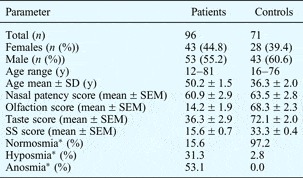
Generally, the Sniffin' Sticks test indicated anosmic olfactory performance in the patient group (mean Sniffin' Sticks total score, 15.2) but normal olfactory performance in the control group (mean Sniffin' Sticks total score, 33.2). Table I shows demographic data, scores for nasal patency and olfactory and gustatory self-assessment, and Sniffin' Sticks test results, for the two groups. Classification of normosmia, hyposmia and anosmia was made with reference to gender- and age-adapted normative data.Reference Hummel, Kobal, Gudziol and Mackay-Sim12
Patient demographics and test results

Self-assessment of nasal patency, olfaction and taste used a visual analogue scale marked from 0 (= highly impaired) to 100 (= perfect). *Classified with reference to gender- and age-adapted normative data.12 Y = years; SS = Sniffin' Sticks total score for olfactory threshold, discrimination and identification; SEM = standard error of the mean
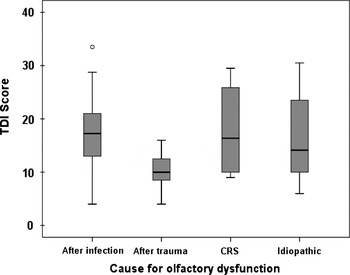
The association between olfactory dysfunction cause and Sniffin' Sticks total score is shown in Figure 1.
Box and whisker plot of patients' olfactory dysfunction aetiology versus Sniffin' Sticks total olfactory threshold, discrimination and identification (TDI) score. Lines represent medians, boxes represent 75 per cent of results and whiskers indicate 95 per cent of results. CRS = chronic rhinosinusitis

Participants' self-assessed (visual analogue scale) nasal patency scores showed no significant difference between the patient and control groups (60.9 vs 63.5, respectively; p > 0.05). Self-assessed scores for gustation and olfaction were both significantly lower for patients than controls (p < 0.05). The patient group had a mean score of 14.2 for olfaction and 36.3 for gustation. The corresponding control group scores were 68.3 (olfaction) and 72.1 (gustation).
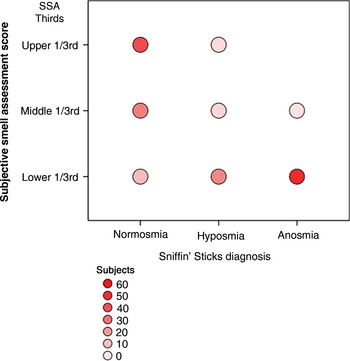
When the participant's subjective smell assessment results were divided into three groups (designated as top third, middle third and lower third), the results correlated well with the Sniffin' Sticks diagnosis of normosmia, hyposmia and anosmia (r s = 0.76, p < 0.01) (Figure 2).
Binned plot of Sniffin' Sticks diagnostic groups versus subjective smell assessment scores, for patients and controls combined. Plot point shading represents the number of subjects involved (see key).

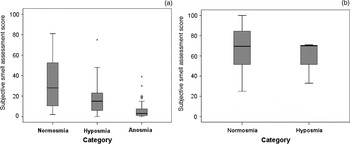
In the patient group, subjective smell self-assessment (visual analogue scale) scores differed significantly amongst normosmic, hyposmic and anosmic patients (χ2 = 27.6 (two degrees of freedom); p < 0.001, Kruskal–Wallis test). Mean ± standard deviation (SD) smell self-assessment scores were 6.1 ± 7.9 for anosmic patients, 17.7 ± 17.3 for hyposmic patients and 35.1 ± 26.1 for normosmic patients (Figure 3). Smell self-assessment scores differed significantly between all three groups: normosmic vs hyposmic, p < 0.035; hyposmic vs anosmic, p < 0.001; and normosmic vs anosmic, p < 0.001 (Mann–Whitney test).
Box and whisker plots of Sniffin' Sticks diagnostic groups (from gender- and age-adapted Sniffin' Sticks total score results12) versus subjective smell assessment scores in (a) patients and (b) controls. Lines represent medians, boxes represent 75 per cent of results and whiskers indicate 95 per cent of results.

Gender differences
In the control group, women showed a non-significant tendency to lower self-assessment scores than men, for both olfaction (mean, 65.2 vs 70.3, respectively) and gustation (mean, 69.1 vs 74.0, respectively). However, mean Sniffin' Sticks total scores were better in control group women than men (33.7 vs 33.1, respectively; p > 0.05, Mann–Whitney test).
In the patient group, this tendency was very similar: mean olfaction self-assessment scores were 10.6 for women versus 17.0 for men, while mean gustation self-assessment scores were 26.9 for women versus 44.0 for men; the latter difference was statistically significant (p < 0.01). The mean Sniffin' Sticks total scores of the two genders were nearly equal, being 15.5 in women and 15.6 in men.
Age
In the total control group, there was a correlation between age and Sniffin' Sticks total scores (r p = 0.495, p < 0.01). However, there was no correlation between subjective olfactory self-assessment scores and Sniffin' Sticks total scores in control subjects aged 16 to 35 years, 36 to 55 years, or 56 years and older.
In the patient group, there was a correlation between subjective olfactory self-assessment scores and Sniffin' Sticks total scores in all age groups, i.e. 16 to 35 years, 36 to 55 years, and 56 years and older.
Correlation between smell self-assessment and Sniffin' Sticks scores
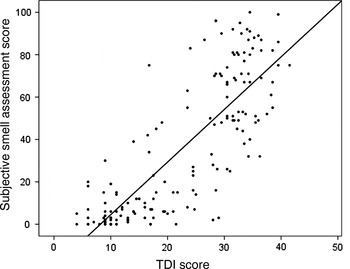
The overall sample (n =167) showed a non-normal distribution. The Spearman rank correlation between participants' smell self-assessment scores and Sniffin' Sticks total scores was significant (p < 0.001), with a correlation coefficient (r s) of 0.802 (Figure 4).
Scatter plot of Sniffin' Sticks total olfactory threshold, discrimination and identification (TDI) scores versus subjective smell assessment scores for patients and controls combined; linear r2 = 0.652.

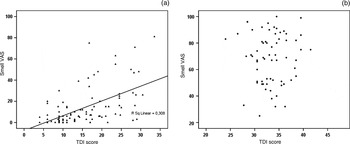
The patient group also showed a non-normal distribution. A significant correlation was found between subjective smell self-assessment scores and Sniffin' Sticks total scores (r s = 0.55, p < 0.01) (Figure 5a).
Scatter plots of Sniffin' Sticks total olfactory threshold, discrimination and identification (TDI) scores versus subjective smell self-assessment scores in (a) patients and (b) controls.

The control group had a non-normal distribution of subjective smell self-assessment (visual analogue scale) scores but a normal distribution of Sniffin' Sticks total scores. In this group, there was no correlation between these two parameters (r s = 0.042, p > 0.05) (Figure 5b).
In the patient group, the correlation between subjective smell self-assessment scores and Sniffin' Sticks total scores (r s = 0.55) was also viable for all subtests (threshold score, r s = 0.52; discrimination score, r s = 0.53; and identification score, r s = 0.45).
In the control group, no correlation between subjective smell self-assessment scores and Sniffin' Sticks subtest scores could be found. In contrast, all subtest scores showed good correlations with the Sniffin' Sticks total scores (r s = 0.47, 0.72, resp 0.72) and the patient group (r s = 0.78, 0.86, resp 0.88).
Olfactory dysfunction aetiology
The subjective smell self-assessment (visual analogue scale) scores of patients with the four main olfactory dysfunction aetiologies were investigated. There was a significant correlation between subjective smell self-assessment scores and Sniffin' Sticks total scores in patients with chronic rhinosinusitis (n = 18, r s = 0.57, p < 0.01), in patients with previous upper respiratory tract infection (n = 25, r s = 0.65, p < 0.01) and in patients with idiopathic olfactory impairment (n = 30, r s = 0.61, p < 0.01). However, in patients with post-traumatic olfactory impairment, the subjective smell self-assessment score correlated only with the Sniffin' Sticks discrimination subtest score (n = 16, r s = 0.53, p < 0.05) and not with the Sniffin' Sticks total score (p > 0.05).
Other correlations
In the combined group, there was a positive correlation between subjective smell self-assessment scores and subjective taste self-assessment scores (r s = 0.642, p < 0.01). This positive correlation was also found in both the patient group (r s = 0.342, p < 0.05) and the control group (r s = 0.480, p < 0.05).
No correlation was found between subjective smell self-assessment scores and subjective nasal patency self-assessment scores.
Discussion
Self-assessment of the human senses is crucial to enable the individual to detect disturbances, since the affected person will seek medical help only if he or she realises an impairment is present. Olfactory self-assessment might be inaccurate, because it is a rather neglected human sense and is often judged as being less important than hearing or vision. Most reported studies investigating olfaction self-assessment have evaluated patients presenting to a specialised centre or, separately, healthy controls. In only one study (the main interest of which was evaluation of olfactory dysfunction frequency) were individuals presenting to an otorhinolaryngology out-patient clinic asked to rate their olfactory function (on a scale of zero to three) and also to undergo Sniffin' Sticks testing. This study found a correlation in hyposmic and anosmic individuals (r = 0.18, resp r = 0.34) but not in normosmics.Reference Landis, Konnerth and Hummel1
In the present prospective, controlled study, subjective assessment of individual olfactory abilities was compared with results from a standardised testing method (assessing olfaction threshold, discrimination and identification), in patients presenting with smell dysfunction and also in normal controls. The study findings indicated that individual subjective smell self-assessment (by means of a visual analogue scale) was not always a suitable method of assessing this chemical sense: only when the combined group of patients and controls was considered did we find a good correlation (r = 0.787) between subjective smell self-assessment scores and Sniffin' Sticks diagnoses (Figure 3). Subgroup analysis also identified a positive correlation (r = 0.52) in patients presenting due to smell deficits (Figure 4). This finding is similar to other studies in which patients were aware of a smell deficit.Reference Klimek, Hummel, Moll, Kobal and Mann13, Reference Gudziol, Lotsch, Hahner, Zahnert and Hummel14 In another study with a similar setting (152 patients tested using Sniffin' Sticks and a smell visual analogue scale),Reference Welge-Luessen, Hummel, Stojan and Wolfensberger8 a reasonable correlation between the two methods of olfactory evaluation was found.
In contrast to this study, the current study also investigated subjective smell self-assessment in a control group without subjective smell dysfunction. No correlation was found between subjective smell self-assessment scores and standardised test results for olfaction threshold, discrimination and identification.
The absence of such a correlation in healthy individuals confirms previous reports using different smell assessment methods.Reference Philpott, Wolstenholme, Goodenough, Clark and Murty9, Reference Landis, Hummel, Hugentobler, Giger and Lacroix10, Reference Knaapila, Tuorila, Kyvik, Wright, Keskitalo and Hansen15 In a study of 186 healthy individuals, Philpott et al. Reference Philpott, Wolstenholme, Goodenough, Clark and Murty9 compared subjective perception of olfaction, using a visual analogue scale, with measured olfactory thresholds; no correlation was found. In another study of 1311 healthy twins, using a rating system from one to seven and a six-item identification test, subjects' olfactory self-ratings correlated with self-ratings for odour annoyance but not with odour identification score.Reference Knaapila, Tuorila, Kyvik, Wright, Keskitalo and Hansen15
In another study, Landis et al. Reference Landis, Hummel, Hugentobler, Giger and Lacroix10 used a visual analogue scale self-assessment and the Sniffin' Sticks tests on young, healthy subjects, and found that the preliminary correlation between olfactory performance and self-assessment was poor. The outcome appeared to be more a rating of the individual's nasal airflow. After subjects were encouraged to focus on their sense of smell, achieved by evaluating their personal assessments after undergoing quantitative testing, a reasonable correlation between olfactory ratings and test results was found.
In the present study, there was a significant difference between the smell self-assessment scores of normosmic, hyposmic and ansomic subjects only in the patient group. Even so, patients with normosmic Sniffin' Sticks scores had mean smell self-assessment scores which were half those of the normosmic control group subjects (Figure 3).
In the current study, subjective smell self-assessment (visual analogue scale) scores correlated with standardised olfaction test results if the subject was aware of a deficit, and enabled a reliable distinction between hyposmia and anosmia. However, in the controls, who described no smell deficit, subjective smell self-assessment was not a reliable measure of olfaction. An important factor might be that patients who presented to our smell clinic had presumably already focused on their olfactory abilities. Our findings indicated that these patients' olfaction self-assessment was more accurate than that of our control subjects, similar to the results of Landis and coworkers.Reference Landis, Hummel, Hugentobler, Giger and Lacroix10
• This study measured smell by subjective self-assessment and ‘Sniffin’ Sticks'
• In subjects aware of an olfactory deficit, the two measures correlated well
• Smell self-assessment is thus reliable in this group
• Smell self-assessment was unreliable in normal subjects
• Therefore, standardised smell tests are generally preferred
The Sniffin' Sticks subtest scores (i.e. for olfaction threshold, discrimination and identification) all correlated with each other in both the patient and control groups, in concordance with previous reports.Reference Hummel, Sekinger, Wolf, Pauli and Kobal16 A statistically significant relationship between these subtest scores and the subjective smell self-assessment scores (with reasonable correlation coefficients) was found only in the patient group.
Regarding olfactory deficit aetiology, three of the four main causes of dysfunction in this study (i.e. previous upper respiratory tract infection, chronic rhinosinusitis and idiopathic causation) showed significant correlation with the subjective smell self-assessment score, the Sniffin' Sticks total score and the subtest scores (r = 0.57–0.65). In patients with post-traumatic olfactory dysfunction, a correlation was found for olfactory discrimination only, which might be due to the fact that this group had the greatest olfactory impairment (mean Sniffin' Sticks total score = 10.3).
Conclusion
In patients who are aware of their smell deficit, subjective smell self-assessment (visual analogue scale) scores correlate with Sniffin' Sticks test scores, and appear to be a reliable measure of olfaction irrespective of age and olfactory dysfunction aetiology. However, subjects with subjectively normal olfaction have unreliable results for smell self-assessment; therefore, standardised testing methods should be used when a reliable assessment of olfactory function is needed.