Introduction
Seed moisture isotherms, the relationship between the amount of water in the seeds and relative humidity [RH (%) = relative vapour pressure × 100] at a given, constant temperature, have been used as a tool for understanding the response of seeds to water loss and to determine optimum conditions for drying, storing and processing seeds, and the nature and rate of biochemical reactions that may occur in the seed tissues (e.g. Vertucci and Leopold, Reference Vertucci and Leopold1984, Reference Vertucci and Leopold1987; Roberts and Ellis, Reference Roberts and Ellis1989; Vertucci and Roos, Reference Vertucci and Roos1990; Sun et al., Reference Sun, Koh and Ong1997; Tompsett and Pritchard, Reference Tompsett and Pritchard1998; Eira et al., Reference Eira, Walters and Caldas1999; Sacandé et al., Reference Sacandé, Buitink and Hoekstra2000; Merritt et al., Reference Merritt, Touchell, Senaratna, Dixon and Sivasithamparam2003; Choi et al., Reference Choi, Lanning and Siebenmorgen2010). For example, Vertucci and Leopold (Reference Vertucci and Leopold1984) showed that while some respiration was possible in intact soybean seeds over the central region (region II) of the triphasic isotherm (between 8 and 25% water content on a dry weight basis), the rate of respiration increased dramatically when seeds were in region III (>25% water content). More recently, Whitehouse et al. (Reference Whitehouse, Hay and Ellis2015) described how the response of rice seeds to high temperature drying depended on the harvest moisture content; if seeds were above the upper inflection on the isotherm, there was a benefit to high-temperature drying, which was attributed to the seeds still being metabolically active at harvest. The boundaries between regions I and II and regions II and III, which coincide with the points of greatest inflection on the isotherm, also broadly coincide with the lower and upper moisture limits to the viability equation (Roberts and Ellis, Reference Roberts and Ellis1989).
Moisture isotherms are usually determined by equilibrating seeds in different (known) RH- and temperature-controlled environments and then determining the water content, either on a fresh- or dry-weight basis (Choi et al., Reference Choi, Lanning and Siebenmorgen2010; Gold and Hay, Reference Gold and Hay2014). If the seeds are adsorbing water to equilibrate with each environment, the resulting isotherm is described as an ‘adsorption’ isotherm; if seeds are desorbing water to equilibrate, the isotherm is described as a ‘desorption’ isotherm. In practice, certainly for desiccation-tolerant (‘orthodox’) seeds, most isotherms are constructed using seeds that have previously been dried to a relatively low moisture content and hence the isotherm that is determined is an adsorption isotherm. Isotherms may also be determined by taking seeds that have equilibrated in a non-known environment and measuring their equilibrium relative humidity (eRH; Gold and Manger, Reference Gold and Manger2014) in a water activity meter and then determining their water content.
Seed isotherms are usually reverse-sigmoid in shape, reflecting how the water is bound within the seed tissues, and there are numerous equations that have been developed to model the water content–RH relationship (for a review in relation to rice, see Sun, Reference Sun1999). The equations most frequently used to describe moisture isotherms in the seed science literature are the D'Arcy–Watt (D'Arcy and Watt, Reference D'Arcy and Watt1970), Guggenheim–Anderson–de Boer (GAB; Van den Berg and Bruin, Reference Van den Berg, Bruin, Rockland and Stewart1981) and Brunauer–Emmett–Teller (BET; Brunauer et al., Reference Brunauer, Emmett and Teller1938) equations. The actual shape or ‘position’ of an isotherm varies between species; shifting to lower moisture contents at a given eRH, the higher the oil content of the seeds. The isotherm position also shifts to lower moisture contents if the seeds are equilibrated at a higher temperature. Lastly, it is not uncommon for there to be a difference in the moisture isotherms, depending on whether the seeds are adsorbing or desorbing, an effect known as ‘hysteresis’ (Pixton and Warburton, Reference Pixton and Warburton1971; Sun, Reference Sun1999; Choi et al., Reference Choi, Lanning and Siebenmorgen2010; Miranda et al., Reference Miranda, Vega-Gálvez, Sanders, López, Lemus-Mondaca, Martínez and Di Scala2012). This hysteresis effect is greatest over region II of the isotherm (Kachru and Matthes, Reference Kachru and Matthes1976). This is the region over which the standard deviation of the normal distribution of seed deaths over time, σ, given by:
 $${\rm \sigma} = p \big / \left({K_{\rm i} - v} \right),$$
where K i is the initial viability (in normal equivalent deviates, NED) and v is the viability (in NED) after p days storage, can be described by the viability equation in terms of either storage moisture content, m:
 $$\log {\rm \sigma} = K_{\rm E} - C_{\rm W} \log m - C_{\rm H} t - C_{\rm Q} t^2, $$
or eRH, r:
 $$\log {\rm \sigma} = K_{\rm E} - C_{\rm W} r - C_{\rm H} t - C_{\rm Q} t^2, $$
where t is the storage temperature and K E, C W, C H and C Q are species viability constants, the values of which are constant for all seed lots within a species, but which do differ between the two equations (Ellis and Roberts, Reference Ellis and Roberts1980; Roberts and Ellis, Reference Roberts and Ellis1989).
Given that seed eRH is thought to better reflect the chemical potential of the water in the seeds (Roberts and Ellis, Reference Roberts and Ellis1989), it might be hypothesized that the longevity–moisture relationship would differ depending on whether or not seeds are on a desorption or adsorption cycle, but that the relationship in terms of eRH, would not. That is, if seed MC is the key factor for longevity, storage life would differ at a given eRH depending upon whether the seeds were on their desorption or adsorption isotherm (Bello et al., Reference Bello, Zuchi, Schwember and Bradford2011; Bradford et al., Reference Bradford, Bello, Schwember, Zuchi, Panozzo, Lohwasser and Böerner2015). The aim of this work was therefore to take freshly harvested rice seeds, which typically have high moisture content (>18% fresh weight basis), and determine the relationship between seed longevity and moisture during desorption and then, following drying, during adsorption. In the first experiment, fresh seeds were dried to different moisture levels or dried to low MC and then rehydrated to those same MC levels. In the second experiment, to determine whether or not longevity relations upon uptake of water depended on the MC to which the seeds had been dried, seeds were dried to 12% MC or to lower moisture levels before rehydration to 12% MC. Cultivated rice seeds have non-deep physiological dormancy and hence we also considered the loss of dormancy during drying and the rate of dormancy loss at different moisture contents.
Materials and methods
Seed lots
Experiment 1
Seeds of two varieties of rice, Huang Hua Zhan-2 and PSB Rc158, were regenerated on the R.S. Zeigler Experimental Station at the International Rice Research Institute (IRRI) following normal cultivation and harvesting procedures. The seeds were harvested on 2 October 2012. After threshing, the seeds were transferred to the laboratory and a sample taken for moisture content (MC) determination. All moisture contents were determined gravimetrically, using the high constant temperature method (130°C for 2 h; ISTA, 2015) to dry three 5-g samples of seeds (approximately 200 seeds each) ground in a Krups 75 coffee grinder. The remaining seeds were temporarily stored in sealed air-tight and moisture-proof electrical enclosure boxes (600 mm long × 300 mm wide × 132 mm deep) (ENSTO, Finland; see Newton et al., Reference Newton, Hay and Probert2009) at room temperature (approximately 21°C).
Experiment 2
Seeds of PSB Rc158 and another variety, NSIC Rc222, were harvested on 11 April 2016, also from plots on the R.S. Zeigler Experimental Station. After threshing, the seeds were transferred to the laboratory and sampled for MC and eRH determination. Seed MC was determined as above; seed eRH was measured by placing the seeds, held in a 3.2 ml sample holder, into the measuring chamber of an AW-D10 water activity station used in conjunction with a HygroLab 3 display unit (Rotronic South East Asia PTE Ltd, Singapore). The water activity (eRH/100) was recorded once the reading had stabilized. The remaining seeds were stored in sealed electrical enclosure boxes, as above.
Moisture equilibration and seed storage experiments
Experiment 1
Once the MC of the two seed lots had been calculated, each seed lot was divided into two and each sub-seed lot either (a) dried to equilibrium over silica gel in a sealed electrical enclosure box placed in the genebank drying room (10% RH, 15°C) for 7–10 days; or (b) subdivided by weight and dried again over silica gel in a sealed box in the drying room, to target moisture contents (MCT) of 24 (or harvest MC), 22 (or harvest MC), 20, 18, 16, 14, 12, 10, 8 and 6. The attainment of each MCT was identified by monitoring the change in weight of the samples and using the formula: weight of seed (g) at MCT = [initial seed weight × (100 – initial MC)]/(100 – MCT). After drying, seeds were sealed inside laminated aluminium foil packets and placed at 15°C overnight.
The seeds that had been dried to equilibrium over silica gel were similarly subdivided by weight and rehydrated by placing over water at room temperature to the same MCT as above, again by regularly checking the weight of the samples. Once the target weight was reached, seeds were sealed inside laminate aluminium foil packets and placed at 15°C overnight, to allow moisture equilibration.
After overnight equilibration, each packet was opened and samples taken for eRH and MC determination, and for an initial germination test. Due to variation in equilibration times to the different moisture levels, the timing of this step varied with the last equilibration (seeds that had been dried and were adsorbing moisture to a target level of 24%) occurring one month after harvest. Seed eRH was measured by placing the seeds, as described above, into the measuring chamber of the AW-D10 water activity station. Seed MC was determined as before. The remaining seeds were subdivided and sealed inside 0.12 m long × 0.09 m wide laminated aluminum foil packets (18 for each seed lot × ad-/desorption × MC), which were placed at 45°C. These packets of seeds were removed from storage at different time intervals, depending on the MC of the seeds (ranging from intervals of 4 h to 90 days), for viability testing. Viability testing involved sowing 200 seeds (as 8 samples of 25 seeds) on two layers of moist filter papers in 90-mm diameter Petri dishes and placing the covered dishes at 30°C with a 12-h light period per day. Seeds with MCT ≤ 14% were placed over water overnight before sowing. Seeds were scored for normal germination after 2, 3, 4, 5, 7, 14 and 21 days. Three additional packets of seeds were used for MC determination at the middle and end of the sampling period.
Experiment 2
The bulk of seeds was divided into six lots and dried over silica gel, monitoring the change in weight as before, to reach MCT of 14, 12, 10, 8 and 6%, and equilibrium. After reaching the respective target weights, each lot was sealed in an aluminium foil packet and allowed to equilibrate overnight before determining seed MC and eRH (three replicate determinations of each). Seeds dried to 12% MC, after MC and eRH determination, were subdivided for a storage experiment at 45°C, as above, removing samples after different storage periods for a germination test. Seeds dried to 10% MC, after MC and eRH determination, were placed over water and the change in weight monitored to identify when the target MC of 12% was reached. The seeds were allowed to equilibrate in sealed aluminium foil packets overnight before MC and eRH determination. They were then subdivided for a storage experiment, as above. Similarly, seeds dried to 8% MC were rehydrated to 10 and then 12% MC; seeds dried to 6% MC were rehydrated to 8, 10 and 12% MC; and seeds dried to equilibrium were rehydrated to 6, 8, 10 and 12% MC. At the intermediate MCs, samples were removed and, after overnight equilibration, seed MC and eRH were determined. Seeds equilibrated to 12% MC were used for storage experiments, as above.
Data analysis
All analyses were made using GenStat (17th edition; VSN International Ltd, Hemel Hempstead, UK). The moisture desorption and adsorption isotherm data of experiment 1 were fitted using a modified version of the D'Arcy–Watt equation:
 $${\rm WC} = y + c\left( {{{{\rm eRH}} / {100}}} \right) + \displaystyle{{k^{\prime}k\left( {{{{\rm eRH}} / {100}}} \right)} \over {1 + k\left( {{{{\rm eRH}} / {100}}} \right)}},$$
where WC is water content expressed as a proportion of dry weight, c, k and k′ are parameters that relate to the number and strength of weak (c) and multi-molecular (k, k′) water-binding sites. As there was little data at very low water contents, the part of the original equation relating to strong water binding sites was substituted by y. The fitted equations were transformed to fresh weight basis for plotting.
The data from all the seed storage experiments were fitted using a generalized linear model with probit link function (Hay et al., Reference Hay, Mead and Bloomberg2014; Whitehouse et al., Reference Whitehouse, Hay and Ellis2015):
 $$y = C_{\rm v} \times \Phi \left( g \right) \times \Phi \left( v \right) = C_{\rm v} \times \Phi \left( {K_{\rm d} - \beta _1 p} \right) \times \Phi \left( {K_{\rm i} - {\,p} {\big/ {\rm \sigma} }} \right),$$
where y is the proportion of seeds that germinate after p days in storage; C v is the control viability parameter (Mead and Gray, Reference Mead and Gray1999), representing the responding proportion of the seed lot; g and v are the proportions (in NED) of non-dormant and viable seeds, respectively; K d is the initial proportion of non-dormant seeds (in NED) and β 1 is the rate (NED day–1), of loss of dormancy (Kebreab and Murdoch, Reference Kebreab and Murdoch1999); K i is the initial viability of the seeds (in NED) and σ is the rate (NED day–1) of viability loss (Eqn 1; Ellis and Roberts, Reference Ellis and Roberts1980). For experiment 1, simple linear regression analysis of parameters (with and without log10 transformation) was also used to explore moisture and longevity relationships, fitting variations of Eqns 2 and 3, specifically:
 $$\log {\rm \sigma} = K - C_{\rm W} \log m\,{\rm in \, which}\,K = K_{\rm E} - C_{\rm H} t - C_{\rm Q} t^2 $$
and
 $$\log {\rm \sigma} = K - C_{\rm r} r\;{\rm and}\,\log {\rm \sigma} = K - C_{\rm r} \log r,$$
in which K is also a function of temperature.
For experiment 2, ANOVA and Tukey's multiple comparison tests were used to evaluate if there was a significant effect of whether the seeds were desorbing or adsorbing to 12% MC on the observed MC or eRH and, if there was, which treatments differed significantly from the others.
Results
Isotherms (experiment 1)
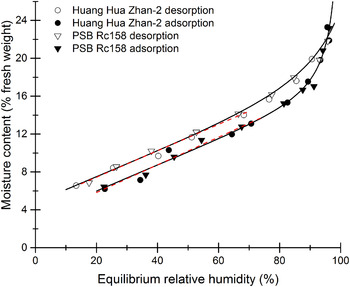
The moisture desorption and adsorption isotherms could be satisfactorily fitted by the modified D'Arcy–Watt equation (Eqn 3), which accounted for 99.4 and 98.3% of the variance, for desorption and adsorption isotherms, respectively (Fig. 1). The desorption isotherm was higher than the adsorption isotherm, with a difference in MC of about 1.6% at RH <80%. At very high moisture levels, the desorption and adsorption isotherms converged. The parameters of the fitted D'Arcy–Watt equation indicated that there was a higher number of weak water binding sites in the adsorbing seeds than in the desorbing seeds, and a decrease in the amount of water in multimolecular binding sites (supplementary table S1).
Moisture desorption and adsorption isotherms for two varieties of rice, Huang Hua Zhan-2 and PSB Rc158. The isotherms were fitted using a modified version of the D'Arcy–Watt equation (Eqn 4); continuous black lines) and by linear regression analysis for the data between 10 and 75% RH (dashed red lines). The isotherms did not differ between the two varieties.

Seed storage: dormancy, after-ripening and viability loss (experiment 1)
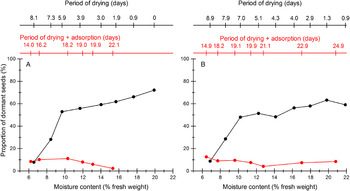
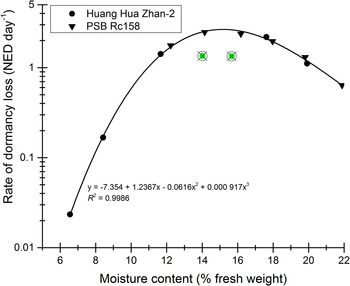
Approximately 70% of the seeds of both varieties were dormant at harvest (supplementary figures S2 and S3; Fig. 2). During drying, dormancy was gradually reduced, reaching approximately 50% at 10% MC. Dormancy was then reduced to <10% by the time the seeds had dried to approximately 6.5% MC. Thus there was relatively little dormancy in the adsorbing seeds. The rate of after-ripening for both (desorbing) seed lots varied in a similar way in response to MC during seed storage, increasing as the storage MC decreased between 22 and 16%, but then decreasing with further reduction in MC (Fig. 3).
The relationship between the proportion of dormant seeds and seed moisture content during desorption (black lines and symbols) or adsorption (red lines and symbols) for two varieties of rice, Huang Hua Zhan-2 (A) and PSB Rc158 (B). Also shown (top axes) is the length of time required to reach the indicated moisture contents during drying (black) and adsorption following drying (red).

The relationship between rate of dormancy loss (in NED day–1) and seed moisture content for desorbing seeds of two varieties of rice, Huang Hua Zhan-2 and PSB Rc158. Excluding the two crossed data points for Huang Hua Zhan-2, the remaining data were fitted by the polynomial equation shown.

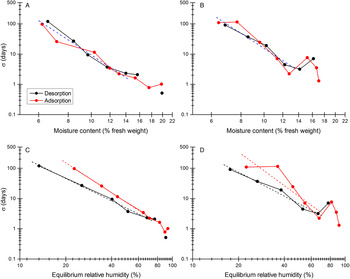
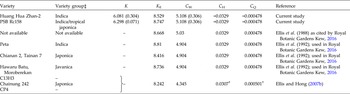
The rate of viability loss also varied with MC (supplementary Figs S2 and S3; Fig. 4). There was a log-log relationship between the standard deviation of the normal distribution of seeds deaths over time, σ, and seed MC between 6 and 14% MC. Within each variety, a single regression line could be fitted through the desorption and adsorption data for the five lowest MC, with a common slope between the two varieties (Fig. 4A, B; Table 1). However, there was a significant difference in the intercept of the regression lines between the two varieties. The estimates for K (Eqn 5) and hence K E (Eqn 6 assuming the universal values for the C H and C Q) therefore differed between the two varieties, although C W did not (Table 1). These estimates of the moisture parameters of the viability equations were very similar to published estimates.
The relationships between σ, the standard deviation of the normal distribution of seed deaths in time and either storage moisture content (A, B) or eRH (C, D) for seeds of rice varieties Huang Hua Zhan-2 (A, C) and PSB Rc158 (B, D). Seeds were stored at 45°C; eRH measurements were made at room temperature. The dashed lines in A and B show the results of fitting, within each variety, a log-log relationship to the desorption and adsorption data for the five lowest moisture levels, constrained to a common slope between the two varieties (Table 1). The dashed lines in C and D show the results of fitting independent (i.e. no constraints within or between each variety) log-log relationships for the five lowest moisture levels (Table 2).

Estimates of the species constants of the seed viability equation (Eqn 1) for the rice varieties used in this study (with SE of estimates in parentheses, where available) and published estimates

‡Variety group as indicated in the published article and not based on more recent SNP-based groupings (McNally et al., Reference McNally, Child, Bohnert, Davidson, Zhao, Ulat, Zeller, Clark, Hoen, Bureau, Stokowski, Ballinger, Frazer, Cox, Padhukasahasram, Bustamante, Weigel, Mackill, Bruskiewich, Rätsch, Buell, Leung and Leach2009).
†Constrained to common values with 11 other species.
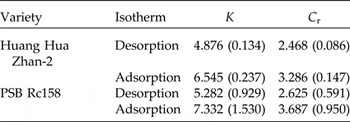
Estimates of the parameters of the eRH version of the seed viability equation (Eqn 8) for the rice varieties used in this study

There was an improvement in fit when a log-log model (Eqn 8) was used to explain the relationship between σ and seed eRH, rather than a log-linear relationship (Eqn 7; e.g. for Huang Hua Zhan-2, 99.4% of the variance accounted for, cf. 94.4%). The lines differed in both slope and intercept depending on whether or not the seeds were desorbing or adsorbing, resulting in differences in the estimates of K and C r (Fig. 4C, D; Table 2).
Moisture desorption, adsorption and seed longevity (experiment 2)
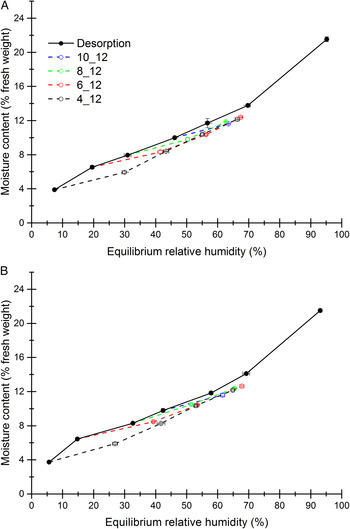
The moisture desorption isotherm was higher than the partial adsorption isotherms, regardless of the MC to which the seeds had been dried (Fig. 5). The difference was greatest (1.8%) at the lowest eRH for which there was data for adsorbing seeds (27–30% eRH) and appeared to reduce as eRH increased (approximately 1% at 65% eRH). For seeds of both varieties, although there was a significant effect of moisture history on both mean seed eRH and mean seed MC (P < 0.05) following equilibration for the storage experiment, only eRH was significantly different for desorbing seeds compared with adsorbing seeds; the MC was not significantly different for desorbing seeds compared with at least two samples of adsorbing seeds (Table 3; Fig. 5). For example, the eRH of desorbing PSB Rc158 seeds was 56.7% (11.7% MC) compared with 62.6–67.4% (11.6–12.4% MC) for adsorbing seeds.
Moisture desorption isotherm (black symbols and black continuous line) and partial adsorption isotherms (open symbols, dashed lines) for seeds of rice varieties PSB Rc158 (A) and NISC Rc222 (B) dried to 10 (10_12), 8 (8_12), 6 (6_12) or 4% MC (4_12). The x- and y-error bars are the standard deviations of three replicates.

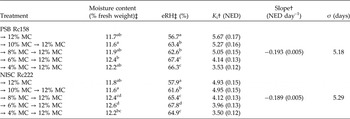
Mean seed moisture content and eRH prior to storage at 45°C and the results of fitting Eqn 5 to the germination data for seeds of two rice varieties, PSB Rc158 and NISC Rc222

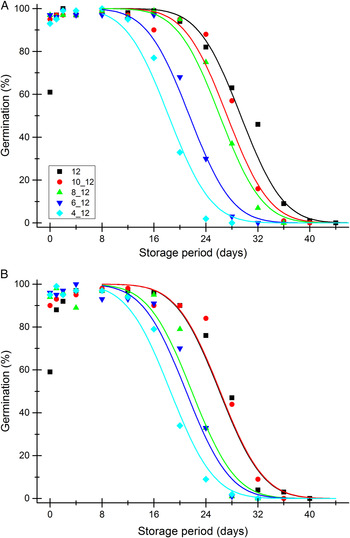
Seeds were either dried to 12% MC or dried to lower MC and then allowed to take up water to reach 12% MC. In order to explore whether or not σ could be constrained to a common estimate within each variety, the data corresponding to storage periods <8 days were omitted (Fig. 6) and only the third term of Eqn 5 was included in the model fitting.
‡Different letters within each variety indicate means that are significantly different (P < 0.05) based on a Tukey multiple comparison test.
†Estimates of the slope (and hence σ) could be constrained to a common value within each variety without a significant increase in residual deviance based on an approximate F-test (P > 0.05); values in parentheses are the standard error of the estimate.
The seed survival curves (Fig. 6), fitted by probit analysis, could be constrained to a common slope (common estimate for σ), without a significant increase in residual deviance (P > 0.05). Hence σ was estimated to be 5.18 days for PSB Rc158 seeds at 11.6–12.4% MC and 56.7% eRH (desorbing) or 32.6–37.4% eRH (adsorbing); the estimate for σ was 5.29 days for NSIC Rc222 at 11.6–12.6% MC and 57.9% eRH (desorbing) or 61.6–57.8% eRH (adsorbing) (Table 3). Approximately 40% of the desorbing seeds were dormant at the start of the storage experiment compared with 5–10% of the adsorbing seeds. However, due to lack of data, it was not possible to model the breaking of dormancy in a model with a common estimate for σ. The estimate for K i decreased the lower the MC to which the seeds were dried before rehydration back to 12% MC (Table 3) such that the desorbing seeds were the longest lived (estimated time for viability to fall to 50%: 29.4 and 26.1 days for PSB Rc158 and NSIC Rc222, respectively; Fig. 6).
Germination during storage for seeds of rice varieties PSB Rc158 (A) and NISC Rc222 (B). Seeds were stored at 45°C and a target moisture content of 12%. Seeds were either on a desorption isotherm (‘12’) or had been dried over silica gel to 10, 8 or 6% MC or to equilibrium (approximately 3.8%) and then rehydrated to 12% MC and were therefore on an adsorption isotherm. Survival curves were fitted to the data corresponding to storage periods ≥8 days using a generalized linear model with probit link function (Eqn 5). Only the third term of Eqn 5 was included in the model fitting so that the survival curves could be constrained to a common slope (Table 3).

Discussion
As reported elsewhere (Kachru and Matthes, Reference Kachru and Matthes1976; Sun, Reference Sun1999), the rice seeds showed a hysteresis effect that resulted in a 1–1.8% difference in the MC of the rice seeds at a given eRH, depending on whether they were desorbing or adsorbing moisture (Figs 1 and 5). Cromarty et al. (Reference Cromarty, Ellis and Roberts1982) concluded that from a genebank management viewpoint, this effect was of little concern, as seeds intended for conservation are always desorbing seeds; seeds are typically harvested at a MC that is in equilibrium with the ambient conditions and then dried to a lower MC for storage in order to minimize the rate of ageing (Hay and Smith, Reference Hay, Smith, Smith, Dickie, Linington, Pritchard and Probert2003; Hay and Probert, Reference Hay and Probert2013). Indeed, it should be noted that Cromarty's equation (e.g. as available in the Seed Information Database; Royal Botanic Gardens Kew, 2016), which is often used to estimate seed MC depending on the seed oil content, ambient RH and temperature, is the expected equilibrium for desorbing seeds. As has been discussed elsewhere (Ellis et al., Reference Ellis, Hong and Roberts1991; Vertucci and Roos, Reference Vertucci and Roos1991), if seeds are transferred between storage environments, as is typical of seed storage experiments in which seeds are allowed to take up moisture at one temperature and then transferred to a higher temperature for ageing, the MC–eRH relationship will change due to the effect of temperature. The seeds may also, if previously dried to a lower moisture level, be on the adsorption isotherm, and hence the MC of the seeds might be lower than predicted using Cromarty's equation. This may be a concern when designing experiments where it is desirable to know and control MC and hence eRH or vice versa in order to make comparisons across seed lots and/or species. For example, it should be noted that the relative longevity data reported by for example, Probert et al. (Reference Probert, Daws and Hay2009) and Merritt et al. (Reference Merritt, Martyn, Ainsley, Young, Seed, Thorpe, Hay, Commander, Shackelford, Offord, Dixon and Probert2014), in which seeds were equilibrated at 60% RH was for adsorbing seeds since the seeds used were from conservation collections that had previously been dried to equilibrium with 15% RH at 15°C. It may also be a problem if predictions of longevity are made using Cromarty's equation to estimate MC based on ambient RH and temperature, when the seeds are adsorbing moisture; since the MC will be over-estimated, longevity will be under-estimated.
The hysteresis effect was greatest over region II of the isotherm, the region where seed longevity can be described by the viability equation (Roberts and Ellis, Reference Roberts and Ellis1989), although the effect has been found to disappear with successive cycles of desorption and adsorption (Chung and Pfost, 1967, as reported by Pixton and Warburton, Reference Pixton and Warburton1971). However, in experiment 1, the relationship between seed longevity (σ) and MC did not vary depending on whether the seeds were desorbing or adsorbing moisture (Fig. 4), and hence the viability constants K and C W did not differ between desorbing and adsorbing seeds (Table 1). Similarly, in experiment 2, the estimate for σ of desorbing and adsorbing seeds equilibrated to the same MC (approximately 12%) could be constrained to a common value (Table 3). The observation that σ is the same at any MC regardless of whether the seeds are desorbing or adsorbing water explains why there is no departure from linearity of the log(σ)-log(MC) relationship when the estimates of σ are from storage experiments in which the seed lots used have an intermediate initial MC and seeds have to be either dried for storage at lower MC or rehydrated for storage at higher MC (e.g. Ellis and Hong, Reference Ellis and Hong2007a). The estimates for C W and, if using the Dickie et al. (Reference Dickie, Ellis, Kraak, Ryder and Tompsett1990) ‘universal’ values for C H and C Q, K E, are not dissimilar to previous estimates for seeds from different varieties of rice (Table 1).
In contrast, when the relationship between σ and eRH was considered, Roberts and Ellis (Reference Roberts and Ellis1989) concluded that there was a semi-logarithmic relationship and that the slope of this relationship, C r (‘like’ C W) did not differ between species. These conclusions were derived from interpolations of data for lettuce and barley. However, it is somewhat surprising that there should be a linear relationship between log σ and eRH (Eqn 7), given that there is a linear relationship between log σ and log MC, and that these two relationships are supposedly valid over the approximately linear part of the isotherm, i.e. region II (Fig. 1). Indeed, it could be that this is where whether or not the seeds are desorbing or adsorbing seeds changes the apparent nature of the relationship. Using data for desorbing seeds (reduced longevity cf. adsorbing seeds; Fig. 4) at low RH and for adsorbing seeds at mid- to high RH (greater longevity cf. desorbing seeds), somewhat linearizes the relationship between log σ and eRH. In experiment 2, adsorbing seeds with the same MC and estimate of σ, had a higher eRH than desorbing seeds (Fig. 5; Table 3). The observation that the longevity–MC relationship does not vary depending on whether or not the seeds are adsorbing or desorbing, but that the longevity–eRH relationship does, is consistent with the conclusions of Bello et al. (Reference Bello, Zuchi, Schwember and Bradford2011) and Bradford et al. (Reference Bradford, Bello, Schwember, Zuchi, Panozzo, Lohwasser and Böerner2015), that MC rather than eRH determines the rate of seed ageing. That is, eRH is not necessarily a good predictor of the rate of ageing reactions, despite the fact that it has been considered to be closely related to the chemical potential of the water in the seeds. K.J. Bradford et al. (personal communication) have indicated that a hysteresis effect was only apparent in a range of vegetable seeds if the seeds were first dried to very low MC (e.g. over an excess of regenerated silica gel). In contrast, in rice seeds, there appeared to be a hysteresis effect even when seeds were dried to just 10% MC before rehydration to 12%, although the extent of the effect was perhaps more pronounced for seeds that had been dried to lower MC (Fig. 5). Butler et al. (Reference Butler, Hay, Ellis and Smith2009) also reported a hysteresis effect for foxglove (Digitalis purpurea L.) seeds that was perhaps greater the lower the MC to which the seeds were first dried. Seeds placed at 95% RH immediately after harvest reached 17.2% MC, as did seeds dried at 80, 65 or 50% RH before placing at 95% RH; however, seeds dried at 30% RH only reached 16.6% MC and seeds dried at 15% RH reached 15.5% MC.
As well as being important for understanding and modelling seed longevity, it has been suggested that the hysteresis effect could be exploited: seeds could be dried to low RH and then equilibrated at a slightly higher RH prior to storage (Bello et al., Reference Bello, Zuchi, Schwember and Bradford2011; Bradford et al., Reference Bradford, Bello, Schwember, Zuchi, Panozzo, Lohwasser and Böerner2015). The seeds, since they are adsorbing moisture, will equilibrate to a lower MC and hence have greater longevity than desorbing seeds equilibrated at the same RH. For genebanks, this may only be practically beneficial if they continue the practice of equilibrating seeds at a certain, constant RH, for example in a drying room (Kameswara Rao et al., Reference Kameswara Rao, Hanson, Dulloo, Ghosh, Nowell and Larinde2006), and not to a target MC. It should also be noted that although it has been suggested that seed longevity is impaired by over-drying (Vertucci and Roos, Reference Vertucci and Roos1990), others have refuted this (e.g. Ellis and Hong, Reference Ellis and Hong2006), and hence although we did not carry out storage experiments on both desorbing and adsorbing seeds at moisture levels less than 13% eRH or 6.5% MC, it seems unlikely that the longevity of the seeds equilibrated to the higher eRH prior to storage could be any greater than that of the seeds that had simply been dried to the lower level.
Although dormancy and after-ripening were not the focus of this study, we also observed the breaking of dormancy during drying, perhaps as a function of the time spent at intermediate moisture levels (Figs 2 and 6), and during storage for those samples that were still showing some dormancy (supplementary Figs S1 and S2; Fig. 6). As reported elsewhere, for red rice (a weed of cultivated rice fields; Gianinetti and Cohn, Reference Gianinetti and Cohn2007) and for example, sunflower (Bazin et al., Reference Bazin, Batlla, Dussert, El-Maarouf-Bouteau and Bailly2011), the rate of dormancy breaking was reduced as the MC of the seeds during experimental storage was reduced (Fig. 3), although caution should be urged as there were different levels of dormancy depending on the MC and it is difficult to accurately model the after-ripening effect when there is limited data. We also saw a slowing in the rate of after-ripening for seeds above 14–16% MC, perhaps due to the limited availability of oxygen, since we stored seeds in air-tight, moisture-proof aluminium foil packets. Bazin et al. (Reference Bazin, Batlla, Dussert, El-Maarouf-Bouteau and Bailly2011) associated loss of dormancy in sunflower seeds with changes in the moisture sorption isotherms. Specifically, with loss of dormancy the isotherm shifted to higher MC for the embryonic axes, but lower MC for the cotyledons. It could be argued that there was a similar effect in our study in that the isotherm of non-dormant seeds was shifted to lower MC (cf. Fig. 2 with Fig. 1). Further work would be needed to independently evaluate whether the isotherm shift is related to dormancy status as well as a hysteresis effect.
Although no obvious trend was apparent in experiment 1, in experiment 2, the lower the MC to which the seeds were dried, the lower the estimate of K i (the initial viability of the seeds when they were first placed into storage) (Fig. 6; Table 3). These seeds had a harvest MC of approximately 21.5% compared with 23.2% for seeds in experiment 1. Levels of dormancy were also not too dissimilar in seeds that were dried to 12% MC (55% in experiment 1 and 40% in experiment 2). Hence all the seeds appeared to have been harvested at a similar level of maturity. Nonetheless, the reduction in K i upon drying suggests that either ageing occurred during the drying and rehydration process or that not all the seeds tolerated drying to successively lower MC which could be a consequence of immaturity at harvest (Hay and Probert, Reference Hay and Probert2013). Alternatively, it could indicate non-truly orthodox, or ‘sub-orthodox’ (Dickie and Smith, Reference Dickie and Smith1995) seed storage behaviour (even at harvest maturity). This is consistent with the relatively short-lived nature of rice seeds compared with seeds of other cultivated species (Walters et al., Reference Walters, Wheeler and Grotenhuis2005) and the observation that seeds of some rice seed lots apparently lost viability faster at –20°C than at 2–4°C (Hay et al., Reference Hay, de Guzman and Sackville Hamilton2015).
Supplementary material
To view supplementary material for this article (table S1 and figures S1 and S2), please visit: https://doi.org/10.1017/S0960258516000222
Acknowledgements
We thank Nora Kuroda and Reaño Renato for technical assistance, and Kent J. Bradford for discussion of the data and comments on previous versions of the manuscript.
Financial support
This research was supported by funding from the German Federal Ministry for Economic Cooperation and Development (BMZ) through the Deutsche Gesellschaft für Internationale Zusammenarbeit (GIZ) GmbH.
Conflicts of interest
None.