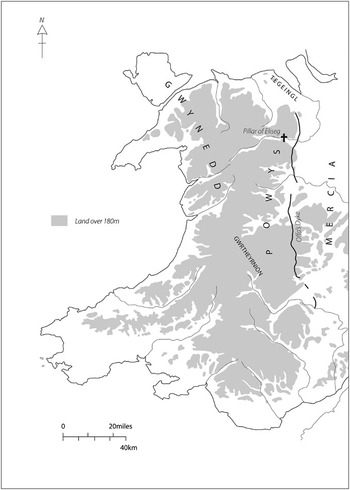
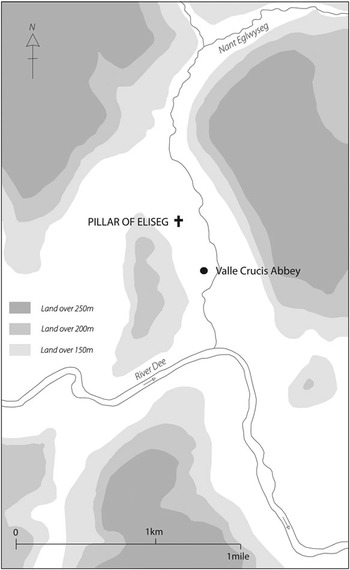
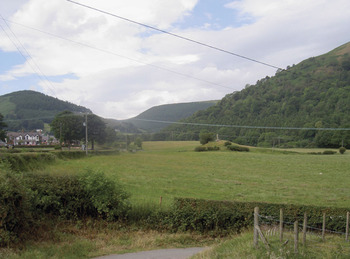
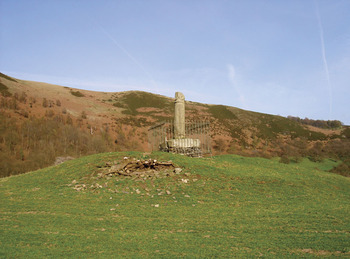
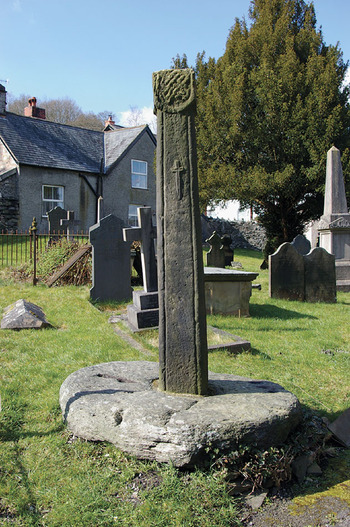
The Pillar of Eliseg (figs 1 and 2) stands in a prominent positionFootnote 1 on top of a barrow in the narrow valley of the Nant Eglwyseg, 1km north of its confluence with the Dee north west of Llangollen (Denbighshire) and 400m north north west of the Cistercian house of Valle Crucis, to which it gives its name (‘Valley of the Cross’). Today, though fragmentary, the monument is still imposing and from the point where it stands there are wide views both up and down the valley (fig 3). It now consists of the upper part of a pillar standing in its original base, which rises to a height of 2.84m (fig 4). Although traces of some letters of the original inscription on the column are visible in oblique sunlight it is now totally illegible. The most important record of the inscription to have survived is that made in 1696 by the antiquary and Celtic linguist Edward Lhuyd (1659/60?–1709) when it was already incomplete. The inscription names Concenn (Cyngen), the ruler of Powys, as the patron and, since it is known that he died in Rome in ad 854, this provides a terminus ante quem for the monument. However, the accuracy of Lhuyd’s transcription has been called into question and, as a result, problems have been raised with its interpretation and use as a document, historical or otherwise. This may account for the general reticence of modern scholars to reassess the significance of this very important monument.
Map of Wales, showing the locations of Welsh and Anglo-Saxon kingdoms mentioned in the text, Offa’s Dyke and the Pillar of Eliseg. Drawing: Tanya Berks

Map showing the location of the Pillar of Eliseg. Drawing: Tanya Berks

The Pillar of Eliseg in its landscape context, looking northwards up the valley of the Nant Eglwyseg. Photograph: Nancy Edwards

The Pillar of Eliseg from the west, showing its position on top of the barrow. Photograph: Nancy Edwards

The history of the monument
The earliest evidence for the Pillar of Eliseg is linked with the nearby Cistercian abbey of Valle Crucis, founded in 1201, which takes its name from the monument.Footnote 2 However, it is first mentioned in the second half of the fifteenth century. The chronicle Brenhinedd y Saesson (‘Kings of the English’) in the Black Book of Basingwerk manuscript copied by Gutun Owain (fl c 1460–c 1498), a native of Dudleston nearby,Footnote 3 refers sub anno 1200 to the location of the foundation of the abbey yNol yrHen Groes yn Ial (‘in the Meadow of the Ancient Cross in Iâl’).Footnote 4 It is likewise mentioned in poems by the same author,Footnote 5 one of whose patrons was Dafydd ap Ieuan ap Iorwerth, the abbot of Valle Crucis, and also by his contemporary, Guto’r Glyn (fl 1440–93), who died there.Footnote 6
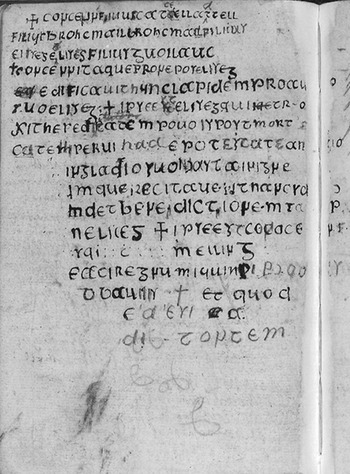
The first known record of the inscription was made in 1648 by the important Merioneth antiquarian and book-collector Robert Vaughan of Hengwrt (1591/2–1667), whose interests also included early royal genealogies.Footnote 7 In 1649 Vaughan sent two copies of his transcript to Archbishop Ussher but neither of these can be traced. However, another copy, probably in his hand, survives in Vaughan’s own Commonplace Book (fig 10).Footnote 8
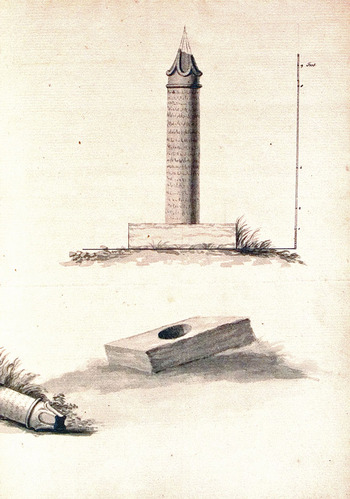
Sketch of the Pillar of Eliseg in 1773 by Daines Barrington before it was re-erected, and his reconstruction of the monument (SAL, Minutes, xiii, 72–3, 20 May 1773). Photograph: Society of Antiquaries of London

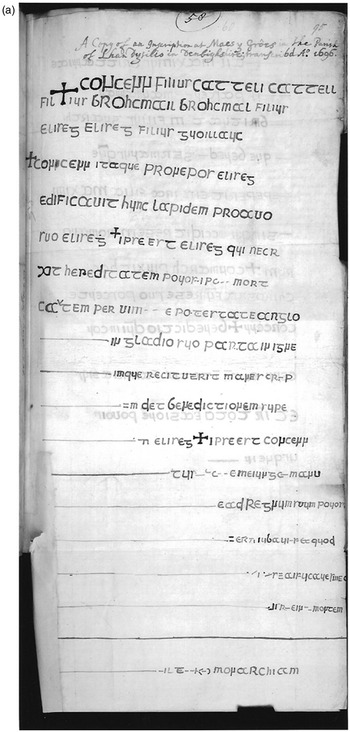
Edward Lhuyd learnt of the Pillar of Eliseg and its inscription in 1693 from the antiquary John Aubrey (1626–97), who had noted it in 1682 in his unpublished Monumenta Britannica, in which he states that the monument had fallen at least forty years before.Footnote 9 Lhuyd believed that this might have occurred during the Civil War, but this is impossible to prove. He appears to have searched unsuccessfully for a copy of Vaughan’s transcript, which he thought might have been made before the monument was thrown down.Footnote 10 However, the inscription seems already to have been fragmentary when Vaughan saw it in 1649. By the summer of 1696 when Lhuyd examined the pillar, which he states had once stood on the mound, it ‘was broken into several pieces’ and the inscription was already badly damaged. He made a line-by-line record of the surviving parts of the inscription and two almost identical copies of this survive in Lhuyd’s own hand (fig 11).Footnote 11
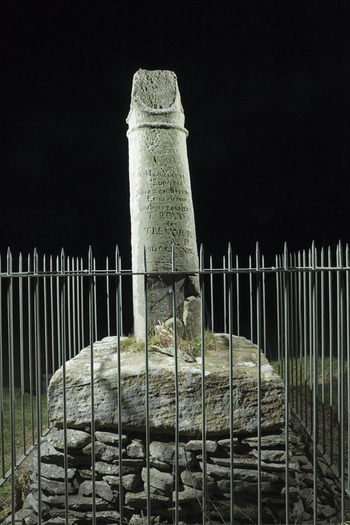
The Pillar of Eliseg from the east, showing the inscription added in 1779, taken at night using artificial oblique lighting. Photograph: © Crown copyright: Royal Commission on the Ancient and Historical Monuments of Wales

In 1773 the gentleman travel writer and naturalist Thomas Pennant visited the monument but could not read the inscription. He notes that at that time the base was lying on top of the mound. Pennant also indicates that the mound had been opened ‘within these few years’.Footnote 12 In the same year a letter from the antiquary Daines Barrington was read at a meeting of the Society of Antiquaries of London. The minutes include an illustration of the fallen monument, a rather fanciful reconstruction (fig 5) and a copy of the inscription obtained from the Bishop of St Asaph.Footnote 13 By the time the pillar was re-erected on top of the mound by the local landowner in 1779 the lower part had been lost. Its base was now placed on a specially constructed drystone plinth obscured by the top of the mound, perhaps to facilitate the view of the monument from the recently extended eighteenth-century lodge near the abbey ruins. A Latin inscription added to the column on the opposite side to the original inscription (fig 6) records its re-erection:
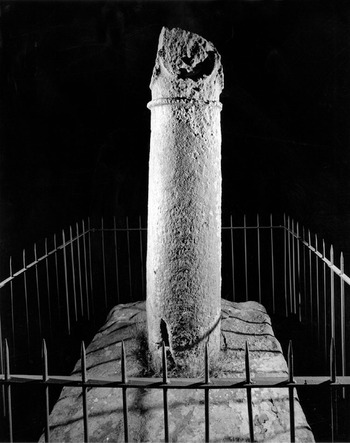
The Pillar of Eliseg from the west, showing the area of the original inscription part way down the column, taken at night using artificial oblique lighting. Photograph: © Crown copyright: Royal Commission on the Ancient and Historical Monuments of Wales

Quod hujus veteris Monumenti
Superest
Diu ex oculis remotum
Et neglectum
Tandem restituit
T. LLOYD
de
TREVOR HALL
A. D.
M D C C L X X I X
That which remains of this old monument, long removed from eyes and neglected, T Lloyd of Trevor Hall finally restored ad 1779
Pennant’s account and the re-erection of the monument as part of a planned estate landscape acted as important catalysts in making the Pillar of Eliseg a worthy stop for early nineteenth-century visitors to the Vale of Llangollen with its picturesque landscape and romantic ruins.Footnote 14
The archaeological context
Lhuyd noted that the monument was ‘erected on a small mount’Footnote 15 and Pennant records that the base was still lying on the top of this.Footnote 16 It is therefore likely that this was its original location. The height of the mound, a barrow, would have given additional prominence to the monument in the landscape. This may be compared with the cross Llanfynydd 1 (Carmarthenshire), which originally stood on a cairn of stones.Footnote 17 Fifth- to early seventh-century inscribed stones in Wales were also sometimes erected on top of, or beside, prehistoric barrows or cairns.Footnote 18 The monument is not associated with any known early medieval ecclesiastical site, though the alternative Welsh name associated with the abbey, Llanegwestl, hints at the existence of an earlier foundation.Footnote 19 It should be noted, however, that at least some Cistercian houses in Wales, notably Margam (Bridgend) and its granges, were on the sites of early medieval ecclesiastical foundations indicated by the presence of early medieval sculpture.Footnote 20 Even if there was no earlier ecclesiastical site, the presence of the monument may well have been influential in the choice of location for the later Cistercian abbey of Valle Crucis.
Apart from Pennant’s brief mention, noted above, the only account of the investigation of the barrow shortly before 1773 was written much later by W T Simpson and published in 1827; it is based on the oral evidence of two old men:
who assisted in opening the tumulus before the pillar was re-erected … On digging below the flat pedestal in which the base of the Pillar had been inserted, they came to a layer of pebble stones; and after having removed them, to a large flat slab, on which it seems the body had been laid, as they now found the remains of it, guarded round with large flat blue stones, and covered at top with the same; the whole forming a sort of stone box or coffin … My informants said they believed the skull was sent to Trevor Hall, but it was returned, and again deposited with the rest of the bones, in its former sepulchre … One of the persons who assisted at the exhumation is now a very old man, and was huntsman to Mr. Lloyd when the tumulus was opened. He says there was a large piece of silver coin found in the coffin, which was kept; but that the skull was gilded to preserve it, and was then again deposited with its kindred bones …Footnote 21
The nature of the account means that it is unlikely to be totally reliable, making it difficult to analyse. Several interpretations are possible. Firstly, the mound may simply be a Bronze Age barrow, the height of which was utilized to make the monument stand out in the landscape and possibly to link the royal house of Powys symbolically with the mythical heroes associated with prehistoric burial mounds in the early Middle Ages as, for example, in the ninth- or tenth-century Englynion y Beddau (‘Stanzas of the Graves’).Footnote 22 In the mid-nineteenth century Williams (Ab Ithel) was of the view that the barrow covered the grave of Eliseg.Footnote 23 Later, Canon Ellis Davies suggested that the monument might have been erected on top of a Bronze Age barrow reused in the later eighth century for the burial of Eliseg.Footnote 24 However, unless the existence of the ‘large piece of silver coin’ (if that is what it was) can be substantiated, it seems unlikely that the barrow was used for the burial of Eliseg since by the later eighth century inhumations without grave goods were the norm and burial in churchyards was becoming more common.Footnote 25 Nor is the inscription on the pillar an epitaph and there is no implication that it marked a grave. The reuse of a Bronze Age barrow in the Roman period or a primary Roman period barrow with an inhumation with a silver coin are also possibilities, though barrows with Roman cremations appear to have been more common.Footnote 26
Re-excavation of the barrow would be necessary to help clarify what was found and obtain satisfactory artefactual and/or radiocarbon dating evidence. Recently, however, following examination of aerial photographs, Dai Morgan Evans (Chester University), Sarah Semple (University of Durham), Alex Turner (SAT Surveys) and Susan Youngs have conducted a series of geophysical and topographical surveys of the site. Both gradiometer and resistivity surveys of the mound and an adjoining area to the north were carried out. In addition Ground Penetrating Radar (GPR) survey and topographical surveys were carried out on the mound and its immediate vicinity. The combined evidence of the geophysical surveys of the area to the north of the mound have indicated a range of activity, including possible curvilinear, rectilinear and linear features, which could represent a palimpsest of potentially prehistoric features overlain by a series of later field boundaries. The GPR and topographical surveys have revealed that the mound, which appears to have a ditch round it, almost certainly consists of two phases of construction. There are now plans to re-excavate the antiquarian trenches dug into the barrow to acquire constructional phasing and dating evidence and to investigate further the archaeological activity to the north.Footnote 27
The form of the monument
The monument (height 2.84m) now consists of the upper part of an incomplete column set in a square base (figs 6 and 7). The surviving part of the column (visible height 2.42m) is divided into two parts. The top is rectangular in section and tapers sharply. There is no mortise hole in the top so the pillar must once have been taller, but it is now unclear whether it was originally a composite monument. The top is divided from the lower section, which is cylindrical, by a curved roll moulding forming four swags with rounded recesses above. Beneath, a horizontal roll moulding runs around the circumference of the column, separating the top from the main part of the shaft. The column itself is slightly oval in section, perhaps so the inscription could be more easily viewed, and it expands slightly from top to bottom. The bottom of the surviving fragment was repaired when it was re-erected in 1779 and the end is obscured by the fact that it has been reset in the base, the socket-hole of which is round, suggesting that the bottom of the pillar was also originally round rather than oval.
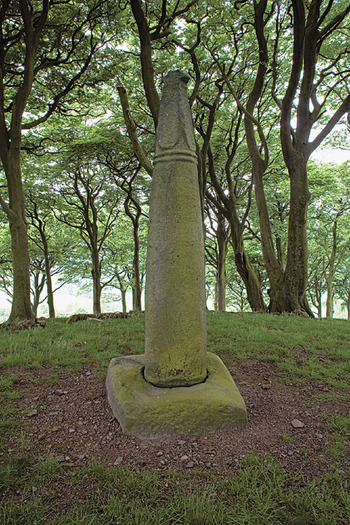
Clulow round-shafted cross, Cheshire. Photograph: © Cadw, Welsh Assembly Government (Crown Copyright)

Corwen shaft, Denbighshire. Photograph: Nancy Edwards

The original form of the monument is not easy to determine from the extant physical evidence. Lhuyd doubted that it had ever ‘been intended for a cross’,Footnote 28 an opinion later reiterated by Westwood.Footnote 29 Bloxam suggested that it was most likely to be a reused Roman column brought from Chester or Wroxeter,Footnote 30 a view which has also recently been revived for the round-shafted crosses of Mercia.Footnote 31 This can, however, be discounted. Firstly, the form of the column is not of Roman type. Secondly, recent examination of the geology by Jana Horák and Heather Jackson of Amgueddfa Cymru – National Museum Wales has identified it as a coarse-grained, well-sorted, quartz-rich, reddish-yellow sandstone, probably the local Cefn-y-fedw sandstone, the nearest exposures of which are only 5km to the east, and no major Roman site is known in the vicinity.Footnote 32 Nevertheless, the form of the monument may have been partially inspired by Roman columns (see below).
In fact it seems certain that the Pillar of Eliseg was originally a free-standing round-shafted cross. Aubrey reports that ‘when it was upright [the monument] was seven yards and upwards in length’.Footnote 33 This cannot be verified, and may well be an exaggeration, but the proportions of the surviving column suggest that in the region of two-thirds to three-quarters of the cylindrical part may be extant. The quadrangular top is also likely to have tapered further and to have been at least double its present height. This would make the column in the region of 4m tall. The references by Gutun Owain and Guto’r Glyn in the second half of the fifteenth century all refer to a cross, and the Cistercian abbey of Valle Crucis is named after it. There is therefore no reason to doubt that the column was once surmounted by a cross-head, though its form, and whether it was carved from the same block of stone as the column which would have restricted its size, or whether it was separate and attached by a mortise-and-tenon joint, are unknown.Footnote 34
J Romilly Allen compared the cylindrical form of the pillar with round-shafted crosses in Anglo-Saxon England, particularly those in Staffordshire, and suggested that the form was probably the result of Anglo-Saxon influence.Footnote 35 Geographically the nearest parallels may be made with plain crosses in north-west Mercia which have round shafts with quadrangular tops, the two sections being separated by horizontal roll mouldings and curved roll mouldings forming swags.Footnote 36 These may be exemplified by the plain shaft at Clulow, near Macclesfield (Wincle 1, Cheshire) (fig 8), one of a group of round-shafted monuments associated with the late Anglo-Saxon parochia of Prestbury and part of a larger grouping centred on the Peak District.Footnote 37 Like the Pillar of Eliseg, the main part of the Clulow shaft is cylindrical and is separated from the upper quadrangular part with its curved swags by horizontal roll mouldings; part of the lower cross-arm is also still extant. Its total surviving height is 2.78m. Interestingly Clulow likewise stands on a mound – in this case natural – at the head of a valley at a conjunction of routeways, and it has been suggested that others in this group, which are not generally associated with church sites, may have functioned as way or boundary markers. However, ornament on some of these monuments suggests that they are of tenth- or eleventh-century date rather than earlier, and Clulow has been dated to the late tenth or eleventh century.Footnote 38 Therefore they cannot be contemporary with the Pillar of Eliseg with its terminus ante quem of 854 (see below).
Inscription on the Pillar of Eliseg as shown in Robert Vaughan’s Commonplace Book (NLW, ms 5262A, fol 68v). Photograph: by permission of Llyfrgell Genedlaethol Cymru – National Library of Wales

Nevertheless, there are a small number of earlier Anglo-Saxon round-shafted crosses of late eighth- or early ninth-century date with complex figural iconography, such as Masham 1 (North Yorkshire), which may have had a separate quadrangular upper part with an associated cross-head,Footnote 39 and the fragmentary Dewsbury 1–3 (West Yorkshire)Footnote 40 and Reculver 1 (Kent).Footnote 41 Some parallels for the form can likewise be made with Beckermet St Bridget 1 (Cumbria), which has been dated to the second quarter of the ninth century.Footnote 42 It is also possible that there were late eighth- or early ninth-century round-shafted crosses in west Mercia, some features of which continued or were revived on the tenth- and eleventh-century examples; these might have served as a model for the Pillar of Eliseg, but have not survived.
The only monument in Wales of a similar type is at Corwen (Denbighshire) (fig 9),Footnote 43 located only 15km to the west, but stylistically it seems somewhat later than the Pillar of Eliseg. The round shaft appears to have been reshaped subsequently to give it a quadrangular section, probably for reuse as a later medieval churchyard cross, but the swagged quadrangular ‘collar’ decorated with plaitwork remained unaltered, and there are further traces of plaitwork remaining on one face of the shaft. The ornament is comparable with that on some of the Peak District group and, like them, it probably dates from the tenth or eleventh centuries.Footnote 44
Edward Lhuyd’s transcription of the inscription on the Pillar of Eliseg (BL, Harleian ms 3780, fol 95). Photograph: © British Library Board. All rights reserved

Edward Lhuyd’s transcription of the inscription on the Pillar of Eliseg (BL, Harleian ms 3780, fol 95). Photograph: © British Library Board. All rights reserved

In Welsh terms the round-shafted form of the Pillar of Eliseg is an exceptionally ambitious monument, which would have taken considerable effort and skill to execute. A long, thin quadrangular block must have been extracted from the quarry with the aid of wedges, but it then had to be transported and shaped into a pillar. The height and slightly oval section of the cylindrical part indicate that it was not produced on a lathe, so the process of shaping and dressing must have been a prolonged one.Footnote 45
The inscription
The lengthy and elaborate inscription (see Appendix) is potentially of great significance as a document that can shed light on the history of the kingdom of Powys, particularly in the later eighth and first half of the ninth centuries. It was also, in its time, an important piece of public propaganda. However, since no more than the general area of the inscription with a few fragmentary letters can now be seen on the stone itself in good oblique light (fig 7), we are totally dependent upon the critical use of antiquarian transcripts.
As we have seen, the earliest surviving transcript may be that in Robert Vaughan’s own Commonplace Book (fig 10).Footnote 46 Only the first sixteen lines of the inscription have been recorded, suggesting that it was already fragmentary when he saw it. While it cannot be proven that the transcript is in Vaughan’s own hand,Footnote 47 this nevertheless seems likely; later additions have been made in pencil in a different hand by someone comparing it with Lhuyd’s. The transcript is, indeed, very similar to Lhuyd’s, but inferior. There is, however, one significant difference: no gaps have been inserted between the words of the inscription, and one would not expect word divisions on early medieval inscriptions in Wales in this period; therefore, in this respect, it may reflect the original more closely.
There are two known surviving copies of Lhuyd’s 1696 transcription, both almost certainly in his own hand. The first (BL, Harleian ms 3780, fol 95) is well known (fig 11). It is appended to a letter (14 September 1696) from Lhuyd to the Revd Dr John Mill, Principal of St Edmund Hall in Oxford, in the hope that he might be able to trace another copy of the inscription, presumably that by Vaughan, which had been sent to Dr Gerald Langbaine of The Queen’s College, Oxford, by Archbishop Ussher.Footnote 48 The second, by contrast, is a recent discovery, located in Bangor University Archives and Special Collections amongst a small group of letters and loose sheets of drawings of monuments and natural history specimens by Lhuyd and his assistants.Footnote 49 These had been sent for comment to one of Lhuyd’s regular scholarly correspondents, Bishop Humphrey Humphreys of Bangor.Footnote 50 The two manuscript copies of the inscription are almost identical and indicate that, by the time Lhuyd saw it, the inscription was already only partly legible; even so, his record is much fuller than Vaughan’s, since thirty-one lines have been transcribed.
No other independent transcriptions are known to have survived. A further copy of Lhuyd’s, in an unknown hand, is extant in BL, Stowe ms 1023, fols 92–93v, an early eighteenth-century manuscript which, together with BL, Stowe ms 1024, provides copies of many of Lhuyd’s inscriptions.Footnote 51 In addition it has been suggestedFootnote 52 that the copy included in the Society of Antiquaries minute bookFootnote 53 might be independent of Lhuyd, but this is unlikely. It is very similar to Lhuyd’s, but undoubtedly inferior.
The accuracy of Lhuyd’s transcription has been called into question, particularly by Bu’Lock;Footnote 54 as a result, problems have been raised with its interpretation and use as a historical document. However, Lhuyd’s transcriptions of early medieval inscriptions in Wales and elsewhere are on the whole remarkably accurate. He took considerable care to copy individual letter forms, often indicating doubt with dotted lines or dots beneath specific characters and illegible characters with dashes.Footnote 55 Therefore, despite the inherent difficulties, a critical study of Lhuyd’s transcriptions has the potential to yield significant results.
To date the most valuable study of Lhuyd’s transcription is that made a century ago by Sir John Rhys, based on BL, Harleian ms 3780, fol 95.Footnote 56 Nash-Williams’s readingFootnote 57 largely follows that of Rhys. Macalister claimed to have verified the majority of the first fifteen lines of the inscription by comparing the traces of letters visible on the still extant part of the column with Lhuyd’s transcription.Footnote 58 However, this should be regarded with great scepticism since CATTELL was almost the only legible word noted by Westwood,Footnote 59 and today only occasional letters are identifiable in good oblique light. Some slight amendents were made to Nash-Williams’s reading by P C Bartrum.Footnote 60 Finally, the recent reading by David HowlettFootnote 61 makes a number of changes and reconstructions, which are not, in my view, borne out by the available evidence of Lhuyd’s record.
Lhuyd shows the fragmentary Latin inscription in thirty-one horizontal lines (fig 11). The beginnings of lines 9 to 25 are missing, lines 15 to 17 are fragmentary and line 18 appears to be missing altogether. The number of letters in each complete line ranges from 21 to 30; the lines at the end appear slightly shorter than those at the beginning. The script is in a decorative mixed-alphabet book hand with some geometric letter forms (N and U).Footnote 62 This would be consistent with the continued use of insular geometric letters into the ninth century, after their heyday in the later seventh and eighth.Footnote 63 Some letters have serifs, presumably reflecting the model. Some letter forms are distinctive (for example, B) and some have more than one form (for example, D and U). There also appears to be a horizontal I in line 10, an archaic feature normally found on sixth- and early seventh-century inscriptions in Wales. The placing of some letters unusually high on the line (geometric N) and some unusually low (G) is distinctive and there may have been some deliberate patterning of the letters to make them pleasing to the eye.Footnote 64 In both manuscripts Lhuyd has mostly, but not always, shown spaces between the words, as he usually did when he recorded early medieval inscriptions. The reading of the text (as transmitted in the Appendix) retains Lhuyd’s word division as far as possible and, like Rhys’s, is derived from BL, Harleian ms 3780, fol 95. An edited text and English translation are also included.
Rhys divided the inscription into nine sections. The beginnings of six of these can be seen on Lhuyd’s transcript marked with an initial cross to facilitate reading; originally the others are likely to have been demarcated in the same way. The use of such crosses is found elsewhere associated with inscriptions on early medieval sculpture in Wales, for example, Llantwit Major 4 (Vale of Glamorgan) and Margam 1 (Bridgend).Footnote 65 In the following discussion each section (a–i) will be considered in turn.
a: lines 1–3
+ Concenn filius Cattell Cattell
filius Brohcmail Brohcmal filius
Eliseg Eliseg filius Guoillauc
+ Concenn son of Cattell, Cattell son of Brohcmail, Brohcmal son of Eliseg, Eliseg son of Guoillauc.
This section was confidently transcribed by Lhuyd and there has been little argument concerning his reading. It clearly consists of a genealogy beginning with Concenn (Cyngen), followed by the names of his father, Cattell (Cadell), his grandfather, Brohcmail (Brochfael), his great-grandfather, Eliseg (Elise), and his great-great-grandfather, Guoillauc (Gwylog).Footnote 66 This parallels the genealogy of the rulers of Powys in BL, Harleian ms 3859, the compilation of which was probably completed in 954; the manuscript may be dated to c 1100.Footnote 67 Concenn was the last of his line and, according to the Annales Cambriae, died in Rome in 854; the obit of Cattell is noted in 808.Footnote 68 The floruit of Eliseg would therefore have been some time in the second half of the eighth century.
b: lines 4–6
+ Concenn itaque pronepos Eliseg
edificauit hunc lapidem proauo
suo Eliseg
+ Concenn therefore, great-grandson of Eliseg, erected this stone for his great-grandfather Eliseg.
The second section is also clear. It reiterates the relationship between Concenn and Eliseg and indicates that Concenn is setting up the monument in honour of his ancestor.
c: lines 6–9
+ Ipse est Eliseg qui nec
xit(?) hereditatem Pouos … mort
c autem(?) per uim … e potestate Anglo
[rum] … in gladio suo parta in igne
+ It was Eliseg who united the inheritance of Powys … however through force … from the power of the English … land with his sword by fire(?).
Lhuyd’s transcript of the third section is incomplete: he was uncertain about some letters in the second half of line 7 and in the middle of line 8; the beginning of line 9 was also illegible. In my view a complete reading is not possible and Howlett’s reconstructionFootnote 69 may be discounted on the grounds of lack of evidence. Nevertheless, the general sense of the section is recoverable and explains why Eliseg was being honoured in this way. It tells us that Eliseg had united Powys by force from English control. However, the details are unclear. The word (lines 6–7) apparently shown by Lhuyd as NECR/XIT is problematic and the R is probably an error. This verb was taken by Nash-Williams to mean that Eliseg ‘annexed’ the inheritance of Powys (from Latin nanciscere).Footnote 70 However, it is more likely, as Macalister suggested, that necxit (from Latin nectere) meaning ‘united’ was intended.Footnote 71 The meaning of --IPC-- MORT/CAVTEM (lines 7–8) is unclear, though the last five letters may well be autem. The next two words in line 8 of Lhuyd’s transcript seem most likely to be per uim (‘through force’). Rhys originally read it as such, but was persuaded by Sayce to render it as per viiii [annos] (‘throughout 9 [years?]’),Footnote 72 and this has been followed by Nash-Williams;Footnote 73 Macalister only read ‘per u[…]’.Footnote 74 It is possible to reconstruct potestate Anglo/[rum](‘from the power of the English’) with reasonable confidence, since this would make sense, but it is possible that further letters have also been lost. The next phrase in gladio suo parta in igne was translated by Rhys as ‘which he made into a sword-land by fire’,Footnote 75 but this does not seem satisfactory. Parta is problematic, but, as Rhys suggested, it might indeed be derived from pars and mean ‘a portion of land’. The phrase would therefore expand on and endorse the idea of a victory or the reconquest of the inheritance of Powys from the Anglo-Saxons.
Contemporary documents are scarce. Nevertheless the historical context alluded to by this section has recently been discussed by both David Hill and Thomas Charles-Edwards.Footnote 76 During this period the border between Powys and Mercia was in flux. Eliseg of Powys would most likely have been a contemporary of King Offa of Mercia who reigned 757–96. To what extent the rulers of Powys were subject to Mercian hegemony in this period is not known, but English raids into Wales and other hostilities during Offa’s reign are noted in the Annales Cambriae.Footnote 77 Indeed, the location of the pillar and the inscription suggest that the English had penetrated westwards along the fertile corridor of the Dee and seized the Vale of Llangollen and probably also the narrow corridor of the Nant Eglwyseg, a strategic north–south route giving access to the borderlands of Tegeingl, bringing them both temporarily under direct Mercian control. The construction by the Mercians of Offa’s Dyke, only 9.5km to the east, provides a further important piece of archaeological evidence. It may be seen, once the Welsh had recovered the area, as the establishment by King Offa of a defended frontier between the hostile kingdom of Powys, which had once stretched further east, and the expanding kingdom of Mercia.Footnote 78 This section therefore proclaims Eliseg’s success in this struggle and in all likelihood the recovery of land in the area where the monument was set up.
d: lines 10–12
[+ Quicu]mque recit(a)uerit manescr[i]p
[tum] … m det benedictionem supe
[r animam] Eliseg
[+] Whosoever shall read out loud this hand-inscribed … let him give a blessing [on the soul of] Eliseg.
The fourth section can be reconstructed for the most part, even though the beginning of each line is missing, because it is a variation on a commemorative formula asking all those who read the inscription to give a blessing on the soul of the person named. Certainly [+ Quicu]mque recit(a)uerit manescr[i]p/[tum] may be reconstructed with some confidence, and John Higgitt has drawn attention to the use of recit(a)uerit, indicating that the inscription should be read out loud to all those who could not read it for themselves.Footnote 79 It may be possible to take this a stage further and to suggest that the inscription as a whole was intended to be proclaimed publicly. The first legible part of line 11, two horizontal strokes followed by an M, could be the end of manescr[i]p[tu]m, as Macalister shows.Footnote 80 This is unlikely, however, because the line would be rather short. Rhys reconstructed lapidem (echoing lapidem in line 5)Footnote 81 and this was followed by Nash-WilliamsFootnote 82 but not Howlett.Footnote 83 While lapidem remains likely, it is too fragmentary to reconstruct and there are other possibilities, notably crucem (‘cross’). The rest of the paragraph det beneditionem supe/[r animam] Eliseg, including the reconstruction of animam, where part of the final M at the beginning of line 12 appears to have been noted by Lhuyd, is reasonably secure because it is a standard formula.
The wording of the section as a whole may be compared with the inscription on Llanwnnws 1 (Ceredigion), likewise datable to the ninth century.Footnote 84 Further parallels may be made with inscriptions on the possibly mid-eighth-century Tullylease 1 slab (Co Cork),Footnote 85 the later eighth- or ninth-century cross-carved pillar at Langombrac’h, Morbihan, in Brittany,Footnote 86 and also with the manuscript colophon in the early ninth-century Irish gospels, the Book of MacRegol.Footnote 87
e: lines 12–17?
+ Ipse est Concenn
… … … … manu
… … … e ad regnum suum Pouos
… … … … et quod
… … … … …
… … … … montem
+ It is Concenn … with his hand … his own kingdom of Powys … and which … the mountain.
Only fragments can be read of the fifth section, which begins in line 12; the beginnings of the lines are missing and substantial parts of Lhuyd’s transcript of the ends of lines 15 to 17 are unintelligible. It is not clear where the section ends. Rhys suggested the end of line 17 (montem) as a possibilityFootnote 88 and this is followed here. The first three words – Ipse est Concenn – mirror Ipse est Eliseg at the beginning of section c, thereby emphasizing stylistically the link between the two men established in the first section. This, and the sense of the other surviving words, suggests that the purpose of this section was to extol Concenn’s deeds as ruler of Powys, including, perhaps, his successes against the Anglo-Saxons, in a similar way to those of Eliseg. It is pertinent to note that Concenn undoubtedly spent much of his long reign, which began in 808, fighting Anglo-Saxon incursions. He died in 854 in Rome,Footnote 89 presumably while on a pilgrimage, though whether he had lost his throne by this date is unclear. He may have been subjected, at least temporarily, to Mercian overlordship in 822, and to that of Ecgberht of Wessex in 828, and again to Burgred of Mercia and Æthelwulf of Wessex when they invaded Wales in 853 and exacted submission from Welsh rulers.Footnote 90
f/g: lines 18–26?
… … … … …
… … … … monarchiam
… … ail Maximus Brittanniae
… nn Pascen[t] … Mau[n] Annan
… Britu a[u]t[e]m filius Guarthi
[girn] que(m) bened[ixit] Germanus que(m)
… peperit ei Se[v]ira filia Maximi
[re]gis qui occidit regem Romano
rum
… monarchy … Maximus of Britain … Pascent … Maun Annan … Britu moreover [was] the son of Guarthigirn whom Germanus blessed [and whom] Sevira bore to him, the daughter of Maximus the king, who killed the king of the Romans.
Lhuyd was unable to read any of line 18 and more may be missing; only monarchiam is legible in line 19. Furthermore, it is unclear where section f begins, but, as Rhys suggested, it may have consisted of lines 18 to 21. He attempted a reconstruction of these lines, though this is purely guesswork. He also suggested that the next section might begin with Britu in line 22,Footnote 91 and this seems likely. Section h clearly commences with the cross in line 26. While it may now be impossible to determine the sections exactly, lines 20 to 26 are clearly linked. They are concerned with Magnus Maximus, the Roman usurper, his links to the British ruler Guarthigirn and his family and the Powys saint Garmon, and they appear to take us back to the origins of the kingdom of Powys in the late and sub-Roman period as they were perceived in the time of Concenn.
The Spaniard Magnus Maximus seized power in Britain in 383 and left with his troops for the Continent where he defeated the Emperor Gratian near Paris. Gratian fled and was killed at Lyons by one of Maximus’ commanders. Maximus took control of Gaul and Hispania in addition to Britain, governing from Trier, but was finally executed by generals of the Emperor Theodosius near Aquileia when he advanced on Italy in 388.Footnote 92 The phrase qui occidit regem Romano/rum in lines 25 to 26 refers to the death of Gratian. The appearance of Magnus Maximus on the Pillar of Eliseg has been explained by David Dumville, who has convincingly shown that, from Gildas’ De Excidio (c 540) onwards, Magnus Maximus acquired increasing historical and mythical significance as the supposed last Roman emperor in Britain and the founding father of post-Roman kingdoms in Wales,Footnote 93 who ultimately re-emerged in the twelfth century as the legendary literary hero Maxen Wledic.Footnote 94 Line 24 of the Pillar of Eliseg inscription also makes the claim that Sevira, the daughter of Magnus Maximus, was the wife of Guarthigirn, thereby linking Maximus directly with the genealogy of the rulers of Powys.Footnote 95
The second major figure, Guarthi/[girn] (lines 22 to 23), has been discussed at length by many writers.Footnote 96 Although the name as transcribed by Lhuyd is incomplete, the context leaves little doubt that Guarthigirn, also known as Gwrtheyrn and Vortigern, has been correctly identified. Unless he is another figure of the same name linked specifically with Powys,Footnote 97 he may be identified as the shadowy fifth-century superbus tyrannus (‘proud tyrant’) in Gildas’ De Excidio et Conquestu Britanniae and the British ruler later named by Bede who invited Hengist and Horsa into Britain as mercenaries, whose rebellion led to the foundation of the Anglo-Saxon kingdom of Kent.Footnote 98 However, he is also treated at length as a reviled figure in the Historia Brittonum, attributed to Nennius and written in north Wales in 829/30;Footnote 99 it is therefore broadly contemporary with the erection of the Pillar of Eliseg. In the Historia Brittonum Gwarthigirn is placed near the head of the ruling genealogy of Builth and Gwerthrynion (named after him), a sub-kingdom in southern Powys.Footnote 100 In the Harleian genealogies, however, the kingdom of Powys has an alternative founder, Catell Dyrnllwc.Footnote 101 The genealogy preserved in the later fourteenth-century Oxford, Jesus College ms 20Footnote 102 may be an amalgamation of the two traditions.Footnote 103 Versions of the names Pascent and Maun Annan, which appear in line 21 on the Pillar of Eliseg, are also found in the various genealogies, and the latter is identified as one of the sons of Gwarthigirn in the Historia Brittonum.Footnote 104 In lines 22 to 23 on the Pillar of Eliseg, Britu is named as another son, not otherwise known, of Guarthigirn, by his union with Sevira.
The third figure is Germanus who blessed Britu (line 23). He should not be confused with St Germanus of Auxerre, who visited Britain twice in the first half of the fifth century to combat Pelagianism.Footnote 105 Rather, in the Welsh form of the name – Garmon – he may be identified as a local saint whose cult is associated with Powys and Gwytheyrnion. One of the strands concerning Guarthigirn in the Historia Brittonum is made up of extracts from a lost life of this saint.Footnote 106 Some 11.75km north of the Pillar of Eliseg is the church of Llanarmon yn Iâl (Denbighshire), the major church in the area, which is dedicated to the saint.Footnote 107
Finally, in this context, it is worth considering why Concenn had genealogical material incorporating Magnus Maximus and Guarthigirn inscribed on the monument. Eliseg is praised for his success against the English in section c, and Concenn’s exploits seem to be compared with Eliseg’s in section e. In f/g, Guarthigirn may be introduced as the ancestor of Eliseg and Concenn because he had been the legitimate ruler of Britain, who had inherited power from the Romans, though he had later lost it to the Anglo-Saxons. The kings of Powys might therefore be claiming to be seen as the rightful rulers of the parts of Britain which Gwuarthigirn had held and to justify the expulsion of the English not just from the greater Powys (including Gwrtheyrnion), which had once stretched east of Offa’s Dyke and Wat’s Dyke, but possibly from Britain as a whole. The adoption of Guarthigirn as a mythical founding hero by the rulers of Powys might also be seen in terms of the increasing power of the kingdom of Gwynedd in the early ninth century and the consequential threat to Powys,Footnote 108 since the Historia Brittonum, which was compiled in Gwynedd, reviles him.
h: lines 26–8
+ Conmarch pinxit hoc
chirografu(m) rege suo poscente
Concenn
+ Conmarch represented pictorially this writing at the demand of his king, Concenn.
Lhuyd’s transcription of this section is complete and the reading is clear. It begins with the name of Conmarch, the person who had literally ‘painted’ (pinxit) the inscription at Concenn’s command. He is almost certainly the composer, presumably a cleric well versed in Latin with a knowledge of legal documents and manuscript writing, who articulated the wishes of Concenn, his patron. He then wrote the inscription out prior to carving, most likely in ink on a scrap of vellum, since the term depinxit is also found in manuscript colophons, for example, in the early ninth-century Gospels of MacRegol.Footnote 109 This could then be used as the model by the mason who carved the inscription. The choice of words might also refer to the painting of the carved letters in the manner of a Roman inscription, possibly in red, to make them stand out more clearly. Composers and craftsmen are seldom named in this way but the inscription on the cross-shaft Merthyr Mawr 1 names Sciloc and that on Merthyr Mawr 2 names Pirus, though the formula is different and it might refer to the patron.Footnote 110 There are also instances in Ireland and Anglo-Saxon England.Footnote 111
The use of the word chirografu(m) is also noteworthy since this term, though it literally means ‘writing’, was also widely used in early medieval Europe in the legal sense of a ‘deed’ or ‘charter’. The term used is drawing attention to the legal formality of the whole inscription. It also suggests that the function of the monument and its inscription was as a permanent and very visible sign of the possession of land and proof of ownership by the rulers of Powys in a political, rather than proprietary, sense.Footnote 112 Early medieval cross-carved stones and free-standing crosses were also set up elsewhere in Wales and other Celtic areas to demonstrate land ownership, and some of the more ambitious monuments have inscriptions that also use terminology identified by Wendy Davies as part of a Latin charter tradition found in Celtic-speaking areas.Footnote 113 The best parallels are provided by the inscriptions on the crosses Merthyr Mawr 2 and St Brides Major and Wick 1, which record the donation of land to the church at Merthyr Mawr (Bridgend).Footnote 114 The inscription on the former includes the word grefium, meaning a ‘charter’ or ‘deed’.Footnote 115
i: lines 28–31
+ Benedictio d(omi)ni in Con
cenn et s(imilite)r(?) i(n) tota familia eius
et in(?) tota ragione(m?) Pouois
usque in …
+ The blessing of the Lord upon Concenn and likewise(?) on all of his household and upon all the province of Powys until … .
The third word of line 29 is not entirely legible, though an abbreviation, s(imilite)r, is a possible reconstruction. In line 30 the abbreviation marks over in and ragione are puzzling and part of the last line of the final section is missing. However, the general sense is clear. Looking to the future, it requests God’s blessing on Concenn and his whole family and the whole kingdom of Powys. The formula benedictio d(omi)ni may be compared with those on the ninth-century cross-carved stones Llanddewibrefi 6 and Llanwnnws 1 (Ceredigion).Footnote 116 Rhys suggested that line 31 should be reconstructed as usque in [Diem Iudice] (‘until the Day of Judgement’).Footnote 117 Though the exact words are unknown, a phrase of this kind is appropriate. For example, the inscription on Merthyr Mawr 2 ends with in proprium usque in Diem Iudice (‘in perpetuity until the Day of Judgement’).Footnote 118
Conclusion
The Pillar of Eliseg is therefore a very ambitious monument. It was erected in response to the increasing threat to the ruling dynasty of Powys during the second half of the eighth and first half of the ninth centuries and was intended to convey a series of messages to its audience.
Its prominent location, commanding the valley of the Nant Eglwyseg, was intended to signify the ownership of the land by the rulers of Powys and its recovery from the English. It may also be argued that its position on top of a probable Bronze Age barrow, which may have been set in a broader landscape of prehistoric monuments, was intended to make a direct link with the mythical past and the ownership of land by Concenn and his forebears since time immemorial.
One might take this a step further and speculate on whether the site could have been a focus of an assembly place and an inauguration site of the rulers of Powys, perhaps in the period after the land was reclaimed from the English.Footnote 119 Very little indeed is known about such sites in early medieval Wales and no examples have been identified on the ground. However, in his discussion of the Welsh word gorsedd, which literally means an ‘over seat’, Thomas Charles-Edwards has shown that it can also mean a ‘mound’ or ‘tumulus’ and a ‘court’ or ‘judicial assembly’.Footnote 120 This suggests that prehistoric barrows or other artificial or natural mounds could have acted as foci for assemblies and royal inaugurations in Wales, as they did in Ireland, Scotland and the Isle of Man, as well as in Anglo-Saxon England and Scandinavia.Footnote 121 The presence of the cross on top of the mound might then be seen as symbolic of the growing role of the Church in such secular ceremonies (also suggested in the inscription in the blessing of Britu by Garmon), the political interplay between Church and State and the role of God as a legal witness of events (as in the late ninth-century Celtic charters added to St Chad’s Gospels when the manuscript was at Llandeilo Fawr, Carmarthenshire).Footnote 122 It has been suggested (above) that the inscription on the monument, with its legal terminology and royal genealogy, was intended to be read out loud and it is possible that the mound itself could have acted as a place of proclamation. Indeed, the public recitation of the royal genealogy may have been an important element of the inauguration of the rulers of Powys. Although early medieval accounts do not survive, the inauguration ceremony of the Scottish king Alexander iii beside a cross in the churchyard at Scone in 1249, which is thought to have incorporated archaic features, included the proclamation of the royal genealogy.Footnote 123 The inscription on the Pillar of Eliseg could have served as a permanent reminder of such an event, perhaps the inauguration of Concenn himself.
The monument may also be compared with the early ninth-century Dupplin Cross, Perthshire, which stood on a ridge overlooking Strathearn and the Pictish royal site of Forteviot. The fragmentary roman-letter inscription on the west face names Cu[sta]ntin filius Fircu, king of the Picts (789–820) and of the Scots (811–20). The iconography is largely secular and regal, consisting of a man on horseback and armed warriors (the king and his retinue?), together with Old Testament episodes from the life of King David.Footnote 124
In form the Pillar of Eliseg was a round-shafted cross, a form unique in Wales, apart from the later shaft at nearby Corwen. Though there were Anglo-Saxon round-shafted crosses of ninth-century date, none is known from north-west Mercia, where the surviving monuments may be dated to the tenth or eleventh centuries. Nevertheless there are sufficient similarities with ninth-century round-shafted crosses from elsewhere in Anglo-Saxon England to suggest that the form of the Pillar of Eliseg could have been at least partly inspired by such monuments.
There is, however, another reason why the round-shafted cross may have been adopted. The cross symbol – and by extension the free-standing cross – was essentially a sign of victory, as the Old English sigbecn inscribed in runes on the Bewcastle Cross makes clear.Footnote 125 Though much smaller, the form of the round-shafted cross is likely to be derived in part from Roman victory columns, such as Trajan’s Column, the Column of Marcus Aurelius or the Roman column reused and set up in the Roman forum in 608 to extol the virtues of the Byzantine Emperor Phocas, all of which remained landmarks to later visitors to Rome.Footnote 126 The form of the cross would therefore have been apposite to record the victory of Eliseg over the English. The fact that the inscription on the pillar traces the origins of the dynasty of Powys back to the Roman usurper Magnus Maximus is also relevant here since the semi-Classical form of the monument would have enhanced its imperial pretensions.
It is also worth noting that there were pillars topped by crosses at an early date in the Holy Land. The anonymous Piacenza pilgrim, who wrote an account of his travels c 570, notes a monument on the road just outside Jerusalem consisting of a large marble column with an iron cross on the top.Footnote 127 A column near the Holy Sepulchre, mentioned by Adomnán and Bede, had an image of Christ on the top crowned by a cross.Footnote 128 A pillar with a cross on top is also shown in a scene depicting the Visitation on an ampulla from the Holy Land dated to the second half of the sixth century.Footnote 129 An image of this kind on a portable pilgrim souvenir could have been one possible source of inspiration for round-shafted crosses in Britain. At any rate the original free-standing cross form of the Pillar of Eliseg makes it a specifically Christian type of victory monument.
In contrast with the Dupplin Cross and Anglo-Saxon ninth-century round-shafted crosses, the only known embellishment on the Pillar of Eliseg was the inscription, the significance of which cannot be ignored because it exists only as an antiquarian transcription. A critical re-evaluation of what Edward Lhuyd recorded has revealed much. Sufficient still survived in Lhuyd’s day to demonstrate that this lengthy and stylistically sophisticated inscription was very carefully composed. Its significance was also enhanced by the decorative, mixed-alphabet lettering, the slightly antiquated style of which lent further gravitas and majesty to the words.
First and foremost the inscription was an important piece of royal propaganda which incorporated the phraseology of a legal document confirming the ownership of land, the kingdom of Powys, from the time of Magnus Maximus and Guarthigirn onwards with the blessing of the local saint, making a clear link between Church and State. The use of genealogy and the repetitious phraseology in section a are important in the confirmation of power over the generations and the link between Concenn and Eliseg. It is also reiterated in the phraseology of the inscription through the use of ipse est at the beginnings of sections c and e, since Concenn is making a direct comparison between himself and his great-grandfather whose successes against the Anglo-Saxons were being extolled.
As we have seen, the inscription may well have been intended to be proclaimed out loud to an assembled audience familiar with stories of the origins and victories of the rulers of Powys in the form of oral poetry. In the end, however, such public propaganda was to no avail and Concenn was the last of the known rulers of early medieval Powys. Nevertheless, as David Stephenson has recently suggested, it is interesting to note that in the mid-twelfth century the then ruler of Powys, Madog ap Maredudd (d 1160), was still seeking to make a link with his early medieval forebears and with the Pillar of Eliseg itself by calling his youngest son Elise.Footnote 130
Acknowledgements
This article arises from work for the third volume of A Corpus of Early Medieval Inscribed Stones and Stone Sculpture in Wales, funded by a British Academy Research Leave Fellowship. Much of the research was carried out while I was a Visiting Fellow at All Souls College, Oxford, during Michaelmas Term 2007. I am very grateful to both bodies for their generosity. I benefited enormously from the opportunity to try out my ideas in the Oxford University Celtic seminar, at Jesus College, and in the Department of Anglo-Saxon, Norse and Celtic at the University of Cambridge. I would particularly like to thank Dai Morgan Evans, Sarah Semple and Alex Turner for sharing the results of their recent fieldwork at the Pillar of Eliseg with me and for their hospitality on my visit to the site. Dai Morgan Evans, Helen McKee, Huw Pryce, Sarah Semple and Patrick Sims-Williams have all commented on drafts of this paper, to its great benefit. Helen McKee has also advised me on the palaeography of the inscription. I am likewise grateful to Richard Bailey, who let me see a draft of the relevant parts of his forthcoming volume on Cheshire in the Corpus of Anglo-Saxon Stone Sculpture, and to Jana Horák and Heather Jackson for their identification of the geology. I would like to thank the late Gifford Charles-Edwards (to whose memory this article is dedicated), Thomas Charles-Edwards, Eric Denton, Maredudd ap Huw, Owain Jones, Katharine K Olson, Mark Redknap, Paul Russell, Richard Sharpe, Diane Williams, Howard Williams, Iain Wright and Susan Youngs for their suggestions and other help in various ways. Finally, my thanks go to Tanya Berks for preparing the maps.
BIBLIOGRAPHY
ABBREVIATIONS
- Abbreviations
- BL
British Library
- BU
Bangor University
- DMLBS
Dictionary of Medieval Latin from British Sources
- NLW
National Library of Wales, Aberystwyth
- SAL
Society of Antiquaries of London
Appendix: The text of the inscription
The text as transmitted
This text of the inscription is derived from BL, Harleian ms 3780, fol 95. The minor differences with BU, ms Penrhos v, 872 are noted as footnotes. Sections are lettered and lines are numbered. Letters which cannot be securely identified are shown in italics; illegible characters are shown as dots; Lhuyd’s dashes are reproduced.
a 1 + CONCENN FILIUS CATTELL Footnote 1 CATTELL
2 FILIUS BROHCMAIL BROHCMAL FILIUS
3 ELISEG ELISEG FILIUS GUOILLAUCFootnote 2
b 4 + CONCENN ITAQUE PRONEPOS ELISEG
5 EDIFICAUIT HUNC LAPIDEM PROAUO
c 6 SUO ELISEG + IPSE EST ELISEG QUI NECR
7 XIT HEREDITATEM POUOS- -IPC- - MORT
8 CAVTEM PER UIM - - E POTESTATEANGLO
9 - - - - - - - - - - - - IN GLADIO SUO PARTA IN IGNE
d 10 - - - - - - - - - - - - .MQUE RECITUERIT MANESCR-P
11 - - - - - - - - - - - - - - .M DET BENEDICTIONEM SUPE
e 12 - - - - - - - - - - - - - - - - . ELISEG + IPSE EST CONCENN
13 - - - - - - - - - - - - - - - - - - - - TU.–.C- -E Footnote 3MEIUNGC–MANU
14 - - - - - - - - - - - - - - - - - - - - - - - - EAD REGNUM SUUM POUOSFootnote 4
15 - - - - - - - - - - - - - - - - - - - - - - - - - - - .E…IUBAUI-S- QUOD
16 - - - - - - - - - - - - - - - - - - - - - - - - - - - - - ….S.AIS-UCAUES.EFootnote 5
17 - - - - - - - - - - - - - - - - - - - - - - - - - - - - - - - - - - - ..R-EIN--MONTEM
f/g 18 - - - - - - - - - - - - - - - - - - - - - - - - - - - - - - - - - - - - - - - - - - - - - - - - - - - -
19 - - - - - - - - - - - - - - - - - - - - - - - - - - - -…--.-. MONARCHIAM
20 - - - - - - - - - - - AIL MAXIMUS BRITTANNIAE
21 - - - - - - - - NN PASCEN -- MAU.ANNAN
22 - - - - - - BRITUA-T-M FILIUS GUARTHI
23 - - - - - - QUE BENED – GERMANUS Q UE
24 - - - -.PEPERIT EISE-IRA FILIA MAXIMI
25 - - - GIS QUI OCCIDIT REGEM ROMANO
h 26 RUM + CONMARCH PINXIT HOC
27 CHIROGRAF U REGE SUO POSCENTE
i 28 CONCENN + BENEDICTIO D IFootnote 6 IN CON
29 CENN  Footnote 7 TOTA FAMILIA EIUS
30 ET I TOTA RAGIO
 Footnote 8 POUOIS
31 USQUE IN - - - - - -
Edited text
Not all the text as transmitted is intelligible. Parts that cannot be read are indicated as ellipses, and question marks in round brackets have been added at uncertain points. Reconstructions are shown in square brackets. Expansions are shown in round brackets.
a + Concenn filius Cattell Cattell/filius Brohcmail Brohcmal filius/Eliseg Eliseg filius Guoillauc/
b + Concenn itaque pronepos Eliseg/edificauit hunc lapidem proauo/suo Eliseg
c + Ipse est Eliseg qui nec/xit(?) hereditatem Pouos …mort/c autem(?) per uim …e potestate Anglo/[rum]…in gladio suo parta in igne/
d [+ Quicu]mque recit(a)uerit manescr[i]p/[tum] … m det benedictionem supe/[r animam] Eliseg
e + Ipse est Concenn /……… … manu/……… e ad regnum suum Pouos/…… …… et quod/…… … ……/…… …… montem/
f/g … ………… /……… … monarchiam/… … ail Maximus Brittanniae/… nn Pascen[t] … Mau[n] Annan/… Britu a[u]t[e]m filius Guarthi/[girn] que(m) bened[ixit] Germanus que(m)/… peperit ei Se[v]ira filia Maximi/[re]gis qui occidit regem Romano/rum
h + Conmarch pinxit hoc/chirografu(m) rege suo poscente/Concenn
i + Benedictio d(omi)ni in Con/cenn et s(imilite)r(?) i(n) tota familia eius/et in(?) tota ragione(m?) Pouois/usque in …
Translation
a ‘+ Concenn son of Cattell, Cattell son of Brohcmail, Brohcmal son of Eliseg, Eliseg son of Guoillauc.
b + Concenn therefore, great-grandson of Eliseg, erected this stone for his great-grandfather Eliseg.
c + It was Eliseg who united the inheritance of Powys … however through force … from the power of the English … land with his sword by fire(?).
d [+] Whosoever shall read out loud this hand-inscribed … let him give a blessing [on the soul of] Eliseg.
e + It is Concenn … with his hand … his own kingdom of Powys … and which … the mountain.
f/g … monarchy … Maximus of Britain … Pascent … Maun Annan … Britu moreover [was] the son of Guarthigirn whom Germanus blessed [and whom] Sevira bore to him, the daughter of Maximus the king, who killed the king of the Romans.
h + Conmarch represented pictorially this writing at the demand of his king, Concenn.
i + The blessing of the Lord upon Concenn and likewise(?) on all of his household and upon all the province of Powys until… .’