The occupational risk of acquiring tuberculosis varies considerably in healthcare settings.Reference Menzies, Fanning, Yuan and Fitzgerald1 Although nosocomial transmission of tuberculosis (TB) has been relatively uncommon in low-TB-burden countries,Reference Davidson, Lalor, Anderson, Tamne, Abubakar and Thomas2 healthcare workers (HCWs) who routinely perform high-risk procedures (eg, bronchoscopy) are at increased risk of TB exposure.Reference Sydnor and Perl3 In addition, international travel has facilitated TB outbreaks in healthcare settings. A recent report from the United Kingdom traced multidrug-resistant TB (MDR-TB) transmission between hospitalized patients in which the index patient was an HIV-positive HCW who had previously worked at a hospital in South Africa during a 2005 outbreak of MDR-TB.Reference Martin Williams, Abeel and Casali4 Nosocomial TB transmission is thus no longer dependent solely on the TB burden of a single country.
Actively screening and treating latent TB infection (LTBI) can reduce the risk of progression to active TB in high-risk groups. On exposure and conversion to LTBI, ∼10% of immunocompetent individuals with LTBI will develop active TB, of whom 5% will develop active disease in the first 2 years and the next 5% of whom will develop TB at some point in their lifetime.Reference Schluger5 LTBI screening for HCWs does not routinely take place in all countries. However, screening programs that focus on testing and treating HCWs who have been identified as high risk may still be valuable. For instance in the United States, the TB incidence rate in non–US-born HCWs was 10-fold higher than in their US-born counterparts.Reference Lambert, Pratt, Armstrong and Haddad6 Although universal screening for LTBI is recommended by the US Centers for Disease Control and Prevention,Reference Jensen, Lambert and Iademarco7 intensified screening of HCWs from high TB-burden countries has also been proposed.Reference Lambert, Pratt, Armstrong and Haddad6
Singapore has an intermediate TB incidence of 35–45 cases per 100,000 population among Singapore residents,8 but a considerable number of HCWs are at higher risk. For instance, almost 25% of nurses in Singapore originate from high-TB–burden countries like the Philippines which has a TB incidence of 288 per 100,000 population.9, 10 Presently, LTBI screening for HCWs is neither mandated nor routinely practiced. Migrant workers in Singapore for >6 months, including HCWs, are only required to undergo a 1-time chest x-ray to screen for active TB.Reference Chee and Wang11
In November 2015, a pediatric nurse at the National University Hospital (NUH), a 1,225-bed tertiary-care hospital in Singapore, was diagnosed with pulmonary TB. The nurse had immigrated to Singapore from a high-TB-burden country and had been coughing for 5 months prior to diagnosis. In that time, she had cared for 481 pediatric patients. No secondary active TB disease was detected but 13 exposed HCWs and 8 exposed pediatric patients had LTBI, and this large-scale exposure resulted in a significant cost (>US$100,000 in direct costsReference Bagdasarian, Chan, Ang, Isa, Chan and Fisher12). Following this incident, we conducted a pragmatic cost-effectiveness and budget impact analysis to evaluate potentially feasible LTBI screening strategies in newly hired and existing HCWs at the tertiary hospital in Singapore to determine the best strategy to implement in our intermediate TB-burden country.
Methods
Model
A decision-tree model (Supplemental Material Fig. 1 online) was designed to simulate various screening strategies and health outcomes among a hypothetical cohort of 30-year old, newly hired HCWs over 3 years, the approximate length for 1 budgetary cycle. Several assumptions, based on published literature or expert opinion, were adopted to simplify model construction.
Newly hired HCWs were categorized as “Singaporean” or “International” (with a higher likelihood of having LTBI because most are from a high-TB-burden country). Existing HCWs were categorized according to the risk of exposure to TB based on their area of work (high- versus low-risk areas; which were mutually exclusive, assuming that HCWs do not work in >1 area concomitantly). High-risk areas were classified as emergency medicine, radiology, respiratory, general medicine, hematology-oncology, microbiology or pathology laboratories, medical intensive care or transplant units, based on the likelihood of encountering unrecognized pulmonary TB, performing aerosol-generating procedures, or encountering infectious specimens.Reference Casas, Esteve and Guerola13–Reference Cook, Maw, Munsiff, Fujiwara and Frieden15
Further assumptions included the following: (1) all HCWs had normal chest x-rays at each screening time point; (2) HCWs diagnosed with LTBI would be adherent to 6 months of isoniazid (INH) treatment; (3) no deaths and no transmission or recurrent TB; and (4) a stable level of occupational risk during the time horizon of 3 years.
Screening strategies
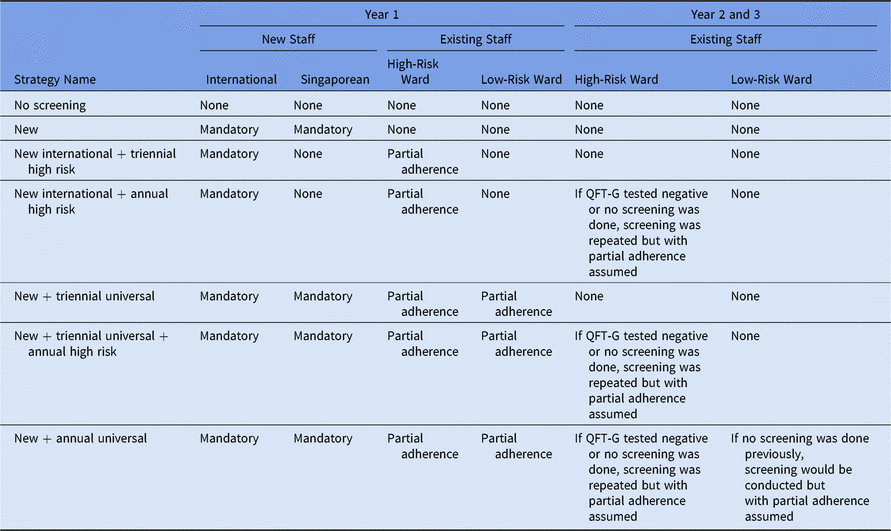
Based on discussion with hospital stakeholders regarding considerations of feasibility and acceptability, we considered the following screening strategies for new and current employees with levels of risk stratification (Table 1).
(1) “No screening” (current approach): No HCWs undergo screening for LTBI.
(2) “New”: All newly hired HCWs undergo a triennial screening at the time of employment.
(3) “New international + triennial high-risk”: Newly hired international staff undergo mandatory LTBI screening, while existing staff working in high-risk areas are screened once every 3 years. Partial adherence to screening among existing staff is assumed.
(4) “New international + annual high risk”: Newly hired international staff undergo mandatory LTBI screening, whereas existing staff working in high-risk areas are screened annually (unless previously tested positive) with partial adherence assumed.
(5) “New + triennial universal”: All newly hired HCW undergo mandatory LTBI screening, whereas all existing staff are screened once every three years. Partial adherence to screening is assumed among existing staff.
(6) “New + triennial universal + annual high-risk”: All newly hired HCW undergo mandatory LTBI screening, whereas all existing staff are screened once every three years. Existing staff in high-risk areas are screened annually (unless previously tested positive) and partial adherence is assumed.
(7) “New + annual universal”: All newly hired HCW undergo mandatory LTBI screening whereas all existing staff are screened annually (unless previously tested positive) and partial adherence is assumed.
Description of Screening Strategies

Note. QFT-G, QuantiFERON-TB Gold In-Tube. Partial adherence refers to adherence rate of screening as defined in Table 2.
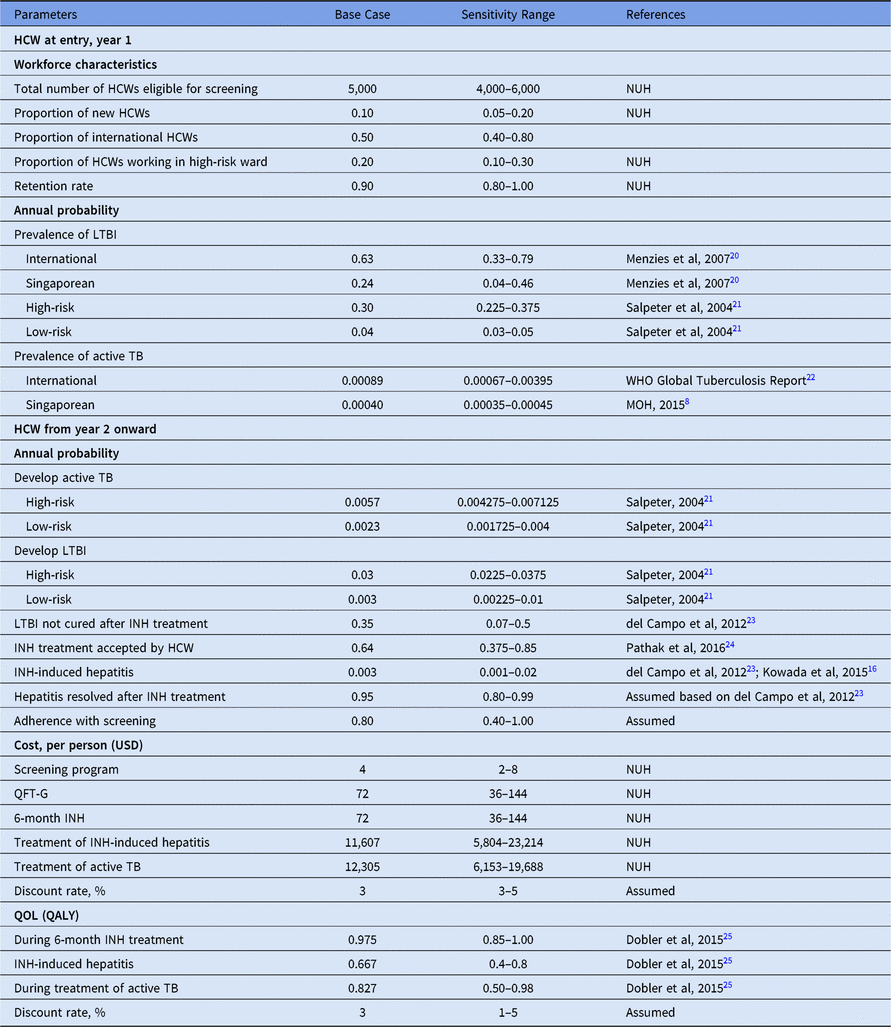
Quantiferon-TB Gold-In-Tube (QFT-G) was the selected screening test for LTBI because Bacille Calmette-Guérin (BCG), which is included in childhood vaccination schedule in Singapore, would interfere with the interpretation of tuberculin skin test. Based on past observation, we assumed that newly hired HCWs would be fully adherent to screening, with 80% adherence rate for existing HCWs. HCWs with prior history of TB or LTBI would not be screened since these populations would have a positive result, and existing guidelines do not recommend treating again with INH.
Effectiveness and cost-effectiveness analysis
A cost effectiveness analysis (CEA) of 7 screening strategies for LTBI was conducted from the hospital’s perspective in a hypothetical cohort of 5,000 frontline healthcare workers employed at the start of the baseline year of 2016, comprising 500 new and 4,500 existing employees. The main outcomes of measure were number of active TB cases averted and ultimately quality adjusted life years (QALYs).
Probabilities and outcomes associated with testing and treatment were obtained from published literature and expert opinions, whereas the HCW population characteristics were assumed to be similar to our own hospital setting. Costs included the direct medical costs of screening (inclusive of tests and labor/overhead costs, converted to a per-head value) and treatment of TB and LTBI, as well as indirect costs related to productivity losses from absenteeism based on average hospital wages obtained from published sources and the hospital finance department. Most newly hired international HCWs come from regional high-burden TB countries (eg, China and the Philippines); thus, estimates for the prevalence of LTBI and active TB were based on these countries. In addition, the quality-adjusted life years (QALY) attributed to an individual with LTBI were assumed to be the same as that of a TB-free individual.Reference Kowada, Takasaki and Kobayashi16 Costs were adjusted to 2016 Singapore dollars and converted to 2016 US dollars (US$1=S$1.3815)17. Both costs and outcomes were discounted at an annual rate of 3%, a commonly used value for discounting in cost-effective analysis.
We simulated the development, detection, and treatment of TB in the hypothetical cohort under each strategy, and we estimated clinical effectiveness by comparing the number of active TB cases and total QALYs experienced by the cohort over the model horizon, relative to the benchmark of “no-screening.” We calculated the total direct and indirect costs related to TB control, treatment, and the incremental cost-effectiveness ratio (ICER) for each strategy (ie, the difference in total discounted costs over the difference in discounted QALYs), relative to the benchmark of “no screening.” To determine whether an intervention was cost-effective, we compared the cost per QALY gained from each strategy to a locally appropriate willingness-to-pay threshold of US$50,000 per QALY, based on World Health Organization CHOICE guidelines.Reference Grosse18 Interventions below this threshold represent an efficient allocation of healthcare resources. TreeAge software (TreeAge Pro Healthcare Williamstown, MA) was used to conduct the cost-effectiveness analysis.
Budget impact analysis
An intervention can be cost-effective but still unaffordable if the total cost required exceeds available resources. In addition to the CEA, we conducted a budget impact analysis (BIA) to estimate the net cumulative cost of implementing the various strategies including the cost of treating potential adverse events (eg, INH-induced hepatitis) and/or the development of active TB. To capture the budgetary obligations of the hospital at full-scale implementation, we assumed a dynamic cohort with a turnover rate of 10% across all areas and an annual inflow of 500 new HCWs while maintaining the same initial cohort size. With a BIA, costs remain undiscounted to assess the actual dollar impact expected at each time point.Reference Sullivan, Mauskopf and Augustovski19 The BIA was performed using Microsoft Excel (Microsoft, Redmond, WA).
Sensitivity analysis
Because the model incorporates many assumptions, we included sensitivity analyses to evaluate the likely impact of parameter uncertainty. We conducted one-way sensitivity analysis, determining plausible ranges for the values of all parameters used in the baseline scenario (Table 2) based on the underlying literature or expert opinions. For each parameter individually, holding all others fixed, we then recalculated ICERs for all the strategies at the extreme ends of the range, quantifying the sensitivity of the ICER estimates to the values assumed. Results were presented in standard tornado diagrams, graphically ranking the model parameters by their impact on the ICER estimate. Likewise, for the BIA, key characteristics like total number of HCWs, proportion of new HCWs, proportion of international HCWs, proportion of HCWs working in high-risk areas and retention rate were varied (Table 2), and the range of resulting total budget estimates were reported.
Estimates for Model Parameters of a Hypothetical Cohort of 30-Year Old Healthcare Workers (HCWs)

Note. HCW, healthcare worker; INH, isoniazid; LTBI, latent tuberculosis infection; NUH, National University Hospital; QALY, quality-adjusted life-year; QFT-G, QuantiFERON-TB Gold In-Tube; QOL, quality of life; TB, tuberculosis.
We also conducted probabilistic sensitivity analysis (PSA), varying all parameters simultaneously according to an assumed probability distribution for each, using a Monte Carlo simulation with 1,000 runs and calculating the realized ICER for each strategy in each one. A gamma distribution was assumed for the cost parameters, whereas β distributions were assumed for probabilities and utilities. Base case values were used as the mean, and the standard deviation was computed by taking 25% of the difference between the low and high values defined in the one-way sensitivity analysis.Reference Singer26 PSA results were presented as a cost-effectiveness acceptability curve (CEAC). This curve shows the empirically determined probability that each strategy is cost-effective (horizontal axis) compared with “no screening” over a range of possible values of the willingness-to-pay thresholds, which is the percentage of simulated runs in which ICER falls below the threshold value (vertical axis).
The National Healthcare Group Domain Specific Review Board exempted this study from full ethics review (reference no.: 2016/01000).
Results
In the “no-screening” benchmark, our model predicted ∼19 cases of active TB over 3 years among the HCWs, close to the 21 cases that were extrapolated from the recorded 7 cases in our hospital in 2015.
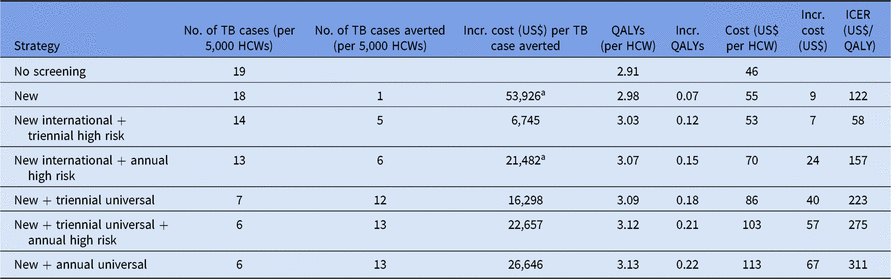
Table 3 lists the clinical outcomes and cost-effectiveness analyses results. The most intensive screening strategy (all new hires and annual universal screening) is the most effective in terms of total TB cases averted and QALYs gained but also the most expensive.
Base Case Effectiveness and Cost-Effectiveness Analysis Results of Screening Strategies Among Initial Cohort Compared With No Screening

Note. HCW, healthcare worker; ICER, incremental cost-effectiveness ratio; Incr., incremental; QALYs, quality-adjusted life-years; TB, tuberculosis.
a Dominated.
All screening strategies were found to be cost-effective by local standards relative to “no screening.” Hence, if any other strategy was implemented, the cost per QALY would be <US$50,000 per QALY. A highly targeted strategy of screening new international employees and high-risk workers once (“new international + triennial high-risk”) was the most cost-effective (US$6,745 per TB case averted; US$58/QALY; reduces active TB cases from 19 to 14). Annual universal screening for all employees (“new + annual universal”) was the least cost-effective (US$26,646 per TB case averted; US$311/QALY). Screening new hires alone (“new”) was more costly and less effective than screening only new international employees and high-risk workers once (“new international + triennial high-risk”), and screening of new international hires combined with annual high-risk screening (“new international + annual high risk”) was also more costly and less effective than screening all newly employed and existing employees once (“new + triennial universal”). These 2 strategies (“new” and “new international + annual high risk”) were therefore considered dominated and were removed from further analyses.
The base case 3-year total budget for TB control under “no screening” was US$238,379, which is the cost of diagnosing and managing active TB cases. Under the most cost-effective strategy of “new international + triennial high risk,” the total hospital budget would be US$332,571, or an additional US$95,000 over 3 years. To decrease the overall cost, the cost of QFT-G (which accounted for majority of the budget in all strategies) could be targeted for reduction.
The one-way sensitivity analysis for undominated screening strategies relative to “no screening” (Fig. 1) shows that ICERs are most sensitive to the cost of QFT-G. However, since all the ranges of recalculated ICER values fall well below US$50,000 per QALY, our cost-effectiveness findings are robust (ie, our conclusions remained unchanged across a realistic range of possible parameters). One-way sensitivity analysis on the BIA results (Supplemental Material Fig. 2 online) showed that in general, the budget would be most sensitive to changes in the total number of HCWs and the retention rate.
One-way sensitivity analysis of model parameters on the incremental cost effectiveness ratio (ICER) of the (a) “new international + triennial high-risk”, (b) “new + triennial universal”, (c) “new + triennial universal + annual high-risk” and (d) “new + annual screening” relative to “no screening.” HCW, healthcare worker; INH, isoniazid, LTBI, latent tuberculosis infection; QFT-G, QuantiFERON-TB Gold In-Tube; TB, tuberculosis.

Finally, the CEAC (Fig. 2) showed that at lower willingness-to-pay thresholds, the targeted screening strategy is most likely to be cost-effective. However, if willingness-to-pay is sufficiently high, a policy of universal screening can most likely be cost-effective.
Probabilistic sensitivity analysis on cost effectiveness of “no screening,” “new international + triennial high-risk,” “new + triennial universal,” “new + triennial universal + annual high-risk,” and “new + annual universal” screening strategies.

Discussion
Nosocomial TB exposures are inevitable in moderate to high-TB-burden countries where screening of LTBI in HCWs is not routinely practiced. Policy makers contemplating a LTBI screening program for HCWs need to consider trade-offs among the additional number of active TB cases prevented, resources used, and budget limitations. A risk-stratified approach to LTBI screening in HCWs may be a novel, pragmatic, and cost-effective strategy, especially in countries like Singapore, where a large proportion of HCWs originate from high TB-burden countries.9
Although regular universal screening can be most effective, it is most expensive and likely to be cost-effective only at high levels of willingness-to-pay. The total cost of instituting universal LTBI screening for all new and existing HCWs is $26,646 per active TB case averted, and policy makers would need to decide its worth. Our results showed that in this setting, targeted screening is likely to be highly cost-effective. The most cost-effective approach in our model involved screening of all new HCWs from high-risk countries of origin, and triennial screening every 3 years for existing HCWs in high-risk clinical areas, costing $6,745 per active TB cases averted (reducing active TB cases from 19 to 14). Our conclusions differ from a recent study published by Mullie et al,Reference Mullie, Schwartzman, Zwerling and N’Diaye27 possibly because that analysis was conducted with relatively high frequency screening in a low-incidence TB country from the healthcare system perspective.
Ultimately, decision makers need to weigh the inevitable tradeoff of greater cost-effectiveness against the greater risk of missed cases. On the one hand, missed TB cases can have heavy clinical, legal, and financial consequences for a healthcare systemReference Teichert28 particularly because whole-genome sequencing has enabled more precise tracing of index cases in outbreak scenarios.Reference Walker, Ip and Harrell29 On the other hand, screening of existing employees in high-risk clinical areas requires additional resources to ensure adherence to LTBI testing and treatment, and resource constraints may be binding or systemic priorities may lie elsewhere.
Wherever possible, decision makers should also consider the use of innovative strategies to increase the efficiency of screening itself. To improve adherence, LTBI screening could be added to existing routine pre-employment screening (ie, screening for hepatitis B, verifying immunity to varicella and measles) and implementing a system to ensure regular LTBI screening for existing workers.
Finally, our results are most sensitive to the cost of QFT-G, which is the most expensive item. Reducing the cost of QFT-G could make all screening strategies more cost-effective, and even cost-saving if the price is lower than the $36 in our model. This could be achieved by negotiating with manufacturers to lower the cost with bulk orders.
This study has certain limitations. Firstly, for simplicity, we assumed 100% specificity and sensitivity of QFT-G, although the documented specificity of QFT-G ranges from 98% to 100%,Reference Kowada, Takasaki and Kobayashi16 and sensitivity ranges between 81% and 87%.Reference Kowada, Takasaki and Kobayashi16, Reference Eralp, Scholtes, Martell, Winter and Exley30 This could reduce the cost-effectiveness of screening, due to fewer positive tests and fewer HCWs treated for LTBI.Reference Zwerling, van den Hof, Scholten, Cobelens, Menzies and Pai31 However, no existing LTBI test meets 100% sensitivity and specificity, whereas the other option, a tuberculin test, has an even lower sensitivity and specificity. However, reports of nosocomial TB in the literature tend to involve large-scale or drug-resistant cases, which limits the relevance to our Singapore setting. Furthermore, it is challenging to determine the duration and extent of exposure required for transmission in the community, let alone in a hospital setting, where shift work is prevalent. Secondly, neither nosocomial active TB transmission nor death due to INH-induced hepatitis/active TB were included in the model. However, the incidence of death due to INH-hepatitis is very low in the general literatureReference Saukkonen, Cohn and Jasmer32 and has been historically zero among HCWs in this hospital, as with deaths from active TB.
Altogether, our study provides insights on the effectiveness, efficiency, and budget impact of LTBI screening strategies among HCWs. We found that LTBI screening strategies can be cost-effective if HCWs are risk-stratified according to their country of origin and area of work. Furthermore, the efficiency of screening could be further improved if health systems ensure adherence to LTBI testing and treatment, and could even be cost-saving if the cost of QFT-G were decreased. These strategies targeting LTBI screening in HCWs in intermediate-TB burden countries should be considered in the effort to prevent nosocomial TB transmission.Reference Mullie, Schwartzman, Zwerling and N’Diaye27, Reference Zwerling, van den Hof, Scholten, Cobelens, Menzies and Pai31
Supplementary material
To view supplementary material for this article, please visit https://doi.org/10.1017/ice.2018.334.
Acknowledgments
Financial support
No financial support was provided relevant to this article.
Conflicts of interest
All authors report no conflicts of interest relevant to this article.