The one aspect of the 1945 general election on which nearly all contemporary commentators would have agreed is that its result was unexpected. The Conservatives were confident that they would be returned to power, albeit with a reduced mandate. Churchill told King George VI that he anticipated a majority of between 30 and 80.Footnote 1 After the first day of polling, the Daily Express predicted a 60 seat majority for the Tories.Footnote 2 The party's local organizers shared the national optimism.Footnote 3 On the Labour side, Hugh Dalton predicted either ‘a Tory majority or a deadlock’.Footnote 4 Attlee believed that Labour was unlikely to win more than 290 seats, and Herbert Morrison feared another hung parliament.Footnote 5 Even the News Chronicle, which published the Gallup public opinion polls predicting a Labour victory, had little confidence in the projections of its pollsters. The front-page article which accompanied the publication of the final poll on 4 July emphasized that the poll, even if accurate about national trends in public opinion, was a very unreliable predictor of the number of seats that would be returned for each party.Footnote 6 Whatever politicians and pundits might have said subsequently, the election outcome took them by surprise.
In the days, months, and years that followed, contemporary observers and subsequent scholars have put forth conflicting interpretations of the reasons for, and long-term implications of, Labour's victory. While contemporary commentators focused on what the Labour party did to win the election, or what the Conservative party did to lose it,Footnote 7 historical treatments have focused more broadly on the mood of the nation, specifically the so-called ‘swing to the left’, which allegedly occurred during the first years of the war. The phrase comes from a Ministry of Information Home Intelligence Survey for the south-west region from the spring of 1942 which reported a ‘distinct swing to what is vaguely called “the Left” … It does not appear to be on Labour party or Socialist lines, but it does seem to be directed against the Conservative Party.’Footnote 8 Repeated swings to independent, and later to Common Wealth, candidates, not to mention the seven defeats of government candidates in wartime by-elections, have been cited as further evidence of this ‘swing to the left’ and as harbingers of the Labour election victory to come. Steven Fielding has warned against viewing these independent candidates as proxies for the Labour party, arguing that ‘whereas there was undoubtedly a desire on the part of important elements of the public to see decisive change in government policy, there was widespread uncertainty that any of the parties could be trusted to execute such a programme’.Footnote 9 But while he questions the party-political allegiances of the wartime electorate, he nonetheless concludes that the wartime radicalization revealed in these elections benefited Labour in 1945. He only cautions that, instead of the independents acting as surrogates for the Labour party from 1942 onwards, ‘it could be argued that in 1945 Labour itself was a surrogate for something deemed more desirable but impossible to achieve’.Footnote 10
In this respect, Fielding has much in common with earlier proponents of the so-called ‘consensus’ view of 1940s politics in that, although they reach their conclusions from opposite premises, none perceives the 1945 election in terms of a positive endorsement of the Labour party. He contends that a large portion of the electorate was politically apathetic in 1945, ‘distrust[ing] the world of politics to such an extent that they felt voting would make no difference to their lives’. Those who did vote Labour did so reluctantly, as a protest vote against the ‘[Conservative] party's hostility to the Beveridge report’.Footnote 11 By contrast, the consensus historians Paul Addison and Angus Calder downplay the anti-Beveridge rhetoric of many within the Conservative party.Footnote 12 By asserting that both parties offered similar programmes, however, they are forced to conclude that Labour's victory was not the result of active support for the party's distinctive vision of a new post-war-Britain. By this logic, the decision of electors to vote Labour in 1945 must be explained not in terms of party programmes, but rather in terms of political prejudices. Addison blames the Conservatives' defeat on the negative tone of their election campaign, claiming that ‘instead of taking a positive line about what they themselves would do, they concentrated on stampeding the electorate away from Labour’.Footnote 13 Others have argued that Labour benefited from the electorate's desire to punish the ‘Guilty Men’ of Munich, and those politicians who oversaw a decade of high unemployment during the ‘Hungry Thirties’.Footnote 14 Still others have suggested that it was just the swing of the pendulum finally working in Labour's favour,Footnote 15 though as Kenneth Morgan has noted, Labour's failure to overtake the Conservatives in the Gallup polls until May 1943 rather undermines the explanatory power of such arguments. In their stead, Morgan contends that Labour won because ‘the perceived beneficial thrust of wartime planning and controls was largely identified in the popular mind with the Labour ministers.’Footnote 16
This analysis is compelling, but it begs the question of why the achievements of the cross-party coalition government were attributed to the Labour ministers. Through detailed analyses of Labour party policies in the 1930s and 1940s, scholars such as Stephen Brooke, Martin Francis, and Richard Toye have shown how earlier studies overstated the extent of cross-party consensus and argued that the development of the post-war welfare state was much more contingent on Labour's victory than had previously been appreciated.Footnote 17 But while these scholars have illuminated the ideological differences between Labour and Conservative cabinet ministers, there has been little attempt to understand how such differences were communicated to the public and how the Labour party managed to win public opinion to its side. Given that opinion polls showed a continued preference for Conservative government well after the publication of the Beveridge report, this is a significant question. We cannot simply assume an inevitable progression from the public furore over the publication of Beveridge in December 1942 to the election of the first majority Labour government two and a half years later. The Labour party needed actively to persuade the public of its qualifications to build the post-war New Jerusalem.
To a certain extent, this process of public conversion was done on Labour's behalf by organizations like the Left Book Club, publications such as the Daily Mirror, and the by-election campaigns of Common Wealth and independent candidates such as Fred Wise at King's Lynn and Charlie White in West Derbyshire, whose unendorsed candidacies nonetheless generated significant publicity for the party.Footnote 18 The belief that Labour benefited from the ‘fifth column’ work of organizations such as the Left Book Club, Penguin Books, the Daily Mirror, the Army Bureau of Current Affairs and the BBC (and in particular J. B. Priestley) was strongly held within the Conservative party both during and after the war. In August 1943, the party researcher-turned-Conservative MP, Henry Brooke, reminded the director of the BBC Talks department of the ‘immense and lasting harm which the BBC did to its reputation in Conservative circles by inviting Priestley to do six postscripts … in 1941’.Footnote 19 According to R. A. Butler's memoirs: ‘The forces vote, in particular, had been virtually won over by the left-wing influence of the Army Bureau of Current Affairs.’Footnote 20 The title of this article alludes to the famous series of ABCA posters, ‘Your Britain: Fight for it Now’, which Churchill regarded as thinly veiled Labour propaganda.Footnote 21
It would be difficult to argue that these progressive publications and organizations did not benefit Labour, though scholars have expressed scepticism as to their impact on both public support for Labour and public opinion more generally.Footnote 22 Similarly, it would be absurd to claim that none voted Labour in 1945 to punish the ‘guilty men’ of Munich, or simply from a desire for change. Yet, historians' focus on the propaganda work of such non-party organizations and individuals has obscured the degree to which the Labour party itself actively worked to convert public opinion to its cause during the war.
This reluctance to consider the possibility that Labour made its own fortunes in 1945 is partially attributable to the impact of scholarship discrediting Conservative accusations about Labour's superior organization at the local level. Historians from Paul Addison to Andrew Thorpe have emphasized the continued organizational advantage of the Conservatives over Labour. According to Thorpe, while the greater atrophy of Conservative organization may have resulted in a comparative improvement by Labour, the ‘Conservatives tended, post hoc, to overstate the extent of their wartime organizational collapse, in part because it allowed them to avoid damaging recriminations about the real reasons for their defeat.’Footnote 23 As a consequence of such studies, historians have largely assumed that the Conservatives remained the better organized of the two principal parties throughout the war, and hence have failed adequately to consider the role of Labour propaganda in changing public opinion. But the emphasis on agency organization overlooks the reality that, as Brooke has noted, although ‘it is less clear that the local branches were in notably good condition, … one can certainly say the central machinery of the Labour party was in good shape in 1945’.Footnote 24 During the war, the party had not only – as Brooke has shown – been actively planning for peace, it had also been working hard to ensure that the nation recognized Labour's unique commitment to forging a new post-war society, built around the five pillars of security articulated in the Beveridge plan, increased state direction of society, and a new international order laid out in the Atlantic Charter.
In examining the mechanics of party publicity in wartime Britain, this article draws attention to an oft-overlooked aspect of political history, and highlights the need for further research on the relationship between the formation of political programmes and rhetoric and their internationalization (or rejection) by the public. Since the publication of Gareth Stedman Jones's now classic essay ‘Rethinking Chartism’ (1983), a generation of ‘new political historians’ have made careers from the close analysis of the role of political language and rhetoric in forging popular constituencies around elite policies.Footnote 25 In focusing on the content of political messages, however, such scholars too often overlook the pragmatic question of how, and how effectively, such discourses are communicated to the public.Footnote 26 In order to understand how political parties mobilize constituencies we need to look not only at the content of political messages but also at the media through which these are communicated.
Studies of political communication invariably raise questions of audience reception, and the exact impact of a particular political poster, propaganda leaflet, or radio broadcast is impossible to quantify. Such difficulties should not, however, dissuade scholars from tackling the important question of the role of publicity in party politics. The following discussion focuses on the mechanics of Labour's publicity campaign, before concluding with an analysis of the available data on the impact and influence of media propaganda in mid-century Britain.
I
In discussing the role of Labour publicity and propaganda in influencing wartime opinion, it is useful, first, to consider both the state of the party's publicity and propaganda organization before the outbreak of war, and public opinion about Labour in the late 1930s. Existing historiography on interwar party politics has emphasized the Conservatives' superior mastery of political propaganda. Numerous scholars have chronicled the anti-socialist biases of the interwar press – a virtual truism of which the Daily Mail's Zinoviev letter stunt is only the most easily cited example. John Ramsden and Richard Cockett have underscored the Conservatives' successful manipulation of the regional press. Sian Nicholas and Philip Williamson have shown how Stanley Baldwin adapted his own and his party's appeal to the age of broadcasting, and Jean Seaton and others have underscored the pervasive anti-socialist biases of the interwar BBC, and in particular its subservient relationship to the government during the general strike.Footnote 27 According to this narrative, while the interwar electorate may have consistently voted Conservative because they subscribed to ‘conventional wisdoms’ about the organized working classes, the Conservatives benefited from having the media on their side.Footnote 28 By contrast, Labour suffered at the hands of a hostile media, and lacked the flair for public relations shown by either their Conservative opponents or the brilliant self-publicist Lloyd George. Where the party did have an advantage was in grassroots organization, and in platform speaking. MacDonald may not have been a natural behind the microphone, but he remained one of the great public speakers of his generation.
While the above characterization may hold true for the 1920s, by 1939 the Labour party was no longer as un-adept and ill-adapted to modern modes of political communication as studies of the 1924 election and the 1926 general strike suggest. By the outbreak of the war, Labour had the political backing of the second-largest circulating newspaper in the country, the Daily Herald, and the de facto support of the Liberal News Chronicle. Its press and publicity department had more than doubled in size since the First World War, and by the end of the 1930s both the party's and the Trades Union Congress's (TUC) publicity officers were on close terms with political and industrial correspondents at the principal metropolitan dailies and in frequent communication with provincial papers. The new generation of party leaders, Clement Attlee, Hugh Dalton, and Herbert Morrison, had all risen to national prominence in the age of broadcasting and were not only better broadcasters than MacDonald had been, but also more attuned to the importance of the BBC in party politics. While the party still placed a high premium on political education, and continued to privilege public meetings and platform-speaking to a greater extent than its rivals, Labour had adapted itself to the new era of mediated politics.Footnote 29 The party consulted with marketing and advertising agents during the 1935 general election and during the 1934 and 1937 London County Council (LCC) elections, and their campaigns reflected a marketing analyst's interest in audience differentiation. The perceived importance of publicity to Labour's success at the LCC elections spurred the national organization to adopt many of the London party's tactics. In December 1937, Will Henderson, Labour's national publicity chief, announced the formation of ‘an advisory panel of publicity experts and journalists’.Footnote 30
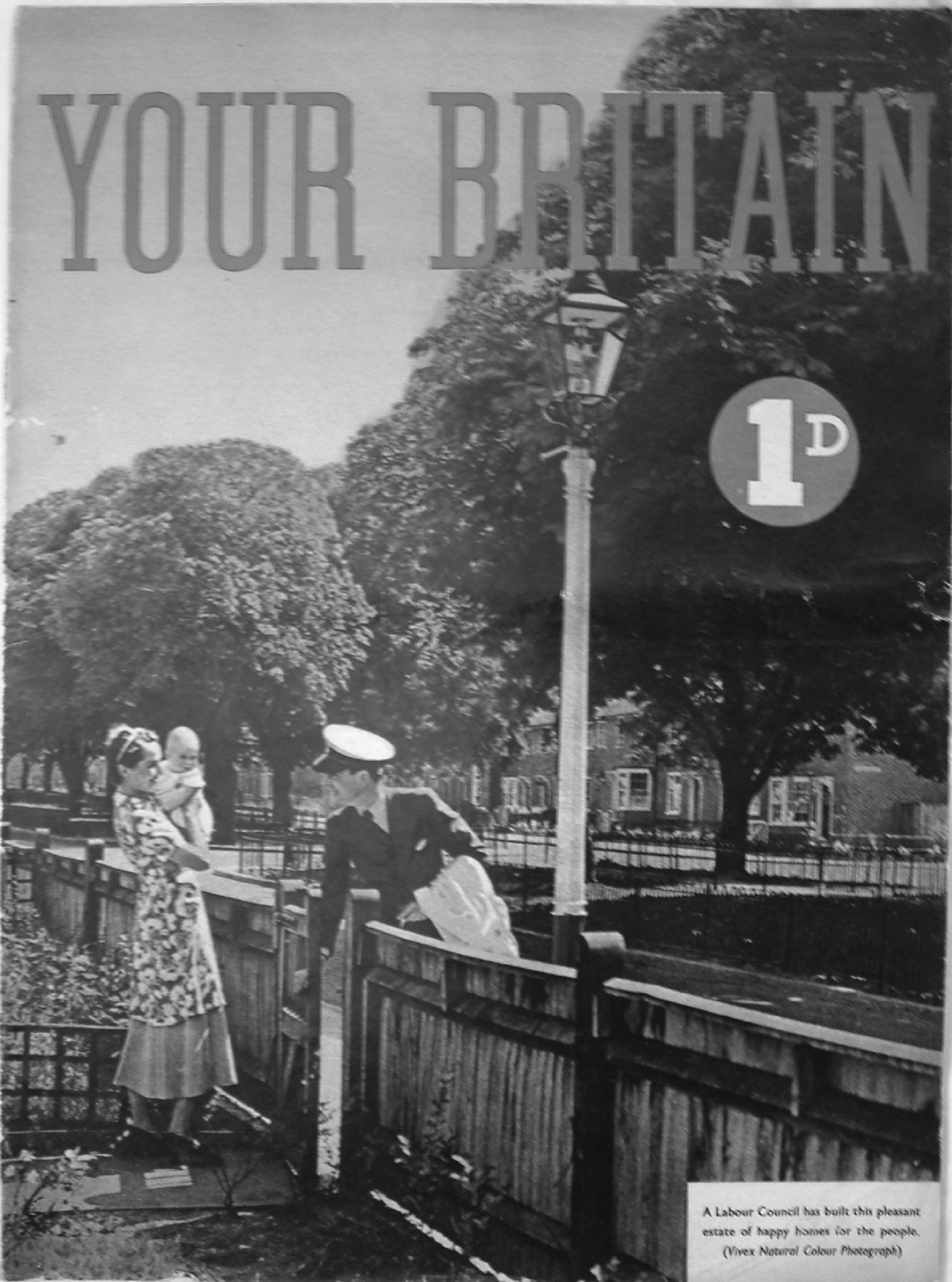
Much of Labour's literature in the late 1930s was notable for its sophistication. In particular its glossy picture magazines Your Britain took readers through the basics of Labour's policies on the economy, housing, foreign affairs, and agriculture with the help of vivid photographs and pithy captions. They were designed with help from an industry consultant and their resemblance to issues of Picture Post was not coincidental. Their intent was to bring the basics of Labour's programme to the attention of housewives and those ‘floating voters’ too busy or politically apathetic to read dense party pamphlets or attend public meetings.Footnote 31 To this end, they were held by the party, the press, and envious Conservative opponents to have achieved an unprecedented success. The National Executive committee (NEC) successfully sold over 600,000 copies of Your Britain No. 1 to local parties in 1937 – well above the sale of any previous party publication during a non-general election year – and its success inspired the production of several successive issues. The magazines' high sales, which exceeded the NEC's expectations and necessitated additional print runs, are indicative of the publications' perceived effectiveness. The interwar Labour party, unlike the Conservatives, did not distribute its nationally produced propaganda to voters free of charge. Instead, the national organization sold its pamphlets and leaflets to constituency organizations at a discount, and the local organizations in turn either freely distributed or sold this literature to constituents. Given their constrained budgets, constituency organizations showed a consistent unwillingness to order material from headquarters that they did not deem effective.Footnote 32
Though the Your Britain magazines were primarily conceived as part of the party's ‘socialist crusade week’, rather than as election propaganda, observers within and outside the party believed that Your Britain No. 1 had aided Labour in the 1937 municipal elections. A Times leader instructed the paper's conservative readership to ‘stud[y] the tactics and methods of the opposing party’. Labour, the paper reported, had ‘prepared attractive and persuasive publications which sold by the hundred thousand [which] … had direct reference to the politics of the locality and the home … Without regard, for the moment, to the merits of the Labour programme itself, here was a meritorious way of presenting it’(Figure 1).Footnote 33 It is likely that the Your Britain magazines influenced the design of the ABCA's controversial ‘Your Britain’ posters during the war.Footnote 34
Your Britain, No. 1 (1937)

When war broke out, the party's press and publicity department was actively preparing for another general election.Footnote 35 While evidence suggests that Labour could not have won an election held in 1939,Footnote 36 one should not underestimate the extent of Labour's revival during the 1930s. Although a majority of electors may not have been prepared to vote for Labour candidates, few continued to view them as grossly incompetent or somehow outside the constitutional pale. As Morgan has emphasized, ‘by the end of the 1930s, Labour looked credible as a potential party of government as it had never done before’.Footnote 37 In part, of course, this was a reflection of the changes in Labour's policy over the course of the 1930s – its embrace of planning, its practical experience of municipal government in London and numerous other borough and county councils, and its spirited resistance to fascism. But while Labour's policies may have appeared more objectively attractive in 1939 than in 1931, the party's progress towards renewed legitimacy owed much to its ability successfully to communicate those policies to the nation. During the war, the party used techniques developed in the 1930s to ‘sell socialism’ to the masses, and ensure that Labour reaped the benefit of the wartime ‘swing to the left’.
II
Like subsequent historians, the Labour leadership was not unaware of the growing radical feeling in the country in the early years of the war. Unlike later scholars, however, they did not take for granted that this left-wing sentiment would redound to the benefit of the party come election time. In March 1943, George Ridley MP, chairman of the Workers' Film Association (WFA) and a member of the NEC's publicity and organization committees, wrote to the party's national agent expressing his fears that ‘although there is undoubtedly a body of leftish opinion thinking largely in our terms, it is not at the same time thinking about us’.Footnote 38 A Parliamentary Labour Party report from June 1943 emphasized that ‘if the Labour party desires to secure government with power in the future, a large part of this awakening public opinion must be enlisted to its side’. The following February, the Clapham Labour party wrote to the NEC expressing its ‘fears that the enthusiasm, which is ours by right is being bypassed by people who are using our phrases, and our ideas’.Footnote 39
But while party supporters in parliament and the constituencies continued to think that Transport House should be doing more to grasp the reins of popular radicalism, the party leadership was working as actively as it felt possible, within the constraints of the electoral truce that the three parties had entered into on 8 September 1939. Despite agreeing not to contest by-elections during the war, the party continued its campaign of public meetings that it had begun in preparation for an expected general election in 1939. While Conservative operatives expressed scepticism as to the impact of these meetings, they feared that Labour's propaganda activity ‘create[d] an unfortunate impression in the mind of the man in the street who is only allowed to hear one side’. One Conservative area agent feared that ‘if we are not allowed to state our case we shall lose the support of all but confirmed Tories’.Footnote 40
In April 1940, the party published a statement of its post-war policy, entitled simply ‘Labour's Home Policy’. In February 1940, the TUC-owned Daily Herald ran a series of articles cast as a public forum on the drafting of a ‘New declaration of the rights of man’, which included contributions from H. G. Wells, the former lord chancellor, Lord Sankey, and the nutritionist, Sir John Orr. Wells opened the forum by positing that man's ‘fundamental rights’ included the ‘right to a common inheritance’.Footnote 41 Over the succeeding weeks, the paper used discussion of the ‘new declaration of rights’ to promote Labour's programme of post-war welfare reform.
After Labour's entry into the coalition government on 10 May 1940, the party, like its Conservative and Liberal allies, initially put party politics on hold. Expenditure on party literature fell from nearly £11,000 in 1939 to under £5,000 in 1940, and to under £4,000 in 1941.Footnote 42 By December 1941, however, Labour's leaders were beginning to rethink their attitude towards party politics. An NEC memorandum posed the rhetorical question: ‘What would be said by the Labour party if the Conservative party were to set about a wide-spread campaign demanding the maintenance of Capitalism?’ It concluded by recommending, not that party propaganda cease, but ‘that speeches and platforms devoted to an exposition of our proposals … be so conditioned that the proposals are accepted as a contribution to a discussion and not as the spearhead of an attack on one political or economic institution by another’.Footnote 43 The die was cast. The Conservatives might justifiably complain that Labour was not ‘adher[ing] loyally to the spirit as well as the letter of the Truce’.Footnote 44 Nonetheless, from late 1941 onwards, Labour determined to resume party-political activity on a level nearly indistinguishable from that of the pre-war period.
The first priority was to draft a general outline of post-war priorities which could serve both as ‘a rhetorical framework on which to hang more specific policy’, and as a statement to the British people of the party's intentions.Footnote 45 In January 1942, the party approved Harold Laski's draft of the ‘interim report on reconstruction’, officially entitled The old world and the new society. The interim report was as much for public as for party consumption. An abbreviated version, intended for ‘cheaper and wider circulation’, was published under the title Labour looks ahead! The NEC courted publicity for the document through press conferences, advertising in Labour and trade union journals, and the distribution of nationally produced news and editorial content to editors of the local and specialized press.
While the daily press, whose circulation surged during the war,Footnote 46 was a valuable forum for propaganda, the previous decade had taught the party the unparalleled utility of the BBC as a vehicle for reaching the broadest possible cross-section of society. As such, Laski contacted the broadcaster about the possibility of a talk or series of talks being given on the report, potentially with ‘a representative of the Conservative or Liberal parties expressing their views on the document’.Footnote 47 His professed willingness to allow for a commentary by Labour's political opponents suggests a recognition that, in an environment where popular opinion was demonstrably to the left, any critical comment by the opposition was likely to redound to Labour's credit. As the party agent, Harold Croft, would write in 1945, ‘In any case, even opposition advertises Labour.’Footnote 48
Laski's suggestion did not meet with an enthusiastic response at the BBC. The view of the BBC Talks director was that any such programme would be ‘quite out of the question’: ‘Since the outbreak of war’, the BBC had,
in the interests of national unity, ceased to broadcast talks and discussions which would emphasize divergence of opinion along party lines; and it seems to us that either a talk or a discussion on the subject of the Labour party's report on Reconstruction would, however carefully prepared, tend to contravene this principle.Footnote 49
That said, the BBC did agree to provide full coverage in their news briefings of the debates on the report at the party conference that June.Footnote 50
Labour's wartime party conferences provided a valuable publicity opportunity for the party, and one which was not shared by their Conservative rivals, who did not hold a party conference from 1938 to 1942. While conference was often a fractious event, and while the wartime conferences routinely served to emphasize the rank and file's frustration with the party's allegedly supine role within the coalition, they were also a forum for presenting Labour's distinctive position on post-war Britain. Even the public wrangling over Labour's role in the coalition thus benefited the party, as it allowed Labour ‘to behave like a party of government and a movement of opposition at one in the same time’.Footnote 51 Both the daily press and the BBC provided consistently good coverage of these conferences – much to the frustration of the Conservatives. When the BBC governor and Conservative party member, Sir Ian Fraser, met with the 1922 committee in June 1942, several backbenchers complained of the publicity that the BBC gave to Labour's conferences. Fraser replied with some exasperation: ‘The Conservative party had not had a conference, and do not make so many speeches in the House … [It's] not for me to say that it would be wise for them to have a Conference, but in the absence of the basic matter there can be no broadcasts.’Footnote 52
The Conservatives felt similar frustration at the publicity given to the annual TUC. In October 1941, Congress was held simultaneously with a meeting of the National Council of Conservative Associations, with the result that coverage of the former more or less swamped reporting on the latter. Sir Robert Topping, the director-general of Conservative Central Office, appreciated that, ‘in present circumstances there was more general interest taken in the TUC Congress than in our Party gathering’. This reality, however, did not prevent members of the Conservative rank and file from expressing their frustration with the BBC's journalistic priorities.Footnote 53
The Conservatives' frustration was partly sour grapes – their decision to resume holding annual conferences in 1943 owed much to the desire for the publicity that conferences would bring.Footnote 54 It was also, however, a legitimate reaction to the fact that the BBC frequently gave the Labour party and the TUC preferential treatment during the war. This preferential treatment reflected government policy, which emphasized the need to placate the unions during the war.Footnote 55 It also, notably, reflected the fact that the TUC and the Labour party made a practice of lobbying the BBC and haranguing the broadcaster for every concession they could get.
Jean Seaton and Ben Pimlott have suggested that such aggressive behaviour was a form of revenge on the BBC for its treatment of Labour in the interwar period. The Labour leadership, and particularly Walter Citrine, remained resentful of the BBC for its behaviour during the general strike, and took the opportunity provided by the war to wreak revenge.Footnote 56 Many at the BBC would have concurred with this assessment. When the National Council of Labour sent a deputation, which included Dalton and Citrine, to protest the BBC's decision not to air a Labour address to the German people in August 1939, the BBC representatives felt that the visit had been a display of power politics: ‘They made it clear to us, as they did to the Cabinet, that without their support the war would stop.’Footnote 57 Although the trade unionists' often abrasive and contemptuous attitude towards the BBC chaffed with the programme producers and staff – Citrine at one point denounced the BBC staff to their faces as ‘a collection of anarchists who didn't understand the team spirit’Footnote 58 – the TUC successfully ensured that workers' views and voices were adequately represented on the airwaves during the war.Footnote 59
The BBC's concessions to Labour were not all extracted via bullying. In mid-1942, Laski, Henderson, and the chairman of the NEC's publicity committee, Barbara Ayerton Gould, met with the directors-general and chairman of the BBC to press the wisdom of running more programmes on post-war reconstruction. The delegation, while emphasizing that they were concerned with the national interest, and not ‘with Labour propaganda at all’, argued that the corporation should make more effort to hold ‘national debate on national problems … considering the main problems with which the world would be faced after the war and how these could be settled in a truly democratic way’.Footnote 60 Four months later, Labour got its wish when the BBC ran a series of features on the contents and consequences of the Beveridge report, which attracted exceptionally high audience interest.Footnote 61
Nearly all analyses of Labour's election victory note that the public associated the party with Beveridge, despite Beveridge's standing as a Liberal candidate. This was not coincidence. From its conception, the party actively sought to link itself in the public mind with the Beveridge committee and its conclusions. When the committee was established in May 1941, the minister of health, Arthur Greenwood, set out to give it the widest possible publicity. Greenwood had long served as secretary of Labour's research department, and, as such, worked in close co-operation with Henderson, whom he invited to serve as his parliamentary private secretary at the ministry of health. It is likely that Henderson provided the inspiration for Greenwood's efforts, which included feeding Fleet Street the line that the committee was a ‘harbinger of social security for all’, and giving a broadcast in the BBC's North American service to the same effect.Footnote 62
On the day that the report was published, eighteen months later, the Labour-controlled Daily Herald devoted almost the entirety of its four pages to a nine-point summary of the report's contents, under headings such as ‘For children’ and ‘Housewives’ charter: husband and wife as sharing team'. The accompanying leader stressed that ‘Trade unionism and the Labour party feel a special satisfaction at its appearance. For it was the insistent pressure of the Trades Union Congress upon the government departments that made plain the need for such an investigation as Sir William has conducted.’Footnote 63 The following day, the paper advertised its exclusive sale of a 3d summary of the report.
Morrison used the report's publication as a pretext to make a series of dramatic speeches on Labour's vision for post-war Britain. Addison has claimed that Morrison's championship of Beveridge stemmed in part from the cynical realization that there was ‘political capital in this for Labour’.Footnote 64 The Conservative press shared this view. The day after his speech on the control of industry after the war, the Daily Sketch ran an editorial which asserted that ‘it is “grossly and culpably irregular” for a socialist minister to talk socialism “in these days of political truce”’.Footnote 65 The next day, the Daily Herald responded with a leader maintaining that, although there was an electoral truce in place, the so-called political truce was ‘a pure fiction – a hypocritical distortion of the purposes of the electoral truce. The “political” truce has been concocted by Diehard Tories for use as a Muzzling Order against Socialist speakers.’Footnote 66 This sentiment should be interpreted as representing the NEC's view. The paper remained in close contact with the party leaders throughout the war; and from November 1942 onwards, the editor, Hugh Cudlipp, attended meetings of the NEC's publicity committee. In January, the NEC made manifest its conviction that Morrison's speeches were within the acceptable boundaries of patriotic party politics by publishing them as a pamphlet entitled ‘Spearhead of humanity’.Footnote 67 The WFA even distributed a promotional package of films ‘on aspects of social security’ for rent to local Labour parties, trade councils and co-operative societies in connection with the report's publication.Footnote 68
The party's publicity campaign in December 1942 is notable for its emphasis on the practical benefits of social welfare and state direction of the economy, not only to the working classes, but to the nation as a whole. In his classic study The middle-class vote (1954), John Bonham noted that the Labour vote rose in each of the five ‘typical’ London regions which he surveyed (Westendia, Suburbia, Blackcoatia, Artisania, and Eastendia) in the general elections of 1923, 1924, 1929, 1935, and 1945, and fell in all five regions in 1931. This coincidence led him to conclude the bankruptcy of class politics for a national party: ‘if you make yourself unpopular with one class, you cannot expect the other class to swing in your favour’.Footnote 69 To a greater extent than historians have hitherto appreciated, the party made a determined appeal to a broad cross-class and cross-gender constituency throughout the interwar period.Footnote 70 This national appeal was similarly evident in the party's wartime propaganda. The Daily Herald's emphasis on the benefits of Beveridge's proposals to British housewives was one example of this policy. So too was Morrison's treatment of the subject of industrial control, which argued for nationalization in terms of industrial efficiency, and pointedly not in terms of the ideological imperative for the socialization of the means of production. Pelling has described the party's election manifesto as ‘skilfully … designed to draw in the uncommitted voter: each proposed measure of nationalization was justified in terms of practical arguments for efficiency’.Footnote 71 As Morrison argued in 1945:
Labour has a programme which can and must appeal to workers by brain as well as by hand. Our appeal is to the community as a whole, including the great numbers of progressive-minded professional people, for there is no cleavage of interest between hand workers and brain workers, factory workers or office workers.Footnote 72
This national appeal was made explicit in the publicity campaign launched by the party in the autumn of 1943. At their 20 July 1943 meeting, the NEC's press and publicity committee agreed a two-stage plan of literature production: the first stage would focus on Labour's policies for health and housing and the second on less immediately tangible questions such as the national minimum, workers' control and ‘the new world order’. The following week, the NEC's organization committee proposed a plan for the ‘intensive development of Party activity commencing in the autumn, consisting of policy conferences, public meetings and the promotion of study and discussion groups’.Footnote 73 The organization committee was headed by Morrison, who would go on to chair the campaign committee appointed after the 1944 party conference. In his memoirs, R. A. Butler wrote of Morrison's party-political activity during the war:
[He] had taken advantage of his position on the Home Front to roll out pamphlets and speeches which gave a very firm impression of leading to the left. He recorded in his biography that [when I became director of the Conservative Research Department,] I carefully examined what he had done for the Labour party prior to and during the 1945 election and told my staff that I wanted to do the same for the Conservative Party. This information was correct.Footnote 74
Butler's comments illustrate the lengths by which Labour outstripped their Conservative rivals in terms of publicity and propaganda during the war. His suggestion, however, that Labour's superior publicity apparatus was attributable to Morrison's position as home secretary and minister of home security is disingenuous. Butler himself served as president of the board of education for the majority of the war, and used his ‘position on the Home Front’ to spearhead several Conservative committees on post-war social policy and party propaganda. He served as chairman of the post-war problems committee, was a member of the Tory reform committee, and co-ordinated the informal committee for future policy in 1940. The remit of the post-war problems committee, which was established in the summer of 1941, included ‘watch[ing] with the utmost care both the Press and the BBC with a view to seeing what is being said by those holding different political opinions … and to consider methods of immediate steps being taken to counter in the most effective and prompt way these activities’.Footnote 75
Left propaganda was meant to be countered by Conservative propaganda articulating the party's own vision for post-war Britain. But while Butler and others were full of ideas for post-war Conservative policy, they encountered hostility from certain corners of the party. Butler's efforts in 1940 to establish a brainstorming group including representatives from the press, non-partisan think-tanks, and even National Labour MPs to help the party ‘adjust its outlook and policies to meet the social changes of the moment’ were dismissed by the Conservative party's vice-chairman, Lady Hester Bourne, as ‘a movement which is certainly not Conservative, but rather pseudo-intellectual and educational and certainly non-party’.Footnote 76 As a result, Conservative by-election candidates were ‘handicapped … by the lack of a positive policy on home affairs’. They were faced with ‘the growing apprehension of an electorate which, seeing the end of the war in sight, is beginning to wonder what lies beyond’.Footnote 77 Despite Butler's best efforts, his party could not even agree a post-war policy, let alone a strategy for publicizing that policy.
By contrast, Labour was exceptionally united during the war. While party activists (and some leaders) disapproved of Labour's presence in the coalition and the ministers' failure to push for more radical wartime social reform, nearly all of Labour's supporters were united around a post-war programme of planning and social welfare.Footnote 78 This consensus would begin to unravel before the end of Attlee's first administration, but in 1943 it meant that the Labour leadership could be assured that nationally produced publicity would be well received in the constituencies, and complement the efforts of local activists.Footnote 79 The party was equally exceptionally united in its willingness to make use of commercial media methods to publicize its programme. Over a decade in the political wilderness had reconciled many erstwhile critics of commercial culture to the argument that the party could not afford to neglect the opportunities for political communication that the new mass media presented. While the majority did not share Morrison's enthusiasm for media propaganda, they were notably agreed as to the wisdom of putting the home secretary in charge of the election campaign. Morrison worked effectively with Henderson and the party's chief propaganda organizer Maurice Webb,Footnote 80 and the three men harnessed the talents of many of the younger men and women in the party, including Evan Durbin, who wrote the principal guide for party speakers, and Aneurin Bevan, who spent all but the final days of the campaign away from his constituency on a national speaking tour.
The campaign began with the production of two pamphlets ‘in the popular style’ on health and housing. The NEC decided to call the housing pamphlet Your Home, an allusion to the enormously successful Your Britain series published in 1937–8. Labour's emphasis on housing is significant, as the Gallup organization's public opinion polls identified housing as the most important election issue in 1945. It has been suggested that voters trusted Labour to deliver on ‘homes for heroes’ because of memories of the Wheatley housing act of 1924.Footnote 81 This, however, is doubtful. For one thing, more homes had been built under Neville Chamberlain's tenure as minister of health than by the first Labour government;Footnote 82 and, for another, the majority of younger first-time voters would not have remembered the 1924 act. The last point is a particularly significant point, given Mark Franklin and Matthew Lander's argument that Labour benefited disproportionately from the youth vote in 1945.Footnote 83 More plausibly, the public believed that Labour was more committed to home-building because it spent more time publicizing its commitment to building homes.
Your Home was followed up a few months later by a summary of Labour's reconstruction policies titled Your Future – the party was clearly determined to exploit fully the popularity of the Your Britain series. The publicity committee also undertook to produce a series of ‘discussion pamphlets’ on reconstruction, and arranged with the managing director of Odhams Press (publishers of the Daily Herald) to secure their subsidized production.Footnote 84 In the political environment of wartime Britain, such pamphlets stood an above-average chance of actually being read and discussed. In the interwar period, many citizens had seemed to pride themselves on their disinterest in politics.Footnote 85 In the winter and spring of 1942–3, in contrast, 635,000 copies of the Beveridge report were sold to individual citizens, and the government was compelled to produce a condensed version of the white paper, titled the ‘Beveridge report in brief’, to meet public interest.Footnote 86 The publicity department further assisted in producing literature and ‘talking points’ for Labour speakers at the conferences and public meetings arranged by colleagues on the NEC's organization committee.Footnote 87
While the body of the guide for Labour speakers, ‘Labour in the war government: a record of things done’, was written by Evan Durbin, Henderson weighed in to ensure that the document packed its intended political punch.Footnote 88 The final draft began with an introductory note encouraging speakers to ‘direct attention to positive social, industrial, economic and other achievements for which Labour's representatives in the Government are rightly entitled to a large measure of credit’. As the pamphlet emphasized, ‘These achievements can justly be presented as examples of the value and influence both of Labour's direct participation in the Churchill Government and of the Labour Movement's powerful contribution to the national war effort.’Footnote 89 The NEC's publicity committee even mooted the idea of producing an illustrated chronicle of the party's contributions to the coalition.Footnote 90
III
In early 1944, Labour moved its publicity operations on to a general election footing. A membership campaign was put into effect with the result that, between 1944 and 1945, party membership rose by 366,000.Footnote 91 The party's chief agent, George Shepherd, contacted his counterparts in the Conservative and Liberal parties in February 1944 to discern their views on the use of state-owned loudspeakers and vans during the election, as well as the ‘question of the equitable use of Aeroplanes for transport purposes’. Later, Shepherd approached his counterparts about arranging for cinema messages to be aired by the three party leaders, as had been done in 1935. The same month, the party assembled an ‘informal consultative group of experts’ to advise on political broadcasting.Footnote 92 By May, the publicity department had compiled a detailed estimate of the money and measures required to run a successful election campaign. The estimate ran to £150,000. By contrast, the party had spent £13,641 9s 8d during the 1935 campaign.Footnote 93 Even taking into account wartime inflation, this still represented more than a sevenfold increase.Footnote 94 The details of the publicity department's proposals reveal the reasons for this surge. They included the ‘preparation of a special documentary film on the lines of Your Britain’; the hire of sixty mobile film units to display this documentary in marginal constituencies; six mobile vans; a national bill-posting scheme including posters up to 6 metres by 3 metres in size; twenty million election leaflets, the inevitable sixteen-page illustrated publication ‘along the lines of Your Britain’; miscellaneous literature; ‘party political advertising in national and provincial newspapers’; and the possible employment of additional staff to consult on the party leaders' election broadcasts.Footnote 95
In both scale and scope, the publicity committee's proposals – which were approved by the full NEC – represented a huge advance on the party's election activity in 1935. This reflected, in no small part, the improvement in the party's financial position during the war. As a consequence of both curbed expenditure and fund-raising, the party's balance sheet went from a debt of £6,045 in 1939 to a credit of £64,950 by December 1944.Footnote 96 The proposals gave the party an enormous imaginative and organizational edge. The Conservatives only formed a propaganda committee in March 1945. Whereas Labour's election committee was staffed by the party's professional propagandists, the Conservative committee included only one professional publicist: Elizabeth Neame, an employee of the wartime ministry of information.Footnote 97
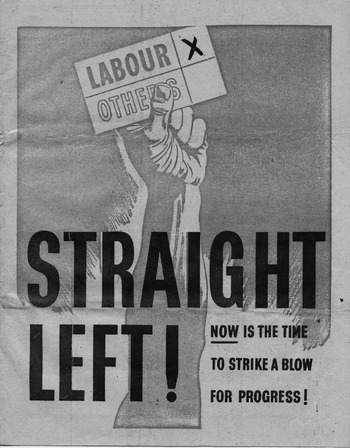
Not all of Labour's plans were ultimately realized – principally owing to their impracticality in an environment of wartime rationing and government commandeering of resources – but it was nonetheless the most ambitious campaign the party had ever run.Footnote 98 An army of commercial illustrators, printing experts, journalists, and advertising strategists were recruited as campaign advisers. Though they fell short of accepting that the media was the message, the campaign team showed an almost fanatical obsession with the design and appearance of party propaganda. The centrepiece of the party's literature campaign was its sixteen-page illustrated election magazine ‘along the lines of Your Britain’, entitled Straight Left. Apart from short leaflets, Straight Left was the principal exposition of the party's programme, and circulated in larger quantities than the party manifesto. When the election date was unexpectedly fixed for 5 July after discussions between Churchill and Attlee in April, Henderson suggested to the NEC's campaign committee that it would be easier to print Straight Left in black-and-white, as they were unlikely to secure the facilities to mass-produce a multi-coloured pictorial magazine while the war was still on-going. The politicians on the committee, however, rebelled against the pragmatic advice of the party's publicist.Footnote 99 A large part of the appeal of Labour's propaganda magazines was their bright, colourful presentation, and this would be lost if they were printed in black-and-white. Ultimately, the NEC acquiesced to printing the magazine in two colours (black and red). Despite this compromise, the journal's publication was still one of the trickiest aspects of the campaign, and the publicity department had to contract with three separate rotary-press printers to secure publication of the required two million copies (Figure 2).Footnote 100
Labour's sixteen-page illustrated election magazine', Straight Left

The production of Straight Left in black and red ultimately gave a chromatic coherence to Labour's election campaign, as the party's text posters were printed in red ink on a white background,Footnote 101 and the colour played a prominent role in their pictorial posters as well. The party's use of the colour red underscores the change in attitudes that had occurred since the outbreak of the war. In the interwar period, Labour posters had largely abjured use of the colour, while the Conservatives had sought to underscore links between Labour and ‘Red Russia’. By 1945, the socialist implications of red propaganda had lost their threatening aspect;Footnote 102 and 1945 was the first election in which the colour was so closely associated with Labour party propaganda at the national level.Footnote 103 Nowhere was this more visible than in the series of party posters produced by Philip Zec, cartoonist for the Daily Mirror.Footnote 104 The most famous of Zec's posters were an image of a solider with the accompanying caption ‘This is our chance to Labour for him’, and a composite portrait of the armed forces – ‘Help them finish their job.’ These two posters explicitly associated the Labour party with the sacrifices of Britain's armed forces, and insisted that only Labour could guarantee these men the future they deserved. As Morrison recalled in his memoirs, it was an appeal directed primarily at women casting a proxy vote for their loved ones overseas, ‘and undoubtedly influenced large numbers of women, who had hitherto imagined that politics were of no importance to them, to think about them and to discuss the subject in their letters to their husbands and sons’.Footnote 105
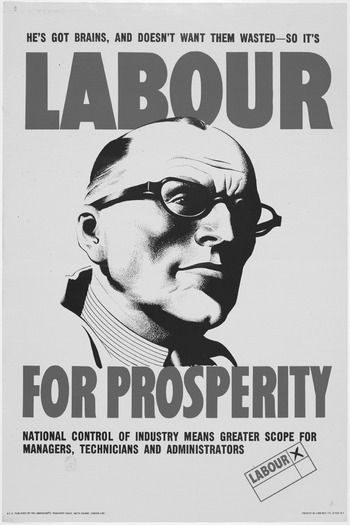
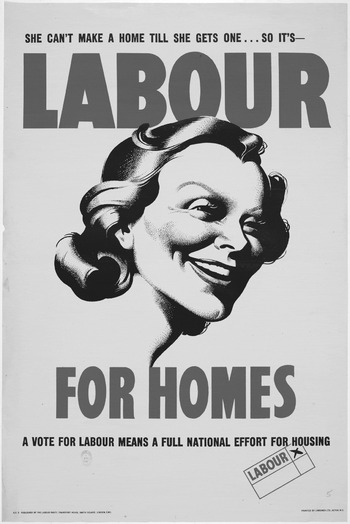
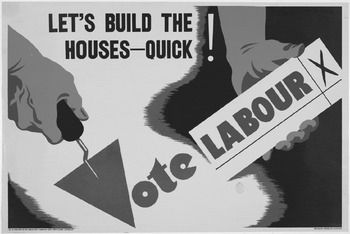
Less famous, but no less telling about the scope of Labour's ambitious appeal, were general election posters nos. 5 and 6 – ‘Labour for prosperity’ and ‘Labour for homes’. The first of these associated the party with the ‘brain workers’ whose votes Morrison perceived to be crucial to a Labour majority. The poster, which emphasizes Labour's appeal outside its traditional working-class base, has recently been used as the cover-image of a revisionist interpretation of Labour's historical development.Footnote 106 The second appealed to female voters, not on the basis of their sympathy for men in uniform, but on the basis of their own future ambitions. The poster underscores the extent to which the issue of housing was conceived in gendered terms during the 1945 campaign, as well as the centrality of the issue to Labour's campaign (Figures 3 and 4). This poster was only one of several housing posters that the party produced for the election, including the to-the-point ‘Let's build the houses – quick!’ (Figure 5).
Zec poster for the 1945 Labour election campaign

Zec poster for the 1945 Labour election campaign

One of many Labour party posters focused on housing

The language and iconography of Zec's posters paralleled that in the Daily Mirror. On election day, the paper ran a front-page leader ‘Vote for them’ opposite a reproduction of Zec's VE-day cartoon ‘Don't lose it again’ in which a battered solider returned ‘victory and peace’ to the British people. The similarities were not coincidental. The Mirror's election day leader was part of a campaign inspired by a letter that had been sent to the paper by an Essex housewife who had declared that ‘I shall vote for him’, in reference to the hopes of her solider husband for a better Britain. The paper's editor discussed the notion of running a campaign around this theme with Morrison, who strongly supported the idea, and later appropriated it for Labour.Footnote 107 The media scholar, James Thomas, recently suggested ‘the need for a re-examination of the [Mirror’s] politics', and argued that ‘the Mirror's coverage was more centrist and anti-Tory than socialist and pro-Labour’.Footnote 108 But while the paper's election-day leader did not specifically mention the Labour party, the language and imagery would have been unmistakable in their message.
Even if the leftward trajectory of the Mirror's editorial policy over the course of the war was determined more by a general populist sympathy than by support for the Labour party specifically, Labour was quick to exploit the opening presented by this editorial realignment. Morrison began writing for the Mirror in the 1930s,Footnote 109 and soon established a personal relationship with the paper's editor, Sydney Elliott, who even advised him on the preparation of his 1945 party election broadcast.Footnote 110 The home secretary also courted the paper's chairman, Guy Bartholomew. Morrison's biographers describe a meeting which Elliott arranged at Morrison's request shortly after the Mirror had run an editorial particularly sympathetic to Labour: ‘Morrison bustled in, put his arm round Bartholomew and addressed him as “you six-ribboned cherub”, and the ice melted. From that point, Bartholomew became a firm friend and Morrison worked closely with the Mirror.’Footnote 111 Labour also received substantial support from the News Chronicle in 1945. As in 1935, the paper officially supported the Liberals, but their election coverage was notably more anti-Tory than pro-Liberal. Together with the Daily Herald, these three papers had a circulation of nearly six million – meaning that, for the first time, the popular press was equally balanced between right and left.Footnote 112
IV
Discussions of the 1945 election campaign have paid particular attention to the two principal parties' negative campaigning.Footnote 113 Certainly, the Conservative campaign was characterized by the aggressive promotion of Churchill, on the one hand, and an attack on Labour's alleged dictatorial tendencies on the other.Footnote 114 Fortunately for Labour, after four decades of ‘Tory scares’, they were prepared. The party's successful deflation of the impact of Churchill's Gestapo broadcast and the Laski Gauleiter affair by pre-emptively warning the electorate to beware cheap Tory stunts has been characterized as ‘the most brilliant piece of prophylactic medicine ever achieved in electoral history’.Footnote 115 But the Conservatives were not the only ones to ‘go negative’. The Daily Herald's coverage was virulently partisan, and election leaflets such as ‘Guilty party’ left little doubt as to where blame lay for both the war and the preceding decades of high unemployment.
Yet notwithstanding such examples, Labour did not run a primarily negative campaign. ‘Guilty party’ ranked seventh out of seven amongst leaflets purchased by local parties from headquarters. While over a million copies were printed, only 800,000 were actually dispatched.Footnote 116 Conservative policy was frequently critiqued, as in the leaflet ‘Britain out of control’, which warned of the economic effects of the rapid deregulation of industry and curtailment of rationing. However, Labour's posters, pamphlets, press interviews, and broadcasts predominantly emphasized the party's own plans for a new socialist Britain, conceived in terms of social welfare, national ownership of industry, and state planning.
It is impossible to know exactly what led 48 per cent of electors to vote Labour in 1945. Many doubtless voted Labour simply because ‘the fashion seemed to be Left’.Footnote 117 Clearly, however, the majority understood what they were voting for or against. In a Gallup poll taken after the election, 56 per cent responded that they expected the newly elected Attlee government ‘to introduce sweeping changes such as nationalization’, whereas only 30 per cent believed that the new government was likely ‘to govern along existing lines, only more efficiently’.Footnote 118 The above survey of the Labour party's publicity during the war years offers an insight into how the public came to appreciate the distinctiveness of Labour's political agenda, even as the party leadership remained publicly wedded to coalition politics. Throughout the war, the party was united around a coherent programme of nationalization, planning, and social welfare that had been worked out in detail in the 1930s. Labour's media campaign ensured that that programme was effectively and attractively communicated to the public.
It is impossible to pinpoint the link between reading or viewing Labour propaganda and supporting Labour. It is, however, possible to establish the extent of the audience for Labour publicity going into the election. Whereas, in 1935, an unofficial Daily Express survey had found that only 30 per cent of listeners tuned in to Herbert Morrison's party election broadcast versus over 40 per cent who heard Stanley Baldwin's, in 1945 Labour's ten election broadcasts were heard by 44.5 per cent of electors, including many middle-class listeners – an audience essentially equal to that for the Conservatives (45.4 per cent).Footnote 119 Given the spike in film attendance during the war, it can be assumed that Attlee's election film, shot by Movietone newsreel corporation, was viewed by a comparably large audience.Footnote 120
As mentioned above, the NEC sold nationally produced literature to constituency parties, and the exceptionally high up-take of NEC pamphlets and leaflets by local parties suggests a high perceived demand at the local level. The full run of two million copies of Straight Left was despatched, as was the full run of the election news-sheet the British Elector, as well as over 90 per cent of the NEC's pamphlet stock, and the full run of quad crown (30″×40″) pictorial posters.Footnote 121 The constituencies' demand for NEC pamphlets as compared to leaflets is striking – 95 per cent of the NEC's pamphlet stock was despatched, compared with 75 per cent of its leaflet stock, despite the significant subsidy that headquarters offered on its leaflets. The figures suggest a belief that electors in 1945 were exceptionally interested in detailed expositions of policy, a conviction substantiated by the high demand for copies of the Beveridge report. By far the most popular pamphlet was Let us face the future, and Thomas Scollan MP was so convinced of the electoral value of the pamphlet that he voiced his personal thanks to the NEC at the 1946 party conference, causing the party chairman, Harold Laski, to reply: ‘We thank Mr Scollan for that testimony. An appreciation of Transport House is as rare as it is welcome.’Footnote 122
Finally, the party's efforts in courting newspapers such as the News Chronicle and the Daily Mirror should not be discounted. While media scholars continue to debate the extent of the press's influence,Footnote 123 it is noteworthy that a plurality of those interviewed by Mass-Observation (M-O) between 1938 and 1940 listed the daily press as their most important external source of information and the biggest influence on their opinion.Footnote 124 In three out of four of the surveys conducted by the organization during the two-year period, the press even ranked higher than ‘reason’ or ‘own opinion’ as a source of interviewees' beliefs. After the 1945 general election, M-O surveyed 400 voters in East Fulham about their party preference and newspaper reading habits. While a plurality of Labour supporters interviewed were found to read the Daily Herald, there was also a strong correlation between voting Labour and reading the News Chronicle and the Daily Mirror.Footnote 125 M-O's sample size is too small to draw any definitive conclusions. It suggests, however, that the party's courtship of the two papers over the preceding fifteen years paid dividends in 1945.
The centrality of media management to the New Labour project and the contrast between the media-savvy approach of Tony Blair, Alastair Campbell, and Peter Mandelson and the lack of media nous of their immediate predecessors have nurtured a misimpression that, before 1994, Labour had neither an appreciation nor an aptitude for political communication.Footnote 126 Studies of the Labour left in the 1950s and 1960s have reinforced that impression by focusing on those sectors of the party most hostile to commercial culture.Footnote 127 Yet, an over-focus on Labour's failures and missed opportunities should not obscure the party's significant successes in this arena. In looking back to the period before 1945 and arguing for the importance of wartime publicity and propaganda to Labour's landslide victory, this article supports the argument put forth by Martin Moore and Dominic Wring that Labour has often been the more innovative of the two principal parties in adapting to an increasingly media-dominated democratic politics.Footnote 128 Further, by emphasizing the relationship between publicity and propaganda and Labour's electoral success, it highlights the importance of considering, not only the content of political appeals, but also the way in which those appeals are presented to the public. Previous studies have broadened our understanding of democratic politics by shifting away from socially deterministic explanations of voting behaviour towards a more pluralistic model which takes into account the multiple ways in which interests can be articulated and mobilized. What is still needed, however, is a clearer understanding of how political parties successfully communicate those messages to the democratic public.