The introduction of sightseeing attractions through texts or images, or through guidebooks, appears to be a form of publication that transcends cultural boundaries.Footnote 1 The central subject of this article, Jinling tuyong (Illustrated Odes on Nanjing), is one such work. Produced in early seventeenth-century China, this book presents 40 scenic spots in and around Nanjing,Footnote 2 a city located on the north-western corner of the lower Yangzi delta – the most culturally and economically advanced area in late imperial China – that had grown into a major commercial metropolis of a million by the end of the sixteenth century.Footnote 3 With an appearance familiar to modern readers, this early seventeenth-century urban guidebook to Nanjing is composed of a selection of pictures, each of a different scenic spot, accompanied by texts and cartouches identifying their special attractions. Moreover, to facilitate travel and sightseeing activities, Tuyong provides brief directions telling visitors how to get to the sites, along with specific instructions to guide the viewing experiences of tourists.
The meticulous prescription of ways of viewing geographic sites is well worth our attention. In doing so, Jinling tuyong, like other tour guides, imposes a specific mode of spatial imagination upon its readers. The tourist gaze, however, is far from innocent and often inscribed with particular social or political agendas. As John Eade points out, in guidebooks ‘we see the familiar tendency to understand a particular place through essentialist and reified images’, but notes that ‘[b]ehind their complacent assertions there lurk unsettling questions about power and inequity’.Footnote 4 To expose the implicit power hierarchy glossed over by the romantic narratives of guidebooks, one of the most frequently invoked contexts is that of empire. In Victorian London, for example, David Gilbert finds guidebooks of the nineteenth and twentieth centuries featuring the city in an evolving context of imperial culture: from mid-Victorian celebration and optimism, followed by intimation of unease about London's imperial role, to explicit promotion of the capital as a kind of front parlour in the imperial home; from anxiety over London's adequacy as a spectacle of imperial power to the 1980s’ and 1990s’ recognition of the legacy of London's imperial past in its post-imperial diversity.Footnote 5 Through the mediation of guidebooks, the consumption of space became an integral element of the colonial project at large.
This insight, however, is intrinsically related to the fact that the rise of mass tourism coincided with colonial expansion in Europe. A close look at guidebooks in late imperial China, in comparison, brings to light a very different connection between empire and spatial imagination. What dominates the shifting images of Nanjing, as it turns out, is not the rise and fall of one particular empire, but, rather, the historical transition between two Chinese empires, the Ming (1368–1644) and the Qing (1645–1911). As the story between the covers of Jinling tuyong unfolds, we will find that the changed ways of looking, contrary to the case of London, did not perpetuate social differentiation and power hierarchy. Instead, they facilitated a sense of cultural continuity and communal solidarity during the dynastic transition. The unique function of Jinling tuyong proves to be a product of the touring culture at its time, when visits to scenic sights became a ritual for educated men of letters to form social networks and to reinforce alliances.
The implication of this finding is profound: it shows that the key to unravelling the diverse cultural significance of guidebooks resides in a more nuanced and contextualized approach to their underlying practice of tourism. This perspective not only provides a productive point for cross-cultural comparisons of tourism but also sheds new light on the studies of Chinese touring culture. To be sure, guidebooks enjoyed a long tradition in China. Compendia of scenic sights appeared as early as the thirteenth century and witnessed a remarkable rise in quantity and quality during the sixteenth and seventeenth centuries, the last decades of the Ming dynasty. The maturation of this genre is generally considered a product of growing physical mobility and cultural consumption brought about by a flourishing economy at the time.Footnote 6 This view, however, tends to take the sightseeing function of guidebooks at face value and leaves the social and cultural connotations of the ‘tourist gaze’ unexplored.Footnote 7 Whose view was imposed on the sightseers? What kind of social agenda prompted the production of guidebooks and shaped their particular ways of looking?Footnote 8 To answer these questions, we will need to examine the spatial representation of guidebooks in terms of the underlying practice of tourism that informed their social purpose and cultural meaning. The following sections, therefore, will first survey the emergence of social tourism in sixteenth- and seventeenth-century China and the key role it played in the production of publications such as Jinling tuyong. This background will allow us to identify the ‘tourist gaze’ imposed by Tuyong even when there are few direct sources relating to the book's audience and their responses. With this context in mind, the second half of the article will exploit Tuyong's social biography to analyse the relationship between guidebook, urban community and imagined urban space. The article will conclude with the new insights allowed by the case study of Jinling tuyong for Chinese history as well as for comparative studies of tour guides.
Touring and tour guides: social tourism in the late Ming dynasty
Cultured touring and social distinction
Jinling tuyong appeared at a time when China witnessed increasing physical mobility and a surge in the production of guidebooks. Indeed, as more people were on the road, tourism became a popular leisure activity that lent guidebooks a broad appeal across late Ming society.Footnote 9 Yet curiously, just when travel became unprecedentedly accessible, authors began to market their guidebooks to armchair travellers. The publisher of Jinling tuyong, for example, claimed in his preface that he commissioned this book out of the desire to see the sights and document a tour of them, a plan that never materialized because of his prolonged illness. In other words, in spite of its detailed instructions directing tourists around Nanjing, Jinling tuyong was in fact a substitute for actual touring experiences, intended to facilitate woyou (imaginary touring)Footnote 10 – a long-established practice among literati to indulge themselves in the pleasure of geographic imagination.
To understand the appeal of virtual guidebooks in an age of extensive travel, we need to take a close look at the peculiar nature of ‘tour’ and ‘tourism’ in late Ming culture. As Tobie Meyer-Fong points out, writers of late Ming guidebooks, like their contemporaries, deliberately distinguished between travel as a process involving movement between places, xinglu, and ‘touring’, you, a destination-oriented aesthetic activity associated with the literati elite and their social imitators. This distinction divides late Ming guidebooks into two groups: the first aims to facilitate the physical movement of travel; most typical are route books proffering practical geographic information or pamphlets advising readers of the common scams and tricks targeting travellers. At the other end of the spectrum stands a distinct form of publication concerning primarily the proper performance of cultured sightseeing. In the words of Meyer-Fong, these works are in effect vehicles for ‘cultural mapping’ because ‘they defined the practice of sightseeing as they were used to define the sightseer as subject’.Footnote 11
This characterization is indeed crucial. Although compendia for famous sites are not without precedents from earlier periods such as Wang Xiangzhi Yudi jisheng (1227) (Records of Famous Sites in the Realm), late Ming authors exhibited a much higher degree of self-consciousness about the very meaning of sightseeing. Who is the entitled sightseer? What is worth seeing? And what constitutes respectable touring behaviour? Indeed, you (touring) had developed into a highly sophisticated practice in late Ming elite circles. We find elaborate treatises on you dao (lit. ‘the way of you’) produced to distinguish every nuanced type of you, which advocated strong opinions on what made one's travel culturally desirable, including the means of travel, the proper age for travel, choice of companions and worthy destinations.Footnote 12 For these devoted practitioners, you was not just a simple act of sightseeing but a deliberate display of one's style and talent. The aura of a successfully preformed you was said to be especially coveted by the class of shengyuan (first degree holders in the civil service exam), the majority of whom, owing to the extremely competitive civil service examination at the time, were bound to spend an extended period of their lives attempting to pass the exam with no certain career prospect in sight. For this group of lettered men, status anxiety was a fact of life and the promise of alternative routes to establishing their names could not have been more alluring.Footnote 13 Thus it is not surprising to find the emergence of a repertoire of elite status performance in which the elevated form of you occupied a central place. Yet as much as these low-level elites aspired to the fame and prestige associated with cultured touring, they also faced substantial financial challenges from extensive travel and sightseeing.
In the light of this dilemma, it is not surprising to find an emerging opinion that contended that the meaning of you ought not to be dictated by the physical act of touring. Tang Xianzu, the great Ming playwright most renowned for his emphasis on the infinite capacity of human emotions, extends this position into spatial practice. Tang employs the concept of yi (mindset) to resolve an irony central to the practice of cultured sightseeing: that is, while the rich and the powerful are equipped with the necessary means to travel all over the land and enjoy the magnificent scenery, they often do not possess the right mindset truly to appreciate the landscape. On the other hand, those who do possess the required inner quality truly to engage with the landscape often could not afford to travel and visit these sites in person. As such, they had to resort to imaginary travelling, woyou, through virtual guidebooks such as Jinling tuyong. In Tang's view, the truth of nature lies in the eyes of the beholders, no matter whether they are looking at a real landscape or at a represented one. Thus ‘with yi, a place more than one thousand li away can be conjured right before one's eyes. Otherwise, even if the scenery is just a few chi away, it is still beyond the reach of those who do not possess yi.’Footnote 14
Tang's ‘yi’-centred interpretation of you exposes a particular social use of late Ming tour guides. Through detailed sightseeing instructions, these guidebooks expanded access to the increasingly fierce competition of status performance. Indeed, as cultured touring came to be seen as an essential benchmark for taste and status, social rivalry over its proper performance also intensified. The resultant anxiety and tension explains why the value of woyou was so enthusiastically advocated: it made it possible for those who lacked the means (money, time, health) nevertheless to take part in this race of truly cultivated sightseeing. To satisfy the growing demand for the imaginary tourism of woyou, the market was flooded with topographical art and illustrated guidebooks such as Jinling tuyong, for, as many contemporaries suggested, landscape images provided a much more accessible venue for geographic imagination.Footnote 15
Social tourism and the formation of ‘touring communities’
In short, the appeal of virtual guidebooks such as Jinling tuyong is rooted in the increasing demand for social distinction at the time. As scholars have well established, the enthusiasm for new platforms of status performance betrays the frequent trespass of prescribed social boundaries in late Ming society.Footnote 16 What has been less discussed, however, is the fact that the increasing social promiscuity also prompted needs to create new ties and communities. Here again, the practice of cultured sightseeing was utilized to facilitate the formation of social networks.
Indeed, by the late Ming, you had developed into a particular form of social tourism in the nature of leisured excursions which, in the minds of contemporary literati, was often associated with the goal of ‘seeking friends’, namely, social networking. Take, for example, Yuan Zhongdao, one of the famed Three Yuan brothers known for their vignette-styled writing, who described his deep passion for you in terms of its socializing function: ‘I came to take a liking to you when I was very young. Since then, wherever I visited, I always sought out local luminaries to befriend.’ And with much pride, he declared that thanks to his long-term passion, he now enjoyed an extremely extensive social network that extended to virtually every corner of the empire.Footnote 17 Given their explicit purpose of social networking, many tours took place around major metropolises with easy access to prestigious elite circles. In fact, Kong Shangren (1648–1718), a famed early Qing playwright, named five ‘must-tour’ metropolises for his peers: Beijing, Nanjing, Yangzhou, Suzhou and Hangzhou.Footnote 18 Best known for his intimate portrait of late Ming Nanjing in ‘Peach-Blossom Fan’, Kong Shangren is an author with a sharp eye for the inner working of literati society. He efficiently dissects the mechanism of urban tourism in an essay written for a new volume of collected poetry compiled by his friend, Guo Gaoxu. Guo had just returned from a trip to Yangzhou, where he had been showered with banquets and poetry because an earlier visit by Guo had resulted in his famous volume of touring poetry on the city. An anthology of these exchanges was assembled, and Kong Shangren was asked to write a preface. Guo's warm and enthusiastic reception in Yangzhou, Kong Shangren observed, was not an accident but part of contemporary culture. According to Kong, by the end of the seventeenth century, urban touring had developed into an established realm of competition analogous to that of the civil service examinations. In this universe, achievement was measured by the quality of one's poetry elaborating on the sights or commemorating the social occasion. Triumph in such literary ventures brought the author literary acclaim, just as passing the exam would entitle one to enter the ranks of imperial officialdom. As described by Kong, major cities, with their rich endowment of celebrated luminaries as an influential audience, became the perfect stage to display one's talent. This development is not surprising – unlike regular scenic spots that garnered attention only from locals, great cities enjoyed empire-wide fame and prestige. Therefore, recognition of an author's literary treatment of urban sights led to fame and publicity at the national level. As a result, visiting and lyricizing renowned sights in a major city became the most effective way to make a debut in the literary world.
The analogy between urban tourism and examination culture further extended into the social ties and communities both generated. Just as candidates who passed the examination in the same year were called tongnian (graduates of the same class in the civil examinations) and seen as reliable political allies in their future official careers, Kong elaborated, similar bonds of tongyou developed among fellow tourers who visited the same site. Guo's fame from his previous visit to Yangzhou earned him an esteemed place in the city's tongyou community; these bonds were manifested in the outpouring of poetry celebrating his visit. The ties developed from touring could also be bequeathed. According to Kong, if a son of a deceased tongyou visited the old site in his place, the fellowship would be renewed and extended into the next generation. The bonds among tourers mandated the best efforts of the older generation to assist the members of the next generation in establishing their names in the elite circle. The formation of touring communities, in this sense, became ritualized. Kong compared the crucial role played by the scenic poetry exchanged every generation and the function of nianyi pu (i.e., genealogy of the friendship between persons of the same graduation class in the civil service examinations), which cemented and bore witness to the newborn alliance. The continuous making and remaking of touring poetry, in this sense, gave life to the associated touring community and allowed it to grow with time. When placed in this context, it becomes clear that the story of Jinling tuyong is ultimately one of a cross-generational touring community spanning across the dynastic divide. As we will find in the following section, through adaptations of touring poetry into an illustrated guidebook and local gazetteers, the touring community associated with Tuyong expanded and its cultural meaning renegotiated.
A sense of place, a sense of cultural continuance: touring and tour guides in Nanjing
Social biography of Jinling tuyong
True to the practice of social tourism of its time, the making of Jinling tuyong is intrinsically related to a series of group outings across two generations of prominent Nanjing families. The first tour took place in the year 1593 when six Nanjing native literati took a trip together to the northern mountain area of Nanjing and recorded their expedition in a set of collaborative poems. For each of the six main scenic points on the trip, each of the authors made a scenic poem. The poems for the same site used the same rhyme (heyun 和韻). Composing such collaborative poems was a popular intellectual game at the time to demonstrate one's talent and connections. One decade later, another set of collaborative poems came into being as a result of a second tour. Three of this new group of authors came from the same families – Gu, Jiao and Zhu – who had taken part in the ‘northern expedition’. The product of this tour was Jinling yayou bian (The elegant tour of Nanjing), in which the number of sites commemorated in and around Nanjing more than tripled to 20. After two decades, Jinling yayou bian was published by Zhu Zhifan, one of the co-authors, in 1624, along with Zhu's Jinling tuyong, an imaginary tour in which twice as many sights were appreciated. In Tuyong, each sight was also illustrated with a wood-block printed image in addition to a poem.
Different from its predecessors, which were intended to commemorate actual tours taken by prominent Nanjing elites, the tour created by Zhu Zhifan was a virtual one, whose goal was to fulfil Zhu's desire to ‘visit’ all the sights around his native city. This virtual tour of woyou, Zhu claimed, presented a long overdue, full view of Nanjing to the reading world. Indeed, the expanded collection of scenic sites in Jinling tuyong clearly owed much to the growing competition over the number of scenic sights as an emblem of local pride. Since every gazetteer now featured a list of famous sites, highlighting local beauty, Zhu stated in his preface, he had grown dissatisfied with the current convention of listing only 8 or 16 sights of Nanjing, a city with a long history and an important role in the Ming dynasty. As a Najing native, Zhu felt a sense of duty to produce the most comprehensive list of scenic sites to showcase the grandeur of his hometown.Footnote 19 Because of Zhu's conviction, over the course of three tours, the geographic coverage expanded from the mountains north of Nanjing to the whole immediate city environs; the documentation of the tour also evolved from private exchanges (collaborative poems) into a guidebook for the general public – from an exercise cementing the social ties of a small group of Nanjing elite into a book instructing the public on how to view Nanjing, a development that is clearly reflected in the texts and images of Jinling tuyong.
From commemoration to tour guiding: the birth of a native paradigm of Nanjing views
From Jinling yayou bian to Jinling tuyong, not only are there more scenic spots introduced and illustrations added; even the texts in each work prescribe very different ways to look at Nanjing. This development is closely related to the change in function since the nature of the publications had moved from lyric commemoration of a group outing to an elaborate vehicle of woyou. Thus although both works highlight historic and literary allusions as essential elements of cultured sightseeing, in general, the textual rendition in Tuyong exhibits a more aggressive and instructive approach to the consumption of scenic sights.
To enhance further its function as a medium for virtual touring, Tuyong also includes illustrations with notable sights identified by cartouches. These images not only allow for a more immediate consumption of space but, most significantly, mark the arrival of a native paradigm in the imagining of Nanjing. To be sure, long before the Ming era, a well-established literary tradition of sight was already in place. Its regulatory forces were so strong that, Stephen Owen argues, it is nearly impossible to imagine Nanjing without invoking its long history of poetic imagery. In Owen's words, ‘To confront Nanjing was to recall the past, but one in which a historical past and a literary past were inextricably woven together.’Footnote 20 Until the early Ming, the act of scenery appreciation was still very much embedded in the city's received poetic past. Most scenic paintings present views of Nanjing that drew heavily on the established poetic tradition. Moreover, probably because the artists were mainly based in Suzhou – another major cultural centre in lower Yangzi delta – the sights portrayed were concentrated along the Yangzi River and were visible without having to enter the city.Footnote 21 True to Zhu Zhifan's complaint, these images were dictated by an ‘outsider's perspective’ and were somewhat myopic in their representation of Nanjing's scenery. Determined to present a complete view of his hometown, Zhu produced Jinling tuyong, which, in time, significantly subverted the sway of ‘poetic Nanjing’ and grounded subsequent art and literary production in a native perspective.
The currency of Tuyong's images might come from the fact that during the process of the three Nanjing tours, a string of prominent names came to be associated with Jinling tuyong, which at the time could be easily translated into public acceptance and commercial success. Of particular prominence were the two co-authors, Jiao Hong and Zhu Zhifan. Both men were high-profile local icons holding the highest title that could be achieved in the civil service examinations, zhuangyuan (optimus). One street in Nanjing was even named after Zhu and his title. In the extremely competitive publishing environment of the late Ming, attributing the authorship of a book to a famous person was a common marketing tool. Because of their prestigious titles, Jiao's and Zhu's names were more than once ‘borrowed’ for collections of essays for civil service examinations.Footnote 22 It is no wonder, then, that a guidebook such as Tuyong with so many celebrated names was able to make a strong impression on readers.
Most significantly, the stardom of associated authors – all Nanjing natives – had a significant impact on locals’ attachment to the Nanjing landmarks described in Tuyong. This sentiment grew particularly strong in the wake of the dynastic transition when the images of Jinling tuyong were intensively copied by famed Nanjing school painters.Footnote 23 In the highly ritualized world of social tourism, the adaptation of Tuyong images in effect re-enacted the tour taken at the peak of late Ming prosperity and engendered a continued sense of community across the dynastic divide. At a time when the ownership of landscape changed hands and established visions were imperilled, Tuyong's ‘ways of looking’ came to play an important role in facilitating the re-imagination of the city.
This sense of cultural continuity reached a new height in the hands of Zhou Lianggong (1612–72), a powerful seventeenth-century Nanjing cultural icon and art patron.Footnote 24 In the 1660s, Zhou assumed the task of compiling the prefectural gazetteer, Jiangning fuzhi (1668), and commissioned one of the Nanjing ‘Eight Masters’, Gao Cen, to produce images of Nanjing with exactly the same perspective and compositional framework as those found in Jinling tuyong.Footnote 25 This gesture had a profound cultural significance since local gazetteers had developed into an essential vehicle for articulating local identity by the late Ming.Footnote 26 The adaptation of Tuyong's images in the local gazetteer drastically expanded the touring community associated with Tuyong from a group of native literati to the Nanjing community at large. It transformed the scenic images, originally produced to commemorate an elite confederation, into the official face of Nanjing as the cultural identity of the land was called into question by the Manchu invasion. However, the effort to reconnect with late Ming prosperity does not imply complete oblivion to the reality of life under a new regime. The tumultuous dynastic transition indeed left its own mark on the public vision of Nanjing – a point further illuminated below by a comparison of Tuyong's images with their early Qing adaptations.
Vision and revision: the transformation of Tuyong images during the dynastic transition
Nanjing as lived space: a vernacular rendering of Jinling tuyong
Produced at the height of late Ming tourism, the images of Jinling tuyong are rather idiosyncratic in their rendition of Nanjing sights. The innovation of Tuyong is most apparent if measured against its time, when scenic painting had developed into an established genre named shengjing tu (scenic paintings). Above all, while conventional shengjing tu tends to focus on one particular item in the scenery and usually does not depict people – except as generic figures directing viewers’ attention to specific highlights of the landscape – the images in Tuyong demonstrate unusual interest in visual details by creating numerous ‘secondary spaces’ within a scene and directing the viewer's attention towards a host of subordinate scenes marked by people engaging in a wide variety of activities. Granted, these scenes are derivative and auxiliary to the primary sight – many of them are not even mentioned in the corresponding textual descriptions. Yet the crowds of small figures and their intensive interaction are so prevalent that they often distract from, if not eclipse, the focus on the central scene. As a result, in Tuyong's images, the represented space is no longer dominated by the splendour of landscape but subjected to the particularities of social activities.
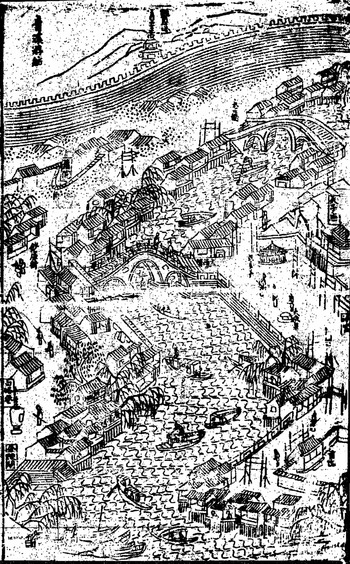
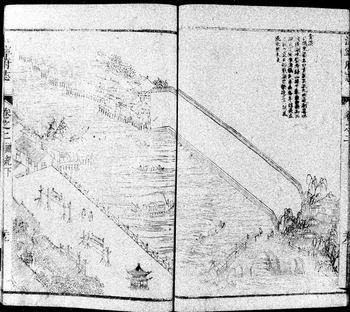
For example, Tuyong's rendition (Figure 1) of the scene around Qinhuai River, where the famous pleasure quarters of Nanjing were located, shows the river in three curves, which divides the space into six segments.Footnote 27 With the city wall indicated at the upper left corner, one more layer is added to the scene. From the top, viewers first see a pagoda before a mountain. Then entering the walls and following the flow of the river, they encounter to the left of the first curve a cluster of buildings marked as jiuyuan, the old pleasure quarters of Nanjing, which had seriously declined by that time – accordingly no tourists are shown in this illustration. Across the bridge is the Confucian temple and school, where people wander about the streets and bridges. To the left is a street called Chaoku jie (Treasury Street), also populated by either tourists or residents. To the right of the next curve is the Examination Hall, surrounded by a river that is also thronged with people in boats. It is indeed a crowded image, fully populated by secondary spaces around the primary landmark, the Qinhuai River.
Qingxi, Jinling tuyong, 31a

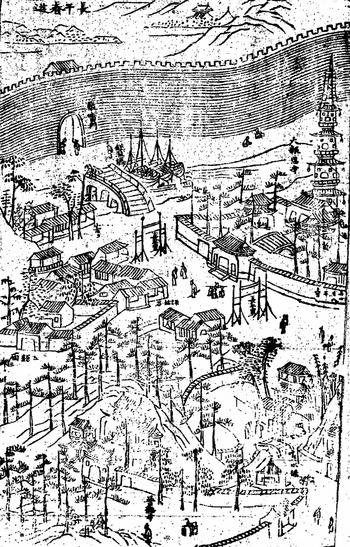
A similar composition was employed to depict many other sights, such as Changgan Li (Figure 2).Footnote 28 The scene is structured around a neighbourhood, where the viewers first enter the city gate, cross a bridge and then pass through an arch inscribed with the characters of Changgan Li. From there, viewers, just like the little figures in the images, would wander about the neighbourhood. To the right are the Bao'en temple and its famous encaustic tiled pagoda; to the left is a Money God temple. To the south is another temple and bridge. The figures found throughout the image not only create many secondary spaces within the temple area but also serve to indicate the diverse possible uses of the space. As we see in the picture, some seem to be enjoying the sight, others work, still others chat. A few are just out for a stroll.
Changgan Li, Jingling tuyong, 21a

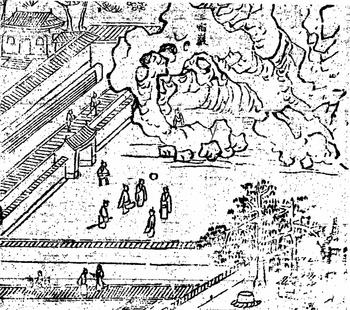
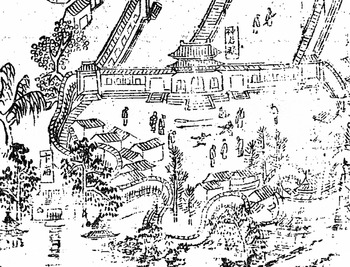
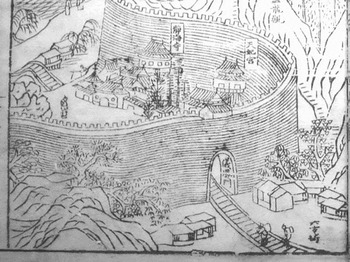
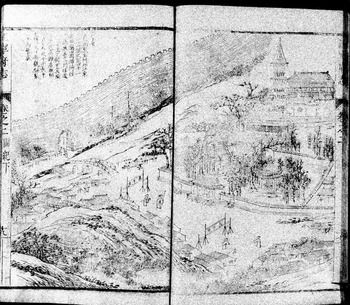
What is being conveyed in Jinling tuyong is that the appreciation of scenic sites is not only a matter of having one's gaze directed and consuming the space at one glance; it is also about living and experiencing the space in a variety of ways. While these attractions might be deployed as a theme by poets or painters, for most people, they signified a lived space where people played, worked or just passed by in their daily lives. The images in the Tuyong are full of details like these where figures kick balls, practise with swords, work in the field, carry goods and many just simply walk around chatting with neighbours (Figures 3–5).Footnote 29 Indeed, the renditions of Nanjing throughout Jinling tuyong consistently exhibit intensive interest in demonstrating the many ways people inhabit a scene as a lived space. To achieve this goal, Tuyong's images tend to highlight topographical partitions and crowd the derivative spaces with figures and activities of all sorts, including both leisure and work. Since these inhabited spaces are derived from the central landmark and not specifically mentioned in the accompanying texts, their meaning can be attained only through the activities performed there. Through the creative and rich details in Tuyong's illustrations, viewers are able to visualize the space of Nanjing through the particularities of daily life and social interaction.
Jinling tuyong, 27a: kick ball game

Jinling tuyong, 29a: sword practice

Jinling tuyong, 16a: people carrying goods before the city gate

Visualizing the urban prosperity of the southern metropolis
The proliferation of secondary spaces in the 1623 Jinling tuyong clearly deviates from mainstream scenic images structured around a central focus scene. The attention to visual details allows Tuyong to develop a unique way of looking at and looking into the lived space of Nanjing through the performance of a wide array of social activities. The idiosyncratic representation of Nanjing might be inspired by its function as a guidebook; that is, by cataloguing possible uses of each area, Tuyong enables viewers to explore the possibilities of space to the fullest extent. Yet at the same time, the emphasis on the performativity of space also evokes a sense of urban prosperity for viewers. Indeed, the extraordinary visual approach in Tuyong is not an isolated invention but reminiscent of the conventions in cityscape paintings, where social activities, instead of the natural landscape, inform and differentiate the representational space.
A good case in point is the contemporary cityscape painting of Nanjing titled Nandu fanhui tu (The Prosperity of the Southern Capital) – a handscroll portraying the energetic urban life in late Ming Nanjing.Footnote 30 Following the tradition of the cityscape handscroll, Nanjing is presented as a generic urban streetscape, that wends from the countryside and culminates in the imperial palace, an established mode for presenting the glamour of urban prosperity. Moving from beginning to end, the viewer walks through an urban space marked not by its physical structure but by an array of spectacles vividly portrayed. Yet interestingly, this seemingly realistic city portrait is interlaced with unrealistic details. For example, the lantern mountain set in the middle of the central street scene indicates a Lunar New Year time frame; however, the dragon boat competitions portrayed on the upper portion would take place only in the fifth month of the year.Footnote 31 Nevertheless, if this image is viewed as a demonstration of the performativity of urban space, in line with what has been observed in Tuyong's images, then the core message of this painting lies in cataloguing a wide variety of possible uses of urban space, not in capturing an actual moment in Nanjing. Urban space, fully inscribed with social activities, is no longer monopolized by a single, culturally approved prospect, but divided and further divided by the people who inhabit the space. It is the people and their interactions, above all else, that animate urban space and furnish it with particular connotations, much in the style of Jinling tuyong.
The re-imagining of Nanjing in the early Qing dynasty
The unique visual details and attention to urban sociality in Jinling tuyong, however, disappeared in the early Qing adaptation. The painter kept the original viewing perspective and composition, but significantly simplified the secondary spaces created in the late Ming version. In the case of Qinhuai River (Figure 6), the three curves are condensed to a single curve, and the people who appear in Tuyong's images, who are granted an actual function signifying the performativity of space, are now reduced to minor details serving only an aesthetic function as pointers to the central scene.Footnote 32 The whole image is centred on and dominated by the landmark the painter intended to highlight. No secondary space is allowed to distract the viewers’ attention.
Qingxi, Jiangning fuzhi (1668), 2.28b–29a

The same editing process can also be observed in the scene of Changgan Li, in which the picture is refocused on the central area. As a result, the rest of the winding streets and back alleys are left out, and the temples detailed in Tuyong's image obscured (Figure 7).Footnote 33 The arch, the pagoda and three pairs of figures are there to show the scene as specified in the textual description, instead of the many other possibilities of the space displayed in Tuyong's images. Above all, unlike in the late Ming Jinling tuyong, the ‘people’ shown in the images here are no longer active interpreters of the space but passive ‘scene pointers’ at the command of the painter. Similar changes can be identified throughout the whole set. Out of 40 scenes, more than 30 exhibit the same simplification process.
Changgan Li, Jiangning fuzhi (1668), 2.17b–8a

The removal of visual details and their undertone of urbanity in the early Qing adaptation of Jinling tuyong appears to be a development inextricably related to its time: two decades after the publication of Jinling tuyong, war broke out, and eventually the Ming regime ceded its power to the Manchus. As the military combat over territory wound down, the battle over the cultural landscape began. Nanjing, as the first and final capital of the Ming regime, became a critical battlefield in the fight over political symbolism, particularly the former Ming palace and the Xiaoling mausoleum.Footnote 34 This view puts the prevalent adaptations of Jinling tuyong's images in late seventeenth-century Nanjing in a very different light. In the works of prominent Nanjing artists such as Gao Cen (for prefectural gazetteer), Zou She, Hu Yukun, and other members of the Eight Masters, the same motifs from Jinling tuyong were repeatedly employed. Yet, despite similar compositions and inscriptions, the early Qing pictures returned to the conventional format focused on a centralized scenery. Evoking the rituals developed from the late Ming social tourism, the persistent adaptation of Jinling tuyong motifs clearly signifies the efforts to extend the touring community of Nanjing elites across the dynastic divide. Yet at the same time, how do we explain the removal of urban scenes that was also characteristic of these works? It is possible that, given that most early Qing painters were professional artists, they considered the conventional format for scenic painting a more apt choice. After all, the creation of secondary spaces in Jinling tuyong is rather idiosyncratic and might well have been inspired by its function as a guidebook. Still, in light of the highly sensitive political atmosphere in the early Qing, it is even more likely that these Nanjing painters deliberately omitted all visual cues of urban sociality, the signature of the late Ming imagination of Nanjing, to distance themselves from the past, from the late Ming landscape marked by urban glamour.Footnote 35 The recreation of late Ming images but with the urban sociality removed gestured towards a deliberately ambiguous acknowledgment of the change in regime: on the one hand, the sharing of visual vocabulary with Jinling tuyong conveys a sense cultural continuity during a time of political disruption. On the other hand, the conspicuous modification also allows for a necessary distance for adjusting to a new political environment. In doing so, Tuyong's early Qing reincarnation is able to articulate a new identity that reconciles the past and the present.
The negotiation of identity through landscape appreciation during the dynastic transition was not unique to Nanjing. An interesting comparison is Yangzhou, a port city along the Grand Canal. Lacking an established repertoire of famous sites inherited from the late Ming as Nanjing had, the urban elite in Yangzhou had to reinvent a late Ming cultural milieu to provide the city with a sense of cultural continuity as it recovered from the traumatic war and regime change.Footnote 36 Tobie Meyer-Fong, in her intriguing study of early Qing Yangzhou, presents a city struggling between the political transition and the ensuing cultural confusion:
In post-conquest Yangzhou, the reconstruction and visiting of famous sites became a vehicle through which the literati elite could present themselves as members of a single class through a celebration of shared cultural values, manifested in conventions for the appreciation of place. Thus through leisure touring and gatherings, early Qing elites gestured toward a culturally constituted Yangzhou. Moreover, by highlighting widely recognized literary icons from the past, they claimed a place for the city alongside more famous places in the empire, and Jiangnan in particular. In so doing, they created a new Yangzhou, filled with references to a Ming past in which, paradoxically, Yangzhou itself had enjoyed little prestige.Footnote 37
In an effort to bridge the cultural gap resulting from dynastic transition, post-Ming Yangzhou reinvented its historicity in Ming Jiangnan, to which cultured sightseeing proves to be the key.
Taken together, these stories bear clear witness to the importance of landscape appreciation in the working of cultural identity and social solidarity. Such place-specific sensibility was by no means permanent but significantly shaped by its time, to which the shift of political regime appears to have been critical. In Yangzhou, the loss and confusion during the dynastic transition prompted the re-imagination of the city in the early Qing through the celebration of a past it never had. In the case of Nanjing, while the recreation of Tuyong's forty sights provided a sense of communal continuity across the dynastic divide, the rendition of urban space was subtly altered to register the impact of regime change.
Conclusion: contextualized ways of looking
Promoting the consumption of space through prescribed ways of looking, tour guides appear to be a form of literature that enjoy broad appeal across different times and spaces. Yet this seemingly universal appearance belies the fact that guidebooks are also a medium susceptible to a wide range of agendas. This perspective calls for a more contextualized reading of guidebooks, an approach that proves rewarding. It brings to light, for example, the impact of political transformation on the ways of looking, either for eighteenth-century London or seventeenth-century Nanjing. The changing spatial imagination, this article further argues, not only reflects the shifting polity at large; in the particular case of Nanjing, it also supplies a sense of cultural continuity that allows urban residents to cope with the disruptive dynastic transition. The added cultural valence of Jinling tuyong, as has been demonstrated, results from the unique practice of social tourism in late imperial China. Under this trend, the practice of landscape appreciation became deeply enmeshed with the workings of local community. The influence of social tourism was so strong that two decades after the publication of Jinling tuyong, as China fell into the hands of Manchus, the colonial regime came to realize that although they had control over the right to the physical land, the cultural landscape had been deeply woven into the fabric of local Han-Chinese society. With the unification of physical territory coming to an end, the highly localized and fragmented representational landscape compelled the court to embark on another cultural enterprise: by the eighteenth century, Manchu emperors were making tours of their realm and producing illustrated guides listing the places they visited, imposing an imperial gaze on to the highly particularized local landscape via the emperor's footsteps. Cultured touring thus turned from a venue of social networking and status performance into a battleground between the state power and local community. Given the importance of landscape appreciation in China's identity politics, it would be interesting to explore its role in the creation of an ‘imagined community’ during the process of nation-building in the early twentieth century when collections of national scenic spots continued to be published.Footnote 38 Authors of titles such as Jinxiu heshan (China the Beautiful) took great pride in the beauty of China's landscape and considered their publications essential to cementing nationalist sentiment.Footnote 39
Finally, the findings of this article also provide a productive point of comparison between different tourist cultures. For example, social tourism appears to have exhibited functions of social networking and status display analogous to the travel culture of ‘virtuosi’, gentry scholars, in seventeenth-century Europe. While in China, sightseeing became an alternative venue of status performance and community-building for those who failed to advance themselves through the excessively competitive civil service examination, in Europe, travel performance allowed the ‘curious travellers’ to attain prized connections with eminent men in other countries and secure their status through the noble accomplishment of cultured travel.Footnote 40 Yet despite the similarities, the very idea of sightseeing was rather differently construed. In Europe, the prestige of sightseeing lay in the ideal of objective vision that yielded immediate and personally verified knowledge. Observations made ‘on the spot’ were considered less susceptible to distortions of memory and, therefore, more authentic. Therefore, travel narratives were considered as true account of the facts that anyone could have viewed if placed in the traveller's vantage point. The premium placed on first-hand objectivity forms a sharp contrast to the emphasis on yi (mindset) in Chinese social tourism where landscape appreciation was an exercise of subjective imagination and a manifestation of the viewer's inner self. The appreciation of the same scenery could be accorded with vastly disparate values depending on the talents of sightseers. First-hand eyewitness experience, therefore, was deemed unnecessary to the practice of cultured touring and was even argued by some to be inferior to imaginary touring (woyou) through guidebooks such as Jinling tuyong. Footnote 41 In this sense, guidebooks and their underlying practice of sightseeing serve as a fertile ground for cross-cultural studies. The many different ‘ways of looking’ essential to the making of guidebooks, in the final analysis, provide not only instructions for their readers to relate to the surveyed space, but also a precious window for scholars to look into the cultural environment in which these publications were created.