Significant outcomes
• A high proportion (73–83%) of conversion disorder patients accept psychiatric referral.
• Only patients who had a structured multidisciplinary joint programme (psychiatric and neurological follow‐ups) had a long‐term (3 years) good outcome.
• Unstructured psychiatric treatment alone is not sufficient for conversion disorder, that seem to benefit from an early support involving both psychiatric and neurological interventions.
Limitations
• The results of this study are highly significant but rely on a small sample of patients and might not be generalised to other conversion disorder population.
• The two groups were not randomised and a selection bias could have happened towards better cases allocated to the treatment group.
• The outcome measures rely on patient's report and are prone to subjective evaluation.
Introduction
Functional neurological symptoms are frequently encountered in neurology Reference Carson, Ringbauer, Stone, McKenzie, Warlow and Sharpe1 and represent an enormous challenge in terms of treatment, as they bear a poor prognosis Reference Carson, Best, Postma, Stone, Warlow and Sharpe2 and are costly in terms of health care system Reference Reid, Wessely, Crayford and Hotopf3 and employment Reference Carson, Stone and Hibberd4. Despite spectacular advances in neuroscience, no definite biological aetiologic model has emerged Reference Nicholson, Stone and Kanaan5 and functional neurological symptoms are understood as ‘psychogenic’ Reference Hallett6 or thought to be part of psychiatric illnesses, as reflected by both DSM‐IV conversion disorders (CD) or CIM‐10 dissociative disorders definitions. Neurologists often refer patients with functional symptoms to psychiatrists Reference Espay, Goldenhar, Voon, Schrag, Burton and Lang7 and both specialists admit they find those patients difficult to handle Reference Carson, Stone, Warlow and Sharpe8. Several psychosocial therapeutic approaches have been tried such as hypnosis Reference Moene, Spinhoven, Hoogduin and van Dyck9, paradoxical injunction therapy Reference Shapiro and Teasell10, individually tailored psychotherapy Reference Reuber, Burness, Howlett, Brazier and Grunewald11 and cognitive behavioural therapy Reference Goldstein, Chalder and Chigwedere12, but no definite treatment plan can be recommended Reference Ruddy and House13. One of the major difficulties in those approaches lies in the fact that patients do not see themselves as psychiatric patients Reference Stone, Binzer and Sharpe14, as they suffer from a physical symptom. When a psychiatric referral is offered, they feel rejected by their neurologists and tend to seek further medical advice Reference Reid, Crayford, Patel, Wessely and Hotopf15. A multimodal approach – combining physical revalidation and psychological intervention has shown some benefit in CD Reference Moene, Spinhoven, Hoogduin and van Dyck16. In this context and in order to avoid the above mentioned issues, a joint consultation, including a neurologist and a psychiatrist, was implemented in our tertiary centre in 2005 (University Hospital, Lausanne), dedicated to the management of patients diagnosed with CD.
The aim of this study was to evaluate the impact of this treatment plan on the long‐term outcome of patients.
Methods
Subjects selection: ‘Joint consultation group’
All consecutive patients followed at the joint consultation from 1 January 2005 to 30 September 2007 were included. They were all newly diagnosed with CD (DSM‐IV criteria) after thorough neurological and psychiatric assessments. The treatment plan consisted of a neurological follow‐up assessment, followed by a psychiatric interview and at the end a common discussion with the patient, the neurologist and the psychiatrist was held. No predefined number of consultations was set but the treatment plan was tailored to the patient needs. The aim of the joint consultation was to explain the functional nature of the symptoms, offer coping strategies and address the potential role of psychological factors.
Controls selection: ‘Standard care control group’
Patients with new onset CD who were not followed up at the joint consultation during the same period were identified through retrospective chart review of all in‐ and outpatients. Electronic patients database was reviewed with the search terms ‘psychogenic’, ‘functional’, ‘dissociative’, ‘somatoform’ and ‘conversion’. Once a diagnosis was established, patients were discharged with a summary to their general practitioner, stating the diagnosis and suggesting psychiatric referral.
Intervention
A postal questionnaire was sent in December 2009 to all subjects, and phone calls were made to those who did not respond to either confirm their refusal or propose them to fill in the questionnaire by phone. The questionnaire included the SF‐36, employment status, medical care use and self‐ratings of symptoms severity. Subjects were asked to rate on a 0–10 Likert scale how severe their symptoms were at first presentation and how severe they were at the time of questionnaire.
Analysis
Across group analysis were done by comparing the mean or median scores with Mann‐Whitney U‐tests. Between group analysis of score changes over time were done with paired Wilcoxon test.
Results
From 1 January 2005 to 30 September 2007, 17 patients were enrolled in the joint consultation programme. Two patients were lost to follow‐up, 3 refused and 12 responded.
During the same period, 28 charts were identified with the above mentioned search terms but only 17 fulfilled the DSM‐IV criteria for CD. In the other cases, search terms were present because CD was raised in the differential diagnosis. Two subjects were lost to follow‐up, 4 refused to take part and 11 responded.
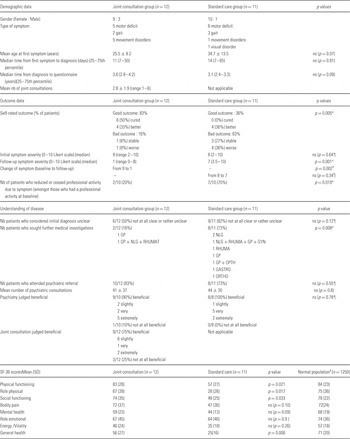
Demographic data did not differ between groups, which had similar female/male ratio and symptom types (Table. 1). The joint consultation group tended to be younger but the mean age was not significantly different between groups (25.5 ± 8.2; 34.7 ± 13.5; p = 0.07 for joint consultation and standard care groups, respectively). The median time from first symptom to diagnosis was similar in both groups (11 days; 14 days; p = 0.81), as well as the time elapsed from diagnosis to follow‐up questionnaire (3.6 years; 3.1 years; p = 0.09). The joint consultation group had a mean number of follow‐up consultations of 2.8.
Demographic and outcome data

The majority of patients from the joint consultation group reported a good long‐term outcome (83%) when only 36% of the standard care group did (p = 0.005). Both groups rated their initial symptoms as equally severe (9 vs. 8, p = 0.64) but only the joint consultation group reported a significant change in symptoms severity (from 9 to 1; p < 0.01 vs. from 8 to 7, p = 0.34). Only 20% of patients from the joint consultation group reduced or ceased professional activity because of initial symptoms when 70% of the patients from the standard care group did (p < 0.05).
Patients from the joint consultation group had better SF‐36 scores on physical functioning, social functioning, general health and less limitation of their activities due to physical symptoms. No differences were found in terms of mental health or limitation of activities due to emotional symptoms, nor in energy level or pain. To compare the SF‐36 scores to what can be expected in the general population, the normal range in the local population Reference Richard, Bouzourène and Gallant17 are presented in Table. 1 but no statistical analysis was carried out. It appears that patients from the joint consultation group reach a normal level for physical functioning, even though they still have lower scores for general health, compared to the healthy local population.
In terms of understanding the disease, both groups considered their initial diagnosis as rather unclear or completely unclear (50 and 82%, respectively for the joint consultation and control group, p = 0.12) but a significant smaller proportion of patients from the joint consultation group sought further medical advice (16 vs. 73%, p < 0.01) (details in Table. 1). A majority of patients in both groups agreed to a psychiatric referral (83 vs. 73%, p = 0.55) and considered this psychiatric intervention beneficial (90 vs. 100%, p = 0.78). Patients from the joint consultation group had a mean number of additional (after the joint consultation programme was over) psychiatric interviews of 41, when patients from the standard care group had a mean of 44 interviews (p = 0.9). A majority of patients followed‐up in the joint consultation judged the intervention to be beneficial (75%).
Discussion
This controlled, questionnaire‐based, follow‐up study showed that at 3 years the group of CD patients enrolled in a standardised programme involving joint consultations (neurologist and psychiatrist) had a better subjective outcome with a decrease of self‐rated symptom severity, compared to standard care patients. This improvement of physical symptoms was also reflected in the results of the SF‐36 questionnaire, showing a significant difference between groups in the subscales involving physical complaints. Objective measures, such as employment status and medical care use also showed a benefit of this programme, as a greater proportion of treated patients returned to work and reduced their medical care use.
Our data show that overall, patients with CD had a high acceptance rate for further psychiatric referral, as both groups agreed to psychiatric evaluation with similar numbers of follow‐up consultations and even judged it to be beneficial. However, patients who had psychiatric treatment outside the joint consultation programme did not improve their physical symptom. This suggests that unspecific psychiatric intervention is not sufficient for CD patients and that the benefit we observe in our study might be due to the targeted goals defined – coping strategies and identification of psychological triggering factors. This is in line with previous work Reference Reuber, Burness, Howlett, Brazier and Grunewald11 showing that tailored psychotherapy, focussing on unresolved issues from the past and coping styles might be efficient in functional neurological symptoms. The second significant finding of our study is that patients from the joint programme reduced their health care use compare to controls. Our structured programme offered early standardised psychiatric intervention in the first weeks after symptom onset, whereas we do not have data on the time elapsed from first symptoms to first psychiatric intervention in the controls group. One could hypothesise that controls had a delay in their psychiatric care that led them to seek further medical help in the meantime. However, as the third goal of the joint programme was to provide reassurance that no other organic cause can be found through repeated medical examination and discussions with the neurologist, this effect could also suggest that the presence of a neurologist is crucial in providing this reassurance and that reduced health care use is a positive consequence of this reassurance. A better understanding of the disease – and attribution to psychological causes – is a recognised predictor of good outcome Reference Sharpe, Stone and Hibberd18 and one could hypothesise that the positive effect we measure is due to an improvement of understanding of the disease in patients followed at the joint programme. Both groups rated their initial diagnosis as being rather unclear and, unfortunately, our questionnaire did not include an evaluation of disease understanding after treatment but the reduction in health care use is an indirect measure of acceptance of the proposed diagnosis.
Our study has several limitations. As the control group was selected based on retrospective chart reviews rather than randomised prospective attribution, a bias could have happened towards cases with better prognosis allocated to the joint consultation group, like patients with isolated CD without comorbid somatization. However, no significant differences were observed between groups at baseline regarding the other major known prognostic factors Reference Carson, Best, Postma, Stone, Warlow and Sharpe2, Reference Couprie, Wijdicks, Rooijmans and van Gijn19, Reference Crimlisk, Bhatia, Cope, David, Marsden and Ron20; time to diagnosis, type of symptoms or baseline symptom severity. As all cases were newly diagnosed, a proportion of cases might have had a spontaneous positive outcome independent from the intervention. However, as both groups had similar times from first symptom to diagnosis, one could expect this effect to be minimised. Another limitation is that our outcome measures are subjective, as they rely on patients' self‐reports and could have been influenced by unrealistic recall of baseline symptoms severity. Finally, as the exact content of the psychiatric intervention in the standard care group is not available, the differences in outcome we measure might not be due only to the procedure (joint consultation) itself as described above but could also be partly explained by a different type of psychiatric treatment. To better refine the effect of the psychiatric approach, a prospective study is needed.
This study however, shows that a joint consultation programme is well accepted by the patients, is effective in alleviating the physical symptoms, allows a better social functioning and reduces unnecessary medical investigations. The proposed intervention has minimal requirement – a psychiatrist and a neurologist ready to work together – and in the era of sophisticated medicine, such simple non‐invasive treatment strategies should be maintained and developed by clinicians, as they seem to be useful to patients and cost‐effective.