Introduction
In many countries, various nonnative grass species have been intentionally introduced for high-quality forage production and have brought substantial benefits to livestock farming (Lonsdale Reference Lonsdale1994; Wilkins and Humphreys Reference Wilkins and Humphreys2003). However, while nonnative forage grasses greatly contribute to agriculture, some have had significant impacts on native biodiversity following their naturalization (Marshall et al. Reference Marshall, Friedel, van Klinken and Grice2011; Scasta et al. Reference Scasta, Engle, Fuhlendorf, Redfearn and Bidwell2015), which has led to serious conflicts between economic profitability and biodiversity conservation (Friedel et al. Reference Friedel, Grice, Marshall and van Klinken2011; Grechi et al. Reference Grechi, Chadès, Buckley, Friedel, Grice, Possingham, Van Klinken and Martin2014). Because dispersion of propagules, such as seeds, from cultivation to surrounding ecosystems is the first, crucial step for nonnative forage grasses to establish wild populations (Driscoll et al. Reference Driscoll, Catford, Barney, Hulme, Inderjit, Martin, Pauchard, Pyšek, Richardson, Riley and Visser2014b; Grice Reference Grice2006), understanding how far and how much nonnative forage grasses disperse their seeds from cultivated settings would enhance our ability to develop effective management plans against the naturalization of these species and hence to balance their agricultural use with conservation of native biodiversity (Grice et al. Reference Grice, Friedel, Setterfield, Ferdinands, Clarkson, Rolfe and MacLeod2011).
Wind is a key dispersal vector of seeds, even for many grass species whose seeds are not specially adapted for wind dispersal (Quick et al. Reference Quick, Houseman and Büyüktahtakin2017; Rabinowitz and Rapp Reference Rabinowitz and Rapp1981), and several of such grass species successfully disperse their seeds beyond planted areas via wind (Egawa Reference Egawa2017). Therefore, wind-mediated seed dispersal was focused on in this study. Knowledge about the wind dispersal distance of nonnative forage grasses can help in detecting their potential invasion ranges around grasslands, where management efforts should be invested. Due to the distinct characteristics of each species, the wind dispersal distance of forage grasses can greatly differ among species. Several previous studies have proved that wind dispersal distance is negatively correlated with the terminal fall velocity of seeds (Soons and Ozinga Reference Soons and Ozinga2005; Tamme et al. Reference Tamme, Götzenberger, Zobel, Bullock, Hooftman, Kaasik and Pärtel2014), which is generally lower for smaller seeds (Cousens et al. Reference Cousens, Dytham and Law2008), and positively correlated with wind speeds when seeds are released (Soons and Bullock Reference Soons and Bullock2008; Treep et al. Reference Treep, de Jager, Kuiper, Duman, Katul and Soons2018). These results suggest that forage grass species that have lower seed terminal velocity and/or produce seeds during windy seasons may have relatively long dispersal distances, and hence larger potential invasion ranges.
Management Implications
Nonnative forage grasses can pose serious impacts on native biodiversity when naturalized; therefore, prevention of their naturalization is an important challenge. To inform prevention efforts, we quantified the wind-mediated seed dispersal distance and the amount of dispersed seed of several nonnative forage grass species, including timothy (Phleum pratense), orchardgrass (Dactylis glomerata), and Kentucky bluegrass (Poa pratensis), from agricultural grasslands in Hokkaido, Japan. The dispersal distance of forage grasses ranged from 2.3 m (P. pratense) to 31.5 m (P. pratensis) from the grasslands, suggesting that the areas within these distances are exposed to invasion risk. The number of seeds of two dominant species, P. pratense and D. glomerata, dispersed outside the field sometimes exceeded 100 seeds m−2 when the grassland was not mown, while the number of seeds dispersed outside mown grasslands was always less than one-third of that number. These results suggest that nonnative forage grasses are at high risk of naturalization if grasslands are not mown. We suggest that land managers invest their efforts in frequent mowing of grasslands to prevent the dispersion of forage grass seeds to surrounding environments. In addition, areas within the dispersal distances of forage grasses should be monitored, because seeds of rapidly regrowing species may occasionally escape between mowing events and establish wild populations. Managers may also consider using forage grass species with relatively short dispersal distances and/or slow regrowth rates, because such species would have a lower risk of escaping to natural ecosystems. Although our observations are limited to a single location in Hokkaido, presumably these basic management strategies would be applicable to many locations.
Additionally, information about the amount of dispersed seed from grasslands (i.e., propagule pressure) can help predict the invasion success of nonnative forage grasses in surrounding ecosystems (Driscoll et al. Reference Driscoll, Banks, Barton, Ikin, Lentini, Lindenmayer, Smith, Berry, Burns, Edworthy, Evans, Gibson, Heinsohn, Howland, Kay, Munro, Scheele, Stirnemann, Stojanovic, Sweaney, Villaseňor and Westgate2014a, Reference Driscoll, Catford, Barney, Hulme, Inderjit, Martin, Pauchard, Pyšek, Richardson, Riley and Visser2014b). The number of dispersed seeds from grasslands presumably depends on the management conditions of the grasslands. In cool-temperate regions, grasslands established for forage production are generally mown several times a year (Peeters Reference Peeters2004), although underused grasslands that are rarely mown also exist (Hanada Reference Hanada2014; Socher et al. Reference Socher, Prati, Boch, Müller, Baumbach, Gockel, Hemp, Schöning, Wells, Buscot, Kalko, Linsenmair, Schulze, Weisser and Fischer2013). Because mowing resets the growth and reproduction of cultivated forage grasses, the number of seeds dispersed from regularly mown grasslands should be much smaller than that from unmown grasslands for any species. Furthermore, the number of produced seeds, and hence the number of dispersed seeds per unit area, also depends on the amount of species plant cover (Goyal and Sharma Reference Goyal, Sharma, Rajpal, Rao and Raina2016); the number of seeds should be larger in sites with high plant cover than in sites with low cover. Therefore, to quantify the number of seeds dispersed from mown and unmown grasslands, and the differences between numbers in those grasslands, the influences of plant cover must be considered. Determining the relationship between plant cover and the number of dispersed seeds under both mown and unmown conditions is one possible approach. The results of such an approach will provide insight into the naturalization risks of forage grasses around mown and unmown grasslands under various plant cover situations and the role of mowing as a countermeasure against naturalization.
Here, we conducted a case study assessing wind-mediated seed dispersal distance and amount of dispersed seed of invasive nonnative forage grasses from agricultural grasslands in Hokkaido. Hokkaido, the largest and northernmost prefecture in Japan, has been a stronghold of grassland-based livestock farming. As of 2017, Hokkaido possessed more than 80% of the total grassland area in Japan (Ministry of Agriculture, Forestry and Fisheries Japan 2018). Most forage grass species that have been cultivated in Hokkaido are nonnatives intentionally introduced during the Meiji era (1868–1912). Among these introduced grass species, timothy (Phleum pratense L.) and orchardgrass (Dactylis glomerata L.) have been the most valued and have occupied the first and second largest shares of usage (Ministry of Agriculture, Forestry and Fisheries Japan, unpublished data). While they are important for agriculture, nonnative forage grasses, including P. pratense and D. glomerata, are now widely naturalizing and threatening the native flora (Hokkaido 2010). The ecological impacts of naturalized populations of nonnative forage grasses are of serious social concern, and P. pratense, D. glomerata, and several other species are included on the national invasive alien species list (Ministry of the Environment and Ministry of Agriculture, Forestry and Fisheries Japan 2015). The Japanese government is now calling upon farmers and landowners who are cultivating listed nonnative forage grasses to prevent their naturalization. Our first objective was to determine the wind dispersal distances from cultivated settings of several invasive nonnative forage grass species. We expected to measure relatively long dispersal distances for species whose seeds had low terminal velocity. We also predicted that species that started their reproduction earlier would have longer dispersal distances, because the wind generally blows more strongly in spring than in summer at our study site. Our second objective was to determine the relationship between plant cover and the number of dispersed seeds of P. pratense and D. glomerata, two invasive but most commonly cultivated species in Hokkaido, under mown and unmown conditions. In the northern part of Japan, including Hokkaido, grasslands cultivating P. pratense or D. glomerata for forage production are generally mown two to three times a year (Deguchi Reference Deguchi2016; Takeda Reference Takeda2004), or occasionally four times for D. glomerata (Mori and Hojito Reference Mori and Hojito2012). We expected that mowing would contribute to reducing the number of seeds dispersed to surroundings, perhaps by more than 90%, of both species, and that these species are at high risk of naturalization around unmown, untended grasslands.
Materials and Methods
Study Region and Species
In the study region, Hokkaido, there were 503,400 ha of agricultural grasslands in 2017 (Ministry of Agriculture, Forestry and Fisheries Japan 2018). The majority of these grasslands are actively used for forage production, but there are also some grasslands, such as those with a complex terrain where mowing efficiency is low, that are left unmanaged for long periods (Hanada Reference Hanada2014) or are completely abandoned (Morimoto et al. Reference Morimoto, Shibata, Shida and Nakamura2017). Grasslands in Hokkaido usually contain various nonnative forage grass species, both deliberately seeded and voluntarily occurring (Deguchi Reference Deguchi2016). Most likely due to the fertilized soil conditions in grasslands, these grasses often remain in grasslands long after abandonment (Tsuyuzaki et al. Reference Tsuyuzaki, Kanda and Narita1994).
In addition to P. pratense and D. glomerata, several perennial grass species that were intentionally introduced for forage production are now considered invasive in Hokkaido; for example, redtop (Agrostis gigantea Roth), sweet vernalgrass (Anthoxanthum odoratum L.), perennial ryegrass (Lolium perenne L.), and tall fescue (Festuca arundinacea Schreb.; syn. Lolium arundinaceum [Schreb.] Darbysh.) are all included on the national invasive alien species list (Ministry of the Environment and Ministry of Agriculture, Forestry and Fisheries Japan 2015). In addition, smooth brome (Bromus inermis Leyss.), meadow fescue (Festuca pratensis Huds.; syn. Schedonorus pratensis [Huds.] P. Beauv.), reed canarygrass (Phalaris arundinacea L.), and Kentucky bluegrass (Poa pratensis L.) are included on the Hokkaido prefectural invasive alien species list (Hokkaido 2010). All of these species are capable of vegetative reproduction (Asai Reference Asai2014; Stone Reference Stone2010). However, clonal expansion is generally range limited, and seeds are the means by which these species establish wild populations in locations remote from cultivated grasslands. None of these species has specially adapted dispersal units for wind dispersal (Asai Reference Asai2014).
Sampling Wind-mediated Seed Dispersal Using Seed Traps
Sampling for wind-mediated seed dispersal was conducted over a snow-free period from May to October 2017 in agricultural grasslands established in the Hokkaido Agricultural Research Center, National Agriculture and Food Research Organization (43.0084°N, 141.4116°E). The location is characterized by a cool-temperate climate with relatively windy conditions; the mean annual temperature and annual precipitation during the study period at the study site were 15.5 C and 739 mm, respectively, and the daily mean and average maximum wind speeds were 2.5 ± 0.3 m s−1 and 8.2 ± 1.2 m s−1 (mean ± SD), respectively (Hokkaido Agricultural Research Center 2017). In this area, stronger wind gusts generally blow in spring and autumn rather than in summer; the maximum instantaneous wind speeds and their directions in each study month were 18.3 m s−1 southwesterly, 13.9 m s−1 southerly, 11.8 m s−1 south-southeasterly, 12.2 m s−1 south-southwesterly, 13.3 m s−1 west-southwesterly, and 18.2 m s−1 northwesterly in May, June, July, August, September, and October, respectively (Supplementary Figure S1).
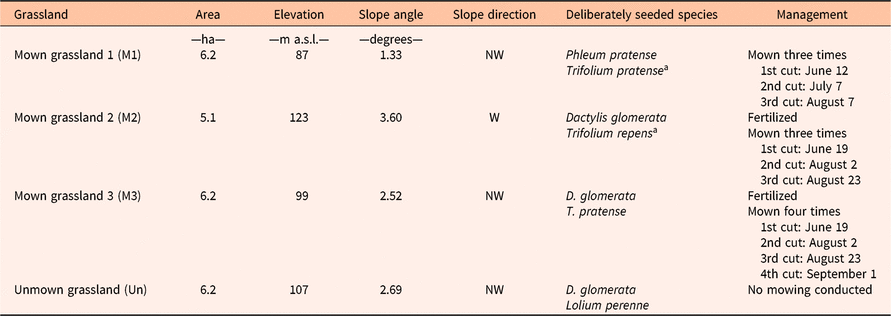
Three grasslands subject to mowing, named M1 to M3 (M1: seeded with P. pratense and mown three times; M2: seeded with D. glomerata and mown three times; and M3: seeded with D. glomerata and mown four times), and one unmown grassland were used for the seed dispersal sampling (Table 1). All grasslands were established in 1966, and the last seeding was conducted before 2007. The three grasslands, M1, M2, and M3, were mown to 5 cm above the ground using disk mowers for the purposes of forage production and vegetation maintenance; the first cut materials were used as fodder, while the second and latter cut materials were left in place. The timing of each mowing operation, which was decided depending on the sward height, availability of the workforce, and weather, differed among the grasslands (Table 1). In grasslands M2 and M3, bulk blend fertilizers were applied in the early spring of 2017 (average 77 kg N ha−1 yr−1, 35 kg P2O5 ha−1 yr−1, and 92 kg K2O ha−1 yr−1). Although the management regimes differed among the three grasslands, all were classified as “mown grasslands,” and the results were combined for subsequent analyses. This was because the purpose of the study was to investigate the effects of mowing on seed dispersal and not the differences between management regimes. The unmown grassland was originally seeded with D. glomerata and L. perenne and grazed until 2013, but it has since been abandoned. In 2017, no management practices, including mowing or fertilizing, were conducted throughout the year in the unmown grassland. The distances between each grassland ranged from 650 to 950 m, which far exceeds the threshold distance of general wind dispersal (Ford et al. Reference Ford, Sharik and Feret1983; Okubo and Levin Reference Okubo and Levin1989).
Attributes of the four study grasslands established in the Hokkaido Agricultural Research Center, National Agriculture and Food Research Organization.

a Red clover (Trifolium pratense L.); white clover (Trifolium repens L.).
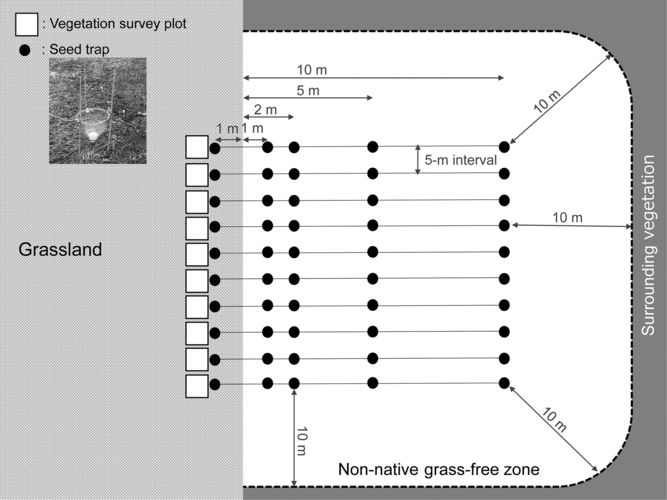
We produced a total of 200 funnel seed traps with a sampling area of 706.5 cm2 in the same form as described in Egawa (Reference Egawa2017). In each of the four study grasslands, 50 traps were installed along 10 transects running from within the grasslands into the surrounding vegetation at 5-m intervals at the end of April 2017. The traps were attached to robust bamboo sticks and placed 35 cm above ground level. Along each transect, one trap was placed inside the grassland 1 m from the edge of the grassland, and four traps were established outside the grassland at distances of 1, 2, 5, and 10 m from the edge of the grassland (Figure 1). The traps inside the grasslands were used to quantify the abundance of seeds dispersed within the grasslands, while those outside were used to quantify escaped seeds. The maximum trapping distance, 10 m, was determined based on previously reported dispersal distances of grass species lacking special adaptation for wind dispersal, which is often limited to a few meters from a source (Quick et al. Reference Quick, Houseman and Büyüktahtakin2017; Rabinowitz and Rapp Reference Rabinowitz and Rapp1981; Rew et al. Reference Rew, Froud-Williams and Boatman1996; Tamme et al. Reference Tamme, Götzenberger, Zobel, Bullock, Hooftman, Kaasik and Pärtel2014). We removed all the nonnative grasses growing within a 10-m radius from each trap outside the grasslands using rotary weeders and herbicides to ensure that there were no seed sources outside the grasslands (Figure 1). However, it was impossible to completely eliminate the possibility of accidental seed contamination from surrounding vegetation outside the buffer zone, particularly for seed traps placed at a distance of 10 m from the grasslands. Nonetheless, we used all data, including those obtained from 10-m distance traps, to estimate seed dispersal distances, because discounting these data may lead to the underestimation of dispersal distances, and hence the potential ranges that invasive nonnative grasses can actually reach. We emptied the traps and sampled the seeds six times during the study period: at the end of May, June, July, August, September, and October. The sampled seeds were identified under a stereomicroscope (SMZ800, Nikon, Tokyo, Japan) using references collected in the field, sample seeds provided from a nursery company, and an illustrated book of seeds by Nakayama et al. (Reference Nakayama, Inokuchi and Minamitani2000), and the seeds were counted by species.
The experimental setup of the seed traps. Both the scale and shape of the objects are illustrative, as are the locations of the transects.

Vegetation Survey
To quantify the plant cover of P. pratense, D. glomerata, and other nonnative grass species established in each grassland, a vegetation survey was conducted during the seed-trapping period. We set a 1 by 1 m plot adjacent to each seed trap within the grasslands; therefore, a total of 10 plots per grassland were established (Figure 1). At the end of May, June, July, August, September, and October, the absolute plant cover (%) was visually estimated for all the species found in each plot. To capture the reproductive phenology of each species, we also recorded flowering for all the observed species in every census.
Data Analyses
To determine wind-mediated seed dispersal distances of nonnative grasses, we estimated dispersal kernels for each species for which seeds were captured at multiple distances. For each studied species, data for months and grasslands were pooled for the dispersal kernel estimation to increase sample size. We followed the estimation procedure employed in recent seed-trapping studies (Egawa Reference Egawa2017; Herrmann et al. Reference Herrmann, Carlo, Brudvig, Damschen, Haddad, Levey, Orrock and Tewksbury2016). First, the Kaplan-Meier survivorship curves were constructed based on the number of seeds collected at each distance, and then dispersal kernels in their one-dimensional form (i.e., probability density functions of the distribution of dispersal distances) were fit to the survivorship curves. We tested three commonly used probability density functions, Weibull, exponential, and lognormal, and selected the best-fit functions based on the Akaike information criterion (AIC) (Burnham and Anderson Reference Burnham and Anderson2002). We collected the terminal fall velocity of seeds for each species from the LEDA plant trait database (Kleyer et al. Reference Kleyer, Bekker, Knevel, Bakker, Thompson, Sonnenschein, Poschlod, Van Groenendael, Klimeš, Klimešová, Klotz, Rusch, Hermy, Adriaens, Boedeltje, Bossuyt, Dannemann, Endels, Götzenberger, Hodgson, Jackel, Kühn, Kunzmann, Ozinga, Römermann, Stadler, Schlegelmilch, Steendam, Tackenberg, Wilmann, Cornelissen, Eriksson, Garnier and Peco2008).
To quantify the seeds dispersed from the mown and unmown grasslands under various plant cover situations, we determined the relationship between the abundance of dispersed seeds and plant cover in the presence and absence of mowing for P. pratense and D. glomerata using generalized linear models (GLMs), which can apply appropriate probability distributions for positive count data. For each species, the number of seeds captured in the traps 1-m inside the grasslands at the six sampling times was summed to quantify the total number of seeds dispersed within the grasslands during the study period. We determined the total number of seeds dispersed outside to be the sum of seeds captured in the traps 1-m outside the grasslands from the six sampling times. The data at other distances (i.e., 2, 5, and 10 m from the grasslands) were not used for this analysis, because the traps at these distances were far from the vegetation survey plot in each transect, and it would be inappropriate to correlate the number of seeds captured in the traps to the plant cover measured in the vegetation survey plot. For each species, the number of seeds dispersed within or outside the grasslands was incorporated as a response variable in the GLMs with a Poisson error distribution and a log-link function. The grassland type (mown or unmown), the annual mean percent cover in each plot, and their interaction were included as explanatory variables in the full model. From a set of models including all possible combinations of the explanatory variables incorporated in the full model, the model that provided the best prediction was selected based on the AIC (Burnham and Anderson Reference Burnham and Anderson2002).
All the statistical procedures were performed using the statistical package R v. 3.3.1 (R Core Team 2016). We used the function survfit in the package ‘survival’ to estimate survivorship curves, optim in ‘stats’ to obtain the maximum-likelihood estimates of the parameter values for probability density functions, and glm in ‘stats’ to construct GLMs.
Results and Discussion
Establishment and Reproductive Phenology of Nonnative Grasses
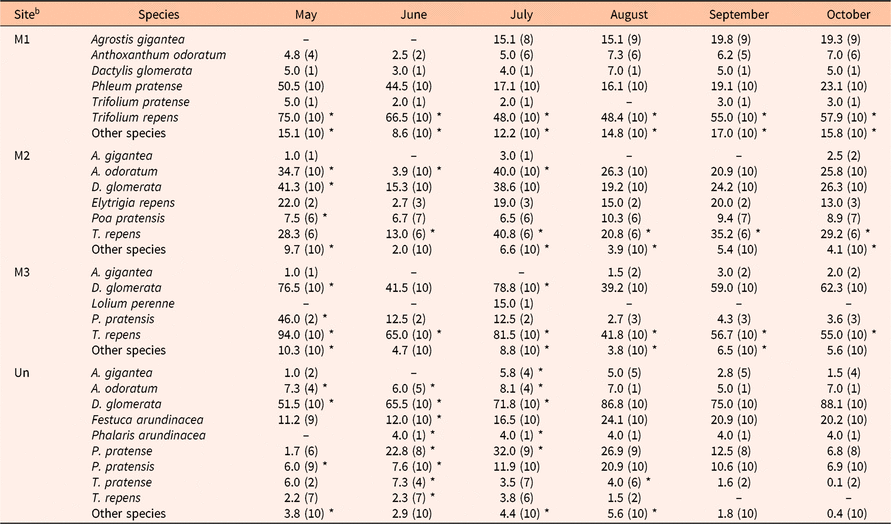
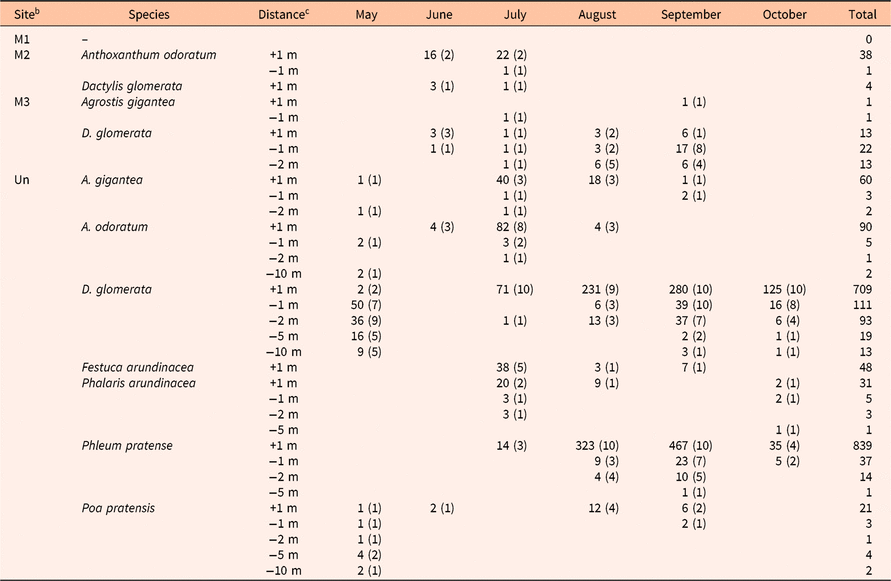
Results of the vegetation survey proved that all the study grasslands included various nonnative forage grasses, both deliberately seeded and voluntarily occurring (Table 2), as is commonly observed in grasslands of the Hokkaido region (Deguchi Reference Deguchi2016). Eight species considered invasive were established in our grasslands: A. gigantea, A. odoratum, D. glomerata, F. arundinacea, L. perenne, P. arundinacea, P. pratense, and P. pratensis. Flowering was observed for all the species except for L. perenne (Table 2). Three species—A. odoratum, D. glomerata, and P. pratensis—started flowering in May, earlier than other species. Flowering of these species was interrupted by mowing in the mown grasslands, but some individuals of A. odoratum and D. glomerata started flowering again after the first cut in grasslands M2 and M3, respectively, in both of which fertilizers were applied (Table 2). This result suggests that these two species can regrow quickly and reach the reproductive stage between mowing events if nutrient conditions are suitable. Flowering of F. arundinacea, P. arundinacea, and P. pratense began in June, and that of A. gigantea began in July in the unmown grassland. Phleum pratense and A. gigantea were also established in the mown grasslands, but neither species flowered in vegetation survey plots in the mown grasslands throughout the study period. All the grass species that flowered dispersed their seeds, some of which were captured in the seed traps (Table 3).
Mean plant cover (%) of nonnative species with the number of occurrence plots in parentheses in the four study grasslands.Footnote a

a Dashes (–) indicate no individuals were observed; asterisks (*) indicate flowering individuals were observed. Other species include dandelion (Taraxacum officinale F. H. Wigg.), broadleaf dock (Rumex obtusifolius L.), red sorrel (Rumex acetosella L.), and buckhorn plantain (Plantago lanceolata L.).
b See Table 1 for site descriptions.
Number of seeds captured in the seed traps placed within and outside the study grasslands.a

a The numbers in parentheses indicate the occurrence frequency (i.e., the number of traps).
b See Table 1 for site descriptions.
c Distance: +1 m indicates seed traps placed 1 m inside the grassland edge; −1, −2, −5, and −10 m indicate seed traps placed outside the grasslands at distances of 1, 2, 5, and 10 m from the grassland edge, respectively.
Wind-mediated Seed Dispersal Distance
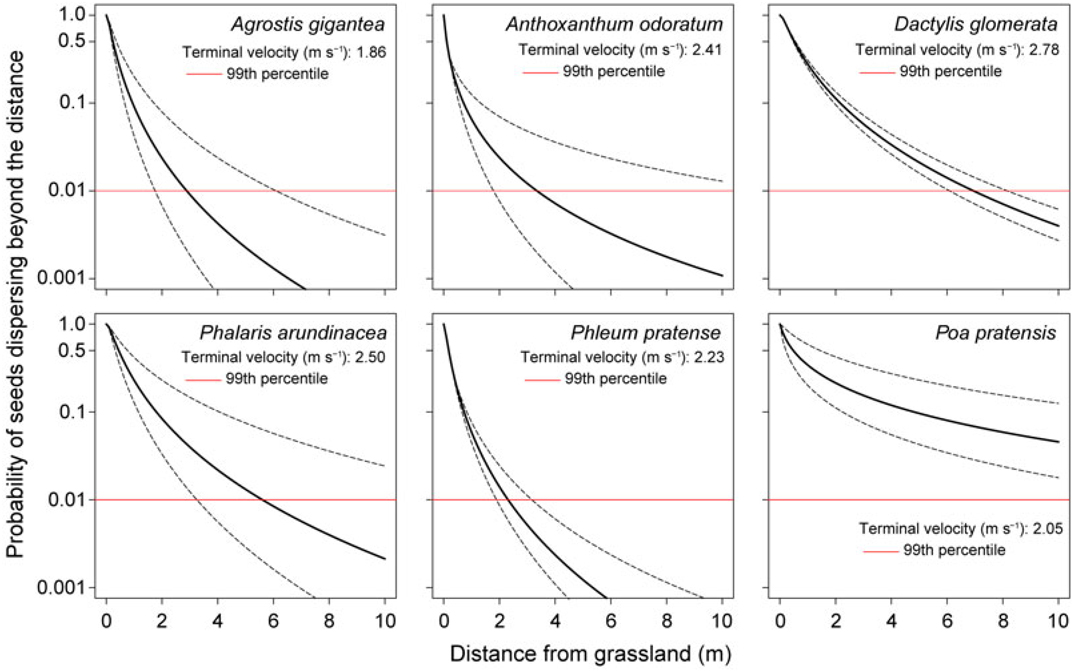
Dispersal kernels were estimated for six species—A. gigantea, A. odoratum, D. glomerata, P. arundinacea, P. pratense, and P. pratensis (Figure 2)—whose seeds were trapped at multiple distances (Table 3). For all six species, the lognormal distribution fit best among the three tested functions (Supplemental Table S1). The estimated seed dispersal distance was longest for P. pratensis, where the 99th percentile dispersal distance, which is often used as an index of the potential maximum dispersal distance (Tamme et al. Reference Tamme, Götzenberger, Zobel, Bullock, Hooftman, Kaasik and Pärtel2014; Treep et al. Reference Treep, de Jager, Kuiper, Duman, Katul and Soons2018), was 31.47 m; this was a fairly long distance for grasses lacking special adaptation for wind dispersal (Quick et al. Reference Quick, Houseman and Büyüktahtakin2017; Rabinowitz and Rapp Reference Rabinowitz and Rapp1981; Rew et al. Reference Rew, Froud-Williams and Boatman1996; Tamme et al. Reference Tamme, Götzenberger, Zobel, Bullock, Hooftman, Kaasik and Pärtel2014). The second-longest dispersal distance was observed for D. glomerata, where the 99th percentile distance was 6.95 m, followed by P. arundinacea at 5.60 m and A. odoratum at 3.35 m. Shorter 99th percentile dispersal distances were obtained forP. pratense at 2.31 m and A. gigantea at 2.89 m.
Estimated dispersal kernels for six grass species. Solid lines indicate median estimates, and dashed lines indicate the 95% confidence intervals. The probability is shown on a log scale. The terminal velocity value of each species was obtained from the LEDA plant trait database (Kleyer et al. Reference Kleyer, Bekker, Knevel, Bakker, Thompson, Sonnenschein, Poschlod, Van Groenendael, Klimeš, Klimešová, Klotz, Rusch, Hermy, Adriaens, Boedeltje, Bossuyt, Dannemann, Endels, Götzenberger, Hodgson, Jackel, Kühn, Kunzmann, Ozinga, Römermann, Stadler, Schlegelmilch, Steendam, Tackenberg, Wilmann, Cornelissen, Eriksson, Garnier and Peco2008).

Although various biotic and abiotic factors, including seed release height (Diacon-Bolli et al. Reference Diacon-Bolli, Edwards, Bugmann, Scheidegger and Wagner2013; DiTommaso et al. Reference DiTommaso, Stokes, Cordeau, Milbrath and Whitlow2018) and humidity (Treep et al. Reference Treep, de Jager, Kuiper, Duman, Katul and Soons2018), can affect wind-mediated dispersal distance, the longest dispersal distance observed for P. pratensis in this study may be partly explained by interactive effects between seed terminal velocity and wind conditions during its reproductive period. In our study site, the strongest wind gusts from multiple directions of up to 18.3 m s−1 were recorded in May. After that, wind gust speeds gradually decreased, as indicated by the maximum instantaneous wind speeds of 13.9 m s−1 in June and 11.8 m s−1 in July (Supplementary Figure S1). Therefore, species that start reproduction earlier would have more opportunities to send their seeds far from grasslands via these stronger wind gusts, particularly if the species had low terminal velocity that promotes seeds remaining airborne (Cousens et al. Reference Cousens, Dytham and Law2008; Soons and Ozinga Reference Soons and Ozinga2005). Poa pratensis started reproduction in May and had the second lowest terminal velocity (2.05 m s−1), and these two advantages may have contributed to its showing a much longer dispersal distance and a larger potential invasion range than other species. In a previous study that compiled the dispersal distances of various species (Cain et al. Reference Cain, Damman and Muir1998), the dispersal distance of P. pratensis was reported to reach 25 m under a wind speed of 20 km h−1 (approximately 5.6 m s−1), suggesting that our estimation of the dispersal distance of this species is not an overestimation. Seasonal changes in wind gust speeds in our study site might also partly explain the second longest dispersal distance of the early-flowering species, D. glomerata, and the short dispersal distance of the latest-flowering species, A. gigantea.
Relationship between Plant Cover and the Number of Dispersed Seeds of Phleum pratense and Dactylis glomerata
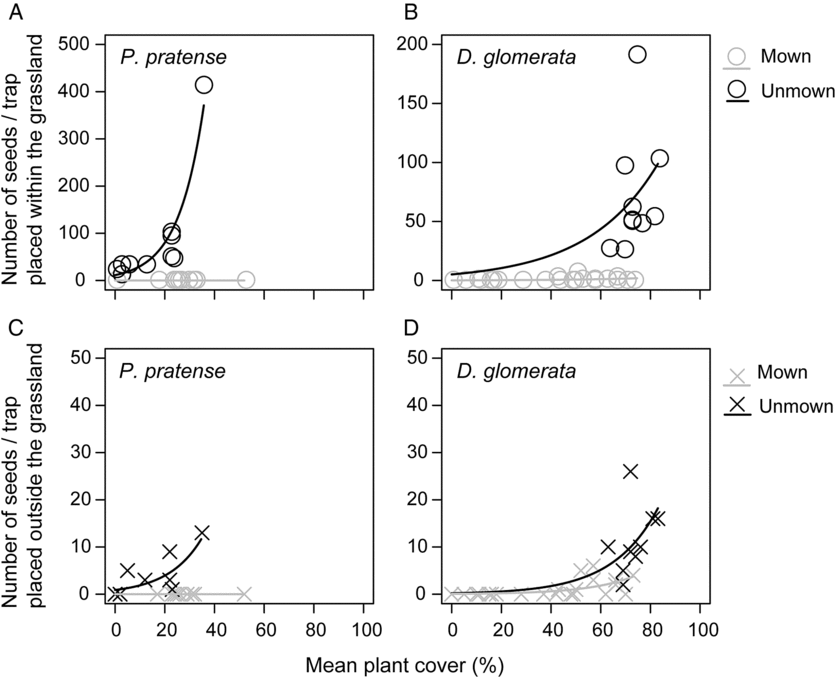
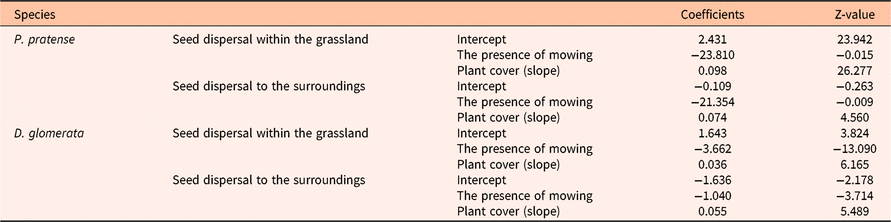
Based on a 6-mo vegetation survey, the annual mean plant cover of P. pratense per 1 by 1 m vegetation survey plot area was 0% to 35% in the unmown grassland and 0% to 52% in the mown grassland. For D. glomerata, the annual mean plant cover per plot area in the three mown grasslands was 0% to 73%, and 63% to 83% in the unmown grassland. For both species, the best GLM with the minimum AIC demonstrated a clear positive correlation between the annual mean plant cover and the number of dispersed seeds (Table 4). The model also quantified clear differences in the number of seeds dispersed within the grasslands between mown and unmown conditions under various plant cover situations. For P. pratense at 30% plant cover, the number of dispersed seeds within the grasslands estimated by the best model was 215 per trap area (3,043 seeds m−2) when mowing was not conducted, whereas that value was 0 when the area was mown (Figure 3A). For D. glomerata at 70% plant cover, the estimated number of seeds dispersed within the grasslands was 64 per trap area (905 seeds m−2) when the area was unmown, whereas that value was 2 (28 seeds m−2) when mowing was conducted (Figure 3B). The number of escaped seeds also decreased with mowing. At a cover of 30%, the estimated number of escaped seeds for P. pratense was 8 per trap area (113 seeds m−2) if mowing was not conducted, while it was 0 with mowing (Figure 3C). For D. glomerata at 70% cover, the estimated number of escaped seeds was 9 per trap area (127 seeds m−2) if mowing was not conducted, but that value was 3 (42 seeds m−2) with mowing (Figure 3D).
Relationship between plant cover and number of seeds that dispersed within the grasslands (A, B) and escaped to the surroundings (C, D). Gray and black solid lines indicate the values estimated by the best generalized linear models (GLMs) for the mown and unmown grasslands, respectively. The gray and black symbols (○ for seed dispersal within the grassland; × for seed dispersal to the surroundings) represent the observed values for mown and unmown grasslands, respectively.

The results provided quantitative evidence that mowing greatly reduced the number of dispersed seeds of both P. pratense and D. glomerata. Despite a large reduction, however, some seeds of D. glomerata still escaped from the mown grasslands when plant cover was high. Dactylis glomerata is known for its fast rate of regrowth after mowing (Kunelius et al. Reference Kunelius, MacLeod and Calder1974), particularly in fertile soils (Peeters Reference Peeters2004). In fact, this species regrew and flowered again after the first cut in our mown grassland where fertilizer was used. The rapid regrowth of this species under fertilized conditions would have allowed some individuals to successfully disperse their seeds even with mowing. In contrast to D. glomerata, mowing completely prevented flowering and seed dispersal of P. pratense. This is likely because P. pratense generally takes a long time to start regrowth after mowing and reach the flowering stage (Yamada Reference Yamada, Iwata, Uchino and Gopal2009). However, although our P. pratense grassland (M1) was not fertilized, fertilization may somewhat accelerate the recovery of this species after mowing. Therefore, future studies are needed to examine the probability of seed escape of P. pratense under fertilized and mown conditions.
In summary, this case study provides valuable empirical data on the spatial and quantitative extent to which invasive forage grass species disperse their seeds via wind from cultivated settings. In our study site, multiple invasive forage grass species, both intentionally and unintentionally cultivated, dispersed their seeds outside the field. The dispersal distance of one of these species, P. pratensis, was estimated to exceed 30 m beyond the grasslands, suggesting that large areas around the grasslands are potentially exposed to invasion from this species. For two dominant species, P. pratense and D. glomerata, the estimated dispersal distances were much shorter than the distance for P. pratensis. However, large numbers of their seeds dispersed outside the grasslands, occasionally exceeding 100 seeds m−2 when mowing was not conducted, suggesting that these species would gradually spread to ecosystems surrounding unmown grassland. These results support a previous study performed in Hungary that proved that abandoned farmlands acted as an active base for nonnative plants to spread throughout landscapes (Pándi et al. Reference Pándi, Penksza, Botta-Dukát and Kröel-Dulay2014). We suggest that owners of untended grasslands be concerned about the undesirable role that their land can play. In our site, regular mowing three to four times a year is a strong measure to prevent the dispersion of forage grass seeds beyond grasslands. Nonetheless, seeds of fast-regrowing species such as D. glomerata can occasionally escape between mowing events if nutrient conditions in grasslands are suitable; therefore, regular monitoring of the areas within their seed dispersal distances is important for the early removal of accidentally established individuals. Land managers may also consider using forage grass species with relatively short dispersal distances and/or slow regrowth rates if possible, because such species would have a lower risk of escaping to natural ecosystems.
Coefficients of mowing and plant cover for the seed dispersal of Phleum pratense and Dactylis glomerata by the generalized linear models (GLMs).Footnote a

a Results of the best models with the minimum AIC values are shown. The coefficients for mowing were calculated with respect to the absence of mowing.
Author ORCIDs
Egawa Chika, 0000-0002-4561-2137
Acknowledgments
We are grateful to Ayumi Matsuda for her invaluable help in the field and the members of the NARO Technical Support Center in Kannondai and Hitsujigaoka for their support in the preparation and maintenance of the seed traps. No conflicts of interest have been declared. This research received no specific grant from any funding agency or the commercial or not-for-profit sectors.
Supplementary material
To view supplementary material for this article, please visit https://doi.org/10.1017/inp.2019.11