





Introduction
Agriculture is the foundation of all successful societies because farming provides much of the food, feed, fiber, fuel, and materials required by humankind for survival (Barkhoff Reference Barkhoff1980). As the world’s largest and arguably most important industry, global agriculture feeds more than seven billion people, with family farms being critical in achieving this responsibility (Feeding the Economy 2025; Robertson Reference Robertson2015). In the United States, more than 90% of all agricultural products are produced by family farms, with each farm currently feeding 169 people annually (American Farm Bureau 2025). However, family farms in the United States are rapidly disappearing, with current estimates that 97 ha−1 of farmland and 1.7 farming operations are lost every hour (USDA-NASS 2025). As farms and farmland disappear, threats to a safe and affordable food supply and to a nation’s security highlight the need for a research initiative to protect family farms under threat due to profitability challenges.
Low farm-gate commodity prices, increasing input costs, and the inability to find seasonal labor are among the top challenges facing family farms today (Parum Reference Parum2025, Reference Parum2026; USDA-ERS 2025a). Additionally, farmers are threatened by pests that steal yield and quality from them each day, which further challenges a farmer’s ability to be efficient, productive, and sustainable (Brain et al. Reference Brain, Perkins, Ghebremichael, White, Goodwin and Aerts2023; Morgan et al. Reference Morgan, Baumann and Chandler2001; Oerke Reference Oerke2006; Samuel Reference Samuel and Wang2021). Although many pests potentially pose serious threats, successful weed management is a universal requirement for prolific crop production. In fact, Zimdahl (Reference Zimdahl2018) highlighted that the ability of a nation to feed its population is directly related to how well farmers control weeds on their farms.
According to historical records, human labor was the primary approach for managing weeds on farms prior to mechanical and chemical technologies. In 1850, 65% of the U.S. population lived on farms; the most common daily task was pulling weeds in their crops (Gianessi and Reigner Reference Gianessi and Reigner2007). The industrialization of agriculture in the early 20th century resulted in new technologies, when human labor was traded for horses and, eventually, tractors (Reganold et al. Reference Reganold, Papendick and Parr1990). The invention of cultivators and other tillage implements were the beginning of mechanical weed control, but even with the development of these machines there were places where weed populations were so dense that crop losses were still high (Gianessi and Reigner Reference Gianessi and Reigner2007). The transition away from hand weeding and tillage to control weeds in agriculture began with the adoption of herbicides in the 1960s (Fernandez-Cornejo et al. Reference Fernandez-Cornejo, Nehring, Osteen, Weschler, Martin and Vialou2014). Better and more herbicide options, machinery improvements, and fertilizers further reduced and replaced hand labor and tillage for many cropping systems, ultimately resulting in greater weed control, lower input costs, higher yields and quality, and greater farm stability (Gianessi and Reigner Reference Gianessi and Reigner2007). Between 1950 and 1985 labor and on-farm expenses declined from 52% to 34% as a share of total production cost due to these advancements (Reganold et al. Reference Reganold, Papendick and Parr1990). By 2021, only 16% of the squash harvested in the United States was produced without herbicides, highlighting the importance of pesticides while also documenting how the exodus of people from farms and rural communities force farmers to be self-efficient (Duvall Reference Duvall2025; USDA-NASS 2022, 2024).
Although pesticides, including herbicides, have dramatically improved pest management over the years, their historical use has been perceived by some to have come with damaging consequences to human health and the environment (Carson Reference Carson1962; US EPA 2025a). In response to these concerns, the pesticide regulatory process administered by the U.S. Environmental Protection Agency has continued to evolve and advance throughout history, reflecting tremendous advancements in scientific understanding (Jacobson et al. Reference Jacobson, Guth, Stone, Desmarteau and Brain2024; McGaughey and Culpepper Reference McGaughey and Culpepper2023; US EPA 2025b). The quantity and quality of unbiased scientific data used within regulatory analyses today is unparalleled to ensure that pesticides are used in a manner that is safe for the applicator, consumer, and the environment. Similarly, the educational outreach associated with safe pesticide use has continued to strengthen. For example, in Georgia, the Using Pesticides Wisely educational training effort has dramatically improved the culture of pesticide stewardship (including improved on-target applications, environmental and applicator safety, pollinator and endangered species protection) across the state. Following the development of this training program in 2014, the University of Georgia Extension has documented a reduction of more than 90% in off-target pesticide drift complaints through 2025, highlighting that applicators are more knowledgeable and better stewards of pesticides (Culpepper et al. Reference Culpepper, Vance, Gray, Johnson and Prostko2020; Hand et al. Reference Hand, Culpepper, Vance, Harris, Liu, Hall, Lyons, Mallard, Edwards, Porter, Roberts, Smith, Virk, Bag, Sintim and Singleton2026).
Although pesticide regulatory and stewardship initiatives are proving effective regarding improved on-target pesticide applications, public misunderstanding and misinformation is threatening the regulatory approach of using science-based data to register pesticides. Numerous lawsuits have challenged this approach (Center for Biological Diversity et al. v. Environmental Protection Agency et al. 2011; Georgia Senate 2025) by forcing decisions of pesticide availability, impact, and future use to be made in the court system or by political leaders. Ensuring that unbiased, scientifically developed data are available to help these decision-makers understand the value, impact, and safety of these tools is paramount.
Thus, we carried out an experiment to evaluate how weeds and fresh market bare-ground squash would respond to weed management efforts focused on herbicides, tillage, or tillage + hand weeding. The primary objective was to evaluate the effectiveness and value of a sound program to manage weeds with herbicides compared to nonchemical, alternative methods focused on tillage alone or tillage supplemented with hand weeding, but without herbicides. A secondary objective was to define the most effective and economical weed control option when using tillage and hand weeding for summer squash farmers who seek alternatives to herbicide use.
Materials and Methods
The experiment was conducted in 2023 and 2025 at the Ponder research farm in Ty Ty, Georgia (31.506°N, 83.657°W; elevation 109 m asl). The soil was a Tifton loamy sand (fine-loamy, kaolinitic, thermic Plinthic Kandiudults) consisting of 88% sand, 10% silt, 2% clay, and 0.7% organic matter with pH values of 5.8 to 6.2. The experimental design consisted of seven treatments plus a nontreated control; each treatment was replicated four times in a randomized complete block with experimental plots 1.8 m wide and 7.6 m long. Land was prepared conventionally with a disk harrow (International Harvester, Chicago, IL) followed by ripping and bedding (6800 Series Ripper Bedder; Kelley Manufacturing, Tifton, GA) with modified equipment designed to create a smooth, flat-bed top 1.5 m wide and 20 cm height, while simultaneously installing a single line of drip tape (Rivulus Irrigation, San Diego, CA) placed 5 cm below the soil surface down the center of the bed. A tractor-mounted hole-punch wheel (Kennco Manufacturing, Ruskin, FL) prepared a single row of planting holes 30 cm apart to a depth of 5 cm immediately adjacent to the drip tape. A single yellow straight neck squash seed (Cucurbita pepo L. ‘Grandprize’) was placed in each hole and covered with soil by hand on May 5, 2023, and May 1, 2025. Crop maintenance, other than weed control, was conducted following standard production recommendations for the region (Kemble et al. Reference Kemble, Albornoz, Bertucci, Bilbo, Jennings, Meadows, Melanson, Rodrigues, Rudolph, Wright-Smith, Walgenbach and Wszelaki2025).
Weed management treatments consisted of a standard herbicide program, two mechanical tillage options (tine weeder, sweep plow), and four mechanical tillage + hand weeding options (tine weeder + maximum hand weeding; tine weeder + limited hand weeding; sweep plow + maximum hand weeding; sweep plow + limited hand weeding). The standard herbicide option (Culpepper et al. Reference Culpepper, Singleton and Vance2025) consisted of fomesafen (140 g ai ha−1) + ethalfluralin (420 g ai ha−1) + paraquat (420 g ai ha−1) broadcast-applied preemergence when weeds were <0.6 cm, followed by S-metolachlor (667 g ai ha−1) broadcast over the top of 2-leaf to 3-leaf squash before additional weeds emerged. Fifteen days after planting (DAP), when weeds were ≤5 cm tall, S-metolachlor (801 g ai ha−1) + trifluralin (561 g ai ha−1) + halosulfuron (26 g ai ha−1) was applied as a row-middle treatment. Clethodim (77 g ai ha−1) was broadcast-applied once annual grasses reached a maximum height of 7 cm. Herbicides were applied with a CO2-pressurized backpack sprayer calibrated to deliver 140 L ha−1. Broadcast herbicides were applied with 110015 induction wide-angle, flat-spray nozzles (TeeJet Technologies, Glendale heights, IL) with 221 kPa. For row middles, herbicides were applied with a TeeJet 9503-EVS Air Induction even-flat-spray nozzle with 143 kPa. An 80% nonionic surfactant (Adept®, Southern States) was included with preemergence and row-middle applications at 2.5 mL L−1.
The two tillage options consisted of a tine weeder (Aerostar; Einböck GmbH & CoKG, Austria) and a sweep plow (Kelley Manufacturing). Each cultivator was modified to accommodate the area where squash were planted to avoid crop damage. Tines from the tine weeder and sweeps from the sweep plow were either adjusted or removed prior to each trip through the field, depending on crop stage of growth, to allow the tines or plow sweeps to run as close as possible to the squash without causing damage. Early-season adjustments allowed the tines to run closer to plants than the plow sweeps. The soil was cultivated to a depth of 5 cm with the sweep plow and approximately 2.5 cm with the tines. Both cultivators were run when weeds reached a maximum of 0.6 cm within respective treatments accounting for two to three times weekly when field conditions allowed until the squash crop became too large and vulnerable to damage from the cultivators. In 2023, the sweep plow and tine weeder were run eight and 15 times, respectively. In 2025, each cultivator was operated six to eight times; fewer trips were made than in 2023 due to heavy spring rains that limited field access.
The four tillage + hand weeding treatments consisted of the tine weeder or the sweep plow as described above supplemented with two levels (maximum and limited) of hand weeding. The goal of first-level (maximum) weeding was to maintain at least 95% visual weed control of all weed species through harvest. The goal of the second level (minimum) was to maintain approximately 75% visual control of each species. Hand-weeding was achieved by using a hoe to remove weeds 15 cm or more away from the squash plants and weeds within 15 cm of the plants were removed by hand to eliminate potential for crop damage from the hoe.
Natural populations of Palmer amaranth, large crabgrass, and wild radish were recorded in the nontreated control plots at populations of 587,953, 495,561, and 220,526 plants ha−1 when averaged over years, respectively. These weed species are among the most common and troublesome that infest fresh market vegetable production across the southeastern United States (Van Wychen Reference Van Wychen2025).
Data Collection
Squash injury and weed control were evaluated visually (Frans et al. Reference Frans, Talbert, Marx, Crowley and Camper1986) using a 0% to 100% scale (0% representing no injury or weed control, 100% representing crop death or complete weed control) beginning 3 d after emergence and continuing weekly to 3 d prior to initial harvest. Additionally, weed population densities were recorded 3 d before the first harvest at 33 DAP, by counting the number of each species present in each plot in its entirety. Also, at 33 DAP, 10 successive squash plants from each plot were clipped at the soil surface and weighed collectively to determine an average fresh-weight biomass per plant. U.S. No. 1 grade marketable fruit (USDA-AMS 2016) were harvested 6 d per week by hand from 10 plants beginning 36 DAP for a total of 21 harvests.
Input costs for all mechanical weed control methods were documented following the University of Georgia estimated cost per hectare of field operations budget (Smith et al. Reference Smith, Parrish, Shurley and Smith2024). The cost of each tillage event was US$20.99 ha−1. Labor expenses were determined based on amount of time recorded for hand weeding each plot and then calculated for each treatment at an hourly rate of $13.67 in 2023 (Fonsah and Shealey Reference Fonsah and Shealey2023) and $16.08 in 2025 (Fonsah and Hancock Reference Fonsah and Hancock2025). Herbicide costs were determined by averaging prices acquired from three local suppliers for each individual herbicide used and calculated on a cost per hectare basis; the total expense for products applied was $71.46 ha−1, plus application costs at $32.60 ha−1 (University of Georgia 2025).
Statistical Analysis
Data for squash growth and development (injury, biomass, fruit number, fruit weight), weed development (visual control, population density), and weed management program costs were assessed for normality, and an ANOVA was conducted using the GLIMMIX procedure in SAS Enterprise software (v. 8.6; SAS Institute, Cary, NC). Weed control methods (herbicide, tillage, tillage + hand-weeding) were treated as fixed effects, whereas replication (nested within year) was treated as a random effect. Interactions across years for all variables were not observed; therefore, data were combined for analysis. Means were separated using a Tukey HSD test at α = 0.05.
Results and Discussion
Weed Control
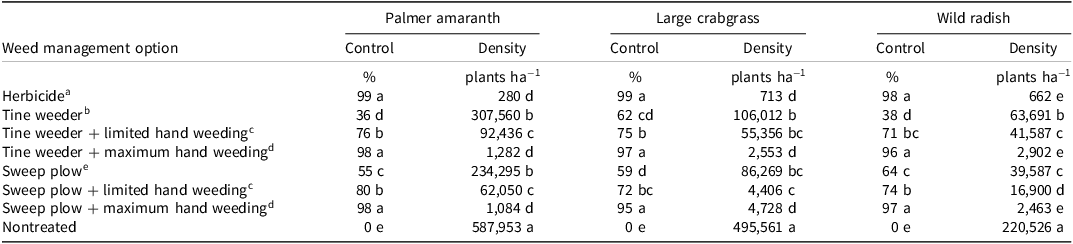
Differences in Palmer amaranth, large crabgrass, and wild radish control were observed among treatments. With six herbicide modes of action included in the analysis, the herbicides effectively controlled at least 98% of each of these weed species from planting through harvest compared with the nontreated plots (Table 1). For Palmer amaranth, control was predominately a result of overlapping effective residual herbicides, including fomesafen, ethalfluralin, S-metolachlor, trifluralin, and halosulfuron (Barkley et al. Reference Barkley, Chaudhari, Jennings, Schultheis, Meyers and Monks2017; MacRae et al. Reference MacRae, Culpepper, Batts and Lewis2008; Shrefler et al. Reference Shrefler, Brandenberger, Webber, Roberts, Payton and Wells2007; Sperry et al. Reference Sperry, Ferrell, Smith, Fernandez, Leon and Smith2017). Previous research has documented that residual herbicides are a crucially necessary for effective weed control in cucurbits, including summer squash, due to the crop’s lack of tolerance to many postemergence herbicides (Besanҫon et al. Reference Besanҫon, Wasacz and Carr2020). The residual activity of fomesafen and the combination of residual and postemergence activity of halosulfuron provided consistent and effective control of wild radish. Clethodim applied in-crop and paraquat applied before squash emergence effectively controlled emerged crabgrass plants, whereas S-metolachlor, ethalfluralin, and trifluralin provided excellent residual control (Besanҫon et al. Reference Besanҫon, Wasacz and Carr2020, Blankenship and Jennings Reference Blankenship and Jennings2025). Population density data collected as part of the study supported visual estimates of control with more than 99% fewer escaped plants for each species in the herbicide program compared with nontreated plots (Table 1).
Palmer amaranth, large crabgrass, and wild radish control and density as influenced by herbicides, tillage, and hand weeding at initial squash harvest (33 d after planting).

Table 1. Long description
The table presents data on the effectiveness of various weed management options on Palmer amaranth, large crabgrass, and wild radish control and density. It includes six different weed management options and their impact on three weed species. The table has 8 rows and 12 columns. The columns are divided into three sections for each weed species: Palmer amaranth, large crabgrass, and wild radish. Each section includes two columns: Control (%) and Density (plants ha^-1). The rows list the weed management options: Herbicide, Tine weeder, Tine weeder + limited hand weeding, Tine weeder + maximum hand weeding, Sweep plow, Sweep plow + limited hand weeding, Sweep plow + maximum hand weeding, and Nontreated. Row 1: Herbicide, 99 a, 280 d, 99 a, 713 d, 98 a, 662 e. Row 2: Tine weeder, 36 d, 307560 b, 62 cd, 106012 b, 38 d, 63691 b. Row 3: Tine weeder + limited hand weeding, 76 b, 92436 c, 75 b, 55356 bc, 71 bc, 41587 c. Row 4: Tine weeder + maximum hand weeding, 98 a, 1282 d, 97 a, 2553 d, 96 a, 2902 d. Row 5: Sweep plow, 55 c, 234295 b, 59 d, 86269 bc, 64 c, 39587 c. Row 6: Sweep plow + limited hand weeding, 80 b, 62050 c, 72 bc, 4406 bc, 74 b, 16900 d. Row 7: Sweep plow + maximum hand weeding, 98 a, 1084 d, 95 a, 4728 d, 97 a, 2463 d. Row 8: Nontreated, 0 e, 587953 a, 0 e, 495561 a, 0 e, 220526 a. The table shows that herbicides and maximum hand weeding options generally result in higher control percentages and lower plant densities for all three weed species.
a The herbicide management option consisted of paraquat + fomesafen + ethalfluralin applied preemergence, S-metolachlor applied postemergence, clethodim applied postemergence, and a row-middle application of S-metolachlor + trifluralin + halosulfuron.
b The tine weeder was operated six to 15 times when weeds reached 0.6 cm and field conditions were conducive for tillage.
c Limited hand weeding was defined as the amount of time needed to maintain approximately 75% visual weed control.
d Maximum hand weeding was defined as the amount of time needed to obtain at least 95% visual weed control.
e The sweep plow was operated six to eight times when weeds reached 0.6 cm and field conditions were conducive for tillage.
When tillage was the only method of weed control used, the sweep plow was more effective than the tine weeder in controlling Palmer amaranth and wild radish, with similar control observed between the two implements for large crabgrass (Table 1). However, weed control with tillage treatments alone was poor and ranged from 36% to 64% for all weed species. Previous research has shown that tillage alone in vegetable production does not provide adequate season-long weed control (Boyd et al. Reference Boyd, Brennan and Fennimore2006; Johnson et al. Reference Johnson, Colquhoun, Bussan and Rittmeyer2010). Escaped weeds were documented in the two tillage treatments at the time of first harvest; at least 234,295 Palmer amaranth, 86,269 large crabgrass, and 39,587 wild radish plants ha−1 were counted (Table 1). Although cultivation can be an effective weed control option, timeliness has historically been a challenge for farmers. One pest that takes advantage of this lack of management timeliness with its rapid growth is Palmer amaranth, which aggressively competes with crops, which leads to yield loss (Rowland et al. Reference Rowland, Murray and Verhalen1999). Excessive tillage can also increase soil and wind erosion and nutrient runoff, decrease soil organic matter, and lead to less fertile soil (Schonbeck et al. Reference Schonbeck, Jerkins and Ory2017).
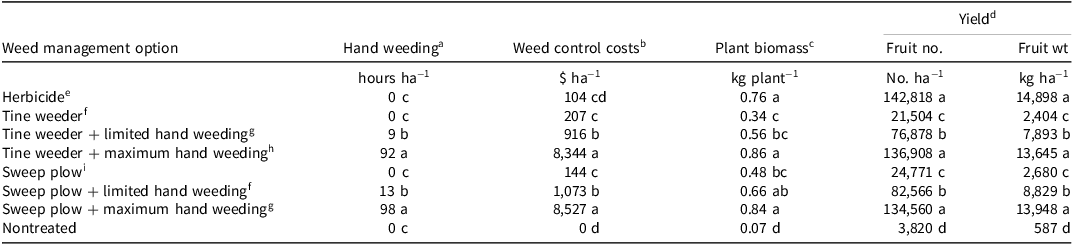
Supplementing tillage with hand weeding to achieve visual control that was comparable to that of plots that received herbicides was successful. At harvest initiation, each species was controlled by at least 95% when maximum hand weeding was included in addition to cultivation. Observers recorded <1,282 Palmer amaranth, 4,728 large crabgrass, and 2,902 wild radish plants ha−1 after those treatments (Table 1). To achieve the level of control observed with the herbicide option, 92 h ha−1 in combination with the tine weeder and 98 h ha−1 for the sweep plow was spent hand weeding (Table 2). Thus, the herbicide option effectively replaced an average of 11 tine weeder cultivations + 92 h ha−1 of hand weeding or 7 sweep plow cultivations + 98 h ha−1 of hand labor (Table 2). These results follow trends from historical records; for example, Holstun et al. (Reference Holstun, Wooten, McWhorter and Crowe1960) determined that chemical weed control made up for 49 h of labor per hectare, and Waldo (Reference Waldo1959) documented that chemical weed control options replaced nine cultivation trips and 106 h ha−1 of hand weeding. Hand weeding is more effective and precise than tillage but at a more significant cost and often not economical (Chandler and Cooke Reference Chandler, Cooke, McWhorter and Abernathy1992; Melander et al. Reference Melander, Rasmussen and Barberi2005).
Hours of hand weeding, weed control costs, squash plant biomass, and squash fruit number and weight as influenced by weed management option at initial harvest (33 d after planting).

Table 2. Long description
A table comparing weed management options and their effects on hand weeding, weed control costs, plant biomass, and yield. The table has 8 rows and 5 columns. The columns are labeled Hand weeding, Weed control costs, Plant biomass, and Yield. The rows are labeled with different weed management options: Herbicide, Tine weeder, Tine weeder + limited hand weeding, Tine weeder + maximum hand weeding, Sweep plow, Sweep plow + limited hand weeding, Sweep plow + maximum hand weeding, and Nontreated. The Hand weeding column shows the hours per hectare for each option. The Weed control costs column shows the cost per hectare in dollars. The Plant biomass column shows the plant biomass in kilograms per plant. The Yield column shows the fruit number per hectare and the fruit weight per hectare. Notable trends include the highest weed control costs for Tine weeder + maximum hand weeding and the lowest plant biomass and yield for the Nontreated option.
a Hand weeding was timed for each individual experimental plot with hourly rates being $13.67 and $16.08 for 2023 and 2025, respectively.
b Total costs included costs of herbicides + applications, cost of tillage operation, and cost of hand labor.
c At 33 d after planting, 10 successive squash plants from each plot were clipped at the soil surface and weighed collectively to determine an average fresh-weight biomass per plant.
d U.S. No. 1 marketable squash were harvested 6 d a week for a total of 21 times.
e The herbicide management option consisted of paraquat + fomesafen + ethalfluralin applied preemergence, S-metolachlor applied postemergence, clethodim applied postemergence, and a row-middle application of S-metolachlor + trifluralin + halosulfuron.
f The tine weeder was operated six to 15 times when weeds reached 0.6 cm and field conditions were conducive for tillage.
g Limited hand weeding was defined as the amount of time needed to maintain approximately 75% visual weed control.
h Maximum hand weeding was defined as the amount of time needed to obtain at least 95% visual weed control.
i The sweep plow was operated six to eight times when weeds reached 0.6 cm and field conditions were conducive for tillage.
The two experiments that targeted approximately 75% visual control with tillage + limited hand weeding were also successful. These options achieved, respectively, 76% and 80% control of Palmer amaranth, 72% and 75% control of large crabgrass, and 71% and 74% control of wild radish. The amount of time spent weeding by hand was 9 h ha−1 with the tine weeder and 13 h ha−1 with the sweep plow (Table 2).
Weed Management Cost
Apart from the nontreated, the most cost-effective treatment option, at $104 ha−1 (Table 2), was to use herbicides. That price included the cost of both herbicide and application costs. Similarly, the sweep plow and tine weeder programs cost $144 and $207 ha−1, respectively. Practices that supplemented tillage with hand weeding to achieve approximately 75% weed control cost at least nine times more than the herbicide option, with a total weed management cost ranging from $916 to $1,073 ha−1. Labor costs for weeding vegetable crops by hand can be significant and often unpredictable. For example, hourly farmworker wages in Georgia ranged from $13.67 to $16.08 between 2023 and 2025 (Fonsah and Hancock Reference Fonsah and Hancock2025; Fonsah and Shealey Reference Fonsah and Shealey2023), while even higher costs of $19.10 h−1 are charged in some areas (Ayoub Reference Ayoub2025; Putnam Reference Putnam1990; USDA-ERS 2025b). The most expensive options were the two tillage methods + maximum hand weeding that aimed to achieve at least 95% control of each weed species. The cost of these options were 80 and 82 times greater than the herbicide option (Table 2).
Squash Plant Biomass, Fruit Number, and Fruit Weight
Plant size, measured as squash biomass, was highly associated with the level of weed control achieved (Tables 1 and 2). Weed management practices that provided at least 95% weed control at initial squash harvest had the highest values for squash plant biomass (Table 2). Previous research has highlighted the impact of weed competition on the growth and development of squash (Besanҫon et al. Reference Besanҫon, Wasacz and Carr2020; Keeley Reference Keeley1987). As weed control decreased, squash biomass generally decreased. For example, tillage-only provided at most 64% control of any weed species, resulting in at least 37% less biomass than when weed control was at least 98% when herbicides were used.
Yield results were also highly associated with weed control (Tables 1 and 2). The highest number and weight of U.S. No. 1 marketable fruits averaged over 21 harvest dates were observed with the options that provided at least 95% weed control. Production from these three options accounted for 134,560 to 142,818 fruit ha−1 weighing between 13,645 to 14,898 kg ha−1 (Table 2). For the two programs that provided approximately 75% weed control, 40% to 47% less fruit and respective fruit weight were recorded compared with fruit weight from the herbicide option. Tillage alone was ineffective at controlling weeds in the crop row, which allowed for competition with the squash leading to a reduction of 83% to 85% in fruit number and weight when compared to the herbicide program.
Practical Implications
This experiment confirms that economically effective herbicides are essential for farmers to maximize crop yields and improve farm sustainability. When herbicides were applied to seeded squash, weed control, yield, and quality were maximized while being among the least expensive weed management options. Cultivation (with a tine weeder or sweep plow) + hand weeding at a level required to achieve at least 95% weed control was as effective as applying herbicides for weed control but it costs 80 to 82 times more due to high labor costs. Additionally, tillage, which had similar input costs as applying herbicides, provided poor weed control, at <64% and produced 83% to 85% less squash.
These results further document the importance of having safe and effective plant protection tools available for U.S. agriculture as family farms strive to increase crop yield and quality; improve pest control; and produce safe, affordable, and sustainable food (Weller et al. Reference Weller, Culbreath and Gianessi2014). Relying on other countries for our food supply could result in devastating consequences, highlighting the need for U.S. consumers, regulators, political leaders, and agricultural stakeholders to work diligently in support of our family farms.
Acknowledgments
We thank Tim Richards for his technical assistance and student workers Addison Jackson, Shelby Whitfield, Elli Bryan, and Tanner Blanks for assisting with the hand removal of weeds and harvesting squash.
Funding
Financial support for this research was provided by the Georgia Vegetable Commodity Commission.
Competing interests
The authors declare they have no competing interests.

 Open access

