Introduction
Anderson et al. have extensively investigated the mechanisms of memory control in humans, showing that attempting to prevent awareness of an unwanted memory hinders its later retrieval (Anderson & Green, Reference Anderson and Green2001). This may be due to the recruitment of inhibitory control processes impairing memory's retrievability. The impairment of recalling suppressed items, compared with recalling baseline items, would increase with the number of suppression attempts. On the contrary, recalling items that were actively retrieved would improve across repetitions. Interestingly, recall of suppressed items was impaired regardless of whether that item was tested with the cue used to train suppression or with a novel cue. This shows that inhibition impairs the unwanted memory itself rather than the association studied in the first phase of the paradigm. The paradigm adopted by Anderson et al. was a think/no-think paradigm exploring the effects of active suppression and active retrieval on later retention of previously studied associations (Anderson & Bell, Reference Anderson and Bell2001; Anderson & Green, Reference Anderson and Green2001). Particularly, a series of weakly related neutral word pairs are shown in the first part of this paradigm to the subjects, who are trained to remember the second member of each word pair when they are presented with the first member. Then, in the second phase of the test, subjects alternatively try to retain the associated word (remembered words; RW) when the first member of each word pair is shown in green or to avoid the associated word to enter their consciousness (suppressed words; SW) when it is shown in red. Also, some words presented in the first phase of the paradigm (baseline words; BW) will not be shown either in green or in red. The estimation of the effects of active suppression and active retrieval on later retention of previously studied associations is obtained by calculating the percentage of words correctly recollected in the third phase. In this section, subjects are presented once again with the first member of each word pair and are asked to remember the associated word either if presented in green or in red in the second phase.
Successively, in a functional magnetic resonance imaging (fMRI) study, Anderson et al. (Reference Anderson, Ochsner, Kuhl, Cooper, Robertson, Gabrieli, Glover and Gabrieli2004) found that prefrontal areas stimulate hippocampal suppression of memory contents. Specifically, they hypothesized (Anderson et al. Reference Anderson, Ochsner, Kuhl, Cooper, Robertson, Gabrieli, Glover and Gabrieli2004) that prefrontal regions would activate during attempts to stop memory retrieval by inhibiting the activation of the hippocampus, which plays a central role in the formation and recollection of declarative memories (Squire & Alvarez, Reference Squire and Alvarez1995; Brewin, Reference Brewin2001; Eldridge et al. Reference Eldridge, Engel, Zeineh, Bookheimer and Knowlton2005). Particularly, the hippocampus is involved in memory consolidation, a key process that allows short-term memory contents to be transformed into long-term-memory contents and to be stored in the neocortex, as well as in memory retrieval (Cipolotti et al. Reference Cipolotti, Shallice, Chan, Fox, Scahill, Harrison, Stevens and Rudge2001; Wittenberg & Tsien, Reference Wittenberg and Tsien2002). On the contrary, prefrontal areas are recruited during the suppression of unwanted memories to disengage hippocampal activation and memory recollection. Prefrontal regions also have an inhibitory role in several cognitive tasks, such as stopping pre-potent motor responses, switching task sets and overcoming interference (Anderson et al. Reference Anderson, Ochsner, Kuhl, Cooper, Robertson, Gabrieli, Glover and Gabrieli2004; Brambilla et al. Reference Brambilla, Cerini, Fabene, Andreone, Rambaldelli, Farace, Versace, Perlini, Pelizza, Gasparini, Gatti, Bellani, Dusi, Barbui, Nose, Tournikioti, Sbarbati and Tansella2007).
Unwanted memories are often elicited in specific psychopathological symptoms, such as emotional and sense of self-instability, flashbacks and intrusive thoughts, which are the psychopathological core symptoms of particular stress-related disorders such as borderline personality disorder (BPD) (Soloff et al. Reference Soloff, Lis, Kelly, Cornelius and Ulrich1994, Reference Soloff, Lynch, Kelly, Malone and Mann2000; Siever et al. Reference Siever, Torgersen, Gunderson, Livesley and Kendler2002; Skodol et al. Reference Skodol, Gunderson, Pfohl, Widiger, Livesley and Siever2002a). It is also interesting to note that neuropsychological studies suggest that BPD patients are characterized by hypervigilance for emotionally valenced stimuli (Arntz et al. Reference Arntz, Appels and Sieswerda2000; Sieswerda et al. Reference Sieswerda, Arntz, Mertens and Vertommen2007), potentially leading to enhanced encoding and to impaired active suppression of salient words and related themes (Korfine et al. Reference Korfine and Hooley2000; Domes et al. Reference Domes, Winter, Schnell, Vohs, Fast and Herpertz2006). On the contrary, in healthy people, it has been showed that memory control of previously learned items is improved if those items have a negative valence (Depue et al. Reference Depue, Curran and Banich2007).
We chose to administer the paradigm developed by Anderson and colleagues (Anderson et al. Reference Anderson, Ochsner, Kuhl, Cooper, Robertson, Gabrieli, Glover and Gabrieli2004) using neutral words to investigate the mechanism of active memory suppression and active memory retrieval of neutral items in patients with BPD and in matched healthy controls. Our hypothesis was that this mechanism is impaired in BPD subjects as a result of dysfunctional prefrontal–hippocampal circuitry; thus we expected abnormal performances on this test in this patient population.
Method
Subjects
Nineteen BPD patients were recruited at the Centre for Research on Personality Disorders of the University of Pavia, Pavia, Italy (16 females and three males; aged 18–45 years, mean age 31.9, s.d.= 7.3 years; 17 right-handed; all Caucasians; length of illness 1–11 years, mean 5.00, s.d.= 5.22 years; years of education 8–18, mean 13.4, s.d.=2.8). Handedness was determined by the Oldfield handedness questionnaire (Oldfield, Reference Oldfield1971). All patients met DSM-IV diagnostic criteria for BPD, as determined by the Structured Clinical Interview for DSM-IV (SCID)-II (Williams et al. Reference Williams, Gibbon, First, Spitzer, Davies, Borus, Howes, Kane, Pope and Rounsaville1992). Diagnoses for BPD were confirmed with the clinical consensus of two staff psychiatrists, according to the DSM-IV criteria. Also, the Diagnostic Interview for Borderline Patients (Gunderson et al. Reference Gunderson, Kolb and Austin1981) was used to confirm the diagnosis of BPD and the Zanarini Scale for BPD (ZAN-BPD) (Zanarini et al. Reference Zanarini, Vujanovic, Parachini, Boulanger, Frankenburg and Hennen2003) was used to assess the severity of the symptomatology. The SCID-I was also administered in order to detect any Axis I disorders (Williams et al. Reference Williams, Gibbon, First, Spitzer, Davies, Borus, Howes, Kane, Pope and Rounsaville1992). Patients with any co-morbid personality disorder, current medical problems, or alcohol or substance abuse within 6 weeks preceding the study were excluded. Patients' clinical information was retrieved from psychiatric interviews, the attending psychiatrist, and medical charts.
Of the 19 BPD patients, four were not taking any medication at the time of testing. Four patients were treated only with antidepressants, two only with a mood stabilizer, and one only with an antipsychotic. The other eight patients were treated with a combination of antidepressants and antipsychotics, antidepressants and mood stabilizers or antipsychotics and mood stabilizers. Eight patients had a history of childhood (physical and/or sexual) abuse, four had a prior history of substance abuse (two with alcohol, one with cannabis, one with cannabis and heroin), and nine of them had attempted suicide in the past at least once. Ten subjects with BPD had co-morbidity with recurrent major depression, four with dysthymia, two with anorexia nervosa, and one with bipolar disorder type II.
The Hamilton Depression Rating Scale (HAMD) – 24 items – (Hamilton, Reference Hamilton1960) and the Brief Psychiatric Rating Scale (BPRS; Andersen et al. Reference Andersen, Larsen, Schultz, Nielsen, Korner, Behnke, Munk Andersen, Butler, Allerup and Bech1989) were used to rate the clinical symptoms. Moreover, the Child Abuse Scale (CABUSE; Soloff et al. Reference Soloff, Lynch and Kelly2002), the Barratt Impulsivity Scale (BIS-11; Patton et al. Reference Patton, Stanford and Barratt1995) and the Buss–Durkee Hostility Inventory (BDHI; Biaggio et al. Reference Biaggio, Supplee and Curtis1981) were utilized to evaluate childhood abuse, impulsivity, and hostility, respectively. All these scales were administered within 10 days of the study. The HAMD and BPRS were completed by trained psychiatric residents with extensive experience in doing them. Indeed, they completed at least 10 HAMD and 10 BPRS with a senior investigator well trained in performing them. Also, we regularly assured reliability scale ratings by holding consensus meeting with psychiatric residents and a senior investigator.
Nineteen healthy subjects 1:1 matched with patients for race, age, gender, handedness, years and type of education were also recruited (16 females and three males; aged 21–48 years, mean age 30.5, s.d.=7.7 years; 17 right-handed; all Caucasians; years of education 8–19, mean 14.9, s.d.=3.6). They had no past or current history of any DSM-IV Axis I or Axis II disorders as determined by the SCID non-patient version interview (SCID-NP), the SCID-II and the ZAN-BPD. Also they had no current medical problems, no history of substance or alcohol abuse, and no history of psychiatric disorders among first-degree relatives. The same psychopathological scales as for the BPD patients were administered to the healthy controls (HAMD, BPRS, BIS-11 and BDHI).
All subjects provided signed informed consent, after having understood all issues involved in participation in the study protocol. This research study was approved by the Biomedical Ethics Committee of the IRCCS San Matteo Hospital.
Memory suppression test
The memory suppression mechanism was investigated according to a modified version of Anderson's paradigm (Anderson & Green, Reference Anderson and Green2001; Anderson et al. Reference Anderson, Ochsner, Kuhl, Cooper, Robertson, Gabrieli, Glover and Gabrieli2004). This test explores the capacity of remembering and suppressing pairs of words previously learned and consists of five phases. In the first phase the subject is presented with 36 pairs of weakly associated words (stimulus word, i.e. ‘squirrel’ and the response word ‘nut’). The probe word and the associated word of each pair were unrelated to the members of other pairs. The response words were chosen so that each was a member of its own category (for example, ‘dry fruit’ for ‘nut’) for permitting later testing of that item with an extra-list category cue. The list of Italian associated words was chosen from the database of the University of Padova, Padova, Italy (University of Padova, 2005; http://dpss.psy.unipd.it/psydata/associations). Each word pair appears in blank in the centre of a grey computer screen for 4 s, followed by an empty grey screen that appears for 5 ms.
In the second phase the subject is presented with the 36 probe words that he/she saw in the first phase. Each probe word appears in blank at the centre of the grey screen. This phase lasts until the subject correctly recalls and pronounces at least 75% of the associated words.
In the third phase, the ‘think–no-think phase’, the subject is presented with two kinds of stimuli: (1) green probes, where he/she has to think of the associated word for the 4 s of the presentation; and (2) red probes, where he has to actively suppress the associated word and avoid this associated word entering his consciousness for the 4 s of the presentation. In this phase, 12 out of the 36 probes of the first phase appear in green and 12 in red. Each red and each green word appears eight times, are presented randomly for 3 s, and are separated from the following probe by a grey empty screen that appears for 1 s. We will refer to the green words of phase 3 as the ‘to-be-remembered words’ (RW) and to the red words of phase 3 as the ‘to-be-suppressed words’ (SW). Finally we will refer to the 12 words presented in phases 1 and 2, which do not appear in phase 3, as ‘baseline words’ (BW).
The fourth phase is the ‘Same Probe Test’ in which the subject is presented with the 36 probe words shown in the first phase. Each probe appears in black either if it was suppressed (SW), remembered (RW) or not shown (BW) in phase 3.
The fifth phase is the ‘Independent Probe Test’ where the subject has to remember the 36 associated words when presented with an extra-list category word and the first letter of the associated word that has to be remembered (i.e. dry fruit, N for nuts).
This paradigm was administered to all subjects in the afternoon, since performances on testing on word pair association of normal people are worse in the early morning than in the afternoon or in the evening (Hidalgo et al. Reference Hidalgo, Zanette, Pedrotti, Souza, Nunes and Chaves2004). The self-perception of having performed correctly the suppression task during Anderson's paradigm was measured through a questionnaire at the end of the test. In this questionnaire each subject explains the strategies adopted during the suppression task and rates the perception of having done well at avoiding thinking of the word that had to be suppressed. The rating ranged from 0 to 10, where higher scores mean higher perception of having done well.
The Anderson paradigm was slightly modified by reducing the duration of the test (from 28 min in the original version, to 16 min) in order to maximize attention, which may decrease in long tasks both in BPD patients (Monarch et al. Reference Monarch, Saykin and Flashman2004) and in healthy subjects (Saud de Nunez et al. Reference Saud de Nunez, Rodriguez Rojas and Niaz1993). Specifically, eight suppress conditions and eight remember conditions instead of the sixteen were used in the third phase. Indeed, Anderson himself showed in his first study that eight repetitions of the suppress or of the remember exercise during phase 3 were enough to observe effects on the later retention of the previously studied association (Anderson & Green, Reference Anderson and Green2001).
Statistical analyses
All analyses were conducted using the SPSS for Windows software, version 11.0 (SPSS Inc., Chicago, IL, USA), and the two-tailed statistical significance level was set at p⩽0.05. Student's t test was used to compare scores on scales between BPD patients and healthy controls, after verifying the normality of the variable distributions (Shapiro–Wilk test). The χ2 test or Fisher's test was used to compare qualitative variables, after confirming the necessary assumptions. General linear model (GLM) repeated-measures analysis and Student's t test were utilized to analyse the Anderson's test performance between controls and patients, whereas paired-sample t tests were used to explore within each group. The assumption that the vector of the measures followed a multivariate normal distribution (Shapiro–Wilk test) and the variance–covariance matrices were circular in form (Mauchly's test) were verified. The Bonferroni correction was used for multiple comparisons.
Results
Psychopathological scales
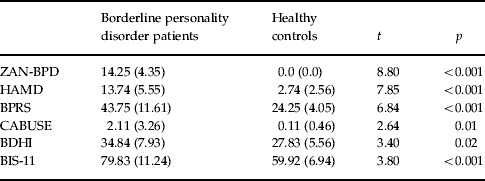
Scores on psychopathological scales were significantly higher for BPD patients compared with healthy controls (Student's t test, p<0.05) (Table 1). Particularly, on the CABUSE, eight patients and one healthy control reported childhood abuse, specifically five patients reported episodes of both physical and sexual abuse, two patients and one control described mild episodes of physical abuse, and one patient reported a mild episode of sexual abuse. The two groups did not differ on educational level (Fisher's exact test, p=0.24).
Psychopathological assessment of borderline personality disorder patients and healthy controlsFootnote a

ZAN-BPD, Zanarini Borderline Personality Disorders Scale; HAMD, Hamilton Depression Rating Scale; BPRS, Brief Psychiatric Rating Scale; CABUSE, Soloff Childhood Abuse Scale; BDHI, Buss–Durkee Hostility Inventory; BIS-11, Barratt Impulsivity Scale.
Values are given as mean (standard deviation).
a Student's t test was used to compare scores on scales between the two groups.
Anderson's test
On Anderson's test, all subjects and controls correctly recalled more than 75% of the associated words when presented with the probe word in phase 2, after the training phase (phase 1). However, correctly remembered response words after the first training cycle were lower in BPD patients compared with control individuals (75.23% v. 82.42%, respectively; t=−2.50, p=0.05), but this performance became comparable at the end of the training phase (79.68% v. 84.21%, respectively; t=1.8, p=0.08).
Inter-group performance
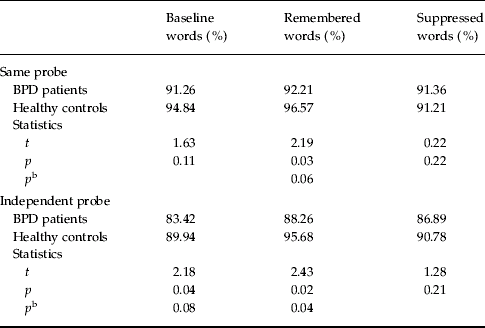
For the Same Probe Test, GLM repeated-measures analysis was performed for BW and RW, which are measures related to memory function, showing significant differences between the two groups (F=5.44, p=0.025). Student's t test was utilized for exploring SW, which is a measure of executive control process, and, as a second exploratory step, for BW and RW. Significant differences were present for percentages of correctly remembered RW between the two groups (t=2.19, p=0.03), which became a trend towards significance after Bonferroni's correction (p=0.06) (Table 2). No significant differences were found for both BW and SW (p>0.05; Table 2).
Correctly recollected remembered words, suppressed words and baseline words in BPD patients and healthy controls on the Same Probe Test and on the Independent Probe TestFootnote a

BPD, Borderline personality disorder; RW, remembered words; SW, suppressed words; BW, baseline words.
a Student's t test was used to compare performance on Anderson's test between the two groups.
b p value after Bonferroni's correction for multiple comparisons.
On the Independent Probe Test, significant differences were also found for BW and RW by GLM repeated-measures analysis (F=8.60, p=0.006). Using Student's t test, correctly remembered RW and BW significantly differed between BPD patients and healthy controls (p=0.02 and 0.04, respectively). After Bonferroni's correction, the discrepancy for RW was still significant (p=0.04), whereas for BW it became a trend towards significance (p=0.08). On the contrary, as for the Same Probe Test, percentages of correctly remembered SW did not show significant differences between the two groups after the Independent Probe Test (p>0.05; Table 2).
When level of depression was used as a covariate, no significant effects on performance for both the Same Probe Test and the Independent Probe Test were found for BW and RW (F=0.002, p=0.97; F=2.15, p=0.15, respectively; GLM repeated-measures analysis with HAMD as covariate) and SW (F=0.18, p=0.68; F=0.91, p=0.35, respectively; analysis of covariance with HAMD as covariate).
Finally, no significant differences for the self-perception questionnaire of having done well on the suppression task were shown between BPD and healthy subjects (mean score 6.55, s.d.=1.67 v. 7.4, s.d.=1.36, respectively; t=1.70, p=0.09).
Intra-group performance
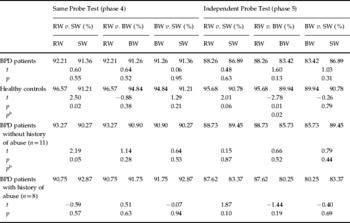
On the Same Probe Test (fourth phase), after the think–no-think phase (phase 3), healthy subjects remembered a significantly higher percentage of correctly recollected words among RW (words that appeared in green in phase 3) than SW (words that appeared in red during phase 3) (t=2.5, p=0.02) (Table 3). In contrast, BPD patients did not show any significant differences (t=0.60, p=0.55), particularly those with childhood abuse (n=8) (t=−0.6, p=0.59) (Table 3).
Correctly recollected words among RW, SW and BW in BPD patients and healthy controls on the Same Probe Test and on the Independent Probe TestFootnote a

BPD, Borderline personality disorder; RW, remembered words; SW, suppressed words; BW, baseline words.
a Paired-sample t tests were used to analyse intra-group performance on Anderson's test.
b p value after Bonferroni's correction for multiple comparisons.
On the Independent Probe Test (fifth phase), as for the Same Probe Test, healthy controls remembered a higher percentage of RW than both SW (t=2.01, p=0.06) and BW (t=−2.78, p=0.01; p=0.02 after Bonferroni's correction) (Table 3). On the contrary, BPD patients did not show significant differences (t=0.48, p=0.63; t=1.60, p=0.13, respectively), even when separating those without (t=0.15, p=0.87; t=0.66, p=0.52, respectively) or with a history of childhood abuse (t=1.87, p=0.10; t=−1.44, p=0.19, respectively) (Table 3).
Discussion
This study showed for the first time that the mechanism of active improving recalling of neutral memory contents, through repetition of retrieval (Lansdale & How, Reference Lansdale and How1996), is impaired in BPD patients, particularly in those with a childhood history of abuse. This impairment may indicate an abnormal function of the neural circuit underlying memory control. BPD patients are known to fail in controlling memory content, particularly when they are emotionally charged. In this regard, hypervigilance, enhanced encoding of salient words and difficulties in disengaging from aversive information have been reported to be cognitive features of subjects with BPD (Arntz et al. Reference Arntz, Appels and Sieswerda2000; Sieswerda et al. Reference Sieswerda, Arntz, Mertens and Vertommen2007). In particular, during direct forgetting tasks, they show an impairment in their intentional inhibition of aversive words, resulting in an increase of wrongly remembered words among ‘negative words to be forgotten’ (Korfine & Hooley, Reference Korfine and Hooley2000; Domes et al. Reference Domes, Winter, Schnell, Vohs, Fast and Herpertz2006) and by a reduced recall of positive information from the ‘positive words to be remembered’ (Domes et al. Reference Domes, Winter, Schnell, Vohs, Fast and Herpertz2006). In healthy people, memory control of emotionally valenced contents has been shown to be more effective than that of neutral contents. Specifically, Depue et al. (Reference Depue, Banich and Curran2006) recently showed that during a think–no-think task, memory for emotional information was enhanced in the think condition and reduced in the no-think condition compared with memory for neutral information. Thus both the facilitative and the suppressive aspects of cognitive control are heightened for emotional as compared with non-emotional information (Depue et al. Reference Depue, Banich and Curran2006).
The paradigm we adopted is not a simple direct forgetting task, but explores how memory improves or impairs across repetitive attempts to retain or to exclude from consciousness a particular content. Reinforcement and inhibition through repetition are two processes that require the activation of prefrontal regions, the limbic system and cortical region supporting sensory components of memory representation (Depue et al. Reference Depue, Curran and Banich2007). In BPD patients, the putative dysfunction of neural structures involved in emotional processing of memory content, particularly of the hippocampus, may determine the worse processing and control also for neutral content.
When we try to retrieve an event, a fact or a word, we have always to face interference from related traces (Levy & Anderson, Reference Levy and Anderson2002). The need to select a memory content is accompanied by the need to stop the associated memories to enter awareness. In both selection and stopping situations, attempts to limit the influence of activated and potentially distracting memories impair memory for those traces. Thus, the ‘capacity of control retrieval’ and ‘forgetting’ are strictly linked (Levy & Anderson, Reference Levy and Anderson2002) and sustained from the same neurobiological systems (Anderson et al. Reference Anderson, Ochsner, Kuhl, Cooper, Robertson, Gabrieli, Glover and Gabrieli2004). Particularly, while the hippocampus activates during encoding and retrieving of items, some prefrontal regions, particularly the dorsolateral prefrontal cortex (DLPFC) and anterior cingulate cortex, activate both during the selection of items that have to be retrieved and during the inhibition of competing and distracting items. Selection of ‘wanted memories’ and inhibition of ‘unwanted memories’ are two parts of a unique mechanism, in which the hippocampus and DLPFC are both involved to achieve the selection of a particular memory content through inhibition of other contents.
Interestingly, in humans, greater hippocampal activation is observed during attempts of inhibition of items that are later forgotten (forgotten SW) than during inhibition of items that are later remembered (remembered SW) (Anderson et al. Reference Anderson, Ochsner, Kuhl, Cooper, Robertson, Gabrieli, Glover and Gabrieli2004). In fact, during memory inhibition, the hippocampal activation advantage is greater for forgotten SW (suppressed items that are later forgotten) compared with remembered SW (suppressed items that are later remembered). Moreover, the advantage in hippocampal activation for forgotten SW compared with remembered SW is associated with greater DLPFC activation, suggesting that stronger inhibition of items that are later forgotten is probably associated with greater hippocampal activation. This may be due to greater inadvertent recollections and finally to greater control by the DLPFC (Anderson et al. Reference Anderson, Ochsner, Kuhl, Cooper, Robertson, Gabrieli, Glover and Gabrieli2004).
In BPD patients the mechanism of memory control may be sustained by an impaired prefrontal–hippocampus circuitry, which may even be more dysfunctional in those with childhood experiences of maltreatment. Several previous neuroimaging studies consistently reported that hippocampal volumes are abnormally reduced in BPD patients, particularly in those with childhood maltreatment (Driessen et al. Reference Driessen, Herrmann, Stahl, Zwaan, Meier, Hill, Osterheider and Petersen2000; Schmahl et al. Reference Schmahl, Vermetten, Elzinga, Douglas and Bremner2003b; Tebartz van Elst et al. Reference Tebartz van Elst, Hesslinger, Thiel, Geiger, Haegele, Lemieux, Lieb, Bohus, Hennig and Ebert2003; Brambilla et al. Reference Brambilla, Soloff, Sala, Nicoletti, Keshavan and Soares2004; Irle et al. Reference Irle, Lange and Sachsse2005) while two positron emission tomography studies reported dysfunction of the DLPFC during recall of traumatic memories in women with BPD (Schmahl et al. Reference Schmahl, Elzinga, Vermetten, Sanislow, McGlashan and Bremner2003a; Sala et al. Reference Sala, Perez, Soloff, Ucelli Di Nemi, Caverzasi, Soares and Brambilla2004; Schmahl et al. Reference Schmahl, Vermetten, Elzinga and Bremner2004). Hypothetically, an affected memory control may sustain some psychopathological core symptoms in BPD, like emotional instability, flashbacks and intrusive thoughts (Schmahl et al. Reference Schmahl, Elzinga, Vermetten, Sanislow, McGlashan and Bremner2003a, Reference Schmahl, Vermetten, Elzinga and Bremner2004; Anderson et al. Reference Anderson, Ochsner, Kuhl, Cooper, Robertson, Gabrieli, Glover and Gabrieli2004).
Two major specific limitations should be considered for interpretation of our findings. First, the sample size was relatively modest (n=38, 19 BPD patients v. 19 controls), although comparable with previous neuropsychological studies in this field (Monarch et al. Reference Monarch, Saykin and Flashman2004). Second, the majority of BPD patients had other co-morbid diagnoses (n=17), in particular major depression. However, this is a condition that is very often present in BPD (Soloff et al. Reference Soloff, Lynch, Kelly, Malone and Mann2000; Skodol et al. Reference Skodol, Siever, Livesley, Gunderson, Pfohl and Widiger2002b), particularly in those seen in usual clinical practice. Therefore, excluding subjects with Axis I co-morbidity would create a non-representative BPD sample that could ultimately limit the generalizability of the findings.
In conclusion, this is the first study showing impaired memory control in BPD, especially in those with a history of childhood abuse, which may be relevant for the pathophysiology and the psychopathology of the disorder. Future fMRI studies will be crucial to explore the neural mechanisms underlying the cognitive control of memory in this patient population.
Acknowledgements
This work was partly supported by grants to P. B. from the American Psychiatric Institute for Research and Education (APIRE Young Minds in Psychiatry Award) and from the Italian Ministry for Education, University and Research (PRIN no. 2005068874).
Declaration of Interest
None.