INTRODUCTION
Ocean sunfish or molas belong to the family Molidae. These species are epipelagic in nature (Matsuura, Reference Matsuura and Carpenter2002). The molid species are characterized in having a distinctive laterally compressed shape and ‘chopped off’ appearance (Fraser-Brunner, Reference Fraser-Brunner1951; Smith & Heemstra, Reference Smith and Heemstra1986), using median fins for swimming, lacking caudal bones, ribs, pelvic fins, spines or girdles and have fewer vertebrae than any other fish (Tyler, Reference Tyler1980).
The long history of the family Molidae goes back to the earliest descriptions by Linnaeus (Reference Linnaeus1758) and by Koelreuter (Reference Koelreuter1766) (see Parenti, Reference Parenti2003). Since then, 19 genera and 54 species of sunfish have been proposed (Parenti, Reference Parenti2003) and the taxonomy of the family has been relatively unstable. The most comprehensive taxonomic revision of the family is that of Fraser-Brunner (Reference Fraser-Brunner1951) in which he distinguished five species in three genera: R. laevis, Masturus lanceolatus, Masturus oxyuropterus, Mola mola and Mola ramsayi. At the present, there are four recognized species: R. laevis, Masturus lanceolatus, Mola mola and Mola ramsayi. The latter species is infrequently mentioned in taxonomic treatments (Smith & Heemstra, Reference Smith and Heemstra1986; Nelson, Reference Nelson1994; Parenti, Reference Parenti2003). Morphological and molecular approaches were attempted to study the relationship among currently recognized genera. Santini & Tyler (Reference Santini and Tyler2002) using morphological characters and Yamanoue et al. (Reference Yamanoue, Miya, Matsuura, Katoh, Sakai and Nishida2004) using molecular data found strong support for the conventional hypothesis of a sister taxon relationship between the genera Masturus and Mola, with Ranzania holding the basal position within the family.
The known distribution of M. ramsayi is in the southern oceans, south-west Pacific: Australia and New Zealand, south-east Pacific: Chile and south-east Atlantic: South Africa. Al-Ghais (Reference Al-Ghais1994) recorded this species from the eastern coasts of the United Arab Emirates at the northern part of the Sea of Oman. That was the first record of this species from the northern hemisphere. Later, Mohan et al. (Reference Mohan, Selvanidhi, Srinivasan and Poovannan2006) recorded it from Chennai waters, India and it was the second appearance for this species in the northern hemisphere. In the present study, we recorded M. ramsayi for the first time from the Omani waters. This is the third record for this species from the northern hemisphere and the second for the Sea of Oman.
RESULTS
SYSTEMATICS
MATERIAL EXAMINED
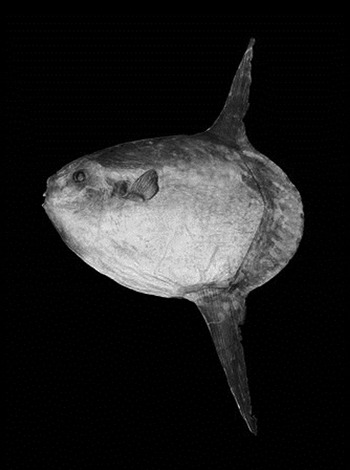
OMMSFC 1085, 916 mm total length (TL), 80 kg, 10 September 2011, coasts of City of Sur (N1384000 E4982000), found stranded on the coast (Figure 1). The fish was strange to the fishermen and their colleagues, who wanted to get rid of it, thinking that it was a ‘bad omen’.
Mola ramsayi, total length 916 mm.

DESCRIPTION
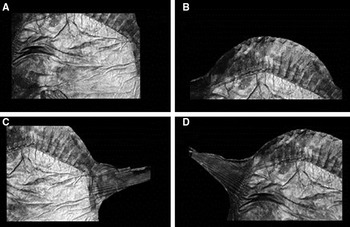
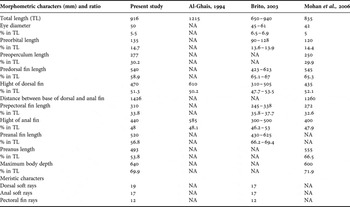
Mola ramsayi differs from M. mola in the following set of characters given by Fraser-Brunner (Reference Fraser-Brunner1951): skin smooth with no denticles and no band of reduced denticles between dorsal and anal fins (Figure 2A) (in M. mola, skin rough with small denticles including a band of somewhat reduced denticles between the bases of the dorsal and anal fins); ossicles close together, much broader than spaces between them (Figure 2B–D) (in M. mola, ossicles widely separated, less broad than spaces between them); clavus supported by about 16 fin rays, of which 12 bear ossicles (Figure 2B) (in M. mola, clavus supported by about 12 fin rays, of which 8 or 9 bear ossicles). Morphometric and meristic details following Matsuura (Reference Matsuura and Carpenter2002) are given in Table 1.
Mola ramsayi: (A) smooth skin; (B) state of ossicles at clavus; (C) clear area at dorsal fins; (D) cear area at anal fins.

Morphometric and meristic characteristics of Mola ramsayi in the Sea of Oman compared with specimens from the literature (NA, not available).

REMARKS
Occurrence of sunfishes in the Arabian Gulf and the Sea of Oman are frequent in the past two decades. Ranzania laevis and Mola mola were recorded (Al-Baz et al., Reference Al-Baz, Bishop and Hamza1999; Jawad et al., Reference Jawad, Hussein and Bulbil2011) from the Arabian Gulf, while only R. laevis was recorded from the Sea of Oman (Jawad et al., Reference Jawad, Al-Mamry and Kharusi2010). Based on the record given in the present study and the other two records from the northern hemisphere (Al-Ghais, Reference Al-Ghais1994; Mohan et al., Reference Mohan, Selvanidhi, Srinivasan and Poovannan2006), the species is more wide ranging than suspected before (Parenti, Reference Parenti2003). Also, this is an oceanic fish and the restricted distribution found in the literature is probably due to insufficient data. The vernacular name seems to be inappropriate but we decided not to suggest an alternative name for a species well known as such in the southern hemisphere.
As far as the authors are aware, few studies have provided morphological measurements for the recorded sunfish specimens collected from the seas of the world (Al-Ghais, Reference Al-Ghais1994; Brito, Reference Brito2003; Mohan et al., Reference Mohan, Selvanidhi, Srinivasan and Poovannan2006). The full morphological data were compared with that of the present study (Table 1). The maximum size reached by this species is 1215 mm TL (Al-Ghais, Reference Al-Ghais1994). The size of our specimen falls well above the half size given by Al-Ghais (Reference Al-Ghais1994). The remaining body proportions agree with those given by other authors (Table 1).
The specimens became stranded for the following possible reasons: (1) net entanglement followed by stress; (2) susceptibility to shark attacks; (3) locomotion difficulty stemming from injuries and exhaustion; and (4) body striking the reefs that form a barrier before arriving at the site where the specimen was found.
There are several fishing net marks revealing that the fish must have been entangled in a fishing net and suffered stress and trauma. Such a state enabled attacks from predators and probably from parasites. Accidental entanglement in fishing gear is one of the main threats to M. ramsayi populations in particular (Araújo et al., Reference Araújo, Silva-Falcão, Falcão, Marques and Joca2010) and mola populations in general, as species from the family are often reported as by-catch in lone-line fisheries (Joung et al., Reference Joung, Liu, Liao and Hsu2005) and drift nets (Akiol et al., Reference Akiol, Erdem, Unal and Ceyham2005).
During the external analysis of the specimen, few recent and old shark bites of different shapes and origins were found. The sides of the body showed more bites than any other body regions. This may likely be due to the fact that these areas are the largest and most easily accessed in this type of attack (Souto et al., Reference Souto, Oliveira, Nunes, Maia-Nogueira and Sampaio2007). Under such a bad morphological state, the specimen must have remained adrift and, upon approaching the coast, suffered a number of scratches from the reefs near by.
There are several possible explanations for the presence of this fish in the coastal waters of the Sea of Oman (e.g. ballast water of ships playing between Europe and the Persian Gulf). Predominantly marine, M. ramsayi is a species with different ecological preferences, for example, it has a larval pelagic existence in coastal waters (Fraser-Brunner, Reference Fraser-Brunner1951).
Changes in environmental factors might relate to the presence of this species in the waters of the Sea of Oman. Warmer water masses might cause the southern ocean sunfish to proceed further north of its native distribution. A sudden southern warming process of the sea surface in the Oman Sea area was evident during the period July–August 2011 where warm water masses were recorded entering through the Strait of Hurmoz (Al-Ahaqsi, personal communication). Different species of molas showed a relation between their presence and the sudden rise in sea surface water temperature. Castro & Ramos (Reference Castro and Ramos2002) and Jawad et al. (Reference Jawad, Al-Mamry and Kharusi2010) related the presence of R. laevis off Gran Canaria (Canary Islands) and the Sea of Oman respectively to the sudden warming process of the sea surface in the central Atlantic and the Sea of Oman.
Since only one specimen was collected and since no further individuals were obtained, it is premature at this stage to consider this species among the fish fauna of Oman. It should only be considered as such, if a breeding population of this species is maintained in the area.
ACKNOWLEDGEMENTS
We thank the Ministry of Agriculture and Fisheries Wealth, the directorate of Agriculture and Fisheries Development Fund and the Marine Science and Fisheries Centre for giving us the opportunity to work on fish samples from the Sultanate of Oman and for providing the appropriate financial support. We thank Professor Dr Paolo Parenti of the Department of Environmental Sciences, University of Milano Bicocca for confirming the species identification and for his valuable advice and suggestions in reading the manuscript. We thank Dr Ofer Gon of the South African Institute of Aquatic Biodiversity for his valuable advice and suggestions.