Introduction
On a sunny day at the lake with family and friends, a two-year-old child grabs a snail by its shell. The mom remarks to the child, “!Mira, el animalito está en su casita!”. Unprompted, the child turns to the adult English-speaking friend and says, “He's in his little house!”. What does this spontaneous interpretation tell us about the child's understanding of the mind? The two-year-old bilingual child has certainly represented that the two adults know different languages. Did she also represent that the friend did not know what she herself knew, because he could not have understood her mother's original utterance in Spanish?
Understanding agents in the environment as having specific thoughts, beliefs, intentions, and desires that may or may not differ from one's own, is conceptualized as the child developing a theory of the mind (ToM). Although assumed to be universal in typically developing children, differential circumstances during development have been shown to affect the rate and the order in which different ToM components develop (i.e., Meristo, Falkman, Hjelmquist, Tedoldi, Surian & Siegal, Reference Meristo, Falkman, Hjelmquist, Tedoldi, Surian and Siegal2007; Schick, de Villiers, de Villiers & Hoffmeister, Reference Schick, de Villiers, de Villiers and Hoffmeister2007; Wellman, Fang, Liu, Zhu & Liu, Reference Wellman, Fang, Liu, Zhu and Liu2006). One such variation, which may have a differential effect on the rate of ToM development among other cognitive capacities, is growing up bilingually. The focus of the present review is as follows: whether, and if so, why and how does growing up in a bilingual environment influence the way young children develop their understanding of the mind?
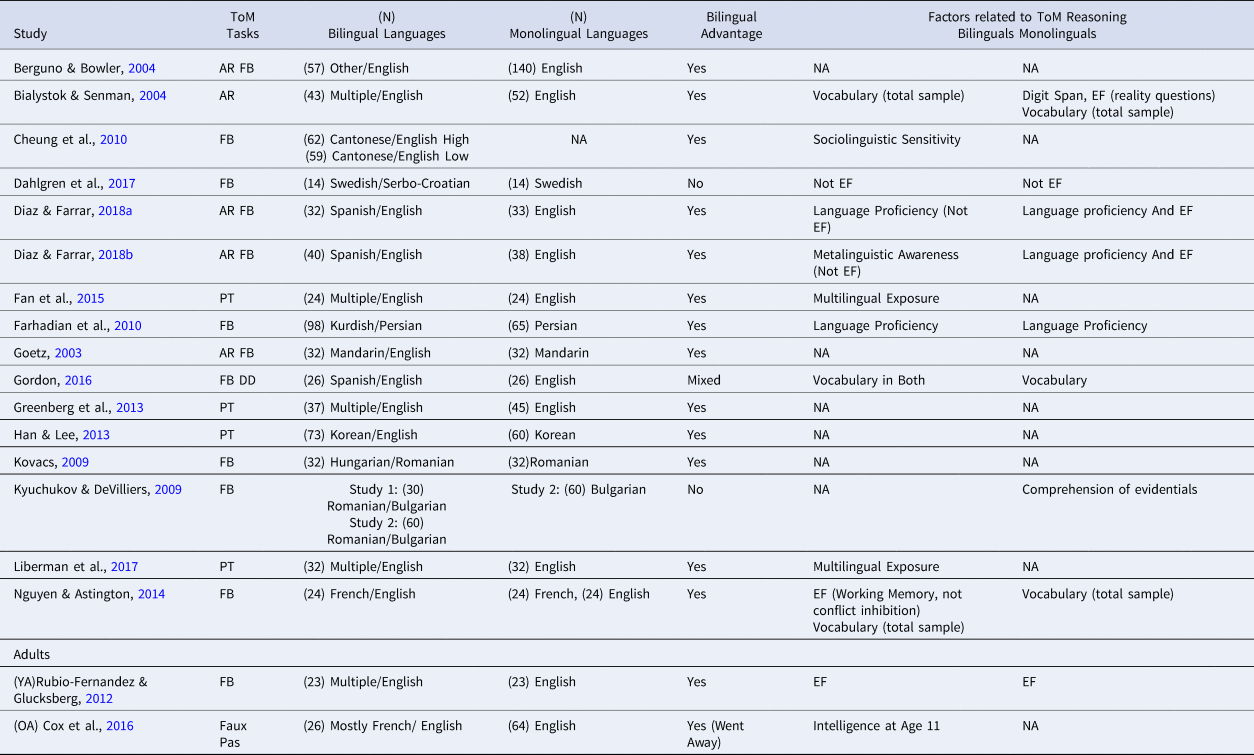
The implications from the present review are important in two main ways. The first and most apparent one is that though previous research has demonstrated that bilinguals develop ToM at an accelerated rate compared to monolinguals (See Table 1), we have yet to develop a conceptual characterization of this differential development. With an emphasis on whether there are enhancements, the question of why and how has not received enough attention. What is driving bilinguals’ ToM development regardless of whether there is an advantage or not? The second way the present review has important implications is that it informs the issue of the emergence of ToM understanding in general, including understanding its potential for diversity. Where does the ability to reason correctly about other people's beliefs come from? What in particular happens at around 4 years of age that allows children to answer correctly about others having a belief that is false when the child knows the truth?
Studies assessing theory of mind (ToM) in bilinguals, type of ToM tasks used, languages involved, sample sizes, the presence of a bilingual advantage, and factors related to bilinguals’ and monolinguals’ ToM reasoning.

Note. EF = Executive Functioning; AR = Appearance/reality; FB = False belief; PT = Perspective taking; DD = Diverse desires; YA = Younger adults; OA = Older adults
Competence versus performance in ToM
The development of a ToM has been framed in terms of the competence vs. performance debate. Proponents of the competence perspective (e.g., Baron-Cohen, Leslie & Frith, Reference Baron-Cohen, Leslie and Frith1985; Perner & Roessler, Reference Perner and Roessler2012) argue that by around 4 years of age children are able to use cues from their environment and previous experiences to construct their own understanding of the mind (Brown, Donelan-McCall & Dunn, Reference Brown, Donelan-McCall and Dunn1996; Sabbagh, Xu, Carlson, Moses & Lee, Reference Sabbagh, Xu, Carlson, Moses and Lee2006). This new competence allows them to make sense of the fact that others may believe something that is false when they know the truth. In turn, proponents of the performance perspective (e.g. Carlson & Moses, Reference Carlson and Moses2001; Baillargeon, Scott & He, Reference Baillargeon, Scott and He2010) argue that, at around age four, children's other cognitive abilities such as executive functioning (EF) (which refers to higher-order capacities including attention management, planning, monitoring, and inhibition of habitual responses, Carlson & Moses, Reference Carlson and Moses2001) are mature enough to allow them to perform well on the ToM tasks, irrespective of a conceptual ToM understanding (Bloom & German, Reference Bloom and German2000; Fodor, Reference Fodor1992). According to the performance perspective, this conceptual ToM understanding is in place as a core ability albeit implicitly, but children are only able to act or perform on it once EF-related capacities have matured. In particular, EF's inhibitory control has been implicated in false belief (FB) reasoning, which refers to children's ability to understand that someone else has a belief that is false when the children themselves know the truth. Inhibitory control has been implicated in the child's ability to inhibit their own and true belief, in favor of someone else's mistaken belief (Carlson, Moses & Breton, Reference Carlson, Moses and Breton2002). In support of the performance perspective, in monolingual children the association between ToM FB reasoning and inhibitory control remains significant even after controlling for age and verbal ability (Carlson & Moses, Reference Carlson and Moses2001).
In bilingual children, the question of competence versus performance seems particularly interesting given the potential differences in the development of both ToM and EF in this population. An accumulating number of studies over the past fifteen years or so have found differences in bilinguals’ ToM reasoning compared to age-matched monolinguals. Bilinguals have exhibited better performance on FB reasoning tasks (Berguno & Bowler, Reference Berguno and Bowler2004; Cheung, Mak, Luo & Xiao, Reference Cheung, Mak, Luo and Xiao2010; Diaz & Farrar, Reference Diaz and Farrar2018a,b; Farhadian, Abdullah, Mansor, Redzuan, Gazanizadand & Kumar, Reference Farhadian, Abdullah, Mansor, Redzuan, Gazanizadand and Kumar2010; Goetz, Reference Goetz2003; Kovács, Reference Kovács2009; Nguyen & Astington, Reference Nguyen and Astington2014) appearance/reality tasks (Berguno & Bowler, Reference Berguno and Bowler2004; Bialystok & Senman, Reference Bialystok and Senman2004; Diaz & Farrar, Reference Diaz and Farrar2018a,b; Goetz, Reference Goetz2003), and perspective-taking tasks (Fan, Liberman, Keysar & Kinzler, Reference Fan, Liberman, Keysar and Kinzler2015; Greenberg, Bellana & Bialystok, Reference Greenberg, Bellana and Bialystok2013; Han & Lee, Reference Han and Lee2013; Liberman, Woodward, Keysar & Kinzler, Reference Liberman, Woodward, Keysar and Kinzler2017). For a recent meta-analysis including all these different tasks see Schroeder (Reference Schroeder2018). In the classic FB task, children are asked where they think a character will look for an object after the object has been displaced unbeknownst to the character, but known to the children (Wimmer & Perner, Reference Wimmer and Perner1983). Appearance/reality tasks, in turn, ask about the true identity or characteristic of an object when its appearance is incongruous with reality. For example, the child is presented with an object that looks like a rock, but it is soon revealed to be a sponge. The child is then asked, “What is the object really and truly” followed by “what does it look like to your eyes right now”. Perspective-taking tasks in turn ask children to interpret another's perspective either visually (Fan et al., Reference Fan, Liberman, Keysar and Kinzler2015; Greenberg et al., Reference Greenberg, Bellana and Bialystok2013; Liberman et al., Reference Liberman, Woodward, Keysar and Kinzler2017), or cognitively or affectively (Han & Lee, Reference Han and Lee2013). Findings related to bilinguals’ ToM development will be explored in further detail.
In regard to bilingualism and EF, numerous studies have found bilingual advantages on conflict tasks requiring inhibition (see Bialystok, Reference Bialystok2009 for a review) and attention management (Bialystok, Reference Bialystok2015). This is now highly contested, especially by findings on adults (see Lehtonen, Soveri, Laine, Järvenpää, de Bruin & Antfolk, Reference Lehtonen, Soveri, Laine, Järvenpää, de Bruin and Antfolk2018 for a meta-analysis; and Paap, Johnson & Sawi, Reference Paap, Johnson and Sawi2015 for a review). When it comes to other EF related tasks such as working memory, findings have also been mixed, with some studies finding an advantage for bilinguals (Blom, Kuntay, Messer, Verhagen & Leseman, Reference Blom, Kuntay, Messer, Verhagen and Leseman2014) while others haven't (Engel de Abreu, Reference Engel de Abreu2011).
After documenting the bilingual advantage on ToM tasks, the question emerged: why may bilinguals have advantages in ToM reasoning? Particularly in the case of FB reasoning, a three-part argument points to bilinguals’ previously documented enhanced EF, and the relation between EF and FB as a performance-based perspective. According to the first part of the argument, EF is involved in FB reasoning while the child inhibits their own knowledge and the true location of the object, in order to answer correctly on the character's (false) belief. The second part of the argument is that, through the need to monitor their languages and inhibit one in favor of another when in a monolingual mode, bilinguals have enhanced EF abilities. The third part of the argument, which brings the first two together, is that these enhanced EF abilities, in turn, give bilinguals an advantage in the FB tasks. Positing EF as a main mechanism for reasoning about FBs falls under the performance side of the competence versus performance debate. As described, this debate is between being able to perform well on the tasks as a result of a newly attained general cognitive maturity, in contrast to an emergent conceptual competence that is constructed by the child. As will be reviewed in the following section, some of the first studies that assessed bilinguals’ ToM understanding followed the above reasoning but did not explicitly measure EF (Goetz, Reference Goetz2003; Berguno & Bowler, Reference Berguno and Bowler2004; Bialystok & Senman, Reference Bialystok and Senman2004; Kovács, Reference Kovács2009). In turn, some of the first studies to measure both EF and ToM reasoning in bilinguals and assess their relation found no relation between the two (Dahlgren, Almén & Dahlgren Sandberg, Reference Dahlgren, Almén and Dahlgren Sandberg2017; Diaz & Farrar, Reference Diaz and Farrar2018a,Reference Diaz and Farrarb; Fan et al., Reference Fan, Liberman, Keysar and Kinzler2015; see Nguyen and Astington, Reference Nguyen and Astington2014 for an exception).
Instead of an EF mediated analysis, in the present work I put forward evidence for the claim that linguistic factors such as bilingual/multilingual exposure in and of itself, (Fan et al., Reference Fan, Liberman, Keysar and Kinzler2015; Liberman et al., Reference Liberman, Woodward, Keysar and Kinzler2017), sociolinguistic sensitivity (Cheung et al., Reference Cheung, Mak, Luo and Xiao2010), language proficiency (Bialystok & Senman, Reference Bialystok and Senman2004; Diaz & Farrar Reference Diaz and Farrar2018a; Farhadian et al., Reference Farhadian, Abdullah, Mansor, Redzuan, Gazanizadand and Kumar2010, Gordon, Reference Gordon2016), and metalinguistic awareness (Diaz & Farrar, Reference Diaz and Farrar2018b) are driving bilinguals’ emerging competence on ToM reasoning tasks. This perspective considers the particular psycholinguistic demands of a multilingual environment. For example, relevant evidence on bilingual children's sociolinguistic sensitivity shows superior abilities to detect breakdowns in communication (Wermelinger, Gampe & Daum, Reference Wermelinger, Gampe and Daum2017) and referential intent in a speaker (Yow & Markman, Reference Yow and Markman2011a,b; Yow & Markman, Reference Yow and Markman2015). These abilities shift the focus on the purpose of language from the specific symbols used to its ability to share the mental contents of the speaker. Arguably, this is related to bilinguals’ enhanced perspective-taking abilities and ToM, mediated by the linguistic challenges present in their everyday environments. These challenges (such as language switches and variations in proficiency across interlocutors) may result in a privileged language-knowledge-person connection that bilingual children are using to decode meaning in communicative interactions. While EF and linguistic elements are undeniably present in at least the processing and comprehension of task narratives and of questions types (Lee, Olson & Torrance, Reference Lee, Olson and Torrance1999), as well as more theoretically significant propositions (see Milligan, Astington & Dack, Reference Milligan, Astington and Dack2007 for a meta-analysis on the relation between language and ToM, and Devine & Hughes, Reference Devine and Hughes2014 for a meta-analysis on the relation between EF and FB), the question I am asking here is one of development and differential influence. Explicitly, a stronger relation between EF and ToM in bilinguals in the studies reviewed below would lend support to the performance perspective, whereas a more robust relation between linguistic and psycholinguistic factors and ToM in bilinguals would offer support to the competence perspective.
Theory of mind in bilinguals
The first studies to examine ToM understanding in bilingual children found an advantage for bilinguals, but usually included no explanatory variable even though EF was often cited as a potential factor. For example, Goetz (Reference Goetz2003) found that three-to-four-year-old bilinguals outperformed monolinguals on a battery of ToM tasks including appearance/reality, perspective taking, and FB. Although inhibitory control (the EF ability related to inhibiting preponderant responses), metalinguistic awareness (which refers to children's understanding of the nature of language as a set of symbols for representation that are used for communication), and sensitivity to sociolinguistic interactions (such as paying attention to speaker characteristics, behaviors, and tone) are cited as possible explanations, they were not directly measured. Similarly, Berguno and Bowler (Reference Berguno and Bowler2004) found an advantage in three-to-four-year-old bilinguals compared to monolinguals on both appearance/reality and FB questions, but no other factors were measured. Bialystok and Senman (Reference Bialystok and Senman2004) found an association with vocabulary scores, as well as a bilingual advantage on appearance/reality questions after controlling statistically for differences in vocabulary. EF factors were not measured in the bilingual sample in this study, though they were also cited as a potential explanation for the bilingual advantage (See Table 1).
A purposeful attempt to examine a bilingual advantage in ToM was explicitly framed in terms of the competence versus performance debate (Kovács, Reference Kovács2009). Could this advantage be attributed to EF (performance perspective), or instead to sensitivity to sociolinguistic interactions due to their experience with speakers of different languages (competence perspective)? The study involved Romanian-Hungarian bilinguals and Romanian monolinguals in a standard and a modified (linguistic knowledge/ignorance) bilingual FB task. According to the author, if bilinguals’ advantage in FB is due to their experience with speakers of different languages (competence account), then they should do better on the modified task due to its sociolinguistic nature. In the study, bilinguals outperformed monolinguals on both tasks, but performed similarly on both the modified and the standard task, which was presented as evidence against the competence account and for the performance account. As pointed out by Rubio-Fernández (Reference Rubio-Fernández2017), however, the modified task was actually made harder for the bilingual participants by asking them to assess the perspective of a character ignorant of a language they themselves speak and take on the perspective of a monolingual. As such, the varying difficulty of the tasks for both groups prevents interpreting the lack of performance difference within the bilingual group as support for the EF performance account, especially in the absence of a direct EF assessment.
In contrast to these previous studies theoretically focused on an EF performance-driven explanation, a number of studies have adopted a linguistic approach. For example, Gordon (Reference Gordon2016) found that, for monolinguals, high language proficiency (as measured through receptive vocabulary) in their one language was associated with successful performance in the ToM battery composed of diverse desire, diverse belief, knowledge access, FB, real-apparent emotions, and belief-emotion connection tasks. For bilinguals, it was proficiency in both their languages that was associated with ToM task performance, though EF measures were not included. Bilinguals’ performance was mixed in terms of advantages on the target questions with bilinguals scoring higher than monolinguals on the diverse desires task, but lower than monolinguals on the explicit FB task. These findings suggest that, for bilinguals, their linguistic experience as a whole is driving ToM development through the successful development of both languages, and not simply proficiency in their dominant language.
Other studies focusing on linguistic explanations have found consistent relations between ToM and language proficiency in bilinguals. In a study by Farhadian and colleagues (Reference Farhadian, Abdullah, Mansor, Redzuan, Gazanizadand and Kumar2010), bilinguals significantly outperformed monolinguals on FB reasoning, and bilingual children's FB was significantly correlated with verbal ability, as was monolinguals’. Verbal ability was measured by a number of factors such as verbal fluency, verbal memory, and opposite analogies. Cheung and colleagues (Reference Cheung, Mak, Luo and Xiao2010) looked at two groups of three and four-year-old Cantonese-speaking children with differing English exposure and found that the group with higher second language proficiency (which can be interpreted as the degree of bilingualism) outperformed the less proficient group on the FB tasks. Performance in a sociolinguistic sensitivity task uniquely predicted performance on the FB tasks. Importantly, sociolinguistic sensitivity accounted for the difference in performance in FB reasoning between the groups, indicating that the more bilingual groups’ superior performance in the FB reasoning task was due to sociolinguistic factors. These studies provide evidence for the relation between the development of ToM reasoning and verbal ability for both bilinguals and monolinguals, as well sociolinguistic sensitivity and degree of bilingualism for bilinguals.
A different perspective on linguistic explanations by Kyuchukov and De Villiers (Reference Kyuchukov and De Villiers2009) focused on specific grammatical structures in preschool-aged Romani-Bulgarian bilingual and Bulgarian monolingual children. This study examined the relation between FB and linguistic markings of evidentiality (found in both Romanian and Bulgarian), which indicate the source of knowledge in the speakers and could be related to mental state reasoning (Aksu-Koç, Reference Aksu-Koç1988; Papafragou & Ozturk, Reference Papafragou and Ozturk2007). This study did not include measures of EF or general language proficiency and the authors report no bilingual advantage in FB reasoning. In turn, the authors report a bilingual advantage on comprehension of evidentials, but no relation between FB and comprehension of evidentials for bilinguals as there was for monolinguals. One explanation for this difference could be due to differential variation in comprehension of evidentials for each group, but the authors do not report this information. These findings suggest that bilinguals’ ToM development is not necessarily linked to particulars of specific languages, even when these present theoretical significance to ToM development. Another important point exemplified by these findings is that we cannot assume the developmental relations that exist in monolinguals also exist in bilinguals.
In addition to studies assessing only linguistic factors, studies assessing EF have reported mixed results in terms of its ability to account for bilingualism's effect on ToM development. Nguyen and Astington (Reference Nguyen and Astington2014) measured FB, verbal ability (receptive vocabulary), and EF (conflict inhibition and working memory) in three-to-five-year-old bilingual and monolingual children. The authors reported significant verbal ability effects on FB for both groups (not reported separately) and found that, even though bilinguals outperformed monolinguals on the FB reasoning task, they did not in the conflict inhibition Day-Night Stroop EF task. Conflict inhibition did not mediate the relation between bilingualism and FB as expected but working memory backward word span did. The relation between EF and FB was not reported for each group separately. Thus far this is the only study to find a relation between a measure of EF and ToM in bilinguals, and not through conflict inhibition. In contrast, Dahlgren and colleagues (Reference Dahlgren, Almén and Dahlgren Sandberg2017) failed to find a relation between FB and EF (inhibitory control [candy tests and grass/snow Stroop], attention flexibility, and working memory) in bilingual children, and found no bilingual advantage in FB. Importantly, however, there were notable sampling differences from other studies such as a wider age range (2–5 years of age), and a smaller sample size (14 in each group). Unfortunately, the relation between language ability and FB was not reported.
Finally, in one of the first studies assessing direct contributions of both EF and language proficiency to bilinguals’ ToM reasoning, Diaz and Farrar (Reference Diaz and Farrar2018a) found in their single time point study that language proficiency (as measured by expressive vocabulary, sentence structure, and word structure) was related to FB and appearance/reality questions for both bilinguals and monolinguals. In contrast, EF inhibitory control (Bear/Dragon Simon Says-like task) was only related to ToM reasoning for monolinguals and not for bilinguals. Reported variability for the mean EF performance was 2.51 standard deviations for bilinguals, versus 1.47 standard deviations for monolinguals. Bilinguals outperformed monolinguals in ToM reasoning after controlling for differences in language proficiency. Similarly, in a different longitudinal study, Diaz and Farrar (Reference Diaz and Farrar2018b) found that, while for monolinguals both EF and language proficiency at Time 1 predicted ToM at Time 2, for bilinguals only the metalinguistic awareness composite at Time 1 predicted ToM at Time 2. This was not the case for monolinguals. A bilingual advantage was found at Time 1 after controlling for language proficiency. These two studies demonstrate predictable relations in monolingual children between EF and ToM reasoning that are in line with previous research. It is notable that these studies do not find these relations to be significant in bilinguals as they are in monolinguals, and, importantly, this relation was expected to be even stronger in bilinguals according to the performance perspective. Instead, bilinguals’ ToM was related to linguistic factors such as language ability and metalinguistic awareness.
Looking beyond FB and appearance/reality tasks, studies assessing perspective-taking have also found advantages for bilingual children at various ages. In a study by Greenberg and colleagues (Reference Greenberg, Bellana and Bialystok2013), eight-year-old bilinguals significantly outperformed monolingual children on a computerized spatial perspective-taking task. The task asked children to choose what an observer would see from three different positions. Though verbal ability (receptive language) and fluid intelligence were assessed, their influence on perspective-taking was not reported separately for each group. Similarly, bilinguals and multilingually-exposed four-to-six-year-olds outperformed monolinguals on the perspective-taking director task, which required following the verbal commands of the ‘director’ when this conflicted with what the children themselves could see (Fan et al., Reference Fan, Liberman, Keysar and Kinzler2015). Though in this task children were required to inhibit their own perspective in favor of what the “director” could see, the bilingual advantage in this study was not related to EF as measured by the aforementioned card sorting task. These findings are remarkable in demonstrating another instance in which a theoretically sound EF explanation is not supported by the data.
In another study using the director task to assess perspective-taking by Liberman and colleagues (Reference Liberman, Woodward, Keysar and Kinzler2017), the “director” asked 16-month-old infants for one of two identical toys when one of the toys was occluded to the director. Multilingually exposed infants (regardless of exposure level) were more likely to choose the toy visible to the director compared to monolinguals. Similarly, a study by Han and Lee (Reference Han and Lee2013) compared bilingual and monolingual preschool-aged children on cognitive perspective-taking and affective perspective-taking. Bilingual children outperformed monolinguals on the affective perspective-taking task where they were asked to identify emotional facial expressions when there was a mismatch between the expression and the situation the character was in. In addition to the perspective-taking tasks only receptive vocabulary was measured, but not reported in terms of its relation to perspective-taking. No EF measures were included. This study and those reviewed above demonstrate that being exposed to multiple languages enhances perspective-taking abilities. These findings also emphasize the affective or social nature of the bilingual advantage in ToM related tasks, rather than the cognitive or EF-related nature of this advantage.
Taken together, it is reasonable to conclude that, in children, EF has not provided a satisfactory explanation for bilinguals’ performance in ToM reasoning tasks. EF was not a significant factor in all but one of the studies reviewed (Nguyen & Astington, Reference Nguyen and Astington2014), even when ToM and EF were related for monolinguals (i.e. Diaz & Farrar Reference Diaz and Farrar2018a,b), which was quite an unexpected finding overall (See Table 1). It is also important to consider the type of EF tasks included in these studies in relation to those for which a bilingual advantage has been found. For example, studies focusing on the bilingual advantage in EF have found advantages on tasks such as the Flanker task, which are not reported by the studies cited here (i.e., Bialystok & Barac, Reference Bialystok and Barac2012). While many of the studies reviewed here focus on inhibition due to the significance of it to the ToM tasks, evidence of a bilingual advantage for inhibition has been found for some inhibition tasks but not for others (Bialystok, Reference Bialystok2015). Interestingly, there is support for the perspective that a bilingual EF advantage may be rooted in monitoring or attentional control, which contains a component of inhibition but also of working memory (Bialystok, Reference Bialystok2015). In this regard, it is notable that the one study reviewed in this section that found a relation between EF and ToM in bilingual children did so using a working memory measure but not inhibition (Nguyen & Astington, Reference Nguyen and Astington2014). It is possible that monitoring of languages and directing attentional control to the relevant language (rather than plain inhibition) is the mechanism behind the EF bilingual advantage through a strengthening of those mechanisms. In terms of ToM in bilinguals, I will lay the argument that displays of language knowledge and ignorance in their interlocutors flag knowledge states very explicitly for bilingual children. It is possible that these markings of knowledge and ignorance (ToM) help direct attention and monitor language thus strengthening EF, as well as facilitating language acquisition in bilingual contexts.
When it comes to adults, there is a different pattern of results where a relation has been found between bilingual adults’ ToM reasoning and EF. For example, Rubio-Fernández and Glucksberg (Reference Rubio-Fernández and Glucksberg2012) found a relation between reaction time on a FB task and an EF Simon task in bilingual and monolingual college students. Bilinguals also showed an advantage on the FB task compared to monolinguals. In another study on 74-year-old adults, participants who had learned another language showed better performance on the EF Simon task and the Faux Pas ToM task. The Faux Pas task requires participants to identify whether a character in a story has said something awkward or that they should not have said. After controlling for childhood IQ at age 11 and social class, the ToM effect went away while their advantage on the EF task remained. Unfortunately, the authors do not report explicitly on the relation between EF and ToM (Cox, Bak, Allerhand, Redmond, Starr, Deary & MacPherson, Reference Cox, Bak, Allerhand, Redmond, Starr, Deary and MacPherson2016).
Although these adult findings contradict the ones on childhood discussed previously, the findings may be reconciled in the following way: once the conceptual competence involved in ToM such as in FB reasoning is constructed during childhood, in adulthood, one relies on EF to inhibit the true belief and focus on the FB. In contrast to adult processing, the central question of the present review regards the emergence of that conceptual understanding. The development of a ToM is different from performing on that theory as an adult, and at least for bilingual children, that development seems to rely on linguistic factors such as the bilingual/multilingual exposure itself, sociolinguistic sensitivity, language proficiency, and metalinguistic awareness to a significantly larger extent than EF factors.
A vote for competence
The unanticipated inability to confirm the hypothesis that EF enhancements account for bilinguals’ advantage in ToM reasoning leaves the question of why there is a bilingual advantage in ToM reasoning unanswered. After reviewing the extant literature for the present review, there is little evidence for the performance EF perspective. Instead, a number of the studies conducted on the topic and reviewed in the preceding section have found relations between bilinguals’ ToM reasoning and linguistic factors. In this section, I revisit the competence versus performance debate and make the argument that these language-related findings provide evidence in favor of the competence perspective. Specifically, I propose that bilingual language acquisition presents an environment enriched with information about different mental perspectives by way of linguistic diversity. This linguistic diversity results in reinforced ToM development by very explicitly flagging knowledge states through displays of linguistic knowledge and ignorance. In addition, bilingual language acquisition presents with distinct language acquisition challenges that I argue bilingual language learners mediate precisely with these enhanced perspective-taking abilities and person-knowledge connections. This section analyzes these particular challenges and the ways that bilinguals overcome them, as well as other examples of situations in which contextual differences in language acquisition such as deafness and cross-cultural differences also result in differences in ToM development.
As described, the competence versus performance debate is a theoretical framework to describe the nature of a child's development of a ToM, with specific predictions regarding bilingual children. Is the ability to reason about the mind a competence that develops through interactions with agents in the environment such that children are able to construct their own understanding of the mind that manifests itself around 4 years of age? Or is it instead that younger children have a proto-understanding of the mind, but are able to perform on it only when their EF-related cognitive capacities such as inhibitory control or attention management have matured? The performance side cites evidence with children younger than preschool age demonstrating an earlier understanding of FBs through looking time (Onishi & Baillargeon, Reference Onishi and Baillargeon2005), as well as through spontaneous versus the traditional elicited responses that are used for older children (Buttelmann, Over, Carpenter & Tomasello, Reference Buttelmann, Over, Carpenter and Tomasello2014). Regarding bilingual children, as described before, a three-part hypothesis cites EF to explain their enhanced ToM reasoning, thus aligning with the performance perspective of ToM development. According to this hypothesis, both EF's relation to ToM development (Devine & Hughes, Reference Devine and Hughes2014) and bilinguals’ potentially enhanced EF abilities (Bialystok, Reference Bialystok2009) are the drivers behind bilinguals’ enhanced ToM (Kovács, Reference Kovács2009). There is, however, not a lot of empirical support for the claim that bilingual children's EF, enhanced or otherwise, is accelerating bilinguals’ ToM development.
Drawing together from the thus far unsatisfactory EF explanations (Dahlgren et al., Reference Dahlgren, Almén and Dahlgren Sandberg2017; Diaz & Farrar, Reference Diaz and Farrar2018a,Reference Diaz and Farrarb; Fan et al., Reference Fan, Liberman, Keysar and Kinzler2015; see Nguyen & Astington, Reference Nguyen and Astington2014 for an exception) and the positive linguistic findings (Bialystok & Senman, Reference Bialystok and Senman2004; Cheung et al., Reference Cheung, Mak, Luo and Xiao2010; Diaz & Farrar, Reference Diaz and Farrar2018a,b; Fan et al., Reference Fan, Liberman, Keysar and Kinzler2015; Farhadian et al., Reference Farhadian, Abdullah, Mansor, Redzuan, Gazanizadand and Kumar2010; Gordon, Reference Gordon2016; Liberman et al., Reference Liberman, Woodward, Keysar and Kinzler2017), I argue for a competence view of the development of ToM reasoning. Specifically, when it comes to bilingual children, through a linguistically and perspective-rich experience of the world, bilinguals are able to construct an earlier understanding of the mind by making agentic observations about variations in language usage, knowledge, and preference. This perspective describes how bilingual children construct their own understanding of the mind by using both the normative developmental tools like language proficiency, and the particulars of the contexts they inhabit that present their own needs, challenges, and advantages, such as increased sensitivity to sociolinguistic interactions and metalinguistic awareness. Specifically, conceptual developments about the nature of the mind are modeled and scaffolded in a bilingual environment by a sharpened attunement to what people know or don't know as exemplified by the particular linguistic knowledge they possess.
A psycholinguistic argument
In bilingual children, I argue, ToM develops through a premature necessity to manage linguistic, sociolinguistic, and psycholinguistic information that is particularly challenging due to the varying linguistic competence of their interlocutors in different languages, as well as the particulars of bilingual language processing and acquisition. These challenges may be structured in this way: on one hand, it is well documented that under standard circumstances bilingual children's language proficiency (such as their receptive vocabulary) is less than that of monolingual children (Bialystok, Luk, Peets & Yang, Reference Bialystok, Luk, Peets and Yang2010). From research conducted on bilingually exposed infants, we also know that since very early on, bilingual infants keep their languages separate (Byers-Heinlein, Morin-Lessard & Lew-Williams, Reference Byers-Heinlein, Morin-Lessard and Lew-Williams2017). Though these findings are typically interpreted in terms of their positive repercussions for cognitive control (Kovács & Mehler, Reference Kovács and Mehler2009), here we are interested in what this language separation means for their understanding of the nature of language and its usage by human agents interacting in the environment.
Because of the effective linguistic separation and the particulars of the sociolinguistic environment they navigate (i.e., one language at home and one at school, or one parent/one language, and varying linguistic competence of their interlocutors), bilingual children may get mostly distributed exposure and practice with each language, along with a restricted range of environments to extract linguistic regularities instrumental for language acquisition (Byers-Heinlein & Fennell, Reference Byers-Heinlein and Fennell2014). This results in differential perceptual narrowing trajectories (a normative process during infancy of becoming attuned to the phonemic characteristics of the languages they are exposed to at the expense of those that they are not) where compared to monolinguals, bilinguals may retain more sensitivity to non-native contrasts (Byers-Heinlein & Fennell, Reference Byers-Heinlein and Fennell2014). Perceptual narrowing serves the purpose of making language perception and acquisition (among other developmental domains) more efficient by allowing the learner to hone in on the meaningful contrasts that they should attend to for their particular environment, and ignore others (Scott, Pascalis & Nelson, Reference Scott, Pascalis and Nelson2007). As such, with less defined perceptual narrowing, young bilingual language learners have a differentially challenging task when it comes to language development; they not only receive linguistic information that is less regular as it is composed of different languages and different speakers with different proficiency in each, but they must do so with less cemented perceptual narrowing, which as stated above, serves the purpose of making language acquisition more efficient.
In addition to differential trajectories in perceptual narrowing, bilingual children also have reduced access to language learning sustaining biases such as the mutual exclusivity bias (Yow & Markman, Reference Yow and Markman2007). Also known as the disambiguation heuristic, this bias refers to children's tendency to assign new labels to new objects rather than to familiar objects, and thus helps children acquire vocabulary. By definition, bilinguals need to overcome the mutual exclusivity bias in order to acquire translation equivalents in the different languages they are acquiring. For example, Byers-Heinlein and Werker (Reference Byers-Heinlein and Werker2009) found that bilingual and trilingual infants to an even larger extent, relied less on the disambiguation heuristic than did monolingual infants. Reduced access to this language learning sustaining bias may make vocabulary acquisition in each language more challenging for bilinguals as evidenced by the reliable differences in receptive vocabulary compared to monolinguals (Bialystok, et al., Reference Bialystok, Luk, Peets and Yang2010), in addition to reduced quantity and quality of input (Smithson, Paradis & Nicoladis, Reference Smithson, Paradis and Nicoladis2014). Of interest then is what bilingual children are using to negotiate these linguistic, sociolinguistic, and psycholinguistic challenges. They are attempting to learn two language systems at the same time, speak the right language in the right setting, and speak the right language to the right person, all in light of their reduced access to normative processes like perceptual narrowing and the mutual exclusivity bias, along with the potential of reduced quantity and in some cases even quality of input.
I make the argument that bilinguals may negotiate all these linguistic challenges through a precocious understanding of the minds of others, or the development of ToM itself. Specifically, through the nature of the linguistic information they receive (different people or the same people knowing different languages at varying proficiency and with distinct preferences of when to speak them), bilingual children are presented with overwhelming evidence early on that there is significant variation in the knowledge that other people possess. With this increased awareness of diversity in mental content, they can then understand the nature of language as a communication tool (or metalinguistic awareness), and use this information to support their language learning. For example, through both ToM and metalinguistic awareness bilingual children identify which interlocutor knows which language, which language they tend to use in which context, who is more likely to code-switch, etc., and from there, which sets of phonemic contrasts to extract and/or attend to. In contrast, monolingual language learners in monolingual contexts do not need to engage in this kind of processing. While the bidirectionality of this argument may present interpretative challenges, it takes into account the inherent dynamism in development. At preschool age, children's language abilities are still developing and could be influenced by related and concurrently developing factors. One empirical way to examine this would be a longitudinal assessment of whether ToM reasoning at one point predicts later language development in bilingual children.
Cheung and colleagues (Reference Cheung, Mak, Luo and Xiao2010) give a clear example of bilingual children integrating sociolinguistic cues and ToM to function effectively in a multilingual environment. They administered a sociolinguistic sensitivity task to two groups of three and four-year-old Cantonese-speaking children with differing English exposure, by asking each child to greet an ethnically Chinese experimenter. If the child greeted her in Cantonese, the experimenter would respond by saying “What?” implying that the child should switch to English, and vice versa. The sooner the child switched to the appropriate language, the higher their score. Performance on the sociolinguistic sensitivity task uniquely predicted FB task performance and accounted for the more bilingual group's higher performance on the FB tasks. This is a clear example of bilingual children integrating sociolinguistic cues and ToM to function effectively in a multilingual environment, such as appropriate language switches.
Several findings dealing with bilinguals’ metalinguistic awareness and sociolinguistic sensitivity support this notion of specialized processing by bilinguals in these domains. For example, despite the vocabulary deficits they experience, bilinguals have an advantage compared to monolinguals when it comes to understanding the nature of language itself (metalinguistic awareness), such as in label-referent independence tasks (Ben-Zeev, Reference Ben-Zeev1977; Cummins, Reference Cummins1978). Label-referent independence tasks assess the child's awareness that a word can be separated from the object it usually refers to. For example, the symbol substitution task asks the child to call an airplane “turtle”. The child is then asked, “Can the turtle fly?”. Importantly, in their longitudinal study, Diaz and Farrar (Reference Diaz and Farrar2018b) found that a metalinguistic awareness composite was a better predictor of ToM reasoning in bilinguals, compared to EF. According to these findings, bilinguals are able to use this understanding of language as symbols for communication between agents, provided that they have an understanding of live agents in the first place (ToM).
In terms of bilinguals’ usage of social cues in linguistic processing, research suggests that bilinguals rely more on person cues and judgments about mental activity to figure out what others are trying to convey than monolinguals do. As mentioned earlier in this section, bilingual children rely less on the mutual exclusivity bias for learning new words (especially when they have a high number of translation equivalents in their vocabulary, Byers-Heinlein & Werker, Reference Byers-Heinlein and Werker2013), and instead rely more on social clues (Yow & Markman, Reference Yow and Markman2007, Reference Yow and Markman2011a). For example, compared to monolingual children, bilinguals are better able to integrate referential cues such as eye-gaze direction to locate a hidden object when presented with other kinds of conflicting information (Yow & Markman, Reference Yow and Markman2011a), and to use tone of voice to identify emotion in natural speech (Yow & Markman, Reference Yow and Markman2011b). In addition, young bilingual children have been documented as being better at repairing breakdowns in communication compared to monolingual children, again demonstrating a privileged connection between mental activity such as speaker intentions and language usage (Wermelinger et al., Reference Wermelinger, Gampe and Daum2017). Another example of enhanced bilingual processing of speaker intentions comes from studies on prosody, where compared to monolingual children bilinguals demonstrate a bias for prosody versus semantics for emotional information when these were mismatched in the experiment, (Champoux-Larsson & Dylman, Reference Champoux-Larsson and Dylman2018). Arguably, this prosodic bias denotes a particular attunement to intentions in the speaker. For example, children use prosody or vocal affect to correctly interpret a speaker's intent in situations involving irony (Milosky & Ford, Reference Milosky and Ford1997).
More evidence that bilingual children are particularly adept at detecting referential intent in a speaker compared to monolingual children comes from a study by Yow and Markman (Reference Yow and Markman2015), in which children were presented with two unfamiliar objects, one of which was occluded to the experimenter. When the experimenter asked, “Where's the [novel-word]?”, bilingual children were more likely to pick the object invisible to the experimenter compared to monolingual children. Interestingly, reminiscent of the literature on ToM reasoning in bilinguals, bilinguals’ advantage was not related to an EF conflict inhibition task (Yow & Markman, Reference Yow and Markman2015). We see then that the experience of speaking with or regularly interacting with people who speak different languages gives bilingual children a privileged understanding of people's intentions that is unrelated to performance factors such as EF, and instead denotes a conceptual understanding of a theory of the mind. It is not then a disembodied EF enhancement affecting bilinguals’ understanding of the mind, but rather the experiential nature of growing up with such overwhelming evidence of different people having different kinds of mental activity represented in varying linguistic forms.
Contextual variations and theory of mind development
Research on other contextual variations such as the impact of deafness and cultural differences provide more evidence for the argument that the particular necessities of sociolinguistic contexts lead to differences in ToM development. Deaf children, for example, by the inadequacy of their surrounding environments to present them with adequate linguistic exposure (such as when their parents are not fluent in sign language, or when they are not taught in an environment supportive of their different modes of communication), underperform in ToM tasks compared to those who do receive adequate linguistic exposure (Schick et al., Reference Schick, de Villiers, de Villiers and Hoffmeister2007). For example, Meristo and colleagues (Reference Meristo, Falkman, Hjelmquist, Tedoldi, Surian and Siegal2007) found that late signers had less ability to attribute mental states than native signers or hearing children. In addition, there is also a strong relation between deaf children's language proficiency (which is related to early and adequate exposure) and their performance on FB tasks.
In a longitudinal and cross-sectional study, children of normal hearing performed better than children hard of hearing in FB tasks at ages 5 and 6. Importantly, however, FB task performance at age 5 was influenced by caregiver mental state talk and child language abilities at age 3 (including measures of expressive morphosyntax or word structure) (Walker, Ambrose, Oleson & Moeller, Reference Walker, Ambrose, Oleson and Moeller2017). This suggests that both their language ability and the way in which language is actually used to refer to mental states in their environment explicitly contributed to the development of their FB understanding, which at age 5 was found to be a significant predictor of socio-pragmatic skills at age 6. This last finding brings full circle the idea that the way language is used in the environment influences children's development of a ToM, precisely so that it can then be used in social interactions that are mediated by language, as exemplified by socio-pragmatic skills.
Another study compared the following three groups on FB and linguistic ability: deaf children being educated in hearing environments with only the support of an individual teaching assistant, deaf children in a bilingual speech and signing environment, and hearing children. Deaf children educated in the bilingual environment not only scored higher than deaf children in hearing environments, but also than hearing children on lexical production (significantly), lexical comprehension, and ToM. This shows once again that children in linguistically rich environments such as bilingual environments show an enhanced appreciation of mental states (Tomasuolo, Valeri, Di Renzo, Pasqualetti & Volterra, Reference Tomasuolo, Valeri, Di Renzo, Pasqualetti and Volterra2012).
Examining cultural differences in ToM development may also be informative for the conceptualization of bilingual development presented in this paper. Research on the effects of cultural variations shows us that the kind of information that children receive from their environment, be it socio-cultural pragmatics or particular linguistic information, influences their development of ToM. These differences need not be about better or worse performance but may be related to the order in which different ToM reasoning abilities are acquired (Wellman et al., Reference Wellman, Fang, Liu, Zhu and Liu2006). In comparing Chinese preschoolers to English monolingual preschoolers, Wellman and colleagues (Reference Wellman, Fang, Liu, Zhu and Liu2006) found that while both groups were similar in their overall rates of development, the order in which the children developed these scores was different: for Chinese children, knowledge-ignorance came before diverse belief, while the reverse was true for Western English-speaking children. Knowledge-ignorance tasks ask the child to judge another person's ignorance (i.e., about the contents of a drawer), when the child has the particular knowledge. In diverse belief tasks, the child has different beliefs from someone else about the same thing (the child does not know which belief is true or false), and the child is asked to predict how the other person will act in light of those beliefs. The authors conclude that, though ToM is possibly universal, variations in culture (i.e. information, practices, and language) mediate differences in the developmental order of this understanding, which I argue is also the case for children growing up in bilingual environments.
In another cross-cultural study comparing Chinese children to children in the United States, Chinese preschoolers performed better than U.S. preschoolers in all EF tasks did, but there were no cultural differences in their ToM task performance (Sabbagh et al., Reference Sabbagh, Xu, Carlson, Moses and Lee2006). Importantly, EF and ToM were significantly correlated for both groups. The authors discuss these findings by highlighting the cross-cultural importance of EF for ToM development. From a different perspective, however, these findings demonstrate an interesting case in which advanced EF does not necessarily translate into advanced ToM, even when the two are related.
Conclusion
Beyond the immediate significance of the arguments developed in this paper for bilingual children's ToM development (which is not well characterized as of yet), this theoretical change in the understanding of ToM has wide implications for at least two other lines of inquiry: ToM development in general and bilingual development in general. For ToM development, this review supports the idea that, beyond the maturation of performance factors like EF (which through inhibitory control allows the child to inhibit the preponderant desire to point to a location or to direct their attention effectively in the FB tasks), an important change in conceptual understanding is taking place. This conceptual change ensues as a result of the child's interactions with different kinds of environments, lending support for a “competence” view of ToM development, and thus informing our general understanding of ToM development and its potential variety.
The other line of inquiry that benefits from this review is that of bilingual development in general. Much has been made of whether bilinguals experience enhanced development (i.e., in EF) or compromised development (i.e., lexical). While such conceptualizations are predictably controversial, the perspective offered here instead is one of differential development. As centrally positioned as language is for cognitive development, it seems reasonable that a powerful variation such as acquiring two or more languages instead of one would reorganize a number of related processes. There is evidence for this in how in some studies ToM reasoning in bilinguals is related to different factors compared to monolinguals (Diaz & Farrar, Reference Diaz and Farrar2018a,Reference Diaz and Farrarb; Kyuchukov & De Villiers, Reference Kyuchukov and De Villiers2009), but also in how bilinguals’ language acquisition draws on different factors compared to monolinguals that are in turn related to judgments about agentic intentions (Yow & Markman, Reference Yow and Markman2007).
This paper presents available empirical evidence related to bilinguals’ performance on ToM reasoning tasks, which suggests that bilinguals have an advantage on the standard tasks, confirmed by a variety of researchers. In addition, it describes the competence vs. performance debate which argues for either a competence-based change (categorical changes in socio-cognitive understanding), or for a performance-based change (EF-like factors which reach adequate maturity) underlying children's successful performance on the ToM FB reasoning tasks. While bilinguals’ otherwise noted advantage in EF seems like a plausible performance explanation for bilinguals’ advantage in ToM reasoning given their own empirically validated relation, only one of the studies directly assessing ToM reasoning and EF in bilingual children support this mechanistic explanation, as related to working memory (Nguyen & Astington, Reference Nguyen and Astington2014). Instead, our literature review on this topic concludes that it is linguistic factors that overwhelmingly account for bilinguals’ ToM performance. With this evidence, I cast a vote for competence on the competence vs. performance debate regarding the emergence of ToM, arguing that different characteristics of the sociolinguistic environment provide children with more or less evidence of mental-agentic relations. In the case of bilingual children, differing evidence of mental-agentic relations happens through what we may consider a privileged language knowledge-person connection. This privileged language knowledge-person connection results from repeated and explicit interlocutor displays of knowledge and ignorance in the form of differing language proficiency, and the resulting need bilingual children have to make these judgments in order to communicate.
This paper presents evidence that, due to these added linguistic complexities of multilingual environments, bilinguals need to rely more strongly on speaker intention cues such as eye-gaze (Yow & Markman, Reference Yow and Markman2011a) and affect through prosody (Yow & Markman, Reference Yow and Markman2011b) for language processing. I argue that ToM develops through these different means compared to monolinguals, whether this results in enhancements or not. Indeed, in the study by Cheung and colleagues (Reference Cheung, Mak, Luo and Xiao2010) we see that sociolinguistic sensitivity to the interlocutor uniquely predicted bilinguals’ FB reasoning. It follows from this line of reasoning that this differential development would be more pronounced for bilingual children in more linguistically segregated contexts, as opposed to a more diglossic society where most individuals would be knowledgeable of both languages at least to a certain extent. In addition to bilingualism, cultural variations and deafness are presented as other examples of differing sociolinguistic environments with repercussions for ToM development. In the case of deafness, limited exposure to early linguistic interactions (as is the unfortunate case for some deaf children) has tempering effects on ToM development (i.e., Schick et al., Reference Schick, de Villiers, de Villiers and Hoffmeister2007) which may be avoided through adequate bilingual exposure (Tomasuolo et al., Reference Tomasuolo, Valeri, Di Renzo, Pasqualetti and Volterra2012). In the case of cultural variations, there is evidence of changes in ToM development that are also independent of EF (Sabbagh et al., Reference Sabbagh, Xu, Carlson, Moses and Lee2006), providing further support for the competence perspective of ToM development.
What does our stance for competence with bilingual children mean for ToM development in general and for monolingual ToM development in particular? In some of the studies reviewed here, the relation between ToM reasoning and EF is significant for monolingual children as would be expected based on previous literature, but not for bilingual children (i.e., Diaz & Farrar, Reference Diaz and Farrar2018a, b). One possibility is that, while both groups are constructing a competence, they are using different tools available to them to get there. For monolingual children, these may be performance factors such as EF that drive the development of their competence (still a vote for competence), for bilingual children the driver may be an advanced psycholinguistic competence resulting from experiences with linguistically diverse speakers that are not the case for monolingual children. It is also important to note that – while in the present review a variety of linguistic factors (bilingual exposure, proficiency in both languages, metalinguistic awareness, and sociolinguistic sensitivity) were identified as operative for bilinguals’ ToM development – for monolingual children it is also the case that previous literature has identified language proficiency as related to monolinguals’ ToM development (see Milligan et al., Reference Milligan, Astington and Dack2007 for a meta-analysis), and is confirmed by some of the literature reviewed here. A similar case has been made for metalinguistic awareness as related to monolinguals’ ToM development (Perner, Stummer, Sprung & Doherty, Reference Perner, Stummer, Sprung and Doherty2002). Based on the studies reviewed here (specifically Diaz & Farrar, Reference Diaz and Farrar2018b) and literature demonstrating a bilingual advantage in metalinguistic awareness tasks such as in the label-referent independence tasks referenced earlier (Ben-Zeev, Reference Ben-Zeev1977; Cummins, Reference Cummins1978), this effect may not be as strong for monolinguals as it is for bilinguals, given the differences in their language development as reviewed in this piece.
Shifting now to repercussions of the current work for bilingual development in general, this review hones in on the point that bilingual development is certainly different from monolingual development regardless of performance differences as we have seen for ToM and language development. Interestingly, the current work also suggests that, in some instances, high proficiency in both languages on the part of the child may not be necessary for some of the effects described here. As reported by Fan and colleagues (Reference Fan, Liberman, Keysar and Kinzler2015), for example, enhancements in social perspective-taking ability were also present in the multilingually exposed group, even in the absence of demonstrable second language proficiency. There are also notable benefits of bilingual environments for deaf children (Tomasuolo et al., Reference Tomasuolo, Valeri, Di Renzo, Pasqualetti and Volterra2012). Following this line of reasoning, it would be interesting to explore the possibility of multilingual exposure for groups that may struggle with social perspective-taking abilities, such as those on the autism spectrum (Baron-Cohen et al., Reference Baron-Cohen, Leslie and Frith1985). It is also encouraging to consider that, even when early language exposure programs may not necessarily lead to fluent bilingualism, they may still be beneficial in other significant ways such as that of perspective-taking abilities.
Limitations for the current review reflect the lack of more direct measures for the relation between ToM reasoning and EF, as well as ToM reasoning and psycholinguistic sensitivity in bilinguals. To that end, it would be informative to systematically assess bilingual and monolingual children on ToM tasks with differing EF demands as well to couple those investigations with measures of sociolinguistic sensitivity. Another way to empirically assess the proposal that bilinguals develop ToM differently from monolinguals because of the information that they get from others about linguistic knowledge, could be to assess differences in self vs. other judgments compared to monolinguals. Based on this review it may be the case that bilinguals may be better at judging mental states in others compared to monolinguals, but not necessary in the self. Another question to explore may be that of desire/aversion tasks, where, for example, the child judges that someone else may have a different desire than them (e.g., preferring broccoli instead of a cookie snack). Based on the hypothesis presented here, we would not expect to see any differences between bilinguals and monolinguals on these tasks, since the additional mental state information they are receiving is mostly about (linguistic) knowledge and not as much about desire.
In conclusion, this work draws from different lines of evidence to make the case that for their successful language development, bilingual children need to accommodate different languages being used in different contexts and different people knowing different languages with differing proficiencies. Bilinguals use person cues to make sense of this information and to which person to speak each language, which may lead to a precocious ToM development.
Acknowledgements
I would like to thank Dr. M. Jeffrey Farrar for the insights and expertise he kindly and generously shared with me throughout the years, as well as his helpful feedback on this manuscript.