Introduction
A significant literature demonstrates that the presence of historic missionary societies—especially Protestant societies—during the colonial period is significantly and positively associated with increased educational attainment and positive economic outcomes (Bai and Kung Reference Bai and James Kai-sing2015; Bolt and Bezemer Reference Bolt and Dirk2009; McCleary and Barro Reference McCleary and Barro2019). In most of these works, scholars claim that the transfer of human capital to local populations through the provision of schools, literacy campaigns, and vernacular translations of religious texts explains this relationship. Yet, it is also possible that missionaries affected long-term educational trends more indirectly through, for example, demonstration effects or spurring educational competition (Woodberry Reference Woodberry2007). It is very hard to disentangle direct from indirect effects, especially for historical analyses that have limited data on missionary influence and educational outcomes. This task is not impossible, however. One potential way to do so is to explore the long-term impact of missionary influence in places in which the direct beneficiaries of missionary education are no longer present.
To explore the indirect effect of missionaries on education, I study the educational legacy of American Protestant missionaries working amongst Ottoman Armenians in the late nineteenth and early twentieth centuries. In line with previous studies, I explore the long-term relationship between the exposure to historical Protestant missions and present-day district-level educational outcomes. Unlike previous research, however, I narrow my focus to human capital spillovers across ethnoreligious lines. Missionaries were banned from converting Muslims in the Ottoman Empire and concentrated most of their efforts on the conversion and education of the indigenous Ottoman Armenian population.Footnote 1 The missionary legacy in Turkey is difficult to pin down for the precise reason that large swaths of Armenian communities were destroyed and displaced as a result of the Armenian Genocide during World War I. The Turkish nation-state established in the former empire’s core territories after World War I was religiously homogenous due to the large-scale ethnic violence and forced population movements of the early twentieth century. The mass expulsions of Armenians and Greeks led to an almost complete removal of these communities over a short time span, so that by 1927, 99 percent of the newly founded Turkish Republic registered as Muslim. Moreover, as a consequence of the early educational reforms of the early republican state, missionary schools were placed under government scrutiny and their operations severely curtailed.Footnote 2 This provides us with a unique situation well suited to empirically assess the long-run indirect effects of missionary societies on local human capital.
The loss of a significant portion of missionary schools and highly educated minority groups undoubtedly led to a setback in education and literacy in the short term in Turkey (Georgeon Reference Georgeon1995: 173).Footnote 3 In spite of this, whether regions with prolonged exposure to missionary societies would maintain their educational lead long after the expulsions is a question with no straightforward answer. For one, missionary effects on education could have persisted through either supply or demand mechanisms. It is possible, for instance, that missionary education during the Ottoman era had human capital spillover effects whereby the Muslim population living in close vicinity to missionary stations began to undergo changes in attitudes and behaviors, placing a greater value on education (cf. Miho et al. Reference Miho, Alexandra and Ekaterina2019). Missionary effects on education could have also been sustained by spurring the Ottoman state’s investment in schooling in places with a more active Christian educational landscape. Through some combination of competition and norm diffusion, the legacy of missionaries could have been sustained through indirect channels even after the removal of the Armenian population. That being said, it is also equally possible that the removal of Armenians and missionary schools created a shock that could have had a persistent negative impact on education in Turkey today. Scholars studying the consequences of forced expulsions of high-skilled minorities generally find the removal of populations to detrimentally affect the educational development of host countries (Acemoglu et al. Reference Acemoglu, Hassan and Robinson2011; Waldinger Reference Waldinger2010). Others, in turn, have attributed the slow convergence in human capital between ethnic groups to “ethnic capital”—that is, the quality of the ethnic environment and the average skills of the parental generation of the ethnic group in which the child grows up (Borjas Reference Borjas1992). Consequently, whether a positive missionary legacy can be measured in the long run in the absence of their target population is an empirical question that, so far, has not been rigorously addressed.
To evaluate long-term missionary legacies, I build and geocode an entirely new historical Geographic Information Systems (GIS) dataset of Protestant mission settlements and Gregorian Armenian schools in Ottoman Turkey between 1820 and 1914. To this I add district-level Ottoman census information and current locality-level information from 2010 on the share of the population with primary and secondary education in Turkey. Using this novel dataset, this article begins by evaluating the impact of Christian schooling for contemporary educational attainment at different levels. I show that districts with a higher concentration of missionaries in the past do not have higher levels of contemporary educational attainment. That being said, I find evidence of a missionary legacy in Turkey working through indirect channels. In the second part of the article, I show that missionary presence and missionary-triggered religious competition had long-term effects on reducing the gender gap in present-day primary and secondary education. I provide evidence that this relationship very likely reflects the causal effects of educational competition rather than selection bias. My baseline results are robust to the inclusion of potential geographic, climatic, commercial, and historical factors that might also have influenced educational development in Turkey.
In the section “Mechanisms,” I examine specific mechanisms through which missionary orders might have indirectly affected long-term educational development. In particular, I check whether an active Christian educational market explains the supply and demand of female Muslim education during the Late Ottoman period. I find that exposure to Protestant missionaries and an active Christian educational environment both shaped Ottoman efforts to build schools and induced local shifts in gender norms even before the large-scale expulsions in Anatolia. I provide evidence that regions with a heightened missionary presence and an active Christian education market had a larger number of primary and secondary Muslim schools, higher levels of female attendance and performed better on the gender parity index (GPI) for Ottoman Muslim primary schools.
These findings allow us to interrogate both the established assumptions about missionary presence and historical development. They also help us specify the mechanisms through which the established missionary legacies are felt today. By removing the direct effects of missionary education, we are better able to isolate the indirect effects of missionary education for populations that were not directly targeted by their proselytizing efforts.
Related Literature
In The Protestant Ethic and the Spirit of Capitalism, Max Weber argued that a “Protestant ethic” was instrumental for the formation of capitalism and economic progress in Western Europe (Weber Reference Weber and Matthews1978). Following this seminal work, scholars have tried to grapple with the question of why Protestant regions of the world are more prosperous compared to their Catholic counterparts (e.g., Glaeser and Glendon Reference Glaeser and Spencer1998). Max Weber’s interpretation rested on the idea that Protestant notions of salvation by grace propelled believers to work harder and save money to show they were chosen by God. More recently, scholars have proposed an alternative explanation, stressing the role of education and a human capital channel in fostering economic development (Becker and Woessmann Reference Becker and Woessmann2009). This theory rests on the assumption that Protestants placed a higher value on education (Boppart et al. Reference Boppart, Josef and Volker2014). Scholars argue that higher schooling rates for Protestants in the past translated into higher economic prosperity today. Similarly, both cross-country (Hall and Jones Reference Hall and Jones1999) and within-country (Gennaioli et al. Reference Gennaioli, Lopez-de-Silanes and Shleifer2012) evidence supports the proposed link between human capital and prosperity. Further aiding this interpretation is the finding that early investment in human capital, once established, can have large and long-lasting effects on educational outcomes (Engerman et al. Reference Engerman, Elisa, Sokolof, Eltis, Frank and Kenneth2009; Huillery Reference Huillery2009). To cite one example, Gallego (Reference Gallego2010) finds that primary enrollment in 1900 explains around 63 percent of cross-national variations in educational attainment figures today.
A related literature argues that the presence of historical missionary societies is associated with an increase in socioeconomic standards. In the case of education, missionary investments in literacy and schooling propelled human capital formation within indigenous populations, prompting the intergenerational transmission of both knowledge and aspirations for education, which manifested in strong and persistent effects on increased educational attainment (Bolt and Bezemer Reference Bolt and Dirk2009; Calvi et al. Reference Calvi, Federico and Lauren2019; McCleary and Barro Reference McCleary and Barro2019). Furthermore, these works argue that missionaries unequally affected their target male and female populations. A number of studies claim that the most significant contribution of Protestant missionary education was women’s emancipation, which manifested itself in comparatively larger educational gains for women when compared to men (Fourie et al. Reference Fourie, Robert and Russel2014; Nunn Reference Nunn, Akyeampong, James, Nathan and Bates2014).Footnote 4
Overall, these studies highlight the importance of early educational investments for contemporary development measures. Yet, the greater part of this literature lacks clarity regarding the mechanisms underlying the long-run consequences of historical educational institutions. Scholars propose two distinct channels for the transmission human capital from missionaries to local populations. The first cluster of explanations can be labeled as direct effects and captures a host of mechanisms that flow from direct contact with missionaries. The arguments falling under this umbrella highlight religious conversion and Westernization (Calvi et al. Reference Calvi, Federico and Lauren2019), the diffusion of Western knowledge and norms (Bai and Kung Reference Bai and James Kai-sing2015; Cagé and Rueda Reference Cagé and Valeria2016; Waldinger Reference Waldinger2017), and investments in schooling infrastructure by missionaries (Bolt and Bezemer Reference Bolt and Dirk2009; Calvi et al. Reference Calvi, Federico and Lauren2019; Castelló-Climent et al. Reference Castelló-Climent, Latika and Abhiroop2017; Waldinger Reference Waldinger2017; Wietzke Reference Wietzke2015) as the key mechanisms for long-run education development. A second group of scholars stress indirect channels, specifically the role of competition or emulation in popularizing educational innovations introduced by Protestant missionaries to broader segments of the population (Gallego and Woodberry Reference Gallego and Woodberry2010; Lankina and Getachew Reference Lankina and Lullit2013; Trejo Reference Trejo2009; Wantchekon et al. Reference Wantchekon, Marko and Natalija2014; Woodberry Reference Woodberry2012; Woodberry and Shah Reference Woodberry and Shah2004). This view is supported by recent studies of plural religious economies that claim that competition ensuing from the entrance of “new” Christian denominations promoted the provision of public goods in the West (Dittmar and Meisenzahl Reference Dittmar and Meisenzahl2020; Finke and Stark Reference Finke and Rodney1988; Xiong and Zhao Reference Xiong and Yiling2019). These two channels of influence on contemporary educational development are categorically distinct, yet few have tried to measure their effects separately. The main reason for this is that it is often hard to disentangle the direct effect of missionary education from the indirect. One way to clearly do so is exploring the consequences of missionary activities in places where missionaries and their target populations are no longer present.
This study considers Protestant missionary activities in Ottoman Turkey. Due to the removal of the Armenian population and closure of the bulk of missionary schools in the Turkish Republic, the legacies of Protestant missionaries should not work through direct channels. Rather, the case of Turkey provides us with a unique opportunity to separate direct effects from indirect effects and examine whether the impact of the latter can be observed in Turkey. If indirect effects exist, their influence should manifest through processes of emulation, reflected not only in an increase in the supply of schooling but also in a greater desire for education. Scholars of poverty and aspirations have found that social interactions with skilled neighbors raise parental aspirations for their children, inducing them to invest more in their education (Dalton et al. Reference Dalton, Sayantan and Anandi2016; Mookherjee et al. Reference Mookherjee, Debraj and Stefan2010). This argument goes hand-in-hand with other forms of human capital spillovers: “peer group effects,” “social interactions,” and “neighborhood effects” (Case and Katz Reference Case and Katz1991; Sanso-Navarro et al. Reference Sanso-Navarro, Maria and Ximénez-De-Embún2017). Using a longitudinal dataset from Wantchekon et al. (Reference Wantchekon, Marko and Natalija2014) show that descendants of uneducated people in villages with missionary schools do better than those in villages with no schools. Scholars have found these human capital externalities to manifest themselves both within and across ethnic and religious groups (Cutler and Glaeser Reference Cutler and Glaeser1997).
Finally, this research speaks to debates within Ottoman historiography. Recent contributions to the study of Ottoman education recognize that the perception of threat from missionaries and the relative educational deprivation of Muslims in relation to Christians significantly shaped the inauguration of and later investments in an empirewide compulsory public education system (Deringil Reference Deringil1998; Evered Reference Evered2012; Fortna Reference Fortna2002). Thus, a desire for an education of better quality by local Muslims could have been complemented by an indirect influence on the supply side. In analyzing the indirect effects of missionary activities, I hope to uncover whether this understanding has empirical backing and whether these legacies can be observed today.
Historical Context
Protestant Missionary Education
The late-eighteenth and early-nineteenth-century Protestant religious revivals (also known as the “Second Great Awakening”) galvanized American Protestants into finding new denominations, benevolent societies, and missionary organizations. The American Board of Commissioners for Foreign Missions (ABCFM) was one of the most influential missionary societies born out of this period. Propelled by evangelical zeal of the time, the ABCFM set itself the goal of “promulgating Christianity among the heathen” (ABCFM 1834: 67) of the world. After expanding its networks to Bombay, Ceylon, and the Hawaii, the ABCFM missionaries turned their attention to the Ottoman Empire and the Holy Lands it ruled over.
The ABCFM work in the Ottoman Empire began in 1820 when two missionaries, Levy Parsons and Plinky Fisk, landed in Izmir (Smyrna). The first generation of ABCFM missionaries were interested in converting the Jews and Muslims of the Ottoman Empire. However, when these efforts did not produce the desired results, the missionaries in 1856 decided to turn the bulk of their attention to the Gregorian Armenians.Footnote 5 This strategic shift turned the missionary gaze away from the coastal regions, inhabited by Muslims, Jews, and Greeks, onto the hinterlands of Anatolia where the majority of Armenians lived. In these regions the missionaries established an extensive network of schools catering to all levels as a way of attracting local populations to their religious message. They opened kindergartens as well as primary and secondary schools in many towns and villages. They also founded several institutions of higher learning: Central Turkey College in Antep (1876), Euphrates College in Harput (1878), Central Turkey Girls’ College in Maraş (1880), and Anatolia College in Merzifon (1886). By the turn of the century, the ABCFM had rapidly expanded its operations in Asiatic Turkey to include 12 stations and 270 outstations headed by 145 missionaries, 811 native workers and 1,266 schools at all levels catering to approximately 60,000 students (Dwight et al. Reference Dwight, Tupper and Bliss1904: 31).
Missionary schools were amongst the first purveyors of modern educationFootnote 6 in the Ottoman Empire and offered an education of good quality. They provided modern curricula and innovations such as science laboratories, programs for girls, coeducation, kindergartens, and demonstrated farm schools. There were also pivotal in introducing technological advancements—such as textbooks, blackboards, reading cards, desks, chairs—into Ottoman classrooms. The study of the Bible occupied a central place in missionary education. The Protestant principle of sola scriptura stressed the individual’s right and need to read the Bible; this meant that spreading literacy and reading the Bible in the vernacular became central components of missionary education. Attesting to this focus, it is reported that 85 percent of Ottoman Protestants could read and write in the 1870s (Masters Reference Masters2009: 387). The religious focus of missionary education was complemented by regular classes on history, literature, mathematics, science, economics, logic, and philosophy (Merguerian Reference Merguerian2006).
One of the most significant educational innovations of American missionaries in the region was the provision of education for women. ABCFM missionaries opened a girls’ day school in Istanbul in 1832, and later transplanted similar institutions to remote Anatolian villages. Attempts to expand education to women was initially met with hostility from established elites of Eastern Christian churches. However, this began to change as the popularity of these schools grew. Ottoman Christians realized that the failure to provide an education of equal footing would leave their girls under the influence of Protestant missionaries. Reflecting on the state of education in the city of Van at the end of the nineteenth century, British traveler H. F. B. Lynch wrote:
There can be little doubt that the Armenian schools are greatly benefited by competition with the less fashionable American institutions. They at least receive a certain stimulus and some new ideas. This is notably the case in respect of their schools for girls, which owe their development to the American example. (Lynch Reference Lynch1901: 95)
This sequence of events was representative of the interactions Protestant missionaries had with the established elites of the Eastern Churches. Greek, Armenian, and Bulgarian hierarchies all fought Protestant missionary inroads into their membership. Armenian schools were, in turn, frequently perceived by the missionaries as “established in imitation or rivalry” (ABCFM 1869: 6). Yet, at the same time, education for the missionaries was “a race” (Barnum Reference Barnum1890) or “a case of the survival of the fittest” (Barnum Reference Barnum1891). Given that both the Gregorian schools and the Protestant schools were targeting a common base, the success of one side invited completion and reform.
Gregorian Armenian Education
The Ottoman State was ruled based on the principle of Islamic Law (shariah). This meant that the Ottoman administration regarded Christian and Jewish populations as peoples of the book (dhimmī) and accorded them semiautonomous status in their community affairs. This allowed these communities to maintain their language and traditions within their own schools and to resort to community courts to resolve their legal disputes. Yet, despite the institutional space available to realize indigenous Christian schooling, it was not until the eighteenth century formalized schooling system developed among the Armenian community in the Ottoman Empire (Somel Reference Somel2007).
Many of the early Armenian schools were funded by powerful amiras (Armenian notables) and provided a predominantly religious education geared toward the children of the religious or economic elite (Barnum Reference Barnum1893; Somel Reference Somel and Elisabeth2005: 254–55). This began to change as progressive Armenians started challenging the established sarraf-amira hierarchyFootnote 7 and vying for power over the Armenian Patriarchate. A group of Armenians who had been educated in Europe—referred to as the Young Armenians—labored to reform the Armenian educational system (Artinian Reference Artinian1988). In 1853, under the auspices of the Armenian Patriarchate, members of the Young Armenians established the National Educational Council. The Education Council was tasked with training teachers, preparing textbooks, and holding annual examinations (Lynch Reference Lynch1901: 457). The council was incorporated into the Political Assembly after the promulgation of the Ottoman Armenian National Constitution in 1862, and was crucial for the systemization of Armenian education in the Ottoman Empire.
Thus, starting in the 1860s, the Armenian Church led a concerted effort to expand its educational efforts beyond the confines of large metropolises. According to a survey conducted by the Armenian Patriarchate in 1834, there were 120 Armenian elementary schools in various parts of Anatolia (Ergin Reference Ergin1977: 753). By the 1870s, the number of Armenian schools in the provinces had more than quadrupled (Young Reference Young2001: 97). One crucial factor that propelled the Armenian community to invest in mass education and modernize its schooling system was the challenge the Armenian church received from the American Protestant missionaries. The doctrinal differences between the two camps (Chopourian Reference Chopourian1972) and the subtraction of tax-paying members of the Gregorian community (Davison Reference Davison1973: 118) generated significant tensions between the two camps. This forced the Armenian Patriarch to publish a bull of excommunication and anathema in 1846 barring all Armenians who were known to have dealings with Protestants from the Armenian Church. As a result, the Evangelical community was forced to seek official millet status and create its own community institutions. The official recognition of Protestant millet in 1850 undermined the unifying power of the church (Kassouny Reference Kassouny1931: 25; Richter Reference Richter1910: 112) and challenged the overlap between race and religion in the empire. Following this event, the relations between the Armenian Church and Protestant missionaries started to evolve from persecution to competition. Crosby Howard Wheeler, a Protestant missionary stationed in Harput (modern-day Elazığ), summarizes the nature of this newfound competition as follows:
But our efforts and those of the Protestant churches and communities, have likewise awakened the public spirit of the remaining Armenians, and the fears of their ecclesiastics, lest we get away all their adherents, so they too open schools, and in other ways teach the people…. Most of the schools sustained by the Armenians may fairly be put to the missionary credit, since, to say nothing of the fact that their opening schools at all is owning to missionary influence, the great majority of them now kept open merely in opposition to Protestant schools, and would be closed if these were to cease. (Wheeler Reference Wheeler1868: 120)
The modernizing reforms that were carried out by the Armenian community in the first half of the nineteenth century were mostly elite-driven projects carried out by Armenians living in and around Istanbul. When Protestant missionaries entered the Ottoman educational market, upper-class male Armenian education was already established and provided by amira-funded Armenian schools and French Catholic missionary schools in Istanbul. Thus, to carve out a meaningful share of the educational market, Protestant missionaries concentrated their efforts on women, the poor, and other socially marginalized members of the community for conversion. The entrance of Protestant missionaries into the educational market pressured the Armenian Patriarchate to expand its educational efforts into Eastern Anatolia and formalize a school system catering to all social classes and sexes. Ottoman provincial yearbooks show that Armenian and Protestant missionary schools were often built in the same year or in quick succession of one another (e.g., Taşkın Reference Taşkın2013). Accompanying this quantitative change was the qualitative transformation of the Gregorian Armenian classroom. To remain competitive in the educational market and stop students from defecting to Protestant missionary schools, Armenian schools adopted many innovations introduced by missionaries. They started using standardized curriculums, printing textbooks, opening coeducational and girls’ schools, and prioritizing the vernacular over classical Armenian (Amasyali Reference Amasyalı2020). Thus, the spread of Protestant competition motivated Armenian elites to promote an education of higher quality for all social groups within the Armenian community. The question remains, however, whether this educational expansion had long-term effects on education in Ottoman Turkey given the subsequent removal of both Armenians and missionaries, an issue I now explore.
Data and Sources
To explore the indirect effects of missionary education, I use spatial analysis techniques to explore whether the presence of missionary and Gregorian schools and competition between both are related to subsequent levels of present-day education. Spatial analysis techniques are an increasingly popular tool in examining the impact of historical missionary societies on modern societies (e.g., Calvi and Mantovanelli Reference Calvi and Mantovanelli2018; Castelló-Climent et al. Reference Castelló-Climent, Latika and Abhiroop2017; Waldinger Reference Waldinger2017). This method is particularly instrumental to understanding the legacies of historical institutions because it allows researchers to combine spatial representation of substantive information from diverse time periods. This study contributes to this field and emerging methodology by examining the effects of historical educational competition in Ottoman Turkey on contemporary education measured as educational attainment of the population for elementary and high schools. The statistical component of my analysis is based on an original GIS dataset, covering all relevant educational institutions, the religious distribution of the population according to the 1893 Ottoman Census, and contemporary regional educational attainment figures.
1893 Ottoman Census and Administrative Divisions
The first step in the data collection process consists of mapping nineteenth-century demographic data onto historically accurate administrative boundaries. For the construction of historical population measures, I use the data reported by the Population Census of the Ottoman Empire conducted between 1881–93 (Karpat Reference Karpat1985), excluding Ottoman regions that fall outside the boundaries of the modern Turkish republic. Excluded from my analysis is also the Sanjak of Kars, which was under Russian jurisdiction from 1878 to 1918.Footnote 8 I then develop a geographical component of the 1893 Ottoman Census as a GIS dataset to gather, manage, and process the different geographic and statistics files to be created. Tanzimat-era Ottoman census data production used three spatial levels: (1) vilayet (province), (2) sanjak (subdivision), and (3) kaza (district). As the first two levels are too expansive spatially to produce refined research results, I arrive at the Ottoman kaza as my preferred unit of observation.
The 1893 Census reports the distribution of the population according to sex and religion at the kaza level.Footnote 9 Several scholars have recognized these figures as the most reliable population figures of the nineteenth century (Elibol Reference Elibol2007; Karpat Reference Karpat1985). There are several additional reasons for selecting this census over other censuses. To begin, the 1893 Census is the first official census to count both males and females. While previous censuses did exist, these records were produced primarily for military purposes and thus counted only males. Efforts to approximate the total population (including women) could lead to biased results. Second, many early census counts were disrupted by wars underway in the Ottoman state during the nineteenth century. For example, the first organized attempt to count the Ottoman population was spearheaded by the PorteFootnote 10 in 1829, only to be abandoned shortly thereafter with the outbreak of the Ottoman-Russian War. This census covered only 10 eyalets (provinces), leaving a great number of villages in those eyalets uncounted. Lastly, the 1893 Census is uniquely valuable in that it predates the ethnoreligious violence that drastically altered the distribution of minorities in the region. The Hamidian Massacres (1894–96) and the Armenian Genocide (1915) led to the decimation of large swaths of the Armenian and other Christian groups in the Ottoman Empire. Those who could escape this onslaught converted to Islam, migrated to larger cities, or sought a new life in Europe, North America, and Latin America. Taken together, these reasons point to the 1893 Census is the earliest and most reliable census to document the population in Ottoman Turkey.
To map the Ottoman kazas captured in the 1893 Census onto modern Turkish districts, I used the 1899 map created by R. Huber, which contains the administrative and political divisions of the Ottoman Empire. The map was georeferenced to the surface of the earth and fit a modified “TUREF/LAEA Europe” projection.Footnote 11 Based on this map, I manually traced the administrative boundaries of all kazas contained within the 1893 census using tools in ArcGIS.Footnote 12 The next stage consisted of creating three sets of files. The first set contains kaza boundary files comprising 332 polygons, which allow for the spatial processing of census data. The file also serves to reconstitute an upward hierarchy of census geography: kaza, sanjak, and vilayets. Along with the kaza geographic files, two sets of statistical files that are linked to kaza and sanjak polygons were also created.
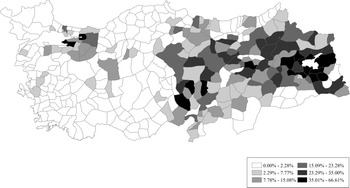
There is yet to emerge a standardized way of linking the names of historical sites and current gazetteers (Berman et al. Reference Berman, Åhlfeldt and Wick2016). To match each modern Turkish district (∼957) to an Ottoman district (∼332), I used the historical gazetteer of the Ottoman Empire compiled by Sezen (Reference Sezen2017). A significant majority of the administrative borders of the kazas were altered when the core region of the Ottoman Empire was succeeded by the Turkish Republic. The Ottoman gazetteer provides an index of 120,000 places from the reign of Suleiman the Magnificent, documenting the changing administrative boundaries of these historic localities. This record allows me to search for the names of modern Turkish districts (ilçe) and identify the Ottoman kaza to which they once belonged. Due to the fact that Ottoman kazas were generally larger than modern Turkish districts, in most cases, I had multiple modern districts that matched with a single Ottoman kaza. Furthermore, for certain modern districts, it was not possible to identify the historic kaza or sanjak that these areas belonged to—in large part, because the given locality was created after the founding of the Turkish Republic and therefore did not exist in the Ottoman times. For such districts, I relied on the geographic coordinates of the district capital as an approximation. Figure 1 presents the share of the Armenian population in Ottoman Turkey according to the 1893 Ottoman Census.
Percentage of Ottoman Armenian population (1893).

Historical Schooling Data
Protestant Missionary Stations and Schools
For the present study, the exact locations of historical mission stations and outstations are not provided. Past studies have used mission atlases such as the Atlas of Protestant Missions, Atlas Hierarchicus, or the World Atlas of Christian Missions to obtain information on the locations of missions. Yet, these sources are known to omit many locations where missionaries and native workers operated, and can potentially yield biased results. Hence, I rely instead on archival missionary sources, such as annual reports, letters and diaries housed at the Archives of the ABCFM at Houghton Library, Harvard University.
Based on the names provided in these missionary publications, I found the exact geographic coordinates of 430 historical mission main stations and outstations contained within the borders of modern-day Turkey.Footnote 13 If the mission station became a present-day locality, I found its coordinates using online geocoding tools. A small minority of locations were cases wherein the name had remained relatively stable from the late Ottoman period to the consolidation of the modern Turkish state (e.g., Adabazar vs. Adapazari). More often, the location of former mission stations had changed in name or ceased to exist. One study finds that around 35 percent of all villages in Turkey experienced a name change since the establishment of the Turkish Republic in 1923 (Tunçel Reference Tunçel2000). Part of this was the result of “toponymical engineering” (Öktem Reference Öktem2008), which aimed to erase the memory of an ethnically, religiously, and linguistically diverse past—especially, in Eastern Anatolia. For these locations, I consulted a variety of sources (Hewsen and Salvatico Reference Hewsen and Salvatico2001; Kévorkian and Paboudjian Reference Kévorkian and Paboudjian2012; Nişanyan Reference Nişanyan2010) and relied on data triangulation (Denzin Reference Denzin1989) to aid the process of geocoding missionary stations. In total, I was able to track down the coordinates for 97 percent of the missionary stations referenced in ABCFM annual reports.
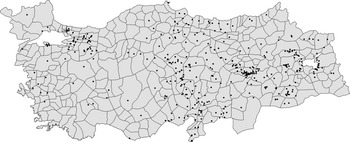
The dataset contains 17 mission main stations and 413 outstations in total. For each station, I recorded the corresponding main station, regional mission, kaza, and vilayet to which it belonged. I also noted any variations on the name of the location, as well as the longitude and latitude of each location. To discern the differences between missionary educational activities and their broader evangelical work, I also collect data on the schools Protestant missionaries founded in Ottoman Turkey. This data comes from Gülbadi Alan (Reference Alan2015) work on American Protestant schools in the Ottoman Empire. Using the information described in the preceding text in conjunction with census data from 1893, I calculate two different measures of missionary density for each kaza: missionary schools per 1,000 people and missionary stations per 1,000 people.Footnote 14 Figure 2 shows the geocoded locations of all missionary stations contained within the borders of modern Turkey.
Geocoded locations of ABCFM missionary stations.

Gregorian Armenian Schools
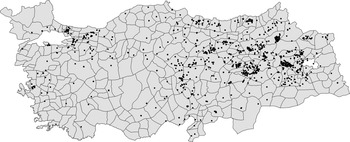
The data for the Armenian schools comes from the Cultural Heritage Map of Turkey created by the Hrant Dink Foundation (https://turkiyekulturvarliklari.hrantdink.org/en). The map carefully records Armenian, Greek, Syriac, and Jewish sociocultural and spiritual life in Ottoman Turkey. Information on public buildings such as churches, schools, monasteries, cemeteries, and hospital was created relying on primary and secondary sources. The online map contains the exact locations of 1,252 Gregorian Armenian schools built during the Ottoman period. Using this source, I compute the exact number of schools in each kaza using tools in the ArcGIS software. Similar to the previous sections, I then calculate a “schools per capita” measure using the Armenian population figures in the 1893 Census. Figure 3 details the geocoded locations of all Gregorian Armenian schools in the Ottoman Empire.
Geocoded locations of Gregorian Armenian schools.

Competition Measure
Informed by the historical outline provided in the section “Historical Context,” I also consider the competition between Protestant missionary and Armenian schools as an explanatory variable. To capture the intensity of local Christian competition, I rely on the geocoded locations of nineteenth-century Gregorian Armenian schools and Protestant missionary stations. Taking advantage of the geographic scale of this data it is possible to determine the places where these two types of schools existed within a 5 km radius of one another. I then calculate how many competitive dyads there are in each kaza. Finally, using the number dyads, I come up with a “competition per capita” figure for each kaza.
Outcome Measures
Throughout this article, I examine the relationship between the location of American Protestant and Gregorian Armenian institutions and contemporary pretertiary educational attainment. The central long-term outcome measures used in this article is educational attainment for elementary and high school education in modern-day Turkey. For each level this is the share of the population above age 14 that has received elementary or high school education. The education data is obtained from the Turkish Statistical Institute (TÜİK) for the year 2010. Building on the district matching techniques detailed in the previous sections, I merge the contemporary educational figures with my GIS dataset. Additionally, using these figures, I calculate a GPI for each educational level measured as the ratio between the absolute number of female and male population with a given degree in 2010.Footnote 15
Control Variables
To account for potential exogenous drivers of public schooling being established in more urbanized or physically accessible areas, I construct several measures of demographic, geographic, and climatic attributes. I rely on the share of Christians living in a given district in 1893 as my proxy for ethnoreligious diversity. The basis for selecting this measure over other more nuanced calculations of ethnic diversity is that one of my primary independent variables, missionary presence, altered the composition of religious diversity in the region.Footnote 16 Furthermore, it is imperative to control for historical Christian presence given that some studies have found that it is positively related to contemporary economic and educational outcomes in Turkey (e.g., Arbatli and Gokmen Reference Arbatli and Gunes2018). To capture geographic characteristics, I measure the average elevation of the district, the average annual temperature of the district (1979–2013), the average annual precipitation of the district (1979–2013),Footnote 17 latitude of district centroid, and the minimum distance from the centroid of the district to major rivers, lakes, and seas. All geographical variables are constructed using tools in ArcGIS. I include these variables to account for any direct impact of geography on development. I also rely on several historical variables to capture differences across districts in initial states that may affect current educational levels. The list of controls include distance to late-nineteenth-century railroad, nineteenth-century carriage road density, distance to major nineteenth-century ports, distance to the capital (Istanbul), distance to Ottoman trade routes, and a dummy variable indicating whether a kaza was the administrative capital of a sanjak in 1893. See table 1 for the descriptive statistics of all variables used in my analysis.
Summary statistics

Results
Educational Attainment
In the following, I use the data set described in the section “Data and Sources” to examine whether long-run educational outcomes differ among localities that had varying concentrations of Protestant missionary schools and Gregorian Armenian schools. Because the channels that direct effects can operate through are blocked, the following models are testing for the presence of indirect missionary effects only. As described in the previous section, I examine the relationship between the location of historical educational institutions and two different contemporary educational outcome variables. My baseline specification in given by:
 $${y_i} = \alpha (Schoo{l_x}){k_i} + \delta ln(P{D_{1893}}) + \beta {X_i} + {\varepsilon _i}$$
Where yi is an outcome of interest, the share of the population with a given degree, in district i. The dependent variable measures percent of population with an elementary or high school degree in 2010. My main variable of interest, (Schoolx)ki, captures the concentration of a given nineteenth-century Christian school x (Protestant Missionary or Gregorian Armenian) in the Ottoman kaza k to which district i was assigned. I use the number of schools per 1,000 persons in a given kaza as my main measure of school concentration. I also consider missionary stations per capita as an alternative measure capturing missionary intensity. In all specifications, α measures the long-term link between nineteenth-century schooling and current educational outcomes. Population density in 1893, ln(PD1893), is included as a proxy for initial economic conditions and urbanization levels. Xi denotes a host of control variables, namely demographic, geographic conditions, climate, location, and political characteristics. Standard errors here and in all following specifications are clustered at the level of the Ottoman sanjak in 1893. There existed 53 Anatolian sanjaks at the time. All control variables are described in detail in the section “Data and Sources” and further information on the calculation of each variable is provided in the data appendix (see supplementary material).
Missionary Institutions
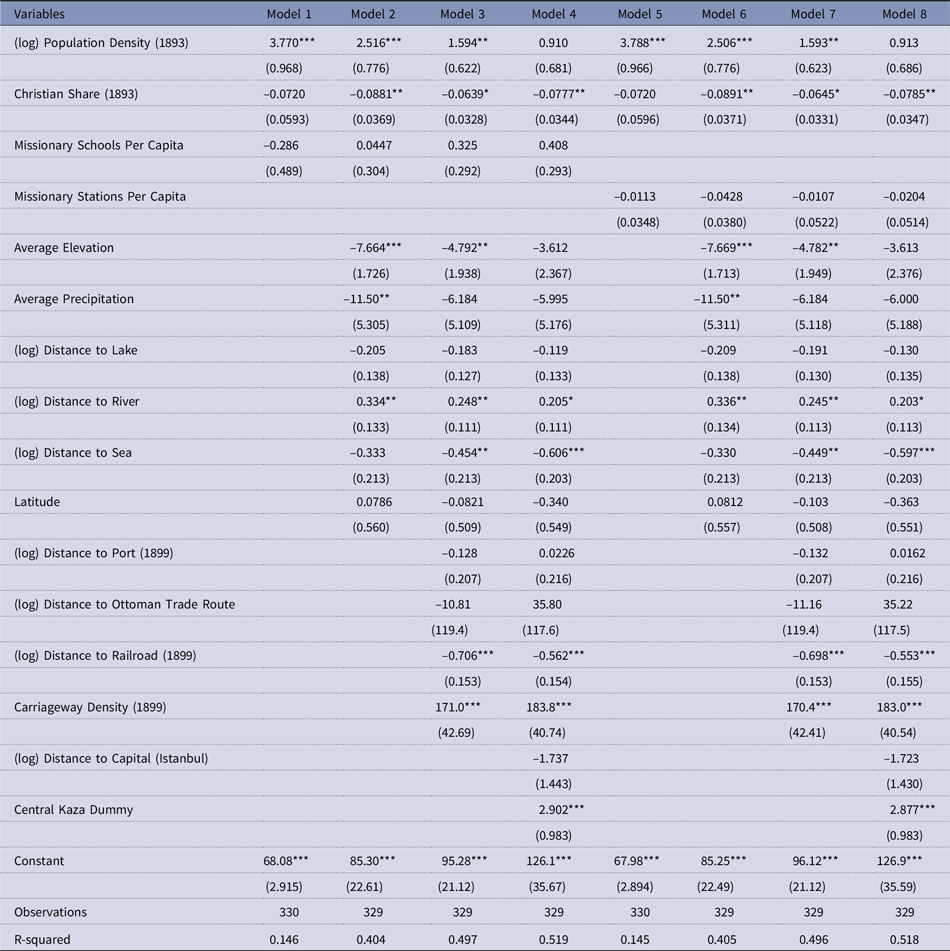
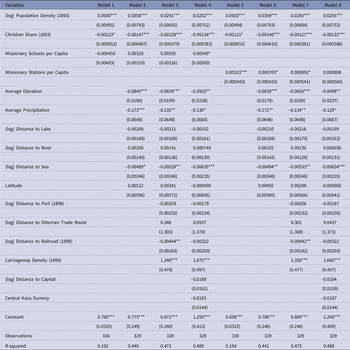
Table 2 begins by reporting the results for the baseline OLS specification for Protestant missionary schools and missionary stations, respectively. Contrary to past analyses of missionary education and educational outcomes, a comparison across columns shows that none of the models identify a relationship between missionary school concentration and contemporary elementary degree attainment. This finding therefore suggests that the impact of missionary education on these outcomes is direct. Moreover, unlike Arbatli and Gokmen (Reference Arbatli and Gunes2018)—who report a positive association between Armenian and Greek shares in 1893 and high school degree holders in contemporary Turkey—my results suggest that share of Christians in 1893 is negatively related to degree holders at lower levels of schooling. My most conservative estimates, reported in Models 4 and 8, indicate a 0.8 percent decrease in the share of the population with an elementary degree for a 1 percent increase in the portion of Ottoman Christian population in 1893. The distance to the nearest sea and distance to nineteenth-century railroad are both statistically significant and negatively related to elementary degree holders in Models 4 and 8. Nineteenth-century carriage road density and distance to the river, however, are positively related to the share of the population with an elementary degree. Finally, being an administrative capital in the nineteenth century increases the share of contemporary elementary enrollment by around 3 percent.
Missionary institutions and elementary enrollment (2010)

Notes: Robust standard errors, clustered at the Ottoman sanjak level in parentheses.
***p<0.01, **p<0.05, *p<0.1
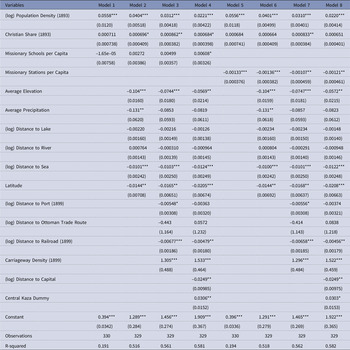
Table 3 replicates the eight models in table 2 but uses high school degree attainment in 2010 as the dependent variable and suggest that missionaries either had no indirect effects on this outcome or had negative effects. As Models 1–4 show, no statistically significant differences were found between places with missionary schools and places that lacked such educational establishments. Whereas, looking at Model 5, 6, and 8, we can see that the concentration of missionary stations is negatively related to contemporary high school degree holders. In Model 8, a one unit increase in the missionary stations per capita decreases the share of the population with a high school degree in 2010 by 0.05 percent. Log of population density in 1893 is significant in Models 1–3 and Models 5–7, but loses its significance in the final models. The only other variables that are positive and statistically significant in this final model are central kaza dummy, nineteenth-century road density, and share of the Ottoman Christian population. Being a nineteenth-century administrative capital increases the share of the population with a high school degree by 6.56 percent, whilst a one-standard deviation increase in road density corresponds to around 1.5 percent increase for the share of the population with a high school degree. A one unit increase in the Christian share of the population in 1893, however, yields 0.06 percent increase in contemporary high school degree attainment. This last point mirrors the findings of Arbatli and Gokmen (Reference Arbatli and Gunes2018) who find a positive link between the share of Ottoman Christians and contemporary high school attainment; yet, in light of the evidence presented in table 2, I claim that the positive educational legacy of Christian presence is restricted to postprimary education.
Missionary institutions and high school enrollment (2010)

Notes: Robust standard errors, clustered at the Ottoman sanjak level in parentheses.
***p < 0.01; **p < 0.05; *p < 0.1.
Gregorian Armenian Schools
The expansion and modernization Gregorian Armenian education was in part due to the stimulus it received from Protestant missionaries, and could have also led to human capital spillovers for the local Muslims. To test this indirect channel, table 4 present the results for the baseline OLS specification for Gregorian Armenian schools. Using Armenian schools per capita as my explanatory variable, I find no evidence that the concentration of Ottoman-era Armenian Schools has an influence on contemporary elementary degree attainment in Models 1–4 or high school degree attainment in Models 5–8. The direction and significance for the control variables in tables 4 are nearly identical to those reported in the models with missionary institutions.
Gregorian Armenian schools and educational attainment (2010)

Notes: Robust standard errors, clustered at the Ottoman sanjak level in parentheses.
***p < 0.01; **p < 0.05; *p < 0.1.
Christian Competition
In this section, I use the dataset and historical schooling data described in the section “Data and Sources” to test whether long-run educational attainment figures differ among localities that had educational competition during the Late Ottoman period. My key independent variable is the number Protestant and Armenian schools within a 5-kilometer radius of one another in a given district adjusted to the Armenian population of that district. The empirical model I estimate is as follows:
 $${y_i} = \alpha (Competition\,Per\,Capita){k_i} + \delta ln{(P{D_{1893}})_i} + \beta {X_i} + {\varepsilon _i}$$
A comparison across Models 1–4 in table 5 shows that competition per capita is positively related to the share of the population with an elementary degree in all models. In Model 4, each additional competitive dyad per capita is associated with a 0.21 percent increase in the share of the population with an elementary degree. Similar to earlier models investigating elementary education, Christian share of the population in 1893, distance to the nearest sea, and distance to nineteenth-century railroad are negatively correlated with contemporary elementary degree attainment. Likewise, Ottoman road density and central kaza dummy are positively related to elementary degree holders. This being said, I am unable to replicate this association for high school educational attainment. Looking at Models 5–8, we see that Christian Competition per capita is not related to high school degree attainment in any of the models. The results therefore suggest that missionaries had indirect effects on education through the competition mechanisms, although this only seems to hold for primary education. That being said, when I substitute Christian Competition per capita with gender parity in enrollment in primary schools in 1914, the relationship is positive and statistically significant. I will investigate this association further in my “Mechanisms” section.Footnote 18
Christian competition and educational attainment (2010)

Notes: Robust standard errors, clustered at the Ottoman sanjak level in parentheses.
***p < 0.01; **p < 0.05; *p < 0.1.
Discussion
The results shown in the preceding text suggest there is no positive and consistent association between missionary schools per capita and educational attainment in Turkey. This stands in stark contrast to the majority of works on missionaries that have found a consistent and positive association between missionary schools and educational development. These findings offer evidence that previous findings are driven by direct effects of missionary investments in schooling such as infrastructure and the intergenerational transmission of human amongst target populations. In the absence of both, I find that districts with a higher concentration of missionary stations are worse off in terms of high school degree attainment. One potential explanation for this observation is the detrimental impact of population movements that Eastern Ottoman Provinces experienced after World War I. Missionaries concentrated their efforts overwhelmingly in Armenian villages that were subsequently resettled by refugees from the Balkans and Caucasus following various episodes of ethnic violence in Eastern Anatolia. There is evidence to suggest that these regions today are more conservative and, consequently, lag behind in terms of education and literacy (Sakalli Reference Sakalli2019).
Whilst missionary presence on its own does not contribute to contemporary elementary schooling, I find that a more active Christian educational market is a significant predictor of share of the population with an elementary degree. Ottoman historians have rightfully pointed out that one of the reasons the Porte invested in public education was the fear that Muslims were falling behind their Christian conationals in terms of education. A dynamic Christian educational market could have motivated the Porte to invest more in education and for Muslims to value education in the short term. Both propositions will be further investigated in the section “Mechanisms.”
Gender Parity Index
Missionary Institutions
The literature on the legacy of missionary institutions also claims that missionaries had different effects on male and female educational outcomes. A number of analysts claim that missionaries empowered women primarily through indirect channels such as educational competition with state-run schools or local shifts in gender norms (Calvi et al. Reference Calvi, Federico and Lauren2019; Lankina and Getachew Reference Lankina and Lullit2013). To test this claim, I include female-to-male ratios of attendance at elementary and high school levels of schooling in 2010 as my dependent variable. Table 6 provides the results for my models with missionary institutions and gender parity for elementary levels of schooling. Looking at Models 1–4, missionary schools per capita is related to the GPI only in Model 4. In contrast, the results in Models 5, 6, and 7 show that missionary stations per capita is positively related to the GPI for elementary schooling. This means that each additional missionary station per capita in Model 7 is associated with an increase in the GPI in contemporary elementary degree holders by around 0.13 percent. Models 8 replicates the positive association but falls short of the cutoff point for the confidence level. Christian share of the population in 1893, distance to nearest sea, average precipitation, and average elevation are all negatively related to the GPI at the elementary level. Contrary to the earlier models investigating the impact of overall educational attainment, the central kaza dummy fails to explain the gender parity in elementary education. Whereas, nineteenth-century road density is a significant predictor of both overall enrollment and improvement of female education—as one standard deviation increase in nineteenth-century Ottoman carriageway density corresponds to around 3.15 percent increase in the GPI.
Missionary institutions and gender parity index for elementary schools (2010)

Notes: Robust standard errors, clustered at the Ottoman sanjak level in parentheses.
***p < 0.01; **p < 0.05; *p < 0.1.
Counterintuitively, as one moves into higher levels of schooling I find contradictory results between the impact of missionary schooling and missionary stations. In Model 4 in table 7, each additional missionary school per capita corresponds to a 0.81 percent increase in the GPI for high schools. Whereas, looking at Models 5–8, we can see that missionary stations per capita is negatively related to the GPI in all models. Model 8 reports a 0.16 percent decrease in the GPI for a one unit increase in missionary stations per capita. What explains this discrepancy? Part of the reason could be the different strategies governing Ottoman investment in postelementary education for women. As shown in table 6, gender parity in elementary schooling is related to missionary presence (i.e., station presence) rather than the concentration of educational institutions they established in a given region. This finding aligns with Ottoman historians’ interpretation that investment in compulsory primary education was driven by the existential threat of missionaries. Higher levels of female education, however, was a costly and undervalued endeavor and was most likely governed by separate dynamics. Furthermore, as mentioned in the previous section, missionary stations were set up in places where the Armenians formed a larger share of the population.Footnote 19 The conservative population that replaced the Armenians might not have valued noncompulsory female education. I will investigate this issue further in the “Mechanisms” section to see whether the existence of primary and secondary female schools in the Late Ottoman period was influenced by schools or stations differently.
Missionary institutions and gender parity index for high schools (2010)

Notes: Robust standard errors, clustered at the Ottoman sanjak level in parentheses.
***p < 0.01; **p < 0.05; *p < 0.1.
Christian Competition
In this section, I use the competition score described in the “Data and Sources” section to test whether the GPI in educational attainment differs among localities that had educational competition. Similar to the previous section, I consider the competition between Protestant missionary and Armenian schools. Basic statistics in table 8 show that competition per capita is significantly and positively related to the GPI for elementary schooling in Models 1 through 4. In Model 4, each additional competitive dyad in a given kaza is associated with a 0.4 percent increase in the GPI for elementary school. Moreover, the size of the coefficient is slightly larger than the those for missionary stations per capita reported in table 7. Nineteenth-century carriageway density remains positive and significant in Models 3 and 4, with a one standard deviation in road density corresponding to a 3.11 percent increase in the GPI in Model 4.
Christian competition and gender parity index for elementary and high schools (2010)

Notes: Robust standard errors, clustered at the Ottoman sanjak level in parentheses.
***p < 0.01; **p < 0.05; *p < 0.1.
Model 5 through 8 in table 8 reports the relationship between the Christian competition per capita and high school GPI. The results show that competition per capita is positive and significant across specifications, with the magnitude slightly increasing as we add more controls. This means that a competitive educational environment also had positive educational legacies for reducing the gender inequality in high schools. In Model 8, each additional competitive relationship corresponds to a 0.42 percent increase in the GPI for high schools. Log population density and nineteenth-century carriageway density are both positive and significantly related to high school gender parity whilst distance to a nineteenth-century railroad, distance to sea, distance to Istanbul, and average elevation are all negatively related. All in all, these results therefore offer clear and consistent evidence that missionary educational competition had indirect effects on female education, suggesting that Ottoman authorities were most likely to expand female education in regions when missionary and Armenian schools competed for female students.
Mechanisms
My results show that historical educational competition played a crucial role in shaping regional educational attainment patterns in contemporary Turkey. I interpret my findings as evidence that religious competition leads to an expansion in the provision of public goods, especially in respect to female education. The historical record shows the popularity of girls’ education among non-Muslim communities of the Ottoman Empire pressured the Ottoman state to modernize traditional schools by instituting a series of female educational reforms in the mid-nineteenth century (Evered Reference Evered2012: 139). The Ottomans founded the first secondary schools for girls in 1859, and then a Women’s Teachers Training School to staff the schools with female teachers in 1870 (Gawrych Reference Gawrych2010: 99). In a bid to introduce an empirewide modern public education system, the Education Act of 1869 would further reform female primary schools.Footnote 20 The expansion of primary and secondary female schools continued to be promoted during the Hamidian era (1876–1909) due to its perceived role in raising a moral and religious generation (Somel Reference Somel2001: 57, 185). Education of women thus occupied a central place in discussions surrounding modernization and saving the empire in the face of foreign encroachment.
Taken together, the first stage of my stage statistical results imply that the existential threat of missionaries alongside competition between Protestant and Armenians increased the supply and demand for female education even after missionary and Armenian schools were no longer present. To test whether educational competition impacted contemporary educational development through the previously specified mechanisms, we need to examine whether its influence can be observed in the short term as well. In this section, I perform various additional analyses to demonstrate that regions with competitive educational environments have higher educational development in the late Ottoman period, as proxied by school numbers, student enrollment, and gender parity in Ottoman schooling.
Supply Side: Number of Ibtidâî Schools and Female Rüşdiyye School Concentration
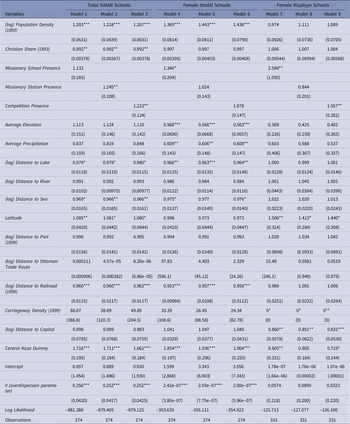
If educational competition in the Ottoman Empire stimulated investment in and demand for schooling across ethnoreligious lines, we should expect Christian competition to also influence the number of Muslim schools in the short term—that is before the large-scale ethnic violence and displacement in Anatolia. To test this hypothesis, I employ information on ibtidâî (1914–15) and rüşdiyye (1905–8) schools gathered from the Ottoman Educational Yearbooks for their respective years (Alkan Reference Alkan2000). Ibtidâîs were Ottoman lower primary schools that educated Muslim children according to new teaching methods (usul-i cedid).Footnote 21 Rüşdiyyes, however, were secondary (or advanced primary) schools that followed training at primary schools. Using the information contained in these statistical reports, I calculate three outcome measures to investigate whether Protestant missionary presence and existence of a dynamic Christian educational market are related to the Ottoman state’s investments into schooling: total number of ibtidâîs, female ibtidâîs, and female rüşdiyye concentration. Given that the conditional variance for the number and concentration of Ottoman schools is significantly larger than the conditional mean (i.e., overdispersion is present), I rely on a negative binominal regression rather than a poisson regression to estimate my results (Cameron and Trivedi Reference Cameron and Trivedi1998). My main variable of interest is a dummy variable indicating missionary station, missionary school, and competitive dyad presence.Footnote 22 Table 9 reports the incident rate ratios of my negative binomial regression models.
Number of Ottoman schools (1914) and Christian education

Notes: Robust standard errors, clustered at the Ottoman sanjak level in parentheses. Results are reported in incidence rate ratios.
***p < 0.01; **p < 0.05; *p < 0.1.
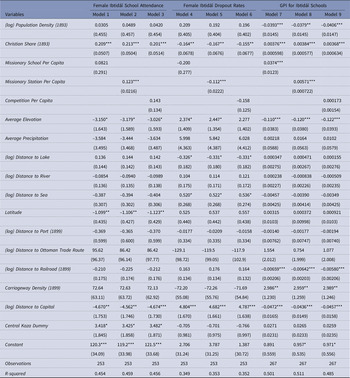
Female ibtidâî attendance and dropout rates (1914); gender parity in ibtidâî schools (1914)

Notes: Robust standard errors in parentheses
***p < 0.01; **p < 0.05; *p < 0.1.
Columns 1–3 in table 9 report the estimated coefficients using the total number of schools as my dependent variable. I find that the presence of a missionary station and competitive dyad in a given kaza corresponds to a 24.5 percent and 22.3 percent increase in the total number of ibtidâî schools, respectively. These findings provide support for the idea that the presence of a missionary station and competitive Christian educational environment are both are both important variables shaping Ottoman investment in primary education during its final years. They also provide evidence that the absence of a significant effect of missionary presence on contemporary enrollment reported in tables 2 and 3 is likely the result of population movements that took place after the establishment of the Turkish Republic. Furthermore, in line with my findings in the “Educational Attainment” section, I discover that the share of the Christian population is negatively related to primary education. This is in line with my expectations because early investments in ibtidâî education concentrated on places were Muslims constituted a majority given that in lower levels of primary education Muslims and non-Muslims were taught separately.
Next, I examine whether missionary orders or competition may have affected the supply of primary and secondary female schools. In Models 4 through 7, I substitute my dependent variable with the total number of female ibtidâî schools in a district. The estimated coefficient in Model 4 suggests that Ottoman districts with a missionary school had on average 34.6 percent more female ibtidâî schools than those areas that lacked such educational institutions.
Finally, in Models 7–9, I investigate whether the supply of primary and secondary Ottoman female schools was driven by separate dynamics. For my dependent variable, I use the concentration of female rüşdiyye Ottoman schools between 1901–19; the data comes from Selçuk Akşin Somel’s (2001) work on the modernization of Ottoman education. As can be seen from table 9, the presence of a missionary school positively effects the number of rüşdiyye schools, whilst missionary stations are negative negatively related. This mirrors my earlier findings regarding the divergent effect of missionary stations and schooling on the GPI for secondary education. That being said, the p-value for missionary station presence is 0.2 and not significant. Besides missionary presence, competition presence is also statistically significant and positively related to upper-primary Ottoman schooling. This result is also in agreement with my earlier findings linking Ottoman-era Christian educational competition to contemporary elementary enrollment and gender parity in pretertiary education. Thus, whilst lower level public instruction was spurred by a general fear of missionaries, Christian competition, and the presence of a significant Muslim population, we can see that the Porte’s strategy in building higher educational institutions for women was partially motivated by the presence of missionary schools and an active Christian educational environment in a given district.
Demand Side: Female Enrollment, Dropout Rates, and Gender Parity in Ibtidâî Schools
In this section, I test whether missionary presence or Christian competition is related to female education becoming greater valued by the Muslim population. To test this hypothesis, I once again rely on the Ottoman Educational Yearbooks of 1914–15. Besides enumerating ibtidâî schools, these statistical reports also contain information on the number of people who have reached the compulsory schooling age, number of students who did not complete their education, alongside figures on the number of students enrolled at ibtidâî schools, all down to the kaza level.Footnote 23 Using this information, I calculate three outcome measures: the rates of primary school attendance for school-age girls, the dropout rates for female students, and the GPI for ibtidâî school attendance. Together, these indictors should provide insight into changing gender norms in the early twentieth century. My primary independent variables are missionary schools per capita, missionary stations per capita, and competition per capita.
The results presented in Table 10 for the Ottoman-era demand models are broadly similar to those found in the contemporary period. The effect of Ottoman-era Christianity is still strong in the last decades of the Ottoman Empire when other geographic, climatic, and political attributes are taken into account. Yet, the effect is stronger, contributing to 20 percent increase in female ibtidâî school attendance, 16 percent decrease in female dropout rates, and 0.4 percent increase in the GPI for 1 percentage increase in the share of Christians living in a district.
The results for missionary presence are also consistent with my earlier findings that demonstrated a positive relationship between missionary station and school concentration and contemporary gender parity. All things being equal, one unit increase in missionary stations per capita corresponds to a 12 percent increase in female students’ attendance at ibtidâî schools, 11 percent decrease in female dropout rates, and 0.6 percent increase in the GPI at ibtidâî schools. Furthermore, the OLS estimate in Model 7 is consistent with the estimates in table 6 and reveal a positive effect of missionary education on gender parity in ibtidâî schools in the period 1914–15.
In addition, I also find that each competitive dyad per capita is 36 percent increase in female enrollment, 33 percent decrease in female dropouts, and 0.5 percent increase in the GPI. However, my results are not statistically significant when I control for Christian share implying that the positive effect of competition on gender parity is in part captured by the share of Christians living in a district.
The results from the Late Ottoman era schooling show that missionary stations per capita and share of the Ottoman Christian population in 1893 are both significant predictors of the demand for female schooling in the Ottoman Empire. Missionary schools, however, were the primary motivator for the supply of both primary and secondary Ottoman female schooling.
Spearman Ranks
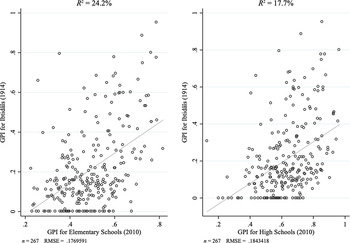
Finally, I evaluate the persistence of cross-district variability of primary school enrollment and gender parity in educational attainment in Turkey. Figure 4 reports the unconditional correlation between GPI for elementary schools in 2010 and GPI for ibtidâîs in 1914. Results suggest a high degree of persistence in subnational differences in the gender gap in education. The regression for the full sample explains 24.2 percent of the subnational variation in gender gap for schooling. The Spearman rank correlation is 0.45 and a test rejects the null hypothesis that schooling variables in the past and today are independent.Footnote 24 This evidence suggests that the gender parity in education is highly persistent and that its early and current levels are closely related.Footnote 25 Substituting the GPI for elementary schools with the GPI for high school levels I find largely similar results. The regression for the sample explains about 17.7 percent of subnational variation. The Spearman rank correlation is 0.45; the test also rejects the null hypothesis that both these variables are independent.
The correlation between GPI at Ottoman primary schools and Turkish schools.

As a final check, I examine the continuity in enrollment rates for primary schools following the collapse of the Ottoman Empire. The regression for the sample explains about 16.8 percent of the subnational variation. The Spearman rank correlation is 0.50; the test also rejects the null hypothesis that both these variables are independent. These simple tests establish in a bivariate framework, that there is a systematic relationship between Late Ottoman era education and contemporary education.
Conclusion
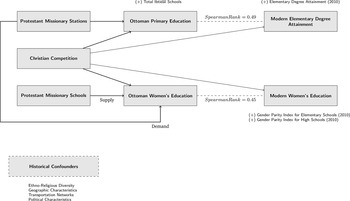
Ottoman society offers unique opportunities to untangle the long-run direct and indirect effects of missionaries. Due to the removal of the Armenian population and closure of the majority of missionary schools, we are able to investigate how the remaining Muslim population responded to the intensification of Protestant missionaries’ activities during the nineteenth century and whether this reaction had long-term effects. Using a novel historical GIS dataset, I found that missionary presence is negatively related to share of population with a high school degree. I interpret this finding resulting from the negative shock of Armenian expulsions and settlement of Muslim refugees in formerly Armenian villages. And whilst missionary presence had a negative effect on contemporary education, I offer evidence that the existence of multiple Christian educational institutions has a positive impact on total elementary enrollment. In line with the literature on Ottoman education, I postulate that a dynamic Christian educational market shaped the construction of ibtidâî schools. Missionary-triggered competition led to the broadening of educational provision by Ottoman bureaucrats, leading to its greater social acceptability and demand (see figure 5).
Long-run indirect effects of Protestant missionaries in Ottoman Turkey.

More importantly, my results also suggest that both missionary presence and Christian competition generated qualitative changes in Ottoman and Turkish education, leading to the institutionalization of education for all social groups formerly excluded from the educational system. I find that concentration of missionaries and competition are both positive and significant predictors of gender parity at the elementary and high school levels. Protestant entrants into the Ottoman educational landscape had to work extra hard to capture a share of an already established market. As a result of the patriarchal and elitist nature of Ottoman and Armenian education, Protestant missionaries were compelled to target women for conversion. Complementing their focus on marginalized members of Ottoman Armenian society were Protestant religious principles that prioritized egalitarian notions of social welfare. The native educational institutions thus had to adapt and change to this increasingly pluralizing religious market. Failure to do so meant losing adherents to their faith or placing them under the pernicious influence of American Protestant missionaries.
Previous research has identified a positive relationship between historical presence of missionaries and a host of socioeconomic measures. This claim has been put forward without specifying whether such developmental outcomes are the result of direct or indirect effects. Using the unique case of Turkey, I am able to isolate the indirect effects and show that missionary presence is most intimately related to the reduction of gender inequality in education. This suggests that previous findings underlining missionary contributions to overall educational attainment are most likely the result of direct effects such as investments in educational infrastructure and intergenerational transmissions of human capital amongst recipients of the missionary message. Previous research on Turkey has attributed the persistent gender gap in education in Turkey to societal views on gender roles. While I do not dismiss the importance of culture specific explanations to educational development, both my case study and statistical analysis show that missionary involvement may be a powerful factor that altered local perceptions regarding women’s education. This is highly significant given the high degree of persistence in the gender gap in education between the Late Ottoman and contemporary Turkish periods.
The expansion of public schooling in the Ottoman Empire was part of a much broader phenomenon of worldwide expansion of state education in the nineteenth and twentieth centuries. What set the Ottoman case apart was that it its tenuous freedom from Western colonialism. Suffering multiple defeats at the hands of European powers, the empire attempted at various self-strengthening reforms that targeted the military, bureaucracy, and education. Thus, in contrast to colonial territories, the indigenous rulers were significant actors in the educational sphere. The Ottoman Empire shared this fate with a handful of large and multiethnic empires that remained independent whilst also falling under attack from the outside world and from internal opposition. The ruling elites in China, Japan, Siam, and the Ottoman Empire saw education as the secret to the West’s success and thus critical to safeguarding their own empires’ futures. Missionary educators working in these places were seen both as harbingers of reform but also the personification of imperial anxieties over Western intervention into their domestic affairs. Missionaries, moreover, could not rely on colonial governments for protection and faced significant indigenous opposition, especially in places with institutionalized religious practices. These factors combined to produce relatively free educational marketplace where multiple indigenous and foreign actors competed against each other. This competitive environment was an especially fertile ground for indirect effects to flourish. Future research would thus benefit from examining such processes, especially in semicolonial territories with long-standing histories of statehood.
Supplementary material
To view supplementary material for this article, please visit https://doi.org/10.1017/ssh.2021.39
Acknowledgments
This article was first presented as a paper at the 2nd Annual Chicago Area Comparative Historical Social Sciences Conference at Northwestern University on May 2019. I am grateful for the comments made at that gathering and for those at subsequent conferences.