The regulatory changes of the hypothalamic–pituitary–adrenal (HPA) axis, and alterations in cortisol levels in particular, have long been considered a primary mechanism through which early life stress (ELS) is translated into physical and psychiatric disease across the life span (McEwen, Reference McEwen1998). Previous findings suggest that this broad association of ELS, HPA axis functioning, and disease states may reflect an allostatic process whereby, for some individuals, ELS results in sustained and/or repeated HPA axis dysregulation and the “wear and tear” on the body reflective of allostatic load (Juster, McEwen, & Lupien, Reference Juster, McEwen and Lupien2010; Lupien et al., Reference Lupien, Ouellet-Morin, Hupbach, Tu, Buss, Walker, Cicchetti and Cohen2006). There is solid evidence, supported by the findings of adult and preclinical studies (see Gunnar & Quevedo, Reference Gunnar and Quevedo2007; Meaney & Szyf, Reference Meaney and Szyf2005; Sanchez, Reference Sanchez2006), that children exposed to ELS exhibit alterations in HPA functioning and increased mental health problems (reviewed in Gunnar & Vasquez, Reference Gunnar, Vasquez, Cicchetti and Cohen2006; Trickett, Negriff, Ji, & Peckins, Reference Trickett, Negriff, Ji and Peckins2011). However, there are many inconsistencies regarding the nature and degree of HPA alterations resulting from different types of ELS, ranging from severe maltreatment and neglect to the less memorable yet prevalent, often co-occurring, day-to-day deficits in the early caretaking environment (reviewed in Gunnar & Quevedo, Reference Gunnar and Quevedo2007; McCrory, De Brito, & Viding, Reference McCrory, De Brito and Viding2010). In addition, previous studies of children have not included repeated assessments of HPA functioning and mental health problems over sufficiently long periods of time to investigate the ways in which ELS influences the allostatic process unfolding over time. The present study addresses these issues, using an allostasis framework to investigate the influence of multiple types of ELS on later HPA axis development across a 6-year period from childhood into adolescence. In addition to investigating the influence of ELS on children's basal, or traitlike, HPA activity across this time period, the study explores the ways in which HPA activity might reflect allostatic challenges associated with episodic increases in children's mental health symptoms.
A substantial body of research has established that children exposed to chronic adversities early in life are more likely than other children to suffer a variety of mental health problems (Essex et al., Reference Essex, Kraemer, Armstrong, Boyce, Goldsmith and Klein2006; Halligan, Herbert, Goodyer, & Murray, Reference Halligan, Herbert, Goodyer and Murray2007; Kim, Cicchetti, Rogosch, & Manly, Reference Kim, Cicchetti, Rogosch and Manly2009; Trickett et al., Reference Trickett, Negriff, Ji and Peckins2011). Numerous individual factors have been proposed to explain this association, including social and academic functioning, cognitive styles and biases, emotional/behavioral dysregulation, and alterations in stress neurobiology (Cicchetti & Rogosch, Reference Cicchetti and Rogosch2007; Cicchetti & Valentino, Reference Cicchetti, Valentino, Cicchetti and Cohen2006; Essex et al., Reference Essex, Kraemer, Armstrong, Boyce, Goldsmith and Klein2006; Gunnar & Quevedo, Reference Gunnar and Quevedo2007; Heim, Shugart, Craighead, & Nemeroff, Reference Heim, Shugart, Craighead and Nemeroff2010). Of particular relevance to questions regarding the allostatic process is the growing body of research focused on the neurobiology of stress during childhood, including the primary allostatic mediators of the HPA axis and sympathetic–adrenomedullary (SAM) system and associated corticolimbic pathways (reviewed in Gunnar & Quevedo, Reference Gunnar and Quevedo2007).
The SAM and the HPA axis are distinct but interrelated systems designed to help the body mobilize resources to deal with psychosocial and physical challenges (Gunnar & Quevedo, Reference Gunnar and Quevedo2007; Lupien et al., Reference Lupien, Ouellet-Morin, Hupbach, Tu, Buss, Walker, Cicchetti and Cohen2006). The stimulation and subsequent regulation of both systems is integral for survival of any organism (McEwen, Reference McEwen1998); however, the contribution of the HPA axis, and its steroid hormone end-product cortisol, to the process of allostasis is of particular interest in developmental studies. Compared to catecholamines released by the SAM system, cortisol is able to cross the blood–brain barrier, exerting direct effects on the brain. In addition, because the HPA axis continues to develop through childhood, exposure to cortisol during these formative years may alter receptor sensitivity in the brain, resulting in long-lasting effects on HPA basal activity as well as responsivity to episodic challenges (Gunnar & Quevedo, Reference Gunnar and Quevedo2007).
Much of the human research on stress neurobiology is derived from preclinical research. Numerous studies of rodents and nonhuman primates have clearly demonstrated that early adverse environmental conditions, ranging from maternal deprivation to less severe variations in maternal care, can sensitize offspring's stress response systems, resulting in immediate and long-term alterations in HPA functioning and behavior (reviewed in Meaney & Szyf, Reference Meaney and Szyf2005; Sanchez, Reference Sanchez2006). Further, the effects of maternal stress appear to be mediated by disturbances in the quality of the mother–infant interaction (Meaney & Szyf, Reference Meaney and Szyf2005), and in nonhuman primates, associated disruptions in caregiver attachment (Sanchez, Reference Sanchez2006).
Because of the prolonged period of human development, much of the human research on the long-term effects of ELS has relied on retrospective reports of early maltreatment. Although useful, these studies cannot describe the process by which ELS “gets under the skin” to influence HPA development. Substantial support exists for the broad influence of early abuse and severe neglect on HPA functioning, although there are major inconsistencies regarding the nature and direction of effects (Miller, Chen, & Zhou, Reference Miller, Chen and Zhou2007), especially when comparing children versus adults (Tarullo & Gunnar, Reference Tarullo and Gunnar2006). It has been hypothesized that types of ELS that heighten HPA activity in childhood contribute to the development of blunted HPA activity in adulthood (Gunnar, Morison, Chisholm, & Schuder, Reference Gunnar, Morison, Chisholm and Schuder2001). In addition, there is now considerable evidence that children's HPA functioning varies by type of maltreatment (Cicchetti & Rogosch, Reference Cicchetti and Rogosch2001; Trickett et al., Reference Trickett, Negriff, Ji and Peckins2011), and that the association of early maltreatment with altered HPA functioning occurs more commonly among those who are currently experiencing depression or internalizing problems (Harkness, Stewart, & Wynne-Edwards, Reference Harkness, Stewart and Wynne-Edwards2011; Hart, Gunnar, & Cicchetti, Reference Hart, Gunnar and Cicchetti1996; Kaufman, Reference Kaufman1991). The combination of type of maltreatment and current internalizing symptoms also has unique effects on later HPA functioning (Cicchetti, Rogosch, Gunnar, & Toth, Reference Cicchetti, Rogosch, Gunnar and Toth2010). Although genetics undoubtedly play an important role in the association between ELS and HPA functioning in individuals with depression/internalizing problems (Heim, Newport, Mletzko, Miller, & Nemeroff, Reference Heim, Newport, Mletzko, Miller and Nemeroff2008), the findings of preclinical cross-fostering studies (Weaver et al., Reference Weaver, Cervoni, Champagne, D'Alessio, Sharma and Seckl2004) and human interventions (Fisher & Stoolmiller, Reference Fisher and Stoolmiller2008) demonstrate that the early caretaking environment also exerts a unique influence.
Previous studies of childhood maltreatment provide compelling evidence of the influence of severe ELS on later HPA alterations. However, effects of severe ELS may be different than the effects of less extreme day-to-day deficits in the early caretaking environment. A developmental psychopathology perspective emphasizes the need for investigating the full continuum of experiences from normal to abnormal, and the importance of such mutually informative studies for understanding developmental processes (Cicchetti & Toth, Reference Cicchetti and Toth2009). Among the less extreme types of ELS, maternal depression (and maternal stress more generally) has received considerable attention. Exposure to maternal depression/stress during the infancy and preschool periods is associated with children's elevated cortisol levels (e.g., Brennan et al., Reference Brennan, Pargas, Walker, Green, Newport and Stowe2008; Halligan et al., Reference Halligan, Herbert, Goodyer and Murray2007; Lupien, King, Meaney, & McEwen, Reference Lupien, King, Meaney and McEwen2000). There is also limited evidence that this association is found only among children with high levels of internalizing problems (Ashman, Dawson, Panagiotides, Yamada, & Wilkinson, Reference Ashman, Dawson, Panagiotides, Yamada and Wilkinson2002). In parallel with animal studies showing sensitization effects (Gunnar & Quevedo, Reference Gunnar and Quevedo2007; Sanchez, Reference Sanchez2006), we have shown (Essex, Klein, Cho, & Kalin, Reference Essex, Klein, Cho and Kalin2002) that preschool-age children exposed to concurrent maternal stress (especially maternal depression) evidenced increased afternoon cortisol levels only if they had been exposed to similar stress beginning at birth. Extending the findings of preclinical studies (Meaney & Szyf, Reference Meaney and Szyf2005; Sanchez, Reference Sanchez2006), it is postulated that maternal depression/stress impacts child HPA functioning through deficits in mother–child interactions and associated insecure attachments (Gunnar & Vasquez, Reference Gunnar, Vasquez, Cicchetti and Cohen2006). Compared to nondepressed mothers, depressed mothers are often less emotionally available and responsive to their children's needs (Bureau, Easterbrooks, & Lyons-Ruth, Reference Bureau, Easterbrooks and Lyons-Ruth2009; Feng, Shaw, Skuban, & Lane, Reference Feng, Shaw, Skuban and Lane2007), and their children are less likely to be securely attached (Milan, Snow, & Belay, Reference Milan, Snow and Belay2009; Toth, Rogosch, Sturge-Apple, & Cicchetti, Reference Toth, Rogosch, Sturge-Apple and Cicchetti2009). Unresponsive maternal care and insecure attachment in turn have been associated with children's heightened HPA reactivity (Bernard & Dozier, Reference Bernard and Dozier2010; Hastings et al., Reference Hastings, Ruttle, Serbin, Mills, Stack and Schwartzman2011), flatter diurnal cortisol slopes (Pendry & Adam, Reference Pendry and Adam2007), and heightened morning cortisol levels in adolescence (Murray, Halligan, Goodyer, & Herbert, Reference Murray, Halligan, Goodyer and Herbert2010).
Less attention has been paid to effects of paternal care on children. Paternal depression and negative parenting behaviors (Connell & Goodman, Reference Connell and Goodman2002; Gross, Shaw, Moilanen, Dishion, & Wilson, Reference Gross, Shaw, Moilanen, Dishion and Wilson2008; Ramchandani, Stein, Evans, O'Connor, & The ALSPAC Study Team, Reference Ramchandani, Stein, Evans and O'Connor2005; Schacht, Cummings, & Davies, Reference Schacht, Cummings and Davies2009; Wilson & Durbin, Reference Wilson and Durbin2010) are associated with children's mental health symptoms and other negative developmental outcomes. However, very little is known about the neurobiology underlying these associations. Mills-Koonce and colleagues (Reference Mills-Koonce, Garrett-Peters, Barnett, Granger, Blair and Cox2011) found that paternal negative parenting behaviors were associated with heightened cortisol reactivity among infants and elevated cortisol levels in toddlers. In addition, we have shown that the combination of low father involvement in infancy and high cortisol reactivity at age 7 prospectively predicted increased mental health problems at age 9 years (Boyce et al., Reference Boyce, Essex, Alkon, Goldsmith, Kraemer and Kupfer2006). These effects were independent of early maternal depression, suggesting that early paternal caretaking has a unique influence on children's HPA axis development and mental health.
Negative family dynamics characterized by conflict and anger also may influence children's HPA axis. A few studies have demonstrated that interparental conflict and expressed anger are associated with children's elevated morning cortisol levels (Davies, Sturge-Apple, Cicchetti, Manning, & Zale, Reference Davies, Sturge-Apple, Cicchetti, Manning and Zale2009; Pendry & Adam, Reference Pendry and Adam2007) and, among kindergartners but not adolescents, elevated bedtime cortisol and flatter diurnal slopes (Pendry & Adam, Reference Pendry and Adam2007). A few other studies have shown that the accumulation of several negative aspects of family dynamics (e.g., turmoil, exposure to violence) and physical aspects of the household (e.g., crowding, noise; Evans, Reference Evans2003) as well as negative events in the family environment like arguments and punishment (Flinn & England, Reference Flinn and England1995) are associated with children's elevated basal cortisol. Although these latter studies did not distinguish the effects of family conflict/anger from other negative aspects of the family environment, Davies, Sturge-Apple, Cicchetti, and Cummings (Reference Davies, Sturge-Apple, Cicchetti and Cummings2007) found that interparental conflict was associated with children's blunted cortisol reactivity independent of other family processes. This suggests that family conflict/anger has a unique influence on children's HPA development, although the direction of the effect remains unclear.
Although previous studies generally support an allostasis model of ELS, HPA functioning, and children's mental health (see reviews in Juster et al., Reference Juster, McEwen and Lupien2010; Lupien et al., Reference Lupien, Ouellet-Morin, Hupbach, Tu, Buss, Walker, Cicchetti and Cohen2006), inconsistent findings (Miller et al., Reference Miller, Chen and Zhou2007), and the lack of long-term developmental studies (Gunnar, Reference Gunnar, Vasey and Dadds2001) leave it unclear just how the allostatic process works from childhood into adolescence. Inconsistent findings may result, in part, from the focus of most studies on single types of ELS and the relative lack of consideration of children's current psychiatric state. To our knowledge, there are no studies of children's HPA functioning and mental health that consider potential differences in the influences of multiple types of ELS representing less severe day-to-day deficits in the early caretaking environment, including both maternal and paternal factors as well as broader family dynamics. Further, outside of studies of early maltreatment (Cicchetti et al., Reference Cicchetti, Rogosch, Gunnar and Toth2010; Harkness et al., Reference Harkness, Stewart and Wynne-Edwards2011; Hart et al., Reference Hart, Gunnar and Cicchetti1996; Kaufman, Reference Kaufman1991), only a few studies of less severe deficits in the early caretaking environment (e.g., Ashman et al., Reference Ashman, Dawson, Panagiotides, Yamada and Wilkinson2002) have considered children's current mental health problems.
In addition, to our knowledge, there are no long-term prospective developmental studies of ELS and HPA functioning with the repeated assessments of HPA functioning and mental health problems critical for investigating this allostatic process. From the perspective of allostasis, alterations in HPA functioning will occur to help the individual adapt to current challenges, in this case, episodic increases in mental health problems. There is considerable instability of mental health problems throughout childhood (Essex et al., Reference Essex, Kraemer, Slattery, Burk, Boyce and Woodward2009), and recent work shows that the expression of mental health symptoms is capable of dysregulating the HPA axis (Ruttle et al., Reference Ruttle, Shirtcliff, Serbin, Ben-Dat Fisher, Stack and Schwartzman2011). Episodic changes in symptom levels may induce an allostatic state to which the child's regulatory systems must adapt, above and beyond the sustained impact of ELS. An allostasis framework postulates that the HPA component that is responsive to episodic challenges is distinct from the longer term stable component that contributes to an individual's homeostatic set point. Thus, the investigation of the influences of ELS on the development of children's HPA functioning and mental health problems requires a study capable of distinguishing these two HPA components. Recent methodological advances based on cross-sectional or short-term longitudinal studies have enabled researchers to distinguish a short-term stable component of cortisol within an assessment period (i.e., epoch-specific) from moment-to-moment cortisol fluctuations (Hruschka, Kohrt, & Worthman, Reference Hruschka, Kohrt and Worthman2005; Shirtcliff & Essex, Reference Shirtcliff and Essex2008; Shirtcliff, Granger, Booth, & Johnson, Reference Shirtcliff, Granger, Booth and Johnson2005; Wismer Fries, Shirtcliff, & Pollak, Reference Wismer Fries, Shirtcliff and Pollak2008). However, to our knowledge, there have been no longer term longitudinal studies with repeated assessments of HPA functioning and mental health symptoms capable of distinguishing the influences of ELS on children's traitlike HPA activity from the influences on the ways in which HPA activity covaries with mental health symptoms. This would provide a strong test of the allostatic process, including ELS effects on basal HPA functioning and the ways in which alterations in HPA functioning unfold at points in children's development when they are challenged by increased mental health problems.
Present Study
The overall aim of the present study is to investigate the influences of three types of ELS reflecting day-to-day deficits in the early caretaking environment on HPA functioning and its covariation with mental health symptoms across childhood and into adolescence. The three types of ELS include maternal and paternal depressive symptoms, representing the influences of both types of caretakers, and family expressed anger, representing the influence of broader family dynamics. Mental health symptoms and cortisol were assessed when children were ages 9, 11, 13, and 15 years; and the traitlike component of cortisol that is stable across the entire 6-year period was distinguished from the epoch-specific component that varies with the episodic challenge of increased mental health symptoms.
The first major research question is whether ELS influences traitlike HPA functioning and its development. We hypothesize that all three types of ELS will exert long-term effects on traitlike cortisol and its development from childhood into adolescence. Because different types of ELS tend to aggregate in families and frequently co-occur (Repetti, Taylor, & Seeman, Reference Repetti, Taylor and Seeman2002), we consider the joint influences, including their interactions, of the three types of ELS. Because of insufficient prior evidence regarding differential influences by type of ELS, we take an exploratory approach to these questions. To investigate the developmental processes from childhood to adolescence, we consider child age rather than pubertal status. Although our larger body of work emphasizes pubertal maturation and tempo (Ellis, Shirtcliff, Boyce, Deardorff, & Essex, Reference Ellis, Shirtcliff, Boyce, Deardorff and Essex2011), we have found in previous analyses of this same data set that age is a more robust indicator of HPA development (Shirtcliff et al., in press). Further, a measure of puberty (e.g., pubertal timing) that is uncorrelated with age would be appropriate statistically, but pubertal timing is not a changing developmental phenomenon (Marceau, Ram, Houts, Grimm, & Susman, Reference Marceau, Ram, Houts, Grimm and Susman2011), which is of central interest here.
The second major research question is whether children's HPA functioning covaries with current mental health symptoms at each assessment in childhood and adolescence, and whether the patterns of covariation are dependent on prior ELS exposure. Because of the high co-occurrence of internalizing and externalizing symptoms at each assessment (rs = .46–.54), we created two scores that distinguished the severity of children's symptoms (i.e., average of the two standardized scores, reflecting score commonality) from the directionality of symptoms (i.e., half difference of the standardized scores, reflecting what differentiates the scores). Because severity and directionality scores are statistically independent, they can be analyzed together without additional Type I error (Essex, Klein, Cho, & Kraemer, Reference Essex, Klein, Cho and Kraemer2003). We hypothesize that children's HPA functioning will change from one assessment period to the next in correspondence with levels of mental health symptom severity, and that this coupling of HPA functioning with mental health symptoms will differ by ELS exposure. Because of insufficient prior evidence regarding differential influences by type of ELS, we take an exploratory approach to these questions.
Method
Participants
A total of 570 women and their husbands/partners were initially contacted during the second trimester of pregnancy through obstetric/gynecology and low-income clinics in the Milwaukee (80%) and Madison (20%), Wisconsin, geographical areas, for participation in the Wisconsin Maternity Leave and Health Project (now called the Wisconsin Study of Families and Work). Because the project originally focused on parental employment leave, family stress, and women's health outcomes during the first postnatal year, female participants met the following inclusion criteria: (a) over age 18, (b) living with the biological father, (c) at least one member of the couple working for pay, (d) not a student, and (e) not unemployed (see Hyde, Klein, Essex, & Clark, Reference Hyde, Klein, Essex and Clark1995, for details). Of the original sample, 560 (98.3%) had eligible live births. At the time of the cortisol assessments (beginning at age 9), only those families living within geographic proximity to the project offices were asked to participate in saliva collection; thus, analyses include the 357 families (64% of the original sample) who lived in geographic proximity and agreed to participate in saliva collection. At the time of recruitment, there were no significant differences between the 357 participants and the remaining families from the original sample in terms of parental education, marital or ethnic status, or annual family income; parents in the 357 families were slightly older: mothers M = 29.6 (SD = 4.2) versus 28.9 (SD = 4.6), t (568) = −1.97, p < .05; fathers M = 31.6 (SD = 5.2) versus 30.7 (SD = 4.8), t (548) = −2.17, p < .05. At the time of recruitment, 44% of the 357 mothers and 52% of the fathers had a high school or technical degree or less, whereas the remainder had at least a college degree; 40% were first-time mothers. Most couples were married (95%); median annual family income was $48,000 (range = <$10,000 to >$180,000). Eleven percent of participating children represented ethnic and/or racial minorities (89% Caucasian, 4% African American, 3% Native American/Alaskan Native, 2% Asian/Pacific Islander, 1% Hispanic, 1% other). Parents gave informed consent at each time point; child assent was obtained beginning at age 13 in accordance with the policies of the University of Wisconsin Institutional Review Board.
Measures
Data on ELS were collected during the infancy (child age 1, 4, and 12 months) and preschool (child age 3.5 and 4.5 years) periods. Data on HPA functioning and child mental health symptoms were collected at age 9 (M age = 9.27, range = 8.6–10.3), 11 (M age = 11.19, range = 10.5–12.3), 13 (M age = 13.22, range = 11.6–14.2), and 15 (M age = 15.50, range = 14.8–16.5) years. At age 9, saliva collection was limited to a subset of the children (N = 165 participants with complete data); at ages 11, 13, and 15 years, all participating children were asked to collect saliva (N = 297, N = 306, and N = 273 participants, respectively).
Child age
In data analyses, age was coded as years since school entry to (a) center maturation on a meaningful event (rather than extrapolate downward to birth), and (b) capture important experience-based social transitions, thereby taking both chronological age and life experience into account (Shirtcliff & Essex, Reference Shirtcliff and Essex2008).
Child salivary cortisol
Within each of the four assessments, children were asked to collect saliva for 3 consecutive days across three target collection times: (a) shortly after waking (before brushing teeth or eating breakfast), (b) between 3:00 p.m. and 7:00 p.m. (prior to dinner), and (c) just before going to bed. Cortisol was assessed in duplicate using well-established salivary enzyme immunoassay kits (Salimetrics, State College, PA). Mean intraassay and interassay coefficients of variation were 3.8% and 7.4%, respectively. Samples were reanalyzed if the coefficients of variation for the duplicate measurements were ≥20% for samples with values >0.02 µg/dl and ≥30% for samples with values ≤0.02 µg/dl. To normalize distributions, raw cortisol was log-transformed and extreme values were winsorized. We tested whether body mass index or medication usage impacted salivary cortisol levels and did not find systematic associations (Shirtcliff et al., in press). Nevertheless, given the likely effect of oral steroids on cortisol levels (Masharani et al., Reference Masharani, Shiboski, Eisner, Katz, Janson, Granger and Blanc2005) the one child taking prednisone was omitted from the analyses for that assessment.
Maternal and paternal depression
Parental depression symptoms were assessed with the Center for Epidemiologic Studies Depression Scale (Radloff, Reference Radloff1977), a 20-item self-report measure of depressive symptoms (e.g., “I felt that I could not shake off the blues even with help from my family or friends”). Parents rated items using a 4-point Likert-type scale ranging from 0 (rarely or none of the time) to 3 (most or all of the time). For each parent separately, scores were averaged within the infancy (child age = 1, 4, and 12 months) and preschool periods (child age = 3.5 and 4.5 years) and then averaged across the two periods. All αs exceeded 0.85.
Family expressed anger
In the infancy period (child age = 1, 4, and 12 months), family expressed anger was assessed with the average of three items from the Partner Role Quality scale tapping overt marital conflict (e.g., concerned about “arguing or fighting”; Barnett & Marshall, Reference Barnett and Marshall1989). Participants rated items on a 4-point scale ranging from 1 (not at all) to 4 (extremely). In the preschool period (child age = 3.5 and 4.5 years), parents completed the marital conflict measure, the Anger Expression Inventory (Spielberger, Krasner, Solomon, & Janisse, Reference Spielberger, Krasner, Solomon and Janisse1988; e.g., “When angry or furious, I argue with others”) and the Negative subscale of the Family Expressiveness Questionnaire (Halberstadt, Reference Halberstadt1986; e.g., “We blame one another for family troubles”). Preschool scores were standardized before averaging the three measures for mothers and fathers separately. For each parent, the infancy score was standardized and averaged with the preschool score, and then mother and father scores were averaged together for a single measure of family expressed anger. All αs exceeded 0.70.
Child mental health symptoms
Mental health symptoms were assessed using mother, teacher, and child reports from the MacArthur Health and Behavior Questionnaire (HBQ; Boyce et al., Reference Boyce, Essex, Goldstein, Armstrong, Kraemer and Kupfer2002; Essex, Boyce, et al., Reference Essex, Boyce, Goldstein, Armstrong, Kraemer and Kupfer2002). Mothers completed the HBQ as a telephone interview and teachers as a written questionnaire; children completed a parallel questionnaire, the HBQ-Child. For internalizing symptoms, mothers and teachers rated items for depression (e.g., “Cries a lot”) and generalized anxiety (e.g., “Worries about things in the future”). For externalizing symptoms, mothers and teachers rated items for oppositional defiant disorder (e.g., “Argues a lot with adults”), conduct disorder (e.g., “Lies or cheats”), inattention (e.g., “Does not seem to listen”), impulsivity (e.g., “Interrupts or butts in on others”), overt aggression (e.g., “Gets in many fights”), and relational aggression (e.g., “Tries to get others to dislike a peer”). Items were rated on a 3-point scale ranging from 0 (never or not true) to 2 (often or very true). For the HBQ-Child, children completed items tapping internalizing and externalizing symptoms parallel to those asked of mothers and teachers (e.g., “I cry a lot/I don't cry a lot”; “I do what adults ask me to do/I don't do what adults ask me to do”). For each item, children chose the one statement from each pair that was most like them and marked how much that statement was like them. Specifically, responses were coded on a 6-point scale based on which statement was selected (positive or negative) and whether the response option marked was really like me (6 if positive, 1 if negative), mostly like me (5 if positive, 2 if negative), or sort of like me (4 if positive, 3 if negative). Coefficient αs ranged from 0.70 to 0.96 across reporters and assessments. Principal components analysis was used to combine mother, teacher, and child reports into multi-informant scores for each construct at each assessment (Kraemer et al., Reference Kraemer, Measelle, Ablow, Essex, Boyce and Kupfer2003). The resulting scores accounted for over 70% of the total variance. Finally, as described earlier, two independent scales were constructed: symptom severity (average of the two standardized scores, reflecting score commonality) and symptom directionality (half difference of the standardized scores, reflecting what differentiates the scores; positive scores indicate a preponderance of externalizing symptoms).
Major analytic strategy
Growth curve techniques were chosen as particularly appropriate for investigating questions of allostasis. Specifically, hierarchical linear modeling (HLM) permits simultaneous modeling of cortisol levels and diurnal rhythms so that short-term (i.e., epoch-specific) stability, developmental change over time, and long-term (i.e., traitlike) stability in an allostatic system can be considered at the same time. Further, HLM allows growth trajectories to be defined at the intraindividual difference level which, in addition to charting how an individual's HPA axis develops over time, provides the opportunity for investigating how individual HPA functioning covaries with other changing processes (here, mental health symptoms at each assessment period). “Fixed” factors like ELS can be modeled in HLM as person-specific predictors of HPA functioning and its covariation with other changing processes. Because missing data is common in longitudinal investigations, HLM is also advantageous because it allows for inclusion of subjects with incomplete data without violating missing data assumptions (Schafer & Graham, Reference Schafer and Graham2002).
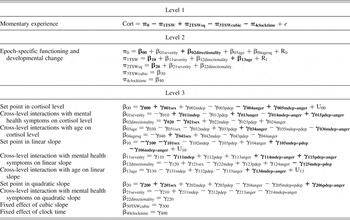
As described in detail below and shown in Table 1, the present study uses a three-level HLM. First, the total variance in HPA activity (cortisol levels and diurnal rhythms) is parsed into the percentages uniquely (i.e., independently) attributable to situation-specific fluctuations (due to unmeasured contextual forces or momentary experience within any given day; Level 1), which is then distinguished from the two components of primary interest: epoch-specific, and developmental change over assessment periods (Level 2), and traitlike (Level 3). Next, other “dynamic,” or epoch-specific, predictors (age, quadratic age, and children's mental health symptom severity and directionality at each assessment period) are included in Level 2; and other “fixed,” or traitlike, predictors (child sex, the three types of ELS, and all two-way multiplicative ELS interactions) are included in Level 3. Finally, cross-level interactions of ELS (Level 3) with mental health symptoms (Level 2) are included.
Illustration of the three levels of the hierarchical linear model

Note: Significant coefficients in the final model are denoted in bold.
Level 1: Distinguishing HPA axis diurnal rhythm and separating situation-specific HPA axis fluctuations
Level 1 examines each single cortisol measure (N = 9,144; maximum of 9 samples/assessment and four assessment periods; on average participants provided 25 samples each). Beyond situation-specific fluctuations within a day, the diurnal rhythm is the largest influence on a single cortisol sample at Level 1. To distinguish situation-specific variability and the diurnal rhythm, Level 1 includes Time (in hours) Since Waking (TSW) as a random predictor of cortisol levels. The diurnal slope is steeper in the morning than in the afternoon. Therefore, curvature of the slope is modeled with (fixed) quadratic and cubic terms although they are not outcomes of interest. TSW holds the advantage of centering the slope on the individual's biorhythm, but there are also extrinsic influences on the circadian rhythm (Shirtcliff & Essex, Reference Shirtcliff and Essex2008). To model that samples taken later in the day may be lower, we include a fixed predictor of “clock time” (i.e., Time Since Noon, residualized from TSW to prevent multicollinearity).
Level 2: Distinguishing epoch-specific HPA axis functioning, development across assessments, and covariation with mental health symptoms
The growth curve model simultaneously includes a Level 2 hierarchy that captures cortisol measures within each assessment period (N = 1041; maximum of four assessment periods per person). Both cortisol levels and rhythms (distinguished in the Level 1 model) are outcomes of interest at each assessment period using a slopes-as-outcomes approach. To examine the developmental trajectory of HPA axis maturation across assessment periods, age since school entry is a fixed predictor of cortisol level and its rhythm. A fixed quadratic term of age is included to test if growth across the 6-year period of childhood into adolescence is nonlinear (Schreiber et al., Reference Schreiber, Shirtcliff, Van Hulle, Lemery-Chalfant, Klein and Kalin2006).
Most important for the present analyses, at each of the four assessments, concurrent mental health symptom severity and directionality are included as predictors of children's morning cortisol level and diurnal slope, thereby capturing whether HPA functioning and mental health symptoms covary concurrently (i.e., a covaried rate of change model; Coe, Lubach, & Shirtcliff, Reference Coe, Lubach and Shirtcliff2007). Because age and quadratic age are simultaneously modeled, significant associations between HPA functioning and mental health symptoms indicate covariation beyond developmental effects. This component is notable because mental health symptoms are allowed to be dynamic and time sensitive, covarying with epoch-specific HPA functioning over time. This fits with the allostatic process of “maintaining stability through change” (McEwen, Reference McEwen1998). Like other stress- or health-related outcomes (Koob & Le Moal, Reference Koob and Le Moal2008a, Reference Koob and Le Moal2008b; Weems & Carrion, Reference Weems and Carrion2009), the episodic changes in mental health symptoms may place the individual in an allostatic state that requires counterregulatory opponent HPA axis processes to help restore functioning at the individual's established set point.
Level 3: Distinguishing traitlike HPA axis functioning and the influence of early life stress
The third level of the hierarchy distinguishes a single estimate of morning cortisol level and diurnal rhythm for each individual that is traitlike across all four assessment periods (N = 357). In addition to child sex, the three types of ELS are included as predictors of children's traitlike morning cortisol level and diurnal slope. The three two-way interactions between the ELS measures (Maternal Depression × Paternal Depression, Maternal Depression × Family Expressed Anger, Paternal Depression × Family Expressed Anger) are also tested as predictors of traitlike HPA functioning, and if significant, remain in the model. Results from the Level 3 analyses address the first research question, that is, whether ELS has long-term effects on traitlike cortisol levels and diurnal rhythms across childhood and into adolescence. This fits within an allostasis framework by considering the long-term effects of ELS on the development of individual's traitlike cortisol, and the “wear and tear” on the body associated with sustained hyper- or hypocortisolism (Gunnar & Quevedo, Reference Gunnar and Quevedo2007; McEwen, Reference McEwen1998).
Cross-level interactions
The second major research question is addressed with cross-level interactions, which consider whether the covariation of epoch-specific HPA functioning and concurrent mental health symptoms (“dynamic” factors at Level 2) are influenced by ELS (a “fixed” factor at Level 3), that is, interactions of ELS and mental health symptoms predicting HPA functioning. Other cross-level interactions captured whether ELS influences the development of the HPA axis across the four assessments (interaction of ELS × Age). Overall, these cross-level interactions were designed to capture how the influence of ELS on HPA functioning can dynamically unfold years later. This fits within an allostasis framework by (a) allowing for the process of maintaining stability through change—in this case, epoch-specific HPA alterations occurring over time in tandem with mental health symptoms—to be different depending on ELS; and (b) considering effects of ELS on individuals' patterns of HPA axis–mental health symptom covariation, and the “wear and tear” on the body associated with repeated HPA alterations to episodic challenges (McEwen, Reference McEwen1998).
Results
Descriptive statistics
Average depression symptom scores for both mothers and fathers across the infancy and preschool periods (five assessments) ranged from 0 to 30 (maternal depression: M = 6.73, SD = 5.21; paternal depression: M = 8.34, SD = 6.01). For mothers, 5% had average scores of 16 or higher, indicating clinically significant levels of symptoms on average across the infancy and preschool periods, and another 9% had average scores above 12, indicating subthreshold levels of depression symptoms; for fathers, 11% had average scores of 16 or higher, and another 12% had average scores above 12. Because family expressed anger is a standardized composite measure of three components, descriptive statistics are limited to each separate component. Average marital conflict ranged from 1 to 4 for mothers (M = 1.40, SD = 0.48) and fathers (M = 1.51, SD = 0.52); preschool anger expression ranged from 3 to 45 for mothers (Mdn = 21, SD = 7.6) and 2 to 43 for fathers (Mdn = 21, SD = 7.7); and preschool negative family expressiveness ranged from 20.5 to 68.2 for mothers (M = 41.9, SD = 9.1) and 19 to 64.2 for fathers (M = 39.6, SD = 8.7). On average, 10% of mothers and 18% of fathers reported marital conflict across the infancy and preschool periods; 10% of mothers and 8% of fathers reported difficulties controlling anger; and 20% and 12%, respectively, reported negative family expressiveness.
The HLM analyses provide descriptive statistics for cortisol's morning levels, diurnal rhythms, and developmental changes. Level 1 results showed that morning cortisol levels were lower as the day progressed (β = −0.02, p = .0001 for linear); significant quadratic and cubic terms indicated this diurnal decline was steeper in the morning than afternoon (β = 0.001, p = .0001 for quadratic; β = −0.00003, p = .0001 for cubic). Samples collected later in the day were lower than samples collected earlier in the day (β = −0.005, p = .0001 for “clock time”). Level 2 results showed that morning cortisol and the diurnal rhythm showed substantial developmental changes across the four assessments from age 9 to 15 years. Cortisol level declined as children grew older (β = −0.006, p = .025) but this was modified by quadratic age (β = 0.0003, p = .038) such that cortisol levels were lowest when children were age 13 and increased again by age 15. In parallel, cortisol's diurnal rhythm flattened as children matured (β = 0.0004, p = .0001). There was no effect of quadratic age on cortisol's slope, so it was removed from further analyses of slope.
In addition to these developmental effects, we also found that child sex influenced nearly every component of HPA functioning. Compared to boys, girls had higher morning cortisol levels (β = 0.038, p = .019), steeper slopes (β = −0.002, p < .0001), and more curvature to their slopes (β = 0.0001, p < .004). Girls also showed stronger developmental changes in HPA functioning (Level × Age, β = −0.009, p = .042, Level × Quadratic Age, β = 0.0008, p = .016). Thus, gender is included as a control variable at Level 3 in all subsequent models.
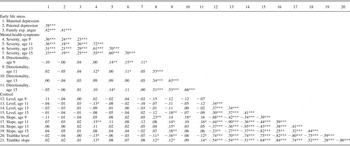
Bivariate associations
Table 2 shows that there were small to moderate significant associations among the three types of ELS, and between each type of ELS and children's later mental health symptom severity; there were no associations of ELS with mental health symptom directionality. In addition, there were no significant associations of ELS with children's HPA functioning. However, there were numerous, but small, significant associations of children's mental health symptom severity, and especially directionality, with children's HPA functioning.
Pearson correlations among variables

*p < .05. **p < .01. ***p < .001.
Influence of ELS on traitlike HPA axis functioning and its development
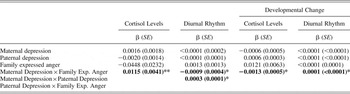
Table 3 presents results of the Level 3 and cross-level analyses addressing the first major research question regarding the long-term influence of ELS on children's traitlike HPA functioning and developmental changes from ages 9 to 15 years. There were no significant main effects of ELS (maternal depression, paternal depression, or family expressed anger) on traitlike morning cortisol level, diurnal rhythm, or developmental changes in cortisol level or slope. There were, however, significant interaction effects, and especially, broad effects of the interaction of early Maternal Depression × Family Expressed Anger on traitlike morning cortisol level and slope as well as their developmental changes.
Hierarchical linear model predicting traitlike cortisol levels and diurnal rhythm, and developmental change in cortisol levels and diurnal rhythm from early life stress exposures

Note: All models controlled for child sex, as well as quadratic age on cortisol levels. Nonsignificant interaction terms were dropped from the final models.
*p < .05. **p < .01.
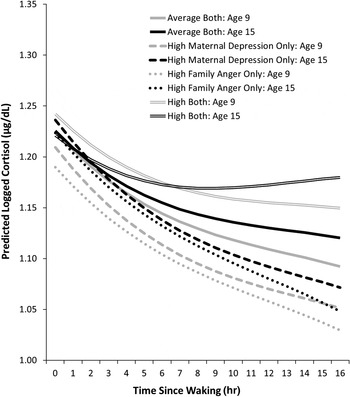
Figure 1 illustrates these Maternal Depression × Family Expressed Anger interaction effects by comparing the effects of exposure to average levels of both types of ELS (solid lines) with the effects of exposure to high levels of early maternal depression only (dashed lines), family expressed anger only (dotted lines), or both types of ELS (double lines); to simplify the presentation, only the age 9 (gray lines) and age 15 (black lines) effects are shown because the developmental change was linear. At age 9, children exposed to average levels of both types of ELS showed moderately high traitlike morning cortisol levels that did not change substantially as they grew older; their diurnal slopes were moderately steep and became flatter with age. In comparison, at age 9, children who had been exposed only to high levels of maternal depression or family expressed anger showed lower traitlike morning cortisol levels but increases in levels as they grew older such that by age 15, their cortisol levels were comparable to those of the children exposed to average levels of ELS; their diurnal slopes were steeper and did not change substantially as they grew older. In contrast, at age 9, children exposed to high levels of both types of ELS showed the highest traitlike morning cortisol levels, which decreased as they grew older such that by age 15, their cortisol levels also were comparable to those of the other children; their diurnal slopes were relatively flat and continued to flatten with age such that by age 15, they exhibited a very flat daytime rhythm.
The overall group comparison of and developmental changes in traitlike cortisol level and diurnal rhythm by early life exposure to maternal depression and/or family expressed anger. Because the developmental change was linear, the age 11 and age 13 effects are omitted and only age 9 (gray) and age 15 (black) are shown.

In addition to broad effects of the interaction of Maternal Depression × Family Expressed Anger on traitlike cortisol, results revealed a single modest (p = .04) effect of Maternal Depression × Paternal Depression on children's traitlike diurnal rhythm (not illustrated in a figure). Children exposed only to early maternal depression evidenced flatter slopes, children exposed only to early paternal depression evidenced steeper slopes, and children exposed to both types of ELS evidenced slopes comparable to the children with average stress exposure.
Influence of ELS on the covariation of epoch-specific HPA axis functioning and concurrent mental health symptoms
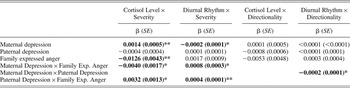
Table 4 presents results of the Level 2 and cross-level analyses addressing the second major research question regarding the influence of ELS on the covariation of epoch-specific HPA functioning with children's concurrent mental health symptoms. Results revealed numerous significant main and interactive effects of ELS on the covariation of HPA functioning and symptom severity, with a single modest effect involving symptom directionality.
Hierarchical linear model predicting the interaction of epoch-specific cortisol levels/diurnal rhythm and mental health symptom severity/directionality from early life stress exposures

Note: All models controlled for child sex, as well as quadratic age on cortisol levels. Nonsignificant interaction terms were dropped from the final models.
*p < .05. **p < .01.
There were significant main effects of maternal depression and family expressed anger on the covariation of mental health symptom severity with epoch-specific morning cortisol level and, for maternal depression, diurnal rhythm (the effect for family expressed anger was only marginally significant, p = .062). Overall, children exposed to early maternal depression showed increases in morning cortisol levels and steeper slopes at assessments when they were experiencing increased mental health symptom severity, and decreases in morning cortisol levels and flatter slopes at assessments when they were experiencing decreased symptom severity. In contrast, children exposed to early family expressed anger showed the opposite patterns, with decreases in morning cortisol levels and flatter slopes occurring concurrently with increased mental health symptom severity, and increases in morning cortisol levels and steeper slopes occurring concurrently with decreased symptom severity.
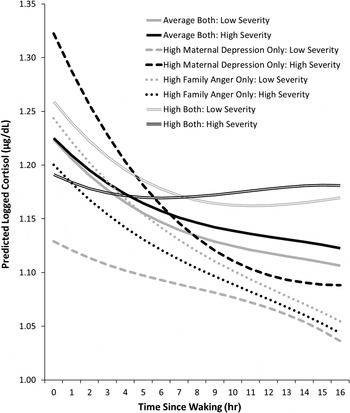
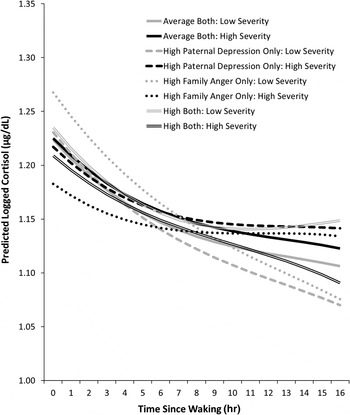
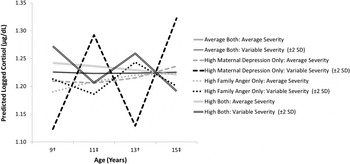
There were also significant interaction effects, especially effects of Maternal Depression × Family Expressed Anger and Paternal Depression × Family Expressed Anger on the covariation of morning cortisol level and diurnal rhythm with mental health symptom severity. Because results are complicated, we simplified their graphical presentation. Figure 2 illustrates the effects of Maternal Depression × Family Expressed Anger; Figure 3 illustrates the effects of Paternal Depression × Family Expressed Anger. Each figure compares the effects on cortisol's morning level and diurnal rhythm of exposure to average levels of both types of ELS (solid lines) with the effects of exposure to high levels of early parental depression only (dashed lines), family expressed anger only (dotted lines), or both types of ELS (double lines). For each type of line, the black version indicates cortisol's level and slope associated with increased mental health symptom severity (plotted at 2 SD above the mean); the gray version indicates cortisol's level and slope associated with decreased symptom severity (plotted at 2 SD below the mean). To reduce the complexity of the figures, the average level of symptom severity is not plotted; the average lines, which represent individual's basal HPA functioning, would simply fall halfway between each pair of black and gray lines. In addition, because there are no differences in the patterns of covariation by age, we present only the results for age 15. However, such a presentation does not adequately present the alterations, or swings, in HPA activity that occur over time in conjunction with increases or decreases in children's mental health symptoms. Thus, Figure 4 illustrates this allostatic process for children exposed to early maternal depression and/or family expressed anger, focusing on cortisol's morning levels and using a hypothetical example in which mental health symptoms alternately increase and decrease from assessment to assessment, beginning with decreased symptoms at age 9.
The overall group comparison at age 15 of epoch-specific cortisol level and diurnal rhythm by concurrent mental health symptom severity and early life exposure to maternal depression and/or family anger. For clarity of presentation, comparison lines for group effects at average levels of mental health symptom severity are omitted. Results did not differ by age, so age 15 is shown as a representative example.

The overall group comparison at age 15 of epoch-specific cortisol level and diurnal rhythm by concurrent mental health symptom severity and early life exposure to paternal depression and/or family expressed anger. For clarity of presentation, comparison lines for group effects at average levels of mental health symptom severity are omitted. Results did not differ by age, so age 15 is shown as a representative example.

An illustration of the covariation in traitlike morning cortisol levels and mental health symptom severity over time by early life exposure to maternal depression and/or family expressed anger. Cortisol levels at average symptom severity are shown (in gray) for comparison purposes. The illustrative lines (black) show cortisol levels for the high ELS groups when symptom severity is set at 2 SD below the mean (dagger, ages 9 and 13) or symptom severity is set at 2 SD above the mean (double dagger, ages 11 and 15).

As illustrated in Figure 2 and Figure 3, children exposed to average levels of ELS (solid lines) showed very small alterations in HPA functioning with increases or decreases (high vs. low severity, respectively) in mental health symptoms. There were no substantial changes in morning cortisol levels; and diurnal rhythms were slightly flatter during times of increased symptom severity (solid black line) and slightly steeper during times of decreased symptom severity (solid gray line). In contrast, children exposed to either or both types of ELS showed wider swings in HPA activity, especially morning levels. Further, there were differences in the direction of the covariation of HPA functioning with mental health symptom severity depending on the type and combination of ELS.
As shown in Figure 2, children exposed only to maternal depression (dashed lines) showed the widest swings in HPA activity, especially morning cortisol levels (see also Figure 4), in correspondence with increases or decreases in mental health symptom severity. They showed the highest morning cortisol levels and the steepest slopes (dashed black line) at assessments when they were experiencing increased symptom severity, and the lowest morning cortisol level and the flattest slopes (dashed gray line) at assessments when they were experiencing decreased symptom severity. In contrast, children exposed only to family expressed anger (dotted lines) showed the opposite pattern, with narrower swings in HPA activity, especially morning cortisol levels (see also Figure 4). They showed decreases in morning cortisol levels and flatter slopes (dotted black line) at assessments when they were experiencing increased symptom severity, and higher cortisol levels and steeper slopes (dotted gray line) at assessments when they were experiencing decreased symptom severity. Children exposed to both types of ELS (double lines) showed a similar general pattern of covariation as those exposed only to family expressed anger; in addition, at assessments when they were experiencing increased symptom severity, their morning cortisol levels and slopes decreased to the point that they exhibited a very flat daytime rhythm.
As shown in Figure 3, the interaction of Paternal Depression × Family Expressed Anger reveals a different pattern. With one exception, children exposed to one or both of these types of ELS showed similar patterns, with the widest swings in HPA activity shown by children exposed only to family expressed anger. Specifically, children exposed to either paternal depression or family expressed anger showed decreases in morning cortisol levels and flatter slopes at assessments when they were experiencing increased mental health symptom severity (black lines) and increases in cortisol levels and steeper slopes at assessments when they were experiencing decreased symptom severity (gray lines). Children exposed to both types of ELS (double lines) also showed this pattern of change in morning cortisol levels; however, unlike the children exposed to only one type of ELS, those exposed both to paternal depression and family expressed anger showed steeper slopes at assessments when they were experiencing increased symptom severity and flatter slopes when they were experiencing decreased symptom severity.
Finally, there was a modest (p = .04) interaction involving mental health symptom directionality (not illustrated in a figure). The interaction of Maternal Depression × Paternal Depression influenced the covariation of symptom directionality with cortisol's diurnal rhythm. Children who were exposed to average levels of both types of ELS showed a modest flattening of the slope at assessments when they were experiencing a preponderance of externalizing symptoms, and a modest increase in the slope at assessments when their symptom profile shifted to a preponderance of internalizing symptoms. In comparison, children exposed to either early maternal depression or paternal depression showed similar, but stronger, patterns. In contrast, children who were exposed to both types of ELS showed steeper slopes during times they were experiencing a preponderance of externalizing symptoms and flatter slopes during times when their symptom profile shifted to a preponderance of internalizing symptoms.
Discussion
We investigated the influences of multiple types of ELS representing day-to-day detriments in the early caretaking environment (maternal depression, paternal depression, and family expressed anger) on later HPA functioning and its covariation with mental health symptoms across a 6-year period from childhood into adolescence. Consistent with an allostasis framework, which emphasizes the establishment of stable HPA functioning and the maintenance of that stability through change, we distinguished the traitlike component of HPA functioning from the epoch-specific HPA component that covaries with episodic challenges, in this case, periodic increases in children's mental health symptoms. Overall, results supported our hypotheses that ELS influences traitlike cortisol and its development as well as the covariation of epoch-specific cortisol with children's concurrent mental health symptoms. Consistent with previous findings (Gunnar & Quevedo, Reference Gunnar and Quevedo2007; Knutsson et al., Reference Knutsson, Dahlgren, Marcus, Rosberg, Bronnegard and Stierna1997), children exposed to typical levels of ELS showed moderately high traitlike morning cortisol with moderately steep slopes across the day, and modest developmental change from age 9 to 15. These children similarly showed very modest swings in HPA activity around their traitlike basal functioning concurrent with episodic increases in mental health symptom severity. In comparison, children exposed to higher levels of any of the three types of ELS evidenced alterations (varying in nature according to the type of ELS) in traitlike morning cortisol and diurnal rhythm, and greater developmental alterations from ages 9 to 15 years. Further, they evidenced substantially wider swings in epoch-specific HPA activity around their basal functioning concurrent with increases or decreases in mental health symptom severity across the four assessment periods.
Our investigation extends previous research demonstrating that ELS has profound effects on children's HPA axis (reviewed in Gunnar & Vasquez, Reference Gunnar, Vasquez, Cicchetti and Cohen2006; Trickett et al., Reference Trickett, Negriff, Ji and Peckins2011) by taking a longer term prospective approach and distinguishing alterations in the traitlike component of HPA activity associated with basal functioning and its development from alterations related to the component that regulates responses to challenges. As part of the allostatic process (McEwen, Reference McEwen1998), the HPA axis operates at an optimal level with efficient recovery from challenges, as illustrated here by the patterns of HPA functioning shown by children exposed to typical levels of ELS. However, patterns shown by children exposed to higher levels of ELS result in HPA alterations (either heightened or blunted) which are (a) sustained over time as traitlike levels and rhythms and (b) show wider swings above and below the individual's traitlike basal level. The additional energy required to regulate and counterregulate these sustained alterations in traitlike HPA functioning as well as the repeated alterations associated with the episodic challenge of increased mental health symptoms may contribute, both separately and jointly, to the “wear and tear” on the body, eventually culminating as allostatic load (Lupien et al., Reference Lupien, Ouellet-Morin, Hupbach, Tu, Buss, Walker, Cicchetti and Cohen2006).
The results of this investigation highlight the cumulative effects of multiple types of ELS on HPA functioning and development across the transition from childhood into adolescence. We found that cumulative exposure to early maternal depression and family expressed anger is particularly influential in defining children's traitlike basal HPA functioning. Compared to children exposed to typical levels of these two types of ELS, children exposed to high levels of only one—either maternal depression or family expressed anger—evidenced lower traitlike morning cortisol and steeper slopes at age 9, with increases in morning levels over time such that by age 15, they evidenced comparable morning levels with lower levels across the remainder of the day. In contrast, children exposed to both types of ELS evidenced the highest morning cortisol and the flattest slopes at age 9, with decreases in morning levels and a continued flattening of the slope such that by age 15, they showed a pattern of increasing dysregulation of traitlike HPA functioning characterized by a very flat daytime rhythm (i.e., comparable morning levels with a lack of the typical decline across the day). The sustained HPA activation across the day shown by children exposed to multiple types of ELS is consistent with the pattern found in other studies of cumulative stress (Evans, Reference Evans2003; Flinn & England, Reference Flinn and England1995). In addition, the longitudinal findings extend this work to suggest that, as part of an allostatic process, the wear and tear associated with sustained HPA activation may result over time in a downregulation of HPA functioning (Miller et al., Reference Miller, Chen and Zhou2007). Because we investigated this allostatic process only into early adolescence, it is not clear if the trajectory of downregulation continues into adulthood. However, the findings suggest that the pattern of hypercortisolism often found in studies of maltreated children compared with the pattern of hypocortisolism often found in adults exposed to early maltreatment (Miller et al., Reference Miller, Chen and Zhou2007) may partly reflect a continuation of the developmental process identified in this study.
The present results also contribute to our understanding of the roles of ELS in defining the later covariation of children's HPA functioning with mental health symptoms. Across all children, there was little evidence that HPA functioning was coupled with mental health symptoms. However, in addition to the cumulative effects of exposure to early maternal depression and family expressed anger on traitlike HPA functioning, children exposed to both types of ELS showed a further blunting of HPA activity when faced with the episodic challenge of increased mental health symptoms. In addition, we found domain-specific effects of each type of ELS. Children exposed only to early maternal depression showed an upregulation in HPA activity with concurrent increases in symptom severity and a downregulation with concurrent decreases in symptom severity. They also showed the widest swings in HPA activity (especially morning cortisol levels) around their basal functioning concurrent with increases and decreases in symptom severity. In contrast, children exposed only to family expressed anger showed a downregulation in HPA activity with concurrent increases in symptom severity and an upregulation with concurrent decreases in symptom severity. Other analyses showed that children exposed only to early paternal depression showed the same pattern of downregulation in HPA activity with increases in symptom severity as that shown by children exposed to family expressed anger. Similar to other stress- or health-related outcomes (Koob & Le Moal, Reference Koob and Le Moal2008a; Weems & Carrion, Reference Weems and Carrion2009), increases in mental health symptoms may create an allostatic state requiring the counterregulatory opponent process (i.e., swings) of the HPA axis to aid in reestablishing functioning at basal levels. Although speculative, it is possible that the allostatic state may, over time, reset physiological set points if mental health problems are persistent or recurrent (Koob & Le Moal, Reference Koob and Le Moal2001, Reference Koob and Le Moal2008b).
Our findings extend previous research that examines children's current psychiatric status as a moderator of the association of ELS with alterations in HPA functioning (Ashman et al., Reference Ashman, Dawson, Panagiotides, Yamada and Wilkinson2002; Cicchetti et al., Reference Cicchetti, Rogosch, Gunnar and Toth2010; Tarullo & Gunnar, Reference Tarullo and Gunnar2006) in two major ways. First, the findings document that HPA activity and mental health symptoms covary over time, reframing the question to consider ELS as the moderator of those patterns of covariation, or coregulation. The expression of mental health symptoms may bring an additional stressor to the system (Ruttle et al., Reference Ruttle, Shirtcliff, Serbin, Ben-Dat Fisher, Stack and Schwartzman2011). It is also likely that cortisol and mental health symptoms work in a bidirectional manner, with each functioning in relation to the other, and possibly exacerbating the other. Second, different types of ELS have unique effects on the covariation of HPA functioning with mental health symptoms. It is notable that there are domain-specific effects only on the covariation of HPA functioning with mental health symptoms, and not on traitlike HPA functioning. This suggests that very early in life, prior to the development of children's cognitive and emotion regulation strategies, it is the accumulation or severity of ELS that most prominently influences the establishment of traitlike HPA functioning. However, as children grow older, they develop cognitive and emotion regulation strategies associated with exposure to each type of ELS (Cummings & Davies, Reference Cummings and Davies2002; Goodman & Gotlib, Reference Goodman and Gotlib1999) and, with repeated exposure, may establish preferential patterns of cognitions and emotions that might underlie the differential calibrations of the HPA axis we see when children are faced with the episodic challenge of increased mental health symptoms.
The patterns of differential calibration of the HPA axis to concurrent mental health symptoms found in this investigation are consistent with previous theory and research on the cognitions and emotions, as well as HPA activity, associated with exposure to maternal depression versus family-expressed anger. The wide swings in HPA activity in association with increases in symptom severity that were shown by children exposed to early maternal depression may reflect the potency of maternal care in the early caretaking environment. According to parental investment theory (Bjorklund & Kipp, Reference Bjorklund and Kipp1996), it is evolutionarily adaptive for a child to be emotionally, physiologically, and behaviorally attuned to the mother. This bond begins physically during pregnancy and through the infancy period (Uvnäs-Moberg, Arn, & Magnusson, Reference Uvnäs-Moberg, Arn and Magnusson2005) and continues throughout early development as children calibrate their development to the mother's emotional and social cues. The upregulation of HPA activity shown by children of depressed mothers when faced with increased symptom severity is consistent with a substantial literature demonstrating increased HPA responsivity in animals as well as human children exposed to deficits in early maternal caretaking (Gunnar & Quevedo, Reference Gunnar and Quevedo2007; Meaney & Szyf, Reference Meaney and Szyf2005; Sanchez, Reference Sanchez2006). These effects are mediated by deficits in mother–child interactions and consequent insecure attachments. When mothers are depressed, they exhibit deficits in communication, sensitivity, and attunement (Hwa-Froelich, Cook, & Flick, Reference Hwa-Froelich, Cook and Flick2008; Murray, Fiori-Cowley, Hooper, & Cooper, Reference Murray, Fiori-Cowley, Hooper and Cooper1996; Trampolini, Ungerer, & McMahon, Reference Trampolini, Ungerer and McMahon2008), which impair the mother–child attachment relationship and negatively influence the child's cognitive representations of the self and parents (Toth et al., Reference Toth, Rogosch, Sturge-Apple and Cicchetti2009). Less secure attachments to caregivers and more negative cognitive representations of self and others are associated with the development of less successful emotional- and self-regulatory strategies across childhood (Calkins & Hill, Reference Calkins, Hill and Gross2007; Crugnola et al., Reference Crugnola, Tambelli, Spinelli, Gazzotti, Caprin and Albizzati2011; Kochanska, Philibert, & Barry, Reference Kochanska, Philibert and Barry2009) that, in turn, impact the way in which physiological processes are regulated (Fox & Calkins, Reference Fox and Calkins2003). In contrast, the downregulation of HPA activity shown by children exposed to family expressed anger when they confront episodic increases in mental health symptom severity is consistent with studies showing that perceptions of uncontrollability are associated with lower morning cortisol, and perceptions of physical threat are associated with flatter cortisol slopes across the day (Miller et al., Reference Miller, Chen and Zhou2007). Parental anger and conflict has been associated with children's cognitive perceptions of threat and self-blame (Grych, Fincham, Jouriles, & McDonald, Reference Grych, Fincham, Jouriles and McDonald2000), perceptions moderated by levels of family cohesiveness (Lindahl & Malik, Reference Lindahl and Malik2011). Further, children exposed to contrived laboratory adult conflicts typically recognize and experience greater anger, sadness, and fear when faced with escalating conflict or conflicts about children (Koss et al., Reference Koss, George, Bergman, Cummings, Davies and Cicchetti2011; Pollak, Messner, Kistler, & Cohn, Reference Pollak, Messner, Kistler and Cohn2009), situations likely to be perceived as less controllable by the child.
Notably, our findings suggest that exposure to maternal versus paternal depression represent very different experiences for the child's psychobiology, possibly because paternal depression is more phenotypically similar to family expressed anger than to maternal depression. While females tend to display the more “classic” symptoms of depression including depressed mood, feelings of worthlessness, and social withdrawal, males with depression typically display higher levels of emotional restriction, aggression, and irritability (Brownhill, Wilhelm, Barclay, & Schmied, Reference Brownhill, Wilhelm, Barclay and Schmied2005; Winkler, Pjrek, & Kasper, Reference Winkler, Pjrek and Kasper2005). Given that children may experience the phenomenon of paternal depression in terms of increased levels of threat, children exposed to paternal depression may evidence patterns of HPA–mental health covariation similar to those displayed by children exposed to family expressed anger.
When interpreted within an allostasis framework, the results highlight the trade-offs of adaptive processes that permit an individual to meet the demands of their environment. Recent models of biological sensitivity to context (BSC; Boyce & Ellis, Reference Boyce and Ellis2005; Ellis, Essex, & Boyce, Reference Ellis, Essex and Boyce2005) and its extension to adaptive calibration (Del Giudice, Ellis, & Shirtcliff, Reference Del Giudice, Ellis and Shirtcliff2011) postulate that neurological and neuroendocrine systems reorganize and adapt to contextual and physiological perturbations. However, when individuals must adapt to a stressful environment, the alterations in HPA activity can incur a cost, promoting a degeneration of functioning and a cascade of change leading to differential developmental trajectories as maturation occurs (Cicchetti & Curtis, Reference Cicchetti, Curtis, Cicchetti and Cohen2006).
According to the adaptive calibration model (Del Giudice et al., Reference Del Giudice, Ellis and Shirtcliff2011), there are profiles of children (along a continuum) defined by the level of their biological sensitivity to context. The first profile describes children who are biologically sensitive (high BSC), and thus, have an enhanced ability to encode and attend to salient social information. In a low stress environment, they are largely protected from physiological costs of such sensitivity and incur many benefits of being calibrated, or open, to positive social and emotional cues (e.g., empathy and prosocial behavior; Shirtcliff et al., Reference Shirtcliff, Vitacco, Graf, Gostisha, Merz and Zahn-Waxler2009). Our prior work distinguished large numbers of such sensitive youth within the Wisconsin Study of Families and Work (Ellis et al., Reference Ellis, Essex and Boyce2005); and in the present investigation, the HPA functioning of children exposed to typical levels of ELS is suggestive of this profile. Their moderate traitlike basal levels and diurnal rhythms, and moderate developmental trajectory suggest that their HPA axis maintained flexibility to change rhythmically across a day and to develop slowly across adolescence. The maintenance of flexibility, variability, and rhythmicity in HPA functioning are important healthy allostatic components (McEwen & Wingfield, Reference McEwen and Wingfield2003). Further, when the challenge of mental health symptoms arise, sensitive children efficiently return to basal levels likely because they are physiologically open to the protective resources in their environment and use these environmental resources to their benefit to overcome mental health symptoms.
The second profile describes children who are exposed to moderate stress—here, only to maternal depression or family expressed anger—who adapt by developing “buffered” traitlike HPA functioning (low BSC). This permits them to be less attentive or focused on their environment, thereby minimizing costs associated with moderate chronic stress beginning very early in life. Children exposed to a single type of ELS demonstrated somewhat lower traitlike cortisol levels with moderately steep diurnal rhythms; across development, cortisol levels became somewhat higher but remained lower across most of the day. The most striking finding was that the coupling of HPA functioning with mental health symptoms was much tighter for these children, especially those exposed only to early maternal depression, and the direction of covariation was dependent on the type and combination of ELS. This suggests that although children exposed to moderate ELS may develop a buffered pattern of traitlike HPA functioning for dealing with chronic stressors, they remain very responsive at least to the episodic challenge of increased mental health symptom severity. Because previous studies have not distinguished the traitlike component of HPA functioning from the epoch-specific component in a long-term prospective design, the meaning of these findings is unclear. It may be that because mental health symptoms reflect, in part, an individual's cognitive and emotional biases developed earlier in life, the tight and domain-specific patterns of covariation of symptoms and HPA function reflect differences in exposure to maternal depression versus family expressed anger, as discussed above. It is notable, however, that despite the apparent allostatic state of the HPA axis during times of increased mental health symptoms, the HPA axis of youth experiencing a single type of ELS appears to be able to maintain diurnal rhythmicity and flexibility to change across development and manage mental health symptoms. When necessary, buffered youth have the physiological resources to cope with challenges.
The third profile appears physiologically similar to the “sensitive” profile, but the costs of maintaining a high BSC are keenly apparent when these children live in a high stress environment—here, both types of ELS. It is adaptive for children exposed to higher levels of stress to be vigilant and sensitive to contextual cues. High traitlike basal cortisol, which we observed, enhances attention to dangerous or unpredictable stimuli, with some physiological trade-offs. Most strikingly, however, our results show that children exposed to multiple forms of ELS evidenced flattened diurnal rhythms as early as age 9, and their diurnal rhythm became progressively flatter across development, and flatter still when mental health symptoms increased. These results suggest that the high sensitivity to environmental cues in high ELS children might increase their stress vulnerability primarily by dysregulating the diurnal rhythm. Flexibility and rhythmicity are important tenets of allostatic processes (McEwen, Reference McEwen1998). Cortisol's diurnal rhythm captures the confluence of intrinsic, biological forces with extrinsic, environmental forces working in concert within an individual on a daily cycle. Individuals exposed to multiple forms of ELS may evidence flattened diurnal rhythms because they are struggling to match their intrinsic physiological set points with their contextual demands (Skinner, Shirtcliff, Haggerty, Coe, & Catalano, Reference Skinner, Shirtcliff, Haggerty, Coe and Catalano2011). This mismatch of intrinsic and extrinsic forces occurs on a daily cycle and appears to steadily worsen with time over the course of development and during times of increased mental health symptom expression. Thus, prolonged exposure to the cumulative effects of maternal depression and family expressed anger, and the addition of later mental health challenges, likely exerts “wear and tear” on the system, resulting in a downregulation of HPA functioning over time (Ruttle et al., Reference Ruttle, Shirtcliff, Serbin, Ben-Dat Fisher, Stack and Schwartzman2011; Weems & Carrion, Reference Weems and Carrion2007, Reference Weems and Carrion2009). For high BSC youth from a stressful environment, the cost of vigilance may culminate in a loss of both flexibility and rhythmicity. By exploring the effect of ELS degree and type on HPA functioning and the coupling of HPA functioning with mental health symptoms, we have made strides toward elucidating the unique processes by which typical functioning becomes atypical.
These findings must be considered in light of several potential limitations to inform future research. First, the possibility of a sampling bias within this population, and the nonrepresentativeness of this sample of the larger US population, must be kept in mind, especially regarding the range of ELS. This sample represents largely middle class, White, and, at least at the outset, intact families in a Midwestern state. However, we emphasize that our findings regarding the importance of considering multiple types of ELS and children's concurrent psychiatric status support recent work with maltreated children (e.g., Cicchetti et al., Reference Cicchetti, Rogosch, Gunnar and Toth2010), and extend it downward to more normative variations in ELS, which is an important tenet of developmental psychopathology. Studies of typical and atypical development are mutually informative (Cicchetti, Reference Cicchetti, Rolf, Masten, Cicchetti, Nuechterlein and Weintraub1990; Cicchetti & Sroufe, Reference Cicchetti and Sroufe2000). Conceptually integrating this investigation with the ongoing research of children exposed to early maltreatment has the potential to advance our understanding of a wide range of processes in child development.
Second, although this study examined multiple types of ELS, there are many other types of stressors in the lives of young children that should be considered in future studies. Consistent with a multilevel approach (Cicchetti & Curtis, Reference Cicchetti and Curtis2007; Cicchetti & Rogosch, Reference Cicchetti and Rogosch2007), it is particularly important to consider stressors at other levels of analysis. For example, the effects on children's HPA functioning of the three types of ELS investigated in this study likely operate through deficits in the more intimate qualities of the parent–child relationship and associated attachments (Gunnar & Vasquez, Reference Gunnar, Vasquez, Cicchetti and Cohen2006). At another level, children experience stresses associated with the SES of the family into which they were born. Previous studies have demonstrated that, although SES is associated with maternal depression and family expressed anger, each of these levels of stressors exert independent effects on children's HPA functioning (Davies et al., Reference Davies, Sturge-Apple, Cicchetti, Manning and Zale2009; Essex, Klein, et al., Reference Boyce, Essex, Goldstein, Armstrong, Kraemer and Kupfer2002; Lupien, King, Meaney, & McEwen, Reference Lupien, King, Meaney and McEwen2001). To more fully understand the allostatic process, it is important for future studies to incorporate stressors at multiple levels into longitudinal models of HPA functioning that distinguish unique and joint effects of ELS on HPA axis development from responsivity to the challenges of life.
Third, although this investigation took a multilevel approach, we considered only the HPA axis as one of the several interrelated primary mediators of the allostatic process (Lupien et al., Reference Lupien, Ouellet-Morin, Hupbach, Tu, Buss, Walker, Cicchetti and Cohen2006; McEwen, Reference McEwen1998). Because of the near impossibility of inferring causation within complex developmental systems, it is important to investigate multiple variables and multiple levels of variables simultaneously (Cicchetti & Blender, Reference Cicchetti and Blender2004; Cicchetti & Toth, Reference Cicchetti and Toth2009). Future work should expand the multilevel approach employed in the present investigation to consider the complex interplay of multiple physiological systems (Hastings et al., Reference Hastings, Shirtcliff, Klimes-Dougan, Allison, DeRose, Usher and Zahn-Waxler2011), as well as genetic and epigenetic effects (Gillespie, Phifer, Bradley, & Ressler, Reference Gillespie, Phifer, Bradley and Ressler2009; McCrory et al., Reference McCrory, De Brito and Viding2010), aware that specific stressors may not affect all stress-related systems equally or in the same general direction or at the same time.
Our findings suggest several important implications for children exposed to different types of day-to-day detriments in the early caretaking environment, especially when facing the challenges associated with increases in mental health problems. Clearly, when exposure to ELS begins at birth (if not earlier) and is chronic throughout early childhood (and possibly beyond), it has substantial and long-term effects on children's HPA functioning, suggesting the importance of very early preventive/intervention strategies. In addition, the broad effects of cumulative ELS, especially exposure to early maternal depression and family expressed anger, suggest that multilevel preventive/intervention strategies aimed at reducing maternal depression and promoting more positive family dynamics may be most effective. Given the centrality of early maternal caretaking, the findings also emphasize the importance of supporting mothers during this critical time in children's development. Perhaps most important, by investigating the association of children's HPA functioning with mental health symptoms as an allostatic process, the findings highlight that (a) allostatic states often emerge when children are experiencing increases in symptom severity, (b) the direction of the HPA axis alteration varies according to the child's history of ELS, and (c) children exposed to ELS are most vulnerable to alterations in HPA functioning with increases in mental health symptom severity. Together, these findings make a compelling argument that any strategy aimed at intervening in the allostatic process to reduce the development of allostatic load during childhood and adolescence should consider these issues, and especially the heightened vulnerability of children exposed to ELS when they are experiencing increases in mental health symptoms.