The modern human rights movement is at a critical juncture in its history. It has been nearly seventy years since the creation of the Universal Declaration of Human Rights, and some of the oldest and most active human rights organizations have been operating around the world for about forty years. More than twenty years have passed since the end of the cold war, and the time when people spoke in triumphal terms of the global success of Western values is now a fading memory. International human rights are ensconced as firmly as ever in international law and institutions, but what about the future of the “human rights movement”?
This is a hard question to answer for a number of reasons. One problem is how to define the movement itself. Another is how to characterize its contribution to actual human rights, which would seem a necessary condition for bothering to think about the movement's future. From both ends of the political-ideological spectrum, critical observers have viewed the international human rights movement as irrelevant at best and a dangerous distraction to more important issues, such as peacemaking and economic development, at worst. However, the evidence suggests otherwise. Human rights organizations (HROs) have played a crucial role in documenting the rights landscape and in pressing for improvements.Footnote 1 They have helped to make it almost impossible for governments to assume that violating the physical integrity of their citizens will go unnoticed and without criticism. No one can possibly doubt that human rights continue to be abused in egregious ways around the world, but the movement deserves a lot of credit for keeping rights issues on the world's conscience.
This essay will make three main points. First, the human rights movement is richer and much more complicated than a narrow focus on major Western transnational nongovernmental organizations (NGOs) would suggest. Organizations such an Amnesty International and Human Rights Watch are crucial, but they are not the dominant actors they were in the 1970s or 1980s. This is a positive development, because the success of the movement depends in large part on authentic and locally relevant rights movements throughout the world. Second, the movement has not achieved all of its multifarious (some would say, proliferating) goals, but it has contributed tremendously to the basic-rights chances of many people around the world. Third, despite some significant success, the movement faces challenges of which most activists are already acutely aware. Some of these challenges are external, and others are internal to the movement itself. Strands of the movement face official opposition to their operation, and even existence, from governments reasserting powerful counterclaims of security and state sovereignty. HROs also face internal tensions about how to prioritize specific rights; difficult strategic decisions about how, where, and when to compromise when pragmatism seems necessary; and perennial issues regarding perceived elitism and professionalism of HROs on the one hand and local experience and suffering on the other. These are reminders that there is nothing inevitable, unidirectional, or unanimous about the success of human rights. However, none of these challenges will be fatal, and most strands of the movement are likely to adapt rather than collapse or disintegrate, at least in the foreseeable future.
Defining the “Movement”
The Oxford English Dictionary defines a movement as, “a course or series of actions and endeavors on the part of a group of people working towards a shared goal; an organization, coalition, or alliance of people working to advance a shared political, social, or artistic objective.” It is difficult and probably unnecessary to draw tight parameters around the edges of the human rights movement, but one key element is a sense of shared goals among the actors who participate in it. The core of the human rights movement, therefore, can be characterized as organizations and individuals who are primarily working to advance human rights; while the edges of the movement may also include entities that work to promote rights at any given time, but whose primary focus is elsewhere. Labor movements and professional organizations, for example, may work to advance rights, but their primary focus is on the welfare of their membership. Faith-based organizations may also at times seek to advance human rights, but their central purpose is to practice and sometimes to convert others to their religious tenets. For purposes of empirical work, human rights organizations can be defined as “organized, non-profit, and non-governmental group[s] whose stated goal is to promote one or more of the principles articulated in the Universal Declaration of Human Rights and its associated treaties.”Footnote 2
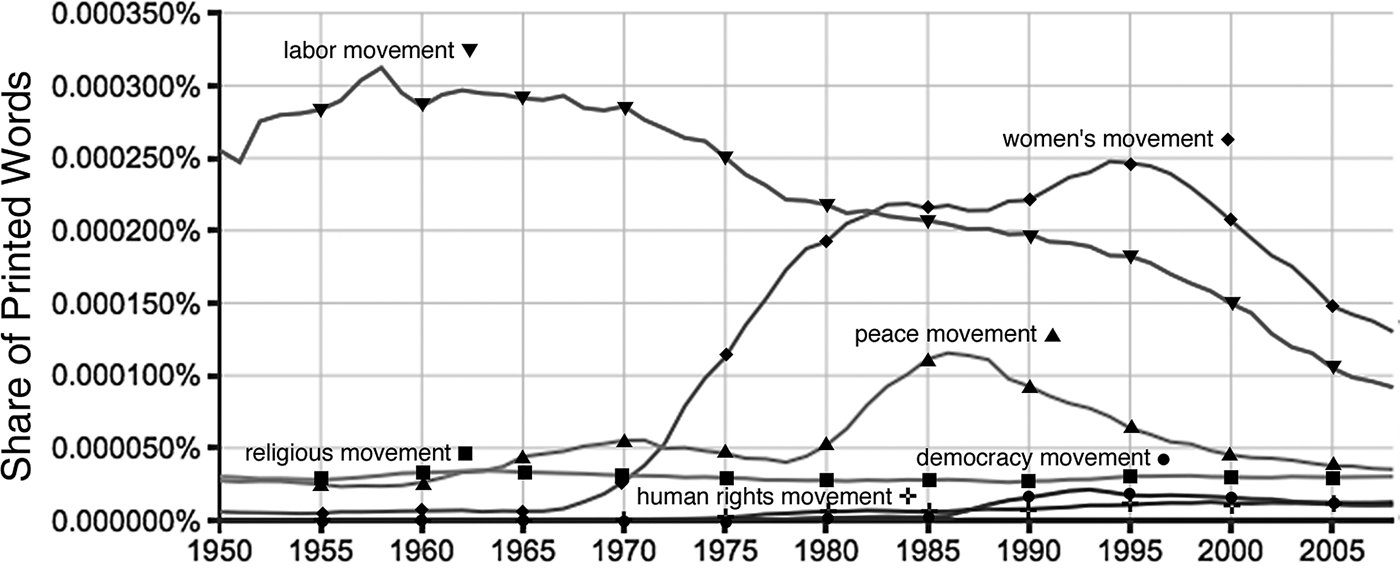
The human rights movement may not be quite as coherent a concept as the topic of this essay suggests. One indication of this is the density of mentions in the corpus of university books published in English since 1950 and scanned by Google. The human rights movement has been dwarfed by other movements in English language literature over the past sixty years, especially the labor movement and women's movement (though references to both have declined steeply in recent years). Peace movements and religious movements continue to command more attention than the human rights movement, which is written about with just about the same frequency as the democracy movement (whatever that is) in scholarly writing (Figure 1).
“Movements” as found in English-language books, 1950–2008

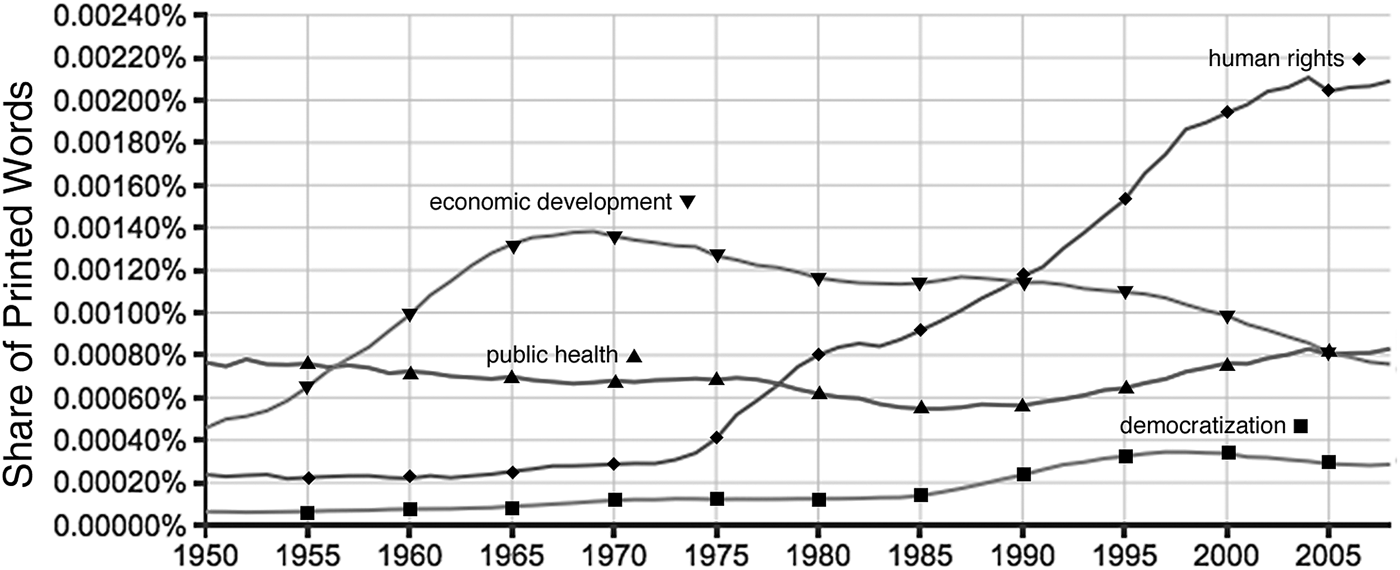
Of course, this is not to say that human rights is a minor issue. On the contrary, scholars have paid steadily increasing attention to human rights over the past sixty years. In the mid-1970s references to human rights surpassed references to public health, and in about 1990 they superseded references to economic development (Figure 2). While these measures hardly tap the underlying importance of each subject, they are an indication of sustained attention to these issues over time.
Big issues in English-language books, 1950–2008

Finally, when we speak of the human rights movement, it is critical to consider, which rights? The content of human rights has always been contested, and it would not be especially productive to rehearse the threadbare debate over what is a human right (civil rights? labor rights? economic rights? national self-determination?), much less the philosophical debate over universal rights versus cultural relativism. Another ambiguity is whether groups that do not use human rights language still qualify as part of the movement I am describing. In the United States, for example, the civil rights movement is in spirit a human rights movement, as it certainly espouses many human rights goals as its primary focus.Footnote 3 Suffice it to say, the human rights movement is multifaceted. It also means very different things in different cultural contexts. Gay rights are now a central part of the human rights movement in North America and Western Europe, but much less so elsewhere. A right to housing is strong in South Africa and weak in the United States. The right to tote a gun, just the opposite. It is therefore difficult from the outset to define the scope of this essay by drawing sharp lines around who is “in” the movement and who is not.
Today's human rights movement is generally thought to have its legal and normative roots in the Universal Declaration. But the 1970s were an important turning point in awareness, as the sharp rise in Figure 2 above seems to indicate. “Over the course of the 1970s,” writes Samuel Moyn, “the moral world of Westerners shifted, opening a new space for the sort of utopianism that coalesced in an international human rights movement that had never existed before.”Footnote 4 Indeed, he writes that “without the transformative impact of events in the 1970s, human rights would not have become today's utopia, and there would be no movement around it.”Footnote 5
The 1970s-as-turning-point account suggests that the institutional core of today's human rights movement largely resides in such major transnational human rights organizations as Amnesty International and Human Rights Watch, which trace their origins to that time. Yet even in the West the movement is far more diverse and complicated than it appears, as Aryeh Neier's exhaustive history of the major HROs suggests.Footnote 6 Adding complexity, it is also comprised of a large network of local and regional organizations, but these are often difficult to identify unless one is on the ground and familiar with the local scene. There is no single authoritative source that accurately reflects the global network of human rights organizations; many descriptions have therefore been partial and often biased in favor of the global players.Footnote 7
In reality, the human rights movement is a sprawling global network with a few central nodes and a vast array of loosely connected organizations. Amanda Murdie has compiled a network of some 681 transnational nongovernmental organizations with a primary focus on human rights issues.Footnote 8 Her work reveals that Amnesty International, Human Rights Watch, the Arab Institute for Human Rights (surprisingly, perhaps), the International Commission of Jurists, and the International Federation of Human Rights Leagues have the densest ties within the network.Footnote 9 About three dozen international HROs have consultative status with the United Nations Economic and Social Council—a status that appears to enhance their ability to advocate for their positions in this official forum. The largest HROs can have quite a wide reach. Amnesty International, for example, is “membership based” and has grown significantly over time: from about 15,000 members in 1969 to over three million today.
Assessing the Rights Movement
The size and complexity of these organizations and their interlinkages makes it nearly impossible to assess their effects with much accuracy. Critics demand an accounting of the movement's accomplishments, arguing that it has been largely ineffective. David Kennedy calls the human rights movement “a drop of liberation in an ocean of oppression, or a fig leaf of legitimation over an evil collapsing of its own weight.”Footnote 10 Stephen Hopgood accuses the movement of confusing ends and means: it “is a global structure of laws, courts, norms, and organizations that raise money, write reports, run international campaigns, open local offices, lobby government, and claim to speak with singular authority in the name of humanity as a whole.”Footnote 11 It has become intellectually fashionable in critical circles to view the movement as morally bankrupt, and to portray human rights activists as often well-meaning but generally credulous individuals seduced into building rights structures that fail to alleviate human suffering.
Careful social science research is beginning to piece together the conditions under which the international human rights movement has come to influence human rights practices worldwide. No one can draw an unambiguous, straight causal arrow between HROs and global human rights, but a range of studies have documented mechanisms that link the movement with improvements in a variety of countries. Thomas Risse and Kathryn Sikkink and their collaborators, for example, have demonstrated that local HROs have cooperated with transnational HROs to create a “boomerang effect” that in many contexts has reduced the ability of governments to commit the worst rights violations against their own people. Their research focuses on the traditional tactic of shaming governments in ways that increase international pressure on their regimes, often ameliorating violations of physical integrity.Footnote 12
Research is also accumulating with respect to the legal structures that HROs have advocated and helped to develop. It is undeniable that leading organizations have helped codify human rights principles into binding international law and constitutions. For example, the International Commission of Jurists contributed heavily to the 1977 Geneva Convention protocols and regional conventions against torture; personnel at Amnesty International drafted suggestions for the Convention against Torture; and Save the Children International had a strong hand in developing the Convention on the Rights of the Child. Furthermore, research on the influence of international human rights treaties on actual rights practices finds that these agreements actually do some good.Footnote 13 No, they are not magic; no one thinks that ratifying the Convention against Torture has done much to reduce torture in stable autocracies where human rights movements are barely able to get off the ground. But where civil society enjoys some modicum of freedom to organize and articulate demands, that is, where the human rights movement has some political and social traction, ratified treaties raise expectations among local citizens and activists that they should be treated decently, and help to focus legitimate human rights demands. Ratified treaties, it turns out, are very useful tools in articulating and sometimes litigating human rights in much of the world.
By the 1980s another major human rights problem was on the agenda: that of transitional justice. The human rights movement during the 1970s and early 1980s had concentrated on criticizing oppressive governments and drafting legal instruments, but few at the time could imagine legal-institutional responses to such oppression, much less criminal prosecutions. With the democratic transitions of the 1980s and 1990s, that assessment began to change, and many groups began to prioritize legal-institutional reforms. New debates began on how to encourage a stable transition to more democratic regimes, involving some mix of reconciliation and legal responsibility for egregious human rights abuses under previous regimes.Footnote 14 Rights advocates came down strongly on the side of accountability, often in the form of criminal justice. Kathryn Sikkink describes the emergence in the 1990s of an “anti-impunity movement” to hold egregious rights abusers criminally responsible for their actions, a development that was largely unthinkable only a decade before.Footnote 15
Has prosecution under the treaties, constitutions, and laws of the rights movement contributed to justice or, even more hopefully, to better rights practices? Only recently has the evidence to answer this question been available. It suggests that domestic and international trials for human rights abuses are not only a justice cascade—they may actually deter further rights abuses in the future.Footnote 16
Challenges for the Movement
The human rights movement has achieved a lot over the past forty-plus years, but it faces many challenges. First, there is the issue of retaining relevance. Human rights will always be important, but the movement must jostle in a world of myriad problems that demand attention, and human rights are not always at the top of everyone's agenda. Second, in many parts of the world governments are using security threats and sovereignty counternorms to repress rights organizations, especially since the launch of the global war on terror. Third, there is contestation within the movement about priorities and tactics. And finally, the movement is open to allegations of Western elitism, which, if not addressed, could undermine its persuasive authority on the ground. How well the movement adapts to these clusters of challenges will have some impact on its future.
Retaining Relevance
The predominance of the human rights movement is challenged by myriad other issues that cannot easily be described compellingly in traditional human rights terms. The Arab Spring is one such example. Westerners like to frame the Arab Spring in terms of democratic rights,Footnote 17 but in many ways it seems to be mostly about responsive government, about getting corruption under control, and, perhaps most especially, about providing for better economic opportunities.Footnote 18 These are all issues that do not fit neatly into the categories outlined in the Universal Declaration.
The world is complex, troubled, and crowded with issues that do not give human rights immediate traction. In this environment, the human rights movement must compete to attract resources to continue its work. The world is rife with good causes and critical needs, as well as periodic recessions that have made fund-raising difficult. The recent global economic climate has not been especially friendly to the human rights movement,Footnote 19 and there is some evidence that major donor governments are rethinking their financial support for “traditional” human rights projects. For example, the Australian government has recently announced the elimination of human rights grants for fiscal year 2013–2014;Footnote 20 and the United States, the United Kingdom, and Japan have moved toward a more business-oriented approach to their aid in Africa, and away from traditional health and human rights programs, which they are increasingly prepared to leave to private organizations.Footnote 21
States—and Their Insecurities
A second very visible threat to the movement has been its inability to operate freely in much of the world. The cold war had barely ended before new threats to security provided states with a rationale to crack down on HROs. Fighting global terrorism has certainly contributed to this phenomenon, as many states have found U.S. justifications for torture and spying on civilians and foreign political allies to be convenient excuses for their own actions; but the reasons for criticizing, restricting, and in some cases shuttering HROs have varied. Bottom line, the human rights movement suffers when governments act out their insecurities by repressing critics.
Nowhere has this been more apparent than in states from the former Soviet Union, central Asia, and parts of Africa. NGOs associated with the West have had an especially hard time since the Color Revolutions of the 2000s. These revolutions sparked official criticism followed by severe restrictions on NGO activities—first in Moscow and then throughout much of central Asia. Between 2004 and 2007, Uzbekistan closed more than 400 NGOs, including Freedom House, Amnesty International, and the National Democratic Institute. State authorities in Kazakhstan, Tajikistan, and Kyrgyzstan tightened their control over a broad range of “liberal” organizations. Using Russia's example, the states of central Asia have used the concept of “sovereign democracy”—the idea that governing legitimacy is domestic and that foreign interference is not to be tolerated—to crack down hard on Western-linked NGOs. Alex Cooley sums the situation up well when he argues that Western norms of democratization and human rights are increasingly outweighed by the counternorms of sovereignty, counterterrorism/security, and stability.Footnote 22
The U.S. position on terrorist financing has had an ominous echo in other parts of the world. Foreign funding has become a convenient excuse for some governments to rein in critical NGOs in many parts of the world. The Ethiopian government, for example, has been able to limit and in some cases eliminate broad swathes of the local and transnational NGO sector by enacting laws that restrict foreign funding. Many of the international NGOs were able to survive, but had to significantly restructure their operations. Southern NGOs that depend heavily on Northern funding make especially vulnerable targets, because opponents increasingly use this fact to portray them as foreign agents. Recent research has found that about 90 percent of local human rights groups in Ethiopia have not survived recent funding restrictions.Footnote 23
National security concerns have even increased pressure against HROs in some democratic countries. “Lawfare” is a derisive term that critics have used to describe HRO tactics of “cause lawyering,” that is, the practice of using law and courts to hold governments accountable for rights violations. Complaints of “lawfare” represent a form of conservative backlash—articulated most strongly in Israel, but also in the United States—against efforts by the human rights movement to provide oversight of state policies in the war on terror.
Contestation over Priorities, Strategies, and Tactics
One of the central challenges facing the rights movement is that it simply does not have the coherence that the use of the definite article implies. As discussed above, human rights organizations have varying priorities, and pursue their rights goals in different ways. For all their efforts at universalism, it is clear that different cultures and different coalitions within cultures have different rights priorities. Gay rights in Africa, abortion rights in Colombia, religious rights in Saudi Arabia, a right to life for capital offenders in the United States—these are all a hard sell. As Wendy Wong has written, the human rights movement is challenged to appeal to “universal values,” and yet to have a high degree of local relevance.Footnote 24 The more it seeks authentic civil society allies around the world, the more the human rights movement will inevitably encounter good faith resistance to the Western version of what constitutes a human right.
“Rights fatigue” is also a serious issue. Framing an issue as one of human rights is no longer the trump card that it once might have been, and today governments increasingly behave as though they are being overwhelmed by rights obligations. Indeed, recent research suggests that when an issue like human trafficking is framed as a human rights issue at the United Nations, it receives less state support than when it is simply framed as a transnational crime issue.Footnote 25 As rights accumulate (a measure of the movement's success, by the way), states are becoming increasingly resistant to take on more obligations. A critical issue within the movement is at what point the concept of rights has stretched beyond any useful meaning.
There are also divisions within the movement over strategy and tactics. One is over the emphasis on litigation, which seems to be on the rise. Some HROs, such as the Open Justice Initiative, include strategic litigation as a major way to achieve their objectives, always in combination with other efforts, such as advocacy, media attention, and working with governments to effectuate policy reform.Footnote 26 Other groups view litigation as a very high-cost, high-risk alternative, which is likely to be useful only under a narrow set of circumstances—where there is just the right plaintiff, just the right issue, just the right facts, and just the right forum.Footnote 27 Critical legal scholars argue that litigation serves to “depoliticize” human rights, removing them from their social context and carrying the fight above the heads of those whose rights are at stake. Many of these critics add that HROs have become too professionalized and bureaucratized to respond nimbly to emerging rights violations. Yet the very diversity of HROs seems in part to address this complaint. Sid Tarrow argues, for example, that the case of Dream for Darfur shows that “small and focused non-state public action can have dramatic short-term results” and can respond quickly in particular cases.Footnote 28 Perhaps it is better to think in terms of complementarity rather than contradiction when assessing the movement at the tactical level.
Beyond tactics, one wonders how the human rights movement will reconcile one of the most difficult choices it faces: whether to compromise or to hold out for the full panoply of universal human rights under all circumstances. Should such organizations bargain or make concessions? And if pragmatism dictates the latter, how much compromise is tolerable? Every movement has had to grapple with this central issue, the human rights movement no less than others.
The Movement and the Masses
Finally, the international human rights movement faces challenges as a result not only of its universalism but of its perceived elitism as well. Populated by college-educated activists and lawyers from the West, how can such a movement really touch those who experience oppression and live and work in its shadow on a daily basis? The charge of elitism and elite agenda-setting that does not necessarily mirror the “meritocracy of suffering” across the world is a serious challenge for the movement.
Once again, there is no single answer to the problem of failing to integrate the most important individuals in the rights movement—those whose rights are most at stake. Sally Engle Merry has written about a transnational class of persons, involved in the international human rights movement but with an authentic foot in the local milieu, whose role is often to “translate” universal principles into local vernaculars in ways that make them much more accessible and relevant to local audiences, as well as to transmit local experience to global forums.Footnote 29 I suspect this transnational class could still be considered “elite” by many definitions, but the linkages are potentially critical to the formation of a global movement.
How transnational organizations connect with local organizations and with everyday people is critically important. Researchers such as James Ron and David Crow have begun to look into mass opinion in the global South (their research has focused on Colombia, India, Mexico, and Morocco) relating to local human rights organizations (LHROs).Footnote 30 In many places they find that LHROs are viewed as counterhegemonic forces, rather than as local foot soldiers in a Western hegemonic project. Some evidence is also emerging that the disconnect between “elites” and the “masses” is quite a bit narrower in these local organizations than it is within the large transnational HROs. Thus, the human rights movement may have local roots that are quite a bit stronger than critics of the movement as a whole might suggest.
Savvy movement leaders will tap into new possibilities to open up the movement to new voices. Online forums such as Sur (Brazilian-based) and Open Democracy are one way to extend opportunities for participation, especially for those who do not have access to the funds or networks of the major organizations. Technologies that facilitate communication, access, and translation will make it increasingly possible to bring in a wider range of people who want to debate, propose, and influence the agenda. Whether the movement is stoked or stalled by the new range of players will become clearer in the future, but more open and more global discussions about human rights are a positive development for a movement often criticized as hegemonic and elite-dominated.
Looking Ahead
The human rights movement will not wither and die anytime soon. It has inspired new voices and local institutions around the globe. Human rights discussions have found a place in civics textbooks worldwide;Footnote 31 countless universities and law schools have developed human rights programs;Footnote 32 and governments across the globe have established national human rights institutions, whose purpose is to provide citizens with independent information about their rights under national and international law, and to inform them of possible remedies in case of violation.Footnote 33 HROs have contributed to a treaty structure to support the principles on which they stand, are now represented in global intergovernmental organizations, and increasingly take the form of local organizations with their own concerns and priorities. The Internet has made it more possible than ever to have a more inclusive dialogue that involves a broad range of stakeholders. With some personal risk, would-be activists in China use the Internet to connect with the human rights movement, which Guobin Yang characterizes as the “moral support” they need to cautiously push back against repression at home.Footnote 34 These are all indicators and accomplishments of a healthy movement.
But some organizations within the movement do need to adjust. If there is a tension between coherence and openness, the movement has tended to opt for openness. Some may feel that that strategy dilutes the message of rights and involves undesirable compromises. However, that may be the price for relevance and authenticity. The human rights movement has always worked at the intersection of the global and the local, between universal principles and their particular application. Much has changed in the world since the cold war rights-issues of the 1970s. Strategies have had to change as well. In the 1970s the international legal structure was relatively thin, but activists could write, pressure, and shame, as well as participate in treaty drafting and information gathering. Democratic transitions in the 1980s and 1990s opened up the possibility of criminal litigation; and while controversial, this strategy has had some positive consequences as well.
The world can certainly change in unpredicted ways. The evidence is mixed and the challenges are many. But this is a movement with significant accomplishments, good momentum, and a flexible structure to respond to challenges in the years to come.