Many adults who try to learn a second language (L2) report great difficulty in doing so. A major barrier to their success is the fact that there are often mismappings between the first language (L1) and L2, at a variety of levels (see e.g., Tokowicz, Kroll, de Groot & van Hell, Reference Tokowicz, Kroll, de Groot and van Hell2002, for the lexical level; Tokowicz & MacWhinney, Reference Tokowicz and MacWhinney2005, for morphosyntax; see also MacWhinney, Reference MacWhinney, de Groot and Kroll1997). Here, we explored the impact of a particular kind of mismapping between L1 and L2 on vocabulary learning. Specifically, we explored translation ambiguity, which occurs when a word in one language has more than one translation into another language. Many instances of translation ambiguity arise from two existing kinds of ambiguity within a language. The first source of translation ambiguity is near-synonymy, which occurs when a given meaning can be expressed by more than one word form (e.g., couch and sofa). The second occurs when a given word form corresponds to more than one meaning (homonymy) or sense (polysemy), as in the case of the English homonym change, which can denote both “coins of small denomination” and “the result of alteration”.
Although there is a paucity of research on adult learning of ambiguous words, children have long been shown to have difficulty when there is not a one-to-one mapping between words and meanings, as in the case of learning homonyms and near-synonyms. For example, Doherty (Reference Doherty2004) examined children's ability to learn a new meaning for a pseudo-homonym. The word fork, for instance, was introduced in a story as referring to a different object. Children were significantly less accurate at selecting the intended referent when a pseudo-homonym served as the referent's label compared to when a nonsense word was used. Further, when children's attention was specifically drawn to the fact that a word may refer to two different things, children were still less accurate at labeling the referent of the pseudo-homonym when the object to which the word typically refers (i.e., an actual fork) was present. Children therefore have difficulty in associating a new meaning to a word they already know (see also Mazzocco, Reference Mazzocco1997).
Traditionally, this difficulty in learning one-to-many mappings has been ascribed to a mutual exclusivity bias, according to which children prefer unique mappings between word form and meaning, and require more evidence to learn words that violate this preference (e.g., Markman & Wachtel, Reference Markman and Wachtel1988). Obviously, children learn to overcome this difficulty with time (e.g., Mazzocco, Reference Mazzocco1997), and multilingual children need to learn from the outset that the same object can have more than one label (e.g., Byers-Heinlein & Werker, Reference Byers-Heinlein and Werker2009). Nonetheless, a one-to-many mapping may continue to pose difficulty in learning even for adults (Golinkoff, Hirsh-Pasek, Bailey & Wenger, Reference Golinkoff, Hirsh-Pasek, Bailey and Wenger1992), perhaps by means of a different mechanism, which will be considered in the Discussion section, below.
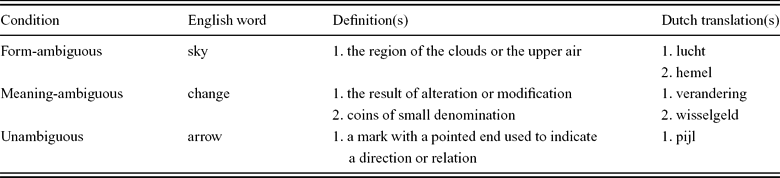
The current study focuses on ambiguity that crosses the language boundary, in that the ambiguity exists in the mapping from a word in one language (English) to more than one word in the other language (Dutch). Such translation ambiguity is relatively prevalent in several cross-language pairs, including English and Dutch (Tokowicz et al., Reference Tokowicz, Kroll, de Groot and van Hell2002; see also Prior, MacWhinney & Kroll, Reference Prior, MacWhinney and Kroll2007; and Tokowicz & Kroll, Reference Tokowicz and Kroll2007, for English/Spanish). Semantic (meaning) ambiguity and near-synonymy contribute to such cross-language ambiguity. Specifically, when a word has more than one meaning (e.g., change) it is rarely the case that one translation in the other language also happens to capture these same two meanings (Frenck-Mestre & Prince, Reference Frenck-Mestre and Prince1997), which are thought to have been accidentally joined (e.g., Rodd, Gaskell & Marslen-Wilson, Reference Rodd, Gaskell and Marslen-Wilson2002). Thus, a given word in English (change) corresponds to two translations in Dutch: wisselgeld refers to the monetary meaning of change, whereas verandering denotes its alteration meaning. Because the English word is ambiguous in its meaning, we refer to this type of ambiguity as meaning ambiguity. Conversely, the English word sky can be translated into one of the two Dutch near-synonyms lucht and hemel. This near-synonymy in Dutch creates cross-language ambiguity that we refer to as form ambiguity, because when translating the English word into Dutch there is relatively no ambiguity in its meaning but rather two word forms are available, placing the ambiguity at the word-form level (see Table 1 for example stimuli).
Example stimuli and definitions by condition.

Translation ambiguity has been shown to affect bilingual language processing. In particular, Tokowicz et al. (Reference Tokowicz, Kroll, de Groot and van Hell2002) found that translation-unambiguous pairs, which map uniquely to one another, were rated as more similar in meaning than translation-ambiguous pairs, which are made up of words that can be translated in more than one way. For example, frog is only translated into Dutch as kikker, and vice versa, and this pair received a higher meaning similarity rating than both change–wisselgeld and change–verandering. Moreover, Tokowicz and Kroll (Reference Tokowicz and Kroll2007) showed that translation-ambiguous pairs were produced more slowly and less accurately in a translation production task by relatively proficient Spanish–English bilinguals, likely reflecting active competition between the two possible output options (see also Tokowicz, Michael & Smith, Reference Tokowicz, Michael and Smith2007; Tokowicz, Prior & Kroll, Reference Tokowicz, Prior and Kroll2009). This slowing of translation production for words with more than one translation became even more pronounced with increased L2 proficiency (Tokowicz, Reference Tokowicz2005); presumably, this proficiency difference is due to increased word knowledge that leads to stronger competition between alternatives.
Recently, Boada, Sánchez-Casas, García-Albea, Gaviln and Ferr (Reference Boada, Sánchez-Casas, García-Albea, Gaviln and Ferr2009) examined processing of translation-ambiguous words in a translation recognition task, in which participants indicated whether pairs of words were translations of each other. Translation-ambiguous pairs were correctly recognized as translations more slowly than translation-unambiguous pairs, demonstrating that translation ambiguity affects recognition as well as production (see also Sánchez-Casas, Buratti & Igoa, Reference Sánchez-Casas, Buratti and Igoa1992).
Despite the prevalence of ambiguity within and across languages, and its effects on the way monolinguals and bilinguals process language (e.g., Elston-Güttler & Friederici, Reference Elston-Güttler and Friederici2005; for a review, see Degani & Tokowicz, in press), and on how children learn vocabulary, very little attention has been paid to the effect of ambiguity on adult language learning. In one study that examined foreign vocabulary learning in adolescents, Bogaards (Reference Bogaards2001) in effect manipulated the mapping between words and meanings. He contrasted learning of completely new words with learning new meanings for already-known word forms. Specifically, native Dutch speakers learned idioms made up of known French words, learned new meanings for already-known French words, or learned entirely new words. Using accuracy on a multiple-choice translation recognition task and a translation production task, Bogaards found that learning a new meaning for an already-known form is easier than learning a completely new word.
The results of the Bogaards (Reference Bogaards2001) study suggest an advantage, rather than a disadvantage, for words with more than one meaning over unambiguous words. Such an advantage was also observed in a study with children that demonstrated an accuracy advantage for words with one form and two meanings over completely novel words in a picture naming task (Storkel & Maekawa, Reference Storkel and Maekawa2005). The authors took their results to suggest that the reduced amount of information that needs to be learned for ambiguous words (because the word form is already known) is what provides words with two meanings an advantage over unambiguous novel words. The discrepancy between studies that demonstrate a disadvantage for ambiguous words (e.g., Doherty, Reference Doherty2004) and studies that find an ambiguity advantage (e.g., Bogaards, Reference Bogaards2001; Storkel & Maekawa, Reference Storkel and Maekawa2005) is explained by differences in the types of representations that the tasks access.
Notably, the studies that found an ambiguity advantage in fact compared learning of novel words, which requires creation of an additional form representation, to learning of new meanings for already-known words, for which no new form representations must be created. Thus, because these previous studies were not focused on comparing ambiguous and unambiguous word learning, ambiguous and unambiguous items differed in the number of representations that needed to be created by the learner.
In the current study, we controlled for the number of representations that needed to be created. Specifically, we taught words in Dutch that did or did not share a common English translation. Therefore, by virtue of being native English speakers, the participants in the current study were familiar with the English ambiguous items and the meanings they encompass. Thus, for unambiguous, form-ambiguous, and meaning-ambiguous items, the English words and the meanings were already known, and only the Dutch translation(s) had to be learned. Thus, the current study measures more directly how one-to-many mappings, per se, rather than the amount of information learned, affect learning.
The primary factor of interest in the present study is translation ambiguity. We compare the cases in which one word form in English corresponds to one word form in Dutch (a one-to-one mapping) to the cases in which one word form in English corresponds to two word forms in Dutch (a one-to-many mapping). Therefore, if learning is affected by the mapping between word forms in the two languages, and learning a one-to-many mapping is more difficult, then ambiguous words should show a disadvantage relative to unambiguous words.
We further examined whether the ambiguity of the source word (i.e., English) modulates the difficulty with which translation-ambiguous items are learned. Therefore, we included both unambiguous English words (e.g., sky) with two Dutch words corresponding to the same meaning (form-ambiguous), and ambiguous English words (e.g., change) with Dutch translations for each of their meanings (meaning-ambiguous). These two types of translation ambiguities may have different consequences for word learning. In particular, if one assumes that a meaning-ambiguous word has one lexical entry but two semantic entries (one for each meaning; e.g., Klein & Murphy, Reference Klein and Murphy2001), then when learning to map a Dutch translation to each of these meanings, the learner can avoid the one-to-many mapping problem. This is especially true if a direct link can be created from the Dutch (L2) word to the semantic/conceptual representation. Although this typically may not be the case in non-immersion learning (see e.g., Kroll & Stewart, Reference Kroll and Stewart1994), we always provided the definition along with the English translation during training, which may have allowed the learners to rely less on the English word forms and more on meaning. For the form-ambiguous items, in contrast, only one semantic representation should exist, by virtue of the one definition provided, and therefore a one-to-many mapping would have to be established. Under this framework, we would predict an advantage for meaning-ambiguous items over form-ambiguous items.
Alternatively, it may be the case that despite knowing the two different meanings of semantically-ambiguous words in English, creating a mapping between English and Dutch requires some additional meaning differentiation. If so, learning meaning-ambiguous items may be as problematic as learning form-ambiguous items. The idea that it is difficult to differentiate two meanings that correspond to a shared label is supported by a recent study showing that bilinguals consider two words that share a translation in the other language they know to be more similar in meaning than two words that do not share a label (Degani, Prior & Tokowicz, in press; see also Jiang, Reference Jiang2002, Reference Jiang2004). This may suggest that the two meanings of an ambiguous word are closer in semantic space by virtue of their shared label, and the need to associate each meaning with a separate Dutch translation may require the learner to pull the two meanings apart.
It is also possible that ambiguous items are harder to learn because each of their alternatives is encountered less often than unambiguous items. Indeed, this is likely the situation in actual language learning. We wanted to examine, however, whether translation-ambiguous items are more difficult to learn, above and beyond the expected decrement due to less-frequent exposure to each pairing of translations. Therefore, we manipulated the number of repetitions of the ambiguous items, such that ambiguous items could be presented half as often or exactly as often as the unambiguous items. This allows us to examine the effects of translation ambiguity both controlled for and confounded with frequency-of-exposure effects. Equating the number of presentations eliminates the possibility that less-frequent encounters alone underlie the predicted ambiguity disadvantage.
Because some tasks may be more sensitive than others at revealing an ambiguity effect in general, and an ambiguity source effect in particular (see Tokowicz et al., Reference Tokowicz, Prior and Kroll2009), several tests were employed in the current study. These include a Dutch-to-English translation production task, a translation recognition task, and an English-to-Dutch translation production task. The latter task was included because translation from L1 to L2 is sometimes more sensitive to meaning effects than translation from L2 to L1 (see e.g., Kroll & Stewart, Reference Kroll and Stewart1994). In addition to the variety of the tests employed, we also sampled participants’ performance at three time points to obtain a more accurate picture of how translation ambiguity affects performance at these very early stages of learning, and to allow us to determine how ambiguity affects performance over time. Because of the potential for frustration due to task difficulty, the English-to-Dutch (L1-to-L2) translation task was administered only during the last session.
To summarize, we expect translation-ambiguous items to have a learning disadvantage as compared to translation-unambiguous items overall. With respect to the source of ambiguity, the various mechanisms we have described make different predictions about the relative difficulty of learning form- and meaning-ambiguous words. If the problem with ambiguous words is that they require a one-to-many mapping, then less difficulty is predicted when learners can avoid a one-to-many mapping. In particular, we would expect that the meaning-ambiguous words would have a learning advantage over form-ambiguous words if learners can directly map each Dutch translation to its corresponding meaning. If, however, meaning-ambiguous words require some meaning differentiation, we would expect them to be almost as problematic as form-ambiguous words, and for unambiguous words to have a learning advantage over both types of ambiguous words.
Method
Participants
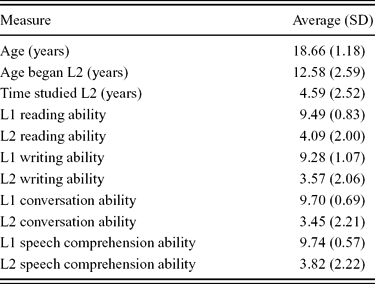
Forty-seven right-handed native English speakers (27 males; mean age 18.6 years) with no prior knowledge of Dutch took part in this experiment. They received credit toward an Introductory Psychology requirement and were paid for their participation in the second and/or third sessions. At the end of the first session, the participants completed a language history questionnaire (Tokowicz, Michael & Kroll, Reference Tokowicz, Michael and Kroll2004; see Table 2). Data from 11 additional participants were excluded because they were native speakers of a language other than English (eight participants) or due to technical problems during training (three participants). Of the final set of 47 participants, 37 returned for a second session two days after the first session, and 17 returned for a third session approximately two and a half weeks after the second.
Language history questionnaire data.

Note. Reading, writing, conversational, and speech comprehension abilities were rated on a 10-point scale on which 1 indicated the lowest level of ability and 10 indicated the highest level of ability. Standard deviations (SDs) are shown in parentheses. L2 varied across participants but was never Dutch or German.
Design
A two translation ambiguity (ambiguous vs. unambiguous) within-participants design was used. For ambiguous items, a two ambiguity source (form vs. meaning) by two repetition level (2 vs. 4) within-participants design was used.
Stimuli
The stimuli were 48 English words presented with their Dutch translations; the words were selected based on translation norms for Dutch–English translation pairs (Tokowicz et al., Reference Tokowicz, Kroll, de Groot and van Hell2002), such that half of the English words had a single translation in Dutch, and half had two translations in Dutch. Twelve of the multiple-translation items were meaning-ambiguous, and twelve were form-ambiguous (see Table 1 for examples). Because half of the English words had two translations in Dutch, the stimuli included a total of 72 Dutch words. See the Appendix for all items and their definitions.
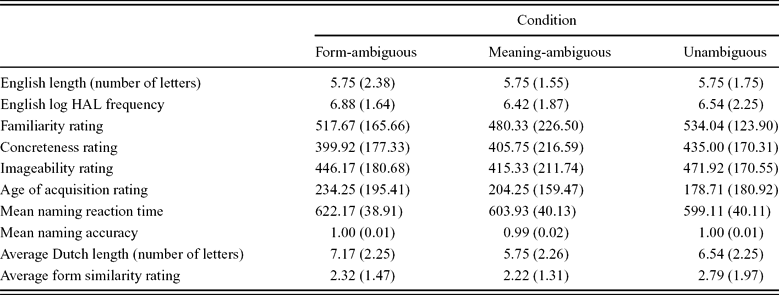
The stimuli were selected such that single-translation items were matched to the meaning-ambiguous items and to the form-ambiguous items on English length, English log frequency, and mean reaction time and accuracy to name the English word (all Fs < 1, except mean naming reaction time p > .26; taken from Elexicon, Balota et al., Reference Balota, Cortese, Hutchison, Neely, Nelson, Simpson and Treiman2002), and on familiarity, concreteness, imageability, and age of acquisition of the English words (Fs < 1, from the MRC database, Wilson, Reference Wilson1988; mean characteristics are given in Table 3). For multiple translation items, an average of the length of the two Dutch translations was computed. Single-translation items did not differ significantly from multiple-translation items in Dutch length (F < 1).
Properties of stimuli by condition.

Note. Stimuli in the three conditions match on all dimensions. English log frequency, and mean reaction time and accuracy to name the English word are from Elexicon (Balota et al., Reference Balota, Cortese, Hutchison, Neely, Nelson, Simpson and Treiman2002), and familiarity, concreteness, imageability, and age of acquisition of the English words are from the MRC database (Wilson, Reference Wilson1988). Form similarity ratings are from Tokowicz et al. (Reference Tokowicz, Kroll, de Groot and van Hell2002). Standard deviations (SDs) are shown in parentheses.
Moreover, Tokowicz et al.'s (Reference Tokowicz, Kroll, de Groot and van Hell2002) norms include form similarity ratings for each English–Dutch pair. This measure indicates how ‘cognate-like’ the pair is; specifically, Dutch–English bilinguals rated the similarity of the pair in spelling and sound on a seven-point scale. Single-translation items did not differ significantly from meaning-ambiguous or form-ambiguous items in their form similarity, which was averaged across the two translations of multiple-translation words (F < 1).
An English definition was created for each of the Dutch words by consulting WordNet (WordNet 3.0, Princeton University, 2006) and Dictionary.com (Electronic commerce, 2007) for each of the English items. To keep the definitions short and concise, slight modifications were made on occasion to those provided by the online tools. A separate definition corresponded to each of the meanings (and Dutch translations) of the meaning-ambiguous items. Although the form-ambiguous items may have corresponded to slightly different senses of the English word for proficient Dutch users, we presented both Dutch translations with a single definition, to create a strong one-to-many mapping; we return to this issue in the Discussion section. Single-translation items were also presented with only one definition.
Three training versions were counterbalanced across participants. Each version included 16 multiple-translation English words (eight form-ambiguous and eight meaning-ambiguous), presented with both Dutch translations. The remaining eight multiple-translation items (four form-ambiguous and four meaning-ambiguous) were presented with only one of their Dutch translations (and one definition). These served as fillers to reduce the number of multiple-translation items in each training set. In addition, 24 single-translation items were presented with only one Dutch translation and definition.
Each version therefore included 64 Dutch words to be learned. The number of repetitions of each word was manipulated as well, such that in each training cycle the single-translation items were repeated four times, but of the multiple-translation items presented with both definitions in that version, 16 were repeated four times and 16 were repeated twice. Thus, the corresponding English items appeared eight and four times, respectively, half of the time with each translation. Two variants of each version were created, such that the multiple-translation items that were repeated four times in one variant were repeated twice in the other.
In the Dutch-to-English translation production task in all sessions, all 64 Dutch words trained in that version of the experiment were presented. In the English-to-Dutch translation production test, all 48 English words were presented. The multiple-translation English items that were trained with both Dutch translations in a given participant's corresponding training were presented twice during the test, for a total of 64 trials.
Four different variants of each training version were created so that the order of testing multiple-translation pairs in the translation recognition test was counterbalanced across sessions. Furthermore, pairings were manipulated such that each Dutch word appeared with its correct English translation half of the time; incorrect pairings were made with other items in the “no” list for that version. Different variants of this task were administered in the second and third sessions.
Procedure
The experiment consisted of three separate sessions, taking place two days and two and a half weeks apart, respectively. During the first session, participants completed two training cycles in which each Dutch word was presented with its English translation and a definition of its meaning. No additional context was provided. On each trial, a fixation cross appeared in the center of the screen until the participant initiated the beginning of the trial by pressing the space bar. The fixation cross was then replaced by a blank screen for 100 ms followed by the Dutch word with its English translation and definition for eight seconds (following Lotto & de Groot, Reference Lotto and de Groot1998). Participants were instructed to try to learn the Dutch words and their meanings. After two cycles of 208 training trials, each presented in a random order, participants were tested in a Dutch-to-English translation production task, in which they were presented with the Dutch (L2) word and were asked to say its English (L1) translation out loud as quickly and accurately as possible. Following these 64 trials of L2-to-L1 production, participants completed the language history questionnaire.
Two days later, participants returned to the lab for a second training and testing session. In this second session, participants were first tested in the Dutch-to-English translation production task. They then completed one training cycle and were next tested in a translation recognition task. In this task, 48 Dutch–English word pairs were presented in randomized order. On each trial, participants were presented with Dutch–English word pairs, and were asked to indicate whether the English word was a correct translation of the Dutch word by pressing the Yes button with their right index finger or the No button with their left index finger.
Approximately two and a half weeks later (M = 17 days, range 14–21), participants returned for a longer-term retention testing session. This third session started with a Dutch-to-English translation production test (L2-to-L1, the same as that administered during the first and second sessions), followed by a translation recognition task (another variant of the task administered in the second session). Participants next completed a working memory span task (the operations-word task, Turner & Engle, Reference Turner and Engle1989; see also Tokowicz et al., Reference Tokowicz, Michael and Kroll2004) as a delay,Footnote 1 before completing an English-to-Dutch translation production task, in which participants orally provided the Dutch (L2) translations of 64 English (L1) words presented in random order.
To summarize, participants completed a total of three training cycles with 208 trials each, and were tested three times in an L2-to-L1 translation production task, twice in a translation recognition task, and once in an L1-to-L2 translation production task. Single-translation (unambiguous) items were trained four times in each cycle, for a total of 12 times in the study. Half of the form- and meaning-ambiguous items were trained twice in each cycle (for a total of six in the study), and the other half were trained four times in each cycle (for a total of 12 in the study).
Results
Data by participants were analyzed using repeated measures Analyses of Variance (ANOVAs) with translation ambiguity, ambiguity source, and repetition level as within-participants variables, and are reported as F1. Data by items were analyzed using repeated measures ANOVAs with translation ambiguity, ambiguity source, and repetition level as between-items variables, and are reported as F2. In all the analyses that follow, an alpha level of .05 was used, and in cases in which the assumption of sphericity was violated, the Fs, MSEs, and ps reported correspond to the significance test with the Greenhouse-Geisser correction applied.
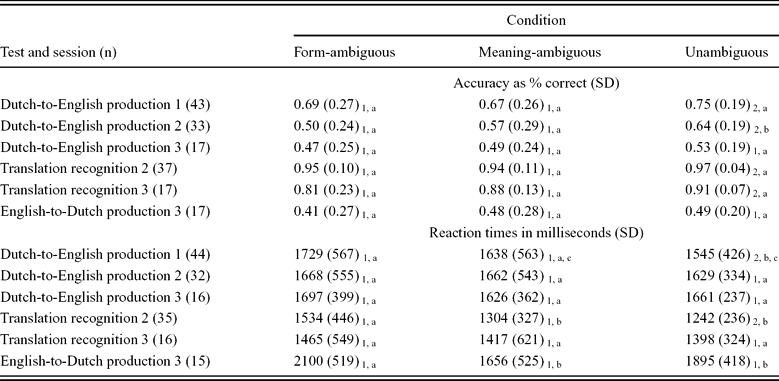
In the analyses that follow, we first report the comparison of unambiguous items to ambiguous items for which the English word was presented four times in each training cycle. It follows that for the ambiguous items, each Dutch translation was presented only twice (half as often as the Dutch unambiguous items). We then report the analyses when keeping the number of presentations of the Dutch items at four per cycle, thus equating participants’ familiarity with ambiguous and unambiguous Dutch items. These analyses are followed by a more detailed analysis examining the role of ambiguity source, in which we specifically compare form-ambiguous, meaning-ambiguous, and unambiguous items that were all presented four times in each training cycle. An overview of the results can be found in Table 4.
Overview of the results.

Note. Data are shown as a function of the type of item (form-ambiguous, meaning-ambiguous, or unambiguous) in the equated repetition condition. Means in the same row that do not share a numeric subscript differ at the p < .05 level, based on F1 analyses comparing ambiguous to unambiguous items. Means in the same row that do not share an alphabetic subscript differ at the p < .05 level based on t-tests between the conditions when the ambiguity source effect was significant by participants. Standard deviations (SDs) are shown in parentheses.
Immediate Dutch-to-English production test: First session
Accuracy
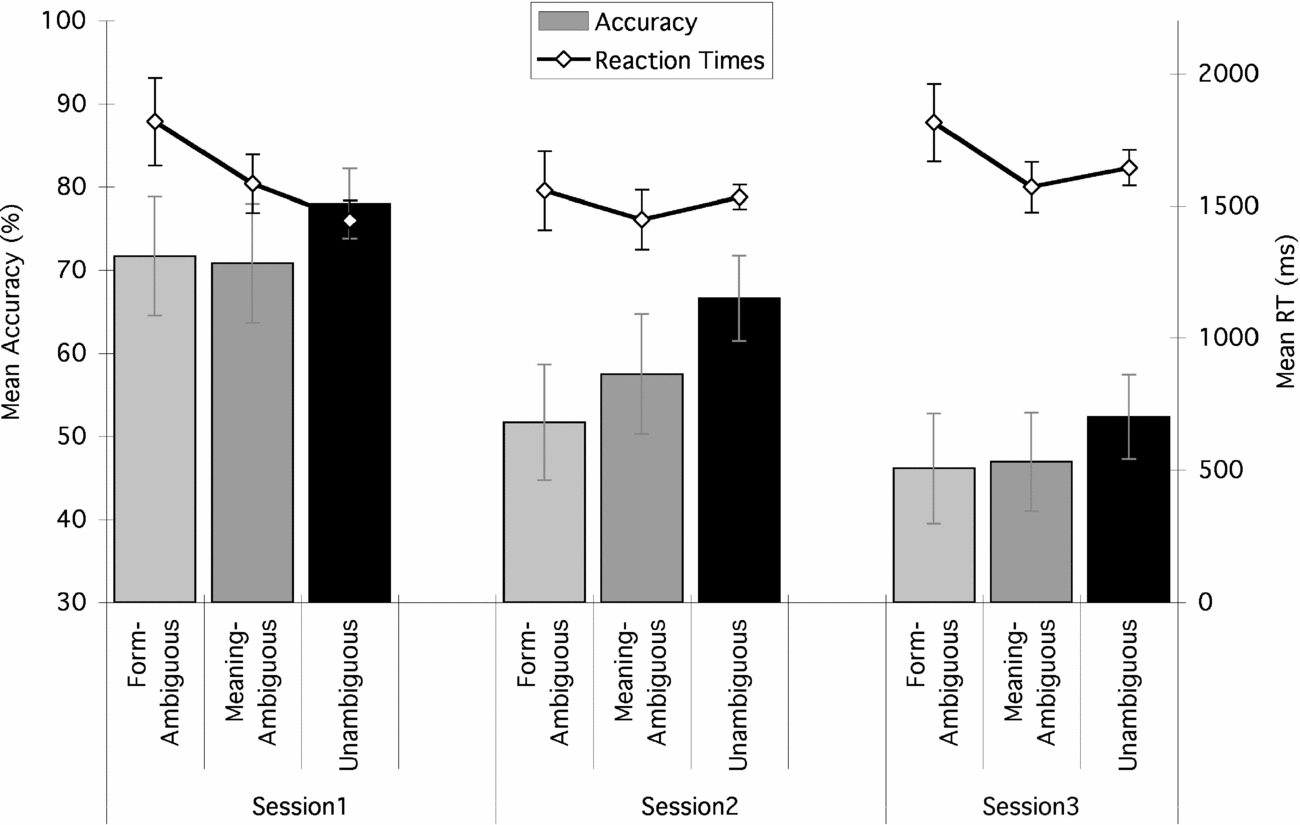
As predicted, ambiguous items were produced less accurately (M = .60) than unambiguous items (M = .75), F1(1,43) = 56.12, MSE = .01; p < .01, F2(1,70) = 8.96, MSE = .04, p < .01. Furthermore, even when the Dutch ambiguous items were trained just as often as unambiguous items, translation ambiguity led to a learning disadvantage; ambiguous items were still produced significantly less accurately (M = .68) than unambiguous items (M = .75) by participants, F1(1,43) = 8.45, MSE = .01, p < .01, and marginally so by items, F2(1,70) = 3.02, MSE = .03, p = .09. The effect of ambiguity source on accuracy was not significant, F1(2,84) = 1.21, MSE = .08, p > .10; F2(2,69) = 1.54, MSE = .03, p > .10.
Reaction times
Based on the distribution of the data, reaction times shorter than 300 ms or longer than 7000 ms, or that fell more than 2.5 standard deviations from each participant's mean reaction time for correct trials were removed from the analyses. These procedures resulted in the removal of 4.9% of the data. Analyses were performed on correct trials only.
The reaction time results from the first session are similar to the accuracy data. Specifically, ambiguous items were produced more slowly (M = 1795) than unambiguous items (M = 1545), F1(1,43) = 23.52, MSE = 58310, p < .001; F2(1,70) = 6.01, MSE = 130482, p < .05. Importantly, as with the accuracy data, equating the number of repetitions of the Dutch ambiguous items during training did not alleviate their disadvantage as compared to unambiguous items; ambiguous items were still produced significantly more slowly (M = 1685) than unambiguous items (M = 1545), in the analysis by participants, F1(1,43) = 6.66, MSE = 65273, p < .05, and marginally more slowly in the analysis by items, F2(1,70) = 3.01, MSE = 128161, p = .09.
A more detailed analysis examining the effect of ambiguity source (meaning vs. form) as compared to unambiguous items revealed a significant effect on learning in the analysis by participants, F1(2,86) = 3.39, MSE = 109881, p < .05; F2(2,69) = 1.69, MSE = 129276, p > .10 (see Figure 1). Planned comparisons revealed that only form-ambiguous items were produced more slowly (M = 1729) than unambiguous items (M = 1545), t(43) = 2.69, p < .05. Meaning-ambiguous items (M = 1638) did not differ significantly from form-ambiguous items, t(43) = 1.22, p > .10, or from unambiguous items, t(43) = 1.35, p > .10.
Accuracy and reaction time data from the Dutch-to-English translation production test in the first, second, and third sessions. Data are shown as a function of the type of item (form-ambiguous, meaning-ambiguous, or unambiguous) in the equated repetition condition.

To summarize the production data from the first session, translation-ambiguous items were harder to learn, as measured by the accuracy and reaction time data in an immediate production task. Furthermore, increasing participants’ familiarity with ambiguous items by repeating them just as often as unambiguous items during training did not alleviate this disadvantage. Further, form-ambiguous, but not meaning-ambiguous, items were produced significantly more slowly than unambiguous items.Footnote 2
Delayed Dutch-to-English production test: Second session
A second Dutch-to-English translation production test was administered at the beginning of the second session, before participants were trained again. It therefore reflects performance after a two-day delay. Thirty-seven participants returned for the second session, but because of technical problems, production data from four participants were lost. Therefore, data from 33 participants are included in the analyses that follow.
Accuracy
As predicted, ambiguous items were produced less accurately (M = .48) than unambiguous items (M = .64), F1(1,32) = 33.83, MSE = .01, p < .01; F2(1,70) = 7.93, MSE = .06, p < .01. As in the immediate test during the first session, increasing the number of repetitions of the ambiguous items during training was not sufficient to alleviate their disadvantage; ambiguous Dutch items repeated just as often as unambiguous items were still produced less accurately (M = .53) than unambiguous items (M = .64), F1(1,32) = 15.87, MSE = .01, p < .01, but the effect was only marginally significant by items, F2(1,70) = 3.65, MSE = .04, p = .06.
Furthermore, source of ambiguity had a reliable effect by participants, F1(2,64) = 7.59, MSE = .02, p < .01, and a marginally-significant effect by items, F2(2,69) = 2.62, MSE = .04, p = .08. Planned comparisons showed that form-ambiguous items were translated less accurately (M = .50) than unambiguous items (M = .64), t(32) = 4.38, p < .01, and marginally less accurately than meaning-ambiguous items (M = .57), t(32) = 1.71, p = .10. In addition, meaning-ambiguous items were translated less accurately than unambiguous items, t(32) = 2.04, p < .05.
Reaction times
Trimming procedures identical to those used for data from the first session led to the removal of 3.9% of the data. Although translation-ambiguous items were still produced more slowly (M = 1732) than unambiguous items (M = 1630), the effect of translation ambiguity was only marginally significant, F1(1,32) = 2.97, MSE = 57788, p = .09; F2(1,69) = 2.20, MSE = 224865, p > .10. Moreover, the effect of ambiguity was not significant when the number of repetitions of Dutch ambiguous items was equated to that of unambiguous items, Fs < 1. Source of ambiguity also did not reliably affect translation latency, Fs < 1.
To summarize the production data from the second session, the effect of translation ambiguity was evident in the accuracy data even after a two-day delay. Ambiguous items were still produced less accurately than unambiguous items, even when repeated just as often during training; by contrast, the reaction time decrement for ambiguous items did not hold when equated for number of presentations. In addition, form-ambiguous and meaning-ambiguous items were produced less accurately than unambiguous items, with a marginally-significant benefit for meaning-ambiguous items.
Longer-term retention Dutch-to-English production test: Third session
The third Dutch-to-English production test was administered at the beginning of the third session, and thus reflects retention after a delay of two and a half weeks. Note, however, that data from only 17 participants were available for the third-session analyses due to participant dropout. The results may therefore reflect reduced power.
Accuracy
Ambiguous items were produced less accurately (M = .42) than unambiguous items (M = .52) by participants, F1(1,16) = 12.78, MSE = .01, p < .01; F2 < 1. When ambiguous items were provided with more training to equate their familiarity with that of unambiguous items, the effect did not reach significance, F1(1,16) = 1.48, MSE = .01, p > .10; F2 < 1, but was in the same direction (M = .48 and .53, respectively). The effect of ambiguity source was not significant, Fs < 1.
Reaction times
Trimming procedures identical to those used on data from the first and second sessions led to the removal of 2.5% of the data. The effect of translation ambiguity was not significant, both when ambiguous Dutch items were trained half as often and when they were trained as often as unambiguous items, Fs < 1. Source of ambiguity also did not reliably affect reaction time, Fs < 1.
To summarize, the results of the Dutch-to-English translation production test from the third session suggest that the pattern observed during the first two sessions holds even after a two-and-a-half-week delay. The effect of translation ambiguity was significant in the accuracy data, however only in the analysis by participants and only when unambiguous items were repeated more often. With only 17 participants contributing data to the above analyses, it is possible that between-participants variability can explain why these effects did not reach significance in the item analyses.
First translation recognition test: Second session
The first recognition test was administered following a Dutch-to-English production test and one training cycle on the second session. Note that accuracy is expected to be higher on this task than on production tasks because chance performance is 50%. Data from 37 participants are included in the analyses that follow.
Accuracy
Ambiguous items were recognized less accurately (M = .94) than unambiguous items (M = .97) by participants and marginally so by items, F1(1,36) = 5.29, MSE = .004, p < .05; F2(1,70) = 2.85, MSE = .01, p = .10. When ambiguous items were trained just as often as unambiguous items, the ambiguous items were at a disadvantage according to the analysis by participants, F1(1,36) = 5.33, MSE = .003, p < .05; F2(1,70) = 1.70, MSE = .01, p > .10; ambiguous items (M = .95) were still recognized less accurately than unambiguous items (M = .97). The effect of ambiguity source was not significant, F1(2,72) = 1.39, MSE = .01, p > .10; F2(2,69) = 1.23, MSE = .01, p > .10.
Reaction times
Based on the distribution of the data, reaction times shorter than 600 ms or longer than 4000 ms were removed as outliers, along with data points more than 2.5 standard deviations above or below each participant's mean for correct responses. These procedures resulted in the exclusion of 4.9% of the data. Because words from different pairs were used as foils for the “no” trials, analyses were performed on correct “yes” trials only (see also Talamas, Kroll & Dufour, 1999).
Translation-ambiguous items were recognized significantly more slowly in the analysis by items (M = 1457 by items) than unambiguous items (M = 1326 by items), F1(1,36) = 2.69, MSE = 51747, p > .10; F2(1,70) = 6.01, MSE = 46047, p < .05. Again, repeating ambiguous items just as often during training did not alleviate their disadvantage; ambiguous items (M = 1401) were still recognized more slowly than unambiguous items (M = 1234), F1(1,36) = 16.03, MSE = 32427, p < .01, although the effect was not reliable by items, F2(1,70) = 2.46, MSE = 57133, p > .10.
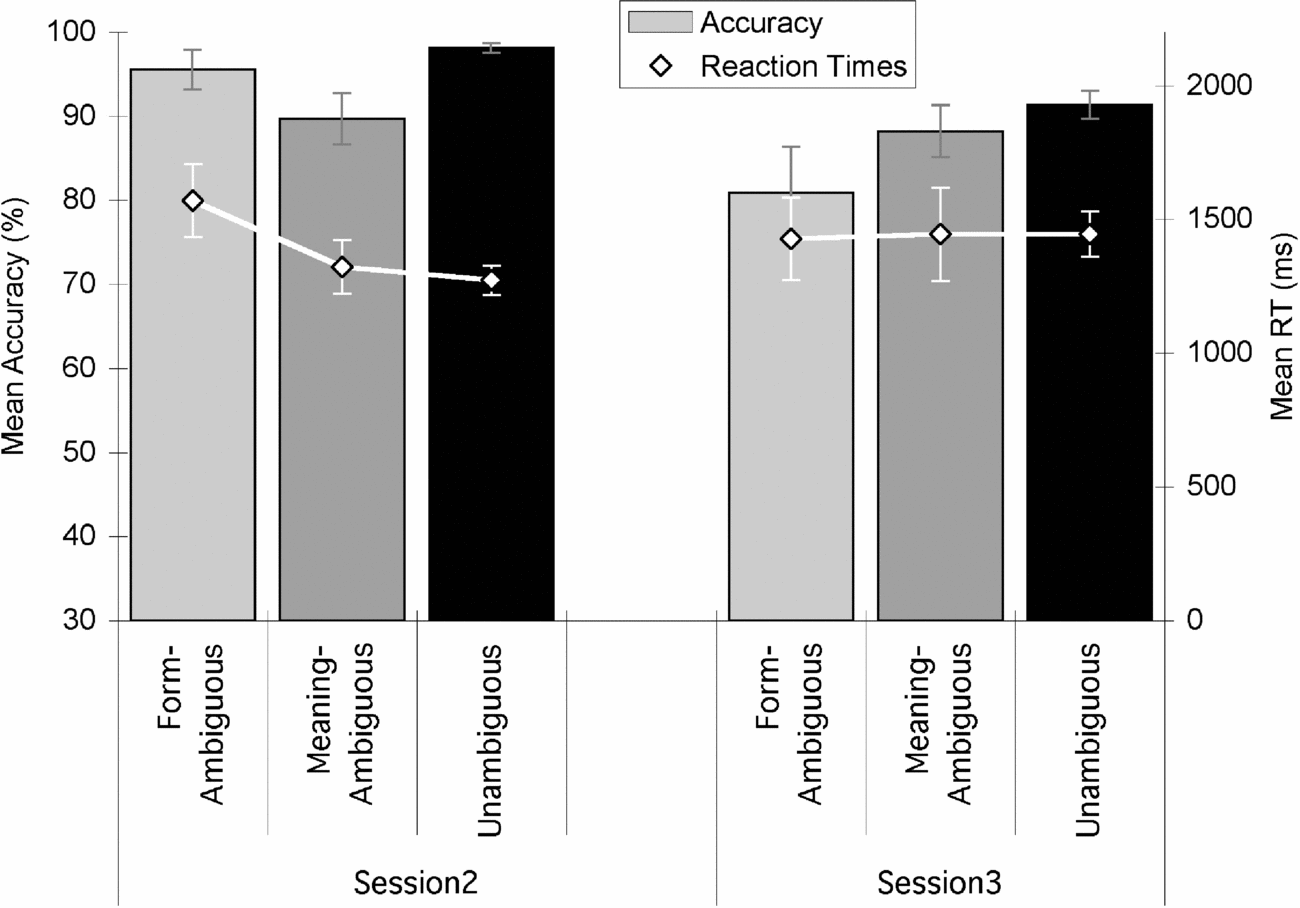
Further, the effect of ambiguity source was significant by participants, F1(2,68) = 7.98, MSE = 144757, p < .01, but not by items, F2(2,69) = 2.21, MSE = 56390, p > .10 (see Figure 2). Planned comparisons revealed that form-ambiguous items were responded to significantly more slowly (M = 1534) than meaning-ambiguous items (M = 1304), t(34) = 2.37, p < .05, and significantly more slowly than unambiguous items (M = 1242), t(36) = 3.93, p < .01, but that meaning-ambiguous items did not differ significantly from unambiguous items, t(34) = 1.16, p > .10.
Accuracy and reaction time data from the translation recognition test in the second and third sessions. Data are shown as a function of the type of item (form-ambiguous, meaning-ambiguous, or unambiguous) in the equated repetition condition.

To summarize, although significant only in the analyses by items or by participants, translation-ambiguous items were recognized less accurately and more slowly than unambiguous items. Furthermore, the recognition data again suggest that increasing the familiarity with ambiguous items by repeating them just as often during training is not sufficient to alleviate their learning disadvantage. The detailed comparison of meaning-ambiguous and form-ambiguous items revealed that form-ambiguous items suffer a learning disadvantage as compared to unambiguous items in the latency data.
Second recognition test: Third session
The second translation recognition test was administered following a Dutch-to-English production test in the third session. Data from 17 participants were included in the following analyses, and the results may therefore reflect reduced statistical power.
Accuracy
The effect of translation ambiguity on accuracy was reliable by participants, F1(1,16) = 7.31, MSE = .01, p < .05; F2(1,62) = 2.26, MSE = .06, p > .10, with ambiguous items being recognized less accurately (M = .84) than unambiguous items (M = .91).Footnote 3 Furthermore, as in the first recognition test, repeating ambiguous items as often as unambiguous items during training did not alleviate their disadvantage. Ambiguous items were still recognized less accurately (M = .85) than unambiguous items by participants (M = .91), F1(1,16) = 7.00, MSE = .01, p < .05; F2(1,70) = 2.76, MSE = .06, p > .10.
The effect of ambiguity source was significant by items, F1(2,32) = 1.98, MSE = .04, p > .10; F2(2,69) = 4.37, MSE = .05, p < .05. Planned comparisons revealed that form-ambiguous items were recognized marginally less accurately (M = .81) than unambiguous items (M = .91), t(16) = 1.93, p = .07, but that meaning-ambiguous items (M = .88) did not differ significantly from either, ps > .10.
Reaction times
Identical trimming procedures to those employed for the first recognition test were used and led to the removal of 3.8% of the data. The effects of translation ambiguity, ambiguity source, and ambiguity when comparing ambiguous items repeated as often as unambiguous items were not reliable, Fs < 1.
To summarize, the accuracy data from the second recognition test demonstrate a disadvantage for ambiguous items, which does not go away with additional repetition of the ambiguous items. The accuracy data also highlighted a learning disadvantage for form-ambiguous items. However, data from only 17 participants were available for these third session recognition analyses, and indeed none of the reaction time effects reached significance, likely due to reduced power.
English-to-Dutch production test: Third session
The English-to-Dutch production test was administered at the end of the third session. Data from 17 participants are included in the analyses that follow.
Accuracy
None of the effects were significant in the accuracy analyses, ps > .10.
Reaction times
Based on the distribution of the data, reaction times shorter than 300 ms or longer than 7000 ms, or that fell more than 2.5 standard deviations from each participant's mean reaction time for correct trials were removed from the analyses. These procedures resulted in the removal of 3.5% of the data. Analyses were performed on correct trials only.
The effect of translation ambiguity was not reliable by participants or by items, either when ambiguous items were presented less often than, Fs < 1, or as often as unambiguous items, ps > 10. However, the effect of ambiguity source was reliable by participants, F1(2,28) = 6.78, MSE = 109433, p < .01; F2(2,64) = 1.29, MSE = 618459, p > .10. Planned comparisons revealed that form-ambiguous items were translated significantly more slowly (M = 2101) than meaning-ambiguous (M = 1656), t(14) = 4.47, p < .01, and unambiguous (M = 1895) items, t(14) = 2.45, p < .05. The difference between meaning-ambiguous and unambiguous items was not significant, t(16) = 1.35, p > .10.
To summarize, the English-to-Dutch production test did not give rise to a robust ambiguity effect. Nonetheless, with only 17 participants the reaction time data still suggest that form-ambiguous items suffer a disadvantage relative to meaning-ambiguous and unambiguous items.
Comparing performance across tests and sessions
Several recognition and production tests were used to track performance over sessions. The pattern of results clearly demonstrates superior performance in recognition over production tasks, particularly with respect to accuracy, which is to be expected because chance-level performance would be 50% in the recognition tasks. Furthermore, translation from English to Dutch was performed less accurately than translation from Dutch to English, consistent with some previous studies (e.g., Kroll & Stewart, Reference Kroll and Stewart1994).
To examine potential changes in performance across sessions, we analyzed the data for the 15 participants who contributed data across all sessions and in all conditions in the analysis by participants. These analyses are therefore limited in their statistical power. In the analysis by items, we were able to maximize statistical power by including data from all participants who participated in each session. We focused these analyses on accuracy, which gave rise to the most robust effects. The analysis of the data from the Dutch-to-English translation task demonstrates that participants’ accuracy decreased across sessions, reflecting the fact that at later sessions, the tests measure retention because they did not follow training, F1(2,28) = 19.22, MSE = .04, p < .01; F2(2,138) = 59.77, MSE = .02, p < .01. There was no differential decay as a function of ambiguity or ambiguity source for the production test. In the recognition test, we again found that accuracy decreased from session two to session three, F1(1,16) = 17.79, MSE = .01, p < .01; F2(1,69) = 14.32, MSE = .03, p < .01. Moreover, there was a significant effect of ambiguity source in the analysis by items such that accuracy was highest for unambiguous items and lowest for form-ambiguous items, with meaning-ambiguous items in between, F1(2,32) = 1.99, MSE = .04, p > .10; F2(2,69) = 4.40, MSE = .03, p < .05. Importantly, there was differential decay across sessions such that accuracy for form-ambiguous items decreased more than for meaning-ambiguous items and for unambiguous items, F1(2,32) = 2.82, MSE = .02, p = .10; F2(2,69) = 3.82, MSE = .03, p < .05.
Discussion
In this study, we examined whether there is an ambiguity disadvantage in adult L2 word learning, and further whether the mapping of words-to-meanings per se influences this disadvantage. Across different tests and time points, we demonstrated that ambiguous words are harder to learn than unambiguous words. Specifically, ambiguous words were translated from Dutch to English more slowly and less accurately than unambiguous words immediately after learning, and this accuracy decrement remained even after a two-day delay. These ambiguous words were also recognized more slowly and less accurately, and showed some increase in reaction time when translated from English to Dutch. The ambiguity disadvantage was generally not alleviated by training the ambiguous items as often as the unambiguous items. Furthermore, the ambiguity disadvantage was more pronounced for the form-ambiguous items (two Dutch translations corresponding to the same meaning) than the meaning-ambiguous items (each translation corresponding to a different meaning of an ambiguous English word); the form-ambiguous items suffered the largest accuracy decay over sessions in the recognition task, further demonstrating the difficulty they pose for learning.
There are several possible reasons why one-to-many mappings such as those reflected by translation ambiguity pose difficulties. One possible mechanism is active competition between multiple translations. Interactive Activation (IA) models (e.g., McClelland & Rumelhart, Reference McClelland and Rumelhart1981) assume a competitive inhibitory interaction between connected representations. In the case of words with more than one translation, one word is connected to two translations in the other language, and competition between these different alternatives is likely to create interference, whereas no such competition is expected for words with only one translation. Thus, the difficulty for adults when they try to learn ambiguous words may be rooted in this competition between alternatives. Likewise, Doherty (Reference Doherty2004) suggested that the children in his study were poor at learning new meanings for pseudo-homonyms because they had difficulty suppressing the primary meaning of the homonyms, suggesting that competition from the primary meaning contributed to the observed effects.
A fan-type explanation could also provide a mechanism for the difficulty posed by multiple translations. In particular, the fan effect refers to the increase in latency to recall a concept as more facts are associated with that concept (e.g., Anderson, Reference Anderson1974). This phenomenon presumably reflects the decrease in associative strength from the concept to each fact, because as more facts are linked to a concept, the probability that a given fact will occur in the presence of the concept decreases (see Anderson & Reder, Reference Anderson and Reder1999, for discussion). Thus, in the case of translation ambiguity, the mapping of one word to two translations may decrease the associative strength of each translation pair.
Although both form- and meaning-ambiguous items could be subject to the same competition or fan-type effect, one-to-many mappings may be manifested differently for these two types of words. Indeed, form-ambiguous words suffered a greater disadvantage than meaning-ambiguous words in several tasks. Thus, learning two translations to the exact same meaning is especially difficult. In natural language learning, it is rarely the case that two word forms correspond to the exact same meaning in the manner implemented in the current study. It is more often the case that proficient language users are aware of slight meaning nuances or register differences between near-synonyms. However, these subtle meaning differences need to be acquired, and beginning L2 learners likely lack the experience to allow them to learn and appropriately apply these meaning nuances. Moreover, many textbooks for beginning classroom instruction do not make these distinctions salient. Therefore, the exact-synonymy we created in the current study for form-ambiguous items, by presenting two Dutch translations with the exact same meaning definition, likely reflects the challenges faced by beginning L2 learners.
Meaning-ambiguous items were learned more easily than form-ambiguous items, despite the existence of translation ambiguity for both. This pattern of results would be predicted if one assumes that because ambiguous English words have one word form but two meanings, it is possible to maintain a one-to-one mapping, perhaps by directly mapping a Dutch translation to each meaning representation. The ability of beginning L2 learners to map L2 words directly to meaning representations is a central issue in models of the bilingual lexicon. The Revised Hierarchical Model (Kroll & Stewart, Reference Kroll and Stewart1994), for example, suggests that beginning classroom learners typically access the meaning of L2 words via their L1 translations (but see e.g., Dufour & Kroll, Reference Dufour and Kroll1995; Duyck & de Houwer, Reference Duyck and de Houwer2008, for a different pattern of results), and that the ability to map L2 word forms directly to meaning increases with proficiency (e.g., Kroll & Stewart, Reference Kroll and Stewart1994; Talamas et al., Reference Talamas, Kroll and Dufour1999). The current study suggests that presenting learners with a meaning definition during training is a useful way to allow learners to more directly link L2 words to their meanings. Furthermore, directly mapping L2 words to their meanings appears to assist the learner in reducing the challenges of learning translation-ambiguous words.
Although meaning-ambiguous items had an advantage relative to form-ambiguous items on some measures, learning meaning-ambiguous items still appears to be more difficult than learning unambiguous items, although the numerical difference between them did not always reach significance. This lack of significance may be rooted in the variability of the meaning similarity of the meaning-ambiguous items. In particular, some ambiguous words have very unrelated meanings (e.g., the small coins and alteration meanings of change), and these two meanings were most likely already distinguished for our native English-speaking participants. Some ambiguous words, however, encompass two related meanings, or senses (e.g., people, denoting the body of citizens of a state or country, and more than one person), and these may not necessarily have a separate meaning representation for each sense (but see Klein & Murphy, Reference Klein and Murphy2001). Recent within-language ambiguity research has emphasized the importance of the degree of relatedness between the meanings or senses of an ambiguous word in explaining ambiguity effects (e.g., Armstrong & Plaut, Reference Armstrong and Plaut2008; Klepousniotou & Baum, Reference Klepousniotou and Baum2007; Rodd et al., Reference Rodd, Gaskell and Marslen-Wilson2002). Thus, it may be important to consider the degree of relatedness of the two meanings (or definitions) of meaning-ambiguous words.
To examine the relatedness of the two meanings of each meaning-ambiguous item in our stimulus set, we collected normative data from a group of 27 monolingual English speakers who rated the semantic relatedness of the two definitions of each meaning-ambiguous word, on a scale from 1 (completely different) to 7 (exactly the same). These norms indicate that indeed our meaning-ambiguous items varied considerably in the degree of relatedness of their meanings (M = 3.9, range 1.5–5.8). Because our items were not chosen to examine the impact of meaning relatedness on learning, and were not matched as such, more detailed examination of this interesting issue is not possible with the current data. Nonetheless, the variability in the meaning relatedness of the items likely influenced the ease with which learners could map a translation uniquely to each meaning. Future studies will investigate this issue more directly.
The ambiguity in the current study was such that two Dutch translations corresponded to the same English word. There was therefore no output competition between two alternatives in the Dutch-to-English translation production task. Nonetheless, a robust ambiguity disadvantage was observed in this task. Thus, our findings extend previous research that showed that translation ambiguity impacts bilingual language processing when output competition is present (e.g., Tokowicz & Kroll, Reference Tokowicz and Kroll2007), and show that translation ambiguity also influences learning.
Lastly, the current study shows that the ambiguity disadvantage goes beyond the decrement due to less-frequent exposure to translation-ambiguous items. With the exception of the Dutch-to-English production test administered during the last session (which had low statistical power), we found that repeating ambiguous items just as often during training was not sufficient to alleviate their accuracy disadvantage, and that one-to-many mapping, per se, creates challenges for learning.
In sum, the current study shows that translation ambiguity poses difficulty for adult L2 learning. Specifically, translation-ambiguous words, and particularly those that map onto a single meaning, were produced less accurately and more slowly than unambiguous pairs, both immediately after training and following a delay. These ambiguous pairs were further recognized less accurately and more slowly as correct translations. These learning decrements were not alleviated by repeating the ambiguous pairs more often during training. Because ambiguity is extremely prevalent in language, it can pose considerable difficulty for L2 learners. Therefore, it would be advantageous to identify teaching methods that are specifically tailored to these ambiguities, to provide learners with a better starting point when they try to communicate in L2.
Complete set of stimuli and definitions by condition