Introduction
Ever since HIV/AIDS emerged on the global scene, sub-Saharan Africa has felt the brunt of the pandemic more than anywhere else in the world. Even though sub-Saharan Africa is home to only 10% of the world's population, the region accounts for more than two-thirds of people living with HIV/AIDS and three-quarters of AIDS deaths around the world (UNAIDS & WHO, 2008). While recent data indicate a 15% decline in new cases since 2001 (BBC News, 2009), the yearly increase has been overwhelming. According to UNAIDS and WHO (2008), about 1.9 million Africans became newly infected with HIV in 2007 while about 1.5 million died from the disease. Although the HIV/AIDS situation in Ghana is not as grievous as in some southern and eastern African countries (UNAIDS & WHO, 2008), data from sentinel sites in the country indicate that prevalence has somewhat stalled at 3.4%, mostly due to high infection rates among young people (Ministry of Health Ghana, 2007). While intravenous drug use and homosexual activities are becoming important factors, heterosexual relationships remain central to HIV transmission in Ghana accounting for about 75–80% of infections (Akwara et al., Reference Akwara, Fosu, Govindasamy, Alayón and Hyslop2005).
In the face of these statistics, there have been calls for a multifaceted approach at addressing the pandemic, involving a critical examination of socio-cultural factors believed to influence the spread of the virus (see Yamba, Reference Yamba1997; Amuyunzu-Nyamongo et al., Reference Amuyunzu-Nyamongo, Tendo-Wambua, Babishangire, Nyagero, Yitbarek, Matasha, Omurwa, Caldwell and Caldwell1999; Caldwell, Reference Caldwell2000). Given its relevance in the lives of Africans (Gifford, Reference Gifford1994; Bediako, Reference Bediako1995; Ojo, Reference Ojo2000; Jenkins, Reference Jenkins2002), it has been argued that religion may have a role in HIV prevention, especially on sexual decision-making, which has implications for the transmission of the virus (Takyi, Reference Takyi2003). Some also interpret the rising HIV/AIDS prevalence as evidence of sexual promiscuity and moral decadence and do consider religion as uniquely situated in the fight against the pandemic (Garner, Reference Garner2000; Trinitapoli & Regnerus, Reference Trinitapoli and Regnerus2006; Adogame, Reference Adogame2007). Indeed, there is a growing interest in sub-Saharan Africa in the interface of religion and several outcomes (for recent studies in Ghana, see Addai, Reference Addai2000; Takyi & Addai, Reference Takyi, Addai, Tettey, Puplampu and Berman2003; Allain et al., Reference Allain, Anokwa, Casbard, Owusu-Ofori and Dennis-Antwi2004; Gyimah et al., Reference Gyimah, Takyi and Addai2006, Reference Gyimah, Takyi and Tenkorang2008; Gyimah, Reference Gyimah2007), which reflects the emergence of religion as a major social force in the region. In a recent BBC News (2005) survey, it was reported that three-quarters of respondents from Africa identified religious leaders as the most trusted group compared with only a third worldwide. Asked who had had the most influence on their decision-making over the past year, a significantly higher proportion of respondents in Africa referred to religious leaders.
Perhaps it is against this backdrop that religion has become relevant in the discourse on HIV/AIDS research (Kagimu et al., Reference Kagimu, Marum, Wabwire-Mangen, Nakyanjo, Walakira and Hogle1998; Takyi, Reference Takyi2003). This realization is also due in part to the fact that the average African's conception of the virus is often shrouded in religious mysteries (Heike, Reference Heike2007). In much of the region, there is still the belief that AIDS could be transmitted through spiritual means or divine punishment (see Yamba, Reference Yamba1997; Trinitapolis & Regnerus, Reference Trinitapoli and Regnerus2006). In Zenebe's (Reference Zenebe2007) study in Ethiopia, some informants were of the opinion that infection with HIV/AIDS is a punishment from God for engaging in an immoral sexual act. In the 2003 Ghana Demographic and Health Survey, it was reported that about 41% of men and 54% of women had the misconception that AIDS could be transmitted through supernatural means. The authors of the present paper agree with Heike (Reference Heike2007) that the thought of AIDS as a curse from God, ancestors, witchcraft, and other supernatural beings could undermine preventive efforts by shifting the cause of the virus to an outwardly spiritual power over which the victim has no control.
Although some recent studies have empirically linked religious involvement to increased AIDS awareness and changes in some specific behaviours (see e.g. Parkhurst, Reference Parkhurst2001; Takyi, Reference Takyi2003), much of this research has been conducted with women samples. Ignored for the most part are studies that focus on African men (for some exceptions, see Lagarde et al., Reference Lagarde, Enel, Seck, Gueye-Ndiaye, Piau and Pison2000; Trinitapoli & Regnerus, Reference Trinitapoli and Regnerus2006). This neglect is unfortunate given the overwhelming evidence that the sexual behaviour of African men is critical to the transmission of the AIDS virus in the region (Caldwell, Reference Caldwell2000; UNAIDS, 2004). Additionally, the exclusive focus on women, as most studies do, could confound one's understanding of the interconnectedness of religion and HIV prevention given the overwhelming influence of men on women's reproduction (see e.g. Ezeh, Reference Ezeh1993; Dodoo, Reference Dodoo1995; Dodoo & Landewijk, Reference Dodoo and van Landewijk1996). While contributing to the literature on religion and public health in Africa, this study focuses on men in particular, and investigates if their religious involvement affects their sexual behaviour using data from Ghana, a highly religious nation (Gallup International, 2000). The focus on men also provides yet another opportunity to test existing theoretical ideas on the link between religion and sexual behaviours, which has implications for the transmission of the AIDS virus.
Religion and HIV/AIDS
Social scientific research has identified a host of socio-cultural, economic, political and behavioural factors as important correlates of HIV/AIDS in sub-Saharan Africa (Caldwell et al., Reference Caldwell, Caldwell and Quiggin1989, Reference Chatterji, Murray, London and Anglewicz1992; Caldwell & Caldwell, Reference Caldwell and Caldwell1993; Oppong, Reference Oppong1995; Brockerhoff & Biddlecom, Reference Brockerhoff and Biddlecom1999; Caldwell, Reference Caldwell2000; Susser & Stein, Reference Susser and Stein2000). On the religion–HIV discourse in particular, two principal schools of thought can be identified, namely, the particularized theology and selectivity theses (Lagarde et al., Reference Lagarde, Enel, Seck, Gueye-Ndiaye, Piau and Pison2000; Parkhurts, Reference Parkhurst2001; Takyi, Reference Takyi2003; Allain et al., Reference Allain, Anokwa, Casbard, Owusu-Ofori and Dennis-Antwi2004; Trinitapoli & Regnerus, Reference Trinitapoli and Regnerus2006). The selectivity school contends that the relationship is somewhat ambiguous and that religious variations in HIV/AIDS preventive behaviour reflect differential access to social and human capital, including education, ethnic affiliation, or extent of exposure to the disease.
The particularized theology paradigm on the other hand contends that religion is a pervasive and salient aspect of social interaction in Africa that can make a difference to people's sexual behaviour (Kagimu et al., Reference Kagimu, Marum, Wabwire-Mangen, Nakyanjo, Walakira and Hogle1998). This view derives in part from Durkheim's notion of religion as an institution of social control based on the idea that doctrinal teachings, beliefs and values of the various religious groups could influence behaviour. As Hummer and colleagues (Reference Hummer, Ellison, Rogers, Moulton and Romero2004) point out, a key function of religious communities is to shape the norms of individual members through behavioural regulations that are specified in sacred teachings, reinforced through authoritative messages from congregational leaders, and solidified through social interactions in the religious community. This is well manifested in Ghana where religious leaders teach and preach to congregations on a broad range of moral issues in places of worship. HIV/AIDS preventive behaviour could, however, be influenced positively or negatively through doctrinal teachings and prohibitions on sexuality and sexual behaviour in general. Discouraging condom use, opposing sex education, and giving religious interpretations to the spread of the virus for instance could undermine AIDS prevention (World Bank, 1997). On the other hand, the ‘born-again’ experience of Pentecostalism, has been found to associate with changes in risky sexual behaviours (Chesnut, Reference Chesnut1997; Maxwell, Reference Maxwell1998; Tenkorang et al., Reference Tenkorang, Fernando and Maticka-Tyndale2009). As Maxwell (Reference Maxwell1998) points out, once individuals become ‘born-again’, they are converted into a ‘community of the saved’ and strive to maintain a state of inner purity necessary to receive empowerment from the Holy Spirit. Religion and faith-based organizations may also be uniquely situated to help in the diffusion of ideas about AIDS prevention through social capital (Rutenberg & Watkins, Reference Rutenberg and Watkins1997; Agadjanian, Reference Agadjanian2001). In Takyi's (Reference Takyi2003) study of women in Ghana, he found significant associations between religious affiliation and increased knowledge about AIDS transmission, which he argued could be due to social networking among certain religious groups.
Although existing studies have found some support for the possible role of religion in influencing HIV-related behaviour, the bulk of such studies has relied on women samples only. The present study attempts to estimate the net effects of religion on the risky sexual behaviours of men in Ghana. Using religious affiliation – the specific religious group a person belongs to – men's HIV/AIDS protective behaviour is investigated, with specific emphasis on the number of sexual partners and participation in paid sex. Since religious beliefs and involvement may be central to the social construction of wellness and health risks, it is expected that sexual behaviour will differ among the various religious denominations at least at the bivariate level.
Data and Methods
The study draws on men's data from the 2003 Ghana Demographic and Health Survey (GDHS-03), which has measures on religion and sexual behaviour. GDHS-03 is a large nationally representative dataset collected by the Ghana Statistical Service and Macro, and it is the fourth of such recent national surveys that form part of the Global Demographic and Health Surveys programme. The study was designed to provide current information about demographic processes in Ghana. The GDHS-03 utilized a two-staged, stratified sample frame in which a systematic sampling with probability proportional to size was used to identify 412 enumeration areas to select households in the country. From the selected households, 5015 randomly selected men aged 15–49 were interviewed. The present study is restricted to only sexually active men, meaning respondents who had never had sex were dropped from the analysis.
The dependent variable for this study is conceptualized as risky sexual behaviour, which according to UNAIDS & WHO (2008) is central to the spread of HIV in West Africa including Ghana. This variable was created from questions that tapped into respondents' sexual encounters, principally on whether they have ever paid for sex or had more sexual partners other than wife or wives. Sexually active respondents who indicated they had more sexual partners or ever paid for sex were considered as high risk-takers. Group membership was used as the measure of religion. While acknowledging that the multidimensional nature of religion is not easily captured by affiliation alone, the study was constrained by the data available (the only religion-related variable in the data). However, the authors also share in Lehrer's (Reference Lehrer2004) view that affiliation by itself provides significant information for exploring religion and other aspects of socio-demographic behaviour. For the analysis, religious affiliation, the main independent variable, is categorized into the following: Christian, Muslim and Traditional/no religion. Appropriate controls included in the models are socioeconomic and demographic factors, and other AIDS-related variables that are known to affect sexual behaviours. These include age, marital status, educational attainment, place of residence, ethnicity, knowledge about AIDS and knowledge about people who have died from AIDS. Following the advice of a reviewer, circumcision status is also controlled for, given its importance for HIV acquisition risk, and association with religious affiliation.
Although the dependent variable is dichotomous, the cases are unevenly distributed between the categories meaning that the logit or probit link functions that assume a symmetrical distribution could produce biased estimates. Given this, a
complementary log–log function was chosen, which is better suited for asymmetrical distribution. The standard complementary log–log model, however, is built on the assumption of independence of observations but the GDHS has a hierarchical structure with respondents nested in survey clusters which could potentially bias the standard error and inferences thereof. An attempt has been made in this study to control for this dependence by using a random-effects complementary log–log model. A useful measure in the random-effects specification is the residual correlation rho defined as  , where
 is the estimated cluster-level variance, and
 is the variance of a standard Gumbel distribution which is asymmetric (Skrondal & Rabe-Hesketh, Reference Skrondal and Rabe-Hesketh2008).
Findings and Discussion
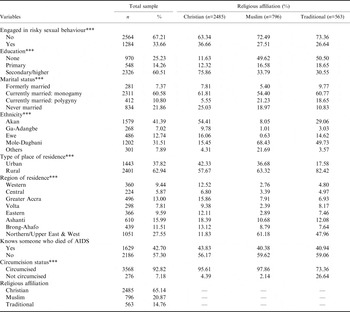
Table 1 presents the descriptive statistics as well as cross-tabulations by religious affiliation. The results suggest a predominantly Christian population with almost two-thirds of the sample compared with a fifth who identified as Muslims and about 15% adherents of Traditional religion. While just about a third of the sample (34%) is involved in high-risk sexual behaviours, there are significant religious differences. The proportion that engages in high-risk sexual behaviour is highest among Christian men (37%) and least among Traditionalists (27%). Circumcision is almost universal (97%) but there are significant religious variations; it is less common among Traditionalists compared with Muslims and Christians. Although descriptive, these results also highlight some socioeconomic differences among men of different religious affiliations. There is evidence that Christians are more urbanized, highly educated and less likely to be found in Northern Ghana compared with Muslims and Traditionalists. For example, about three-quarters of Christian men have at least secondary education compared with about a third of Muslims and Traditionalists. On the other hand, the proportion of rural residents as well as those in polygynous marriages is higher among Muslims and Traditionalists. It needs mentioning that these socioeconomic and demographic differences could bear significantly on the relationship between religion and sexual risk-taking.
Descriptive statistics of the variables

*** p<0.001.
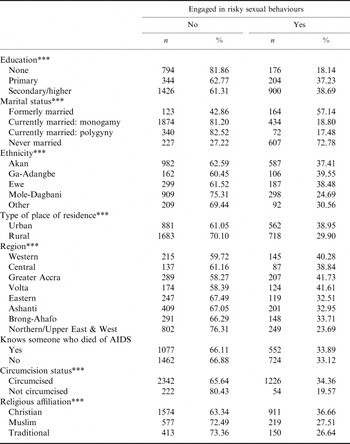
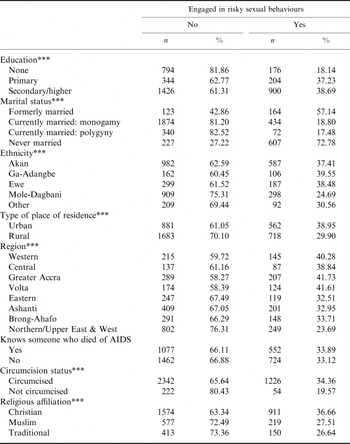
Table 2 shows bivariate analyses of the dependent variable, sexual risk-taking, and theoretically relevant covariates. There is evidence that Muslim and Traditional men are less likely to engage in risky sexual behaviour compared with Christians. The relatively high risk among Christians could be partly attributed to the fact that some Christian denominations are more ideologically tolerant and lax in enforcing doctrinal beliefs (see Agadjanian, Reference Agadjanian2001; Tenkorang et al., Reference Tenkorang, Fernando and Maticka-Tyndale2009). Compared with Muslims and Traditionalists, some Christian sects in Ghana tend to be more sexually liberated, probably because they are better educated and may, by default, resist cultural norms regulating sexual behaviours (see Addai, Reference Addai1999). This is not usually the case among Muslims and Traditionalists who, although more likely to be in polygynous marriages, have stricter sanctions governing sexual conduct. Among the Muslims for instance, sexual misconduct, in the form of premarital sex or sex outside marriage, is punishable under the Sharia. The case of a 17-year-old girl in Zamfara, Nigeria, sentenced to 180 lashes for indulging in premarital sex is still fresh in the minds of many (see Adepegba, Reference Adepegba2001). Traditionalists also place high premium on virginity and frown on sexual promiscuity, which in the past had severe sanctions (Awusabo-Asare et al., Reference Awusabo-Asare, Abane and Kumi-Kyereme2004).
Bivariate analysis of risky sexual behaviour and selected variables
*** p<0.001.
Educational attainment is also a significant predictor of sexual risk-taking at the bivariate level. About two-fifth of those with primary and secondary education can be classified as high risk takers compared with less than a fifth of those with no education. Culture is always an important variable on issues of sexuality and sexual behaviour in sub-Saharan Africa (see Caldwell et al., Reference Caldwell, Caldwell, Ankrah, Anarfi, Agyeman, Awusabo-Asare and Orubuloye1993; Caldwell, Reference Caldwell2000; Awusabo-Asare et al., Reference Awusabo-Asare, Abane and Kumi-Kyereme2004). Although racially homogenous, Ghanaians come from different socio-cultural background implying that norms regulating sexual behaviour may be different among ethnic groups. Compared with the Akans, the Mole-Dagbanis are significantly less likely to indulge in high sexual risk-taking behaviours. While Ga/Adangbe men seem more likely to indulge in high sexual risk-taking behaviours, the effects are not statistically significant. The ethnic differences could, however, be a function of socioeconomic and geographic factors since ethnic groups in Ghana tend to be regionally based with remarkable differences in socioeconomic development. Respondents from urban areas are also more likely to indulge in risky sexual behaviours compared with those from rural areas. There are some regional differences regarding sexual risk-taking among Ghanaian men with respondents in the southern regions more likely to engage in risky sex compared with those in the north. There are significant differences by marital status, the risk being highest among never and formerly married men.
Overall, the bivariate results in Table 2 suggest significant associations between religious affiliation and risky sexual behaviour among men in Ghana, but the question arises as to whether the effects of religion will be retained net of other variables. For example, Ghana, like most developing countries, shows a marked north–south regional imbalance in development that can partly be traced to colonialism and the ineptitude of post-colonial governments. Thus, any meaningful analysis must control for the north–south regional disparities. It is important to note that while Christians are more likely to be found in the South, Muslims are predominant in the North. Circumcision could also be a confounder given the religious differences discussed earlier.
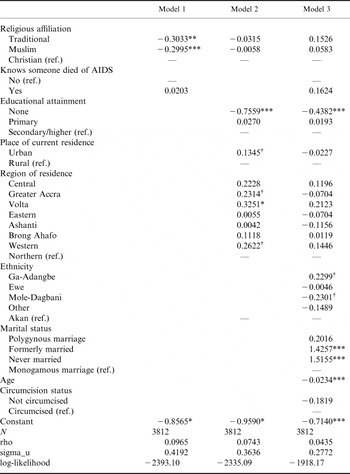
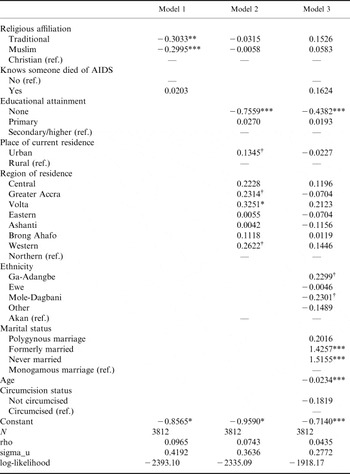
Taking cues from these, the multivariate models control for theoretically relevant covariates. The results of the random-effects model presented in Table 3 explore whether the religious differences in sexual risk-taking could be attributed to other socioeconomic factors in line with the selectivity thesis. The rho ranges from about 10% in Model 1 to 4% in Model 3. The significant reduction in rho across models suggests that there is little cluster-level dependence after controlling for the observed covariates. Model 1 controls for religion and whether respondents know of someone who died of AIDS. There is evidence that Muslims and Traditionalists have a 26% lower risk (1 − exp b) of engaging in risky sexual behaviour compared with Christian men, which is consistent with recent findings in Cameroun (Kongnyuy et al., Reference Kongnyuy, Wiysonge, Mbu, Nana and Kouam2006). Model 1 also suggests that those who know of someone who died of the disease are more likely to indulge in risky sexual behaviour, although the effects are not statistically significant at conventional alpha levels. Evidence from Model 2, however, suggests that the relatively lower risk among Muslims and Traditionalists relative to Christians is primarily a function of socioeconomic and location factors. While the direction of the effects for Muslims and Traditionalists in Model 2 is consistent with observations in Model 1, there is a significant attenuation of their magnitudes. It is worth mentioning again that Muslims and Traditionalists in Ghana tend to be less educated, and are geographically concentrated in the North and rural areas (see Table 1) where cultural norms regulating sexual behaviours tend to be less permissive. It is thus not surprising that once these factors are controlled, the relatively low risk among Muslims and Traditionalist attenuates. The results of Model 2 are thus more consistent with the thesis that the denominational differences in Ghana reflect socioeconomic differences.
Random-effects complementary log–log model of risky sexual behaviour among men in Ghana
*** p<0.001;
** p<0.01;
* p<0.05;
† p<0.10.
After controlling for all the covariates in Model 3, however, some significant patterns on the affiliation variable in particular are discernible where the likelihood of engaging in risky sexual behaviour is elevated for Muslims and Traditionalists although not statistically significant at conventional alpha levels. The elevated risk for Muslims and Traditionalists in the final model suggests that the religious differences observed in Model 2 are suppressed by socio-cultural and demographic factors, particularly the marital status variable. As reported in Table 1, about a fifth of Muslims and Traditionalists are in polygynous unions compared with 6% of Christians. The elevated risks for formerly married and never married men are consistent with previous findings in sub-Saharan Africa (see Waithaka & Bessinger, Reference Waithaka and Bessinger2001; Chatterji et al., Reference Chatterji, Murray, London and Anglewicz2004; Kongnyuy et al., Reference Kongnyuy, Wiysonge, Mbu, Nana and Kouam2006). With regard to the other control variables, there is evidence in Model 3 that those who know someone who has died of AIDS are more likely to engage in risky sexual behaviours. Although this sounds counterintuitive, there are plausible reasons. Macintyre and colleagues (Reference Macintyre, Brown and Sosler2001) specified two possible reactions of individuals given their exposure to AIDS deaths. The first relates to behavioural change which only occurs if individuals know how to protect against the disease. The second is to react with a sense of fatalism, which usually stems from lack of knowledge that AIDS can be avoided and in which case, knowing whether someone has died of AIDS could fail to produce the anticipated effects (Caldwell, Reference Caldwell and Caldwell1999; Tenkorang et al., Reference Tenkorang, Fernando and Maticka-Tyndale2009). It is also likely that those reporting to have known someone who died of AIDS may belong to a network of high sexual risk-takers involved in similar lifestyles. However, it was not possible to examine this thoroughly given that there is no information on the relationship of respondents and those who died of AIDS. Usually, it is expected that AIDS deaths will invoke behavioural change when it precedes sexual behaviours, but the cross-sectional nature of the data used does not allow the causal connections between AIDS deaths and sexual behaviours to be clearly disentangled. Clearly, further studies are needed in this area, especially with longitudinal data.
Turning to ethnicity, it is observed that the Ga-Adangbes are more likely to indulge in risky sexual behaviours, compared with the Akans. HIV/AIDS prevalence among the Adangbes (especially the Krobos) has been historically high compared with other ethnic groups in Ghana (see Sauve et al., Reference Sauve, Dzokoto, Opare, Kaitoo, Khonde, Mondor, Bekoe and Pepin2002). It is documented that they often embark on poverty-driven adventures to neighbouring countries where they sometimes indulge in promiscuous lifestyles (see Anarfi, Reference Anarfi1993; Sauve et al., Reference Sauve, Dzokoto, Opare, Kaitoo, Khonde, Mondor, Bekoe and Pepin2002). The final model also indicates that those with no education are less likely to indulge in risky sexual behaviours than their highly educated counterparts. Although it would seem logical to think that highly educated men will rather be less likely to engage in sexual risk-taking mainly because they are better equipped to make informed choices, there are conflicting findings in the literature. While some studies demonstrate an inverse relationship between education and risky sexual behaviours (UNAIDS/WHO, 2003; Zellner, Reference Zellner2003), others show a positive relationship (Booysen, Reference Booysen2004; Dinkelman et al., Reference Dinkelman, Lam and Leibbrandt2008; Tenkorang & Fernando, Reference Tenkorang and Fernando2008), and no link (Meekers, Reference Meekers1994; Akwara et al., Reference Akwara, Fosu, Govindasamy, Alayón and Hyslop2005). The present findings are consistent with others that indicate that highly educated men are more likely to engage in risky sexual behaviours. Some explanations for this include resources available to highly educated men that make them more desirable and sought-after sexual partners, their greater rejection of traditional and religious teachings and their greater openness to new trends (Hargreaves & Boler, Reference Hargreaves and Boler2006; Tenkorang & Fernando, Reference Tenkorang and Fernando2008). Also, the young and single men are more likely to engage in risky sexual behaviour. This is consistent with recent findings in Ghana where the stall in HIV/AIDS prevalence rates has been attributed, in part, to risky behaviour among young people (UNAIDS, 2007). Their vulnerability is compounded by the scant knowledge of how HIV is spread and how the disease can be avoided.
Conclusions
Although a growing body of research has linked religious involvement with health-related outcomes, including HIV/AIDS-related behaviour, in Africa, most of the existing studies are based on women samples only. Given the patriarchal nature of African culture and the fact that men's sexual behaviour has increasingly been linked to women's vulnerability to HIV, there is a need to focus on men as well. Using data on men from the 2003 Ghana Demographic and Health Survey, this paper explored the interconnectedness between risky sexual behaviours and religious affiliation. At the bivariate level, the results suggested significant differences in risky sexual behaviours among men of different religious faiths. In particular, Traditional and Muslim men were less likely to engage in risky sexual behaviours compared with Christian men. In the multivariate models, however, the religious differences disappeared after controlling for socioeconomic and geographic factors.
These findings are thus more consistent with the selectivity thesis that attributes group differences to socioeconomic characteristics than intrinsic factors per se. As Gyimah (Reference Gyimah2007) has argued, however, there is the need to distinguish between mediating and confounding effects of the socioeconomic factors. Educational attainment, for example, can be thought of as a mediating variable in that religious affiliation may influence the proclivity to seek formal education, which in turn affects sexual behaviours (see Takyi & Addai, Reference Takyi and Addai2002). On the other hand, region and place of residence have a confounding effect on religion in the Ghanaian context given the higher prevalence of Islam and Traditional religion in rural areas and northern Ghana. So the non-significant effect of religion after controlling for the socioeconomic factors does not necessarily mean that religion is unimportant but rather its effect is indirect and operates through education.
The paper has policy suggestions that underscore the need to tailor intervention programmes to the unique needs and circumstances of specific groups. With respect to the religious effects, while the potential for faith-based institutions in combating the HIV/AIDS pandemic is undeniable, policy-makers need to heed the important differences among these institutions while devising ways to harness this potential. Compared with the other religious groups, this study found that sexual risk-taking among Christians is high, but this is not because Christians lack education as to how HIV/AIDS can be prevented. Indeed, as has been found by other studies, Christians are more educated than the other religious groups (see Garner, Reference Garner2000; Tenkorang et al., Reference Tenkorang, Fernando and Maticka-Tyndale2009). It is the authors' conviction, however, that compared with the other religious faiths, some Christian faiths have been lax in socializing and enforcing religious doctrines governing sexual behaviours. To this extent, there is the need to pay particular attention to Christian groups as they have a role to play in AIDS prevention in Africa. The message of sexual abstinence among young people, which was once met with stiff opposition, must be revived, especially as studies have shown that delaying sexual intercourse could help curb the spread of the virus (see Tenkorang & Maticka-Tyndale, Reference Tenkorang and Maticka-Tyndale2008). Younger men and those not currently married were found to be significantly more likely to engage in risky sexual behaviours. Specifically designed campaigns targeting these men may play a significant role in behaviour change. Again, while HIV prevention programmes often focus on the illiterate population, this study found that it is rather the highly educated men who are more at risk, which calls for a paradigm shift in the design of preventive campaigns.
The study had some limitations that need to be acknowledged. First, as with most population-based surveys on sexual behaviour, self-reports of sensitive questions bearing on sexuality, including sexual behaviour, could be biased through under- or over-reporting (Zaba et al., Reference Zaba, Pisani, Slaymaker and Boerma2004). Second, since the respondents were asked about their affiliation only, it was not possible to explore intrinsic and extrinsic aspects of religion on risky behaviour among Ghanaian men. Also, because the questions deal with religion at the time of the survey, it was not possible to address the issue of religious switching across the life-span on sexual behaviour, a limitation that is best handled with longitudinal data. Given these limitations, a more comprehensive dataset with several variables on various dimensions of religiousness, supplemented by qualitative interviews, could go a long way in clarifying the links between religion and AIDS behaviour in Africa. Also, homogenizing the Christian faith as was done in this study conceals subtle but important liturgical differences. Future studies could examine the sub-denominational differences within the Christian groups.
Acknowledgment
The authors gratefully acknowledge funding from the Social Science and Humanities Research of Canada (SSHRC) Standard Research Grant #410-2009-0209 entitled ‘Religion, religiosity, and reproductive behaviour in sub-Saharan Africa’.