INTRODUCTION
Almaco jack, Seriola rivoliana Valenciennes, 1833 (Osteichthyes: Carangidae) is a circumtropical and temperate fish occurring in the Pacific Ocean (Eschmeyer et al., Reference Eschmeyer, Herald and Hammann1983), Indian Ocean (Smith-Vaniz, Reference Smith-Vaniz, Fischer and Bianchi1984) and the western Atlantic (Nakamura, Reference Nakamura, Flandorfer and Skupien1980). In the eastern Atlantic, it is known from the Azores, Portugal and Madeira (Fischer et al., Reference Fischer, Bianchi and Scott1981), and has also been observed off southern England (Wheeler, Reference Wheeler1986), and in the Bay of Biscay (Quéro, Reference Quéro1998).
MATERIALS AND METHODS
In August 2010, three specimens of Seriola rivoliana were caught off the Balearic Islands (western Mediterranean). Two specimens were captured on the 17 August (only one was preserved, Sp1) and the other on the 18 August (Sp2). The specimens were frozen and subsequently examined at the Centre Oceanogràfic de les Balears (Instituto Español de Oceanografía). The second specimen was preserved in formalin and deposited in the fish collection of the Balearic Islands Society of Natural History, with the reference number MNIB0184.
The meristic and morphometric characters of the specimens were measured according to Fischer et al. (Reference Fischer, Bianchi and Scott1981). The main features used to identify the specimens as S. rivoliana were: (i) supramaxilla of adults broad, with posterodorsal angle acute; (ii) second dorsal fin lobe 4.0 to 6.3 times in fork length; (iii) nuchal band, when present, extending from eye to origin of first dorsal fin; and (iv) first pterygiophore of anal fin straight in specimens larger than ~10 cm fork length (Smith-Vaniz, Reference Smith-Vaniz and Carpenter2002).
RESULTS
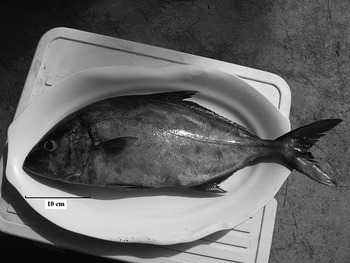
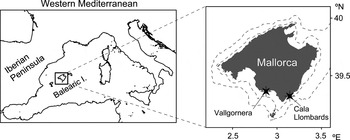
Both individuals were immature females, measuring 45.9 cm (Sp1) (Figure 1) and 47.9 cm (Sp2) total length (TL), and weighing 1.2 and 1.4 kg, respectively. No stomach contents were found. The specimens were caught, together with individuals of greater amberjack Seriola dumerili, in trap nets (called ‘morunas’) at Cala Llombards and Vallgornera, in the south of Mallorca (Figure 3), where this traditional fishing gear is used by professional fishermen.
Seriola rivoliana (45.9 cm total length; Sp1) captured off Mallorca (Balearic Islands; western Mediterranean).

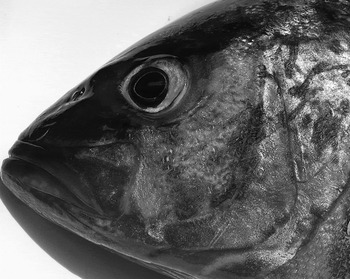
Detail of the upper jaw supramaxilla of Seriola rivoliana (45.9 cm total length; Sp1) captured off Mallorca.

Map showing the locations where the three specimens of Seriola rivoliana were captured off Mallorca (Balearic Islands; western Mediterranean).

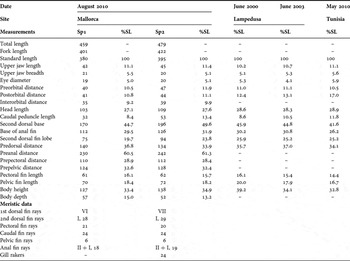
Morphometric (in mm) and meristic characteristics for both specimens are presented in Table 1. They correspond to those described in the literature for this species (Fisher et al., 1981; Smith-Vaniz, Reference Smith-Vaniz and Carpenter2002). Dorsal fin lobe of Sp1 and Sp2 were 5.3 and 4.5 times in fork length, respectively. The broad supramaxilla was clearly visible (Figure 2), and distinguished the specimens from its co-generic species Seriola fasciata. Morphometric measurements, as a percentage of standard length (%SL), are also given for other specimens reported from the Mediterranean (Table 1).
Morphometric measurements (mm) and meristic data of the two specimens of Seriola rivoliana captured off Mallorca (Balearic Islands, western Mediterranean). The percentages of all measurements with respect to the standard length (%SL), as well as those of the other specimens previously cited in the Mediterranean (Castriota et al., Reference Castriota, Greco, Marino and Andaloro2002, Reference Castriota, Falautano, Greco and Andaloro2004; Mansour et al., Reference Mansour, Azzouz, Boumaïza, Ben Amor and Capapé2011), are also shown.

These captures represent the first report of S. rivoliana from the western Mediterranean, and the fourth and fifth specimens for the whole Mediterranean. In 2000 and 2003, two specimens of this species were recorded off Lampedusa Island (Castriota et al., Reference Castriota, Greco, Marino and Andaloro2002, Reference Castriota, Falautano, Greco and Andaloro2004), and in 2010 one specimen was recorded off the northern coast of Tunisia (Mansour et al., Reference Mansour, Azzouz, Boumaïza, Ben Amor and Capapé2011), in the central Mediterranean.
DISCUSSION
Greater amberjack Seriola dumerili is the only native species of the genus Seriola in the Mediterranean Sea. Nevertheless, other species of this genus of Atlantic origin have been recorded in the area during the last two decades. That is the case for the lesser amberjack Seriola fasciata, which was first recorded by Massutí & Stefanescu (Reference Massutí and Stefanescu1993) and has also been recorded at different sites in the Mediterranean, including the southern Tyrrhenian Sea, off Sicily and Lampedusa in the Sicily Channel, Gulf of Lions, Gulf of Gabès, Rhodes and Israel (Golani et al., Reference Golani, Orsi-Relini, Massutí, Quignard and Briand2002). In fact, this is considered to be one of the Atlantic fish species that has expanded its range in the Mediterranean (Massutí et al., Reference Massutí, Valls, Ordines, Golani and Appelbaum-Golani2010), and has also increased its northern range in the eastern Atlantic (Bañón & Mucientes, Reference Bañón and Mucientes2009). Similarly, Guinean amberjack Seriola carpenteri, a species relatively common along the African coasts of the Atlantic, has also been recorded off Lampedusa in the Mediterranean (Pizzicori et al., Reference Pizzicori, Castriota, Marino and Andaloro2000) and has also been captured in North Atlantic waters, far from their main distribution area (Wheeler, Reference Wheeler1986).
The present report increases the known distribution area of S. rivoliana in the Mediterranean and supports the expansion of sub-tropical Seriola species, entering through the Strait of Gibraltar, into the area. Both S. fasciata and S. carpenteri seem to be well established in the area (Golani et al., Reference Golani, Orsi-Relini, Massutí, Quignard and Briand2002) and the former has even increased sufficiently to have become of importance to fisheries in the Sicilian Channel area (Andaloro et al., Reference Andaloro, Falautano, Sinopoli, Passerelli, Pipitone, Addis, Cau and Castriota2005).
It also represents a new report of an Atlantic species in the western Mediterranean, increasing the number of exotic and vagrant fish in the area. Massutí et al. (Reference Massutí, Valls, Ordines, Golani and Appelbaum-Golani2010) reported 38 new fish since the middle 20th century and Zenetos et al. (Reference Zenetos, Gofas, Verlaque, Cinar, García Raso, Bianchi, Morri, Azzurro, Bilecenoglu, Froglia, Siokou, Violanti, Sfriso, San Martín, Giangrande, Katağan, Ballesteros, Ramos-Esplá, Mastrotorato, Ocaña, Zingone, Gambi and Streftaris2010) reported 45 new fish (20 established and 25 casual) inventoried in the 20th century. Most of them are of tropical (subtropical) Atlantic origin.
The current information on S. rivoliana in the Mediterranean, for which all the specimens captured in this area have been solitary, is not enough to consider this species as an established Atlantic migrant. However, the ecological role of these new species within the western Mediterranean ecosystems, and their potential impact on native populations of other carangids needs to be better understood.
ACKNOWLEDGEMENTS
Greatest thanks are expressed to fishermen M. Munar and J.J. Clar, for contacting the Centre Oceanogràfic de les Balears (Instituto Español de Oceanografía) and the Direcció General de Pesca (Govern de les Illes Balears) after the capture of the individuals, and to Francesc Ordines who provided the map.