INTRODUCTION
The PCR-based RAPD marker technique is widely used for distinguishing genetic variation of populations at the individual level since it detects mutations in coding and non-coding regions of genomes (Kirsten et al., Reference Kirsten, Dawes and Cochrane1998), genetic mapping (Chalmers et al., Reference Chalmers, Cambell, Kretschmer, Karakousis, Henschke, Pierens, Harker, Pallotta, Cornish, Shariflou, Rampling, McLauchlan, Daggard, Sharp, Holton, Sutherland, Appels and Langridge2001) and for identification of markers linked with desired traits (Bai et al., Reference Bai, Huang, Hulst, Meijer Dekens, Bonnema and Lindhout2003). Assessment of the genetic variability of seagrasses has been attempted using a variety of techniques including isozyme analyses (McMillan & Williams, Reference McMillan and Williams1980; McMillan, Reference McMillan1981, Reference McMillan1982; Laushman, Reference Laushman1993; Capiomont et al., Reference Capiomont, Sandmeier, Caye and Meinesz1996; Reusch, Reference Reusch2001), RAPD analysis (De Heij & Nienhuis, Reference De Heij and Nienhuis1992; Kirsten et al., Reference Kirsten, Dawes and Cochrane1998; Procaccini et al., Reference Procaccini, Mazzella, Alberte and Les1999; Angel, Reference Angel2002; Jover et al., Reference Jover, Del Castillo-Agudo, Garcia-Carrascosa and Segura2003; Micheli et al., Reference Micheli, Paganin, Peirano, Caye, Meinesz and Bianchi2005), AFLP (Waycott & Barnes, Reference Waycott and Barnes2001), and microsatellites (Randall et al., Reference Randall, Suba, Procaccini, Zimmerman and Fain1994; Davis et al., Reference Davis, Childers and Kuhn1999; Reusch, Reference Reusch2002; Reynolds et al., Reference Reynolds, Waycott, McGlathery, Orth and Zieman2012). Isozyme analysis revealed only low diversity even over large geographic distances as it is less sensitive to genomic changes than the DNA markers, because they sample functional enzymes in coding regions that are relatively conserved evolutionarily (Nei, Reference Nei1987); whereas DNA fingerprinting provides better resolution of genetic relationships as it assesses more loci than directly assaying the genome (Avise, Reference Avise1994). RAPD, microsatellites and AFLP typically show higher levels of genetic variation than isozymes and are generally inexpensive to implement and require significantly less development time than most other methods for detecting genetic variation. Co-dominant nature and ensuring reproducibility (Clark & Lanigan, Reference Clark and Lanigan1993; Lambert & Millar, Reference Lambert and Millar1995; Grosberg et al., Reference Grosberg, Levitan, Cameron, Ferraris and Palumbi1996) are the only limitations of RAPD techniques.
RAPD markers have been successfully used to assess the pattern of genetic diversity and the genetic structure of rare plants and help in the conservation of endangered plants (Dong et al., Reference Dong, Gituru and Wang2010). The technique also helps track the long-term evolutionary history of species (shifts in distribution, habitat fragmentation and population isolation), mutation, genetic drift, mating system, gene flow and selection (Schaal et al., Reference Schaal, Hayworth, Olsen, Rauscher and Smith1998). Patterns of genetic diversity in seagrasses are also influenced by other factors such as the spatial structure, age and maturity of the meadows, which affect the recruitment potential of seedlings, pollen and vegetative propagules. Despite all these points, RAPD has been successfully used to assess genetic diversity of seagrasses, this includes intra-population variability in Posidonia australis (Waycott, Reference Waycott1998), high genetic homogeneity in Cymodocea nodosa from the Northern Atlantic (Alberto et al., Reference Alberto, Mata and Santos2001), genetic diversity of Cymodocea nodosa and P. oceanica populations in the Mediterranean Sea (Procaccini & Mazzella, Reference Procaccini, Mazzella, Kuo, Phillips, Walker and Kirkman1996), low degree of gene flow between populations in Zostera muelleri (Jones et al., Reference Jones, Gemmil and Pilditch2008) and P. oceanica from Santa Marinella meadow (Rotini et al., Reference Rotini, Micheli, Valiante and Migliore2011) among others. Furthermore, RAPD markers revealed a decreased genetic diversity in P. oceanica along the anthropogenic disturbance gradient, both on a small scale within a meadow and on a large scale in the Mediterranean Sea (Micheli et al., Reference Micheli, Paganin, Peirano, Caye, Meinesz and Bianchi2005). This gives an indication that these techniques can also be used to assess the health of the seagrass beds at any given time.
Reports are available on the use of molecular markers such as RFLP, AFLP and microsatellites to estimate the genetic diversity of seagrasses, however, these are co-dominant markers, and analyse one locus at a time. RAPD markers are one of the most popular approaches (Martin & Hernandez, Reference Martin and Hernandez2000) and dominant markers can amplify many loci (Chalmers et al., Reference Chalmers, Cambell, Kretschmer, Karakousis, Henschke, Pierens, Harker, Pallotta, Cornish, Shariflou, Rampling, McLauchlan, Daggard, Sharp, Holton, Sutherland, Appels and Langridge2001) at a time. Although the technique was largely used to uncover genetic diversity among populations, gene flow from different populations, etc., researchers alternatively used this technique to investigate the genetic diversity of a single population of different genera. Lucas et al. (Reference Lucas, Thangaradjou and Papenbrock2012) is the only gene-based study available on Indian seagrasses to date. Studies on Orchidaceae (Lim et al., Reference Lim, Teng and Lee1999), Verbenaceae (Viccini et al., Reference Viccini, Souza da Costa, Machado and Campos2004) Musa spp. (Das et al., Reference Das, Jena and Samal2009), Apocynaceae (Mahmood et al., Reference Mahmood, Iqbal, Nazar, Naveed, Abbasi and Naqvi2011) and Cyprinidae (Callejas et al., Reference Callejas, Luskova and Ochando2004) are the few classic examples. Considering the non-availability of RAPD datasets for Indian seagrasses, the present study aimed to discriminate the genetic variability among the Indian seagrasses by using the RAPD technique and to standardize the technique for population level studies in future.
MATERIALS AND METHODS
Collection and selection of taxa
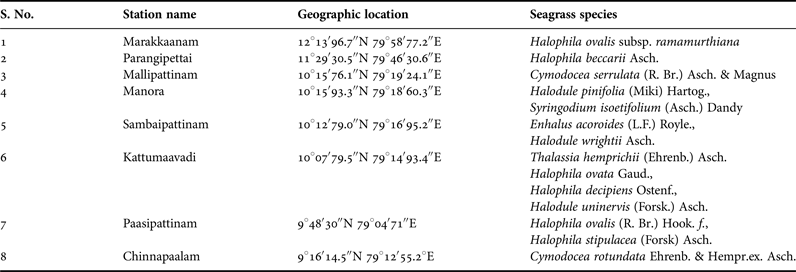
Young seagrass (Enhalus acoroides, Thalassia hemprichii, Halophila ovalis, H. ovalis subsp. ramamurthiana, H. ovata, H. decipiens, H. stipulacea, H. beccarii, Cymodocea serrulata, C. rotundata, Halodule pinifolia, H. uninervis, H. wrightii and Syringodium isoetifolium) leaves devoid of any epiphytic overgrowth were collected from Tamilnadu coast. Care was taken to collect the samples from a single extension of the rhizome (Table 1). The identification and taxonomic status of the samples were confirmed using the keys for seagrasses (Den Hartog, Reference den Hartog1970) and other local keys (Ramamurthy et al., Reference Ramamurthy, Balakrishnan, Ravikumar and Ganesan1992; Kannan & Thangaradjou, Reference Kannan and Thangaradjou2006). Samples were washed thoroughly in seawater to remove debris and sediments and rinsed with double distilled water. Then the whole leaf material was cut and immersed in NaCl/CTAB solution (Storchova et al., Reference Storchova, Hrdlickova, Chrtek, Tetera and Fitze2000) until the extraction of genomic DNA.
Geographic location of the study areas.

PCR analysis by using RAPD markers
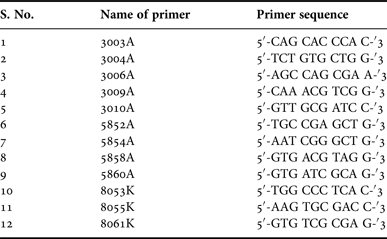
Fresh leaves (100 mg) of seagrass sample were extracted for Genomic DNA by using Plant Genomic DNA Minispin kit (Chromous Biotech, Code: RKT07/08; Bangalore, India) according to the protocol supplied by the manufacturer. Twelve decamer RAPD primers of two series (A and K) obtained from Carl Roth GmbH, Karlsruhe, Germany, were used for DNA amplification (Table 2). The PCR conditions were optimized for DNA concentration, the PCR reaction was performed in a Mastercycler gradient PCR (Eppendorf, Germany) with Red dye PCR master mix (GeNei, Cat:105908; Bangalore) in a total volume of 1× concentration of 12.5 µl reaction mixture by adopting the following PCR program: 5 min 94 °C, 40 cycles of 1 min at 94 °C, 1 min at 36 °C, 2 min at 72 °C, followed by 5 min of the final extension at 72 °C. The success of the PCR reactions was monitored by running 12.5 µl of PCR reaction on 1% agarose (Himedia, Mumbai) in 1× TAE buffer (40 mM Tris-acetate, 1 mM EDTA) gel (ethidium bromide concentration 0.1 µg per 1 ml of gel) with 50 V applied voltage. DNA bands on the gel were visualized under UV light using Royal Intas Gel1x imager gel doc (Brandenburg, Germany).
List of primers selected from Kit A and K used for the study.

Data analysis of amplified profiles
The electropherograms were manually converted into binary matrices reflecting the presence (1) or absence (0) of resulting alleles. The matrices were assessed by FreeTree software, ver. 9.1 using the Unweighted Pair Group Method with Arithmetic Mean (UPGMA) construction method. The similarity coefficient was calculated according to Nei and Li (Reference Nei and Li1979) and the pairwise genetic distance according to Nei (Reference Nei1978). On the basis of the genetic distance among individuals, calculated as the average taxonomic distance using the similarity for interval data routine and principal coordinates analysis (PCoA) was performed with the average taxonomic distance in NTSYSpc 2.11L software (Rohlf, Reference Rohlf2000). The original matrix was resampled with 500 times bootstrap and a consensus tree was generated. All dendrograms were displayed and printed using TreeView software ver. 1.6 (Page, Reference Page1996). The percentage polymorphism was calculated by using the following statistics.
Per cent polymorphism = Number of polymorphic bands/Total number of bands × 100
RESULTS
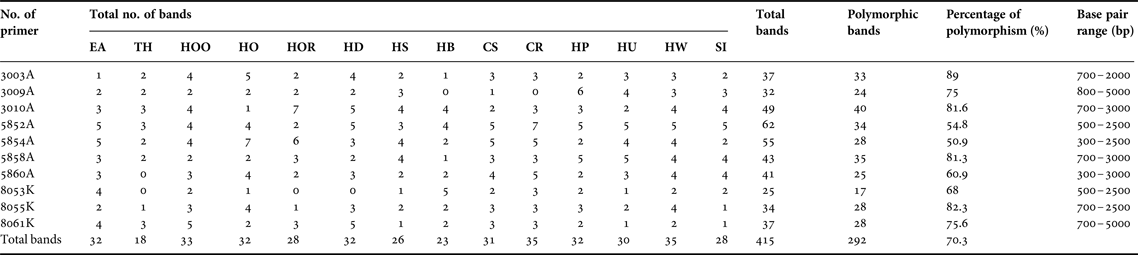
Seagrass species (14 belonging to six genera) from Tamilnadu coast, India were analysed using 12 RAPD primers, in order to select a set of RAPD primers which produces reliable and reproducible fingerprints for the Indian seagrasses. After the initial screening 10 primers were retained for assessment of the genetic diversity between the seagrass species while the primers 3004A and 3006A were left without any further analysis as they failed to show any significant genetic differences among different species. The reproducibility of all these markers was checked by performing at least two experiments per RAPD primer, in the event of inconsistency in results then the experiment was repeated again for consistency. The results from each RAPD product were assumed to represent a single locus and data were scored as the presence of these bands and compared with samples of different species. These 10 primers amplified 415 DNA fragments with an average of 41.5 fragments per primer. Of the total 415 amplified fragments only 123 (29.7%) were monomorphic and the remaining 292 (70.3%) were polymorphic (Table 3) in Indian seagrass species.
The total number of polymorphic bands recorded for each of the 14 seagrass species, using 10 RAPD primers.

EA, Enhalus acoroides; TH, Thalassia hemprichii; HOO, Halophila ovalis subsp. ovalis; HO, Halophila ovata; HOR, Halophila ovalis subsp. ramamurthiana; HD, Halophila decipiens; HB, Halophila beccarii; CS, Cymodocea serrulata; CR, Cymodocea rotundata; HP, Halodule pinifolia; HU, Halodule uninervis; HW, Halodule wrightii; SI, Syringodium isoetifolium.
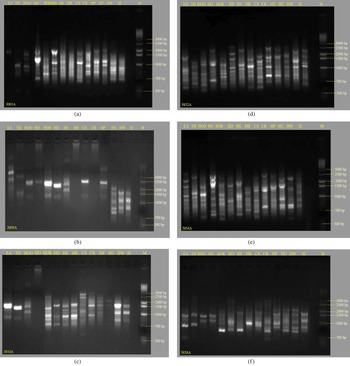
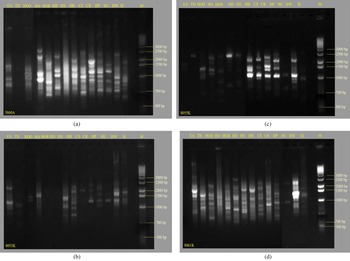
The maximum number of bands produced by a single primer 5852A was 62 ranging 500 to 2500 bp while the minimum of 25 bands with 500 to 2500 bp were amplified by the primer 8053K. The number of RAPD bands amplified by the remaining primers ranged between 32 and 55 fragments and alleles ranged from ~300 to 5000 bp in length (Figures 1 and 2). A high percentage of polymorphism was observed with primers 3003A, 8055K, 3010A and 5858A with 89, 82.3, 81.6 and 81.3%, respectively.
The electropherogram of RAPD profiles for marine angiosperms of India using different primers: (A) 3003A, (B) 3009A, (C) 3010A, (D) 5852A, (E) 5854A, (F) 5858A.

The electropherogram of RAPD profiles for marine angiosperms of India using different primers: (A) 5860A, (B) 8053K, (C) 8055K, (D) 8061K.

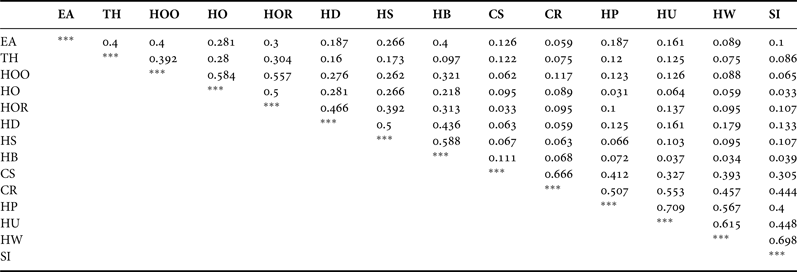
The unbiased pairwise genetic distance showed that the lower values were obtained at intraspecies level of genera Halophila, Cymodocea and Halodule as 0.5, 0.66 and 0.61, respectively. However, higher genetic distances were observed between intergeneric levels (Table 4) for all seagrass genera. Species of Halophila ovalis subsp. ovalis, H. ovata and H. ovalis subsp. ramamurthina showing subtle morphological variations recorded a genetically distinct relation with a genetic distance of 0.584, 0.557 and 0.5, respectively.
Nei's unbiased pair-wise genetic distance values recorded for 14 Indian seagrass species.

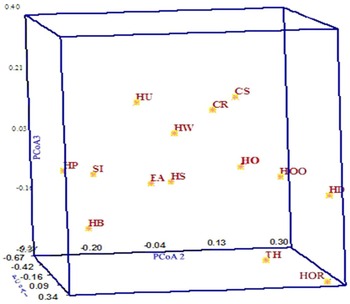
The relationship among the different seagrass species was further subjected by PCoA which recorded the first three coordinates, accounting for 34.65, 23.9 and 19.72% of variance, with a total cumulative variance of 78.27%. In this analysis, the majority of groupings followed the same pattern as depicted in the dendrogram with minor differences such as the genus belonging to Cymodocea and Halodule also being clustered together in the PCoA. However, the PCoA (Figure 3) showed a separation of the individuals into scattered form and grouping of individual species belonging to the same genus grouped together except H. beccarii.
Principal coordinate analysis of the 14 Indian seagrass species.

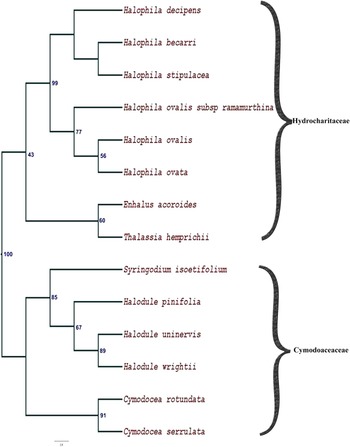
The UPGMA dendrogram (Figure 4) generated by following the Nei's distance matrix revealed clear genetic relationship among the 14 seagrass species. The rooted dendrogram clustered the species within distinct groups according to their genus specificity. Interestingly, the dendrogram formed two distinctive clusters corresponding to Cymodoceaceae and Hydrocharitaceae families. Cluster I divided into three subclusters viz. (1) H. ovalis, H. ovata and H. ovalis subsp. ramamurthiana, (2) H. decipiens, H. beccarii and H. stipulacea and (3) E. acoroides and T. hemprichii. Cluster II divided into two subclusters (1) Cymodocea and (2) Halodule and Syringodium and further subdivided up to species level.
Dendrogram showing genetic relationships among the 14 Indian seagrass species. The neighbour-joining method (FreeTreeware) was applied to an average 'taxonomic' distance matrix among the individuals.

DISCUSSION
Results herein represent the first successful application of RAPD markers to characterize the genetic variations among the Indian seagrasses, which provide important functions in shallow coastal ecosystems. The RAPD survey of 14 seagrass species (Enhalus acoroides, Thalassia hemprichii, Halophila ovalis subsp. ovalis, H. ovalis subsp. ramamurthiana, H. ovata, H. decipiens, H. stipulacea, H. beccarii, Cymodocea serrulata, C. rotundata, Halodule pinifolia, H. uninervis, H. wrightii and Syringodium isoetifolium) demonstrates that the seagrasses display a wide range of genetic diversity between genera and registers close similarity between intraspecies of genus Halophila, Cymodocea and Halodule which are critical in discriminating the species through conventional means.
Primers used to generate the RAPD profile for each seagrass recorded 70.3% polymorphic loci (292) confirming the uniqueness of genotypes of different seagrasses. Waycott (Reference Waycott1995) used RAPD markers to determine genetic variation and clonality with the seagrass Posidonia australis, four primers identified 45 loci which includes 56% polymorphic and five RAPD primers used on Florida T. testudinum produced 29 polymorphic loci (Kirsten et al., Reference Kirsten, Dawes and Cochrane1998). Micheli et al. (Reference Micheli, Paganin, Peirano, Caye, Meinesz and Bianchi2005) have reported 80% of polymorphism within the population of a P. oceanica bed at Punta Mesco. However, in the present study some of the primers such as 3003A, 3010A and 5852A are capable of showing more than 30 polymorphic loci in Indian seagrasses. This confirms the efficiency of selected primers in distinguishing the genetic variability within Indian seagrasses.
Among the 10 primers used 3003A, 3010A, 5858A and 8055K are the key primers capable of distinguishing all the Indian seagrasses and proved to be quite powerful in detecting a high degree of polymorphism. However, the present study carried out with single populations of species warrants further tests with different populations so as to check the consistency of the primers in showing the polymorphism. Moreover, polymorphic variation was obtained from different species to show the genetic variability among different species. The polymorphic alleles recorded in all the tested species encourages further work with these primers to finalize the taxonomic tools.
Among the different primers used for the present study primers such as 5852A and 5854A are capable of showing more DNA bands (62 and 55 respectively) than the others. Unfortunately the percentage of polymorphism was very low (54.8 and 50.9% respectively). Such primers are key to confirming the identity of Indian seagrasses in tracking the origin of the plant samples. Based on the performances of different primers in resolving the genetic differences in seagrasses, it is evident that during the growth stage, the different markers (Mariette et al., Reference Mariette, Le Corre, Austerlitz and Kremer2002) show differing RAPD results for the same species; under these conditions selection of plants and experimental consistency are key in the successful application of RAPD techniques in seagrass taxonomy. The present result found 0.031–0.709 pairwise genetic variability among Indian seagrasses. Waycott & Barnes (Reference Waycott and Barnes2001) clearly stated that the genetic diversity of a seagrass population ranges from zero to high for different species and populations; this warrants the need for testing these primers at population level. Waycott & Barnes (Reference Waycott and Barnes2001) also emphasized that several studies to date are inadequately sampled and this often reduces the interpretability of the existing results. Hence in the present study the utmost care was taken for sampling, Samples were collected based on the following criteria, (1) should be from a single extension, (2) fresh young leaves in first three nodes only collected and (3) leaves attached with epiphytes were removed.
Throughout the world the systematic placement of the Halophila section has been based on morphology (Eiseman & McMillan, Reference Eiseman and McMillan1980) and isozyme banding (McMillan & Williams, Reference McMillan and Williams1980) characteristics. In India, the genus Halophila is represented by six species (Halophila ovalis subsp. ovalis, H. ovalis subsp. ramamurthiana, H. ovata, H. decipiens, H. stipulacea and H. beccarii). Subtle morphological and vegetative differences (number of cross veins, seeds, shape of the leaf lamina etc.) among Halophila ovalis, H. ovalis subsp. ramamurthiana and H. ovata make identification challenging and often results in misidentification. The present RAPD study showed clear genetic distance between the species (0.584, 0.557 and 0.5, respectively). Similarly, Smith et al. (Reference Smith, McMillan, Kenworthy and Bird1997) found a genetic similarity of 0.6 and 0.66 for H. decipiens and H. johnsonii which means a genetic distance of 0.4 and 0.44. This indicates that RAPD markers provide more reliable results than the morphological characters which are able to resolve the distinctions of closely related species (Pau & Othman, Reference Pau and Othman2002). Further in depth studies of these three species with different populations may result in identification of the possible parent species of the subspecies H. ovalis subsp. ramamurthiana and also help to resolve the relatedness of the species with H. ovalis subsp. ovalis and H. ovata. Recently, Nguyen et al. (Reference Nguyen, Thangaradjou and Papenbrock2013) studied Amplified Fragment Length Polymorphism (AFLP) among the subspecies of H. ovalis subsp. ovalis, H. ovata and H. ovalis subsp. ramamurthiana and they concluded that H. ovalis subsp. ramamurthiana was genetically different between species as well as geography. It is evident that the genetic structure of the plant populations could enable elucidation of the evolutionary linkages, mutation, genetic drift, mating system, gene flow etc. (Slatkin, Reference Slatkin1987; Schaal et al., Reference Schaal, Hayworth, Olsen, Rauscher and Smith1998). Even the PCoA and UPGMA dendrogram showed similar pattern of variation between these three species. Other Halophila species have distinct vegetative characters, such as serrulate leaf margin and stiff hairs on abaxial side of the leaf (H. decipiens), serrulate leaf margin and sheathed leaf base (H. stipulacea) and more than 6 leaves per node (H. beccarii). The Halophila group showed a close similarity in DNA fingerprints among each other and clustered together in a single clade in the dendrogram. It confirms that the RAPD markers are capable of bringing out the interspecies differences within the genera. The PCoA plot also clearly distinguished these species into separate entities comparable to the UPGMA dendrogram.
The genetic distance between Enhalus acoroides and Thalassia hemprichii was 0.4, the PCoA plot separated these two genera from each other, and the UPGMA dendrogram grouped these plants in one cluster indicating the relatedness of these two species. Isozyme studies of three Hydrocharitaceae genera also enable to distinguish these species, but Enhalus is more similar to Thalassia than to Halophila (McMillan, Reference McMillan1982). Even the morphological distinctness of Halophila having petiolate leaves is a clear character distinguishing the other two genera of the marine Hydrocharitaceae family which are apetiolate in nature.
The sympatric species C. serrulata and C. rotundata have a close similarity in DNA fingerprinting and shared a common node in UPGMA dendrogram with a genetic distance of 0.666. The heterogeneous RAPD pattern found between the Cymodocea species indicates that the leaf morphometrics such as difference in width of the leaf lamina (3–6 mm for C. rotundata and 4–10 mm for C. serrulata), serrulation in the apex (rarely serrulate in case of C. rotundata and serrulate in C. serrulata), number of nerves (9–14 for C. rotundata and 12–22 for C. serrulata) were associated with an increased genetic variation between the species. Alberto et al. (Reference Alberto, Mata and Santos2001) also applied RAPD techniques in C. nodosa from six populations of the Atlantic sea using 28 random primers and found genetic homogeneity among C. nodosa populations of the Atlantic sea, which means the genetic characters of the same species of the same regions are more homogeneous in nature, but this is not common to all species of seagrasses. However, Rotini et al. (Reference Rotini, Micheli, Valiante and Migliore2011) reported that RAPD showed low genetic variability in P. oceanica from Santa Marinella seagrass meadows; whereas, Nguyen et al. (Reference Nguyen, Detcharoen, Tuntiprapas, Soe-Htun, Sidik, Harah, Prathep and Papenbrock2014) analysed genetic diversity of seagrasses based on microsatellite markers and revealed that the genetic variability in the Western Pacific is higher than in the Eastern Indian ocean.
The genetic variation between the Halodule species of H. pinifolia (no lateral teeth), H. uninervis (tridentate leaf tip) and H. wrightii (bidentate leaf tip) conventionally can be identified by leaf tip morphology (Den Hartog, Reference den Hartog1970) but the fragile nature of leaves means that they easily break away under natural conditions and can result in a taxonomic paradigm. The genetic distance of 0.709, 0.567 and 0.615 recorded for these species gives a clear clue for differentiating the species without any ambiguity.
The high level of similarity at intraspecies level has also shown that all the samples of each species are monophyletic. It can be inferred from the present investigation that the RAPD technique is a useful tool for the analysis of genetic diversity among the Indian seagrasses and can be used as the tool to resolve the taxonomic issues of Indian seagrasses. Primers 3003A, 3010A and 5852A are the key primers that can be used as a tool for identifying the genetic and species variations after testing the primers at different populations of the same species.
ACKNOWLEDGEMENTS
The authors thank Dr K. Kathiresan, Director and Dean, and Dr T. Balasubramanian, former Director and Dean, CAS in Marine Biology, Faculty of Marine Sciences and authorities of Annamalai University for providing facilities and support. The contents and views reported in this manuscript are of individual authors and do not reflect the views of institutions to which they belong.
FINANCIAL SUPPORT
E. Dilipan is thankful to the DAAD and the Leibniz University Hannover, for financial support through ‘A new passage to India’ with which the present study was carried out.