

Politicians' personal backgrounds and beliefs powerfully shape politics and policy: legislators often vote their personal preferences (e.g., Miller and Stokes Reference Miller and Stokes1963; Washington Reference Washington2008) and dedicate greater effort to causes they find personally important (e.g., Broockman Reference Broockman2013; Burden Reference Burden2007; Hall Reference Hall1996; Mendez Reference Mendez2014). But why do legislators and candidates tend to have the personal backgrounds and beliefs that they do? This paper argues that party and interest group elites strategically shape the candidate pool by encouraging like-minded individuals to run for office, much like these elites strategically shape the electorate by encouraging like-minded individuals to vote. What political elites personally believe is good public policy may thus reflect resource imbalances in the process by which individuals with particular views tend to be encouraged to run for office.
In this paper I first unearth a nascent body of qualitative and survey evidence that suggests political actors routinely recruit candidates for office with personal appeals. I then present a novel experiment testing whether such appeals can increase interest in office in a field setting. I conclude by considering implications of conceptualizing candidate entry through the lens of strategic mobilization and directions for further research.
HOW OFTEN DO ELITES MOBILIZE CANDIDATES? UNCOVERING A NASCENT BODY OF EVIDENCE
Before the 2006 Congressional elections, Democratic Congressional Campaign Committee Chair Rahm Emanuel made his “first step” the “recruit[ment of] good candidates” (Bendavid Reference Bendavid2007). As Rep. Wasserman-Schultz put it, “strategizing about how to get top-tier candidates into [Congressional] races” consumed Emanuel for months: Emanuel enlisted dozens of sitting Members of Congress to help identify promising candidates in their regions, meticulously researched potential candidates' backgrounds in order to determine “the right angle to reel [them] in,” and then relentlessly pressured these targets to run (Bendavid Reference Bendavid2007).Footnote 1
Emanuel's obsession with recruitment appears far from unique among political elites. When more than two dozen scholars over the last several decades have gone into the field to investigate various other political phenomena, they have routinely noted political elites strategically mobilizing candidates. These observations can be found in many literatures, including older case studies of particular regions (e.g., Sorauf Reference Sorauf1963) and recent accounts of other phenomenon, such as Rozell and Wilcox's (Reference Rozell and Wilcox1996) investigation into the Christian right, Masket's (Reference Masket2009) description of informal party organizations in California politics, and Galvin's (Reference Galvin2010) study of Presidential party-building.Footnote 2
These qualitative accounts typically describe party and interest group leaders encouraging individuals to run with whom they have close personal relationships and believe are like-minded. These close relationships appear to serve two crucial roles. First, these relationships allow recruiters to assess potential candidates' personal beliefs and abilities with confidence. For example, union leaders may sensibly expect that a person who has dedicated tremendous time and effort to the union's political efforts for the last decade would remain committed to advancing unions' political priorities if elected. In addition, personal relationships appear to facilitate mobilization: Recruiters often stress to potential candidates that their group or party “needs” them to run, consistent with literature that personal appeals can compel even substantial actions (e.g., Christensen et al. Reference Christensen, Fierst, Jocody and Lorenz1998).
These accounts sit at odds with the discipline's longstanding view of why individuals run for office. Scholars' “dominant assumption” has been that people seek office because of pre-existing “intense desire for political power” and “extraordinary . . . personal political ambition” (for reviews, see Fowler Reference Fowler1993; Fowler and McClure Reference Fowler and McClure1989; Moncrief Reference Moncrief1999). Within this traditional framework, variation in personal “utility of officeholding” and the political opportunities available for satisfying such ambition principally explain who seeks office (Black Reference Black1972; Prewitt and Nowlin Reference Prewitt and Nowlin1969; Schlesinger Reference Schlesinger1966).Footnote 3
Convinced that personal ambition principally explains candidacy decisions, as Maisel (Reference Maisel, Cohen, Fleisher and Kantor2001) reviews, scholars have generally thought parties and interest groups must play “a limited role at best” in recruiting candidates as they lack selective incentives for inducing candidacy among those not otherwise intending to run.Footnote 4 Recently, research on women's candidacies has accumulated evidence at odds with this skepticism and found that elite encouragement appears to play an important role in the dearth of female candidates (e.g., Bjarnegard Reference Bjarnegard2013; Crowder-Meyer Reference Crowder-Meyer2011; Lawless and Fox Reference Lawless and Fox2005, Reference Fox and Lawless2010; Niven Reference Niven1998; Preece et al. Reference Preece, Bogach and Fisher2014; Sanbonmatsu Reference Sanbonmatsu2003, Reference Sanbonmatsu2006a, Reference Sanbonmatsu2006b). Such literature has consistently found that self-reports of recruitment are strongly associated with interest in office.
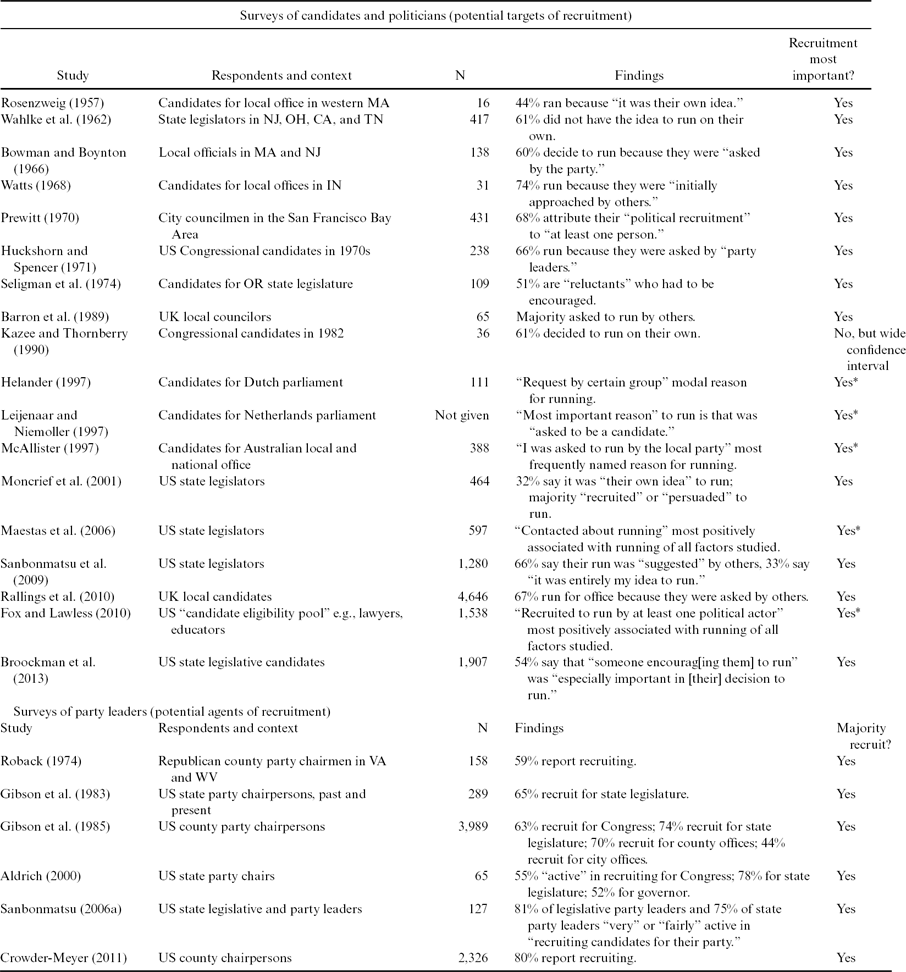
A heretofore unappreciated body of survey research also suggests that encouragement to run for office is not only impactful but also extremely common. I performed a thorough review of extant elite surveys and uncovered 24 studies that have asked candidates (potential recruitees) and party leaders (potential recruiters) about recruitment. Table 1 presents these surveys' sampling frames, sample sizes, and findings about recruitment's prevalence.
Review of Findings from Elite Surveys
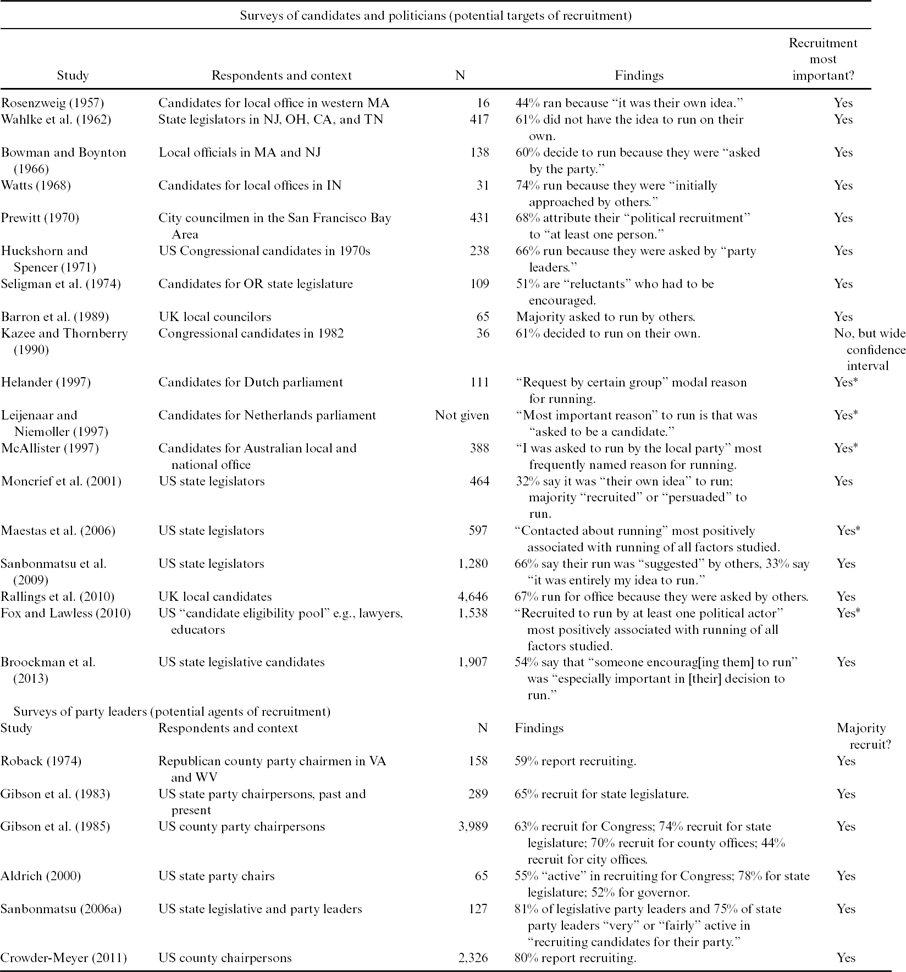
Note: Asterisk denotes unavailability of the statistic that recruitment was the most important factor in candidacy decisions.
When researchers ask political candidates and officeholders why or when they decided to run for office, a majority consistently report that encouragement to do so from others played the most important role. In five surveys where this statistic is not directly available (denoted with an asterisk) the results are still consistent, with having been asked to run the modal explanation for candidacy or the factor most positively associated with interest in running.
Most party leaders also report recruiting for offices at all levels, including for Congress and state executive office. Not only do candidates consistently report being recruited by existing elites, those existing elites also consistently report doing such recruiting.
To summarize, a sizable nascent body of qualitative and quantitative evidence suggests that candidate recruitment efforts are widespread and significant. In such recruitment, party and interest group elites appear to use personal appeals to strategically encourage individuals to run for office whose candidacies would advance their goals, much like how they mobilize like-minded members of the public to vote in order to shape the electorate (Gerber and Green Reference Gerber and Green2000).
CAN PERSONAL APPEALS INCREASE INTEREST IN RUNNING FOR OFFICE? A FIELD EXPERIMENT
Many officeholders and elites claim that recruitment is widespread. However, similar to once-common skepticism that voters could really be mobilized without selective incentives, scholars have been dubious that personal appeals alone could lead individuals to undertake such costly behaviors. As Maisel (Reference Maisel, Cohen, Fleisher and Kantor2001) reviews, scholars have long doubted that recruitment could spur an individual to run as would-be recruiters have “few incentives” to offer prospective recruits (see also Carson et al. Reference Carson, Engstorm and Roberts2007; Cox and Katz Reference Cox and Katz2002).
The experiment puts this skepticism more directly to the test by examining whether personal appeals can tangibly increase interest in candidacy, as qualitative evidence has suggested. The experiment randomized the presence of personal encouragement to run for office in an actual candidate recruitment effort, the first field experiment on candidate recruitment.
In the experiment, CREDO Action, an American liberal political interest group with approximately 3.5 million members,Footnote 5 sent appeals to run for office to 99,935 of its most active members via email. The skeleton text of this message is in Box 1. CREDO Action informed every recipient about a project by a separate organization, the New Organizing Institute, to support new candidates for office. The underlined text in Box 1 was a hyperlink and, if clicked, brought participants to the New Organizing Institute's website where they could learn more about running for office, browse offices to run for, and agree to run for an office.
Text of Recruitment Email
From: Becky Bond, CREDO Action
Subject: [Treatment subject.]
Dear [subject's first name],
[First treatment line.]
I'm writing because you're one of our best activists. We think more people like you should be holding elected office, instead of those who are beholden to special interests.
[Second treatment line.] That's why I want to tell you about a project from our friends at the New Organizing Institute. It's called the Candidate Project.
The Candidate Project helps people like you learn about local board seats and other public offices—and, it provides resources to help people like you run for these offices, including tools, trainings, and connections to others who are ready to offer a helping hand.
There are more than half a million elected positions in our country—that's more than 500,000 people who help decide what children learn in schools, which industries move into our towns, and whether to treat us differently based on how we look or who we love. The Candidate Project can connect you to the resources to run a successful campaign for offices like these.
Your activism has already helped make a positive change. Now, I hope you'll consider taking the next step: if you're interested in learning more about running for office and how the Candidate Project can help you do so, let them know here.
2012 is a critical year. Thanks for everything you are doing to work for social change.
Becky Bond, Political Director
CREDO Mobile
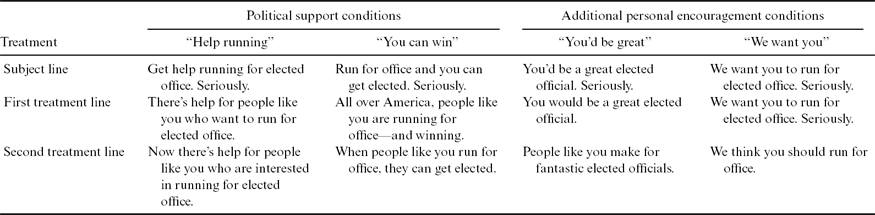
The emails promised all recipients material political “resources” to run but varied the presence of personal encouragement to run. The treatments are shown in Table 2. Emails in the “Additional Personal Encouragement” conditions provided explicit personal encouragement of the kind that the qualitative evidence suggested recruiters do, stressing to potential candidates that their own candidacy was needed or that the group believed in the recipient's ability to be a successful elected official.
Experimental Treatments
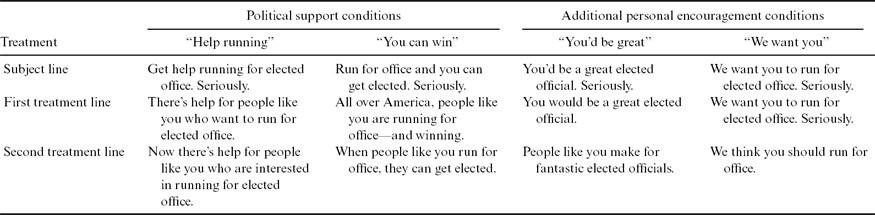
Note: The table shows the lines that were spliced into the corresponding sections of the script shown in Box 1.
To measure interest in office, the dependent variables are (1) opening the emailFootnote 6 (after reading the subject line), (2) clicking the link “if you're interested in running for office. . .” to learn more about running (after reading the text), and (3) committing to the New Organizing Institute to “run for local office in 2012” (after visiting New Organizing Institute's website and learning more). (See below for comments about generalizability of these outcomes.)
To appreciate the relevance of the treatment and outcomes for the possibility that candidates can be mobilized, recall that traditional explanations for candidacy attribute interest in office to ex ante idiosyncratic personal differences in political ambition; in this view, anyone who might run for office would be expected to jump at the email's offer of support (e.g., Black Reference Black1972). By contrast, personal encouragement is typically not expected to increase interest in office as it does not represent a material selective incentive (see Maisel Reference Maisel, Cohen, Fleisher and Kantor2001 for review). If this view of candidacy were correct, the share of those who showed interest in office in the experiment should remain similar across the conditions varying the presence of personal encouragement.
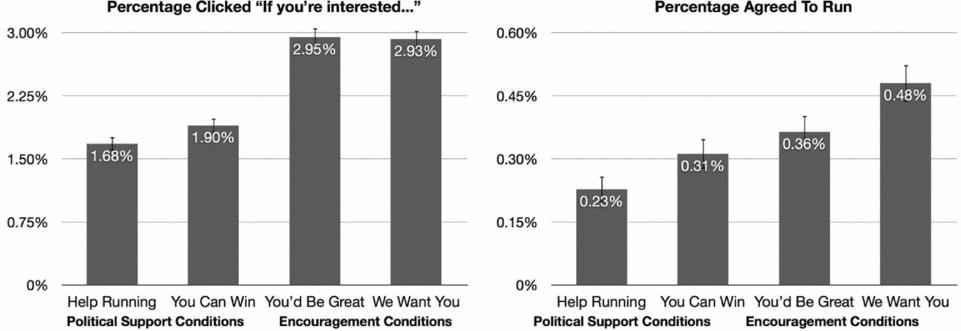
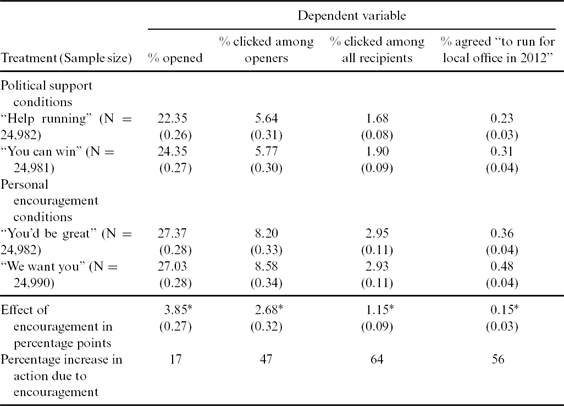
Notes: The left panel shows the percentage of recipients who sought more information about running for office after receiving each of the treatment appeals (a behavioral outcome). The right panel shows the share of recipients of each appeal who ultimately agreed “to run for office in 2012” (a self-reported outcome).
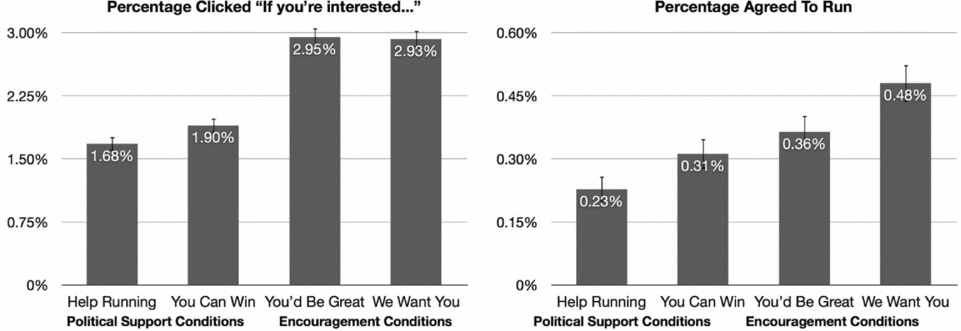
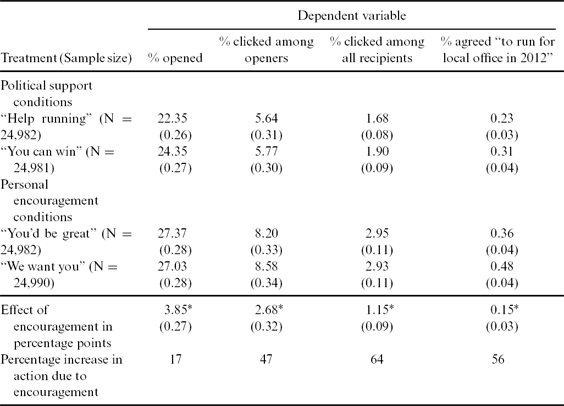
Table 3 presents the differences in interest in office by treatment condition. Recipients were significantly more likely to open the email, click the link to learn more about running, and pledge to run after receiving emails in the personal encouragement conditions. Overall, 25.3% of recipients opened the emails, but emails with subject lines employing personal encouragement to run for office were 17% more likely to be opened. The number of subjects who chose to learn more about running in the personal encouragement conditions also increased by 47% compared with the political support conditions. Finally, a total of 346 people promised the New Organizing Institute “to run for local office in 2012” after receiving the appeal, although the share of people who did so differed greatly by treatment: 56% more people in the personal encouragement conditions agreed to run for office than in the political support conditions.Footnote 7 In summary, the addition of personal encouragement appeared to have a large effect on recipients' interest in running for office as measured by their decisions to learn more about running and promises to run.
Open, Click, and Run Agreement Rates by Email Treatment
Note: *p < 0.001.
What do these different reactions to email messages about a candidate recruitment program say about candidate recruitment more broadly?
Propitious for the generalizability of the results, the setting and population were highly naturalistic: participants were not aware they were being studied and are politically active group members of the variety that elites typically recruit. Moreover, the decisions to open the email and gather more information about running on the organization's website are behavioral outcomes less susceptible to biases in self-reported measures. By contrast, existing experimental work relies on student samples (e.g., Kanthak and Woon Reference Kanthak and Woon2013) and nearly all work relies exclusively on self-reported interest in office and strictly observational designs (e.g., Lawless Reference Lawless2012; Maestas et al. Reference Maestas, Fulton, Maisel and Stone2006).
The design also has several shortcomings that can be addressed in future research. First, the treatment and context of the experiment—encouraging phrases in an email—clearly differ from real-world analogues like protracted exhortations from Emanuel, and thus the experiment is more equipped to speak to the presence of a psychological mechanism than estimate the absolute magnitude of other appeals. Moreover, as the key dependent variables in the analysis could only be gathered in the context of an email message about recruitment, the study lacks a true “control group” that received no contact at all. In these ways the experiment is more akin to a laboratory or survey experiment that attempts to isolate the existence of a particular mechanism among a population of interest. Future work can and should build on these findings and uncover the absolute efficacy of other recruitment tactics.
In summary, the experiment attempted to evaluate longstanding doubts that personal encouragement could increase interest in office, doubts that have left many scholars dubious that recruiters could mobilize candidates for office as they lack material selective incentives. The results show that personal appeals can increase interest in office in a real-world setting, consistent with the view that recruiters are able to mobilize candidates.
DISCUSSION
Parties and organized interest groups are typically conceptualized as the creatures of ambitious candidates and politicians (e.g., Aldrich Reference Aldrich1995) who create political organizations to help them satisfy their personal political ambitions (Black Reference Black1972; Prewitt and Nowlin Reference Prewitt and Nowlin1969). This paper suggested an inversion of this perspective: Many candidates and politicians may be the creation of parties and organized groups who strategically mobilize like-minded individuals to run (Bawn et al. Reference Bawn, Cohen, Karol, Masket, Noel and Zaller2012).
Consistent with this perspective, this paper unearthed decades of qualitative and survey evidence documenting that elites consistently report encouraging candidates to run for office and that candidates for office consistently report having been recruited. Scholars have nevertheless long been dubious that parties and interest groups could stimulate individuals to run without selective incentives (Maisel Reference Maisel, Cohen, Fleisher and Kantor2001). An experiment embedded in an actual candidate recruitment effort provided a unique test of this hypothesis by isolating whether personal encouragement to run increased interest in seeking office and found that it did. These results added further support to the notion that elites can increase interest in office with personal appeals, potentially allowing them to strategically shape the candidate pool just as they strategically shape the electorate.
Conceptualizing candidate entry as a process of strategic mobilization practiced by rational political elites—and not simply reflecting candidates' idiosyncratic personal differences—may offer a novel lens for understanding politics and politicians. For example, as groups with resource advantages are likely better able to screen for and mobilize candidates, recruitment may be a conduit by which the wealthy's preferences are translated into policy (e.g., Bartels Reference Bartels2008; Carnes Reference Carnes2014; Gilens Reference Gilens2009; Hacker and Pierson Reference Hacker and Pierson2010). Candidate recruitment could also have an important role in how legislative parties succeed in maintaining discipline (e.g., Cox and McCubbins Reference Cox and McCubbins1993; van Houweling Reference Van Houweling2013) if parties can screen for and mobilize candidates who are likelier to be loyal partisans if elected, something qualitative evidence has suggested Republican lawmakers actively do (Hacker and Pierson Reference Hacker and Pierson2005). Recruiters' personal biases could also have dramatic consequences on the personal backgrounds of the candidates voters have the opportunity to choose between (e.g., Carnes Reference Carnes2014; Niven Reference Niven1998). More scholars should follow political actors' lead in attending to candidate recruitment's potentially significant implications like these.