Significant outcomes
∙ In the present work the treatment with a preferential neuronal nitric oxide synthase (nNOS) inhibitor, 7-nitroindazole (7-NI), was tested in a behavioural model in which the effect of antidepressant drugs is usually observed after prolonged treatment.
∙ Similar to clinical antidepressants, only repeated, but not acute, treatment with 7-NI produced an antidepressant-like effect in the learned helplessness (LH) model.
∙ The antidepressant-like effects of 7-NI may involve increased brain-derived neurotrophic factor (BDNF) signalling in the hippocampus.
Limitations
∙ To help us to elucidate the latency period of 7-NI effects, a time-course curve of BNDF levels should have been performed.
∙ BDNF levels were measured only in the hippocampus of non-stressed animals. Analysis of BDNF content in other structures, as well as in stressed animals, could add significant information.
∙ Analysis of expression and/or activity of nNOS was not performed.
Introduction
Since the discovery of the antidepressants and their mechanism of action, it has been postulated that a monoaminergic imbalance in the brain was responsible for the development of depression, which would be restored by long-term antidepressant treatment (Reference Schildkraut and Kety1–Reference Castren3). This so-called ‘Monoaminergic Theory of Depression’, however, does not explain why the therapeutic effects appear only after chronic treatment despite their acute effects on monoamine levels (Reference Blier4,Reference Kiss5).
Amongst the several neurotransmitters that have been studied in an attempt to better understand the neurobiology of depression, nitric oxide (NO) has received considerable attention in the last decades. NO is an intercellular messenger which plays a critical role in several neural physiological processes (Reference Kiss6–Reference Garthwaite10). It is synthesised during the conversion of l-arginine to citrulline by the enzyme NOS. Of the three isoforms of NOS that have been identified – nNOS), endothelial NOS (eNOS), and inducible NOS (iNOS) (Reference Paakkari and Lindsberg11) – nNOS is the most expressed in the brain (Reference Moreno-Lopez, Noval, Gonzalez-Bonet and Estrada12). nNOS is usually activated in response to Ca+2 influx, after the opening of N-methyl-d-aspartate (NMDA) receptors by glutamate binding (Reference Garthwaite, Charles and Chess-Williams13,Reference Prast and Philippu14). NO diffuses rapidly and influences NO-responsive target cells in a widely extended area, modulating neuronal function in several ways (Reference Prast and Philippu14,Reference Brenman and Bredt15). Besides its involvement in physiological processes, NO can also be harmful due to its high reactivity, thus triggering pathophysiological responses (Reference Guix, Uribesalgo, Coma and Munoz7).
The observation that treatment with NMDA antagonists induces antidepressant-like effects in experimental protocols (Reference Trullas and Skolnick16,Reference Petrie, Reid and Stewart17) raised the possibility that NO could also be involved in the neurobiology of depression. Since the first report by Jefferys and Funder (Reference Jefferys and Funder18), showing that systemic administration of NOS inhibitor reduces immobility time in the rat forced swimming test, several additional studies have confirmed an antidepressant-like effect in response to treatment with different NOS inhibitors in animals submitted to different models predictive of antidepressant activity (Reference Joca, Moreira and Wegener19–Reference Wegener, Harvey and Bonefeld24). Besides, antidepressants drugs are able to reduce NOS activity in hippocampus (Reference Wegener, Volke, Harvey and Rosenberg25) while the discontinuation with imipramine treatment induces opposite effects in rats (Reference Harvey, Retief, Korff and Wegener26). There is also clinical evidence supporting the involvement of NO in the neurobiology of depression (Reference Suzuki, Yagi, Nakaki, Kanba and Asai27–Reference Naylor, Smith and Connelly29).
Despite consistent evidence showing antidepressant-like effects of nNOS inhibitors in animals submitted to different preclinical models [for review (Reference Joca, Moreira and Wegener19) and (Reference Wegener and Volke30)], it remains to be investigated if repeated treatment with NOS inhibitors is actually required to induce antidepressant-like effects. Given the fact that acute blockade of NMDA receptors, which are key modulators of NO synthesis in the CNS, is shown to promote rapid antidepressant-like effects (Reference Berman, Cappiello and Anand31–Reference Abdallah, Sanacora, Duman and Krystal33) we investigated if acute treatment with nNOS inhibitor could induce similar effects. In addition, the effect of nNOS inhibition in the LH model has not been described before. In this context, the present work aimed at investigating the effects induced by acute and repeated treatment with a nNOS inhibitor in animals exposed to LH, a model that is irresponsive to acute (single injection) antidepressant treatment (Reference Maier34–Reference Willner37).
Repeated treatment with different antidepressants drugs increases the expression of BDNF, a neurotrophin critical for neuronal survival (Reference Castren and Rantamaki38), in the hippocampus (Reference Bjorkholm and Monteggia39). Normalisation of BDNF levels in the hippocampus has been proposed as a crucial mechanism for antidepressant-induced behavioural effects (Reference Duman, Heninger and Nestler40,Reference Duman and Monteggia41). Evidence from in vitro and in vivo studies indicate BDNF levels can also be modulated by NO. For instance, administration of NO donors or NOS inhibitor decreases or increases, respectively, BDNF secretion in cultured cells (Reference Canossa, Giordano, Cappello, Guarnieri and Ferri42). Besides, nNOS inhibition attenuated the decreased levels of BDNF in the hippocampus of animals exposed to chronic mild stress exposure (Reference Yazir, Utkan and Aricioglu43).
Based on these pieces of evidence, the aim of present work was to investigate the effects induced by acute and repeated administration of 7-nitroindazole, a preferential nNOS inhibitor, in rats submitted to the LH model of depression. We also evaluated if the behavioural effect of this drug was temporarily associated with changes in hippocampal BDNF levels.
Materials and methods
Animals
Male Wistar rats weighing 200–220 g at the beginning of each experiment were individually housed in Plexiglas cages (30×19×13 cm) and kept in a temperature-controlled room (24±1°C), under standard laboratory conditions with free access to food and water and a 12 h light/12 h dark cycle (lights on at 06:30 a.m.). The welfare of the animals was assessed daily. The cages and bedding were changed every 2 days as well as food and water replacement. All animal used came from a breeding facility from the University of São Paulo – Campus Ribeirão Preto, São Paulo, Brazil.
Animals were randomly assigned to the different experimental groups and procedures were performed in conformity with the Brazilian Council for the Control of Animals under Experiment (CONCEA), which are in compliance with international laws and politics. The local Ethical Committee approved the experimental protocol (number 08.1.233.53.5), and all efforts were made to minimise animal suffering.
Drugs
Imipramine Hydrochloride (Sigma-Aldrich, Saint Louis, MO, USA) was administered i.p. at the dose of 15 mg/kg (according to (Reference Joca, Padovan and Guimaraes44)) and 7-nitroindazole (7-NI minimum 98%; Sigma-Aldrich, St Louis, MO, USA), a preferential nNOS inhibitor (Reference Bush and Pollack45), was administered i.p. at the dose of 30 mg/kg (according to (Reference Yildiz, Erden, Ulak, Utkan and Gacar21,Reference Zhou, Hu and Hua46)). The drugs were dissolved in 40% dimethyl sulfoxide (DMSO; Gold Lab, Diadema, SP, Brazil), immediately before use, and administered at the volume of 2 ml/kg.
Apparatus
The experiments were carried out in two automated shuttle boxes with two compartments of equal size (25×22×22 cm) separated by a wall with a central open door and equipped with a stainless-steel grid floor through which the scrambled shocks were delivered (Automatic Reflex Conditioner no. 7502 – UGO BASILE Biological Research Apparatus, Varese, Italy). One of the shuttle boxes was made of grey Plexiglas walls while the other was made of white Plexiglas walls and both had transparent covers. The behavioural tests took place in a sound attenuated, temperature-controlled (25±1°C) room.
Behavioural procedure
LH
The procedures for the LH, a widely used behavioural test for the detection of antidepressant-like effects, were similar to those previously described by Joca et al. (Reference Joca, Padovan and Guimaraes44,Reference Joca, Zanelati and Guimaraes47). The behavioural procedure consisted of two experimental sessions conducted in day 1 (pre-test or habituation) and day 7 (test) in different shuttle boxes as described above. At the beginning of each experiment, naïve animals were randomly assigned to one of the following conditions: stressed group (pre-test with inescapable footshocks) or non-stressed group (habituation in the shuttle-box without footshocks). The animals in the pre-test group were placed in the shuttle box and submitted to 40 inescapable footshocks (1 mA, 10 s duration) given according to a variable time schedule with a mean interval of 60 s (range from 30 to 90 s). The rats in the habituation group were placed into the same apparatus for 30 min but no shock was given during this time. Six days later, animals of both groups were placed individually into the shuttle box and submitted to the test session (T). The test consisted of 30 escapable footshocks (0.8 mA, 10 s duration, 30–90 s interval) preceded by a tone (60 dB, 670 Hz) that started 5 s before each shock and lasted until the end of the footshock. Animals were free to cross to the opposite side of the chamber at any time during the test. They could avoid the shock (if they cross during sound presentation) or interrupt its presentation (if they cross during sound plus shock presentation). Absence of one of these behaviours was considered an escape failure, which was automatically registered during the test. The number of intertrial crossings were also automatically measured as an index of locomotion during the test (Reference Geoffroy48).
Hippocampal BDNF measurements
The animals were deeply anaesthetised (chloral hydrate 5%, 10 ml/kg) and sacrificed. Their hippocampi were dissected and homogenised in lysis buffer (NaCl 137 mM; Tris-HCl 20 mM pH 7.6; glycerol 10%) containing protease inhibitor cocktail (Sigma-Aldrich, Saint Louis, MO, USA, Cat# P2714). After centrifugation (20 000 g, 15 min), the supernatant was collected and stored at −80°C until use. An aliquot of each sample was reserved and used to determine the total proteins levels using the Bradford method. Hippocampal BDNF was measured by ELISA (BDNF Emax® ImmunoAssay System kit; Promega, Madison, WI, USA, Cat# G7610) according to the manufacturer’s instructions. Briefly, 96-well plate was pre-coated with a primary monoclonal antibody against BDNF overnight at 4°C. Following 1 h blockade with BSA solution, supplied by the kit, we added the samples (2 h incubation at room temperature) and later the secondary polyclonal antibody (2 h incubation at room temperature). After incubating for 2 h at room temperature with the tertiary Horseradish peroxidase (HRP)-conjugated, colorimetric detection of peroxidase activity was achieved by adding tetramethylbenzidine (TMB One) solution. The enzymatic reaction was stopped with hydrochloric acid (HCl) 1 M and the colour intensity of each well was measured at 450 nm using a plate reader (VictorX3; Perkin Elmer, Boston, MA, USA). A standard curve was generated using values from the dilution series of a recombinant human BDNF standard (also supplied by kit) and was used to determine the BDNF concentration. Data was normalised by total protein levels in each sample.
Experimental design
LH
Independent groups of rats were submitted to pre-test or habituation (PT or H). In the repeated treatment group, animals received 7-NI (30 mg/kg), imipramine (15 mg/kg) or vehicle (1 ml/kg) for 7 days (the first injection was delivered immediately after PT or H, and the last one was delivered 1 h before test). In the acute treatment group, a single injection of 7-NI (30 mg/kg) or vehicle was administered either on the first day (immediately after pre-test or habituation) or on the seventh day (1 h before test) and the animals received vehicle injection on the other days.
BDNF measurements
Independent groups of naïve animals received 7-NI (30 mg/kg), imipramine (15 mg/kg) or vehicle (1 ml/kg) once day for 7 days (repeated treatment). An additional experimental group received vehicle (1 ml/kg) injections for 6 days and a single injection with 7-NI (30 mg/kg), imipramine (15 mg/kg) or vehicle (1 ml/kg) on the last day (7th). One hour after the last injection, animals were killed and the hippocampus (both hemispheres) was collected.
Experimental conditions
Behavioural experiments
Animals were kept in groups of four animals/cage (41×34×16 cm) for at least 1 week before the beginning of the experiment. For behavioural experiments, animals were brought to the lab on day 1 and taken individually to experimental rooms, where they were exposed to PT or H. Immediately after completion of H or PT, animals received the administration of the drug or its vehicle. After that, they were housed individually in smaller cages (30 ×19×13 cm) and taken back to the animal house. Every day, at 07:00 am, the animals were brought to the lab experimental rooms, where they were weighted and injected with drug or vehicle, according to the groups they had been randomly assigned to and then taken back to the animal room.
The animals assigned to BDNF analysis were maintained in the animal house for at least 1 week until the beginning of the treatment procedure, under the same conditions described above for animals submitted to behavioural experiments. On first day of treatment (day 1), animals were brought to the lab, where they were weighted and randomly assigned to the different treatment groups. After injection, they were housed individually in smaller cages (30×19×13 cm) and taken back to the animal house. Every day at 07:00 am, the animals were brought to the lab, where they were weighted and injected with drug or vehicle, and then taken back to the animal keeping room. On the treatment 7th day, the animals received the last injection and returned to their boxes where their remained undisturbed for 1 h. After that time, they were anaesthetised and sacrificed for hippocampus dissection. The last treatment injection and sacrifice were performed in random order to avoid circadian influences on BDNF analysis in individual treatment groups.
Sample size
The probable number of animals per group was calculated using the program G*power 3.1.9.2. Based on that, the sample size required for LH experiments is about 13 animals per group. The total number of animals used was 175 male Wistar rats, and this number is close to the number predicted by G*power program (204 animals). It is important to highlight that in some experimental groups the number of animals was smaller than expected due to the following exclusion criteria: animals that presented no crossing during test session, inflammation in the site of injection or other health issues.
Statistical analysis
The total number of intertrial crossings and escape failures were calculated for each animal and analysed by Kruskal–Wallis test. BDNF levels were analysed by one-way analysis of variance (ANOVA) followed by Dunnett’s Multiple Comparison test. Probability <0.05 was accepted as significant.
Results
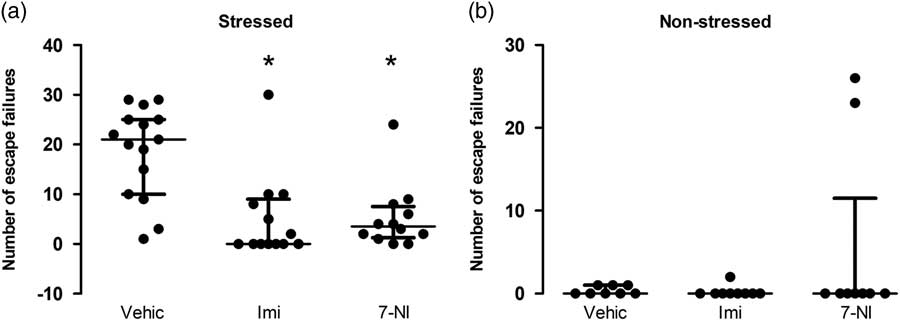
Effect of imipramine or 7-NI repeated treatment on the number of escape failures in stressed and non-stressed animals (Fig. 1): (A) Kruskal–Wallis analysis indicated a significant effect of repeated pharmacological treatment with imipramine and 7-NI when compared with control (H=15, p=0.0006, n=12–15). The number of escape failures (mean±SEM) for veh, imi, and 7-NI treatment, respectively, were: 18.67±2.35, 5.00±2.35, and 5.25±1.89. Besides that, (B) in H group, Kruskal–Wallis analysis did not find any effect of repeated pharmacological treatment (H=1.101, p=0.5767, n=8–9). The number of escape failures (mean±SEM) for veh, imi, and 7-NI treatment, respectively, were: 0.375±0.1830, 0.2222±0.2222, and 5.444±3.610.
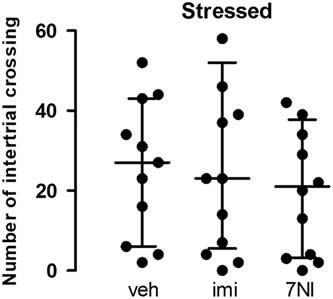
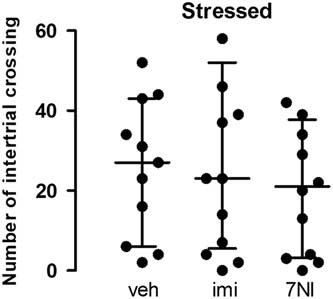
Effect of imipramine or 7-NI repeated treatment on the number of intertrial crossings (Fig. 2): Kruskal–Wallis analysis did not find any effect on the number of intertrial crossings (H=0.704, p=0.7, n=12–15). The number of intertrial crossing (mean±SEM) for veh, imi, and 7-NI treatment, respectively, were: 25.6±5.2, 32±7.9, and 27.7±9.7.
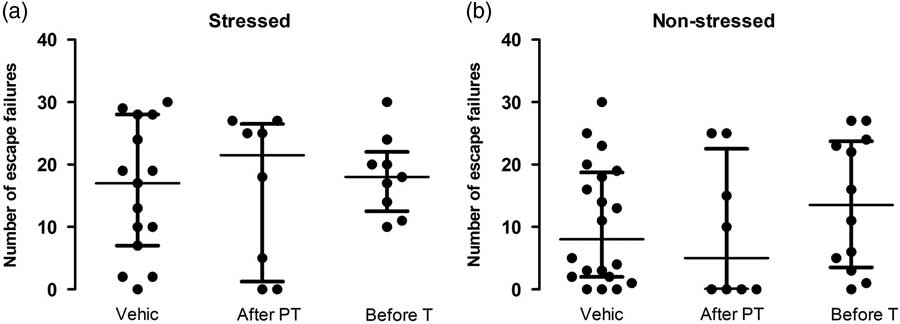
Effect of 7-NI acute treatment on the number of escape failures in stressed and non-stressed animals (Fig. 3): Kruskal–Wallis analysis did not find any effect of acute pharmacological treatment, after PT and before T, with 7-NI in (A) stressed group when compared with control (H=0.1944, p=0.9074, n=9–15). The number of escape failures (mean±SEM) for veh, 7-NI after PT, and 7-NI before T, respectively, were: 15.87±2.713, 15,88±4.311, and 18.22±2.100. The same occurred on (B) habituated group with Kruskal–Wallis analyses (H=0.1864, p=0.3937, n=8–20). In this case, the number of escape failures (mean±SEM) for veh, 7-NI after PT, and 7-NI before T, respectively, were: 10.45±2.155, 9.375±3.946, and 13.75±3.048.
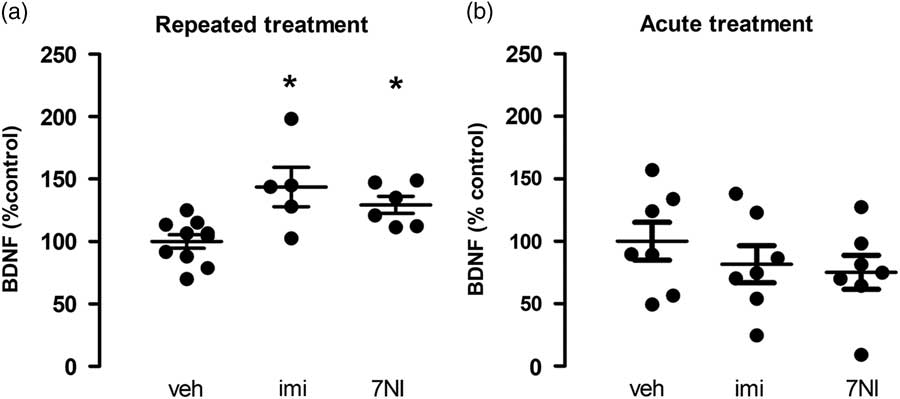
Effect of imipramine or 7-NI repeated or acute treatment on BDNF content in hippocampus (Fig. 4): (A) Imipramine and 7-NI (in the same dose and drug regimen that induced antidepressant-like effect in LH) increased hippocampal BDNF, as indicated by one-way ANOVA (F(2,18)=7.25, p<0.05) followed by Dunnett’s multiple comparison test (veh vs. imi: p<0.05, veh vs. 7-NI: p<0.05, n=8). (B) The single injection with Imipramine and 7-NI was ineffective in increasing hippocampal BDNF, as indicated by one-way ANOVA (F(2,20)=0.7907, p>0.05, n=8) followed by Dunnett’s multiple comparison test (veh vs. imi: p>0.05, veh vs. 7-NI: p>0.05).
Repeated treatment with 7-NI counteracts the effect of stress in the learned helplessness model. Rats submitted to (A) pre-test (inescapable footshocks, stressed group) or (B) habituation (no shocks, non-stressed) were treated for 7 days with imipramine (imi), 7-NI or vehicle (vehic) and then submitted to learned helplessness test (escapable footshocks). Graphs represent the number of escape failures (median with interquartile ranges) measured during the test session. Kruskal-Wallis test indicated significant difference from corresponding vehicle-treated group (*p<0.05).

Effect of imipramine or 7NI repeated treatment on the number of intertrial crossings during the test: Rats submitted to the pre-test (inescapable footshocks, stressed group) were treated for 7 days with imipramine (imi) or 7-NI and then submitted to learned helplessness test (escapable footshocks). Graphs represent the number of intertrial crossings (median with interquartile range) measured during the test session. Kruskal wallis test didn’t indicate significant difference from vehicle-treated in the stressed group (p>0.05).
Acute treatment with the preferential nNOS inhibitor 7-NI is not sufficient to counteract the effect of stress in the learned helplessness model. Rats submitted to (A) the pre-test (inescapable footshocks, stressed group) or (B) habituation (no shocks, non-stressed group) received a single injection of 7-NI either immediately after the pre-test or 1h before the test, and then were submitted to learned helplessness test (escapable footshocks). The graph represents the number of escape failures (median with interquartile range) measured during the test session. Kruskal wallis test didn’t indicate significant difference from vehicle and the treatments in the stressed and habituated groups (p>0.05).

7-NI and imipramine repeated treatment increases BDNF protein in hippocampus. BDNF from total hippocampus of naïve animals treated with 7-NI or imipramine (A) during 7 days or (B) with a single injection 1h before the sacrifice was quantified by ELISA method. Data represent mean±sem normalized by control (vehicle group). *p<0.05 versus vehicle group.

Discussion
The present work demonstrated that: (1) repeated, but not acute, treatment with 7-NI induced an antidepressant-like effect in the LH paradigm; (2) BDNF levels were increased in the hippocampus of animals repeatedly treated with 7-NI. This data agrees with several studies that pointed to the involvement of NO in the development of stress-related disorders (Reference Jefferys and Funder18,Reference Yildiz, Erden, Ulak, Utkan and Gacar21,Reference Joca and Guimaraes22,Reference Zhou, Hu and Hua46,Reference Ghasemi, Sadeghipour, Mosleh, Sadeghipour, Mani and Dehpour49–Reference Mutlu, Ulak, Laugeray and Belzung51). However, none of the previously published studies investigated if acute inhibition of nNOS either during the test assessment or immediately after stress presentation would be sufficient to induce antidepressant-like effect. Therefore, this is the first report that nNOS inhibition fails to induce rapid antidepressant-like effects in an animal model that is insensitive to acute effects of conventional antidepressant treatments (Reference Sherman, Sacquitne and Petty35).
The clinical effect of antidepressant drugs has been associated with repeated treatment, as the mood improvement in depressed patients can only be observed only after 4–5 weeks of continuous treatment (Reference Kiss5). Based on this observation, animal models that are sensitive to repeated but not acute antidepressant treatment are believed to have a better predictive validity to the antidepressant effect (Reference Willner and Mitchell52). Thus, these models could provide additional and valuable information about the time course for the effects of new experimental drugs.
The LH does not respond to acute (single injection) treatment, with the antidepressant-like effect being observed after at least 3–4 days of continuous treatment (Reference Porsolt, Le Pichon and Jalfre53–Reference Rantamaki, Hendolin and Kankaanpaa56). Moreover, LH is not sensitive either to anxiolytic drugs (diazepam, lorazepam) or to stimulants (amphetamine, caffeine), what confers a good predictive validity to the model (Reference Maier34,Reference Martin and Puech57). This model also presents good face validity, as the behavioural deficit in controlling the presentation of aversive stimuli in animals previously exposed to uncontrollable stress (LH) is usually accompanied by endocrine, neurochemical and neuroanatomical changes that are also observed in depression (Reference Pryce, Azzinnari, Spinelli, Seifritz, Tegethoff and Meinlschmidt58,Reference Seligman59). Helplessness has been found in depressed patients and, as a consequence, it has been the main focus of important preclinical and clinical depression research (Reference Pryce, Azzinnari, Spinelli, Seifritz, Tegethoff and Meinlschmidt58,Reference Seligman59). Therefore, in the present study the LH model was used to investigate if helplessness behaviour induced by pre-exposure to stress could be counteracted by treatment with a NOS inhibitor. We also tried to identify the critical period when the NOS inhibition would be required.
Our findings demonstrated that repeated treatment (7 days) with a preferential nNOS inhibitor, 7-NI, counteracted the development of LH, thus inducing an effect similar to that induced by the prototype antidepressant imipramine. This effect does not seem to be associated with unspecific locomotor changes as no difference in the number of intertrial crossings was found. Interestingly, it was observed that the acute 7-NI administration (either immediately after the pre-test stress or 1 h before the test) was not sufficient to induce antidepressant-like effect. These results suggest that a prolonged inhibition of NOS is necessary to achieve the antidepressant-like effect in the LH model. It is not clear why repeated treatment, rather than the acute, is needed. Some studies have suggested that stress could imbalance the normal nitrergic neurotransmission by increasing the nNOS expression (Reference Zhou, Hu and Hua46,Reference de Oliveira, Aparecida Del Bel, Mamede-Rosa, Padovan, Deakin and Guimaraes60). We speculate pre-test stress could induce a sustained increase in NO production that would be counteracted only by repeated administration of NOS inhibitors. Additional investigation is necessary to test this possibility and its triggering mechanisms, as well as to verify the time course of this process.
Learning and memory mechanisms should be considered when evaluating drug effects on LH paradigm. Escape failures in the test (the core representation of LH) have been interpreted as animal learning during PT that shock and its response are not contingent, thus leading to impairments in forming relevant contingencies in the future test session (Reference Maier and Jackson61). Alternatively, it is seen as impaired associative learning during the test, due to increased fear (and freezing) and/or attentional deficits (Reference Jackson, Alexander and Maier62,Reference Minor, Jackson and Maier63). Nevertheless, evidence from the literature has consistently shown that LH animals, either congenitally (Reference Richter, Zeuch, Lankisch, Gass, Durstewitz and Vollmayr64) or stress-induced (Reference Song, Che, Min-Wei, Murakami and Matsumoto65,Reference Yang, Wang and Jin66), present attentional, learning and memory impairments, along with increased fearful associations and decreased fear extinction. These effects are similar to deficits of attention and working memory observed in patients with major depression (Reference Clark, Chamberlain and Sahakian67–Reference Marazziti, Consoli, Picchetti, Carlini and Faravelli69), what gives further support to LH face validity as an animal model of depression. Accordingly, chronic antidepressant treatment attenuates cognitive impairments in LH animals (Reference Song, Che, Min-Wei, Murakami and Matsumoto65,Reference Schulz, Mirrione and Henn70) and in depressed humans (Reference Clark, Chamberlain and Sahakian67–Reference Marazziti, Consoli, Picchetti, Carlini and Faravelli69).
Learning and memory mechanisms, particularly memory consolidation can be modulated by NO (Reference Bohme, Bon, Stutzmann, Doble and Blanchard71–Reference Mizutani, Saito and Abe73). In that scenario, it is important to consider that 7-NI effects could have resulted from disruption of consolidation of PT experience, impairments in retrieval of the aversive situation (PT) and/or impairments in the associative learning during test. Regarding aversive memories, evidence from contextual conditioning paradigm indicates that 7-NI administration, at the same dose used in the present study (30 mg/kg), immediately after the conditioning session with footshocks (consolidation period), did not interfere with the expression of learned fear later on (Reference Chen, Yan, Wang, Wang, Yuan and Li74). This is in agreement with our results observed with single injection of 7-NI after PT, which resulted in no effect in the test session. 7-NI treatment also did not impair the retrieval of already existing memory trace (Reference Chen, Yan, Wang, Wang, Yuan and Li74), again supporting our evidence that a single injection before the test was ineffective in the LH paradigm. In addition, in the same work (Reference Chen, Yan, Wang, Wang, Yuan and Li74), authors reported 7-NI disrupted context-shock associative learning, which could potentially decrease learning to escape in LH paradigm, thus leading to increased escape failures, which were not observed herein. Based on that, it is unlike that 7-NI effects observed in the present work resulted from impairments in learning and memory mechanisms. Alternatively, as the attenuation of fear and anxiety during the test facilitates associative learning and improve performance in LH (Reference Maier, Grahn, Kalman, Sutton, Wiertelak and Watkins75), it is more likely that 7-NI effects in attenuating fear and anxiety (Reference Guimaraes, de Aguiar, Del Bel and Ballejo76,Reference Spolidorio, Echeverry, Iyomasa, Guimaraes and Del Bel77) could have facilitated the attenuation of escape failures. Accordingly, L-NAME administration into the dorsal raphe nucleus reduced freezing induced by previous inescapable shock exposure and decreased escape failures during the test (Reference Grahn, Watkins and Maier78).
Emotional and cognitive effects of stress can result from impairments in cellular plasticity, including reduced neurogenesis, dendrite atrophy, loss of synaptic connection and neuronal cell death (Reference Lanfumey, Mongeau, Cohen-Salmon and Hamon79–Reference McEwen82). This is supported by evidence that chronic, but not acute, treatment with monoaminergic antidepressants counteracts stress-induced effects in neural plasticity (Reference Castren and Rantamaki38,Reference Malberg, Eisch, Nestler and Duman83,Reference Nibuya, Morinobu and Duman84). In fact, prevention of stress-induced impairments in neural plasticity seems to be crucial to the antidepressant effect (Reference Santarelli, Saxe and Gross85,Reference Malberg and Duman86). Similar to conventional antidepressants, NOS inhibition increases cell proliferation (Reference Moreno-Lopez, Romero-Grimaldi, Noval, Murillo-Carretero, Matarredona and Estrada87,Reference Packer, Stasiv and Benraiss88) and prevents hippocampal neurogenesis impairment induced by chronic mild stress (Reference Zhou, Hu and Hua46).
In line with that, previous evidence indicated NO/cGMP pathway modulates BDNF levels (Reference Biojone, Casarotto, Joca and Castren89), a neurotrophin widely associated with cell proliferation, survival and differentiation (Reference Castren and Rantamaki38). In hippocampal cell culture NO donors (SNP, NOR3) decreased BDNF release whereas the inhibition of NO production increased its levels (Reference Canossa, Giordano, Cappello, Guarnieri and Ferri42). Also, rats systemically treated with L-NAME (a non-selective NOS inhibitor) for 7 days presented increased levels of BDNF mRNA in the dentate gyrus (Reference Pinnock and Herbert90). However, in that study, behavioural effects of L-NAME were not investigated. Accordingly, in the present work, 7 days treatment with 7-NI increased hippocampal levels of BDNF, whereas acute injection was ineffective. Therefore, our data present evidence for a temporal association between the antidepressant-like effect of NOS inhibition and increased hippocampal BDNF levels. However, as BDNF levels were not investigated in stressed animals, it does not allow was to suggest a causal relationship between the increased levels of BDNF observed in non-stressed animals and the antidepressant-like effect induced by 7-NI.
Previous evidence suggests nNOS inhibitors increase serotonin availability in the hippocampus (Reference Wegener, Volke and Rosenberg91) and serotonin mediates their antidepressant-like effect in the Forced Swimming Test (FST) (Reference Harkin, Connor, Walsh, St John and Kelly92). On the other hand, different classes of antidepressants can decrease hippocampal NOS activity in vivo and in vitro (Reference Wegener, Volke, Harvey and Rosenberg25), indicating there is a complex interaction between the nitrergic and serotonergic systems. Altogether, it is possible to suggest that the behavioural and molecular effects of 7-NI in the LH model could involve the modulation of serotonergic neurotransmission. However, this hypothesis warrants further investigation.
In conclusion, our findings, showing that inhibition of NO production induces antidepressant-like effects, corroborate the hypothesis that an increased production of NO might be related to the development of behavioural consequences of stress, such as LH. In addition, the antidepressant-like effect of nNOS inhibition could be mediated by increased BDNF signalling in the hippocampus.
Acknowledgements
The authors acknowledge J. C. de Aguiar, E. L. T. Gomes and F. Salata for their helpful technical assistance. This research was supported by grants from FAPESP (2012/1612.5) and CNPq (2012/17626-7). L. Stanquini received student fellowship from FAPESP and C. Biojone is a post-doc beneficiary from FAPESP.
Conflicts of Interest
The authors declare no conflict of interest. S.J. is an Associate Editor of Acta Neuropsychiatrica. However, S.J. did not handle the manuscript nor was involved in any decisions related to the present work.
Supplementary material
To view supplementary material for this article, please visit https://doi.org/10.1017/neu.2017.28