1 Introduction and motivation
In this paper, we revisit the problem of the sharing of longevity risk between an annuity provider and a group of annuitants. As advocated by Denuit et al. (Reference Denuit, Haberman and Renshaw2011) and Richter and Weber (Reference Richter and Weber2011), re-designing annuity products to mitigate the systematic longevity risk threatening the provider's solvency offers promising perspectives. Part of this systematic risk is then left with the annuitants by letting annuity payments depend on actual mortality improvements experienced by a reference group (the general population of the country, for instance). See also Bravo et al. (Reference Bravo, Real and Silva2009), Donnelly et al. (Reference Donnelly, Guillén and Nielsen2014) and Piggott et al. (Reference Piggott, Valdez and Detzel2005) for related approaches to this problem.
Even if the coverage against individual longevity risk provided by such a product is inferior to that of a life annuity offering guaranteed payments, transferring only part of the longevity risk to the annuity provider
-
- Decreases its need for risk capital and is expected to make the product less expensive: because of solvency margins and reserving requirements, substantial capital has to be set aside in respect of annuity products. Lowering the need for capital reduces the cost-of-capital loading in the premium charged to policyholders.
-
- Still protects the annuitant against the risk of outliving assets: compared to alternatives like income drawdown, longevity indexed annuities still provide lifelong income, albeit subject to re-evaluation.
For a given amount of premium, the policyholders will then be granted a higher initial periodic payment in a longevity-indexed life annuity.
The present paper considers an alternative to (or complement to) payment indexing. Many life annuity contracts comprise a deferment period. The length of this deferment period can also be subject to revision, keeping the payments at a constant level when they start. Clearly, the two approaches can be combined, allowing for an adaptation of both the deferment period and annuity payments, and limits can be imposed on the extent to which these two components are subject to indexing on realized longevity.
Indexing the deferment period keeping periodic payments constant once they start or adjusting the amounts of periodic payments as proposed by Denuit et al. (Reference Denuit, Haberman and Renshaw2011) are just two ways to share the systematic longevity risk with annuitants. From the annuity provider's point of view, regular adjustments of the periodic payments better protect against unexpected longevity trends while the annuity is being paid. Unless appropriate caps and floors are specified to avoid excessive variations in periodic payments, annuitants may well prefer the alternative consisting in adjusting the length of the deferment period, leaving the periodic payments unchanged once they start, provided that an upper limit is placed on the longevity indexed delay in the deferment period.
In practice, both mechanisms can be combined and subjected to restrictions on the amplitude of the correction resulting from realized longevity. For instance, the annuity provider could specify in policy conditions that variations in periodic payments are up to a maximum of 20% compared to the initially stated one and that the delay in the start of the payments is up to 6 months. Given that these rules first apply to large cohorts, impacting the majority of annuitants except those who die early, they considerably improve the provider's solvency at the cost of moderate variations induced by the longevity experienced by the policyholder. Of course, annuitants opting for this kind of flexible contracts should be granted an attractive premium discount.
In this paper, we consider the indexing of the deferment period. We consider deferred life annuity contracts that might be acquired at a young age or bought at retirement age to provide protection against individual longevity riskFootnote 1 . We assume that no surrendering is possible. The payments are initially supposed to start at a given age. However, if longevity improves, the annuity provider is allowed to delay this starting age, according to some pre-defined mechanism. Saving a few periodic payments on the whole portfolio provides the annuity provider with considerable additional resources to increase the probability of remaining solvent.
The type of annuity discussed in the present paper is similar to so-called contingent deferred annuities, including the ruin-contingent life annuity studied by Huang et al. (Reference Huang, Milevsky and Salisbury2013). In such products, two distinct events must be triggered before the annuitant gets paid: the individual must obviously be alive but a second event related to the financial market has also to occur (for instance, a reference portfolio index reaches zero, as in the ruin-contingent life annuity case). We extend this idea by considering biometric events instead of financial events, reflecting the longevity improvements experienced by a reference population. Of course, both approaches can be combined and annuity payments may start only if two or more events, related to mortality or longevity and to financial markets occur simultaneously.
The indexing mechanism considered in this paper is based on period life expectancies. Of course, other demographic indicators can be used to index the length of deferment periods. Recall that demographic indicators can be calculated in two ways. Period indicators are worked out using age-specific mortality rates for a given year, with no allowance for any later actual or projected changes in mortality. Cohort indicators are worked out using age-specific mortality rates which allow for known or projected changes in mortality in later years. In this paper, we consider the period life expectancy, computed from the set of death rates corresponding to a given calendar year for two important practical reasons. First, period life expectancies are regularly available from public bodies, including Eurostat or national institutes of statistics. Second, they are transparent and not subject to manipulation.
The problem studied in the present paper shares similarities with indexing retirement age in Social Security systems. See, e.g., Stevens (Reference Stevens2011). It is indeed likely that longevity risk sharing in Social Security will have to become intra rather than inter-generational. For instance, several industrialized countries have now introduced longevity adjustments in public pension schemes. In that respect, the indexing mechanism proposed in the present paper can also be used to adapt the retirement age in an automated way, without further political intervention.
The remainder of the present paper is organized as follows. In Section 2, we propose a simple rule to make the length of the deferment period dependent on actual longevity improvements. In order to make the product transparent, we assume that the indexing mechanism is based on general population statistics, leaving the annuity provider with basis risk. Section 3 provides some numerical illustrations. The final Section 4 concludes and discusses the results.
To end with, let us introduce some notation used throughout this paper. Henceforth, we analyze the changes in mortality as a function of both age x and calendar time t. This is the so-called age-period approach. The remaining lifetime of an individual aged x on January the first of year t is denoted as T x (t). Thus, this individual will die at age x + T x (t) in calendar year t + T x (t). Then, q x (t) = P[T x (t) ≤ 1] is the probability that an x-aged individual in calendar year t dies before reaching age x + 1 and p x (t) = 1 − q x (t) = P[T x (t) > 1] is the probability that an x-aged individual in calendar year t reaches age x + 1.
2 Deferred life annuities with deferment period subject to longevity indexing
2.1 Indexing mechanism
Let us consider an individual buying a deferred life annuity at age x 0 in calendar year t 0, with deferment period of length d. According to this contract, the annuitant receives an annual payment as long as he or she survives, starting from age x 0 + d. The amount specified in the contract is one monetary unit. However, in our proposed scheme, the value of d is not fixed but is subject to re-evaluation based on actual longevity improvements experienced by the general population (to make the product transparent). The initial computations at age x 0 are based on an appropriate life table and interest rate. This technical basis does not need to be disclosed to annuitants who are likely to be more interested in the length of the deferment period and the amount of periodic payments (assumed here to be 1 monetary unit, paid at the end of the year).
Specifically, the payments are delayed if the period life expectancy at age x 0 + d recorded in calendar year t 0 + d exceeds a contractual value specified in the policy conditions. The payments start at age x 0 + d + Δ (thus, after an additional Δ years) if the period life expectancy at age x 0 + d + Δ is for the first time less than, or equal to this specified contractual value. Alternatively, payments may start after d years but at a reduced level. Let us precisely explain how this mechanism works.
Assume that the contractual value is based on the period life table available for calendar year t
0. When the product is issued, a contractual threshold value e* is specified. If at time t
0 + d the observed period life expectancy
 $e_{{x_0} + d}^ \uparrow ({t_0} + d) \le {e^*}$
then the payments start at that time. The vertical arrow ‘↑’ used as a superscript to the life expectancy recalls that this demographic indicator is computed in the period approach, i.e., along a vertical in the Lexis diagram. This means that its calculation is based on the life table for calendar year t
0 + d obtained from the mortality experienced by the reference population during that year, without allowance for future changes.
In contrast, annuity payments are further delayed as long as
 $e_{{x_0} + d + k}^ \uparrow ({t_0} + d + k) \gt {e^*}$
. If at time t
0+d we observe
 $e_{{x_0} + d}^ \uparrow ({t_0} + d) \gt {e^*}$
then the payments start at age x
0+d+Δ where Δ satisfies
 $$\Delta = \inf \left\{ {k \in \left\{ {1,2,3,...} \right\}\left\vert {e_{{x_0} + d + k}^ \uparrow ({t_0} + d + k) \le {e^*}} \right.} \right\}.$$
Of course, the insurer does not need to wait until the end of the deferment period to inform the policyholder about possible variations in the value of d but may provide regular update about likely variations Δ based on available mortality statistics.
Let us make the following comments:
-
(i) This indexing mechanism is based on a period indicator. Its impact on the corresponding cohort indicator can be assessed using the techniques developed in Goldstein and Wachterb (Reference Goldstein and Wachterb2006) who derived formulas for gaps γ and lags λ such that
 $$e_x^ \uparrow (t) = e_{x + \gamma} ^ \nearrow (t)\quad {\rm and}\quad e_x^ \uparrow (t) = e_x^ \nearrow (t - \lambda ).$
-
(ii) Also, indexing is based on life expectancies whereas the annuity provider is more interested in life annuity premiums. A limited Taylor expansion provides an approximation of annuity prices based on life expectancies. Denote as K x he curtate remaining lifetime of an individual aged x. Then, viewing the annuity price as a function of the interest rate i, we get
$${a_x}(i) = \mathop \sum \limits_{k \ge 1} {(1 + i)^{ - k}}P[{K_x} \ge k].$
$${{d\over di} a_x(i)=- \sum\limits_{k \ge 1} k(1+i)^{-k-1}P[K_x \ge k]} $$
higher-order approximations can easily be derived, if needed, but appear to be moderately useful for small enough interest rates. Because of the adoption of financial participation mechanisms, the choice i = 0 is becoming rather common. This makes life expectancies even more relevant for longevity indexing.
$${a_x(i) \approx e_x - 0.5 - i\sum\limits_{k \ge 1}kP[K_x \ge k]=e_x - 0.5 -i {E[(K_x - 1)(K_x - 2)] \over 2}} $$
-
(iii) As mentioned previously, the annuitant may also decide that the payments start at time t 0 + d but at a reduced level. In this case, the annuity payments are scaled by the factor
Alternatively, the annuitant can wait for an extra year. Either the condition is met and the payments start at the level initially guaranteed, or the annuitant requires the payments start at a reduced level
$$\displaystyle{{e^*} \over {e_{{x_0} + d}^ \uparrow ({t_0} + d)}}.$
or he can wait for another extra year. And so on.
$$\displaystyle{{e^*} \over {e_{{x_0} + d + 1}^ \uparrow ({t_0} + d + 1)}}.$
-
(iv) The concept underlying longevity indexed life annuities is essentially a profit share: the insurer absorbs risk and profit from interest rates and idiosyncratic mortality risk, and the annuitants share with the insurer the pooled systematic longevity risk. As the annuitant is unlikely to be in a position to absorb all of the longevity risk, it seems reasonable to limit the impact of the index on the annuity payments. Therefore, instead of allowing all possible delays Δ, we specify that the payments start at age x 0+d+Δmax at the latest, where Δmax is the maximal additional delay allowed under the longevity indexed annuity contract.
-
(v) The additional delay ∆ only depends on general population life expectancy in order to ensure maximum transparency. Indeed, policyholders are used to the concept of life expectancy, which is widely used in the media to communicate about mortality improvements. These demographic indicators are regularly published by public bodies and are thus not subject to manipulations by the annuity provider. General population mortality statistics compiled by governmental agencies can be regarded as objective and are therefore preferred to portfolio specific mortality experience in that respect.
Even if life expectancies seem to be a familiar notion for the majority of policyholders, other candidates for defining ∆ can nevertheless be envisaged. The proportion of individuals surviving the initially specified deferment period d might also be a good choice: as this probability is likely to increase over time, it is computed by increasing annuitants’ age until it reaches the value stated in policy conditions and ∆ is determined accordingly.
Other internal factors, such as the insurance company profitability, should not be used to determine ∆ as it exposes the product to moral hazard. A combination of demographic and financial indicators could nevertheless be used, provided the financial component reflects market performances in terms of stocks or interest-related instruments. This is in line with the innovative product studied by Huang et al. (Reference Huang, Milevsky and Salisbury2013). A double-trigger mechanism, requiring that both the demographic component and the financial one reach specified target could be specified to decide when the payments start.
-
(vi) In practice, the compilation of mortality statistics needed for the publication of demographic indicators by governmental agencies may require some time. It is usual to wait for 12–18 months before life expectancies become publicly available. Basing re-evaluations on the lagged value of the life expectancy should nevertheless not constitute a significant problem.


2.2 Example with the Lee–Carter model
The method described in the preceding section can be applied with any mortality projection model. We refer the reader, e.g., to Pitacco et al. (Reference Pitacco, Denuit, Haberman and Olivieri2009) for a review. In this section, we consider the classical approach proposed by Lee and Carter (Reference Lee and Carter1992); see Section 3 for an application with another mortality projection model, based on modeling mortality improvement rates.
We recall the basic features of the classical Lee–Carter approach. In this framework, the population central death rate at age x in calendar year t, denoted as m x (t), is of the form
 $$\ln {m_x}(t) = {\alpha _x} + {\beta _x}{\kappa _t}.$$
Interpretation of the parameters involved in model (3.1) is straightforward. The value of α x is an average of ln m x (t) over time t so that exp α x represents the general shape of the age-specific mortality profile. The actual forces of mortality change over time according to an overall mortality index κ t which is modulated by an age response variable β x . The coefficient β x indicates the sensitivity of different ages to the time trend so that the shape of the β x profile indicates which rates decline rapidly and which slowly over time in response to changes in κ t .
In order to make forecasts, Lee and Carter (Reference Lee and Carter1992) assume that the α x and β x remain constant over time and forecast future values of κ t using a standard univariate time series model. In the majority of studies based on the Lee–Carter mortality projection model, a simple random walk with drift, or ARIMA(0,1,0) model, is used to describe the dynamics of the time index κ t ; see, e.g., Denuit et al. (Reference Denuit, Haberman and Renshaw2010). In some cases, higher-order ARIMA models are needed to appropriately describe the dynamics of the time index.
Let us denote as
 $e_x^ \uparrow ({t_0} + k\vert{\kappa _{{t_0} + k}})$
the period conditional life expectancy at age x in year t
0+k, given
 ${\kappa _{{t_0} + k}}$
. Assuming that the deaths are uniformly distributed over the calendar year, this demographic indicator is given by
 $$e_x^ \uparrow ({t_0} + k\vert{\kappa _{{t_0} + k}}) = \displaystyle{1 \over 2} + \sum\limits_{d \ge 1} {\exp \left\{ { - \sum\limits_{\,j = 0}^{d - 1} {\exp \left( {{\alpha _{x + j}} + {\beta _{x + j}}{\kappa _{{t_0} + k}}} \right)}} \right\}}. $$
In many applications of the Lee–Carter model, we find that all of the β
x+j
typically have the same sign. It is then easy to see that
 $e_x^ \uparrow ({t_0} + k\vert{\kappa _{{t_0} + k}})$
appears as a one-to-one monotone function of
 ${\kappa _{{t_0} + k}}$
(and only depends on a single time index). Let us assume that all of the β
x+j
are positive. Then,
 $e_x^ \uparrow ({t_0} + k\vert{\kappa _{{t_0} + k}})$
is a decreasing function g
x
of the time index
 ${\kappa _{{t_0} + k}}$
Then,
 $$\Delta \ge 1\quad {\rm if}\quad {g_{{x_0} + d}}({\kappa _{{t_0} + d}}) \gt {e^*} \Leftrightarrow {\kappa _{{t_0} + d}} \lt g_{{x_0} + d}^{ - 1} ({e^*}).$$
 $$\Delta \ge 2\quad {\rm if}\quad {g_{{x_0} + d + 1}}({\kappa _{{t_0} + d + 1}}) \gt {e^*} \Leftrightarrow {\kappa _{{t_0} + d + 1}} \lt g_{{x_0} + d + 1}^{ - 1} ({e^*}),$$
etc., so that
 $${\rm \Delta} = {\rm \Delta (}\kappa {\rm )} = \mathop \sum \limits_{k \ge 0} I\left[ {{\kappa _{{t_0} + d + k}} \lt g_{{x_0} + d + k}^{ - 1} ({e^*})} \right]$$
where I[A] is the indicator function of the event A, equal to 1 if A is realized and to 0 otherwise. Hence, payments start only when the trajectory of the time index
 ${\kappa _{{t_0} + d + k}}$
does reach the barrier
 $g_{{x_0} + d + k}^{ - 1} ({e^*})$
k = 0,1,…. Now, the conditional survival probabilities are decreasing in the time index whereas the additional deferment period Δ is increasing in the time index, providing the hedge against unexpected longevity improvements.
3 Numerical illustrations
In order to compute the simulations described below we follow the approach of Haberman and Renshaw (Reference Haberman and Renshaw2012, Reference Haberman and Renshaw2013). Specifically, we have fitted the Gaussian cohort-based mortality improvement rate (MIR) model (which we abbreviate as – MIRCO) with a multiplicative bilinear parametric predictor structure η xt =β x κt to the UK male mortality experience, ages 1–89, for periods 1961 to t 0. We recall from Haberman and Renshaw (Reference Haberman and Renshaw2013) that this approach targets the MIR which is defined the ratio of the period one-step mortality improvements to the average of the two adjacent mortality rates.
The fitted period component κ
t
is extrapolated by treating it as an ARI(1,0) process. Retirement age is set at age 65, and we have focused on individuals aged x
0 < 65 in year t
0 and define d = 65 − x
0. For each choice of focus point (x
0, t
0) (and fitted MIRCO model), the associated ARI(1,0) process has been simulated 1,000 times to generate the reported sequences of median period life expectancies
 $e_{{x_0} + d + k}^ \uparrow ({t_0} + d + k)$
; k = 0,1,2,…,24. All simulations are subject to topping out to age 110 (by a hyperbolic function with the setting of q = 1 at age 110).
In the present exercise, we have generated 16 such sequences by cross-classifying the periods t
0 = 2009, 2004, 1999, 1994 with ages x
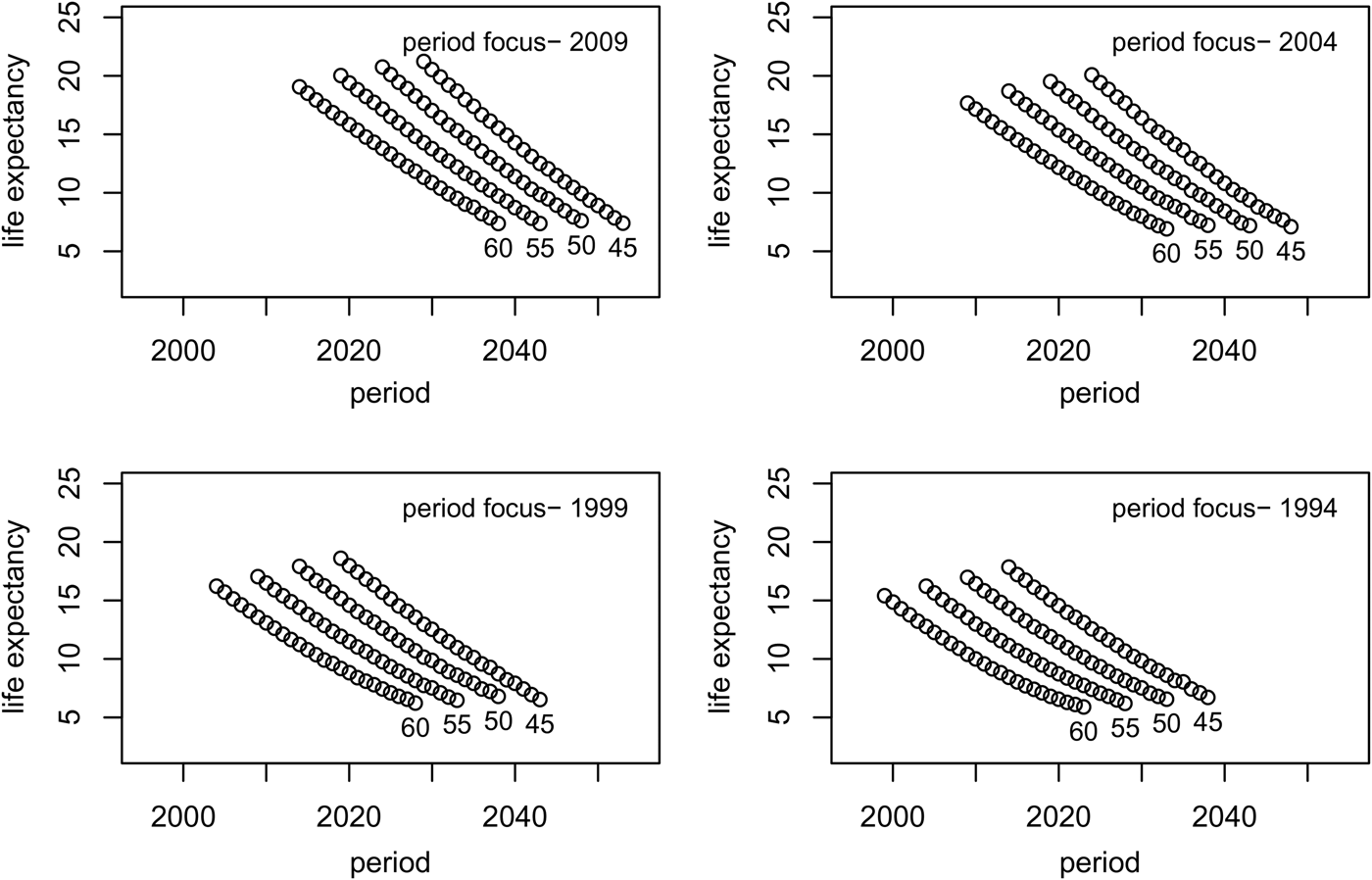
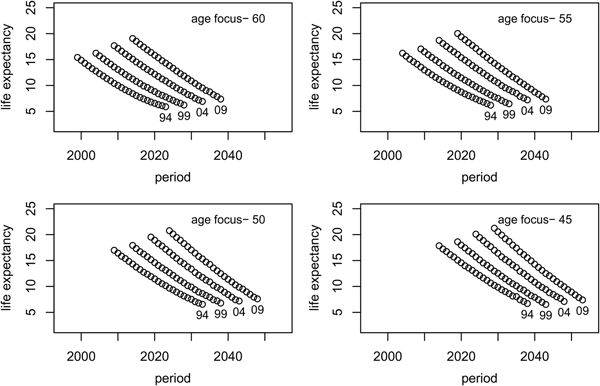
0 = 60, 55, 50, 45. Figures 1 and 2 display the values of
 $e_{{x_0} + d + k}^ \uparrow ({t_0} + d + k)$
as a function of k for these four different generations. Thus, in the first panel of Figure 1 which relates to t
0 = 2009, we present curves for x
0 = 60 (and hence d = 5) and k = 0, 1, 2, 3…and x
0 = 55, 50 and 45. The other panels relate to t
0 = 2004, 1999 and 1994. Similarly, the first panel of Figure 2 relates to x
0 = 60 (and hence d = 5) and we present curves for t
0 = 1994 and k = 0, 1, 2, 3… and t
0 = 1999, 2004 and 2009. The other panels relate to x
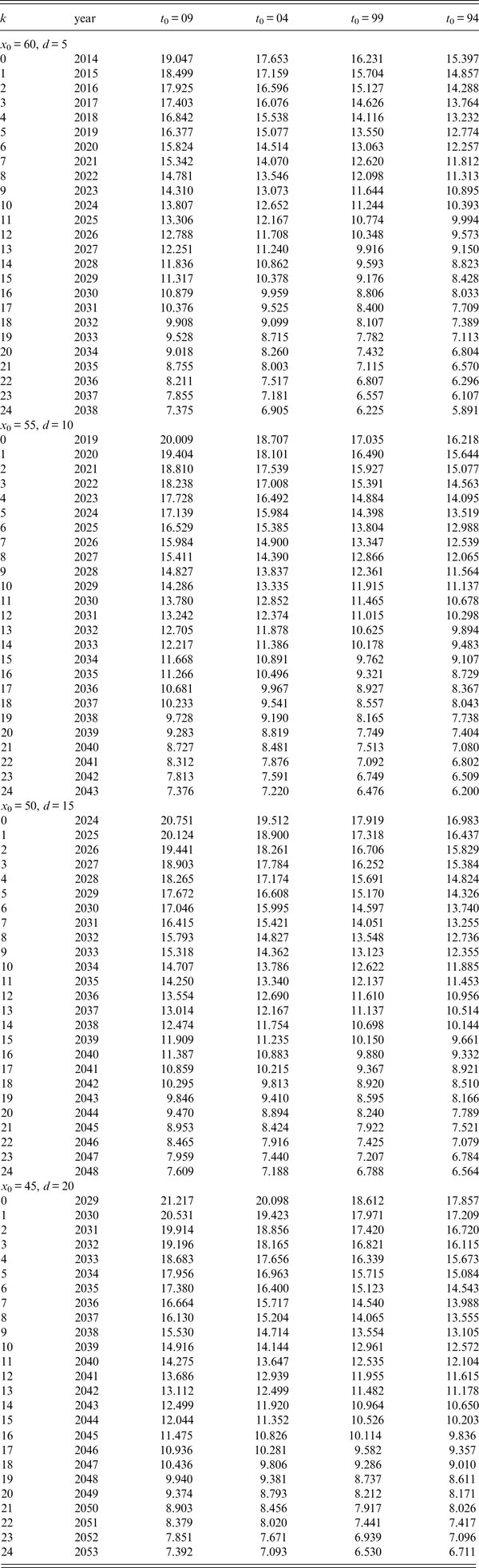
0 = 55, 50 and 45. The corresponding values have been listed in Table 1.
Simulated median deferred period life expectancy projections, focus ages 60(−5)45, based on retirement age 65. UK male mortality 1961−2009(−5)1994 experience (by panel), ages 1−89. MIRCO joint modeling with multiplicative bi-linear age−period parametric structure. ARI(1,0) time series.

Simulated median deferred period life expectancy projections, focus ages 60(−5)45 (by panel), based on retirement age 65. UK male mortality 1961−2009(−5)1994 experience, ages 1−89. MIRCO joint modeling with multiplicative bi-linear age−period parametric structure. ARI(1,0) time series.

Median period life expectancies
 $e_{{x_0} + d + k}^ \uparrow ({t_0} + d + k)$
, k = 0,1,2, …, 24, by cross-classifying the periods t
0 = 2009, 2004, 1999, 1994 with ages x
0 = 60, 55, 50, 45

Notice specifically in this tabulation that the second column headed year matches with the life expectancy entries in the third column only. It is necessary to deduct an additional 5 years to match this column up for each move to the right through columns 4, 5 and 6.
If we set e* = 15 (corresponding to some contractual value fixed at policy issue, say) and we follow the generation aged 45 in 1994, the prediction for Δ based on the then available mortality statistics are 6 in 1994, 6 in 1999, 7 in 2004 and 8 in 2009. Alternatively, the payments could still start at age 65 but at a reduced level estimated to 0.840 = 15/17.857 in 1994, 0.837 = 15/17.919 in 1999, 0.802 = 15/18.707 in 2004 and 0.788 = 15/19.047 in 2009. With e* = 17, the predicted Δ would have been 2 in 1994, 2 in 1999, 4 in 2004 and 4 in 2009. Of course, more accurate computations are possible, expressing Δ in months or weeks, if needed.
4 Discussion
In this paper, we have examined indexed life annuities, where the length of the deferment period is subject to re-evaluation, as opposed to periodic payments scaled by the ratio of the proportion of the population still alive compared to some reference forecast as in Denuit et al. (Reference Denuit, Haberman and Renshaw2011). Considering a deferred life annuity bought at age x 0 with payments starting at age x 0 + d, we let d vary according to actual longevity improvements: if longevity increases in the future, then payments start at age x 0 + d + Δ instead of x 0 + d. In the Lee–Carter case, Δ is the time needed by the time index to reach a specified barrier. The systematic risk is thus passed to the annuitants. Considering the difficulties that have been experienced in issuing longevity-based financial instruments, this might well be an efficient alternative to help insurers to write annuity business.
The approach developed here applies to life annuities bought at young ages starting at retirement as well as to contracts bought at retirement with payments starting at more advanced ages, typically 80, 85 or even 90, as a protection against individual longevity risk.
The annuity provider can inform the policyholder on a regular basis about the adjustment to the length of the deferment period so that the annuitant is able to adapt his or her consumption level during the deferred period.
Of course, alternative indexing mechanisms can be considered as any longevity index can be used to adapt the length of the deferment period. We could play with the proportion of policyholders still alive at the end of the deferment period and delay the payments until this proportion is in line with a conventional value, for instance. However, we believe that this kind of rule is less transparent than indexing based on the period remaining life expectancy of the general population, a concept which seems natural to most individuals.
The indexing mechanisms that are discussed here and in Denuit et al. (Reference Denuit, Haberman and Renshaw2011) are also relevant for other financial products subject to substantial longevity risk, such as reverse mortgages, for instance. The adaptation of the length of the deferment period is similar to the problem of linking retirement age to actual longevity in public pension systems.
Of course, the question about the demand for such new annuity products remains. More specifically, what are the premium discounts required by policyholders to sacrifice some certainty in their annuity payments? Policyholders valuing income stability might well continue to take the highly loaded conventional delayed life annuity contracts whereas others may consider that some decrease in the premium compensates for future income variability. A careful product design is certainly needed to make the new products acceptable to policyholders. In that respect, the restrictions placed on the maximal delay (and on the variations of the periodic payments in the case where both indexing mechanisms are combined) are likely to play a central role.