In mountainous areas dairy farming is important, for economic reasons (Sturaro et al. Reference Sturaro, Cocca, Gallo, Mrad and Ramanzin2009; Mack et al. Reference Mack, Walterand and Flury2013), biodiversity maintenance (Marini et al. Reference Marini, Klimek and Battisti2011), landscape conservation (Hunziker, Reference Hunziker1995), and cultural heritage (Kianicka et al. Reference Kianicka, Knab and Buchecker2010; Eriksson, Reference Eriksson2011). In European mountains, summer farms are temporary units where the livestock herds are moved to during summer to graze on highland pastures. Traditional dairy farming rely on summer transhumance for improving fodder supply and increasing the number (and production) of reared animals (García-Martínez et al. Reference García-Martínez, Olaizola and Bernués2009; Penati et al. Reference Penati, Berentsen, Tamburini, Sandrucci and De Boer2011).
Summer grazing profoundly affects lactating cows from many points of view: physiological (adaptation to new environment and management), social condition (regrouping of animals), feeding (change in feedstuffs quality and availability), nutritional (rumen and gut functions and body reserve variation), and productive (reduction of milk yield) (Sturaro et al. Reference Sturaro, Thiene, Cocca, Mrad, Tempesta and Ramanzin2013b). Some knowledge on how these effects translate into changes of milk quality traits (composition, fatty acid profile, carotenoids, vitamins, etc.) is available (Calderón et al. Reference Calderón, Tornambé, Martin, Pradel, Chauveau-Duriot and Nozière2006; Revello Chion et al. Reference Revello Chion, Tabacco, Giaccone, Peiretti, Battelli and Borreani2010), while effects on technological properties (coagulation, curd firming and syneresis, cheese yield, losses of nutrients in whey, etc.) remains scarce (Bovolenta et al. Reference Bovolenta, Ventura and Malossini2002). Nowadays, high-priced, high-quality, territory-based dairy products partly compensate for low productivity and high costs that often characterize farms in the mountains (Farruggia et al. Reference Farruggia, Pomiès, Coppa, Ferlay, Verdier-Metz, Le Morvan, Bethier, Pompanon, Troquier and Martin2014).
The aims of this study were to analyse the variations of bovine milk technological traits before, during, and after the summer transhumance, and in particular to compare the results yielded by dairy, dual purpose and locally adapted hardy breeds and to quantify the effects of parity, days in milk and compound feed supplementation of cows reared in a large sample of permanent and temporary summer farms.
Materials and methods
Alpine highland pastures sampled
The data used in this study were collected from 15 summer farms (multi-breeds herds) located in the Trento Province in the north eastern Italian Alps. The lactating cows moved during summer to these highland pastures came from 109 permanent farms of the same Province. Characteristics of summer farms and of dairy cows sampled in the present study are detailed in Zendri et al. (Reference Zendri, Ramanzin, Bittante and Sturaro2016), while the dairy systems represented by the permanent farms are described by Sturaro et al. (Reference Sturaro, Marchiori, Cocca, Penasa, Ramanzin and Bittante2013a) and goes from very traditional system with tied cows to more modern ones with loose housing, milk parlor and total mixed rations. The large majority of permanent farms and all temporary farms have cows of more than one breed. The sampled summer farms reflected the characteristics of the summer farms of the study area in terms of elevation (1683 ± 285 m asl), pasture surface (78·6 ± 67·4 Ha), number of dairy cows (65 ± 36), and stocking rate (1·09 ± 0·60 livestock unit/Ha) and were subdivided on the basis of the amount of supplementary compound feed given to the cows: low (3·4 ± 0·6 kg/d; 10 summer farms with 613 lactating cows from 77 permanent farms) and high (5·6 ± 1·2 kg/d; 5 summer farms with 367 cows from 32 permanent farms).
Animals sampled
After selection of animals discarding those with incomplete information or with outlier data (yield, milk spectra, predictions), the study retained 649 dairy cows from two specialized dairy breeds (Holstein Friesian, 81 cows, and Brown Swiss, 260 cows), one transboundary dual-purpose breed (Simmental, 180 cows), and three ‘local breeds’ (Rendena, 24 cows, Alpine Grey, 82 cows and crossbreds, 22 cows), which were grouped together for their similar body sizes and productivity. All the information on individual cows (breed, date of birth and calving, number of lactations, days in milk) was retrieved from the national cattle population register.
Milk sampling
The cows were registered in the Italian Herd Books of their breed, and in the milk recording system (AT4) of Trento Province. Monthly (excluding August) milk samples were collected and transported to the provincial milk laboratory of the Breeders Federation of Trento. Sampling started in May in the permanent farms before transhumance to the summer farms, continued in the summer farms (June, July and September), and ended soon after the cows had returned to the permanent farms (October). Data on daily milk yield were retrieved from official recording database. Cows not enrolled were not considered and data of enrolled cows incomplete in a given control date were discarded.
FTIR spectral data
Spectral data for this study were recorded at the provincial milk laboratory of the Breeders Federation of Trento Province using a Fourier-Transform Infra-Red (FTIR) spectroscope MilkoScan FT6000 (Foss Electric, Hillerød, Denmark) during routine milk recording. The spectral range was 5011 to 925 wave number × cm−1. Two spectral acquisitions were carried out for each sample and the results averaged prior to data analysis.
A preliminary analysis using Mahalanobis distances of the FTIR spectra confirmed that the spectral absorbance variability was very similar among the different breeds. A total of 1879 spectra were used for the predictions. Within breed spectra were evaluated and outlier spectra (and all information of the cow in that sampling day) were discarded (Cecchinato et al. Reference Cecchinato, Albera, Cipolat-Gotet, Ferragina and Bittante2015).
Milk coagulation, curd firming and cheese-making traits FTIR prediction equations
All milk coagulation and curd firming traits prediction equations were produced using data recorded in Brown Swiss cows by Cipolat-Gotet et al. (Reference Cipolat-Gotet, Cecchinato, De Marchi, Penasa and Bittante2012) using a laboratory lactodynamograph (Formagraph; Foss Electric, Hillerød, Denmark). The FTIR predicted traditional, single point milk coagulation properties (MCP) were defined as: RCT, the time (min) from rennet addition to milk gelation; k 20, the time (min) from milk gelation to curd firmness equivalent to 20 mm; a 30 (a 45), the curd firmness (mm) recorded after 30 (45) min from rennet addition. The FTIR predicted parameters for modelling all curd firming and syneresis point observations with time (CFt model) of each individual milk sample were defined (Bittante, Reference Bittante2011; Bittante et al. Reference Bittante, Contiero and Cecchinato2013) as: RCTeq, like traditional RCT (min) but from modelling all observations and not as a single point trait; CFP, potential asymptotic curd firmness (mm) at infinite time attainable in absence of syneresis; k CF, instant curd firming rate constant (%/min) measured after RCTeq leading curd firmness toward CFP at infinite time; k SR, instant syneresis rate constant (%/min) measured after RCTeq leading curd firmness toward null value at infinite time. Two more predicted traits derived from CFt individual equations were defined as: CFmax, the maximum curd firmness (mm) attained by CFt individual equations, and T max, the time (min) at which CFmax is attained.
For cheese-making traits, predictions were based on data recorded on the same Brown Swiss cows by Cipolat-Gotet et al. (Reference Cipolat-Gotet, Cecchinato, De Marchi and Bittante2013). The FTIR predicted cheese-making traits included three measures of cheese yield (%CY), %CYCURD, %CYSOLIDS and %CYWATER, representing the ratios between the weight of the curd, the curd dry matter, and the water retained in the curd, respectively, and the weight of the milk processed; and milk component recoveries (RECs) in the curd, RECFAT, RECPROTEIN and RECSOLIDS representing the ratios between the weights of the fat, protein, and total solids in the curd, respectively, and the corresponding components in the milk (energy recovery RECENERGY was also estimated). The daily cheese yield traits (dCYCURD, dCYSOLIDS and dCYWATER; kg/d) were determined by multiplying the different predicted %CYs (curd, dry matter and water, respectively) by the daily milk yield of individual cows (dMY; kg/d).
As described by Ferragina et al. (Reference Ferragina, Cipolat-Gotet, Cecchinato and Bittante2013) for predicting %CY and REC traits, the WinISI II software (Infrasoft International LLC, State College, PA) was also used for MCP and CFt parameters and derived traits. The chemometric algorithm for calibrating all the traits was calculated using modified partial least square regression (MPLS): compared to the traditional methods (i.e. PLS), in this case the non-analyte interference in multicomponent determinations can be coped more successfully and the interference spectrum can be provided as well. Spectra were used both without pre-treatment and with various pre-treatments, including standard normal variate (SNV), standard normal variate and detrend (SNVD), multiplicative scatter correction (MSC), and first and second derivatives. FTIR spectra were analysed across the whole interval (from 5011 to 925 wavenumber × cm−1) and without the two regions known to have very high phenotypic variability: the transition region between the short-wave to mid-wave infrared (SWIR-MWIR or NIR-MIR, 3669 to 3052 cm−1) and region MWIR-2, from 1698 to 1586 wavenumber × cm−1 (Bittante & Cecchinato, Reference Bittante and Cecchinato2013).
The best prediction equations (lower SECCV and higher RVAL) obtained from the tested chemometric models for all the traits were used to predict the traits on the sets of population spectra. Predictions of traits with a R VAL < 0·60 were not used in the present study (CFP and k SR were excluded). The need for breed specific calibration, as shown for predicting individual fatty acids contents of milk samples from Jersey cows, respect to Holstein ones, by Eskildsen et al. (Reference Eskildsen, Rasmussen, Engelsen, Larsen, Poulsen and Skov2014) was not observed for FTIR predictions of cheese yield and recovery traits when tested at population level on Holstein Friesian, Brown Swiss and Simmental breeds (Cecchinato et al. Reference Cecchinato, Albera, Cipolat-Gotet, Ferragina and Bittante2015) and for MCP-CFt traits of milk samples from 6 cow's breed reared in the same area (unpublished results), also because of the large overlapping of breed distributions of the studied traits.
Statistical analysis
All the milk coagulation, curd firming and cheese-making showed a normal distributions: data out of three standard deviations from the mean were considered to be missing. All the data of the 18 predicted traits were analysed using the MIXED procedure (SAS Institute Inc., Cary, NC). The following fixed effects were tested: feed supplement level (class 1: ≤4 kg/cow/d; class 2: >4 kg/cow/d); breed (class 1: Holstein Friesian, class 2: Brown Swiss, class 3: Simmental, class 4: Local Breeds); parity of the cow (class 1: primiparous, class 2: multiparous); DIM at the time the cow was transported to the summer farm (class 1: <120 d, class 2: 120–180 d, class 3: 181–240 d; class 4: >240 d); month (class 1: May; class 2: June; class 3: July; class 4: September; class 5: October). Summer farm (14 units, nested within class of feed supplement) and cow (649 dairy cows, nested within class of feed supplement, summer farm, breed, parity, and initial DIM) were considered random effects. After a preliminary analysis of the effects of the different interactions, the following interactions were also included in the statistical model: compound feed × breed, breed × month, initial DIM × month. Summer farm was the error line for testing compound feed, cow was the error line for testing breed, parity, initial DIM, and compound feed × breed, and the residual was the error line for testing month, breed × month, and initial DIM × month.
Orthogonal contrasts were estimated between least square means of traits for the effect of breed [(a) Holstein Friesian + Brown Swiss vs. Simmental + Local Breeds (comparison between specialized dairy breeds and dual purpose breeds), (b) Brown Swiss vs. Holstein Friesian (comparison between the two specialized dairy breeds) and (c) Local Breeds vs. Simmental (comparison between the two dual purpose breeds)], of initial DIM [(a) linear, (b) quadratic and (c) cubic component (to describe the effects of different DIM at the beginning of summer pasture on considered traits)] and of month [(a) May vs. June (effect of transfer of cows from permanent to temporary farm), (b) June vs. September (effect of long term effect of summer grazing), (c) July vs. June + September (effect of possible non-linear variation during summer-grazing) and (d) September vs. October (effect of return of cows to permanent farms)].
Results
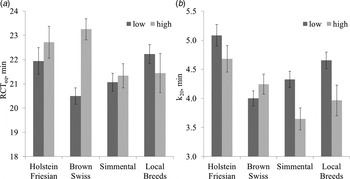
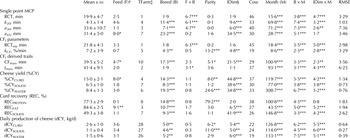
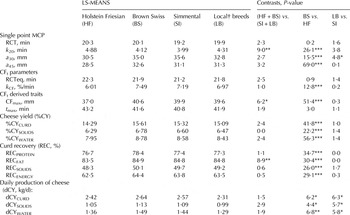
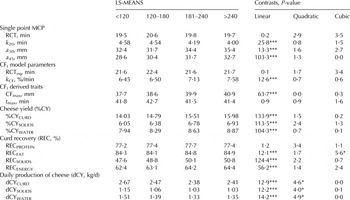
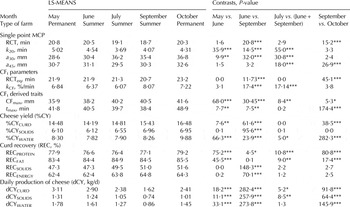
The descriptive statistics (mean ± sd) and the results of the ANOVA for the milk coagulation/firming and for the cheese-making traits are reported in Table 1. The amount of compound feed significantly affected only few technological parameters, although with low statistical significance. The breed effect was statistically significant for almost all the traits, with the exception of RCT and t max. The least square means of breed factor are presented in Table 2 and for RCTeq and k 20 in Fig. 1. The first contrast shows that only few traits (k 20, CFmax and RECFAT) were more favourable for dual purpose breeds (Simmental and local breeds) than for the specialized ones (Holstein and Brown Swiss). Holstein and Brown Swiss, as outlined by the second contrast, were very different for all the traits analysed, with more favourable values for Brown Swiss. The differences between the two groups of dual purpose breeds of Alpine origin were almost negligible, except for daily cheese production that was higher for Simmental. The fixed effect of class of parity affected mainly %CYCURD, water retained in the curd and protein recovery in the curd (Table 1). The initial DIM, which shows the differences between cows at different stages of lactation when they were moved to summer farms (Table 3), influenced all traits with the exception of RCT, RCTeq, t max, and RECPROTEIN. A strong linear trend was observed for all the affected traits, with the only exception for RECFAT (cubic effect).
Rennet coagulation time (a) predicted by CFt model and k 20 (b) of cows of different breeds going to temporary summer farms distributing a low (≤4·0 kg/d) or high (>4·0 kg/d) compound feed.

Descriptive statistics (Mean ± standard deviation) and results from ANOVA for milk coagulation traits with F-value and significance for fixed effects and the proportion of variance (in percentage) explained by random effects (TFarm and cow)

RMSE, Root means square error
*P < 0·05; **P < 0·01; ***P < 0·001
† Effect of class of temporary summer farms according the average daily amount of compound feed given to lactating cows (≤4·0 vs. >4·0 kg)
‡ Temporary farm (15 farms)
§ Initial Days in milk (at the time the cow is transported to the summer farm)
Effect of breed of cows on milk technological traits

*P < 0·05; **P < 0·01; ***P < 0·001
† The local breed group included Rendena, Alpine Grey and crossbreds cows
Effect of days in milk at the transport of cows to temporary summer farms on milk technological traits

*P < 0·05; **P < 0·01; ***P < 0·001
The month effect (Table 4) combines the effects of transfer to summer farms, of advancing lactation within cow, and of changes in seasonal environmental conditions. The transfer to summer pasture (May vs. June) was favourable for lactodynamographic properties, negative for %CYCURD, due to a decrease in water retention in curd (increased syneresis), and varying for nutrient recovery, being negative for protein, positive for fat, and negligible for total solids and energy. The comparison between June and September showed large differences between the initial and final stages of the summer season for all trait categories. The trends were favourable for all cheese-making traits, with the exception of RECFAT that was almost constant. However, this was not sufficient to guarantee a higher daily cheese production in September, due to the lower daily milk yield when compared to June (and to the other months). The contrast between July and the average of June and September reflects possible non-linear trends in observed traits from the beginning to the end of the summer transhumance. Rennet coagulation time (RCT and RCTeq), time to maximum curd firmness, %CYCURD, %CYSOLIDS, RECSOLIDS and RECENERGY showed an almost linear improvement during summer pasture. A non-linear trend was instead observed for the other traits, which often improved in July and slightly worsened in September. In the last comparison (September vs. October), milk gelation tended to be slower after returning to permanent farms, but curd firming was faster; %CYCURD improved because of a greater water retention in the curd (%CYWATER), REC traits relative to fat and protein improved, while solids and energy recoveries were unaffected.
Effect of the month of recording on milk technological traits

*P < 0·05; **P < 0·01; ***P < 0·001
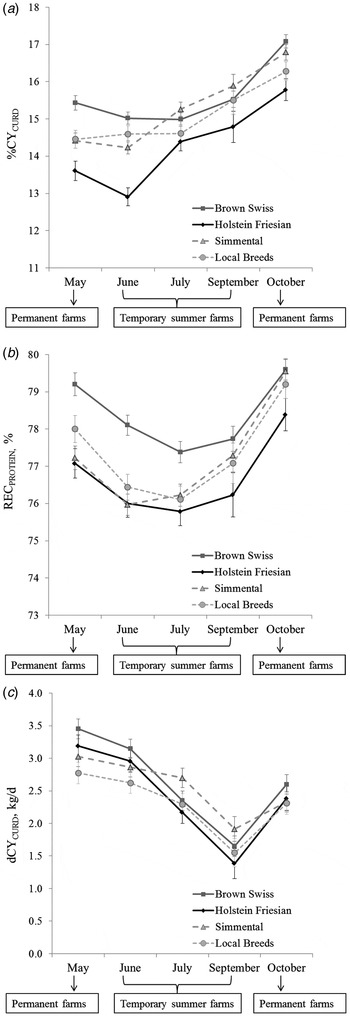
The interaction compound feed × breed was significant only for some coagulation properties traits. The interaction between breed and month resulted important almost for all the traits particularly for %CYCURD, RECPROTEIN and CYCURD (Fig. 2); the same result was observed for the interaction IDIM × month. Considering the aim of this research, the most interesting result to discuss is the evolution of the analysed traits before, during and after transhumance for the different breeds. The interaction feed × month was significant only in few cases. The proportion of variance explained by individual cow was higher than that explained by the summer farms for all the milk cheese-making traits, ranging from 19% for k CF and dCYWATER to 46% for RCT. Summer farms variability was higher (from 26% to 28%) only for dCY, as a consequence of the cows daily milk yield variability between summer farms: the summer farms using the high level of compound feed had milk with more favourable k 20, a 45, CFmax, %CYCURD, and RECFAT than those using the low level (data not shown). Correlations among milk coagulation, curd firming and cheese-making traits and with milk protein and fat are given in the Supplementary file (Supplementary Table S1). All the cheese-making traits resulted moderate related with coagulation: among these correlations, RCT, RCTeq and kCF showed lower values of coefficient of determination especially when associated with all the 3 %CYs, with RECPROTEIN and with RECSOLIDS.
Fresh cheese yield (%CYCURD, a), milk protein recovery in curd (RECPROTEIN, b) and daily cheese yield (dCYCURD, c) of milk of cows of different breeds before, during and after summer transhumance.

Discussion
Milk coagulation and curd firming
To understand the effect of summer transhumance on milk coagulation/firming processes, it is important to mention that these traits are characterized by a curvilinear evolution during lactation, worsening at the beginning of lactation and improving toward the end (Bittante et al. Reference Bittante, Cipolat-Gotet, Malchiodi, Sturaro, Tagliapietra, Schiavon and Cecchinato2015). As cows in very early lactation are not normally moved to summer farms, the expected pattern of coagulation and curd firming traits of the cows in this study was stable with a tendency for improvement in the last months. This was indeed with respect to the milk characteristics of cows with different DIMs at the beginning of lactation (Table 3). However, DIM does not take into account the effect of advancement of lactation during the observation period, when the effects of changes in environment, management, and feeding of cows are added to those of changing lactation stage. Moreover, pasture increases intake of vaccenic acid and the availability of rumenic acid and other conjugated linoleic acid (CLA) isomers (Kelly et al. Reference Kelly, Kolver, Bauman, Van Amburgh and Muller1998). The latter substances may have a negative effect on de novo synthesis of fatty acids in the udder, leading to a reduction of milk fat content (Bauman et al. Reference Bauman, Perfield, Harvatine and Baumgard2008; Shingfield et al. Reference Shingfield, Bernard, Leroux and Chilliard2010; Schiavon et al. Reference Schiavon, Cesaro, Tagliapietra, Gallo and Bittante2015), and depressed on milk coagulation and curd firming processes in ewes (Bittante et al. Reference Bittante, Pellattiero, Malchiodi, Cipolat-Gotet, Pazzola, Vacca, Schiavon and Cecchinato2014).
On the other hand, in the present study the depression of milk fat content at the beginning of summer pasture was very limited (from 3·70% in May to 3·61% in June), which could explain why moving to summer pastures had no short-term effects on coagulation time and a favourable effect on the curd firming process; in fact, the maximum curd firmness was greater and attained quicker at the beginning of summer pasture than before moving (Table 4). Curd firming process improved further during the first phase of summer pasture, but then declined to the initial values. The return to permanent farms was accompanied by a delay in coagulation and an improvement in curd firmness. Macheboeuf et al. (Reference Macheboeuf, Coulon and D'Hour1993) and Leiber et al. (Reference Leiber, Kreuzer, Leuenberger and Wettstein2006) observed that moving cows from barn feeding based on silage and concentrates to lowland pasture had a favourable effect on traditional MCP in experimental stations, but Leiber et al. (Reference Leiber, Kreuzer, Leuenberger and Wettstein2006) found the effect to be unfavourable when moving from lowland grassland to Alpine pastures.
The cows that in summer farms received more concentrates produced milk with similar coagulation times but better curd firming aptitude than those receiving less concentrates (data not shown), confirming a pattern observed with traditional MCP by Bovolenta et al. (Reference Bovolenta, Ventura, Piasentier and Malossini1998, Reference Bovolenta, Corazzin, Saccà, Gasperi, Biasioli and Ventura2009). Notably, this effect was not common across breeds. The differences between breeds observed in this study are consistent with the results reviewed by Bittante et al. (Reference Bittante, Penasa and Cecchinato2012), highlighting the inferiority of milk from Holstein Friesian cows with respect to that from breeds of Alpine origin. Similarly, Martin et al. (Reference Martin, Pomiès, Pradel, Verdier-Metz and Rémond2009) obtained better MCP values with Montbéliarde than with Holstein cows at pasture. What has not been previously observed is the interaction between the level of compound feed administered and breed (Fig. 1). Increasing concentrates was accompanied by a clear worsening of the coagulation time of milk for Brown Swiss cows, a smaller negative effect for Holstein Friesian and Simmental cows, and a small positive effect for cows of local breeds. Concentrates improved curd firming and curd firmness traits with all breeds, excluding Brown Swiss.
Cheese yield and milk nutrient recovery in curd/loss in whey
Information on variations in cheese yield and curd nutrient recovery from milk obtained in summer farms is very scarce. After the peak in milk production, fresh cheese yield (%CYCURD) generally tends to increase with DIM, because of a simultaneous increase in milk fat and casein contents, and so do recovery of total solids (RECSOLIDS) and milk energy (RECENERGY), mainly because of the reducing proportion of lactose to total solids with advancement of lactation (Cipolat-Gotet et al. Reference Cipolat-Gotet, Cecchinato, De Marchi and Bittante2013). In the present study, %CY and REC traits increased almost linearly with initial DIM of cows at the beginning of summer pasturing, which was due to the absence of cows in the very early phase of lactation (Table 3).
This study confirmed (Table 2), the ranking of breeds observed in the long term on all the farms in the province of Trento independently of summer transhumance (Cecchinato et al. Reference Cecchinato, Albera, Cipolat-Gotet, Ferragina and Bittante2015), with lower %CY traits from Holstein Friesian cows as a consequence of a lower content of milk dry matter and of a lower nutrients recovery in the curd. Interestingly, the two specialized breeds showed a similar pattern during summering, with a constant superiority of Brown Swiss over Holstein Friesian cows, while Simmental and local breeds showed intermediate values, and a tendency for initial declines and following increases to be less accentuated (Fig. 2). In a study on processing milk for Cantal cheese production, Martin et al. (Reference Martin, Pomiès, Pradel, Verdier-Metz and Rémond2009) found Montbéliarde cows to have a higher cheese yield than Holstein Friesians reared at pasture.
Comparing the %CY traits results between May and June, instead of the expected increase due to the advancement of lactation, a decrease in %CYCURD was observed (Table 4). This does not seem to be attributable to a change in milk composition, but mainly to a lower retention of water in cheese. The RECSOLIDS and RECENERGY were not affected by moving to summer pastures, while RECPROTEIN decreased and RECFAT increased (Table 4). Later on, the expected change with advancement of lactation was instead observed (increases in all %CY traits and in RECSOLIDS and RECENERGY), particularly in the first phase of summer pasturing, probably due to an adaptation of cows after the initial stress. Also the return to permanent farms occasioned an improvement in all %CY and REC traits, more pronounced than expected from the advancement of lactation, indicating here, too, the effect of an improvement in the cows' conditions, especially their feeding.
The correlations included in the Supplementary Table S1 showed higher values between coagulation and cheese-making traits than what found by Cecchinato & Bittante (Reference Cecchinato and Bittante2016): normally, when compared to those measured, higher correlations are expected because the spectrum represents the measurement for all the predicted traits and because those spectra normally show high repeatability.
Concluding, we showed that summer transhumance affected cheese-making aptitude of milk, with some difference according to parity, initial days in milk, breed and concentrate supplementation of cows. This study provided new knowledge on the effect of summer transhumance on milk cheese-making traits. New information was gathered on the effects of summer pasture on milk coagulation and curd firming properties, cheese yield, and milk nutrient recovery in the curd or loss in the whey with cows of different breeds.
Supplementary material
The supplementary material for this article can be found at http://dx.doi.org/10.1017/S0022029916000583.
The Authors acknowledge the Province of Trento for funding, the Provincial Federation of Breeders of Trento and Dr Ilario Bazzoli for collaboration in data collection, milk sampling and FTIR spectra storing, Dr Alessandro Ferragina (DAFNAE department of Padova University) for FTIR calibrations and prof. Giovanni Bittante for useful discussion and interpretation.