Introduction
The UK government publishes official poverty measurements annually in the Households Below Average Income (HBAI) data series (DWP, 2009). The HBAI series draws on data from the Family Resource Survey (FRS) and British Household Panel Survey (BHPS). Income measurement in these surveys is complex: more than 400 pages of BHPS user guide explain the derived income variables (Taylor, Reference Taylor2007). The FRS and the BHPS measure household income from wages, state benefits, tax credits, investment earnings and maintenance payments. However, neither the FRS nor the BHPS collect data on income from gifts. FRS does ask respondents about ‘maintenance and separation allowances’ (FRS, 2010: 271), while BHPS asks about ‘maintenance and alimony’ and ‘payments from a family member not living here [i.e. in the respondent's household]’ (BHPS, 2010: 89). But such regular contributions should be classed as ‘maintenance’ or ‘payments’ rather than as ‘gifts’; court-enforced child support, for example, can hardly be classed as a ‘gift’. Such transfers have therefore not been included in this article. On the other hand, respondents would be unlikely to identify genuine gifts as ‘maintenance’ or ‘payments’ and so many transfers from one household to another are simply missed in household surveys.
The absence of questions explicitly dealing with gifts from both FRS and BHPS is puzzling considering the Family Resources Survey's stated intention:
The primary function of the FRS is to collect information on the resources of households, that is income received from all sources . . . It is crucial for all DWP uses of the survey that information is as accurate as possible. (DWP, 2008: 27)
The new Wealth and Assets survey does include one question about regular gift income (UK Data Archive, 2010: 137), but curiously the responses to these are absent from the published report (ONS, 2010).
We are not alone in noting the unwarranted absence of gifts from household income measurement. Ruspini (Reference Ruspini2000) notes that reliance on income alone in measuring poverty is problematic, as it exclude other resources. More recently, Bradshaw asked ‘whether household income is a valid indicator of living standards as it excludes borrowing, dissaving,Footnote 1 gifts and home consumption’ (Bradshaw and Richardson, Reference Bradshaw and Richardson2008: 525).
Policy work on the contribution of gifts to the household economy has been extremely limited in the UK context. The main literature on gifts is from the United States, where economists have produced considerable work on inter-vivos transfers (gifts from living older parents to grown-up children) and post-mortem bequests (inheritance). Villaneuva (Reference Villanueva2005) has estimated that in the mid-1980s 11 per cent of aggregate net worth in the US came from inter-vivos transfers. He estimated the net worth of gift income in the UK as $433 per head at 1985 values. This raises the question of why government statisticians have overlooked a contribution to UK household net worth, which Villaneuva estimates as £22billion in 1985.
Various studies have concluded that adult children are more likely to receive financial help when they are in poor circumstances, so such transfers should be of particular interest for those interested in low-income households (see Wolff et al., Reference Wolff, Spilerman and Attias-Donfut2007 for France; Spilerman, Reference Spilerman2004 for Israel; Kazianga, Reference Kazianga2006 for Burkina Faso; Dunn and Philipps, Reference Dunn and Phillips1997 for the US; Kohli and Kunemund, Reference Kohli, Künemund, Bengtson and Lowenstein2003, give a synthesis of several international studies). Most of the work on inter-vivos transfers has been statistical in nature and conducted by economists (Hayhoe and Stevenson, Reference Hayhoe and Stevenson2007, are an exception).
Qualitative accounts of gift exchanges are found in many anthropological studies, where gift-giving is usually associated with reciprocity (Komter, Reference Komter1996; Offer, Reference Offer1997; Silber, Reference Silber2009). Across the life-course, inter-generational transfers are reciprocated to some degree, but it has been suggested that gift-giving, at least in North America, works to the financial advantage of children (Offer, Reference Offer1997). In development studies, remittances have attracted interest. International flows of remittances exceed total development aid and have become the largest financial flow to some developing countries (Kunz, Reference Kunz2008).
Compared to this wealth of international research, work on gifts in the UK context is limited. Finch and Mason's (Reference Finch and Mason1993) study of family relationships in Britain touched on gifts and their significance. Kempson et al. (Reference Kempson, Bryson and Rowlingson1994) included analysis of financial help exchanged between low-income families, especially informal loans. Rowlingson and McKay's work on inheritance found an inheritor sometimes passed inherited money directly to their children, and noted some other examples of inter-vivo gifts (Rowlingson and McKay, Reference Rowlingson and Mckay2004, Reference Rowlingson and Mckay2005; Rowlingson, Reference Rowlingson2006). Several other commentators on household income have mentioned gifts in their studies (Goode et al., Reference Goode, Callender and Lister1998; Room, Reference Room, Gordon and Townsend2000; Ridge, Reference Ridge2002). Goode et al. (Reference Goode, Callender and Lister1998: 22) concluded that: ‘almost without exception, couples received regular financial help from their extended family’. However, none of these studies dealt with gifts as their main theme. The only exceptions to this are Tatch (Reference Tatch2007), who showed the importance of parental gifts in helping first time buyers on to the housing ladder, and Wilson (Reference Wilson1987), who found that grandparents played an important role in providing material support to families with children in inner London. Gifts are generally omitted from social surveys and there is a dearth of published studies on gifts in the United Kingdom. More research is needed if we are to properly understand the role of gifts in the household economy.
This article reports the findings of two doctoral research projects concerned with low-income families in the UK: in one case focusing on children, in the other mothers. A gift has been defined as any contribution to a household's income which comes from another household. In both studies, gifts had a qualitative and quantitative importance not recognised in previous research (Bradshaw, personal communication, Reference Bradshaw2009; Wilson, personal communication, Reference Wilson2009). The studies are presented in turn below. This is followed by an assessment of the monetary value of gifts to the recipients. The article ends with a discussion of the implications of the neglect of gifts in household income measurement and suggestions for further research.
In order to explore the nature of the gifts in the studies in more depth, a simple typology was devised which divided gifts into five distinct types: regular gifts, one-off gifts, help in-kind, loans and hand-me-downs. Regular gifts are the most likely to be included in social surveys, while regular support from non-resident parents to their ex-partners is measured in FRS, HBAI and BHPS. It has already been stated that such contributions should be classed as ‘maintenance’ rather than as ‘gifts’ and they have therefore been excluded from this article. On the other hand, gifts made by an absent parent directly to their child, even those made on a regular basis, will not be recorded in household surveys, and these are therefore included here. One-off gifts include inheritances and any gifts of money that occur less than once a month. These include birthday and Christmas presents and were often found to be small in nature. However, one-off gifts of several thousand pounds transformed the financial position of a few households in the studies. Help in-kind is defined as the provision of services at no charge which would otherwise have to be paid for, such as baby sitting or gardening. The services provided in the two surveys were difficult to quantify in cash terms, especially as in many examples the household would not actually have been able to afford to pay for the service delivered. Although each occurrence of help in-kind had a small monetary value, the regularity of these services amounted to a considerable contribution to annual income. Loans from family or friends are not strictly gifts at all. However, other families in the studies had to resort to door-step loans, paying back double the amount that had been borrowed. Interest-free loans therefore effectively amount to a ‘gift’ of several hundred pounds of foregone interest payments. Hand-me-downs were perhaps the most common form of gift-giving in the second study. They usually involved used clothes with a small cash value but for many of the households considered they were important. For both mothers and children, the provision of good-quality clothing was important for self-esteem and comfort, and freed up money to spend on other important things.
First study: the contribution of gifts to children in low-income families
The following section discusses part of the findings of a study of child poverty dynamics in the UK conducted by Sarah Taylor.Footnote 2 Respondents were identified through the co-operation of the administrators of the European Communities Household Panel sub-sample of the BHPS.Footnote 3 Respondents’ parents took part in this survey from 1997 to 2001.Footnote 4 During this time, the interview sample, of 30 young people in 21 families experienced between one and five years in poverty (i.e. they lived in households with incomes below 60 per cent of the median before housing costs). Interviews took the form of a semi-structured life history and were conducted in respondents’ homes from February to June 2008, in England, Scotland and Wales. At this time, the sample were between 15 and 21 years of age.
The purpose of the interviews was not to question the facts of the BHPS, but to interpret them. In relation to gifts, however, data were missing, which was found to be of such qualitative importance and quantitative size as to bring some income measurements produced by BHPS data into question. The particular focus of the following section will be to discuss the importance of these missing data, gifts, to children.
Regular gifts
There were three cases in the study where a non-resident father had regularly given cash directly to his children. Malcolm received several thousand pounds from his father every year between 1994 and 2008, plus an annual holiday up until 2001. Natalie, James and Mark received substantial cash gifts from their father over many years. The total value was estimated by them to have been in the region of £3,000 a year. Finally, 17-year-old Tony still received pocket money from his non-resident father, with no expectations in exchange: ‘even though I haven't seen him or spoken to him for nearly a year he still puts 50 pounds in my bank every month, since I was about 12’.
One-off gifts
Grandparents were the most important and largest contributors of one-off gifts for respondents. Previous work has shown that, as children age, grandparents begin to support them directly, rather than indirectly through parents (Dench and Ogg, Reference Dench and Ogg2002). Bradshaw et al. (Reference Bradshaw, Stimson, Skinner and Williams1999) found grandchildren making material contributions to grandparents, and scattered references to this were made in this study. However, these were substantially outnumbered by comments indicating the reverse. The large and regular sums transferred down the generations were clearly significant for many of those interviewed.
Grandparents could spend apparently unlimited sums on their grandchildren without them being seen as ‘spoilt’. Kaitlin said that because she was the first grandchild on both sides of the family: ‘I was completely doted on’. Dench and Ogg (Reference Dench and Ogg2002) also noted that first grandchildren benefited from additional support from grandparents.
Several respondents were able to go on holiday abroad through the contributions of their grandparents. In one family, the grandmother took the younger sister shopping for clothes and shoes every other weekend, took the siblings out for dinner and distributed pocket money. The youngest appreciated these contributions, but also felt they were normal, as her friends were also ‘spoiled’ by their grandparents.
One respondent was particularly aware of the importance of her grandmother's contribution, citing Christmas, when half her presents would be from her mother and half from her grandmother. She would give ‘little bits of cash’, clothes, school uniforms, pocket money and would buy shopping while the family stayed at her home during holidays. ‘I would say if it weren't for my gran being there, we wouldn't have had as much, it's down to my gran that we had everything we wanted.’ Another respondent went on holidays with his grandparents and had had bonds taken out by them on his behalf. One received casual cash gifts from his grandparents, and although he could not remember precise amounts he stated that it was ‘enough to make me happy’.
Aunts, uncles, siblings and the non-resident partners of parents also contributed cash and other gifts to many respondents. Clare, for example, remembered that when her uncle moved house he could not take his piano, so gave it to her family. Another respondent spoke generally of getting things he wanted from his aunts and uncles.
A number of examples were given of respondents’ siblings contributing small and large sums, particularly older siblings, before and after leaving home. Where relevant, the new partners of separated parents were a useful source of income: one respondent received a £170 dress from her father's girlfriend for her school leaving event.
The friends of their parents were also important for three respondents. One of these three, Kaitlin, and one of her friends, received mobile phones from another girl's father. She reported that her mother was unwilling to buy her a mobile due to their cost, ‘so we got one for free, so that was good, but, otherwise, I wouldn't really have got one’. She also mentioned family friends, from whom she received toys and other items. Even small amounts of money were appreciated; one girl mentioned a school friend who gave her 20p or 30p for sweets.
We know from Bradshaw et al. (Reference Bradshaw, Stimson, Skinner and Williams1999) that a majority of non-resident fathers support their children with birthday and Christmas presents, clothing, shoes, pocket money, and holidays or outings. In fact, similar levels of financial support are given formally and informally (ibid.). Indeed, in this sample, gifts from non-resident fathers were most visible to children when in the form of non-cash gifts intended for the use of children themselves, such as holidays and games consoles. In the sample of 30, 14 respondents did not live with their father for part of their childhoods due to divorce or separation. A number of respondents benefited to a notable extent from transfers from non-resident fathers, materially, financially and socially.
For example, the potential for reliably receiving things he wanted reduced Ed's perception of being badly off during his childhood.Footnote 5 He said, ‘If I asked my mum for something she might say no or, soon, but if I asked my dad I'd get it, just no questions.’ His level of self-perceived deprivation was affected, leading to a qualitatively lowered impact of low income. In terms of the material impact of gifts from fathers, one respondent knew his father was richer than his mother, due to a higher paying job, and so ‘if I wanted anything I would just go to him and he would get it for me’. He cited bikes, a games console, holidays and other activities. This was enough to make his life ‘some better, a bit better’. Similarly, Natalie suggested the qualitative importance of these payments and in-kind payments from her father by stating that ‘I'd always get everything I wanted’.
Tony was the only respondent who mentioned receiving an inheritance, ‘a few grand’ in 2000, which was sufficiently large to pay for a car.
Help in-kind
Dench and Ogg (Reference Dench and Ogg2002) have shown that while wealthier grandparents generally provide cash and gifts, less affluent grandparents are more likely to provide in-kind support. However, possibly because this help was less ‘visible’ to the respondents, none mentioned it. Perhaps an additional interview question on in-kind contributions, carefully worded, would have elicited a greater response.
Some non-resident fathers did provide help in-kind, for example through providing meals on visits, and through babysitting. This is a difficult area, as both the children themselves and their resident parents did not see these things as ‘gifts’ but as a normal part of being a responsible parent. Whether or not these things can be classed as ‘gifts’, and if not how else they might be classified and measured, requires further reflection.
Loans
Access to conventional credit was often impossible for respondents, due to their age and limited income. Being able to call on family members for cash loans was therefore sometimes important. One respondent borrowed money from his mother's boyfriend when his mother had none. Another respondent was loaned money from his grandfather in order to buy a car: ‘he lent me hundred quid to get it, so it was quite good’. Other respondents benefited when their parents were able to access loans. For example, one respondent benefited through a transfer from his grandparents to his parents: his mother borrowed money from them to refurbish the house when the family was ‘struggling’. Farah was able to go on holiday with her family after her uncle loaned a sum to her father, the amount of which was unknown to her. Given that her family was large, and the holiday was long-haul and lasted for six weeks, we may assume the figure was substantial.
Hand-me-downs
Only one respondent mentioned hand-me-downs, saying how important his friends had been to him: ‘it's a good job I had good mates, because they would give me their clothes, nice clothes’.
The quantitative importance of gifts
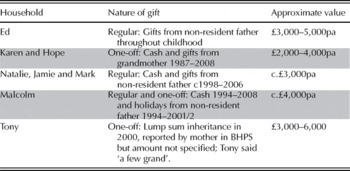
All 30 respondents received some level of extra-household support from family members or, less often, from friends. The smallest gifts reported were annual birthday gifts of around £5 in cash. The largest gifts are recorded in Table 1.
Households with significant gifts, Taylor study

Source: Analysis of interview transcripts.
Having discussed the qualitative importance of gifts to children, it is possible to attempt to quantify those that formed a large proportion of household income. In five households, for eight respondents, transfers reached such an extent as to cast doubt on household income figures (Table 1). This did not necessarily coincide with the qualitative importance or salience to respondents, although the two were not unrelated. The difficulty of estimating the value of the gifts makes it correspondingly difficult to assess their contribution to overall household income. However, taking together the evidence in the interview transcripts and the BHPS record of their family earnings, gifts represented an unrecorded addition of between one quarter and one half to the household incomes of all those listed in the table.
Second study: the contribution of gifts to mothers in low-income families
The second study involved semi-structured interviews with 17 mothers from low-income working families in Newcastle upon Tyne, recruited through Sure Start Newcastle East and Fossway, and was undertaken by Chris Warburton-Brown between July 2008 and April 2009. All of the women were living with a man and a child (or children) under 18. In all the households at least one adult worked over 30 hours a week, but for low wages; the household income, after tax and benefits, was between 60 per cent (the poverty line) and 80 per cent of median income before housing costs.
The main aim of the study was to gain a greater understanding of how mothers manage their family finances, and gifts emerged as one of the most interesting aspects of this. Following the example of Goode et al.'s (Reference Goode, Callender and Lister1998) study, a specific question on gifts was included in the interview schedule: ‘Do you ever get any gifts of money, clothes or other items from family members or friends who don't live with you (including Christmas and birthdays)?’. Information on gifts in-kind also emerged from other questions, such as those dealing with spending on children's clothes.
Regular gifts
Regular gifts had a relatively small significance for the mothers in this study. Although five women had children from previous relationships, only one had any contribution from a previous partner, just a couple of hundred pounds a year. In two families, regular sums were given to children by their grandparents, ranging from ten pounds a month to one thousand pounds a month: ‘Dad gave us one thousand pounds a month until he retired . . . They're a bit like us, they don't spend a great deal. So he just wanted to get rid of it really. We've got ISAs and PEPs for the kids.’ These sums would not be accessible to the children until they were 18.
Finally, one woman in the study was giving substantial amounts of money to her sick parents, in spite of her own straitened financial circumstances. This consisted of regularly paying for their shopping, with a value of around 15 pounds a week.
One-off gifts
Grandparents (meaning the parents or parents-in-law of the women interviewed) were the most important source of one-off gifts to the household economy. They were both the most generous and the most regular givers. A majority of the mothers in the study mentioned gifts of money from grandparents. In most cases, this was less than two hundred pounds in a year. However, the importance of even small sums of money should not be under-estimated. For two of the women, the money they received at Christmas and birthday was the only money they had to spend freely on themselves in the entire year: ‘I get Christmas money off my mam . . . That money from my mam, I just go and buy myself a top or a pair of jeans with it.’ Another mum was given money by her father to visit her dying mother in hospital, even though they had been divorced for years.
In a couple of cases, direct financial help was much more generous. When both she and her husband were made redundant, Debbie's parents and parents-in-law offered to pay their mortgage until her husband found a new job. This took only four months, but the mortgage payments enabled them to keep their house, which otherwise would have been lost. The most extreme case in the study group was that of Marie's family. They had been given £20,000 as a one-off gift by her husband's parents. This was used to build a conservatory and a toy room for the new baby, buy furniture and carpets, redecorate and go on holiday.
Several of the mothers received important non-monetary gifts. One was given a food hamper every Christmas by her mother-in-law, a crucial contribution to the family finances when they were most stretched. Two other women said that gifts of new clothes made a major contribution to their ability to provide for their children. For 12 of the 17 families in the study, finances were too tight to allow them to afford a holiday. However, for three of these households grandparents treated them to a family holiday. One mother had received £5,000 when her grandfather had died, and the money had been used to buy a new bed, a sofa bed and a holiday.
Gifts from extended family were less important than grandparental support, and relatives often expected a degree of mutuality which grandparents did not. However, they were specifically mentioned by more than half the mothers in the sample.
For two mothers, relatively small sums of money given by extended family members enabled them to buy things for the children which otherwise would have been difficult:
They always get 50 pounds for Christmas and birthdays [from their great aunt]. It makes a big difference, because Claire [daughter] is desperate for a proper pair of shoes. So I was able to buy her a good pair of shoes, and the rest went to my bank account, and when summer comes round I can buy her some good clothes.
Help in-kind
Help in-kind from grandparents and other family members also made a significant contribution to the lives of the interviewees. A number of families got occasional money from family members when especially needed for major one-off expenses such as moving house. Several were able to call on their parents or parents-in-law to help with decorating their home or DIY:
Colin's dad has been really good . . . He helped a lot getting the house sorted . . . whenever I need anything I'll just say to him ‘if you spot it, will you get me this or that?’ and he never expects any money back from me.
Four families had regular contributions to decorating or gardening work from relatives: ‘My [unemployed] uncle does all the gardening and that for me, so you don't really have to pay anybody for that, just give him cups of tea (laughs).’ In one case, a new porch, a new kitchen, a conservatory and new plumbing had been built by the husband working with his cousin, a bricklayer, and her brother, a plumber. The total value of work done was close to ten thousand pounds and had transformed the house. In return, the husband had been working on the homes of the cousin and brother-in law.
Loans
Two families had received interest-free loans of five hundred pounds from extended family to help them move. One used this money as a deposit on a rented property and the other to furnish the new house. Without this, it was doubtful whether they would have been able to move to better accommodation even when it was offered to them.
Hand-me-downs
Seven mothers specifically mentioned hand-me-downs as making a contribution to their household economy. These comments were not usually made in response to the ‘gifts’ question, but when discussing the provision of clothes:
For the kids, virtually all of their clothes are second hand or given to us as presents. We've been really lucky as several of our friends have got slightly older children. It tends to be the mums I'm meeting for coffee anyway, so I'll be meeting with them and I'll get a great big bag of clothes, which is fantastic.
Adults also sometimes benefited from hand-me-down clothes: ‘My next door neighbour has got two twin boys who are in their twenties, so whenever they decide to change their fashions, [my husband] gets clothes.’ However, a couple of mothers were reluctant to have their children dressed in hand-me-down clothes.
Clothes are not the only things given as hand-me-downs. Over a five-year period, Jill had received almost everything she needed for her house from friends who were up-grading their own homes. The estimated monetary value of all these items exceeded five thousand pounds:
The car, old video machines and TVs, our dishwasher, our computer, our washing machine, our microwave, cooker, fridge and freezer. We just get given everything. We never have to buy anything really.
The quantitative importance of gifts
Sixteen of the 17 mothers interviewed had some kind of gifts coming into their household. It is possible to divide these mothers into three groups. The first group was those for whom gifts made little contribution. Four of the 16 families who received gifts fit into this category. Gifts were small, and their value was no greater than the gifts which the household was making to other households (for example, the mutual exchange of Christmas presents).
The second group were those for whom gifts were making difficult financial circumstances easier. The monetary values of these gifts ranged from 50 to several hundred pounds in a year, either as direct cash contributions, as interest free loans or indirectly through baby sitting or regular help with DIY or gardening. For example, Gabrielle's mother-in-law provided childcare one afternoon a week, freeing Gabrielle from the need to put her daughter in a paying nursery. This in-kind contribution, worth around £700 a year, amounted to a 3 per cent addition to the household income. For other women, a financially small contribution, such as a food hamper or £100 for children's clothes, played a valuable role when money was particularly stretched. Others in this group were able to access loans or gifts which enabled them to move house or decorate. This group contains seven families, all of whom would have found financial life significantly more difficult without these gifts.
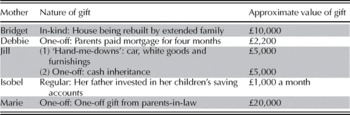
The third group consisted of the five families for whom gifts made a huge contribution, in excess of one thousand pounds in the last two years. For these families, gifts transformed their financial circumstances, increasing annual incomes by between 20 and 100 per cent. No understanding of the financial circumstances of these families would be complete without a recognition of the role gifts played. The details of these families are given in Table 2.
Households with significant gifts, Warburton Brown study

Source: Analysis of interview transcripts.
Conclusion
We have seen that standard household income measurements do not capture the ways in which regular, irregular and one-off sums flow between households known to each other. Children are seen individually and collectively as a priority, and benefit financially from this. Gifts may be a buffer, a continual trickle or an occasional loan. Grandparents, family friends, grown-up children, uncles and aunts give presents, grants, loans, time, skills, hand-me-downs and money to their families. These can make a substantial improvement to living standards and alter young people's financial self-perceptions. For mothers, being able to access support, be it financial or in-kind, during times of particular stress or difficulty can make a crucial difference to their ability to steer their families though poverty shocks or changing circumstances. Larger gifts allow investments in quality of life, particularly through house moves, better furnishings or home improvements, which significantly reduce material deprivation.
Nearly all of the families in the studies benefited from gifts to some extent. Moreover, both studies contained families for whom the impact of gifts was highly significant and transformed their financial situation, at least in the short term. Where gifts are substantial or sustained over time, household income provided in survey data will be reduced downwards; income measures will underestimate what the household can actually afford. Conversely, where occasional large gifts reduce household material deprivation, attempts to establish the connection between that material deprivation and the income level of the household will overestimate what the household can actually afford.
However, it is important to stress that only in a minority of cases do gift contributions make up a large enough proportion of household income to cast doubt on official figures. Given the small and unrepresentative nature of the samples in both studies, it is not possible to estimate the proportion of households in the overall population for which this is the case. It is also difficult to extend our findings to better-off families, for two reasons. Firstly, falling into financial difficulties may itself prompt gift-giving by other households. Secondly, and working in the opposite direction, low-income households are disproportionately likely to be part of low-income networks with limited resources for gift-giving.
Implications for future research
Both studies found that gifts were of considerable importance in low-income families, both to children and to mothers.Footnote 6 The dual focus of the paper has allowed us to confirm that these gifts are viewed as positive and important contributions by both generations. This has not been recognised in existing literature. These are, of course, both small-scale studies and it is important not to use them to over-state the importance of gifts across the whole population. Future qualitative studies of household incomes should therefore explore this topic further, including explicit questions on gifts – including gifts in-kind – with a clear discussion of the role gifts play in shaping the financial position of the families investigated. This should take account of the potential variability of gift-giving over time. Future quantitative studies should consider the way in which gifts can be assigned monetary value and included in calculations of household income.
Three areas may merit particular attention in future. Firstly, work is needed on the ways in which mutually supporting networks of extended family and friends can ameliorate the effects of low incomes across the life-course, and the ways in which policy might foster such networks. Secondly, there is a need for research on the ways in which gifts may represent a significant inter-generational income transfer from an older generation (grandparents) to a younger (parents), therefore off-setting some of the cost of children. Thirdly, further consideration should be given to the ways in which access to the financial resources of extended family members, both through regular support and crisis gifts or loans, can help families weather poverty shocks. We are intrigued as to whether families who can draw on gift-giving networks are better placed to deal with unexpected poverty crises than families who have no gift-giving networks. If so, families who appear to have identical incomes are in fact very differently placed in relation to surviving life on a low-income.
Acknowledgements
Chris Warburton-Brown holds an ESRC CASE Ph.D. studentship co-sponsored by the UK Department of Work and Pensions. This paper was first presented at the Social Policy Association annual conference, Edinburgh, July 2009.
The authors would like to thank Professor Moira Munro of the University of Glasgow and Professor Robert Walker of the University of Oxford for their invaluable comments. The opinions stated in this article do not represent those of the DWP or of the ESRC.