INTRODUCTION
Madagascar has a biota that is unique for its very high level of endemism at all taxonomic levels. High species richness has been generated in a large number of adaptive and non-adaptive radiations in a range of animals and plants (Vences et al. Reference VENCES, WOLLENBERG, VIEITES and LEES2009). Extensive radiations have been made possible by the large area of Madagascar (578,000 km2), great diversity of vegetation types and climates, and ancient isolation (Madagascar became separated from the African continent and India 160 and 80 MY ago, respectively; De Wit Reference DE WIT2003). The Malagasy biota has a skewed representation of taxa in comparison with continental biotas, as it has been mostly assembled via overseas colonization (Yoder & Nowak Reference YODER and NOWAK2006) across the currently 400-km-wide Mozambique Channel. At present, the Malagasy fauna and flora are severely threatened by habitat loss and fragmentation. Only a fraction of the original forest cover remains and the rate of deforestation remains high at 0.9% y−1 (in the years 1990–2000; Harper et al. Reference HARPER, STEININGER, TUCKER, JUHN and HAWKINS2007). Wet forests, which were once much more widespread, are now located as remnants on the eastern slopes of the main mountain chain running for 1300 km from south to north.
Typically, tropical forests have a diverse community of scarabaeine dung beetles represented by up to nine tribes (Davis & Scholtz Reference DAVIS and SCHOLTZ2001), but the Malagasy forest communities have just two tribes, Canthonini and the endemic subtribe Helictopleurina in the tribe Oniticellini. Furthermore, in addition to the unusual composition in terms of higher taxonomic units, Malagasy forest communities consist of entirely endemic species. Recent phylogenetic and systematic studies suggest that the entire extant dung beetle fauna of Madagascar originates from nine independent colonizations by beetles representing four different tribes (Wirta et al. unpubl. data). Four colonizations, three by separate lineages of Canthonini and one by Helictopleurina, have given rise to a large radiation with 37 to 101 extant species each, while the remaining five colonizations have been numerically less successful with only one or two extant species, none of which has been able to enter wet forests. The wet-forest dung beetle communities in Madagascar have therefore been assembled in an unusual manner. In the past centuries, a process of disassembly has started with rapid deforestation, which may have already caused the extinction or near extinction of a large number of species with small geographical ranges (Hanski et al. Reference HANSKI, KOIVULEHTO, CAMERON and RAHAGALALA2007, Reference HANSKI, MEYKE and MIINALA2009).
The structures of local and regional dung beetle communities are greatly affected by the abundance and species composition of large herbivorous mammals, which provide most of the resources for dung beetles (reviewed by Nichols et al. Reference NICHOLS, GARDNER and SPECTOR2009). Madagascar and New Guinea are exceptional among the major tropical forest regions in lacking native large herbivorous mammals. Instead, Malagasy dung beetles have radiated in parallel with lemurs (endemic primates) and some small-bodied mammals (Wirta et al. Reference WIRTA, ORSINI and HANSKI2008, unpubl. data). Madagascar had an unusual megafauna of giant lemurs, hippopotami, giant land tortoises and the 500-kg elephant bird, but they all went extinct following human colonization 2000 y ago (Burney et al. Reference BURNEY, PIGOTT BURNEY, GODFREY, JUNGERS, GOODMAN, WRIGHT and JULL2004; New Guinea was colonized by humans some 40,000 y ago and subsequently many large-bodied mammals were introduced). Of these species, only giant lemurs, replaced by humans, were likely to have been an important source of resources for dung beetles.
There is substantial taxonomic knowledge of the Malagasy dung beetle fauna due to the works of Lebis (Reference LEBIS1953) and Paulian & Lebis (Reference PAULIAN and LEBIS1960) and to the more recent studies by Montreuil (Reference MONTREUIL2003a, Reference MONTREUILb; Reference MONTREUIL2004, Reference MONTREUIL2005a, Reference MONTREUILb; Reference MONTREUIL2006, Reference MONTREUIL2007, Reference MONTREUIL2008), Montreuil & Viljanen (Reference MONTREUIL and VILJANEN2007) and Wirta & Montreuil (Reference WIRTA and MONTREUIL2008). Molecular phylogenies have been reconstructed for the major lineages (Orsini et al. Reference ORSINI, KOIVULEHTO and HANSKI2007, Wirta Reference WIRTA2009, Wirta et al. Reference WIRTA, ORSINI and HANSKI2008). In contrast, ecological studies are completely lacking. Here, we describe two local dung beetle communities inhabiting wet forests in north-eastern and south-eastern Madagascar. We describe the structures of these communities in terms of the taxonomic and ecological composition of species and their abundance relationships. The two communities, though inhabiting essentially similar wet forests and separated by only 650 km, have very few species in common. Such regional turnover in species composition helps explain the unusually large total fauna of dung beetles in Madagascar, though local communities, as will be described here, are less species-rich than comparable communities elsewhere in the tropics (Viljanen et al. Reference VILJANEN, ESCOBAR and HANSKI2010). The large total fauna implies that a limited species pool does not restrict the numbers of coexisting species in local communities. Alternatively, a large body of ecological theory about species communities (reviewed by Morin Reference MORIN1999, Tokeshi Reference TOKESHI1999) suggests that the limited range of distinct resources available for dung beetles in Madagascar may hinder the coexistence of many ecologically similar species. We test this hypothesis by characterizing the ecological traits of the species in the two local communities in terms of their elevational occurrence, body size and resource use, and by analysing the observational data for non-random patterns in resource use.
METHODS
Study sites and sampling
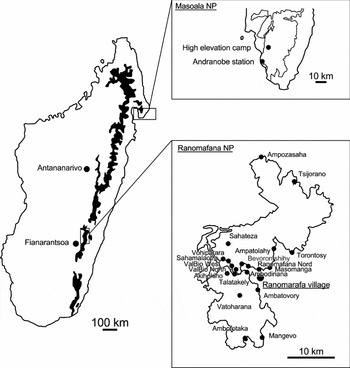
Field work was carried out in the Ranomafana National Park (RNP), south-east Madagascar (47°18′–47°37′E, 21°02′–21°25′S), in 2003–2006, and in the Masoala National Park (MNP), north-east Madagascar (49°55′–50°20′E, 15°12′–15°50′S), in 2004–2005 (Figure 1). RNP covers 43,500 ha of relatively undisturbed mid-elevation wet forest at elevations of 400–1400 m asl. MNP comprises 230,000 ha of lowland and mid-elevation wet forests at elevations from sea level to 1200 m asl. The climate is humid and tropical, with annual mean precipitation of 1500–2400 mm and the mean annual temperature of 19 °C to 23 °C (Moat & Smith Reference MOAT and SMITH2007). The high-rainfall season is from December to March, while September and October are the driest months.
The locations of the Ranomafana National Park and the Masoala National Park in Madagascar. The black areas on the main map show the extent of the remaining wet forest along the north–south-oriented mountain chain. The dots on the Ranomafana and Masoala maps indicate the trapping sites within the parks.

The two national parks have mammalian faunas that are characteristic of wet forests in Madagascar. The larger-bodied native dung producers include 12 (RNP) and 10 (MNP) species of lemur with substantial variation in their diets and body weights. The pooled density and biomass of five diurnal lemur species in the well-studied Vatoharana primary forest area in RNP are 34 individuals km−2 and 107 kg km−2, respectively (Johnson et al. Reference JOHNSON, IRWIN, WRIGHT, ARRIGO–NELSON, GRASSI, SAMONDS and SMITH2003). Other mammalian groups include bats, rodents, endemic tenrecs (Insectivora: Tenrecidae) and small endemic and introduced carnivores (Viverridae, Herpestidae). The dung of these latter species is unlikely to provide significant resources for dung beetles, but carcasses of small mammals are used by many carrion-feeding dung beetle species.
Beetles were trapped with baited pitfall-traps (plastic cups, 1.5 dl) over which a plastic cover or a large leaf was placed to prevent rainwater entering the trap. Traps were filled up to one third of their volume with water containing soap to decrease water tension. A bait of approximately 3 cm3 was wrapped in gauze and the bundle was hung from a stick above the trap. Traps were left in the forest for 2 d, and the samples were preserved in 90% ethanol for identification and counting.
We characterize the resource use of the species in terms of diet, diel activity and seasonality, which are the key niche dimensions in tropical forest dung beetle communities (Hanski Reference HANSKI, Lieth and Werger1989, Hanski & Cambefort Reference HANSKI and CAMBEFORT1991). The type of the bait varied according to the purpose of the trapping (Appendix 1). Fish and chicken intestines were used in standard trappings as they are easy to obtain and have been found to be suitable for trapping of dung and carrion-feeding beetles in other tropical forest regions (Hanski Reference HANSKI1983). Results for the RNP, in which a wide range of bait types have been used over many years, demonstrate that only about 20% of the forest-inhabiting dung beetle species are not effectively attracted to fish or chicken intestine. Human faeces were used repeatedly as another main bait type along with fish in both study areas. There are practically no dung beetles in Madagascar that would not be attracted by either fish bait or human faeces.
Diel activity of beetles was studied in Talatakely and Vatoharana forest areas in RNP in 2003, 2004 and 2006, when traps were checked at frequent (usually 3 h) intervals throughout the 24-h cycle. In both RNP and MNP, small numbers of traps were hung from branches at 1.5 to 2 m above the ground to trap beetles that did not enter traps set at the ground level (Appendix 1).
The total trapping effort equalled 4806 and 1601 trap-nights in RNP and in MNP, respectively, excluding studies of diel activity and traps set above the ground level.
We used two additional data sets to analyse the mechanisms of community assembly and to examine the generality of the results for RNP and MNP. First, we collected data for the regional species pools around the two study areas, defined to include wet-forest localities within 100 km from the focal community. In RNP, data for the regional species pool were available from a biodiversity study of several animal taxa by Johnson et al. (unpubl. data), conducted at seven localities around RNP in 2004–2005 (Figure 1, Appendix 1). These seven localities occur within an area of 20 by 40 km with altitudes ranging from 730 to 1190 m asl (Figure 1). Most of the data for the regional species pools around RNP and MNP were obtained from our own database, which includes all museum records as well as the results of our Madagascar-wide sampling conducted at 54 forest localities in 2002–2007 (Rahagalala et al. Reference RAHAGALALA, VILJANEN, HOTTOLA and HANSKI2009, Wirta et al. Reference WIRTA, ORSINI and HANSKI2008).
Second, we extracted trapping results from the Madagascar-wide database for six additional wet forest localities apart from RNP and MNP: Marojejy NP, Anjanaharibe-Sud, Makira, Ambila, Andasibe and Manonbo (from north to south). These data have been collected in the same way as the data for RNP and MNP using a mixture of baits, though the samples are not as large for these six additional communities as for the main study sites. We used rarefaction to calculate the expected number of species in all eight communities in a sample of constant size. Similarity in the species composition between pairs of communities was calculated as the number of shared species divided by the total number of distinct species in the pooled material for the two communities. We regressed the similarity in the species composition to the distance separating the two communities.
Canthonini and Helictopleurina were identified by H. Viljanen, H. Wirta and O. Montreuil based on comparisons with type specimens and series in the Paris National Museum of Natural History. New species have been described by Montreuil (Reference MONTREUIL2003a, Reference MONTREUILb; Reference MONTREUIL2004, Reference MONTREUIL2005a, Reference MONTREUILb; Reference MONTREUIL2006, Reference MONTREUIL2007, Reference MONTREUIL2008). The type specimens are located in the Paris National Museum of Natural History. Aphodius (Aphodiinae) were identified and new species described by Jason F. Mate from the Natural History Museum, London, UK (Mate Reference MATE2007). The type specimens are located in the museums in Paris, London and the University of Antananarivo, Madagascar. Species were divided into the functional groups of rollers and tunnellers (Hanski & Cambefort Reference HANSKI and CAMBEFORT1991) based on taxonomy, Canthonini being primitive rollers (Viljanen Reference VILJANEN2009) and Helictopleurina being tunnellers.
Abundance relationships and resource partitioning
To estimate the relative abundances of different species, one has to take into account differences in the diet among the species and the numbers of traps baited with different bait types. A species was classified as a specialist for carrion (dung) if the capture rate (individuals per trap per 24 h) with carrion (dung) was at least nine times greater than with dung (carrion); otherwise the species was classified as a generalist (thus a specialist is defined as a species with >90% of individuals captured with a single resource type, taking into account the numbers of different kinds of trap). As an example, the calculations for Epilissus apotolamproides in RNP were as follows. There were 881 and 310 individual traps baited with carrion and dung, respectively, and operated in places and times when E. apotolamproides was active. The capture rates were 0.11 and 0.03 individuals per trap per 24 h for carrion and dung, respectively, hence the species was classified as a generalist, and all traps baited with either dung or carrion were taken into account while calculating the abundance estimate. If a species was classified as a dung or a carrion specialist, only traps with the appropriate bait type were taken into account while calculating the abundance estimate. The estimate thus obtained is an approximation, but much better than entirely ignoring the diet of the species. If the species was caught only at a site or sites where only fish or chicken intestine were used as the bait, its diet remains uncertain (either carrion specialist or generalist).
The species were divided into low-elevation and high-elevation species and generalists in terms of their elevational occurrence. In RNP, species collected between 700 and 1000 m asl were classified as low-elevation species, while those occurring between 850 and 1200 m asl were classified as high-elevation species. In MNP, with somewhat different elevations sampled, a species was considered a low-elevation or a high-elevation species depending on whether it occurred below or above 600 m asl. Rare species with less than 10 individuals sampled and dung specialists were omitted from these analyses, as dung-baited pitfall traps were not operated as frequently at different elevations as carrion-baited traps.
Preliminary analyses of these data indicated differences in the elevational occurrence, resource use and body size of congeneric and ecologically similar species. To test whether these differences could have occurred by chance alone, we used Monte Carlo randomization tests. The first analysis was concerned with the elevational occurrence of the species, which were divided for the purpose of this analysis into three classes, low-elevation, high-elevation and generalist species. The analysis was restricted to the 25 species in eight genera that are attracted to carrion baits, because this bait type was used in trapping at all elevations. We randomized the elevational occurrence class of each species 1000 times, and scored for each randomization the number of congeneric pairs consisting of one low-elevation and one high-elevation species. The observed number of such congeneric pairs was compared with the distribution of the same statistic for the randomly selected pairs of species. Another randomization test was conducted in a similar manner to test ecological divergence in Helictopleurus species in terms of body size and resource use.
RESULTS
Species composition, species richness and abundance distributions
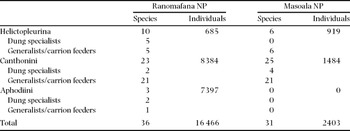
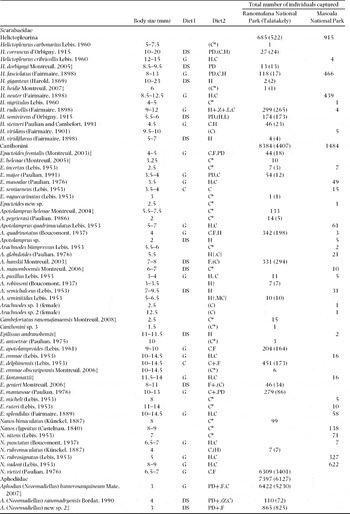
Table 1 summarizes the taxonomic composition and species richness in the two communities as well as data on resource use (diet) and pooled abundances (Appendix 2 gives more detailed data on individual species, including information on body size, resource use, and abundance). The two Scarabaeinae lineages, Helictopleurina and Canthonini, are similarly represented in the two communities, with 10 and 23 species in RNP and 6 and 25 species in MNP. The smaller number of Helictopleurina in MNP is due to lack of small-bodied dung-specialist species (Table 1, Appendix 2). There is an unexpected difference between the two communities in the occurrence of Aphodius species (Aphodiinae), with three very abundant species in RNP but none in MNP. This difference cannot be due to ecology, because the resources used by Aphodius, the excrements of small lemurs and carrion (Appendix 2), are equally prevalent in the two study areas. The pooled material for the two study areas includes 15 previously undescribed species (Appendix 2), which makes 24% of all the species (four other Canthonini remain unidentified, O. Montreuil pers. comm.).
Local dung beetle communities in the Ranomafana National Park (RNP) and in the Masoala National Park (MNP) in eastern Madagascar. Data on individual species are presented in Appendix 2. The total trapping efforts were 4806 and 1601 trap-nights in RNP and in MNP, respectively. This table includes species that have been sampled in areas with carrion–baited traps only (Appendix 2). These species are here classified as generalist/carrion feeders since dung specialist species are rarely sampled with carrion-baited traps.

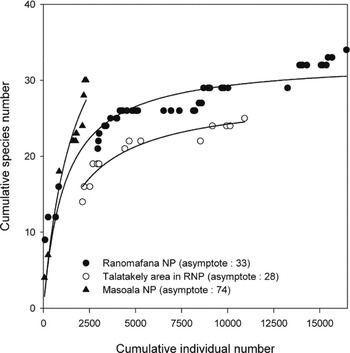
The species accumulation curves for the intensively studied Talatakely forest region in RNP (6 km2) as well as for the entire RNP (435 km2) approach an asymptote of 28 and 33 species, respectively. The smaller sample from MNP includes 31 species but does not reach an asymptote (Figure 2). The predicted asymptote of 74 species is definitely unrealistically high as the total number of species in the regional species pool is only 43. The large number of species from MNP reflects sampling that was designed to reveal as many species as possible.
Species accumulation curves for Ranomafana National Park, Talatakely forest region in the RNP, and Masoala National Park. The jumps in RNP and in Talatakely curves are due to trapping no. 8 (new bait – human faeces in Talatakely) and no. 28 (new low-altitude area in Torontosy).

Both communities are strongly numerically dominated by a few species, the four most abundant species accounting for 85% and 77% of the pooled sample in the RNP and MNP, respectively.
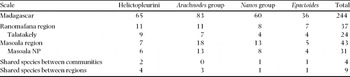
Though species richness in the two communities is very similar (Table 1), the two communities and the respective regional species pools have strikingly distinct species compositions, with only four and five shared species, respectively (Table 2). Furthermore, three of the four shared species differ greatly in their relative abundances between the two communities.
Species number and shared species in four groups of species at three spatial scales, in local communities (Talatakely in Ranomafana National Park (RNP) and Andranobe in Masoala National Park (MNP)), region (within 100 km from the focal community) and entire Madagascar. Ranomafana region includes RNP, Vatovavy mountain (50 km east from RNP) and Andringitra NP (100 km south). Masoala region includes MNP, Makira (50 km north-west from MNP) and Marojejy NP (70 km north). Arachnodes group includes Arachnodes and Epilissus, and Nanos group includes Nanos, Apotolamprus and Cambefortatus.

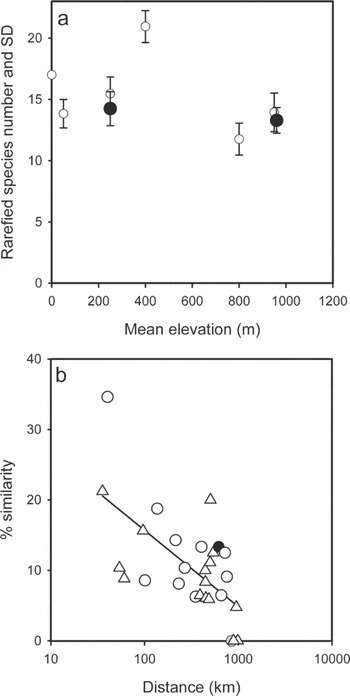
Figure 3 shows the rarefied species number in a sample of 263 individuals in eight wet-forest-inhabiting dung beetle communities in eastern Madagascar (263 was the smallest sample size available from these communities). It is apparent that the results on species richness for RNP and MNP are representative of this larger set of communities, and that there is no significant effect of elevation on species richness within the range of elevations covered by this sample of communities (up to 1000 m asl; Figure 3a). Figure 3b shows the percentage similarity in the species composition in pairs of communities as a function of their pairwise distance. Similarity in the species composition declines with increasing distance between the two communities that are compared. Similarities in the species composition are generally very low, and the pairs of communities involving either RNP or MNP are not different from the other pairs of communities (Figure 3b).
Comparison of local species richness and similarity in the species composition among eight local communities of dung beetles in wet forests in eastern Madagascar. Rarefied species number and standard deviation in a sample of 263 individuals (263 was the smallest sample size from the eight communities). The horizontal axis gives the average elevation of the sampling sites in the eight communities. The Ranomafana NP (RNP) and Masoala NP (MNP) data points are shown with a black dot (a). Percentage similarity in the species composition in pairs of local communities against their pairwise distance (linear regression adjusted R2 = 0.38). The black dot indicates the pair RNP-MNP, and the white dots indicate pairs in which either RNP or MNP was included (b).

Patterns in resource use
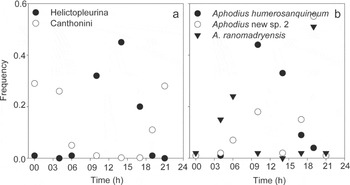
Based on the intensive 24-h trappings conducted in RNP, the dung beetle community is clearly divided into diurnal and nocturnal sets of species that almost completely agree with taxonomy: Helictopleurina are diurnal and Canthonini are nocturnal (Figure 4a). There are no strictly crepuscular species. On the other hand, and in constrast to Scarabaeinae, there is clear differentiation of diel activity among the three species of Aphodiinae (Figure 4b).
Diel activity of dung beetles in the Ranomafana National Park. Results are shown separately for Helictopleurina (n = 91 individuals) plus Canthonini (n = 509) (a) and for three species of Aphodius (b).

Malagasy dung beetles are generally small in comparison with species in other tropical regions. The largest Helictopleurina and Canthonini are maximally 25 mm and 15 mm long, respectively, and small species (<10 mm) are numerically dominant in both communities. In spite of the two communities having only four species in common, the body size distributions of the respective species are similar (χ2 = 0.69, df = 2, P = 0.71).
Resource use could be reliably determined for eight common Helictopleurina and nine Canthonini in the local community in RNP (Appendix 2). The two tribes exhibit an overall difference in diet. Helictopleurina are mostly coprophagous and Canthonini are mostly necrophagous, though there are some exceptions. The two largest Helictopleurina are dung specialists, and one of them (Helictopleurus giganteus) is strongly specialized on human faeces, possibly the equivalent of the faeces of the extinct giant lemurs. Among the remaining six Helictopleurus species, there are three dung specialists and three generalists (Appendix 2). In contrast, the two largest Cathonini species are a carrion specialist and a generalist, and only two of the nine well-studied Canthonini use primarily dung. Corresponding data for MNP indicate a similar pattern of resource use, with four species using dung and 15 species using carrion or being generalists. Only two species have been trapped in small numbers using cattle dung in forests. Considering the more extreme forms of specialization, two and one species of Arachnodes (Canthonini) were sampled only with traps set above the ground level in RNP and MNP, respectively. These species most likely use lemur dung attached to leaves in the canopy.
RNP is the more seasonal of the two study sites, but even in RNP there is no obvious seasonality in the occurrence of dung beetles, though their pooled abundance was generally higher during the wet season (December–February) than in the dry season (June–August). All the common species were recorded in each of the four quarters of the year, while the absence of the less common species in some quarters can be explained by small sample size alone (Appendix 2).
Ecological differentiation of potentially competing species
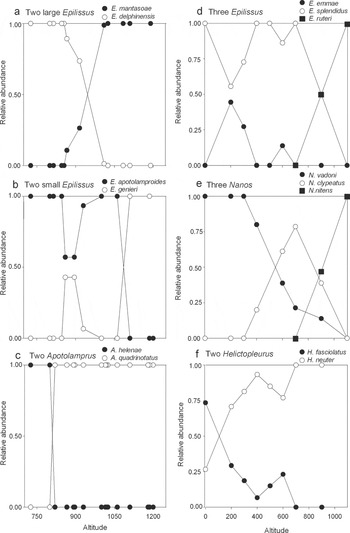
Sampling in RNP was conducted between the altitudes of 730 and 1200 m asl, which range covers the elevations at which species composition typically turns over on tropical mountains. The four most abundant species of Epilissus (Canthonini), which are potential competitors due to their similar diet and diel activity, exhibit clear elevational differentiation. The two large-bodied species have overlapping distributions at sites from 850 to 1000 m, but only E. mantasoae occurs above 1000 m and only E. delphinensis occurs below 850 m (Figure 5a). Among the two small-bodied abundant Epilissus species, a similar pattern is evident, as only E. genieri is present above 1050 m and only E. apotolamproides is present below 850 m (Figure 5b). Among the other species, the congeneric species pair Apotolamprus helenae and A. quadrinotatus shows a similar divergence in elevational occurrence (Figure 5c).
Elevational occurrence of selected species in the Ranomafana National Park: Epilissus mantasoae and E. delphinensis (a); E. apotolamproides and E. genieri (b); Apotolamprus helenae and A. quadrinotatus (c); and in the Masoala National Park: Epilissus emmae, E. splendidus and E. ruteri (d); Nanos vadoni, N. clypeatus and N. nitens (e); Helictopleurus fasciolatus and H. neuter (f).

We used a randomization test to compare the observed result with an appropriate null hypothesis. The test statistic was the number of congeneric pairs consisting of one low-elevation and one high-elevation species. The probability of having three or more such pairs, which was the observed number, was 0.17. However, it is reasonable to impose the restriction that the species in the pairs should not be very rare, because a rare species is not expected to restrict the occurrence of its potential competitor. In the three observed pairs, the rarest species had 46 individuals in our samples. To have a conservative test, we excluded pairs in the randomization in which one or both species had <10 individuals. The probability of having three or more congeneric pairs of common species with divergent elevational occurrence was 0.005, suggesting that the observed pattern is not due to chance.
Similar differences in the elevational occurrence are evident in congeneric species in MNP. One large Epilissus (ruteri) occurs only above 900 m, while two other species (splendidus and emmae) occur at lower elevations (Figure 5d). In Nanos, N. vadoni occurs from the sea level up to 900 m, being the only species at the lowest elevations; N. clypeatus occurs from 400 m up to 900 m, being most abundant at 700 m; and N. nitens was found on top of the forest ridge from 900 m to 1100 m (Figure 5e). In Helictopleurina, Helictopleurus fasciolatus and H. neuter, which are abundant and have similar ecologies (Appendix 2), have dissimilar elevational occurrence, the former being more abundant at low elevations and the latter one at mid-elevations (Figure 5f).
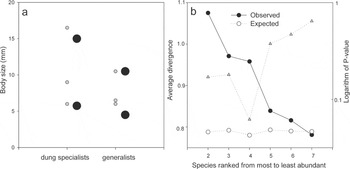
The dung beetle community in RNP has 10 species of Helictopleurus with little difference in their elevational occurrence, with the caveat that several species are uncommon and hence their elevational distributions are not well known. On the other hand, there are clear differences in their diets, with five dung specialists and five carrion specialists/generalists, and body sizes, from 4.5 to 16.5 mm (Appendix 2). The four most abundant species out of the 10 species exhibit unique combinations of diet and body size (Figure 6a), consistent with the idea that each common species occupies a distinct niche. We tested this hypothesis by calculating average ecological divergence for sets of two to seven most abundant species, and compared this value with the same measure calculated for two to seven randomly selected species. The result shows that average ecological divergence among the four most abundant species is greater than expected by chance at 6% level (Figure 6b).
This figure presents the results of a Monte Carlo randomization test of ecological divergence among 10 co-occurring Helictopleurina species in the Ranomafana National Park. Ecological divergence in body size and resource use (dung specialists versus generalists) (a). The large black dots represent the four most abundant species, the small dots are uncommon species. Average ecological divergence in the most abundant species (observed) and in the corresponding number of randomly selected species (expected) (b). Ecological divergence was calculated as the average Euclidian distance of pairs of species (left y-axis). The calculations were repeated separately for the two most abundant species, the three most abundant species, and so on, up to the seven most abundant species. The triangles show the probability of the observed number of x most abundant species having greater divergence than the corresponding number of randomly selected species (right y-axis).

DISCUSSION
Local dung beetle communities in Madagascar
The two dung beetle communities in the Ranomafana NP and in the Masoala NP that we have studied have only four species in common, yet the two communities share similar structure in terms of species number and taxonomic composition, the body size distribution of the species, and their resource use. In terms of local species richness and regional turnover in the species composition, the results for RNP and MNP are representative of other wet-forest-inhabiting local communities in eastern Madagascar. In comparison with comparable communities elsewhere in the tropics, which have typically more than 50 species (average 54.9, SD = 20.4, n = 11 for Scarabaeidae; Davis Reference DAVIS2000), the Malagasy communities have clearly fewer species. This cannot be explained by sampling effort, as the community in RNP in particular has been studied more intensively than probably any of the communities included in Davis's study (Davis Reference DAVIS2000).
Species richness in local communities commonly reflects the size of the species pool in the surrounding region rather than any ecological conditions in the focal environment (Cornell Reference CORNELL1999, Hugueny et al. Reference HUGUENY, CORNELL and HARRISON2007). This is especially likely when examining highly mobile organisms. In the present case, however, the relatively small number of species in local communities cannot be explained by the limited size of the species pool, because in fact the total number of species in Madagascar, more than 250 species, is greater than the total number of species in the comparable large islands of Borneo and Sumatra (Hanski & Cambefort Reference HANSKI and CAMBEFORT1991). A comparative study by Viljanen et al. (Reference VILJANEN, ESCOBAR and HANSKI2010) showed that while local species richness is substantially lower in Madagascar than in communities in South America, mainland Africa and South-East Asia, the regional turnover in the species composition (beta diversity) is in fact significantly higher in Madagascar. High beta diversity is consistent with very low mobility of at least some of the Malagasy dung beetles (Viljanen Reference VILJANEN2009), though it is not known whether Malagasy beetles are on average less mobile than dung beetles elsewhere in tropical forests.
If not the size of the species pool, the reason for low local species richness in Madagascar is likely to be in the ecological conditions. A likely explanation is the exceptionally narrow range of mammalian dung producers in Madagascar, and hence a narrow range of resource types available for dung beetles. Evidently small and medium-sized primates (lemurs), rodents and insectivores in Madagascar, weighing from 40 g to 8 kg, cannot support similar species richness of dung beetles than the diverse mammalian assemblage in, for example, Borneo, consisting of large-bodied primates, five species of deer, wild pig, elephant, buffalo and several medium-sized and small-bodied mammals. The local dung beetle species richness is two to three times higher in Borneo (66–87 species; Davis Reference DAVIS2000, Hanski Reference HANSKI, Lieth and Werger1989) than in Madagascar in spite of the smaller species pool in the former. Of particular importance is the lack of native large herbivorous mammals (‘ungulates’, Artiodactyla and Perissodactyla) in Madagascar. In the global context, the number of dung beetle species in tropical wet forest communities increases with the species number of large-bodied herbivorous mammals and/or the species number of ungulates (Viljanen et al. Reference VILJANEN, ESCOBAR and HANSKI2010).
Four other features apart from low local species richness set the Malagasy communities apart from other tropical forest dung beetle communities. First, the Malagasy communities are strongly dominated by a few very abundant species. The four most abundant species accounted for 85% (80% if Aphodiinae are excluded) and 77% of the pooled sample in RNP and MNP, respectively. For comparison, the four most abundant species accounted for 42% and 50% (58% excluding Aphodiinae) of the pooled sample in a community in Borneo (Hanski Reference HANSKI1983) and Central Amazonia, Brazil, respectively (Andresen Reference ANDRESEN2002). Second, Malagasy communities consist of smaller species on average than the continental communities and entirely lack very large species, >20 mm in length (Viljanen et al. Reference VILJANEN, ESCOBAR and HANSKI2010). Third, species in the Malagasy communities exhibit a low degree of resource specialization, 79% of the species in the present study being generalists and using both carrion and dung. Among the tropical forest regions elsewhere in the world, roughly one third of dung beetle species have been classified as generalists, a significantly lower proportion than in Madagascar (Cambefort & Walter Reference CAMBEFORT, WALTER, Hanski and Cambefort1991, Feer & Pincebourde Reference FEER and PINCEBOURDE2005, Gill Reference GILL, Hanski and Cambefort1991, Hanski Reference HANSKI1983, Hanski & Krikken Reference HANSKI, KRIKKEN, Hanski and Cambefort1991). All these three features can be attributed to the limited range of resources available for dung beetles in Madagascar, and in particular to the lack of resources required by large-bodied species and produced by large herbivorous mammals.
The fourth particular feature of Malagasy communities relates to diel activity. Tropical forest dung beetle communities have typically nocturnal, diurnal and crepuscular guilds of species (Andresen Reference ANDRESEN2002, Feer & Pincebourde Reference FEER and PINCEBOURDE2005, Hanski Reference HANSKI, Lieth and Werger1989), though many species may have even more restricted periods of activity (Hanski Reference HANSKI1983). Typically there is variation in diel activity among genera within tribes as well as among species within genera. For instance, in the large genus Onthophagus, which is phylogenetically and ecologically closely related to Helictopleurina (Wirta et al. Reference WIRTA, ORSINI and HANSKI2008), there are both strictly nocturnal and strictly diurnal species in e.g. Sarawak in South-East Asia (Hanski Reference HANSKI1983). In contrast, in Madagascar there is a clear difference in diel activity between the two tribes, Canthonini being nocturnal and Helictopleurina diurnal, with very few exceptions. A correlate of this difference in diel activity is the difference in diet, Helictoleurina using more dung and Canthonini using more carrion, which could be expected given that the largest dung produces (lemurs) are diurnal while many small mammals are nocturnal.
Extinct megafauna and dung beetles
In the well-studied community in the Ranomafana NP, the dung specialist species largely or entirely use the faeces of the largest lemur species, Propithecus edwardsi (7 kg). In the near past, prior to the extinction of the Malagasy vertebrate megafauna 1000 to 1500 y ago, dung beetles lived in an environment with more abundant and diverse food resources than today, which raises the question whether some species might have gone extinct with the megafauna. In the absence of subfossil evidence, we cannot answer this question conclusively, but some considerations are relevant in this context.
The faeces of the giant lemurs would probably have been adequate for larger species of dung beetles than presently occur in Madagascar. On the other hand, to a large extent humans themselves have played the same role as the extinct large lemurs. Human faeces are highly attractive to dung beetles in tropical forests (Davis Reference DAVIS2000, Hanski Reference HANSKI1983) and Madagascar is no exception. Both the faeces of the largest extant lemur species and human faeces attracted 18 dung beetle species each, and larger numbers than the other bait types used in RNP. Though it is possible that some large species have gone extinct, this need not have happened, and species such as Helictopleurus giganteus may represent the largest species in the fauna prior to human colonization. However, it is noteworthy that the largest species are presently uncommon, unlike the largest species in many other tropical dung beetle communities (Hanski Reference HANSKI1983, Viljanen et al. Reference VILJANEN, ESCOBAR and HANSKI2010), which may reflect the current scarcity of resources for large-bodied beetles. Combined with the adverse consequences of forest loss and fragmentation, the low density of the largest species makes them vulnerable to extinction (Hanski et al. Reference HANSKI, MEYKE and MIINALA2009).
Assembly of local communities
To return to the overall pattern of dung beetle species richness in Madagascar, local communities have low species richness in comparison with comparable communities elsewhere in tropical forests, but total diversity is high, which must reflect past opportunities for extensive radiation within a large heterogeneous area during a long period of time (Wirta et al. Reference WIRTA, ORSINI and HANSKI2008, unpubl. data). We suggest that there must be ecological reasons for low species richness in local communities in the presence of a large regional species pool. Without such local factors – most likely interspecific competition for a limited range of resources – more species would expand their presently restricted geographical ranges and enhance local species richness.
The community of dung beetles using cattle dung in open areas provides an informative example. Cattle were introduced to Madagascar about 1500 y ago (Burney et al. Reference BURNEY, PIGOTT BURNEY, GODFREY, JUNGERS, GOODMAN, WRIGHT and JULL2004). Though no endemic species has specialized in using cattle dung in wet forests, four species of Helictopleurus (Wirta et al. Reference WIRTA, ORSINI and HANSKI2008) and three species of Arachnodes (Wirta et al. unpubl. data), which probably used to live in dry forests in western Madagascar, have shifted to use cattle dung in open habitats. Most of these species now occur, exceptionally for the endemic dung beetles, across the whole of Madagascar (Rahagalala et al. Reference RAHAGALALA, VILJANEN, HOTTOLA and HANSKI2009, Wirta et al. Reference WIRTA, ORSINI and HANSKI2008, unpubl. data). Molecular genetic data conclusively show that the cattle dung-using Helictopleurus species have expanded their geographical ranges following the shift to the new resource, apparently because the resource shift relaxed interspecific competition (Hanski et al. Reference HANSKI, WIRTA, NYMAN and RAHAGALALA2008).
The observations that there are similar numbers of species in local communities with broadly similar distributions of traits that are directly or indirectly related to resource use, while very few species are shared between the communities, are consistent with the hypothesis that interspecific interactions restrict the numbers of locally coexisting species with similar ecological requirements. Indeed, our results demonstrate that there are significant ecological differences in resource use, body size, and elevational occurrence among locally coexisting abundant species. Different groups of ecologically related species have diverged along different ecological dimensions, which makes it hard to establish non-random patterns with observational data. In addition to the guilds of species analysed here, there are several other examples of pairs or trios of co-existing abundant species that exhibit a clear ecological difference in some particular respect. Thus the species pair Nanos viettei and Arachnodes hanskii, two morphologically very similar and abundant species, show a difference in diet (generalist versus dung specialist), while Epactoides frontalis and E. major show a clear difference in diel activity (diurnal versus nocturnal). Several guilds of Canthonini include species with clear differences in their elevational occurrence, similar to the patterns of significant segregation of congeneric species along an elevational gradient on Mount Mulu in Sarawak (Hanski Reference HANSKI1983, Reference HANSKI, Lieth and Werger1989).
To demonstrate conclusively that resource competition is responsible for the limited number of coexisting species in local communities and for the general lack of coexistence of ecologically similar species would require experiments. Unfortunately, such experiments would be logistically difficult to conduct in a multispecies community in the field. Nonetheless, the hypothesis about resource competition structuring Malagasy dung beetle communities is highly plausible, as resource competition is often considered to be the dominant process determining the numbers and types of coexisting species of dung beetles, and this hypothesis is supported by various types of data (Andresen Reference ANDRESEN2002, Barbero et al. Reference BARBERO, PALESTRINI and ROLANDO1999, Finn & Giller Reference FINN and GILLER2000, Gittings & Giller Reference GITTINGS and GILLER1998, Lumaret et al. Reference LUMARET, KADIRI and BERTRAND1992, Ridsdill-Smith Reference RIDSDILL-SMITH1986).
ACKNOWLEDGEMENTS
P.C. Wright, F. Ratelolahy and T. Keitt are thanked for data collected during the work funded by the David and Lucile Packard Foundation. ANGAP (Association Nationale pour la Gestion des Aires Protegees), MICET (Madagascar Institute pour la Conservation des Environnements Tropicaux), and ValBio research station in the Ranomafana NP are thanked for help in research arrangements in Madagascar and in the Ranomafana NP. Members of the Metapopulation Research Group are thanked for help in the field. Three anonymous reviewers are thanked for helpful comments. This work has been supported by the Academy of Finland (Finnish Centre of Excellence Programme 2000-05, grant no. 44887).
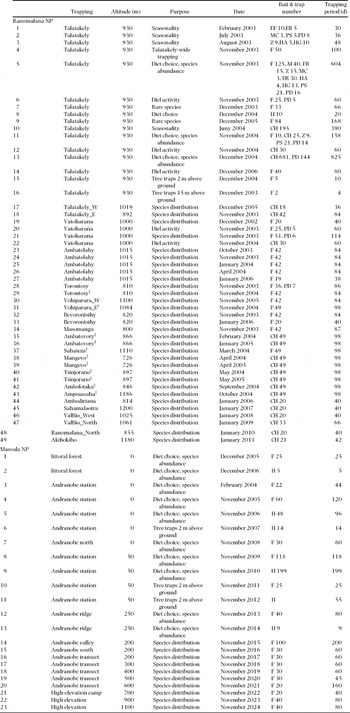
Dung beetle trappings conducted in the Ranomafana National Park and in the Masoala National Park. The dung beetle community in the Ranomafana National Park was studied in years 2003–2006. The total trapping effort was 5631 days, excluding studies of diel activity and traps set above the ground level. The trappings were conducted at 726 to 1200 m asl. Dung beetles were trapped with baited pitfall traps. The baits used were meat, rotten fruits, cattle dung, pig dung, human faeces and the faeces of seven lemur species (Microcebus rufus (Lesson), Eulemur rufus (Audebert), E. rubriventer (Geoffroy), Hapalemur aureus Meier et al., H. griseus (Link), Prolemur simus (Gray), and Propithecus edwardsi). Studies of species’ diet choice and diel activity were conducted in Talatakely at 900 m (secondary forest area) and Vatoharana at 1000 m asl (primary forest area) during rainy season in November and December in 2004–2006. Traps were placed at 5–10-m intervals along the marked trails. Trapping time was two nights except in diel activity experiments. Diel activity was studied in Talatakely and Vatoharana areas in 2003, 2004 and 2006. In 2003 and 2004, traps were checked at 00h00, 04h00, 06h00, 10h00, 14h00, 17h00, 19h00 and 21h00 (total trapping time 12 d, 30 traps), while in 2006 the traps were emptied at 05h00 and 17h00 (total trapping time 14 d, 40 traps). The tree traps were set at 1.5–2 m and 15 m height hanging from the branches. More limited trappings were conducted at 14 locations along the road running across the park from east to west at several elevations (800–1200 m asl) to study species distributions and elevational ranges. Additional data from seven locations (726–1186 m asl) come from a study of Johnson et al. (unpubl.) around the park in the years 2004–2005.
The dung beetle community in the Masoala National Park was studied in years 2004–2005. The total trapping effort was 1601 days excluding traps set above the ground level. The baits used were fish and human faeces. The trappings were conducted from sea level to 1100 m asl.
A study of species diet choice was conducted at Andranobe station at 0–200 m asl in November 2005. Trapping time was two nights. The tree traps were set at 1.5 to 2 m height hanging from the branches. More limited trappings were conducted at several elevations near Andranobe station (sea level to 600 m) and at a high-elevation camp 10 km northwards, from 700 to 1100 m asl to study elevational ranges in November and December in 2005.
The following table gives details on each individual trapping. F = fish, CH = chicken intestine, m = raw meat, FR = rotten fruit, Z = cattle dung, PG = pig dung, H = human faeces, MC = Microcebus rufus faeces, EF = Eulemur rufus faeces, ER = Eulemur rubriventer faeces, HA = Hapalemur aureus faeces, HG = Hapalemur griseus faeces, PS = Prolemur simus faeces, PD = Propithecus edwardsi faeces. † Unpublished data of Packard–project.

Taxonomy of dung beetles and their ecological traits in the Ranomafana National Park and the Masoala National Park. The column Diet1 gives a generalized diet that is based on the more detailed Diet2. G = generalist, DS = dung specialist, C = carrion/carrion specialist, F = faeces, H = human faeces, Z = cattle dung, L = lemur faeces, PD = Propithecus edwardsi faeces, HA = Hapalemur aureus faeces. C* = area only baited with carrion, † = traps in trees, 2 m above ground, ‡ = species described during the project. Aphodius sp. 2 includes two species: A. viljanenae Mate, Reference MATE2007 and A. ranomafanaensis Mate, Reference MATE2007. The figures in the parentheses give the number of individuals captured in Talatakely area in the Ranomafana National Park.