Introduction
Adherence to long-term therapies remains a major problem in medical care (WHO, 2003). Medication adherence in patients with type 2 diabetes, which is a major chronic disease, was estimated as 61–85% (Cramer, Reference Cramer2004).
Cognitive impairment presents further challenges to compliance with a medication regimen (Campbell et al., Reference Campbell, Boustani, Skopelua, Gao, Unverzagt and Murray2012). Simple reminders such as a medication reminder device (Holthe, Reference Holthe2004; Sather et al., Reference Sather, Forbes, Starck and Rovers2007; Kamimura et al., Reference Kamimura, Ishiwata and Inoue2012) or automated phone calls (Ownby et al., Reference Ownby, Hertzog and Czaja2012) have been reported to improve medication adherence among elderly patients with cognitive impairment. Although human support could be essential for the use of this device, this issue has not been addressed. In addition, little attention has been paid on the pharmacological and psychosocial effects of such devices. This may be a reason for such devices to have not been widely used in patients with cognitive impairment.
This case report provides insight into the type of human support that enables elderly patients with both cognitive impairments and chronic diseases, such as type 2 diabetes, to establish the daily use of such a device through observation of the device's pharmacological and psychosocial effects.
Case presentation
This report focused on a 79-year-old female diagnosed with type 2 diabetes and mild cognitive impairment (MCI), with a Clinical Dementia Rating score of 0.5 and Mini-Mental State Examination score of 30. She lived independently with her husband who had been diagnosed with Alzheimer's disease. Her daughter often visited home to help them. She was prescribed oral hypoglycemic agents along with anti-dementia medication. Oral hypoglycemic agents (Glinides and Biguanide) were prescribed for three times a day before each meal, while anti-dementia agents were prescribed for once a day after breakfast. Her daughter often reminded her to take her medication either in person or by phone. However, she sometimes still forgot the medication, which led to inadequate glycemic control (hemoglobin A1c (HbA1c), 8.0%).
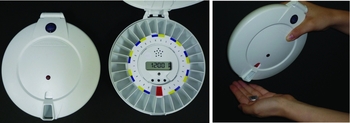
We, therefore, assessed the effects of the medication reminder device (Pivotell Ltd, UK; Figure 1). This device sounds an alarm and displays a flashing light to remind the user when to take his/her medication. When the alarm rings, the correct medication dose is automatically dispensed into an opening in the lid. The user must then invert the device to retrieve the medication and stop the alarm. The patient has to fulfill the following requirements for using the device: adequate auditory, visual, and finger dexterity ability; ability to comprehend that the alarm is a reminder to take medication; and the habit of taking medication regularly at home, albeit with occasional lapses and with other person's assistance (Table 1).
Requirements for using the medication reminder device

Note: *If the device is in an inverted position at the alarm time, the warning beep sounds, and this ability is included in these requirements.
The medication reminder device (Pivotell Ltd, UK).

The device was initially used to provide doses twice a day (before lunch and dinner). To limit the burden of learning to use this new device, its use was limited to only part of her prescription. Because of her routine outings once a week, help was provided only at the time of medication. However, no help was provided for morning doses.
Her daughter assisted in loading the device with medication, providing advance notice in person or by phone before automatic reminders, monitoring unused medication, and adjusting the timing of reminders according to her mother's daily routine.
According to the amount of unused medication as determined by her daughter, medication adherence improved from 64% (five missed doses per week) in one week before activation of the device to 86% (two missed doses per week) one week later. The reason for these two missed doses after activation was a non-routine outing for dinner.
After observing these positive results, the number of instances for the daily administration of medication using the device was increased from two to three times a day (before each meal). In addition, when family members accompanied her during outings, they reminded her to take the medication. Approximately two weeks after using this device, she needed assistance from her daughter only to load the device with medication and to check for unused medication.
After a month, medication adherence improved to 95% (one missed dose per week), and HbA1c decreased to 7.8%. She reported an increase in self-confidence because of these improvements. According to a four-point ordinal scale, her daughter's burden while assisting to maintain the medication regimen decreased from “3: mild burden” before activation of the device to “2: little burden” after one month of usage. Both patient and her daughter reported the device as helpful, especially in relieving their worries about taking medication. After three months, medication adherence was 100%, and HbA1c was 6.9%. Her daughter reported “1: no burden” on ordinal scale. After six months, medication adherence was 95% (one missed dose per week), and HbA1c was 7.1%. Her daughter reported “2: little burden” with regard to the level of assistance necessary in maintaining her mother's medication regimen. After 15 months the patient continued to use the device. Her daughter said: “Though the cognitive impairment of my mother have deteriorated, she can continue to use the device. It is very helpful for my family because we need not worry about her taking medication in spite of the increasing difficulties of my mother's daily life.”
Discussion
Our findings suggest that an individual with MCI and without any other mental/physical disability and who has acquired the habit of taking medication regularly at home, albeit with occasional lapses and with help from others, is a suitable candidate to use a simple reminder device. In addition, loading the device with medication, providing advance notice before automatic reminders for a short period after the device's activation, monitoring unused medication, and adjusting the timing of reminders according to user's daily routine, seemed to facilitate its daily use.
Sohlberg and Mateer (Reference Sohlberg and Mateer2001) stated that an effective strategy for facilitating the use of external aids to assist adults and children with cognitive impairments included systematic prompting, performance monitoring, and errorless learning. Our findings, which followed Sohlberg and Mateer's (Reference Sohlberg and Mateer2001) recommendations, revealed that the use of such methods could be beneficial in improving adherence to medication regimens in elderly patients.
Similar to previous studies (McCurry et al., Reference McCurry, Pike, Logsdon, Vitiello, Larson and Teri2010; Ownby et al., Reference Ownby, Hertzog and Czaja2012), our report showed that a caregiver is likely to be a determinant in adherence to therapy in elderly patients with cognitive impairments. The assistance provided by the caregiver in this study, however, may not be typical, and therefore a focus on reducing the caregiver's burden may promote the use of such a device. Other strategies may include alternative prescriptions with a decreased daily dose frequency.
This study showed that elderly patients with type 2 diabetes and cognitive impairments may benefit from the medication reminder device. The American Diabetes Association recommended an HbA1c level of <7.0% for most patients and a slightly higher level (7.5–8.0%) for frail elderly patients (Inzucchi, et al., Reference Inzucchi2012). The device was effective in improving glycemic control according to these clinical criteria.
Furthermore, with regard to the psychosocial effects, our observations suggest that the medication reminder device, in addition to caregiver's assistance, may increase self-confidence in elderly people with cognitive impairments and decrease caregivers’ burden.
One limitation of this technique is that it cannot prevent patients from forgetting to take the medicine after retrieving it from the device, and this can easily occur in elderly patients with cognitive impairments. To compensate this limitation, knowledge of the patient's previous medication experiences and adjustment with the timing of the reminders according to his/her daily routines are necessary. Further modifications are required for a patient without such habits.
Further studies are required to validate the medication reminder device's pharmacological and psychosocial effects, which we found in this study, because these results were based on a case report. Furthermore, to clarify a list of qualifiers for using such a device among elderly patients with cognitive impairments, an additional evaluation study is required on the suggested requirements as determined in our study (Table 1).
Conflict of interest
None.
Description of authors’ roles
T. Kamimura formulated the study question and wrote the paper. H. Ito assisted in writing the paper.
Acknowledgments
The patient provided written informed consent to publish this paper.