Introduction
Antibiotics and antibiotic resistance genes play vital roles in the ecology and evolution of environmental microbiota (Aminov Reference Aminov2009). Antibiotics are secreted by bacteria to inhibit competitors (Gullberg et al. Reference Gullberg, Cao, Berg, Ilbäck, Sandegren, Hughes and Andersson2011) or communicate (Aminov Reference Aminov2009). Bacteria with antibiotic resistance genes in soil and water (hereafter the resistome) therefore act as a reservoir for antibiotic resistance (D’Costa et al. Reference D’Costa, McGrann, Hughes and Wright2006).
Antibiotic-secreting actinobacteria often associate with hymenopterans (Matarrita-Carranza et al. Reference Matarrita-Carranza, Moreira-Soto, Murillo-Cruz, Mora, Currie and Pinto-Tomas2017). For instance, fungus-growing ants (tribe Attini) form symbiotic relationships with antibiotic-secreting actinobacteria (Cafaro & Currie Reference Cafaro and Currie2005; Mueller et al. Reference Mueller, Dash, Rabeling and Rodrigues2008). Specifically, leaf-cutter ants (genera Atta and Acromyrmex) are known for their 1) obligate mutualism with fungi in the family Lepiotaceae, which the ants cultivate (Mueller et al. Reference Mueller, Rehner and Schultz1998), and 2) complex eusocial societies with a caste system (Wilson Reference Wilson1983). The caste system distinguishes between ants that tend the fungal garden (gardeners), forage for leaves (foragers), and remove waste from the fungal garden (garbage workers) (Hart & Ratnieks Reference Hart and Ratnieks2001).
The parasitic fungus in the genus Escovopsis is commonly found in leaf-cutter ant fungal gardens, where it attacks Lepiotaceae, threatening colony survival (Currie et al. Reference Currie, Scott, Summerbell and Malloch1999). The mutualistic relationship with actinobacteria helps the ants to suppress Escovopsis (Currie et al. Reference Currie, Scott, Summerbell and Malloch1999). Ants house actinobacteria biofilms on their cuticles, which feed on compounds excreted by exoskeletal glands (Yek & Mueller Reference Yek and Mueller2011) and secrete protective compounds against Escovopsis (Cafaro et al. Reference Cafaro, Poulsen, Little, Price, Gerardo, Wong, Stuart, Larget, Abbot and Currie2011). Actinobacteria secretions may also protect fungal gardens from other fungi (Seipke et al. Reference Seipke, Barke, Brearley, Hill, Yu, Goss and Hutchings2011; Sen et al. Reference Sen, Ishak, Estrada, Dowd, Hong and Mueller2009) and bacteria (Ortius-Lechner et al. Reference Ortius-Lechner, Maile, David Morgan and Boomsma2000). Other compounds secreted from these symbionts have also been shown to suppress bacterial growth (Bot et al. Reference Bot, Ortius-Lechner, Finster, Maile and Boomsma2002; Carr et al. Reference Carr, Derbyshire, Caldera, Currie and Clardy2012; Poulsen et al. Reference Poulsen, Erhardt, Molinaro, Lin and Currie2007), including from the inhibition of soil bacteria (Schoenian et al. Reference Schoenian, Spiteller, Ghaste, Wirth, Herz and Spiteller2011). These broad-spectrum secretions could therefore change the soil resistome by applying selective pressure. This hypothesis has not yet been assessed.
We evaluated whether actinobacteria associated with leaf-cutter ants act as a driver of antibiotic resistance in soil bacteria. We hypothesize that proximity to leaf-cutter ant fungal gardens affects antibiotic resistance in soil bacteria. As ants excavate the nest’s underground tunnels, they bring material to the surface, creating a mound (Swanson et al. Reference Swanson, Schwendenmann, Allen, Aronson, Artavia-León, Dierick, Fernandez-Bou, Harmon, Murillo-Cruz, Oberbauer and Pinto-Tomás2019). The constant mixing of soil may expose topsoil bacteria to antibiotics from the fungal gardens, applying selective pressure on antibiotic resistance genes. A prediction of this hypothesis is that antibiotic resistance in soil bacterial communities should be greater closer to leaf-cutter nest mounds. We evaluated this by measuring antibiotic resistance to common veterinary antibiotics in bacterial communities from topsoil samples collected at various distances from leaf-cutter ant nests (this study’s first goal).
Another prediction of the proposed hypothesis (and this study’s second goal) is that antibiotic resistance is greater in underground fungal chambers than at the surface. This assumes that the main source of antibiotics would be gardener ants, which remain underground (Hart & Ratnieks Reference Hart and Ratnieks2001), have proportionally larger metapleural glands than other castes (Hughes et al. Reference Hughes, Bot and Boomsma2010), and are more resistant to pathogens than other workers (Yek & Mueller Reference Yek and Mueller2011). To test this, we evaluated whether soil bacteria inside fungal gardens are more resistant to antibiotics than soil bacteria outside the nest.
We also conducted an exploratory study to evaluate whether topsoil bacterial communities are similar in number and in community composition at different proximities to the ant nest. Actinobacteria associated with leaf-cutter ants may be dominant in communities near the mound, which would negate any selective pressure from their own antibiotic secretions. This analysis tests whether, rather than being associated with altered bacterial communities, leaf-cutter ant nests and associated actinobacteria select for antibiotic resistance within topsoil bacteria, using morphospecies as a coarse indicator for species. Despite technological advances in molecular bacterial identification, morphology-based studies may be important to detect the effects of antibiotics on bacteria, which may not all be detected using molecular methods (Sousa et al. Reference Sousa, Machado, Nicolau and Pereira2013). Preliminary studies based on morphology are therefore valid and valuable (Lee et al. Reference Lee, Lee, Han, Seong, Wijesinghe, Kim, Jeon, Jung and Kim2020).
Materials and methods
We studied Atta cephalotes, a species with a symbiotic relationship with actinobacteria (Currie et al. Reference Currie, Scott, Summerbell and Malloch1999), on the Pacific slope of Monteverde, Costa Rica, in the tropical premontane wet forest life zone (Haber Reference Haber2000), between April 2018 and April 2020. We compared relative antibiotic resistance in different soil communities by growing soil bacteria samples in agar with a focal source of antibiotic (a paper filter disc) and quantifying how close the colonies could grow to that source. Because bacterial colonies that are resistant to antibiotics would be able to grow near a source of antibiotics (Piddock Reference Piddock1990), we can reasonably assume that the closer we find bacterial growth (i.e., a bacterial colony halo) to the source, the higher its resistance to the antibiotic is. In other words, this ‘inhibition distance’ is inversely proportional to the resistance of the bacterial colony to the antibiotic used. Therefore, the smaller the distance between the antibiotic-treated disc and the halo or closest colony, the greater the inferred antibiotic resistance. We illustrate this measurement in Figure S1. Different agar media may affect diffusion distances for each antibiotic (Huys et al. Reference Huys, D’Haene and Swings2002), so we measured relative differences between the same type of antibiotic for each agar and used various agars.
Sample sites
Samples were collected in Santa Elena and San Luis near the town of Monteverde, Costa Rica. Specifically, sample sites for the experiment testing soil bacteria antibiotic resistance as a function of proximity to ant nest with all morphospecies were collected from the Bajo del Tigre Reserve (10.305593, -84.814384) (2 nests), Finca San Francisco de Asis (10.309129, -84.831539) (5 nests), and a private home (1 nest), all forested areas, with 8 nests total, from April 15–26, 2018. Samples for the experiment with individual morphospecies were collected from Finca San Francisco de Asís (5 nests previously sampled in 2018) and the CIEE Global Institute campus in San Luis (10.281248, -84.799229) from April 5–19, 2020 (5 nests). Samples for the experiment testing soil bacteria antibiotic resistance as a function of proximity to the fungal garden were collected from 7 nests at the Caballeriza El Rodeo in Santa Elena (10.313468, -84.828739) from October 18–November 10, 2018. Caballeriza El Rodeo is a horse-riding business that includes open areas and forest patches. The owners of these sites do not try to control the population of leaf-cutter ants in their properties, so it is extremely unlikely that the ant mounds in these sites would have previously been exposed to toxic chemicals.
Experiment 1: Soil bacteria antibiotic resistance as a function of proximity to ant nest
We measured antibiotic resistance of soil bacteria on agar plates as a function of proximity to ant nests (the first goal of this study) in two ways: 1) using entire soil samples to include all possible bacteria and 2) with individual morphospecies per plate, including replicates of all morphospecies cultivated previously from all soil samples (for the exploratory study, details below). Samples were collected near the towns of Santa Elena and San Luis in 30-year-old secondary forests without livestock to avoid contamination with antibiotics excreted in dung (Spielmeyer Reference Spielmeyer2018). We collected samples from 8 nests for the analysis using all samples and from 10 nests for the analysis with individual morphospecies (5 of the same nests previously sampled and 5 new nests). Site details are in supplementary material (section: “Detailed sample sites”).
Soil collection and plating
Soil samples were collected from large nests with a definitive mound. At each nest, three topsoil samples of approximately 5 g in the top 5 cm of soil were collected during the day 0 m, 10 m, 20 m, and 50 m away from the nest mound (where 0 m is on the nest mound itself, at one of the leaf-cutter ant exits) in a straight line. We did not sample beyond 50 m from the nest due to the proximity to other leaf-cutter ant nests. We only sampled fresh soil covered by vegetation without contact with the ants’ foraging trails. From each soil sample, 0.5 g was suspended in 9 mL of phosphate buffer saline solution (PBS, 1X, pH 7); 1 mL of the suspension was diluted in 9 mL of PBS (Ghosh & Lapara Reference Ghosh and Lapara2007). We spread 0.7 mL of the diluted samples using the standard technique (Herigstad et al. Reference Herigstad, Hamilton and Heersink2001). For the analysis with the entire soil sample, each sample was plated on a unique agar plate (bacteriological agar 1.5%) and exposed to antibiotics (described below). For the exploratory analysis based on morphospecies, individual soil samples were first plated in nutrient-rich agar to maximize the diversity of bacteria that would be able to grow (Balestra & Misaghi Reference Balestra and Misaghi1997). After 5–7 days at room temperature, we classified colonies by morphospecies according to colour, size, texture, margin, and form following Sousa et al. (Reference Sousa, Machado, Nicolau and Pereira2013) and Benson (Reference Benson2001) for the exploratory study (with detailed descriptions of all morphospecies in Table S2). Morphospecies are used as a very coarse indicator for species, although cannot be assumed to represent individual species, and therefore, this analysis is exploratory. A dataset with all morphospecies and their abundance per agar plate was developed to test for potential changes in bacterial community composition as a function of nest proximity. It is possible that when using this technique, competition for resources among bacteria results in the masking of certain morphospecies. Individual colonies representative of common morphospecies present at all proximities from a nest (14 morphospecies) were transferred to individual plates with nutrient-rich agar, tracking the identity of the source (colony, proximity to nest, original sample number), and were exposed to antibiotics as described below.
Antibiotic treatment and measurement
Antibiotic treatment was applied to freshly inoculated plates via filter paper discs soaked with minimum inhibitory concentrations (Piddock Reference Piddock1990). We chose several antibiotics of common veterinary use known to induce resistance in soil bacteria in agricultural settings (Walsh & Duffy Reference Walsh and Duffy2013). These antibiotics also exhibit varied modes of action and therefore test different potential manners of antibiotic resistance. Antibiotic treatments included discs soaked in minimum inhibitory concentrations of Gentamicin (16 µg/mL), Oxytetracycline (16 µg/mL), Penicillin/Dihydrostreptomycin (henceforth ‘Penicillin’) (32 µg/mL), Ceftiofur (8ug/mL, only used with entire soil samples), and a control disc (1X PBS). One paper disc per antibiotic was placed on each plate equidistant from other discs, along with a control disc soaked in PBS (Figure S2). Plates were sealed with parafilm and kept in a chamber at room temperature for several days (details in Table S1). Distances to the closest bacterial colony on the growth halo from each disc were measured and scored blindly (Figure S1).
Experiment 2: Soil bacteria antibiotic resistance as a function of proximity to the fungal garden
Soil collection and plating
To assess whether antibiotic resistance is greater inside the fungal garden (the second goal of this study), we excavated 7 nests in open areas near forest edges. We identified exits where ants were removing soil pellets and dug around them to find a fungal garden, which were all less than one metre below the exit. We collected three soil samples of approximately 5g during the day within the fungal garden (∼1 m deep in relation to the nest mound top), on top of the nest mound (0 m), and 30 m from the mound. Soil samples were plated following the approach used in Experiment 1 for the whole soil sample on an agar plate (details in Table S1). The site hosts a horse-riding business, so we cannot exclude the possibility that topsoil samples were at some point in contact with antibiotics excreted by horses, as antibiotics are commonly given to horses in the area.
Antibiotic treatment and measurement
Sample processing, plating, and measurement of antibiotic resistance followed the same protocol outlined in Experiment 1 for entire soil samples. Each plate only had one disc soaked in Oxytetracycline (16 µg/mL) and a control disc soaked in 1X PBS (details in Table S1).
Statistical analysis
Change in soil bacteria antibiotic resistance as a function of proximity to ant nests
For both datasets (entire soil sample or one morphospecies per plate), inhibition distance (distance from disc to closest bacteria, dependent variable) was compared between proximities to the nest (0, 10, 20, 50 m) and antibiotic treatments (control and each antibiotic employed) using linear mixed models (LMM, see details in supplementary material). Plate and ant nest identity (the former nested within the latter) were included as random effects in the LMM to control for the lack of independence in data points (i.e., multiple samples/plates per colony). Proximity to nest, antibiotic treatment, and the interaction between these were included as fixed effects. All analyses were conducted in R 4.0.0 (R Core Team 2020).
Change in soil bacteria antibiotic resistance as a function of proximity to the fungal garden
Inhibition distance (distance from disc to closest bacteria, dependent variable) was compared between proximities to the garden (inside, mound, 30 m away) using an LMM that included plate and ant nest identity (the former nested within the latter) as random effects.
Change in bacterial community composition as a function of nest proximity
We evaluated whether morphospecies richness changed with proximity to ant nests with an LMM (proximity to nest as fixed effect, nest identity as random effect). We also calculated the overlap in morphospecies composition between proximities to the nest using the Morisita similarity index. Finally, we visually examined the similarity of bacterial communities based on morphospecies composition with Multidimensional Scaling (MDS) and tested for community structure according to proximity to the nest using multivariate analysis of variance (details in supplementary material).
Results
Resistance due to proximity to nest and fungal chamber
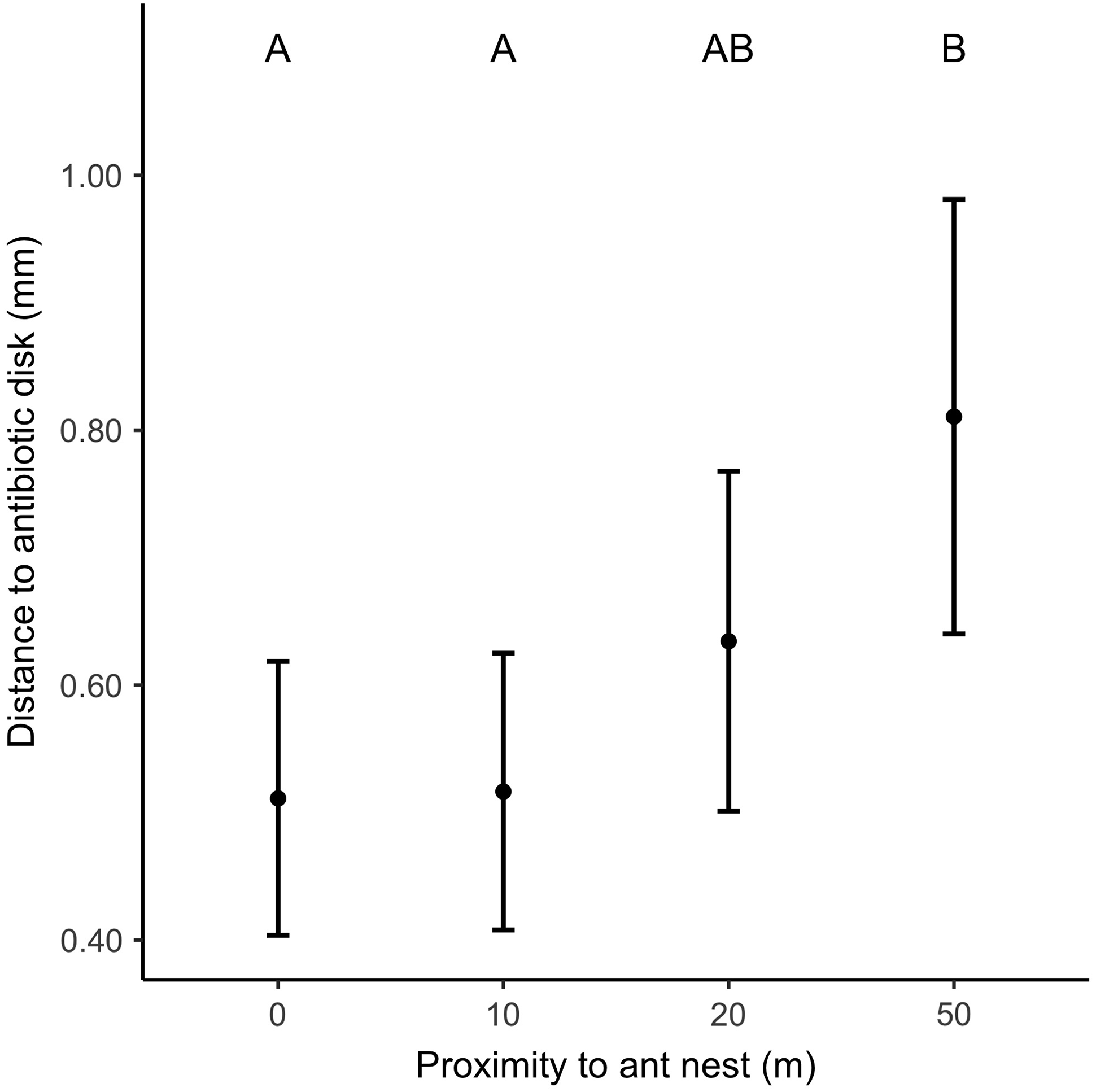
In general, soil bacteria collected in close proximity to ant nests were significantly more resistant to antibiotics than soil bacteria collected farther away from ant nests, especially to oxytetracycline. We illustrate this pattern with the results from the experiment using the entire soil sample per agar plate across all antibiotics: LMM Proximity term: χ2 = 24.7, df = 3, p < 0.001; Fig 1. When the whole soil sample was plated on an agar plate, this pattern was consistent for gentamicin, oxytetracycline, and penicillin, although was only consistently significantly different between 0 and 50 m from the nest and was marginally non-significant for ceftiofur (Fig S4). However, the pattern was only consistent for oxytetracycline when just one bacterial morphospecies was grown on an agar plate (Fig S7).
Antibiotic resistance in soil bacteria, measured as distance from the closest bacterial colony in an agar plate to an antibiotic-soaked paper disc, by proximity to Atta cephalotes nests in Monteverde, Costa Rica. Shorter distances indicate higher resistance. Topsoil samples were collected 0 m to 50 m from eight A. cephalotes nests and plated on agar plates (n = 96). Least square means are presented with one standard error. Different letters above means indicate a significant difference between proximities to nest (Tukey posthoc pairwise comparison, p < 0.05).

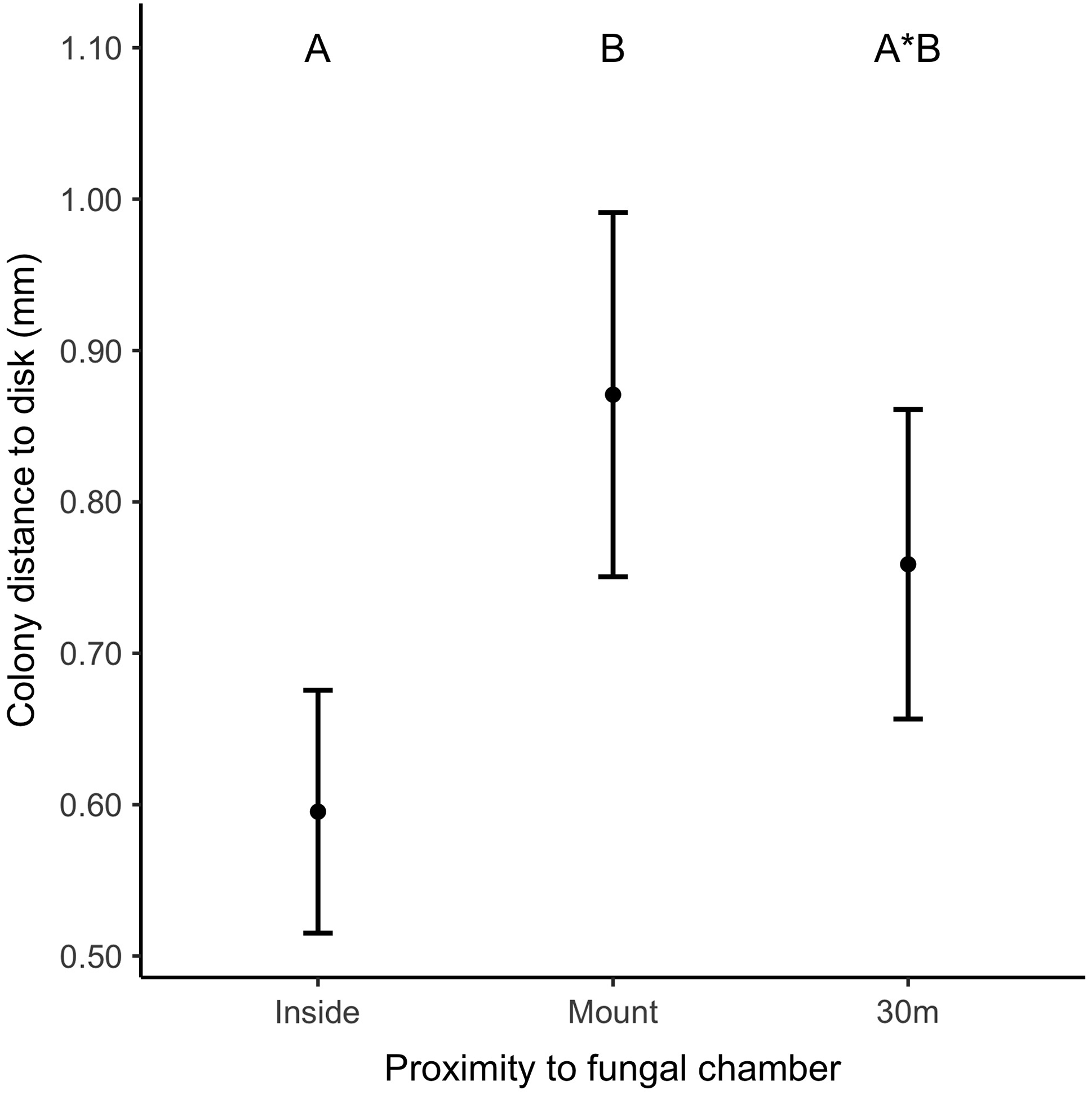
Antibiotic resistance to oxytetracycline in bacteria from underground fungal chambers was higher than in soil bacteria sampled on the surface (LMM Proximity term: χ2 = 7.099, df = 2, p = 0.029) both from 1) on the top of the mound and 2) 30 m away from the mound, although the latter comparison was marginally non-significant (Fig 2).
Antibiotic resistance in soil bacteria, measured as distance from the closest bacterial colony on an agar plate to a paper disc soaked in antibiotic, compared between samples collected inside (fungal chamber) and outside (nest mound and 30 m away) Atta cephalotes nests. Shorter distances indicate higher resistance. Topsoil samples collected from seven A. cephalotes nests in Monteverde, Costa Rica, were plated on agar plates (n = 63) and treated with oxytetracycline. Least square means are presented with one standard error. Different letters above means indicate a significant difference between sample location (Tukey posthoc pairwise comparison, p < 0.05;*: 0.05 < p ≤ 0.10).

Exploratory study: Bacterial community analysis
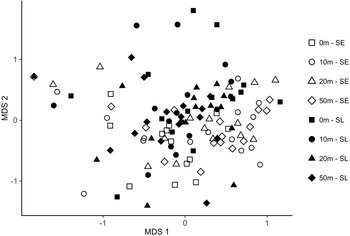
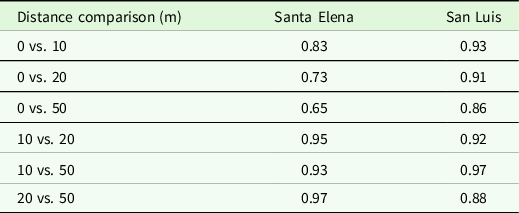
Morphospecies do not cluster between sites or proximities to nest (MDS, Fig 3), indicating lack of spatial structure in morphospecies composition (multivariate analysis of variance: F=0.84, df=3,115, p = 0.67). These results were supported by a lack of significant differences in richness between proximities to nests (LMM proximity*site: χ2=2.02, df=3, p=0.57, p=0.64, supplementary material, Fig S9) and high similarity in morphospecies composition (Morisita similarity index >73 %) between sites and proximities. Morisita similarity indices averaged 88%, indicating a high degree of morphospecies shared between different proximities to the nest, with similar relative abundances (Table 1). Communities in Santa Elena and San Luis were also similar (Morisita similarity index >72% at all distances). Common morphospecies were generally found at all distances, and no morphospecies found at multiple sites were restricted to or excluded at 0 m from the nest.
Multidimensional scaling analysis (MDS) to evaluate community structure of soil bacteria collected 0 m, 10 m, 20 m, and 50 m (n = 15 samples per distance) from Atta cephalotes nests from two sites in Monteverde, Costa Rica: five nests in Santa Elena (SE) and five in San Luis (SL). The axes define the space of maximum possible separation between the samples in the MDS.

Pairwise Morisita index of similarity values between bacterial communities grown from soil samples collected at 0 m, 10 m, 20 m, and 50 m from leaf-cutter ant nests. Soil samples were collected from Atta cephalotes nests at two sites in Monteverde, Costa Rica: five in Santa Elena and five in San Luis. An index value of 0.9, for example, indicates 90% of morphospecies at two different distances are shared with similar relative abundance.

Discussion
Antibiotic resistance increases with proximity to leaf-cutter ant nests
The patterns identified in this study are consistent with the hypothesis that actinobacteria living symbiotically with A. cephalotes secrete antibiotics that exert a selective pressure on nearby soil bacteria, increasing antibiotic resistance in and around the nest, particularly to oxytetracycline within 20 metres from the nest. The results from experiments measuring antibiotic resistance by proximity to ant nests demonstrate increasing resistance closer to ant nests to at least one antibiotic. The experiment analysing resistance as a function of proximity to the fungal garden suggests antibiotic resistance is higher inside the nest than immediately outside, supporting the prediction that gardener ants are the main source of antibiotics from actinobacteria. We suspect that foraging ants may also carry antibiotic-secreting bacteria in their exoskeleton that may help them combat potential detrimental bacteria in the internal parts of the colony they have access to. This hypothesis would explain how resistance to oxytetracycline is spread up to 20 metres from the nest.
The high degree of similarity between bacterial morphospecies communities sampled from different proximities to ant nests in an exploratory study indicates the observed resistance pattern is likely not due to differences in community composition. Hence, it is unlikely that differences in resistance are driven by bacterial communities near the nest being composed of actinobacteria resistant to their own secretions.
The resistance patterns observed here could be site, colony, or community-specific, depending on nest size, nearby pathogens, and local bacterial communities. For example, in the experiment measuring resistance by proximity to the fungal garden, antibiotic resistance to oxytetracycline 30 m from the nest was higher than expected relative to the experiment measuring resistance by proximity to the nest, in which there was a gradient of resistance up to 50 m. This experiment was conducted in open areas, where the density of leaf-cutter ant nests is typically higher than forested areas (Jaffe & Vilela Reference Jaffe and Vilela1989). Therefore, samples 30 m from the nest could have greater resistance due to proximity to neighbouring nests. Samples may have also inadvertently been collected from ant trails as they are not marked by cleared vegetation as in forests, which could interfere with resistance patterns due to leaf-cutter ants and therefore actinobacteria presence on trails. Bacteria 30 m from the nest may also have been exposed to horse traffic, as horses tend to avoid large nest mounds at this site (personal observation). This could expose soil to manure from horses treated with antibiotics, which can induce antibiotic resistance in soil bacteria (Fahrenfeld et al. Reference Fahrenfeld, Knowlton, Krometis, Hession, Xia, Lipscomb, Libuit, Green and Pruden2014).
There were also variations in the number of antibiotics demonstrating the resistance pattern in the analyses measuring resistance as a function of proximity to nest. Bacteria grown on media with low nutrients demonstrate somewhat similar resistance patterns to four antibiotics, while bacteria grown on rich media only show this pattern with oxytetracycline. Bacteria in low nutrient environments may gain tolerance to antibiotics by inducing growth arrest (Nguyen et al. Reference Nguyen, Joshi-Datar, Lepine, Bauerle, Olakanmi, Beer, McKay, Siehnel, Schafhauser, Wang and Britigan2011), therefore preventing them from metabolizing inhibitory antibiotics and inducing similar levels of sensitivity between antibiotics. Growing single morphospecies may also have driven this variation, as rare morphospecies that were not selected for analysis may have been responsible for the gentamicin and penicillin resistance patterns shown by the analysis growing all morphospecies. Future research could focus on what antibiotic mechanisms these soil bacteria are most resistant to. Further, morphospecies analysis is not necessarily indicative of all the bacterial species present, representing just a fraction of bacterial species present in the soil. Even so, this analysis demonstrates a promising trend. Results should be verified with molecular methods such as metagenomic analysis of bacteria in soil samples at different distances from the nest. This would deepen the results of the morphospecies exploratory study presented here.
Implications
This study reveals ecological mechanisms driving environmental antibiotic resistance, demonstrating organisms other than humans exert significant selective pressure on environmental microbiota. These results suggest A. cephalotes not only impact forests through herbivory and changes to soil and light (Swanson et al. Reference Swanson, Schwendenmann, Allen, Aronson, Artavia-León, Dierick, Fernandez-Bou, Harmon, Murillo-Cruz, Oberbauer and Pinto-Tomás2019) but that they also alter the environmental resistome. With rising deforestation and degradation, leaf-cutter ants may become more abundant in the neotropics (Jaffe & Vilela Reference Jaffe and Vilela1989), and it is therefore crucial to understand their role as ecosystem engineers. Our results suggest that other organisms associated with antibiotic-producing actinobacteria, such as other insects in the order Hymenoptera (Matarrita-Carranza et al. Reference Matarrita-Carranza, Moreira-Soto, Murillo-Cruz, Mora, Currie and Pinto-Tomas2017), may also exert selective pressure on bacterial communities. The environmental origins of antibiotic resistance are largely ignored relative to the escalating anthropogenic impacts on antibiotic resistance, despite the significant overlap between the two. A better understanding of antibiotic resistance genes in nature may help us to predict their movement and therefore clinical relevance (D’Costa et al. Reference D’Costa, McGrann, Hughes and Wright2006). Antibiotic resistance genes from soil bacteria can spread to different ecosystems through animals, wind, water, and dust (Allen et al. Reference Allen, Donato, Wang, Cloud-Hansen, Davies and Handelsman2010) and could be transferred from soil bacteria to pathogenic bacteria (Forsberg et al. Reference Forsberg, Reyes, Wang, Selleck, Sommer and Dantas2012), potentially exacerbating the clinical antibiotic resistance crisis.
Supplementary material
For supplementary material accompanying this paper visit https://doi.org/10.1017/S0266467422000323
Acknowledgements
We thank Diana Pérez for helping cultivate bacteria, José Carlos Calderón for helping collect soil samples, Adrián Pinto-Thomas for advice, and Pablo Allen-Monge and Bernal Matarrita-Carranza for comments on earlier versions of this manuscript. We also thank Finca San Francisco de Asís, Bosque Eterno de los Niños, Orlando Torres-Ortega, and Caballeriza El Rodeo for allowing us to sample on their land. This project was conducted under the government research permits 041-2018-ACAT, 169-2018-ACAT, and 068-2020-ACAT.
Financial Support
This research received no specific grant from any funding agency, commercial or not-for-profit sectors.
Competing Interest Declaration
The authors declare none.